How to Deliver an Effective Cloud Center of Excellence
6 October 2025 - ID G00841045 - 15 min read
By Lydia Leong, Ken Rothenberger
Heads of I&O must support a CCOE to ensure successful execution of their organization’s cloud strategies. The CCOE delivers adaptive governance that facilitates achieving desired cloud-enabled business (and AI) outcomes. Exercise caution when it is part of I&O rather than enterprise architecture.
Overview
Key Findings
- Many organizations struggle with unstructured and ungoverned cloud adoption. This is a result of not only “shadow IT” adoption, but also business units moving faster to adopt cloud than central IT is ready to support.
- A cloud center of excellence (CCOE) is an effective practice for facilitating and scaling successful cloud adoption in organizations of all sizes and types, regardless of the organization’s cloud strategy. A CCOE must spread cloud competence across the organization, not concentrate it.
- The ideal CCOE is a business-outcome-driven enterprise architecture (EA) function that provides cloud governance, offers cloud brokerage capabilities and leads the transformation activities that are necessary for a successful cloud journey. It may be launched with just a single cloud architect.
Recommendations
- Support your organization’s creation of a CCOE. Ensure that it has an executive mandate and well-defined role. To drive transformation, the CCOE must work collaboratively with cloud computing stakeholders across the organization via a cloud computing advisory council (CCAC) that has oversight of cloud strategy and policy.
- Clearly define the CCOE’s high-level goals and tasks, starting with its role in overseeing and maturing cloud computing adoption. The CCOE should provide governance via guidelines and guardrails, offer consultative capabilities to business stakeholders seeking the best cloud solutions for their business needs, and guide the transformation in processes and skills necessary to successfully optimize cloud value.
- Focus the CCOE on business outcomes, not I&O priorities. The CCOE is an EA function and should report to enterprise architecture (EA), the office of the CTO, or the like. It should only be based in I&O if there is no appropriate EA parent organization.
Introduction
Organizations frequently struggle with key organizational problems related to cloud adoption. Different organizations have different problems, and some organizations have many problems. Common problems include:
- There is no function that drives the execution of the cloud strategy. Without cloud champions that provide oversight and motivation, the cloud strategy is often just a piece of paper.
- The business adopts public cloud services without any IT oversight. When the organization lacks effective governance of cloud computing, it is often exposed to dangerous risks.
- IT focuses on control rather than adaptive governance and enablement. When risk and business benefit are not appropriately balanced, IT may hamper the delivery of desired business outcomes from cloud adoption.
Over more than a decade of Gartner client discussions, the vendor-neutral CCOE has emerged as the best practice for leading cloud computing adoption and maturation across geographies, verticals, company sizes, IT operating model maturity levels and cloud strategies. All organizations can benefit from a CCOE from the start of their cloud computing journey, and it remains useful until cloud computing is mature and pervasive throughout the organization.
The Gartner CCOE model is a centralized EA function that empowers the organization and enables successful cloud adoption by providing cloud governance, brokerage and guidance for transformation. The CCOE allows central IT to:
- Oversee the execution of the organization’s cloud strategy
- Govern all types of cloud service models — infrastructure as a service (IaaS), platform as a service (PaaS) and software as a service (SaaS)
- Enable the business to choose the best solutions
- Gather and disseminate cloud best practices
- Provide change leadership for cloud-related transformation
- Facilitate the development of cloud-related skills across IT and the business
- Sponsor at least one cloud community of practice (CoP) for sharing cloud knowledge and experiences, and to encourage cross-organization employee networking on cloud topics
Analysis
Note: This research modifies the guidance in Empower Your Business Through a Cloud Center of Excellence for heads of I&O who are sponsoring a CCOE. It has been adapted from How to Design a Cloud Operating Model and Build a Cloud Center of Excellence.
Ensure the CCOE Has an Executive Mandate and a Well-Defined Role
To be successful, a CCOE must possess:
- An executive mandate: A CCOE needs sponsorship from the CIO or other executive leader who must persuade business and IT leadership to adhere to the CCOE’s policies. A CCOE that lacks authority will be ineffectual, thereby exposing the organization to unmanaged cloud risks.
- A well-defined role: The CCOE should be created with a formal charter that defines its role, structure, principles and objectives, including related metrics (see Solution Path for Implementing a Cloud Center of Excellence for a template and guidance). Ill-defined CCOEs often focus on tactical emergencies rather than providing strategic guidance, which may lead to a failure to progress in cloud maturity. This leads to wasted money and unmanaged risks.
A CCOE consists of a lead cloud architect and one or more additional cloud architects (see How to Staff Your Cloud Center of Excellence). A CCOE may be embedded in another team (such as the general EA function). Because a CCOE can be launched with minimal personnel and budget, and because it is best to govern cloud adoption from the start, it is never too early in an organization’s cloud journey to create a CCOE. Although a CCOE can be augmented with contractors or consultants if the organization needs additional skilled personnel, the function’s leadership must be a long-term employee because the CCOE is strategic for the organization and should not be fully outsourced.
A CCOE is not merely a cloud operations function, an architecture review board, a cloud strategy council, or a cloud “tiger team.”
The goal of enterprise architecture is to provide guidance and advice to business and IT leaders for technology-enabled investment decision making, helping to formulate and translate business strategy into actionable plans and outcomes. As an entity with an EA-aligned mission, the CCOE’s role is to enable the business outcomes that the organization desires from its adoption of cloud computing.
Organizations are often confused about the role of the CCOE, a problem heightened by the varying ways that vendors define the term and provide implementation advice aligned with vendor-centric viewpoints. For example:
- A CCOE is not merely an architecture review board (ARB) or standing architectural committee. An enterprise cloud architect functions as a domain architect for cloud computing and may be a member of one or more ARBs within the organization.
- A CCOE is distinct from a cloud strategy council or CCAC. The CCAC is a virtual committee responsible for the cloud strategy as a living document and for providing ongoing advisory to the CCOE. The chief cloud architect may lead both the CCOE and the CCAC, but this is not a requirement. The CCOE is focused on answering “how” to do cloud, while the council is more focused on addressing “why.”
- A CCOE’s enterprise architecture responsibilities are distinct from any cloud implementation responsibilities. Implementation functions, such as cloud operations (or engineering), are focused on “doing” cloud. The CCOE does not perform “hands-on” work. However, in some small IT organizations, the CCOE team initially has operations responsibilities because of the limited number of cloud-skilled personnel. As this consolidated CCOE team grows, cloud EA responsibilities (i.e., “pure” CCOE responsibilities) should be separated from cloud engineering and operations responsibilities, even if personnel for each set of responsibilities remain in the same team.
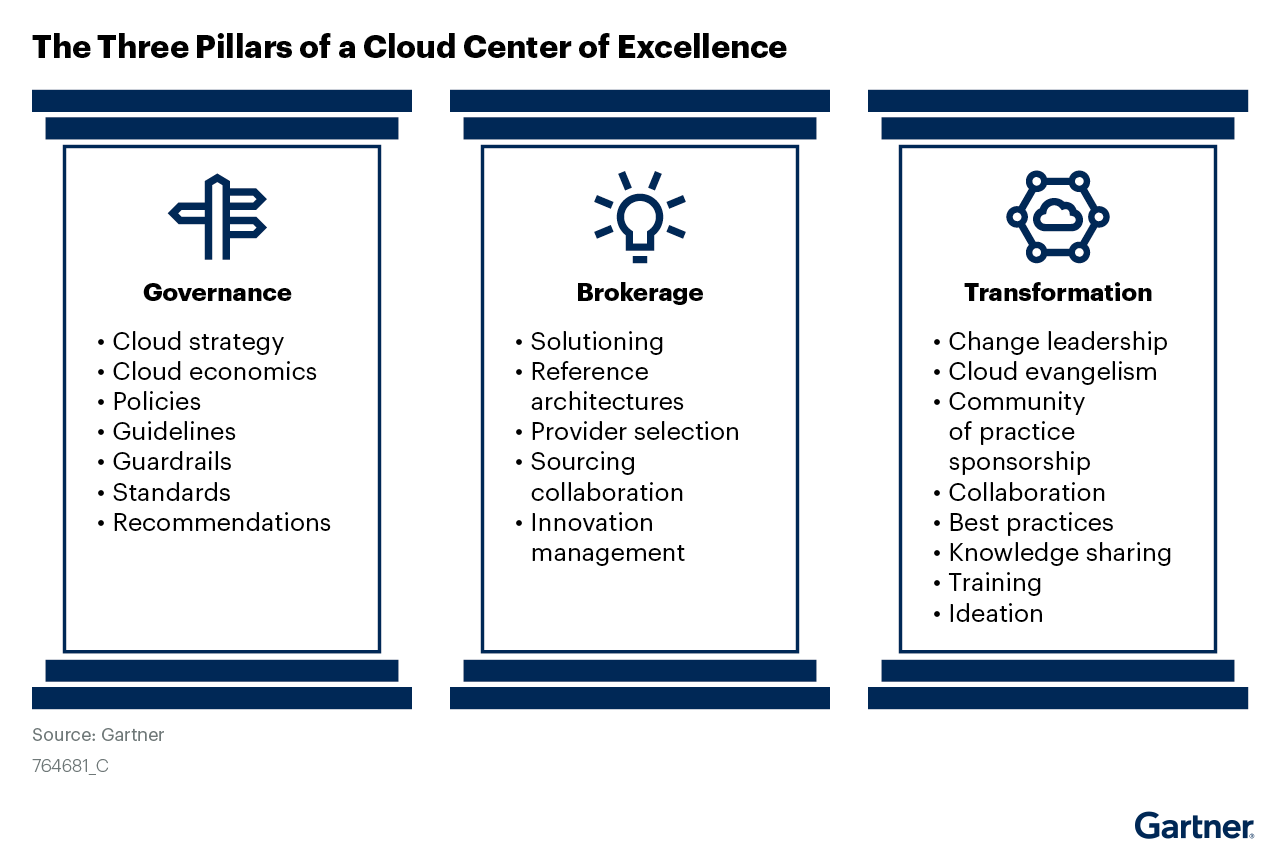
In the Gartner conceptual model, the CCOE has three core pillars of cloud enablement (see Figure 1):
- Governance: The CCOE leads and governs the adoption of cloud computing so that the organization adopts good practices and manages risks appropriately.
- Brokerage: The CCOE helps to match business needs with high-quality cloud solutions and strives to maximize the business value of cloud computing.
- Transformation: The CCOE drives change leadership around cloud computing and facilitates the spread of cloud expertise throughout the organization.
A CCOE is only one part of a successful cloud operating model. See Use a CCOE as the Core of Your Cloud Operating Model for an explanation of how the CCOE fits into the broader cloud operating model.
Clearly Define the CCOE’s High-Level Goals and Tasks
The CCOE’s high-level goals should be aligned to the purpose of strategic planning activities and goals. These goals usually include:
- Supporting cloud adoption, including for teams inside and outside IT, through advising on solutions, building reference architectures, and providing implementation guidance
- Establishing lightweight governance that enables self-service while managing organizational risks
- Accelerating digital transformation through cloud-enabled, business-led innovation efforts and by advising on strategic business decisions that could be impacted by the use of cloud computing
The CCOE typically performs the governance, brokerage and transformation tasks summarized in this section. The scope of the CCOE’s responsibilities should be clearly defined in its charter. That scope may change as the CCOE matures.
Governance Tasks
The CCOE plays a critical role in cloud governance. The goal of cloud governance is to manage organizational risks, promote the use of good practices, and successfully manage cloud providers and associated costs. It is a form of adaptive EA governance (see Use Adaptive EA Governance to Balance Autonomy and Control) that empowers the business and enables self-service and flexibility in the use of cloud services so that both IT and the business gain the benefits of agility.
Therefore, the CCOE assists with the alignment of IT and the business through the CCAC. The CCOE must work through the CCAC to ensure input and communication regarding governance to the broad enterprise audience and stakeholders, not just IT.
Governance is distinct from the notion of “control,” and consists of two elements:
- Guidelines communicate good practices and where the risks are
- Guardrails are mechanisms designed to prevent a bad outcome from occurring, even if someone does something wrong — intentionally or otherwise
The CCOE supplies both guidelines that foster “doing the right thing,” and guardrails that limit exposure to cloud-related risks.
The CCOE’s governance tasks include:
- The CCOE establishes cloud adoption policies and standards. These are the policies that govern when cloud services can and should be used, what cloud solutions are appropriate under a given set of circumstances, and the related standards for implementation.
- The CCOE helps manage cloud-related risks. The CCOE establishes cloud risk management and cloud security policies for enforcing guardrails on cloud adoption. It does this in conjunction with the organization’s security, risk management, and legal functions.
- The CCOE helps to manage cloud economics. The CCOE sets cloud cost governance policies and strives to maximize the value of cloud computing to the business. It plays a collaborative role in forecasting cloud demand and helps ensure that actual cloud spending is aligned against the forecasts and budgets (see Build Scalable Practices to Manage Cloud Costs With FinOps Principles for details).
The CCOE builds policies for guardrails, but the implementation of guardrails is generally the responsibility of cloud engineers or others in the organization. There is no “one size fits all” for the balance of guidelines and guardrails within organizations, but, in general, automated enforcement is preferable to manual enforcement and such automation should be implemented as early as is practical.
The Importance of Pragmatic Governance
It can be beneficial for the CCOE to set a “north star” vision for a future ideal or “art of the possible.” However, the CCOE’s leadership needs to be practical, not theoretical. If the CCOE sets standards and guidelines that cannot be realistically implemented given the organization’s resources and skills, it will be ignored out of necessity.
Policies need to be sufficiently flexible to cover ordinary use. Exceptions should be rare. A policy that requires frequent exceptions is flawed — it is impractical, unenforceable, or overly rigid. Few organizations have good exception governance, which means that exceptions represent unmanaged risks.
EA retains long-term cloud governance responsibilities, even when cloud capabilities have spread throughout the organization and a center of excellence is no longer necessary. At that level of maturity, cloud is simply another domain within the EA portfolio.
Brokerage Tasks
The CCOE is an internal cloud service broker. In this capacity, it provides capabilities that help the organization choose, integrate and customize cloud solutions. Its brokerage tasks include:
- Assisting users in selecting and designing cloud solutions
- Establishing reference architectures and related recommendations
- Determining the process and life cycle for adopting cloud providers within the organization
- “Future-proofing” cloud adoption and managing provider innovation
- Collaborating with the sourcing team for cloud vendor management
The CCOE’s brokerage tasks are usually the first to transition to “business as usual” execution as the organization’s cloud adoption matures. For example, cloud solutioning typically moves to a solution architecture team, while detailed reference architectures may move to a cloud engineering team.
Transformation Tasks
The organization and its cloud-related skills often pose the biggest barrier to successful cloud adoption. Thus, the CCOE’s role in guiding the organization through cloud adoption and possible cloud transformation is just as vital as its brokerage and governance roles:
- The CCOE bears significant responsibility for driving change leadership around cloud computing. The CCOE’s architects serve as change champions and may be responsible for evangelizing cloud computing within both IT and the business.
- The CCOE establishes the cloud community of practice (CoP) — a virtual community. The CoP brings together cloud stakeholders, facilitates collaboration, and encourages the sharing of cloud knowledge and experiences. Although the CoP may eventually become member-led, the CCOE initially coordinates virtual and physical events to promote CoP member interaction.
- The CCOE gathers and disseminates best practices. The CCOE engages in active outreach to learn from organizationwide cloud computing experiences.
- The CCOE helps the organization adapt and transform itself for cloud adoption. The CCOE facilitates cloud-related training and skills development in collaboration with the learning and development team. The CCOE collaborates on the process reengineering for cloud transformation. The CCOE helps IT leaders determine the roles and skills that will be necessary in the future, and it helps to provide relevant training, mentorship and experiential learning opportunities (see How to Build a Cloud Skills Training Program for guidance).
Ensure the CCOE Is Business-Outcome Driven
Gartner’s CCOE model is aligned to the principles of business-outcome-driven EA, and is typically most successful when the CCOE resides in EA, the office of the CTO, or a similar function. However, smaller organizations often do not have an EA team. Furthermore, some organizations do not have a practical or effective EA function. Consequently, the CCOE must sometimes reside in another part of the organization — most commonly I&O.
Heads of I&O often focus on predictably and efficiently delivering reliable and secure infrastructure and platforms. However, a successful CCOE’s core principles are rooted in adaptive governance. The ultimate goal of adaptive governance is to fuel enterprise speed and agility, while simultaneously managing risk to provide stability. Consequently, when the head of I&O owns a CCOE, they must ensure that it retains its EA-aligned purpose, rather than focusing on I&O priorities. Furthermore, they must ensure their CCOE’s cloud architects have an enterprise architecture skill set, not just (or even primarily) an I&O skill set.
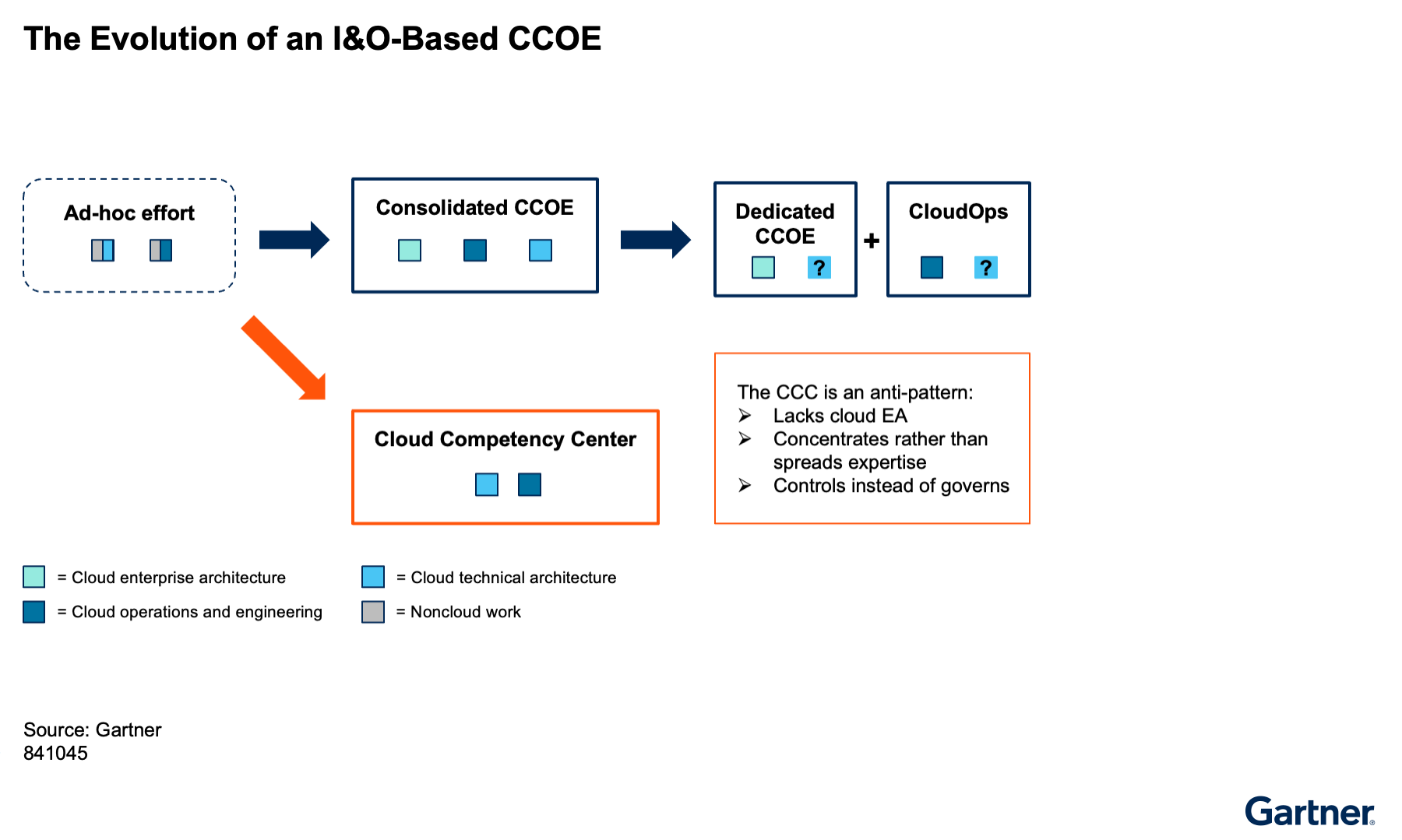
CCOEs embedded in EA often begin with the elevation of a cloud domain architect to lead the CCOE, and the team grows as cloud architects are added, without fundamental structural shifts. However, CCOEs that begin in I&O have a different genesis, and are more likely to follow the evolutionary path illustrated in Figure 2.
Heads of I&O need to be aware of the challenges that exist at each stage of this evolution:
- Ad hoc effort: Employees with cloud skills may gather informally or be formally reorganized into a team that provides best-effort support for cloud adoption. These employees often have some non-cloud primary job duty. Even though this group is sometimes called a “CCOE,” it often lacks adequate authority to make or enforce policy. It may operate in a state of constant crisis. This model is not sustainable. Unless the organization evolves beyond it, this model often leads to team burnout, wasted cloud spending, significant risk exposure, and failure to achieve expected outcomes.
- Consolidated CCOE: This Gartner model is often chosen when the head of I&O sponsors the creation of a team that is dedicated to handling public cloud services. One or two members are dedicated to cloud enterprise architecture, while the majority of the team is dedicated to cloud implementation needs (notably, operations and engineering). This may be a long-term approach in midsize businesses. In enterprises, this model typically only persists until the team is large enough to be split into a dedicated CCOE plus a cloud operations (CloudOps) function.
- Dedicated CCOE: When the CCOE resides in I&O, the CCOE may contain not only cloud EA, but also cloud technical architecture (rather than cloud technical architecture belonging to the cloud engineering team in CloudOps). Otherwise, a dedicated CCOE in I&O closely resembles an EA-based CCOE.
Avoid the “Do Everything” Cloud Competency Center Anti-Pattern
Some organizations may try to pull together all personnel with cloud skills into a single team that does all things related to cloud -— a cloud competency center (CCC). This team may be dedicated or matrixed from other teams — and, in some cases, it may be a committee or tiger team assembled from technical professionals who have appointed themselves to the task. Gartner considers a CCC to be an anti-pattern, but it is unfortunately common in organizations with low cloud maturity.
Although organizations frequently claim their CCC is a CCOE, a CCC is not aligned with the Gartner concept of a CCOE because it is intended to concentrate cloud expertise rather than focusing on spreading that expertise. In many cases, when this model is used, the cloud EA responsibilities are deprioritized or ignored in favor of implementation activities. Furthermore, CCCs are frequently focused on control instead of governance.
Finally, heads of I&O must:
- Focus on cloud maturity as a journey. Do not expect the creation of a CCOE to instantly solve cloud adoption problems within your organization. The organization’s cloud strategy should contain a maturity roadmap that helps the organization reach the desired future state on an incremental basis.
- Avoid overtasking the CCOE. Prioritize the most important needs. Do not allow immediate projects to prevent cloud architects from having the time to establish long-term governance. Otherwise, you are likely to find that cloud adoption will proceed as a series of increasingly risky emergencies.
- Raise awareness of the CCOE’s existence. Maximizing the CCOE’s effectiveness for business enablement requires “marketing” its existence. You must amplify the CCOE’s internal messages, which must be attractive to the business and focused on business-outcome benefits, as determined and documented by the organization’s cloud strategy.
Gartner has discussed the CCOE concept and related challenges with thousands of clients over the period of more than a decade.