Optimize Product Data for Agentic Commerce
15 January 2026 - ID G00843661 - 13 min read
By Jason Daigler, Sandy Shen
The rise of AI platforms and AI agents has the potential to transform digital commerce, requiring a shift in how businesses manage and expose product data. Organizations need to offer more structured and enhanced product data while integrating to specific channels.
Insights at a Glance
Agentic commerce, where buyers rely on AI platforms or agents to discover, negotiate, decide, and transact, is evolving so quickly that organizations must act now to claim an early advantage.
Key take-aways:
- Market dynamics are shifting weekly as GenAI and AI platforms advance. Staying ahead requires continuous monitoring, rapid roadmap updates and flexible investment strategies.
- The foundation for success is comprehensive, well-structured product data with complete attribute coverage organized with a consistent taxonomy and schema.
- Ensure accurate product information such as pricing, availability, and descriptions so buyers receive reliable recommendations.
- Agentic commerce opportunities differ by customer segment and product category. Analyze audiences and offerings to assess where agentic commerce can deliver the greatest impact.
- Early movers with complete product data can gain superior positioning in recommendation and transaction workflows, making it harder for competitors to catch up.
Critical next steps:
- Audit and enrich your product catalog for depth and structure.
- Develop segment-specific strategies to prioritize high-value agentic use cases.
- Optimize product feeds to support AI platforms, ensuring seamless data delivery and updates.
Strategic Planning Assumption
By 2030, 20% of digital commerce transactions will be executed through AI platforms using on-platform check-out or by AI agents.
Impact Brief
Many organizations are unprepared for agentic commerce because their product data is insufficient for AI platforms to accurately interpret, evaluate, and recommend products. As AI-driven product discovery evolves, organizations must ensure their product data is both accessible and optimized for AI platforms. Failing to implement these preparations will inherently diminish product visibility and result in missed opportunities. The size of this opportunity is frequently debated and traffic to sites from AI platforms is currently low, but several published data points suggest incredible potential. In July 2025, OpenAI stated that ChatGPT receives 2.5 billion prompts per day,1 and in September 2025, OpenAI stated that 2.1% of ChatGPT prompts were about purchasable products.2 That represents 52.5 million chats, per day, about purchasable products, and it doesn’t even include other AI platforms like Gemini, Perplexity, etc. Digital commerce site traffic originating from AI platforms was up 805% YoY on Black Friday in 2025.3
Yet most organizations do not understand the full scope of their options and the opportunities presented by submitting direct product data feeds to AI platforms and exposing additional and enhanced product data on their digital commerce sites. Organizations must develop a clear strategy to ensure product information remains accurate, secure, and discoverable as agentic commerce evolves. Furthermore, best practices for agentic commerce success are evolving incredibly rapidly, sometimes evidenced by multiple announcements from AI platforms every week. Consequently, planning necessary investments becomes difficult when the governing guidelines are changing so quickly.
Actions and Cautions
Agentic commerce is defined as a buying journey in which a buyer uses an AI platform or agent to discover products, negotiate, decide, or transact. Organizations must take specific actions to capitalize on agentic commerce and prepare their product data and systems, while understanding key pitfalls, to drive success in this rapidly evolving space.
Actions
- Enrich product data by incorporating structured attributes, generating short-form natural language answers, and detailed evaluation criteria such as sustainability, compliance and customer reviews to ensure AI platforms and AI agents can accurately interpret and recommend products.
- Create product data feeds and track MCP and other interagent protocol developments. These steps will help ensure product information is discoverable and usable by current and emerging AI agents.
- Optimize product discoverability by balancing product data feeds directly to AI platforms with expanding and enhanced content on digital commerce and content sites, understanding that each AI platform will have different methods for prioritizing products to consumers.
Cautions
- Rapid innovation in agentic commerce makes it challenging for practitioners to stay current, align roadmaps, and prioritize investments amid continuously shifting developments.
- Agentic commerce approaches vary by customer segments and product types. Organizations must assess their specific audiences and offerings to accurately gauge opportunities and develop strategies.
- AI platforms may find and expose your product data, even if no action is taken and product data is not optimized. Inaction could result in lack of favorable positioning relative to competitors, brand degradation, or inaccurate product representation. Even with optimized product data, AI platforms could hallucinate and incorrectly present product information to buyers.
How to Execute
The rapid growth of AI platforms and the emergence of AI agents is changing digital commerce. Organizations now face a new type of nonhuman economic actor: AI agents that can independently discover, evaluate and purchase products and services. This shift, known as agentic commerce, is already underway.
This disruption is increasingly driven by AI agents, which evolve web browsing into a more automated, agent-led experience, potentially moving away from manual user navigation. This shift could lead to diminished user engagement and reduced human traffic directly to digital commerce sites, impacting marketing and business functions. To remain competitive, organizations should prepare for a future where traditional website visibility and direct customer interactions may be altered, adapting their product data not only for agent interpretation but also for this evolving landscape.
This research focuses on the challenge of preparing product data for agentic commerce. Our insights draw on recent market trends, vendor developments and feedback from organizations working to make their product information discoverable, accurate and actionable for AI channels. The main challenges, such as lack of structured, contextual, and comprehensive product data, are based on gaps seen in current product information management solutions and the new requirements of AI platforms and AI agents. As organizations prepare for this new era, it is important to understand the opportunities and risks of exposing product data to AI channels. Organizations must optimize product data for discoverability, accuracy and integration with the next generation of AI platforms and AI agents.
The strategies offered here are most effective for organizations with mature digital commerce capabilities and significant exposure to AI-driven buyer journeys. They are especially relevant for businesses looking to maintain or grow market share, in preparation for AI agents becoming key decision makers in B2C and B2B buying journeys. Organizations with limited digital infrastructure or those in highly regulated industries may need to adapt these approaches to fit their compliance or operational needs.
Enrich and Structure Product Data for Agentic Commerce
The ways in which consumers interact with AI platforms and AI agents, and how these agents engage with sellers, are changing rapidly and remain uncertain. However, one requirement is constant: agentic commerce depends on accurate, well-organized and structured product data. Unlike humans, AI agents process large volumes of information in real time and the processes by which they consume information are fundamentally different from human customers. To meet these new demands, organizations must rethink how they prepare and manage product content and data, ensuring it is immediately accessible, reliable and optimized. Without this foundation, AI platforms and AI agents will fail to deliver reliable recommendations, positive customer experiences or successful transactions. Also, while human consumers can process unstructured and emotional information for purchase decisions, AI agents will rely on structured product data to be successful. Poor data structure will result in poor outcomes, regardless of product quality.
Augment Structured Data With Semantic, Outcome-Focused Product Data
Traditional product data, which focuses on basic specifications and attributes, is insufficient for AI agents. AI agents also require enriched, semantic and outcome-focused product content to accurately understand products and deliver relevant recommendations to buyers. Companies must go beyond listing features and technical details by providing information about how products are used and the specific problems they solve.
Instead of simply stating a product’s dimensions or materials, organizations should include context such as use cases, benefits, and customer outcomes in short form natural language.
Provide Comprehensive Organizational and Product Evaluation Data
AI platforms and AI agents may require a much broader set of data than human buyers, extending well beyond basic product details and specifications. Traditionally, human buyers made decisions based on whatever information was available and visible on a commerce site, often proceeding with a purchase even if some data was missing. In contrast, when interacting with AI platforms, consumers can specify exactly what criteria matter to them, such as sustainability, country of origin or product certifications, and the AI platform or agent will filter options accordingly. If the seller does not provide this information, their products may not even be presented as options to the consumer. To remain competitive in agentic commerce, organizations should ensure they provide comprehensive information, including product compliance and certification data, sustainability information, component or ingredient details, customer ratings and reviews, and reliability data. Making this data readily available increases the likelihood that products will meet the evolving requirements of buyers.
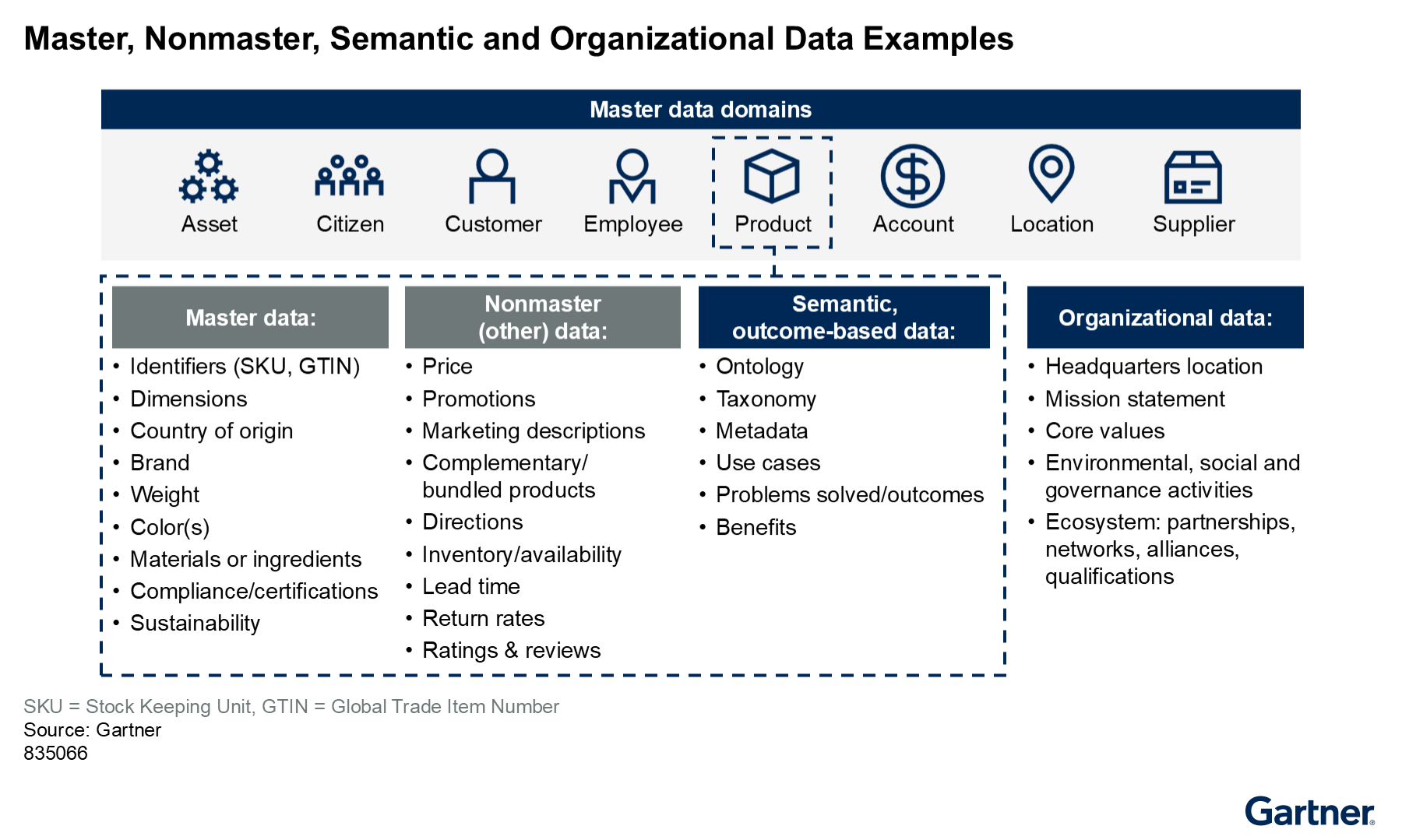
Beyond product data, AI platforms may also require other master data or organizational data, either directly or implicitly requested by consumers. For example, in previous interactions with an AI platform, a consumer may express a preference for companies that are based in a specific region, are supportive of specific societal causes and are carbon-neutral. While the consumer may not repeat those preferences when searching for products, as AI platforms learn consumer preferences and develop greater memory capabilities, they may seek and return that type of information when searching for products. Organizations should expose that information in case it is needed. For an example of master, nonmaster, semantic and organizational data that might need to be exposed to AI platforms and AI agents, see Figure 1.
Adopt and Support Emerging AI Channels and Protocols
To capitalize on the growth opportunity presented by agentic commerce, organizations must adapt their digital commerce technologies and processes to serve AI platforms and AI agents effectively. They must expand the accessibility of their product data beyond traditional human-facing interfaces to cater to emerging AI channels (see Winning Product Discovery on AI Platforms).
Broaden Product Data Reach to AI platforms and Optimize Sites for Discoverability
In addition to expanding the amount of product data available to AI platforms, organizations must ensure that this data is accessible through machine-readable interfaces, such as APIs, files, tables and page code. Companies should also broaden their data exposure by providing direct data feeds to AI platforms where consumers begin their buying journeys. Specific integration paths for popular AI platforms are listed in the table below. Note that this information is current as of the publication date of this research, but the methods and schemas may change frequently.
AI Platforms and Product Data Integration Processes
AI platform | Product data integration process |
OpenAI/ChatGPT |
|
Google/Gemini |
|
Perplexity |
|
Source: Gartner (January 2026)
Delivering product feeds to AI platforms is merely the first step to ensure product discoverability. In addition to referencing product data within the feeds, most AI platforms will also access product data on digital commerce sites or content-based sites in order to train their models and better respond to consumer prompts.
To ensure web content is discoverable, it is also important to update robots.txt files to explicitly allow access by major AI crawlers, such as OpenAI’s GPTBot.7 Sites should also deploy proper schema-based data markups such as for products, offers, and return policies, and include metadata in XML sitemaps or JSON-LD snippets to enable AI agents to quickly locate the information they need.
Prepare for Model Context Protocol in Agentic Commerce
The landscape for AI agent interaction is changing quickly, with new protocols emerging to standardize how AI agents and applications communicate and transact. The model context protocol (MCP), introduced by Anthropic in November 2023, has become a leading open standard for this purpose. MCP enables integration between AI platforms and external data sources or tools. By providing a standardized method for AI agents and applications to discover and access contextual information, MCP simplifies the development and composition of AI solutions. This allows AI agents to automatically identify and use external tools for tasks such as checking inventory, returning product data or placing orders through fulfillment APIs (see Innovation Insight: Model Context Protocol). However, organizations must address the security and governance challenges inherent in the protocol by implementing MCP Gateways (see Innovation Insight: MCP Gateways).
However, AI platform discovery mechanisms remain undefined. Today’s platforms ingest product feeds or scrape websites, but none have publicly committed to querying or pulling data directly from MCP servers. Rather than immediately committing to a full MCP deployment, organizations should maintain a measured, observant stance. They should actively monitor MCP advancements, stay informed about evolving specifications and use cases, and review vendor roadmaps to anticipate shifts in protocol capabilities. Organizations should also track which of their current or prospective application vendors offer MCP support and how their MCP offerings could support product discovery. For example, digital commerce platforms (e.g., commercetools and Shopify) and product information management (PIM) systems (e.g., Akeneo, Bluestone PIM and Viamedici), now support MCP server creation, with more vendors expected to follow. Even if MCP adoption grows, it’s important to remember that MCP is a method for AI platforms to identify and access external resources. To enable orders, an MCP server needs to provide tools to access data and APIs that could accept purchases.
Looking further ahead, MCP could become especially important as AI agents interact with digital commerce sites. These agents may seek to query MCP servers directly for product discovery, product details, price updates, and availability checks. Likewise, browser-embedded chat interfaces, such as Perplexity’s Comet, OpenAI’s ChatGPT Atlas, and Google’s Gemini in Chrome, might one day leverage MCP protocols to obtain richer, more accurate product context. Although the timing and scope of these integrations remain uncertain, they underscore the need to anticipate agent-driven use cases in MCP evaluations.
Organizations should also monitor the evolution of interagent protocols, such as Google’s Agent2Agent (A2A) and AGNTCY’s Agent Calling Protocol (ACP). These protocols currently facilitate structured communication between agents and, depending on their implementation, have the potential to support order placement workflows. These protocols could complement existing MCP solutions in the future if MCP is adapted to handle transactions in the future (see Innovation Insight: AI Agent Communication Protocols).
Success Measures
To evaluate progress in agentic commerce, track:
- Early engagement metrics rather than absolute volumes. Traffic and orders from AI platforms and AI agents may lag other channels in this nascent phase, but organizations should see month-over-month increases.
- Completeness of product data including attributes, variants, and metadata that were recently added to prepare for agentic commerce.
- Accuracy and readability of product information surfaced within AI platforms (prices, availability, descriptions).
- Relative positioning of products versus direct competitors in AI-driven recommendations and search results.
1 ChatGPT Users Send 2.5 Billion Prompts a Day, TechCrunch
2 How People Use ChatGPT, OpenAI
5 BigCommerce and Feedonomics Team Up With Perplexity to Help Brands Excel at AI Product Search, Commerce
6 Catalog API Reference, Shopify
7 Overview of OpenAI Crawlers, OpenAI Platform