Market Guide for Agentic Analytics
9 February 2026 - ID G00841394 - 24 min read
By Deepak Seth, Georgia O'Callaghan, and 2 more
Organizations are moving from exploratory use of AI agents for analytics to early-scale deployment but struggle with ROI, trust, governance, and cost control. These insights help D&A leaders understand how agentic analytics is maturing and where it delivers value today, and how to scale it responsibly.
Overview
Key Findings
- Focusing on specific analytical scenarios delivers measurable value
Organizations achieve the greatest benefits from agentic analytics when initiatives are anchored to well-defined, repeatable analytical scenarios. This approach leads to reduced cycle times and improved quality of insights, such as greater accuracy, relevance, and groundedness. - Semantic and policy alignment is foundational for effective agentic analytics
Ontologies, semantic layers, and knowledge graphs provide essential context for agentic systems to generate relevant and reliable insights. However, the investment required means organizations should selectively apply these foundations where the benefits outweigh the costs. - Formal human-AI interaction frameworks support responsible automation
Establishing clear escalation paths and operational guardrails is necessary to determine when and how humans should intervene in agentic analytics processes. Defined oversight helps organizations manage risk and maintain accountability as agentic systems take on greater roles in analytics workflows. - Real-time monitoring and guardrails are critical for control and cost-efficiency
Real-time monitoring, usage throttling, and cost controls are essential to prevent excessive compute consumption and unchecked agent behavior. These measures enable organizations to scale agentic analytics efficiently and responsibly.
Recommendations
- Anchor initiatives to high-value, frequently occurring analytics tasks
Move beyond generic productivity goals. Focus on initiatives that target specific, commonly repeated analytics tasks or business questions, and measure success by improvements in the speed and quality of insight generation. - Invest selectively in semantic and policy alignment
Build a strong foundation for agentic analytics by developing ontologies, semantic layers, and knowledge graphs, especially in complex or high-value areas. Carefully weigh the costs and benefits, as not every use case will justify this investment. - Establish formal human-AI interaction frameworks
Create explicit escalation paths and operational guardrails that define the degree of human involvement for different analytics processes. Set clear criteria for when human review or intervention is required, tailored to the risk and impact of each use case. - Implement real-time monitoring and usage controls
Choose platforms and vendors that provide real-time monitoring, usage throttling, and cost management features or the ability to leverage guardian agents (see Market Guide for Guardian Agents) or other TRiSM technology such as those that offer those capabilities (see Market Guide for AI Governance Platforms). These controls are essential to prevent uncontrolled agent activity and maintain efficiency as agentic analytics capabilities expand.
Strategic Planning Assumptions
- By 2028, 60% of self-service analytics users will use general-purpose LLMs for ad hoc and exploratory analysis, while production-grade reporting will remain in traditional ABI platforms.
- By 2028, 60% of agentic analytics projects relying solely on MCP will fail due to the lack of a consistent semantic layer.
Market Definition
Gartner defines agentic analytics as software used for the process of data analysis that applies AI agents across the data-to-insight workflow, orchestrating tasks semiautonomously or autonomously toward stated goals that support, augment or automate insights. Agentic analytics’ must-have capabilities are data source connectivity, data preparation, agent workflow orchestration, automated insights and natural language query. Optional capabilities include data storytelling, a coding assistant, function calling, agent memory, embedded analytics and platform administration. Agentic analytics is the evolution of augmented analytics through the application of AI agents to data analysis.
Agentic analytics streamlines operations by identifying inefficiencies and reducing expenses, optimizing costs across the organization. It facilitates seamless information exchange, ensuring data is accessible and usable throughout the organization. By leveraging AI systems, agentic analytics can perform tasks and generate responses based on programming and training data, often without continuous human intervention. This is achieved by breaking down requests into subtasks, delegating execution to specialist agents, and leveraging existing platform features to accomplish goals.
Agents, often powered by large language models (LLMs), automate tasks such as data preparation, analysis, visualization, insight generation, code creation and explanation. This frees up data and analytics professionals to focus on strategic initiatives and increases analytics adoption among nontechnical users.
Agents also support collaborative analytics through shared dashboards, reports and discussion threads, enhancing data literacy by facilitating real-time learning and interaction. They enable seamless integration of analytics platforms with external systems via APIs or plug-ins, continuously incorporating user input and feedback.
Agentic analytics platforms address numerous business challenges, including:
- Increased organizational resilience: By continuously analyzing and predicting improvements, agentic analytics monitors and prevents failures in systems, in addition to dynamically managing resources to maximize efficiency.
- Enhanced analytics governance: AI algorithms automatically clean and validate data, integrate information from multiple sources, and uncover hidden patterns, delivering deeper insights. They unify disparate data systems, ensuring adherence to governance policies and promoting a cohesive data environment.
- Enhanced organizational agility: By automating routine tasks and streamlining workflows, agentic analytics platforms increase organizational agility, allowing teams to focus on strategic initiatives and respond swiftly to changes. Automation reduces reliance on expensive data scientists and large analyst teams.
Use case examples:
- Financial services: Develop holistic customer financial profiles that analyze comprehensive financial behaviors beyond traditional credit scoring.
- Government agencies: Perform real-time monitoring of public safety data, enabling rapid response to emerging threats.
Mandatory Features
Agentic analytics platforms’ “must have” capabilities include:
- Data source connectivity: The ability to handle multimodal data input and produce multistructured analytics outputs. Agentic analytics seamlessly integrate a wide range of data types — structured, semistructured and unstructured — from both internal and external sources. This includes diverse formats such as text, audio, images and video, enabling comprehensive analytics.
- Data preparation: The ability to combine data from various sources to create analytics models, including user-defined measures, data pipelines, sets, groups and hierarchies. AI agents can autonomously explore and understand complex data structures, dynamically addressing quality issues and inconsistencies. Additionally, they can comprehend relationships between data attributes, automatically suggesting meaningful joins and integrations while recognizing semantic connections across disparate sources. They infer potential data transformations based on historical patterns and business context, sharing insights and best practices across different data preparation tasks.
- Agent workflow orchestration: The ability for platforms to semiautonomously or autonomously manage tasks to achieve specified goals. These platforms feature adaptive workflow design, self-configuring process flows based on new data inputs or evolving objectives, real-time decision making regarding task sequencing, and automatic error detection and recovery mechanisms. AI agents can dynamically allocate and optimize resources, continuously learning and improving orchestration strategies.
- Automated insights: The ability to employ machine learning techniques to automatically generate insights for end users, such as identifying key attributes in a dataset. AI agents proactively identify significant patterns, trends and anomalies, generating human-readable narratives that explain data findings. They provide probabilistic confidence scores for each insight and contextualize them within broader business performance frameworks. Responsible insight generation includes audit trails, explicit confidence scoring, uncertainty quantification, statistical significance and potential limitations. The platforms also detect algorithmic bias across multiple dimensions and offer human oversight options.
- Natural language query: The ability to enable users to interact with data using natural language, either typed or spoken. Advanced chatbots facilitate conversational Q&A, delivering data-to-insight interactions with full data visualizations. The platforms can group, filter and rank answers, providing comparisons, trend analysis, and geospatial and temporal understanding. They utilize temporal algorithms (e.g., time since/until, longer/slower) and geospatial algorithms (e.g., distance, route), presenting answers as maps. AI-enabled predictions and forecasting come with explanations and customizations, enhancing user engagement and understanding.
Common Features
Additional capabilities for agentic analytics can be natively part of the platform or can be offered through the incorporation of other tools or frameworks. For effective agentic analytics utilization, user organizations should develop an understanding of the kind of insights that it generates, how and where agentic practices could be applied, and which capabilities are therefore the most important ones.
Agentic analytics’ “should have” features include:
- Data storytelling: These features autonomously translate complex data patterns into engaging narratives. AI agents can generate multiple narrative perspectives, scenarios and outcomes, helping users grasp potential impacts. They enhance user engagement by leveraging voice, mobile, chatbots, touchscreens and collaborative platforms. They also possess contextual understanding that allows the AI agents to interpret data within the context of business strategy, adapting storytelling complexity to user preferences by specifying detail, verbosity and tone. They provide role-specific insights by utilizing active metadata, background and user preferences.
- Coding assistant: This feature provides intelligent, context-aware support for data analysis, boosting developer productivity. It automatically suggests code snippets based on the current project context, previous analysis patterns and machine learning model recommendations. It also enables the creation of code from natural language descriptions, adapting to the user’s coding style and project conventions, and converting code between languages like Python, R, SQL and JavaScript. It includes built-in bias detection for data manipulation scripts, automated documentation of data transformation steps, privacy-preserving code suggestions and computational efficiency recommendations.
- Function calling: This feature empowers the AI agent to interact with external systems and services by invoking specific functions through APIs. It can perform real-time data processing tasks, such as fetching data from external sources, integrating advanced algorithms like machine learning models from cloud services, updating records or triggering actions in other systems based on analytics insights. It helps users compose and automate data-driven decision workflows. Triggers include buttons (no-code), conditional drag-and-drop thresholds (procedural or functional), automated insights (AI-powered), reusable blocks/recipes (low-code) from marketplaces, or bring-your-own-model (code). These also write back to operational systems, cloud applications or datasets.
- Agent memory: Agentic analytics platforms incorporate agent memory, enabling the AI agent to retain and utilize historical data and interactions to enhance future analyses and decision-making processes. This involves storing past queries, user preferences and analytical outcomes to provide contextually relevant insights and recommendations.
- Embedded analytics: While traditional embedded analytics integrate analytical capabilities directly into business applications, websites and portals, agentic embedded analytics elevate these capabilities by becoming proactive, intelligent systems. They autonomously understand organizational context and anticipate information needs before users express them. These platforms adapt analytical presentations to individual cognitive styles, providing dynamically generated, contextually relevant insights as part of a business user’s workflow.
- Platform administration: These features allow users to track usage statistics, manage costs by monitoring capacity or credits, and intervene by pausing or prioritizing jobs. The agent measures query performance and provides feedback to content authors, offering recommendations to optimize datasets and reports to minimize inefficient or slow queries.
Market Description
Agentic analytics represents a fundamental shift from augmented analytics, moving from assistive capabilities in the data-to-insight workflow to goal-driven systems that can autonomously plan and execute analytical tasks with limited human intervention. While augmented analytics focuses on supporting users through recommendations and automation, agentic analytics applies AI agents to operate across the analytics workflow within a business context.
AI Agents Transformative Impact
Forty-one percent of respondents to the 2025 Gartner Generative and Agentic AI in Enterprise Applications Survey report their organizations have deployed (16%) or are deploying (25%) AI agents.1 Fifty-four percent deployed “true” AI agents — goal-driven autonomous (no human oversight) or goal-driven semiautonomous (requiring human validation) — or are exploring, planning, piloting or deploying them.1 Seventy-nine percent of IT Leaders surveyed think the productivity impact of integrating AI agents into their organization’s enterprise application portfolio will be significant, and 26% believe it will be transformative.1
Organizations are moving from exploratory use of agentic analytics focused on accelerating productivity and enabling self-service through natural language interaction and automated insight generation toward early-scale deployment. At this stage, buyers are increasingly evaluating platforms based on their ability to support reusable, governed analytics products and processes, rather than just one-off analytical tasks.
Key characteristics shaping buyer consideration today include:
- The ability to operate across both structured and unstructured data sources
- Integration into business workflows through embedded and conversational experiences
- Support for human oversight, escalation, and accountability
- Visibility into cost, performance, and agent behavior
- Alignment and integration with existing semantic layers and business context
Agentic analytics should not be viewed as an enhancement to dashboards but as a mechanism to make analytics more continuous, contextual, and operationally relevant.
Core Use Cases
Agentic analytics platforms address business challenges including:
- Continuous monitoring of complex environments
- Early detection of anomalies, risks, and opportunities
- Removal of manual analytical effort
- Faster alignment between insight and action
- The ability to ask and answer more complex questions, not just simple search or descriptive queries, enabling deeper analysis such as root cause identification through conversational interfaces
Use cases continue to span industries such as financial services, government, healthcare, retail, and supply chain, and are increasingly focused on enabling more advanced and automated analytics beyond traditional BI tool capabilities.
The market is in its early stages, with established analytics and business intelligence (ABI) vendors incorporating agentic capabilities into their platforms, while new specialized players emerge with purpose-built solutions (see Figure 1).
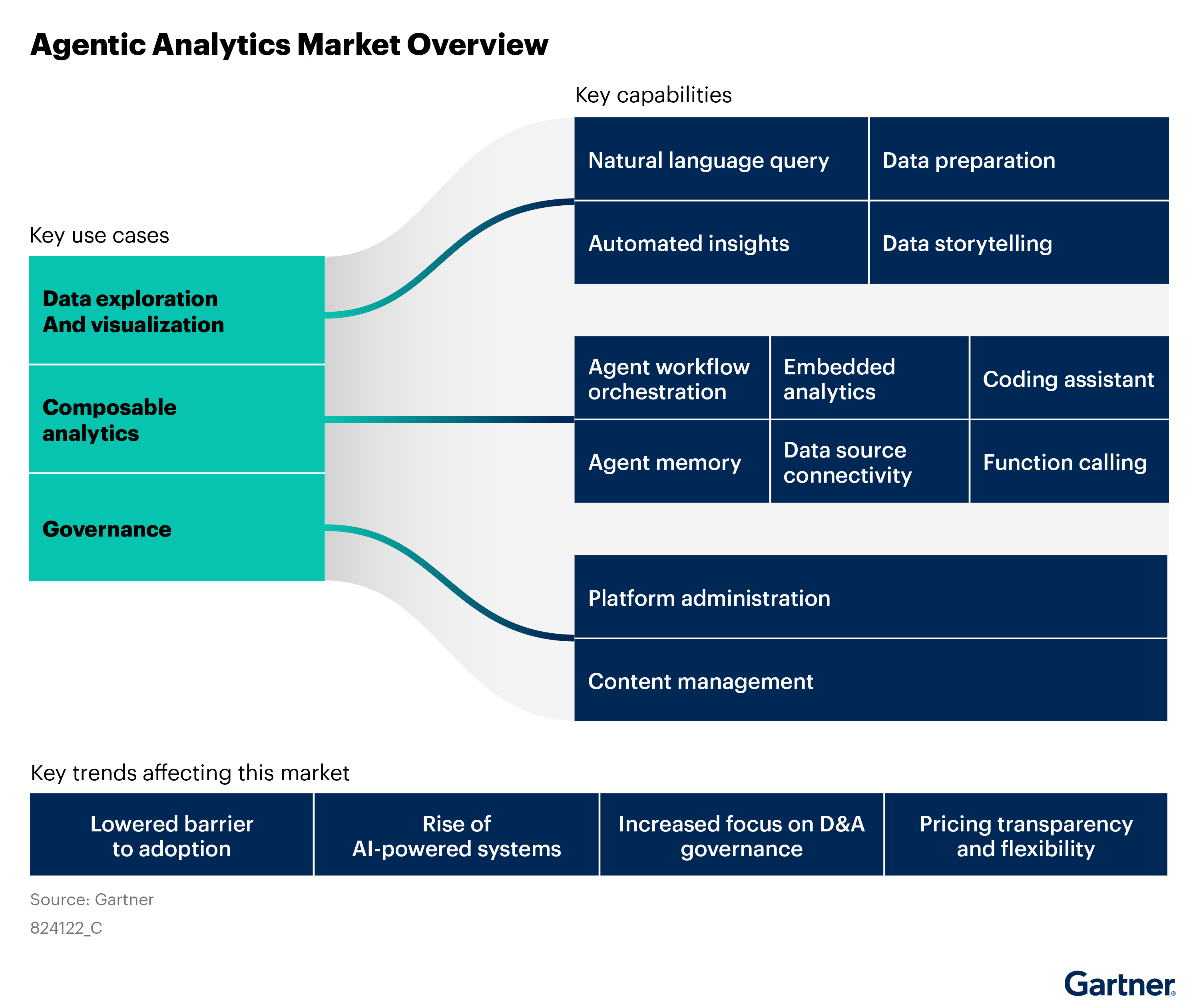
Differentiation will increasingly be driven by:
- Depth of semantic modeling
- Ability to integrate with operational systems
- Maturity of delegation and escalation mechanisms
Market Direction
The market for agentic analytics is entering an early scaling phase, with more organizations moving beyond initial pilots to broader adoption of these platforms. This shift is characterized by the expansion of both the number and the capabilities of available solutions. While static dashboards for corporate KPIs and at-a-glance insights will continue to play an important role, organizations are increasingly adopting agentic analytics platforms that deliver support for analytics tasks through conversational interfaces and event-driven triggers, particularly during analysis, discovery, and interactive exploration.
Over the next 12 to 18 months, adoption of agentic analytics will continue to grow, but unevenly, as organizations vary greatly in semantics maturity, governance readiness and tolerance for delegating analytical tasks to autonomous systems. Organizations are moving cautiously from experimentation to controlled scale, prioritizing use cases with bounded risk and clear business value (see How D&A Leaders Can Prepare Their Organization for Agentic Analytics).
Capabilities gaining the most traction for adoption today include:
- Conversational analytics embedded in workflows that support more complex questions and analyses rather than stand-alone BI tools
- Automated monitoring and alerting that proactively perceive issues and opportunities
- Context-aware orchestration that adapts analysis based on data changes or business conditions
- Capabilities related to ROI, such as success benchmarks and accuracy evaluation
These capabilities enable platforms to support, augment, and automate the data-to-insight workflow.
Agentic analytics platforms are expanding the scope of data and analytics through advanced automation and conversational interfaces. The market is currently in an early stage of adoption, with most organizations experimenting and seeking value through pilot projects and targeted use cases. The number and comprehensiveness of available solutions are growing, with established ABI vendors incorporating agentic features and new entrants, such as data management platforms (e.g., Databricks, Snowflake, SAP) and semantic tools (e.g., Cube), offering purpose-built capabilities. External forces, including regulatory pressure, cost containment initiatives, and enterprise AI governance programs, will further shape buying behavior, favoring solutions that balance autonomy with control.
Agentic analytics platforms continue to evolve to be “always on,” proactively delivering insights and recommendations to users when they need them most. This is being achieved through the implementation of AI agents across the analytics pipeline (see Figure 2).
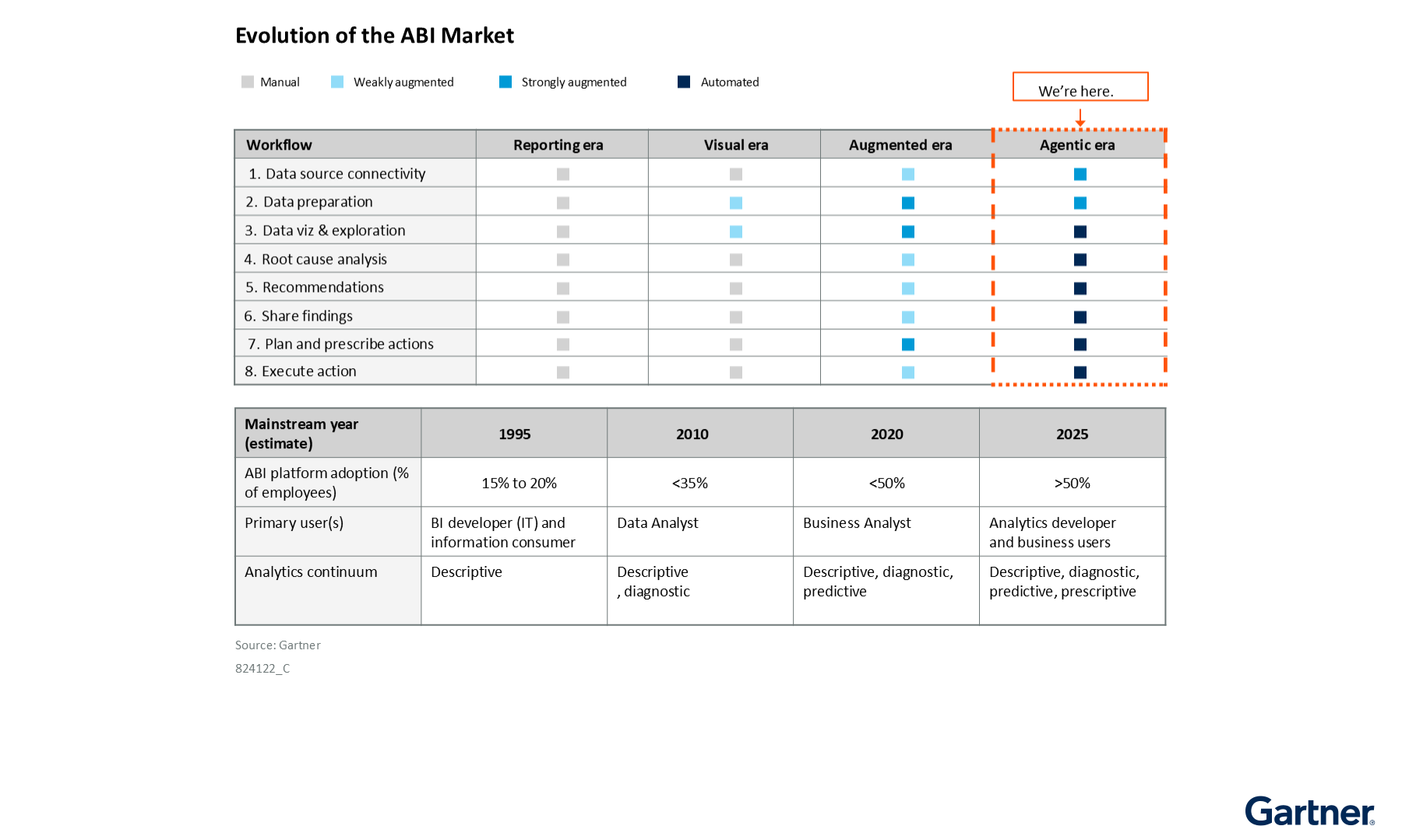
Building on its recognition as a top trend for 2025 (see Top Trends in D&A for 2025) and its position in the “Peak of Inflated Expectations” in the Hype Cycle for Analytics and Business Intelligence, 2025, agentic analytics continues to gain momentum due to rising demand for more accessible analytical approaches and smarter natural language interfaces, which reduce reliance on centralized data teams.
Traditional analytics and BI tools remain underutilized, prompting organizations to embrace agentic analytics for its ability to handle diverse and complex data types and provide multimodal insights. Growing user comfort with AI-augmented decisions and a continued social media interest further accelerate adoption (the volume of conversations about agentic analytics has surged by nearly 2,500% since the start of 2024 to the end of June 2025, based on a Gartner analysis of social media listening data).2 Emerging technologies, such as vendor-managed data ecosystems and new standards like model context protocol (MCP), are also enabling seamless integration between AI models, applications, and data sources, reinforcing agentic analytics as a foundational trend beyond 2025.
Market Analysis
The agentic analytics market remains early but is clearly transitioning from feature experimentation to architectural differentiation. Vendors are approaching the market from multiple directions, resulting in a mixed and evolving set of capabilities.
The market can be understood across three overlapping dimensions:
- Level of Agency
Solutions range from assistive agents that accelerate insight creation to systems capable of orchestrating multistep analysis and recommending actions under defined constraints.
- Insights Orientation
Some platforms remain insight-centric, while others increasingly emphasize insight framing, scenario evaluation, and outcome feedback, signaling convergence with ABI platforms.
- Governance Maturity
Differentiation is emerging around semantic consistency, explainability, cost controls, and delegation frameworks, rather than model sophistication alone.
Adoption is strongest where insights are frequent, time-sensitive, and well-bounded. Conversely, organizations lacking semantic alignment or governance maturity struggle to scale beyond pilots. Over time, market leaders are likely to emerge based on their ability to operationalize agentic analytics as a dependable, governed capability rather than a productivity enhancement.
This market is also seeing specific trends that will impact its current and future evolution. Some are elaborated below:
- Perceptive Analytics and Agentic Systems
The market is shifting toward systems with foresight, using real-time data streams and composite semantic layers (including structured semantic models, knowledge graphs, ontologies, and taxonomies), to autonomously optimize actions through perception (see Figure 3). A key advancement is the integration of multimodal data fabrics, enabling agentic analytics platforms to blend structured and unstructured data for more comprehensive analytics and decision support.
Organizations that adopt perceptive analytics gain real-time situational awareness that enables proactive, context-aware decisions rather than reactive analysis. Those that do not will remain dependent on lagging indicators and episodic insights, limiting their ability to anticipate and respond to change.
Perceptive Analytics
Perceptive analytics leverages AI technologies, including AI agents, to deliver context-aware strategic insights and executable recommendations that continuously adapt to business conditions by monitoring and responding to analysis of structured and unstructured data, business events and goals, and user needs. It empowers organizations with deep situational awareness that proactively optimizes outcomes through autonomous or collaborative planning, action and feedback.
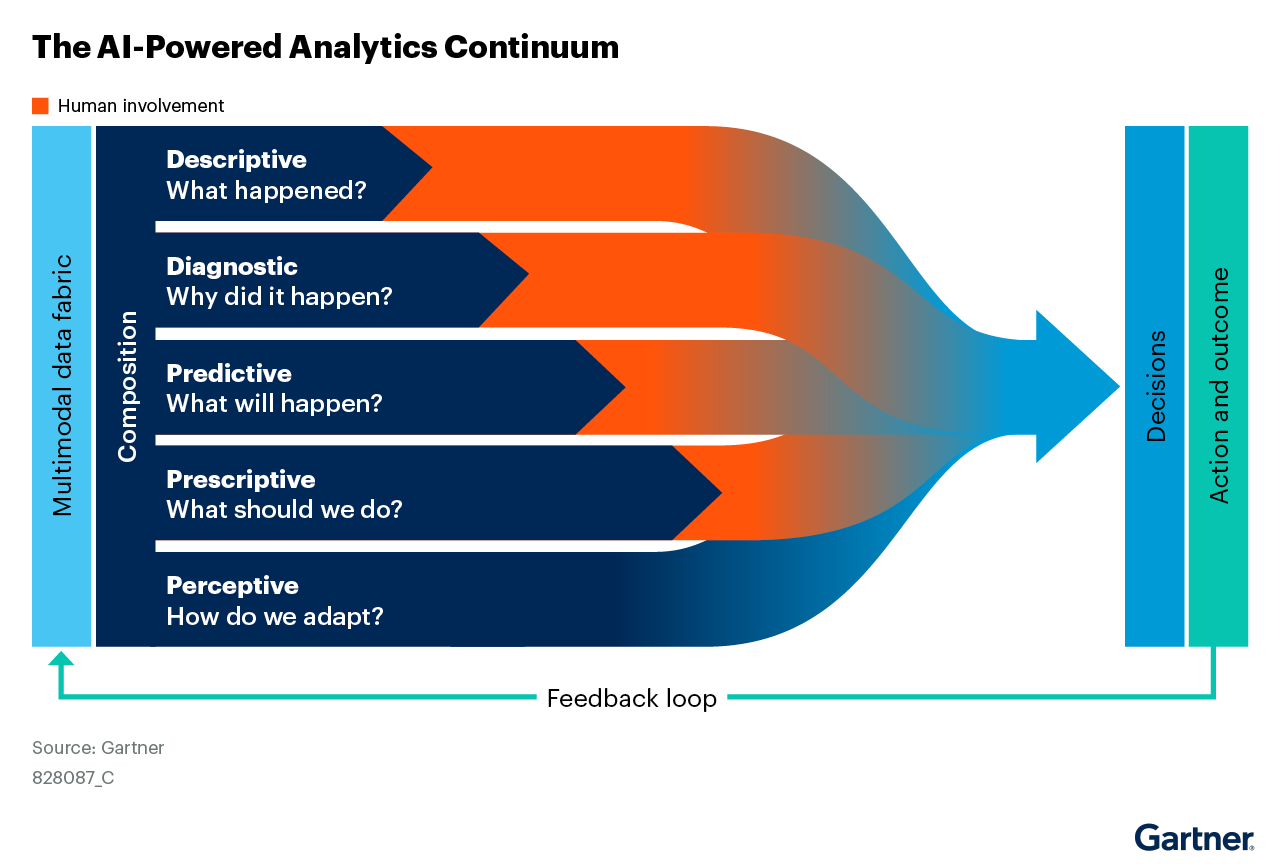
- Convergence of Agentic Analytics and ABI Platforms
Agentic analytics is increasingly blending with augmented analytics and business intelligence (ABI) platforms, leading to a convergence of capabilities across these categories. As agentic features such as automation, conversational analytics, and advanced orchestration are integrated into ABI solutions, traditional boundaries between analytics, business intelligence, and operational AI are becoming less distinct.
Converging agentic analytics with ABI platforms simplifies architectures and embeds intelligence directly into business workflows, accelerating adoption and value realization. Organizations that treat these as separate layers will face fragmented experiences and slower translation of insights into action.
- Advanced Governance Technology
Organizations may need to deploy specialized guardian agents within agentic analytics systems to monitor for bias, accuracy, policy compliance, and drift. This capability is essential for scalable oversight of autonomous analytics, ensuring that agent-driven insights remain trustworthy and compliant as systems evolve.
When evaluating analytics platforms, organizations should look for integrated governance features or consider supplementing with an AI governance platform (AIGP) to close any gaps. According to recent studies, Organizations that implement governance features are multiple times more likely to report the highest level of business value from GenAI (see Adopt 5 AI Governance Practices to Boost GenAI Value). Without this critical layer, scaling agentic systems can expose organizations to increased operational, regulatory, and reputational risks. - Domain-Calibrated Agents
Generic agents are being replaced by domain-calibrated agents tailored for specific functions and industries.
Domain-calibrated agents improve relevance, trust, and speed by embedding industry- and function-specific context into analytics and recommendations. Relying on generic agents will increase manual intervention and limit adoption in complex or regulated domains. - Workforce Evolution
The impact of agentic analytics extends across both the D&A workforce and the broader line-of-business (LOB) workforce:
- D&A workforce: The role of analytics professionals and data scientists is evolving from primarily building models to acting as supervisors, orchestrators, and knowledge engineers who focus on refining objectives, developing and maintaining semantic models, and overseeing autonomous analytical systems.
- LOB workforce: As agentic analytics platforms automate more analytical tasks, business users and other line-of-business professionals will see shifts in their roles, with new opportunities emerging for decision support, oversight with analytics, and collaboration with AI-driven systems.
Evolving the workforce toward supervision, orchestration, and semantic stewardship allows organizations to scale agentic analytics without proportionally increasing headcount. Organizations that fail to realign roles and skills will underutilize agentic capabilities and create bottlenecks in oversight and decision accountability (see AI Agents Shift Workforce Skills and Roles: Guidance for Adaptation).
Today’s agentic analytics platforms do deliver several of these capabilities, but only unevenly and rarely end to end. Most leading platforms reliably support conversational analytics, automated insight generation, and basic multistep orchestration, and these perform as expected in bounded, well-defined use cases. However, perceptive analytics, true domain calibration, decision memory, and continuous guardian-style oversight are still emergent, typically implemented through add-on components, custom configuration, or adjacent governance tooling rather than as native, integrated capabilities. As a result, platforms perform credibly in pilot and early-scale deployments, but few yet sustain consistent performance, cost control, and accountability once agent autonomy increases across multiple domains or decisions, making deliberate architectural and governance design essential for scaling.
Representative Vendors
The vendors listed in this Market Guide do not imply an exhaustive list. This section is intended to provide more understanding of the market and its offerings.
The vendors listed in this Market Guide do not imply an exhaustive list. This section is intended to provide more understanding of the market and its offerings.
Vendors are widely diverse in their agentic analytics capabilities. Gartner encourages D&A leaders to inspect the products under consideration and for the potential broader capabilities outside the scope of this report (see Critical Capabilities for Analytics and Business Intelligence Platforms).
Table 1 provides a list of agentic analytics tool vendors. This list is not intended to be comprehensive but representative of the agentic analytics market.
Vendor Selection
Gartner sizes this market at about 37 vendors that meet the majority of the key capabilities as outlined in this Market Guide. However, many are not fully featured or may not be relevant to Gartner clients, which tend to be global, enterprise companies. Representative vendors are of interest to Gartner clients, as evidenced by client interactions throughout 2025. A vendor’s absence from this research does not mean that it lacks viability. Gartner regularly advises clients to explore the broader market to select a fit-for-purpose solution.
Representative Vendors in Agentic Analytics
Vendor | Platform | Headquarters |
Aible | Aible Platform | California, United States |
Alation (formerly Number Station) | Alation Agentic Data Intelligence Platform | California, United States |
Amazon Web Services (AWS) | Amazon Quick Sight | Washington, United States |
Arhasi | Arhasi AI Analytics Agent | Texas, United States |
Bicycle.ai | Bicycle.ai | California, United States |
Cognite | Atlas AI | Lysaker, Akershus, Norway |
Contentful | Contentful Analytics | Berlin, Germany |
Cube.dev | Cube D3 | California, United States |
Databricks | AI/BI Genie | California, United States |
DataGenie | Genie+ | New Jersey, United States |
Diwo | Diwo Decision Intelligence | Michigan, United States |
Domo | Domo.AI | Utah, United States |
Dremio | Agentic Lakehouse Platform | California, United States |
EDB | EDB Postgres AI Analytics Accelerator | Massachusetts, United States |
Getdot.ai | GetDot.AI Platform | California, United States |
GoodData | GoodData Platform | California, United States |
Google Looker | Gemini in Google Looker | California, United States |
Hex Technologies | Hex | California, United States |
Instacart (Maplebear) | Agentic Analytics | California, United States |
Kater.ai | Kater | California, United States |
Microsoft | Copilot in Power BI; Microsoft Data Agent | Washington, United States |
Narrative BI | Narrative BI Platform | California, United States |
Plotly | Plotly Studio | Quebec, Canada |
Pyramid Analytics | Pyramid’s decision intelligence platform | Amsterdam, The Netherlands |
Salesforce (Tableau) | Tableau Next | California, United States |
SAP | Joule Agents | Walldorf, Baden-Wurttemberg, Germany |
Snowflake | Cortex Analyst | Bozeman, Montana, United States |
Spindle AI | Spindle Agent | California, United States |
Strategy (formerly MicroStrategy) | Strategy One | Virginia, United States |
Tellius | Tellius Platform | Virginia, United States |
TextQL | TextQL | California, United States |
ThoughtSpot | Spotter | California, United States |
Unsupervised | Unsupervised | Colorado, United States |
Veezoo | Veezoo | Zurich, Switzerland |
WhizAI (an Iqvia business) | WhizAI | New Jersey, United States |
Xenonstack | Agentic Analytics platform | Texas, United States |
Zoho | Zoho Analytics | Tamil Nadu, India |
Source: Gartner (February 2026)
Market Recommendations
D&A leaders should:
- Evaluate enterprise readiness and integration capabilities
Assess platforms for their ability to operate across both structured and unstructured data sources, integrate with existing business workflows, and support conversational and embedded analytics experiences. Ensure platforms can handle complex business questions and support advanced planning and reasoning. - Anchor deployments to high-value, well-bounded use cases
Begin with scenarios where agentic analytics can deliver clear, measurable business value and where risk is manageable. Prioritize use cases that benefit from automation, faster insight-to-action alignment, and reduction of manual effort. - Insist on robust semantic and contextual foundations for scale
For enterprise deployments, require platforms to support composite semantic layers, including structured semantic models, knowledge graphs, ontologies, and taxonomies, to enable consistent interpretation of business entities, relationships, and policies. Recognize that while semantic layers are foundational for governed, scalable agentic analytics, individual- or group-focused tools may operate with less control and consistency. - Establish formal governance and delegation frameworks
Expand governance beyond traditional data and model oversight to include agent delegation, escalation paths for uncertainty, confidence thresholds, and outcome monitoring. Define which insights agents may influence and set clear criteria for human oversight and accountability. - Monitor and manage costs at the outcome level
Shift cost management focus from query volume and compute usage to outcome-level metrics, such as cost per insight supported, cost per avoided error or delay, and cost per accelerated outcome. Demand transparency from vendors regarding pricing models and cost visibility tied to business outcomes. - Support advanced automation and conversational experiences
Choose platforms that embed agentic analytics into business workflows, enabling users to interact through natural language and conversational interfaces. Ensure the platform can interpret complex business questions, optimize business goals by breaking them into sub-goals, and involve AI agents to connect, prepare, and contextualize data sources. - Assess vendor fit and specialization
Understand the main categories of agentic analytics vendors:- Traditional ABI platforms incorporating agentic features for enterprisewide deployment
- Capability-centric platforms with technical depth in specific analytics areas
Domain-specialized platforms tailored for industry-specific challenges
Select vendors whose market position and specialization align with your organizational needs.
Select vendors whose market position and specialization align with your organizational needs.
- Plan for gradual adoption and integration
Recognize that most organizations are still in the experimentation and pilot-to-scale stage as they evaluate & iterate for continuous improvement. Develop a roadmap for scaling agentic analytics from pilot projects to broader deployment, ensuring alignment with business goals, data infrastructure, and change management requirements. - Maintain flexibility for individual and team-level solutions
While enterprise-scale platforms require robust governance and semantic layers, allow for the use of individual or group-focused agentic analytics tools where agility and speed are prioritized over consistency.
Acronym Key and Glossary Terms
| ABI | Analytics and business intelligence |
1 2025 Gartner Generative and Agentic AI in Enterprise Applications Survey. This study was conducted to understand the key challenges and opportunities when deploying generative AI (GenAI) tools, and where organizations should focus their AI investments. This research also aims to understand what stage organizations are at on their AI agent journey and their thoughts on AI agents. The research was conducted online from May through June 2025 among 360 respondents from organizations with at least 250 full-time employees across all industries (except IT software) in North America (n = 149), Europe (n = 140) and Asia/Pacific (n = 71). Soft quotas were established for country, company size, and respondent’s function type and job level to ensure a good representation across the sample. Organizations were required to have deployed or plan to deploy in less than one year at least one generative AI tool in at least one core enterprise application domain: digital workplace applications, customer relationship management applications, or enterprise resource planning applications. Respondents were team leaders or above, excluding C-level, and involved in the rollout of generative AI tools; they were required to have certain responsibilities regarding these generative AI tools. Disclaimer: The results of this survey do not represent global findings or the market as a whole, but reflect the sentiments of the respondents and companies surveyed.
2 SM25 Gartner Social Media Analysis Methodology. Gartner conducts social listening analysis leveraging third-party data tools to complement or supplement the other fact bases presented in this document. Due to its qualitative and organic nature, the results should not be used separately from the rest of this research. No conclusions should be drawn from this data alone. Social Media Data in reference is from 1 January 2023 through 30 June 2025 in all geographies (except China) and recognized languages.