Market Guide for Privacy UX
2 February 2026 - ID G00842292 - 16 min read
By Stefan Dumitrescu, Shadrock Roberts, and 1 more
An effective privacy user experience (UX) is critical to increasing user trust while facilitating compliance. Cybersecurity leaders should use this guide to identify the key components to manage consent and preferences, subject rights requests, and web trackers.
Overview
Key Findings
- Organizations that prioritize a seamless privacy UX enjoy significant benefits, including high customer loyalty, lower regulatory risk, improved operational efficiency, and more suitable data for AI projects.
- By earning and retaining user trust through the use of a privacy UX, organizations not only fulfill user expectations, but also naturally unlock opportunities to collect first-party personal data, thus enabling greater value creation and enhanced AI performance.
- Transparency is the foundation of trust; consumers demand clear visibility into why their information is needed, how it is handled, and the ability to control it.
Recommendations
- Streamline privacy management activities by building an integrated privacy UX to reduce long-term operational costs, mitigate regulatory risks, increase customer loyalty, enhance efficiency, and ensure more reliable data for AI initiatives.
- Foster and uphold consumer trust by providing transparent, engaging privacy experiences that obtain reliable first-party data and drive maximum ROI (including AI initiatives).
- Empower individuals by providing clear, actionable, real-time insights into — and control over — how their data is used and shared through privacy UX tools.
Market Definition
Gartner defines the privacy user experience (UX) as the components of an organization’s privacy program that directly touch an individual. These components provide transparency and control over individuals’ personal data, enabling them to manage and exercise preferences and rights. Privacy UX provides organizations with a compliance-backed foundation for responsible data use by consolidating and synchronizing individual choices across all touchpoints, thus enabling robust consent management and efficient subject rights processing.
Central to most privacy laws are people, and their clarity and control over their personal data. The privacy UX enables individuals to control how much personal data to expose, to whom and for what purpose. It encompasses all the touchpoints where individuals meet and engage with organizations.
For organizations, the privacy UX provides a strong foundation for compliance-backed data usage, with detailed tracking and auditability. Privacy UX helps organizations earn the trust of individuals by providing transparency over data handling processes, capturing the consent of individuals (including web tracking) and processing of subject rights requests in an accurate and expedient fashion.
Mandatory Features
The mandatory features for this market include:
- Consent and preference management (CPM) core services that work in concert to enable an organization to maintain and enforce a unified view of user choices. Examples include:
- Multidimensional preference matrices/single source of truth that facilitate the representation of highly configurable and granular consent structures.
- Harmonization engine that allows platform administrators to connect multiple preference repositories, providing synchronization of user preferences with the CPM single source of truth.
- Tracker consent that focuses on the recording of online visitors’ permission with respect to the capture of data deemed nonessential to functioning of said channel. This includes recognition and honouring of browser signals such as “Global Privacy Controls” and “Do Not Track,” as well as execution of scans to maintain compliance.
- Subject rights request (SRR) management that provides an end-to-end process for handling SRRs in a scalable and repeatable manner and includes request capture, request logging, identity verification, request triage, response collation, response validation and response communication.
- User and integration services that enable workflows to be established for capturing consent and receipt of SRRs and connectivity with all systems and touchpoints, both inside and outside an organization, for successful CPM and handling of SRRs:
- User services: Examples are consent collection/capture, provision of banner or notice, maintenance of consent for duration needed (such as session, type of interaction), contextual and learning consent, layered workflow, offline interface, delegated consent, simplified opt-out, bot-capable interface, and/or redaction capabilities for SRR management.
- Integration services: Examples are partner consent services, consent/SRR triggers, identity integration, rich APIs, direct marketing augmentation, mail gateway integration and/or website tag managers.
Optional Features
The optional features for this market include:
- Administration services: Examples are administration interface, records of consent, web tracking enforcement and multitenancy, testing services (including A/B testing), and/or privacy policy administration.
- Self-service privacy center: This refers to extending a preference center where users can administer their consent choices and submit SRRs. It synchronizes data access, consent management and SRRs across all touchpoints to reduce fragmentation and provide a cohesive UX. Well-developed preference centers elevate an organization to a higher level of privacy management maturity and place control back into the individual’s hands.
Market Description
Every organization has a privacy UX — even if they haven’t built one intentionally. For most organizations, it is fragmented and disparate, consisting of point solutions implemented to address regulatory requirements.
This leads to inefficient processes and introduces the possibility of missed deadlines and/or procedural errors. It also puts you at risk of noncompliance, fines, and reputational damage.
Cybersecurity leaders must build a holistic privacy UX that unifies all touchpoints with individuals into a cohesive experience. By investing in a unified platform combining tracker consent management, consent and preference management (CPM), and subject rights requests (SRR) fulfillment, organizations can facilitate automation and scale compliance efforts across multiple jurisdictions.
When individuals are met with a clear, consistent interface where they can manage their preferences, they are more likely to feel empowered. This sense of control builds confidence in the brand and increases trust over time. That trust converts into sustained access to critical data assets, which in turn strengthens analytics initiatives and powers AI-driven insights.
A key part of building and maintaining this trust is ensuring that individuals’ privacy rights are respected, especially when it comes to SRRs. SRR fulfillment is one of the key components of an organization’s privacy program. Organizations wishing to achieve scalable SRR fulfillment need a consistent, documented and repeatable process for handling each request. See Best Practices for Automating Subject Rights Requests for details.
Adopt an integrated approach to privacy UX by investing in technology that fosters individual trust, unlocks richer and higher quality data, and facilitates compliance with regulatory requirements in an efficient, cost-effective manner.
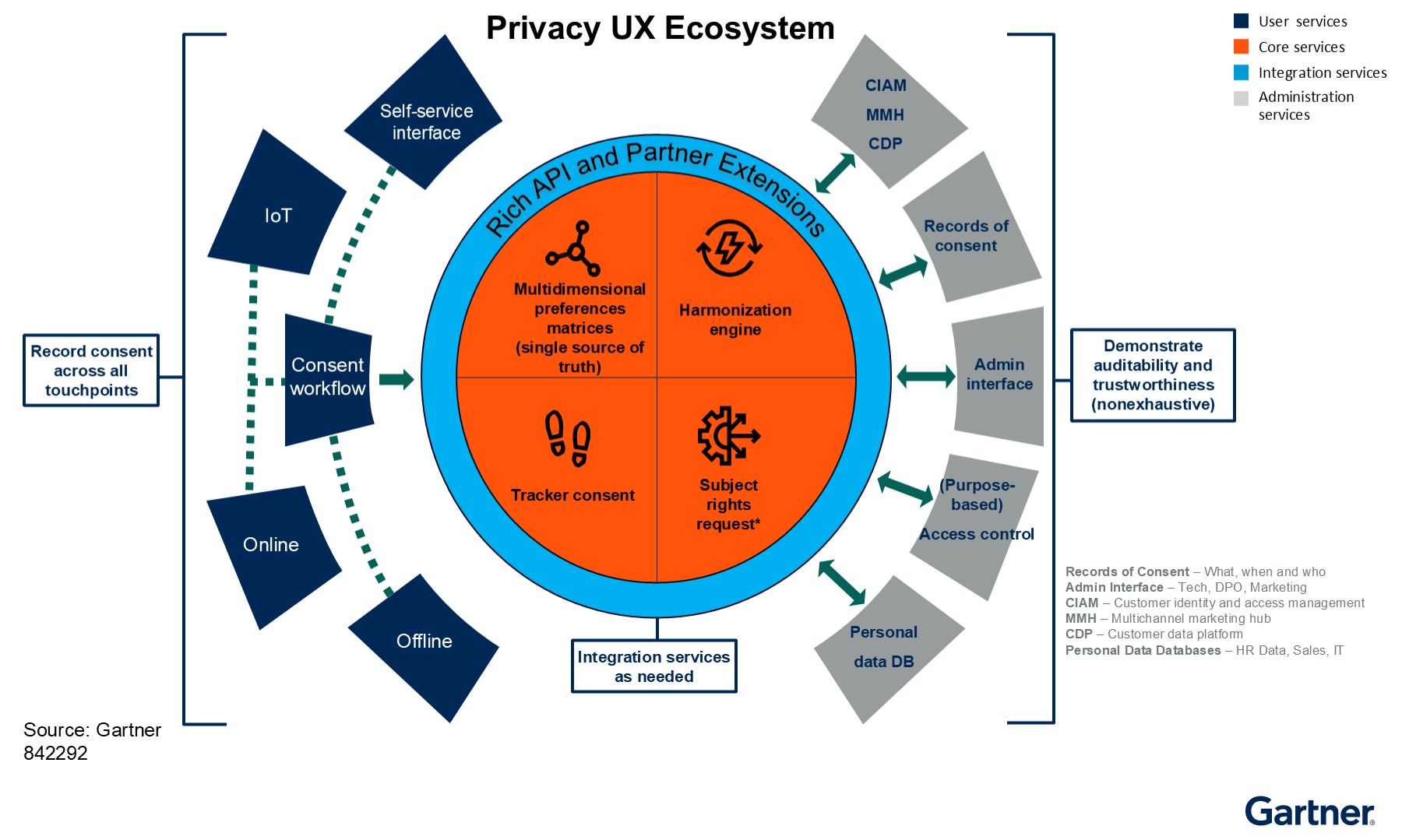
Figure 1 provides a high-level overview of the different services and where they fit within the overarching privacy UX ecosystem.
Privacy UX Capabilities
Consent and preference management core services that combine to enable the organization to maintain and enforce a unified view of user choices include:
- Multidimensional preference matrices (single source of truth): A highly configurable, granular consent model that lets users set channel- and topic-specific preferences, such as end-of-day football updates by email versus real-time basketball alerts via SMS.
- Harmonization engine: Bidirectionally syncs those preferences across all repositories. Prebuilt connectors (Salesforce, Adobe, etc.) and collision-resolution rules ensure a consistent, unified view of user choices across the entire organization.
- Tracker consent: Records online visitors’ permission to capture nonessential data through tracker consent by extending configurable management of cookies, pixels, web beacons, and tags, even for unregistered users. This includes maintaining consent choices and honoring browser signals like Global Privacy Controls and Do Not Track as well as execution of scans (automated and manual) with a reference library of cookies/trackers to optimize compliant consent rates.
- Subject rights request management: Delivers a comprehensive, scalable, and repeatable workflow for processing SRRs from start to finish. It encompasses request capture, logging, identity verification, request triage, compile response, validate response, and response communication.
User and integration services are used for setting up consent capture and SRR workflows, and connecting all internal and external systems and touchpoints for seamless CPM and SRR handling.
User services include:
- Consent collection: Configuring consent across any interface (such as web, mobile, in-person) and capturing preferences at the point of data collection.
- Contextual and learning consent: Requesting consent during relevant user actions with tailored wording to boost opt-in rates.
- Consent (layered) workflow: Using multistage opt-in where users confirm consent on-site and via email, with unconfirmed requests expiring.
- Offline interface: Allowing users to give or manage consent in person, on paper, or by phone through service center agents.
- Delegated consent: Supporting third-party authorization (such as a parent consenting on behalf of a minor) when the data subject cannot or should not consent directly.
- Simplified opt-out: Offering a one-click opt-out for specific processing activities, complying with requirements such as California’s “Do Not Sell” link.
- Self-service interface: Providing a preference center where users control tier consent settings, boosting privacy management maturity.
- Bot capable interface: Using interactive bots for consent collection, revalidation, or revocation to create a more engaging experience and lift opt-in rates.
Integration services include:
- Partner consent services: Enabling sharing data with third parties, while tracking and communicating any changes in consent and preferences. This ensures transparency and rapid propagation of user choices, as reinforced by France’s CNIL guidance.
- Consent triggers: Using time- or event-driven rules to modify consent automatically, such as revoking marketing email permission if a recipient fails to open or click three consecutive campaigns within six months.
- Identity integration: Providing APIs that link the consent management platform’s single source of truth with an organization’s customer identity and access management (CIAM) or master data management (MDM) system, or resolving new adtech identifiers.
- Rich APIs: Offering extensible APIs for federated consent repositories and service desk platforms, enabling custom integrations that let marketers leverage external analytics and visualization tools.
- Direct market augmentation: Supporting mail footer generation, administration, and pixel tracking to measure engagement and trigger consent modifications based on the data subject’s behavior.
- Mail gateway integrations: Monitoring outbound mass mailers to ensure unsubscribe and consent preferences are honored. Advanced mail gateway integrations block noncompliant emails or inject preference-management options directly into the footer.
- Website tag manager: Allowing the ability to deploy and manage analytics, advertising, and conversion tracking snippets from a single dashboard without touching the source code. Some features include triggers, version history, preview mode, and customizable permissions.
- Administration services: Encompass features such as the admin interface, records of consent, enforcement of web tracking, and support for multitenancy, testing services (include A/B testing), and privacy policy management.
- Self-service privacy center: it is build on a preference hub, which allows users to manage their consent settings and submit SRRs directly. It keeps data access, consent management, and SRR processing synchronized across every touchpoint to minimize fragmentation and deliver a seamless user experience. A robust preference center enhances an organization’s privacy management maturity and empowers individuals with greater control over their personal data.
Early Approaches to Privacy UX
Historically, organizations have adopted a checkbox mentality and built their privacy UX using a combination of manual workflows and sporadic investments in automation. Even when investing in technology, their focus has primarily been workflow automation, not integration with systems storing personal data.
As privacy regulations continue to modernize, organizations are evolving their approaches to the privacy UX, focusing on connecting to data repositories storing personal data. This reduces the time for processing SRRs while enabling integrated consent and preference workflows with granular, purpose-specific choices and easy withdrawal, directly mapped to how data is collected, processed, and used across systems.
Organizations are also centralizing the management of tracker consents, where signals are linked to consent and preference in real time. This ensures that data is not isolated at the browser or device level, but can be reliably associated with individual choices and made available for compliant analytics and AI use cases.
It is important to note that investments are simply focused on the purchase of solutions, as some organizations have chosen to build some of the components due to a combination of in-house expertise and/or complexity in their infrastructure.
More progressive organizations have started to adopt a unified, self-service portal for processing the full spectrum of SRRs, as well as consent and preferences.
Market Direction
Gartner expects the privacy UX to continue its evolution from a fragmented set of tools to integrated platforms that unify CPM, tracker consent management, and SRR management. While there are organizations that still choose to prioritize a “best of breed” approach to individual components, the resulting administrative efforts often wind up costing more, compared to the operational efficiencies gained from a singular platform. The market is now converging on a model that prioritizes a unified privacy UX upfront, supported by specialized systems on the back end fueling a growth phase for privacy UX.
Growth Fueled by Regulation and Digital Ecosystems
Organizations are increasingly operationalizing privacy UX as a system-level capability rather than viewing it through the lens of compliance. They align user-facing controls with back-end enforcement mechanisms that ensure state privacy commitments are executed. Standardizing privacy UX orchestration across jurisdictions allows organizations to manage regional regulatory variance while maintaining a unified/consistent technical architecture and consistent user experience.
Therefore, vendors offering solutions that scale across jurisdictions can expect to see the strongest growth. Privacy UX will ultimately shift from a modular approach within privacy management tools to a core layer of orchestration that delivers a unified experience.
This growth will directly be impacted by:
- AI governance requirements that demand greater transparency around data use and model training inputs.
- An increased volume across different channels of collecting data, such as web, connected TV, kiosks, automotive systems, and Internet of Things (IoT) environments.
- New and amended privacy laws including but not limited to U.S. state laws and India’s DPDP Act and others.
- Support for local languages to provide interoperability across jurisdictions.
- Maturing privacy UX programs, where early adopters, having instrumented and tracked user interactions, are now compelled to automate workflows in response to rising demand, complexity, and cost pressure.
Growth in the privacy UX market will also accelerate due to the shortcomings of manual workflows. Regulators are actively enforcing the delayed or inaccurate SRR responses, dark patterns in consent collection, and inappropriate controls around web tracking. In response, organizations are shifting toward automated portals, preference centers, and synchronized consent systems.
Market Analysis
Current State
The privacy management tools market, which includes CPM and SRR, reached approximately $5.1 billion in 2025, and it is forecast to grow to $14.6 billion by 2030. Within that market, CPM makes up a significant portion, as reports show that roughly 31% of privacy software spending in 2024 was dedicated to this functionality.1 Gartner forecasts that the CPM market alone will grow from $0.7 billion in 2024 to $1.6 billion in 2029, for a compound annual growth rate (CAGR) of 20.2% over this period.2
SRR automation maintains a growth trajectory, although year-over-year growth is expected to slow as this is one of the first components organizations implement in response to privacy regulations. Gartner forecasts that the stand-alone SRR management market will double from $1 billion in 2024 to $2 billion in 2020, for a CAGR of 14.3% over this period.
Tracker consent management has a strong web adoption; however, compliance gaps remain widespread, especially in the absence of clear reject options and persistent tracking after the data subject has opted out.3
— Cisco 2024 Consumer Privacy Survey Report, Cisco.Consumer trust pressure accelerates adoption; 75% of consumers say they avoid companies that they do not trust with their data, reinforcing privacy choice interfaces as a decision factor.
Expected Evolution
Tracker consent controls will continue to expand from websites to a unified model covering applications, connected TVs and kiosks, IoT endpoints, and automotive and entertainment systems. While tracking mechanisms differ by endpoint, such as cookies and device identifiers on the web, IP- or device-based signals on connected TVs, and vehicle identifiers in automotive systems, regulated enterprises will demand a consistent user experience and enforcement across all endpoints, not just the browser.
In parallel, there will be continued demand for “universal” or “unified” consent and preference management. As organizations push to personalize experiences/journeys for their customers, the ability for a privacy UX to not only gather and record consent, but also to permit individuals to customize their preferences, and then harmonize such choices across all touchpoints, will be a key differentiator. Harmonization will require the privacy UX to connect to CRM, customer data platforms (CDPs), and other marketing-related platforms.
Regulators care not only that the consent was collected but also that systems honored individuals’ choices downstream. This will drive demand for real-time multidimensional preference matrices that propagate consent and opt-out signals into analytics platforms, ad-tech, and tag managers, as well as back-end data stores supported by auditable evidence, demonstrating that preferences were enforced throughout the data life cycle.
SRR will consolidate into authenticated self-service portals that will automate orchestration across different systems. This is gaining traction not because response timelines are new, but because rising request volumes, broader channel coverage, and increased enforcement make long-standing obligations, such as CPRA 45 days and LGPD’s 15 days response requirements, far more difficult to meet though manual processes. That makes manual intake, routing, and fulfillment too risky and too costly at scale, which will force the automation into the privacy UX layer.
Over the next several years, the market evolution will lean toward unified, automated, omnichannel privacy UX platforms that will have the ability to integrate tracker consent management, CPM, and SRR management into one coherent layer across all user touchpoints.
When these elements are integrated into a single platform:
- Organizations avoid layering on separate processes or tools for each requirement.
- There are increased cost savings and compliance, alongside strengthened consumer confidence that directly supports long-term trust.
- A frictionless privacy UX guarantees continued access to increasing amounts of high-quality data, which is critical to any organization’s AI strategy.
Representative Vendors
The vendors listed in this Market Guide do not imply an exhaustive list. This section is intended to provide more understanding of the market and its offerings.
Vendor Selection
This guide features illustrative representative vendors that provide a platform handling all three of CPM, tracker consent management, and SRR management. The vendors are listed in alphabetical order and have been in the market for at least five years, with most active over six years (see Table 1).
Representative Vendors in the Privacy UX Market
Vendor | Product Name | Headquarters | Founded |
Privacy Portal | New York, U.S. | 2016 | |
Privacy Requests, Multi-Regulation Consent Management, and Preference Management | France | 2017 | |
Consent and Preference Management and Data Subject Rights Manager | Oregon, U.S. | 2008 | |
DSR Automation, Consent Management, and Marketing Preference Management | California, U.S. | 2020 | |
DSR Automation, Consent Management, and Privacy Center | Israel | 2019 | |
Consent Management Platform, and Privacy Automation | Georgia, U.S. | 2016 | |
Cookie Consent, Subject Rights Management, and Unified Consent &Preference Hub | Texas, U.S. | 2018 | |
Consent Management and Data Subject Request Automation | California, U.S. | 2018 | |
Consent Management, Preference Management, Cookie Management, and Data Management | U.K. | 2000 | |
DSR Automation, Consent Management, Preference Management, and Privacy Center | California, U.S. | 2017 | |
Cookie Consent Manager, Consent and Preference Manager, and Individual Rights Manager | California, U.S. | 1997 | |
Smart Consent and Preference Management, Data Privacy | Arizona, U.S. | 2017 | |
Source: Gartner (February 2026)
Market Recommendations
Organizations entering the privacy UX market need to anchor their offerings on enabling and reinforcing customer trust as a core outcome. The privacy UX needs to encompass all touchpoints with individuals, from tracker consent management, to CPM and SRR management. Simple consent choices and easily accessible preference controls facilitate compliance and reduce operational risk, while enabling individuals to make informed decisions over their data.
Differentiation in this market will come from streamlining privacy management through automation, by enabling organizations to cut operations costs, reduce manual errors, and consistently meet compliance obligations. Privacy UX platforms that automate tracker management enforcement, consent propagation, and subject rights handling will help organizations maintain service-level agreement (SLA)-backed accuracy while human workload is reduced. These efficiencies translate into strong customer loyalty, reduced regulatory exposure, and higher data reliability for AI and analytics programs.
1 Privacy Management Software Market Size & Share Analysis — Growth Trends and Forecast (2026-2031), Modor Intelligence.
3 A Cross-Country Analysis of GDPR Cookie Banners and Flexible Methods for Scraping Them, Cornell University.
Note 1: Gartner’s Initial Market Coverage
This Market Guide provides Gartner’s initial coverage of the market and focuses on the market definition, rationale for the market, and market dynamics.