The Impact of AI Agents on Marketing
7 November 2025 - ID G00834229 - 9 min read
By Nicole Greene, Lizzy Foo Kune
AI agents offer the potential to automate interactions, processes and strategies, both for marketers and customers. AI agent maturity exists on a spectrum, and there’s an entry point for every organization. CMOs must understand what AI agents can do and take action now to stay ahead of the impact on marketing across data, people, process and technology.
Insights at a Glance
Agentic AI is a top strategic technology trend that has gained the attention of the C-suite due to its potential to impact business over the next five years. In fact, Gartner saw a 750% increase in AI-agent-related inquiries between 2Q and 4Q of 2024.1
Agentic AI is less a successor to GenAI and other AI practices and more a set of capabilities that have been given transformational potential by their forerunners’ advancements. Increasingly, complex processes and human tasks can now be (semi)autonomously executed by AI agents, enabling more effective generative outputs.
Agentic AI is less a successor to GenAI and other AI practices and more a set of capabilities that have been given transformational potential by their forerunners’ advancements. Increasingly, complex processes and human tasks can now be (semi)autonomously executed by AI agents, enabling more effective generative outputs.
For CMOs, AI agents allow teams to move beyond reactive bots and assistants to deliver personalized, efficient, and adaptive customer experiences.
- At their core, AI agents help marketers optimize omnichannel experiences by analyzing behavior and preferences to recommend content, automate tasks, and support smarter decisions.
- Agents are built to perceive, decide, act, and achieve goals — making marketing strategies more predictive and proactive. Using GenAI for reasoning and planning, agents can access tools, take unscripted actions, and request user input in semiautonomous scenarios.
- Each agent operates with a defined goal, bounded by guardrails to limit scope and reduce errors.
- This approach drives personalization, boosts conversions, and enhances the customer journey — ultimately improving efficiency, agility, and marketing performance.
CMOs looking to understand the impact of AI agents on marketing can use this research to assess business value and feasibility, including technology capabilities and cultural readiness for AI agents.
Strategic Planning Assumptions
By 2027, 90% of CMOs will pilot AI agents to deliver personalized, adaptive customer experiences.
By 2028, only 15% of agentic AI deployments will be highly autonomous, expert agents, up from less than 5% in 2025.
By 2033, 15% of agentic AI deployments will be fully autonomous, compared with less than 1% in 2025.
Impact Brief
How AI Agents Differ From AI Assistants
AI agents are goal-driven and can take autonomous actions to achieve outcomes, while assistants are typically reactive, responding to user commands without independent decision making. The Gartner AI Agent Assessment Framework recognizes that such agency and other capabilities are not all-or-nothing properties. Instead, there exists a spectrum of agent capability levels: from minimal to advanced (see Figure 1).2
CMOs can use this spectrum to gradually introduce agentic processes into well-scoped use cases that align with enterprise capabilities. Rather than aiming for full autonomy immediately, marketing can scale gradually as governance, data, risk mitigation and team readiness mature.
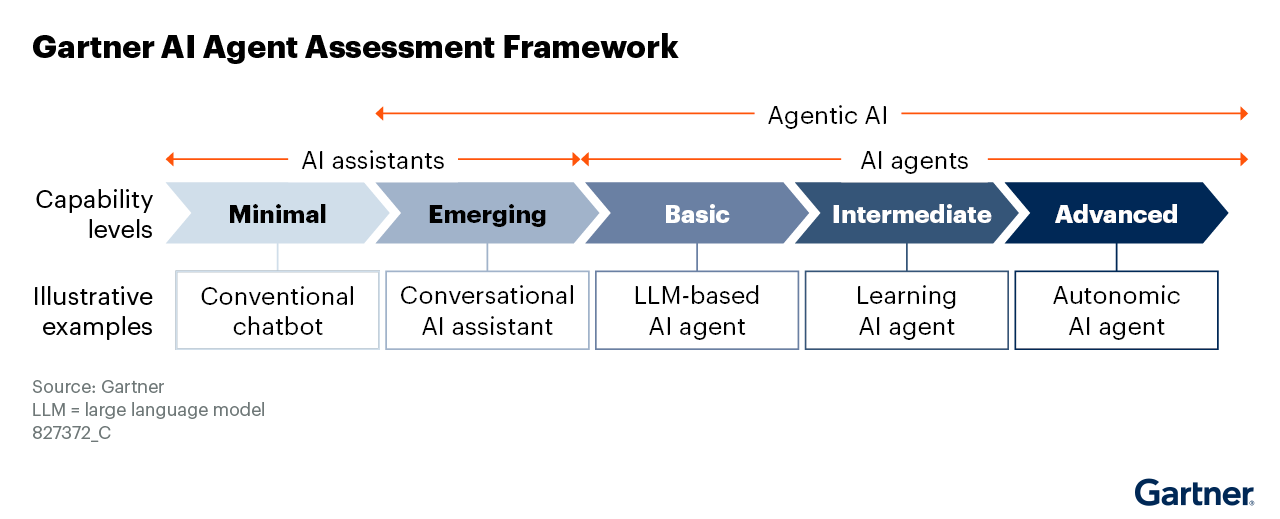
- AI assistants (minimal to emerging): AI assistants are specialized applications or modules in a wider system that incorporate AI techniques to support or carry out tasks as requested, specified and led by external (human) actors through a (conversational) interface.
Example: An e-commerce chatbot that can help customers find products to meet their needs. - AI agents (basic to advanced): AI agents are autonomous or semiautonomous software entities that use AI techniques to perceive, make decisions, take actions, and achieve goals in their digital or physical environments.
Example: An autonomous agent uses campaign results to automatically generate and test new, more engaging ad copy. - Agentic AI (emerging to advanced): Agentic AI is an approach to building AI solutions based on the use of one or multiple software entities that are classified, completely or at least partially, as AI agents.
Example: A team of AI agents, each handling a specific marketing function, that autonomously shares insights and coordinates actions to optimize campaigns across channels.
What AI Agents Can and Can’t Do
The hype and investment around AI agents inflate expectations and create confusion around what AI agents can and can’t do to help marketing achieve its goals. If the promise of AI agents is that marketers can do more with less, that seemingly boundless potential is also where lies the peril for CMOs assessing agentic investments. Additionally, even “qualified” AI agents require training in key capabilities such as perception.
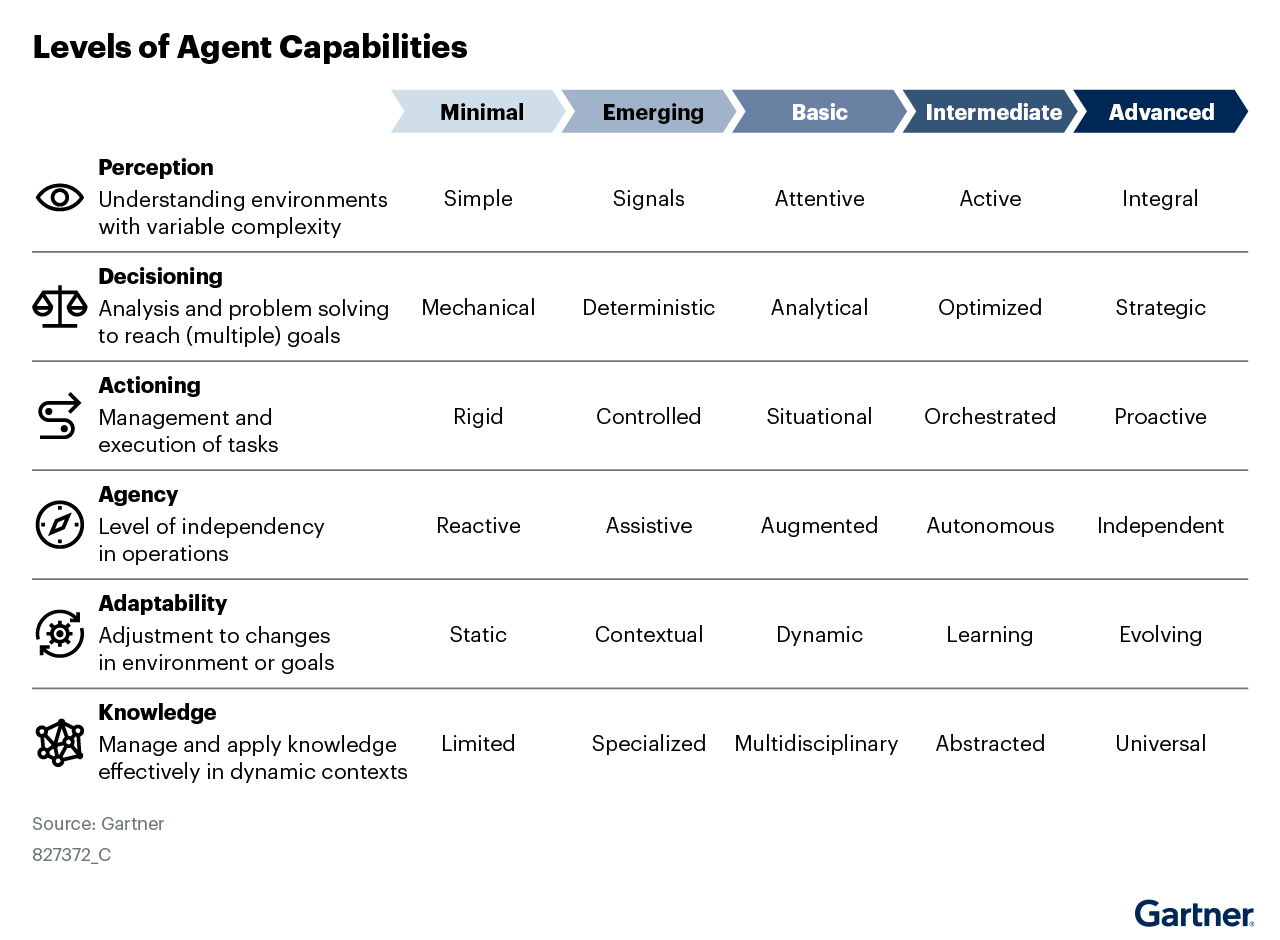
To ensure sound decisions about building, buying, or deploying AI agents, CMOs and martech buyers must objectively differentiate capabilities in the assessment process. Additionally, the use of consistent terminology aligned with IT, chief AI officers, operations and others to evaluate AI agents can keep CMOs from being misled by hype or AI washing. The Gartner AI Levels of Agent Capabilities help evaluate an agent’s sophistication, from minimal to advanced, across defined capabilities (see Figure 2).2
Actions and Cautions
Actions
Marketing can serve as a pilot environment for the enterprise, where CMOs can test end-to-end processes with AI agents.
- Bring order to a fragmented market by integrating AI agent capabilities into your scenario planning, strategy, and workforce development. Assess their growing autonomy and broad applicability across use cases and customer touchpoints.
- Establish governance and test environments to safely explore agentic capabilities, address early challenges, and validate benefits before full deployment. Take the lead from the enterprise and adapt for customer-facing risk mitigation.
- Pilot in controlled scenarios with clear escalation paths to human supervisors to quickly demonstrate value and build trust for broader adoption.
- Test resilience through red team exercises and experimentation to uncover functional gaps and guide agents toward actionable outcomes like better insights or faster processes.
Cautions
- Reliability: AI agents introduce security, data, and governance risks. Marketers must manage the AI supply chain through which agents operate.
- Privacy and ethics: As agents act independently, they may bypass rules tied to business or employment agreements. CMOs must ensure agents comply with industry standards.
- Lack of trust: Agents may act rapidly without explaining their reasoning, leaving users uncertain about their reliability in high-impact scenarios.
- Oversight: Without constraints, agent sprawl can occur, leading to opaque policies and potential misuse of deceptive tactics to achieve goals.
How to Execute
How to Adopt AI Agent Technology for Marketing
AI agents are broadly capable, but not all processes are equally ready to be automated. CMOs should assess which marketing processes, such as journey orchestration, workflow automation, content creation, and strategic planning, will extract the most value from agentic support. From a feasibility perspective, end-to-end process mapping along with a workforce capability assessment will help determine if your organization is ready to use AI agents (see CMOs: Scale AI Skills Quickly to Future-Proof Marketing Teams).
CMOs can begin by asking teams to evaluate these processes for AI agent-enabled performance gains:
- Customer journey orchestration: Use reasoning models to analyze situations, make inferences, and guide actions across commerce, personalization, advertising, and sales enablement.
- Workflow optimization: Agents interact with tools to automate repetitive tasks like segmentation, ideation, project tracking, campaign optimization, and content personalization.
- Competitive research & customer insight: Combine and act on disparate data streams to uncover insights and identify key events (see Market-Shaper CMOs Add Insights Infusion Teams to Marketing Org Structure).
- Scenario & strategic planning: Process structured and unstructured data to deliver timely context and adjust strategies.
- Content & campaign creation: Use tools to draft, test, and generate content across modalities (vision, audio, language), bypassing traditional design and approval cycles.
CMOs and leadership can assess readiness across these processes by considering advancing AI agent capabilities:
- Automating time- and data-intensive tasks in new ways
- Acting independently to eliminate redundancy and free teams for strategic work
- Learning and adapting based on customer feedback and data shifts
- Interacting with customer-facing agents to configure offers, negotiate, and fulfill requests
- Creating new governance, experimentation, and operational models to scale agents
- Evolving into multiagent systems for complex, multistep goals
- Replacing always-on martech with on-demand agents for specific tasks
The AI Agents for the Marketing Provider Landscape
CMOs face a fragmented and evolving vendor and provider landscape, offering a growing range of marketing-specific solutions. Understanding the range of agentic capabilities from basic automation to more advanced, semiautonomous systems will support informed, context-appropriate investment decisions.
This mix of opportunity and risk has created a diverse provider landscape: hyperscalers, enterprise vendors, startups, custom builds, and consultants, each offering agentic services for different needs (see Figure 3). CMOs should adopt a flexible tech strategy that accommodates multiple provider types to capture value and manage risk as agent maturity evolves. Multiagent systems (MAS) add to this complexity and require cross-functional work, since they are capable of operating both collaboratively and independently, supporting decentralized decision making.
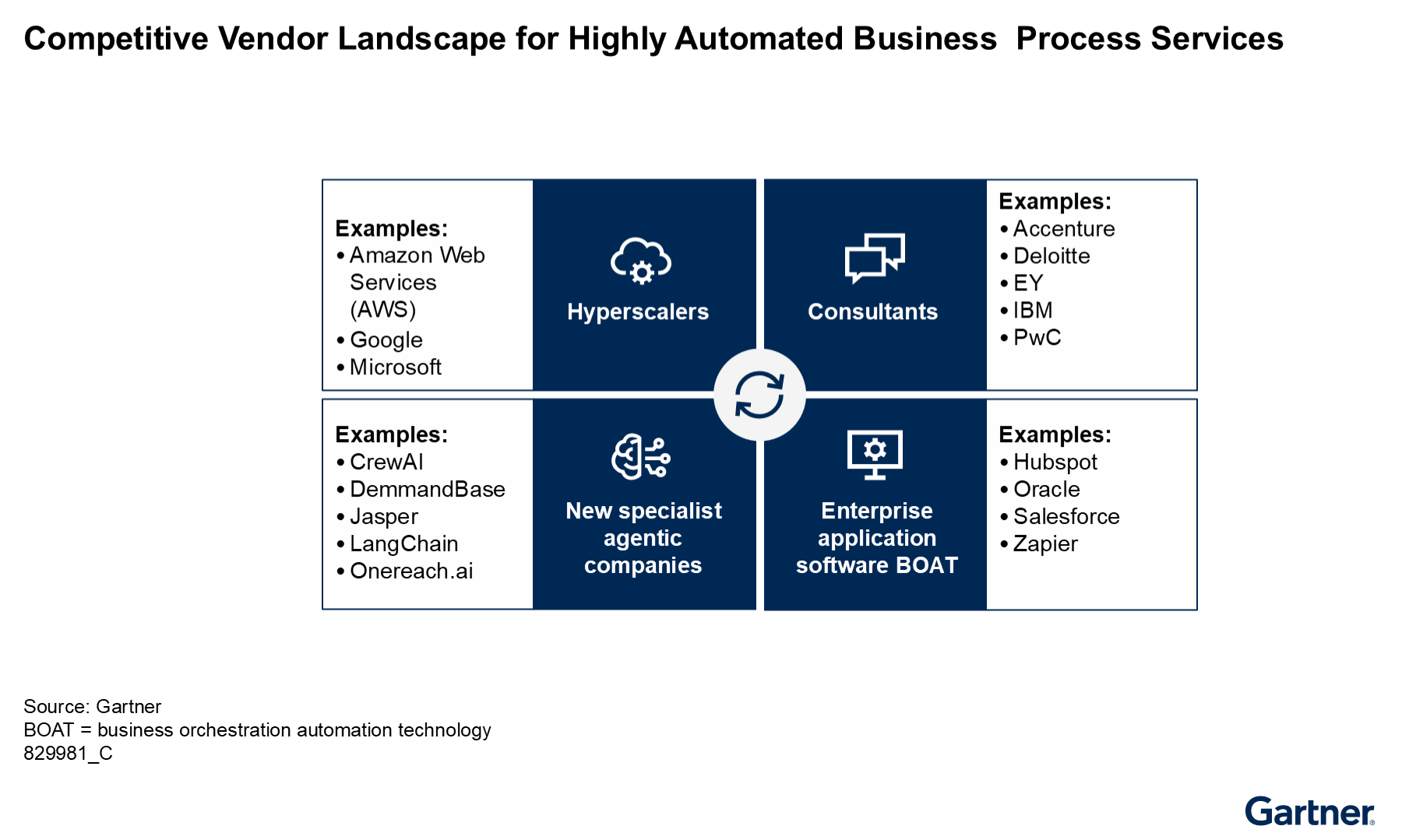
The cost of AI agents has an extremely wide range. CMOs need to consider the total cost of ownership of each agent. Recurring costs of AI agents at scale are driven by the number and complexity of reasoning steps in an agentic AI workflow or decision flow, the size of context prompts and output, the deployment model, the license model, and AI data readiness. Vendor pricing models and data management costs are key drivers of cost variability. 3 CMOs need to be aware of the competitive vendor landscape to help determine the best way to bring agentic capabilities into the organization. Unpredictable runaway costs from API and LLM usage will be a barrier to approval of efforts where value is hard to quantify.
CMOs should begin investing in foundational capabilities now, including API development with IT and operations teams. Open-source protocols, like Model Context Protocol (MCP) and Agent2Agent (A2A), rely on APIs for data, context, tools and resources for consumption by autonomous agents and AI applications. In fact, widespread adoption of MCP and A2A will lead to more APIs and more API usage, not less.4 AI agents offer solutions to legacy challenges like tech debt and lack of stack harmonization, but the impact extends beyond technology. AI agents blend human and machine work into new forms of automation, raising challenges around data quality, governance, process and explainability.
Sample Vendors
Amazon Web Services; Anthropic; CrewAI; Demandbase; HubSpot; Microsoft; OneReach.ai; Oracle; Salesforce; Writer; Zapier
Success Measures
What Marketers Need to Do Today
- Incorporate AI agents into strategic planning by investing in understanding their capabilities and potential applications across marketing, including data and analytics, content creation, advertising, e-commerce and sales enablement.
- Be mindful that not every problem is best solved by an AI agent, or even GenAI. Map existing human-led workflows and understand decision-making logic, objectives and the tools used. This forms a framework to determine how an agent can automate or augment workflows. See Capture the Unit Cost of Multichannel Marketing for more on how to measure the associated costs.
- Promote the development and integration of a variety of AI practices, enabling learning, workflow automation and decision-making capabilities.
- Position marketing as a pilot environment with a secure, internal simulation environment for testing agentic applications and for controlled, limited pilots that have passed trials to build confidence before deployment.
Contributors
Audrey Brosnan, Suzanne Schwartz
1 Analysis from Gartner client inquiries for the keywords “Agentic AI” or “AI Agents” between the dates of April 2024 and December 2024. This observed a 750% increase in inquiries from the second quarter (April through June 2024) to the fourth quarter (October through December 2024).