Predicts 2026: AI’s Impact on Enterprise Applications
4 December 2025 - ID G00840815 - 14 min read
By Tad Travis, Jason Wong, and 3 more
AI is changing the purpose, form, and function of enterprise applications. Enterprise application leaders should use these predictions to shape their application roadmaps up to 2030, particularly if they are engaged in digital transformation or modernization initiatives.
Overview
Key Findings
- According to a 2025 survey, 46% of respondents agreed with the statement that “most” of their enterprise applications will be replaced by AI agents. This is too optimistic. Custom-developed AI agents will have a role in your application strategy, but will not replace “most” of your enterprise applications.
- Many organizations will prioritize adopting agentic AI in applications without having a clear understanding of how it aligns with and enhances their specific business goals and objectives. To date, based on a 2025 survey, only 22% of organizations report that GenAI tools return significant value to their organizations.
- Even though 77% of organizations plan to prioritize investment in AI-ready data, they will struggle to realize the benefits of advanced AI capabilities due to poor data quality, inadequate risk controls, escalating costs, or a lack of clarity about desired outcomes. Most digital workers expect to adapt application experiences to their needs. Fifty-one percent of digital workers build tools from digital technology provided by IT, while 49% use digital technology provided by IT as is.
- 49% of application leaders indicate that aligning business and application strategies is their top objective for their application programs; however, achieving this objective is hindered by the fact that application management is often based on mere intuition.
Recommendations
A head of enterprise applications should:
- Not rush to implement custom-developed AI capabilities in their applications simply to find cost savings.
- In the near term, only deploy agentic AI that addresses use cases with low business risk and high technical viability.
- Assess COTS AI capabilities prioritizing data quality for embedded solutions; challenge data norms; and invest in tools for efficient AI data preparation and integration.
- Empower digital workers to create personalized application experiences that align with their unique workflows by providing them with the necessary technology, governance, training and support.
- Stop evaluating and selecting applications based solely on functionality; instead, assess applications based on their ability to improve business outcomes.
Strategic Planning Assumptions
- By 2030, no more than 30% of functionality in enterprise commercial-off-the-shelf (COTS) applications in an organization will be replaced by custom-developed AI solutions.
- By 2030, 35% of organizations leveraging agentic AI in enterprise applications will have realized measurable business value.
- By 2030, 35% of large organizations will have improved the quality of the AI-ready data in their enterprise applications, up from 14% as of 2025.
- By 2030, 30% of digital workers will create tools for themselves and their teammates to manage the noise from fluid knowledge in workplace applications.
- By 2030, 60% of enterprise applications will be selected based on alignment with business objectives, not by functionality.
Analysis
What You Need to Know
AI is fundamentally changing the purpose, form, and functions of enterprise applications in ways not seen since the advent of multitenant SaaS applications 26 years ago. AI holds great promise for changing how processes are automated, how knowledge is optimized within an organization, and how insights are turned into action. Gartner terms this new direction “intelligent applications.”
Intelligent applications will come in many forms, catering to different business goals. Gartner outlines these options in Intelligent Applications Enable the Autonomous Business.
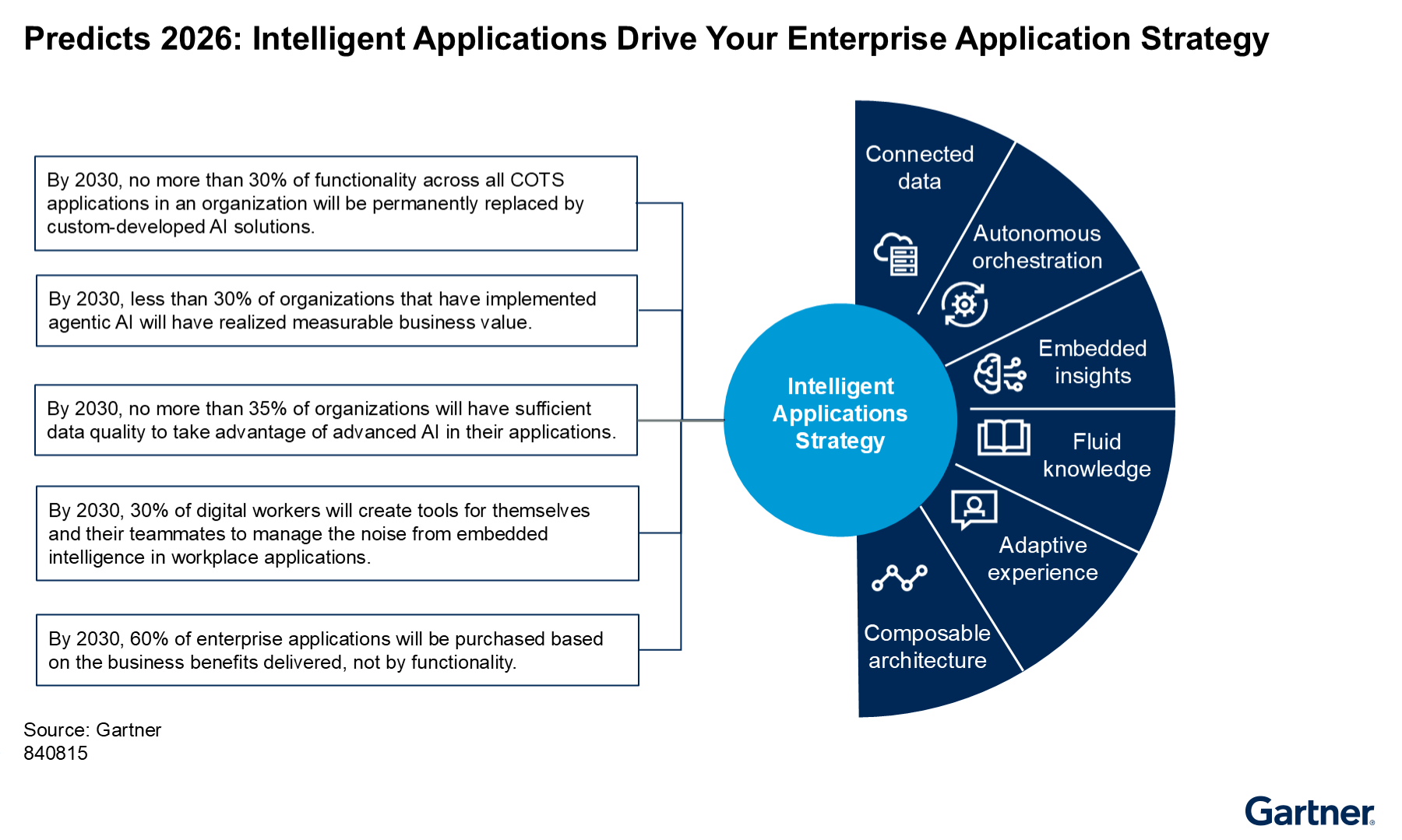
As with any emerging technology, hype often outpaces reality. To build better application roadmaps and manage stakeholders’ expectations effectively, enterprise application leaders should utilize the implications and recommendations from these five predictions to shape their application roadmaps (see Figure 1).
More Detail
Strategic Planning Assumption: By 2030, no more than 30% of functionality in enterprise COTS applications in an organization will be replaced by custom-developed AI solutions.
Analysis by: Tad Travis, Jason Wong
Key Findings:
- 46% of IT leader respondents agreed with the statement that AI agents will replace many commercial-off-the-shelf CRM, digital workplace, and ERP systems within two to four years.1
- This expectation is driven by a narrow focus on finding immediate cost reductions from application investments and a misunderstanding about the capabilities of AI agents from AI platforms.
- Returns on AI agents, to date, have been very variable; only 22% of application leaders indicate that AI tools had returned “significant value.”
- AI agents can be costly to run; consumption-based pricing makes it difficult to estimate costs.
- Integration standards for multiagent systems are still evolving.
Market Implications:
- Gartner believes that custom-developed AI agents will definitely have a role in your application strategy, but they will not replace “most” of your enterprise applications, nor the majority of your application functionality. Replace, in this context, means building and deploying AI agents on an AI agent platform that is separate from your COTS applications.
- Implementation and deployment of AI agents, to the extent implied by the survey results above, will be inhibited by hurdles such as technical debt, a lack of AI-ready data, competing AI technologies, and organizations’ own entropy.
- Enterprise applications will continue to be the primary technology for enabling business capabilities.
- Enterprise application vendors are adding AI capabilities at a rapid pace, which balances out some reasons for moving to custom-developed AI applications and custom multiagent systems.
Recommendation:
- Do not rush to implement custom-developed AI capabilities in your applications simply to find cost savings. AI agents are too unproven, and the ROI is too elusive, to make the case that custom-developed AI agents can replace large parts of your applications.
Strategic Planning Assumption: By 2030, 35% of organizations leveraging agentic AI in enterprise applications will have realized measurable business value.
Analysis by: Johan Jartelius
Key Findings:
- To date, based on a 2025 survey, only 22% of organizations report that generative AI (GenAI) tools return significant value to their organizations.1
- Many organizations prioritize adopting agentic AI in applications without having a clear understanding of how it aligns with and enhances their specific business goals and objectives.
- Most IT leaders (56%) strongly believe that IT cannot drive GenAI adoption on its own and requires significant business support.
- Gartner research reveals that organizations with high AI maturity have centralized their AI strategy, governance, application development, and data management practices.1
Market Implications:
- Agentic AI implementations will increasingly follow both traditional agile delivery and risk-mitigation practices.
- The dangers associated with AI systems operating independently necessitate the establishment of robust rules, thorough risk assessments, and clear behavior guidelines before deployment, thereby driving investment in innovative monitoring and control capabilities.
- However, agentic AI implementations in enterprise applications should not be tied to traditional ROI models. Organizations that insist on proven business cases will risk falling behind those that acknowledge that agentic AI is experimental and requires iteration to identify and realize value.
Recommendations:
- To achieve value with agentic AI in the near term, only deploy agentic AI that addresses use cases with a low business risk and high technical viability.
- To realize long-term value from AI investments in applications, implement new governance practices, aiming for mature objective alignment, AI DevOps, AI-ready data, and AI guardrails.
Strategic Planning Assumption: By 2030, 35% of large organizations will have improved the quality of the AI-ready data in their enterprise applications, up from 14% as of 2025.
Analysis by: Dixie John
Key Findings:
- The successful deployment of AI, as well as intelligent applications, depends on having AI-ready data.
- According to a 2025 survey, only 14% of application leaders are “very confident” that their data assets are suitably secured and governed to provide substantial value to both AI and human interactions.3
- Even though 77% of organizations plan to prioritize investment in AI-ready data, organizations struggle to realize the benefits of advanced AI capabilities due to foundational issues with poor data quality, inadequate risk controls, escalating costs or unclear business value.3
- In response to these gaps, several of the largest COTS vendors, notably Salesforce, Microsoft, and Oracle, have customer data platform (CDP) products that serve as the data lake of AI-ready data.
Market Implications:
- Organizations that invest in AI at scale need to evolve their data management practices and capabilities not only to preserve the evergreen classical ideas of data management but also to extend them to AI.
- Preparing application data to participate in advanced AI use cases will require consideration beyond traditional data management techniques. AI use cases may be interested in anomalies which, from a traditional data management approach, would normally be cleansed.
- Organizations will have to manage AI-ready data iteratively to cater to existing and upcoming business demands, ensure trust, avoid risk and compliance issues, preserve intellectual property, and reduce bias and hallucinations.
- Because AI capabilities are essential to vendors’ product roadmaps, expect vendors to offer CDP capabilities or partnerships with independent third-party CDP providers.
Recommendations:
- Assess COTS AI capabilities prioritizing data quality for embedded solutions; challenge data norms; and invest in tools for efficient AI data preparation and integration.
- Review AI data readiness by using a checklist (see AI-Ready Data Assessment Toolkit).
Strategic Planning Assumption: By 2030, 30% of digital workers will create tools for themselves and their teammates to manage the noise from fluid knowledge in workplace applications (see Quick Answer: Unlock Real AI Impact Through Fluid Knowledge).
Analysis by: Helen Poitevin
Key Findings:
- The mean number of applications used by digital workers (defined as employees who are required to use digital technology to perform their jobs) at work is nine. Surprisingly, 72% of those using 16 to 25 apps see themselves as more productive. Compared with others, those using 16 to 25 applications at work also have the greatest satisfaction with work applications.2
- Just over one-third of digital workers struggle to find the information they need to perform their job at least half the time,1 highlighting the need for more efficient information-retrieval systems.
- Due to technical debt, fragmentation of business application portfolios and limited data sharing across applications, much of the embedded intelligence will create more noise for users to process than actually help them to get things done.
- Many organizations face challenges with fragmented application portfolios, technical debt, and limited data sharing between apps. As a result, AI features embedded in individual applications may generate alerts, suggestions, or data that lack relevance or utility, making it harder for users to focus on what matters.
Market Implications:
- Embedded intelligence will help drive adaptive experiences within applications. However, these benefits are often limited to single apps, not extending across the entire suite of tools.
- To support effective cross-application workflows and access to information, AI insights need to be easily discoverable and usable in other applications. This includes using metadata and APIs to share information securely.
- The most successful solutions will allow users to set preferences and, where appropriate, use approved platforms to build simple automation or AI agents that can securely access and combine data from multiple applications. Users can then share their AI agents with peers to use.
Recommendation:
- Empower digital workers to create personalized application experiences that align with their unique workflows by providing them with the necessary technology, governance, training and support.
Strategic Planning Assumption: By 2030, 60% of enterprise applications will be selected based on alignment with business objectives, not by functionality.
Analysis by: Tad Travis
Key Findings:
- Gartner research (see How to Measure the Business Value of Enterprise Applications) reveals that the top reason that organizations purchase applications is to improve operational efficiencies. This objective is understandable, but it is also an indictment of the traditional process of application management.
- Applications are deployed to improve operational efficiencies because process execution is the most direct representation of how to achieve revenue growth, cost reduction, or regulatory compliance business objectives.
- CIOs regularly report to Gartner that their business partners cannot articulate the business impact nor align to business objectives associated with new application requests.
- The traditional path of delivering applications is as follows: define a business objective, model the processes that support the objective, implement an application, and then hope that the application improves the business objective.
- Organizations need a better way of selecting applications. They need assurance that new applications or new technical capabilities will improve business outcomes.
- Soon, organizations will select new applications, or rationalize and modernize applications, based on a new paradigm: define a business objective, determine the business outcome, and then select the application. The steps of process definition, modeling, and design are not needed. Applications with AI functionality will have native data fabric, embedded insights, and fluid knowledge capabilities.
- Organizations that have been using ERP or CRM applications for several years already have an acceptable level of structured data and unstructured data to use this new selection paradigm.
Market Implications:
- Because of the capabilities that underpin intelligent applications, particularly connected data and autonomous orchestration, organizations will have a better sense of what discrete process steps, actions, and decisions have the most impact on their business outcomes.
- This means that enterprise application leaders will have a richer set of master, transactional, and metadata about business process execution. They will also have better data to establish the correlation between process steps and business outcomes.
- GenAI, LLMs, and AI agents mean more scenario testing, and thus statistical validation of possible business outcomes, before selection and implementation start.
Recommendation:
- Stop evaluating and selecting applications based on functionality alone; pivot to assessing applications based on the ability to improve business outcomes. This can be accomplished in the evaluation phase by using a test set of historical data, in a pilot test, to determine if the AI capabilities in the proposed applications indicate an improvement in your business outcomes. As noted above, AI-ready data is important, but do not let low levels of AI-ready data be an inhibitor to starting to change how your organization selects enterprise applications.
A Look Back
In response to your requests, we are taking a look back at some key predictions from previous years. We have intentionally selected predictions from opposite ends of the scale — one where we were wholly or largely on target, as well as one we missed.
This report is too new to have on-target or missed predictions.
Acronym Key and Glossary Terms
| AI | Artificial intelligence |
| COTS | Commercial-off-the-shelf applications |
| CRM | Customer relationship management |
| ERP | Enterprise resource planning |
| LLM | Large language model |
1 2025 Gartner Generative and Agentic AI in Enterprise Applications Survey. This study was conducted to understand the key challenges and opportunities when deploying GenAI tools, and where organizations should focus their AI investments. This research also aims to understand what stage organizations are at on their AI agent journey and their thoughts on AI agents. The research was conducted online from May through June 2025 among 360 respondents from organizations with at least 250 full-time employees across all industries (except IT software) in North America (n = 149), Europe (n = 140) and Asia/Pacific (n = 71). Soft quotas were established for the country, company size, and respondent’s function type and job level to ensure a good representation across the sample. In less than one year, organizations were required to have deployed or plan to deploy at least one GenAI tool in at least one core enterprise application domain: digital workplace applications, CRM applications, or ERP applications. Respondents were team leaders or above, excluding C-level, and involved in the rollout of GenAI tools; they were required to have certain responsibilities regarding these GenAI tools. Disclaimer: The results of this survey do not represent global findings or the market as a whole, but reflect the sentiments of the respondents and companies surveyed.
2 2024 Gartner Digital Worker Survey. This survey sought to understand workers’ technological and workplace experience and sentiments. The research was conducted online from April through July 2024 among 5,141 respondents, who were from the U.S. (n = 1,121), Australia (n = 1,086), India (n = 996), the U.K. (n = 973) and China (n = 965). Participants were screened for full-time employment in organizations with 100 or more employees and were required to use digital technology for work purposes. Ages ranged from 18 through 74 years old, with quotas and weighting applied for age, gender, region and income, so that results were representative of countries’ working populations. We defined “digital technology” as including any combination of technological devices (such as laptops, smartphones and tablets), applications, and web services that people use for communication, information or productivity. Disclaimer: The results of this survey do not represent global findings or the market as a whole, but reflect the sentiments of the respondents and companies surveyed.
3 2024 Gartner Evolution of Data Management Survey. This survey was conducted to establish the characteristics of a successful data management function and understand the future operating model, architecture and investment areas of data management teams. It also sought to identify what makes data management leaders successful in delivering data to business domains, meeting their SLAs and being able to defend their position by showcasing value. The research was conducted online from August through September 2024 among 248 respondents from across the world. Respondents were required to have involvement in, knowledge of and responsibility for implementing the data management side of the D&A strategy at their organizations. Disclaimer: The results of this survey do not represent global findings or the market as a whole but reflect the sentiments of the respondents and companies surveyed.