Emerging Tech: The Future of Exposure Management Will Be Preemptive — Driven by Autonomous Interdiction
13 February 2026 - ID G00845340 - 13 min read
By Elizabeth Kim, Luis Castillo, and 2 more
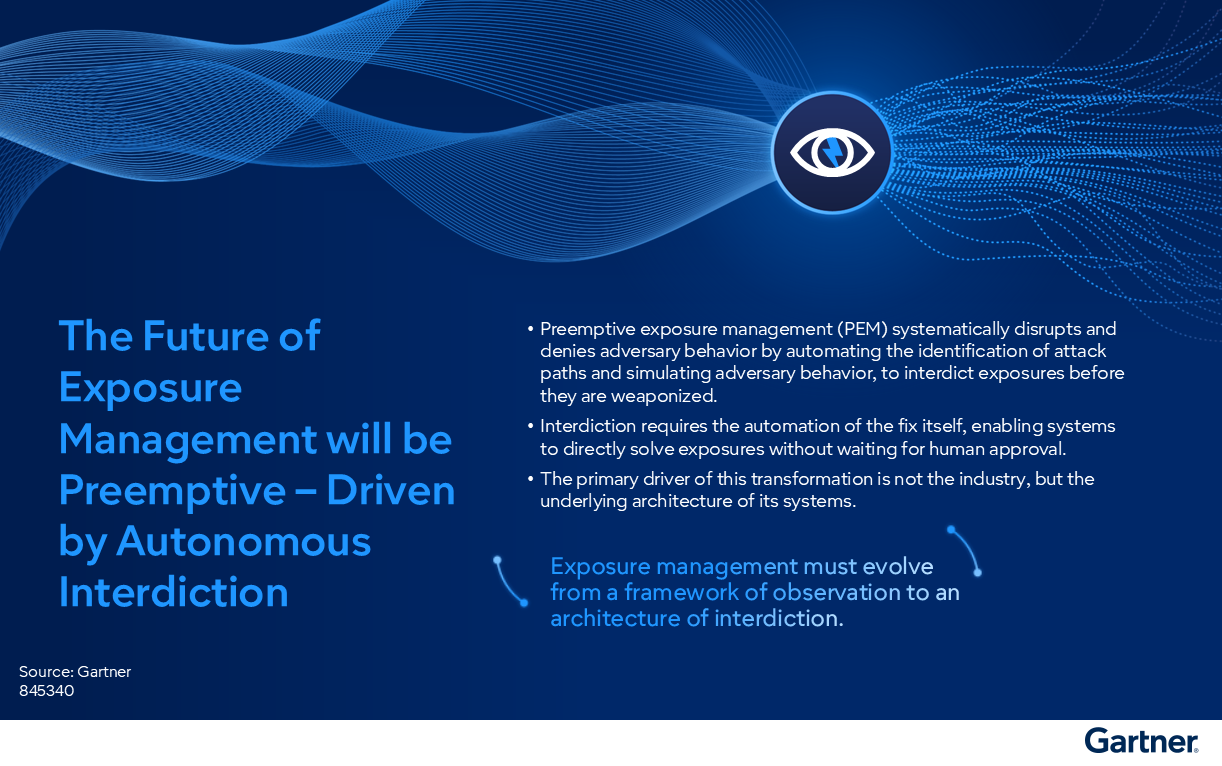
In an age of AI-driven, subsecond exploitation, simply “managing” your exposure will become nothing more than documenting your own eventual breach. Exposure management must evolve from a framework of observation to an architecture of interdiction. For product and innovation leaders, the mandate is clear: Stop building “dashboards of despair” that only report on decay and start engineering autonomous engines of defiance.
Overview
Opportunities
- C-level executives must decide when and how they will adopt more preemptive approaches to exposure management to stay ahead of emerging AI-enabled cyberthreats.
- The shift toward preemptive cybersecurity emphasizes acting before an attack occurs and seeks to eliminate the possibility of attacks altogether, aiming for a state where threats are neutralized before they can manifest.
- Preemptive exposure management (PEM) demands progressive techniques to accelerate tasks from continuous discovery of attack surfaces and exposures to validating exposures with high accuracy by leveraging intelligent simulations combined with predictive threat intelligence, AI and analytics to accelerate mitigation actions and interdict attacks before they begin.
- Preemptive exposure management cannot be fully achieved without autonomous interdiction. The expanded scope of exposures facing organizations and the pace at which AI-enabled threat actors can exploit them make it unrealistic to rely solely on human-led remediation and mitigation.
Recommendations
- Shift toward a unified exposure management platform to enable end-to-end automated exposure management and to execute automated mitigation and remediation outcomes.
- Incorporate agentic AI to autonomously execute containment. Examples include isolating hosts, disabling unnecessary ports and services, restricting or removing unused access and software, revoking credentials, terminating sessions, and rolling out configuration changes when systems are found to be outdated, unsecured or exploitable.
- Build user trust in automated mitigation and remediation by embedding the ability to preview the impact of automated changes, in the first phase of deployment. Additionally, by allowing organizations to run remediation as a semi-automated state in the interim can assist with easing organizations into fully automated remediation.
- Establish transparency in agentic remediation by making agentic inference steps easy to view and summarize, which makes it easy to understand the justifications that led to agentic remediation. Additionally, make human-in-the-loop options easy to enable and disable at any point in the remediation process.
- Develop services that focus on implementing successful automated mitigation and remediation outcomes for organizations. Assist organizations in defining suitable candidates for automation such as more straightforward and low-risk issues. Leverage historical data to identify which types of automated remediations were successful to inform decision making.
Strategic Planning Assumptions
By 2029, 60% of unified exposure management solutions will incorporate domain-specialized automated mitigation, remediation and threat containment capabilities to interdict threats before they can manifest.
By 2028, AI agents and assistants will remediate 70% of software code vulnerabilities, up from 10% in 2025, by either updating dependencies or suggesting code fixes.
Analysis
Figure 1 shows emerging technology top disruptors.
Technology Definition (Required)
Preemptive exposure management (PEM) pushes the boundary beyond traditional exposure management (EM) with AI-driven technology to accelerate steps across the life cycle of exposures from discovery to mobilization with high accuracy and greater automation — the shift from human-in-the-loop to human-on-the-loop exposure management. PEM systematically disrupts and denies adversary behavior by automating the identification of attack paths and simulating adversary behavior to close exposures before they are weaponized.
Sample vendors: Backline, Bitdefender, Breeze Security, Check Point, CrowdStrike, CyberMindr, Darktrace, Nagomi, Reach Security, Reclaim Security, Skyhawk Security, Trend Micro, Tuskira, Vicarius, Zafran, Zest Security
- Aggressive, proactive, AI-driven exposure management is foundational to an overall preemptive cybersecurity strategy, which is about acting before an attack occurs by denying cyber-adversaries the opportunity to identify and target assets. To support preemptive cybersecurity, exposure management needs to be automated across all processes — discovery, assessment, prioritization, validation, remediation and mitigation.
- Greater autonomy across exposure management is the only way to keep pace at the rate at which vulnerabilities are created, detected and exploited across the ever-expanding attack surface. With the autonomy to plan and execute necessary countermeasures, including containment, mitigation and resolution, PEM operates at machine speed and scale, outpacing attackers and neutralizing threats without the need for human input and before human responders could even react.
- Preemptive exposure management requires remediation that goes beyond simply automating manual workflows or handling repetitive, low-complexity tasks. True automated remediation is the automation of the fix itself, enabling systems to directly solve exposures without waiting for human approval. As this capability evolves toward autonomous remediation, it will transform how security organizations respond to threat exposures, allowing for faster, more adaptive, and self-directed actions. AI including agentic AI and intelligent simulation will be foundational to this technology evolution.
Autonomous remediation is a fundamental shift in how organizations manage risk. The primary driver of this transformation is not the industry, but the underlying architecture of its systems; it is an operational philosophy shift where the distinction between stateless and stateful architectures serves as the leading indicator of system fragility.
In stateless environments, such as those found in AdTech and MarTech, every request is an independent transaction. These are “Cattle” systems: disposable, autonomous, and easily restored from a “Golden Image.” In these sectors, adoption speed is higher because the mathematical cost of failure is low; AI agents can fail safely as the system is killed and reset with zero data loss. When combined with high-availability architectures, this “remediate via redeploy” strategy eliminates manual intervention, collapsing patch cycles from 55-94 days to as low as 6-13 days.1
The majority of highly regulated industries possess sophisticated security detection tools and have stateful architectures that are unique and tightly coupled to their data: “pets.” A single incorrect remediation by an autonomous agent can trigger a loss of coherence requiring considerable manual reconciliation. Highly regulated industries are overcoming the risk of “fast mistake” by adopting a “bridge strategy” that decouples stateful data from application logic.
Banking and Financial Services (the Stateful Challenge)
The banking and securities sector represents the most “important” disruption because it illustrates how autonomous remediation must evolve to handle high fragility and strict regulatory mandates. Banks have historically led the way in security maturity, yet they are the most “paralyzed” by the persistence of state. For a bank, the “state” is the ledger; any automated action that corrupts this ledger is a catastrophic failure.
Banks are adopting tiered autonomy and logic-gate frameworks, based on Gartner’s AI TRiSM principles. Before any patch, agents cross-check plans against a golden knowledge base for reliability, explainability, and privacy. Autonomy is governed by a business impact score (BIS): high-risk patches trigger human-in-the-loop oversight, while low-risk, stateless fixes remain automated.
The disruption is shifting banking from using AI for detection to resilient, stateless architectures. Banks are refactoring front-end services into microservices to enable safe automation, while tightly gating the ledger layer. By treating every transaction as an immutable log event, banks can safely kill and recreate servers, restoring state by replaying the log. “Shadow mode remediation” with digital twins lets autonomous agents test and fix issues in a mirrored environment before touching production ledgers.
Healthcare
Patient data systems are highly stateful and tightly regulated. Electronic healthcare record (EHR) systems demand constant uptime, making “remediate via redeploy” strategies risky as they can disconnect clinicians or corrupt files midupload. To solve this, healthcare organizations use a dual isolation approach that separates security from core clinical data at both the application and data layers.
At the application layer, sidecar security architectures2 within a service mesh deploy autonomous security agents in isolated containers. This lets security components be patched or restarted independently, never touching the main EHR logic. Database virtualization with “thin clones” allows testing patches on real-time data copies, ensuring no corruption and uninterrupted clinical workflows.
At the data layer, database virtualization protects transactional integrity. Virtualized instances mirror production, letting IT safely validate patches without risking schema drift or live record corruption. This move toward immutable, autonomous remediation helps organizations meet regulatory demands and strengthen risk management.
Wider Highly Regulated Industries
This approach applies to manufacturing and utilities, where balancing stability with rapid patching is a constant challenge. Success demands deep technical expertise and a cultural shift, transforming fragile, stateful “pets” into resilient, autonomous systems. As these industries move toward 2030, the adoption of workspace immutable secure endpoints (WISE) will become the standard for infrastructure security. By enforcing immutable baselines and baseline reversion, organizations shift from reactive patching to preemptive immutability, a move projected to reduce ransomware incidents by 70% and incident response times by at least 40% (see When to Use a Service Mesh in Cloud-Native Architectures).
The move from traditional vulnerability management to preemptive exposure management has been accelerated by both technical innovation and shifting global requirements. This evolution, fueled by advances in AI and unified standards, is expected to lead to the emergence of an autonomous cyber immune system (ACIS) within the next 15 years. The path to autonomy will progress through three phases, each building on greater automation and cross-domain coordination.
Now (0-1 Years): Automated Remediation Workflow Orchestration
Currently, automation in exposure management remediation is primarily focused on streamlining workflow orchestration. AI-powered tools are being used to automatically generate and assign remediation tasks, enrich tickets with relevant context, and track progress through integrated ticketing systems. Early-stage AI agents validate closure and escalate overdue actions, which helps ensure accountability and efficiency. While today’s solutions concentrate on automating task management and oversight, new goal-driven AI capabilities are beginning to coordinate multistep remediation efforts across teams, paving the way for more autonomous and comprehensive mobilization in the future.
The Near-Term Horizon (1-3 Years): The Agentic Breakthrough
In the first phase of autonomous remediation, organizations will move beyond basic workflow automation to adopt active, AI-driven security actions. Industry leaders are identifying 2026 as a pivotal year, with CISOs prioritizing pilot projects for agentic remediation. By the end of 2026, it is expected that 40% of enterprise applications will include AI agents capable of independently assessing vulnerabilities and initiating mitigating responses. Forward-thinking companies are already leveraging the model context protocol (MCP), allowing agents to analyze security findings and automatically implement fixes, reducing response times from days to seconds.
This advancement is also changing how success is measured. Instead of focusing on “time to patch,” organizations are adopting “mean time to neutralize” (MTTN) as the new standard. MTTN is a better metric because it captures the total time to actually mitigate risk, whether through patching, configuration changes, or compensating controls, rather than just the time to deploy a patch. With autonomous systems, the mitigation cycle is being reduced from hours to milliseconds, significantly increasing the speed and effectiveness of enterprise security operations.
The Medium-Term Transition (3-8 Years): Collaborative, Domain-Specialized Ecosystems
During this phase, the market will shift toward domain-specialized autonomous remediation, with capabilities delivered through highly tailored models. The rise of domain-specific language models (DSLMs), trained on technical, security, and regulatory data unique to environments or asset scopes such as industrial control systems (ICSs), medical IoT, and cloud-native pipelines, will enable autonomous agents to operate with precision within their domains. These DSLMs ensure that remediation actions are both compliant and safe for specialized operational contexts.
As the timeline progresses, these capabilities will evolve into collaborative multiagent generative systems (MAGS) that provide broader coverage across the entire attack surface. Organizations will deploy networks of specialized agents, such as those dedicated to discovery, analysis, and validation, that work together to manage complex remediation tasks end-to-end. This includes planning, performing impact analysis, executing necessary changes, and validating successful outcomes. The collaborative ecosystem will support agent-to-agent (A2A) negotiation and interoperability, enabling security preemption to scale across diverse applications and data environments without manual intervention.
The Long-Term Future (8+ Years): The Multidomain Immune Era
After 2035, autonomous remediation will reach its full potential with the development of autonomous cyber immune systems (ACIS). These advanced, decentralized systems will act independently to protect the entire global attack surface grid, detecting, responding to, and adapting against threats in real time and at any scale.
Future security architectures will be designed for operational agility, aligning with military strategies to autonomously choose and apply the best solutions for new challenges. This will enable self-healing networks that anticipate and counter adversarial actions across air, space, and cyberspace. Central to this era is cross-domain reasoning: AI agents will leverage a “cyber mesh” architecture to analyze and respond across different environments, for example, identifying a breach in IT and automatically isolating affected cyber physical system (CPS) assets. This integrated, proactive approach will set a new standard for cybersecurity resilience.
The Shift Toward Unified Exposure Management Platforms Will Accelerate as It Becomes the De Facto Architectural Foundation for AI-Driven Exposure Management
In enabling the level of automation in exposure management, there will be a preference toward a platform approach. The platform will enable better end-to-end orchestration across exposure management processes from discovery exposures, prioritization of the exposure, validation of the exploitability, assessment of impact, and the determination of the best path for resolution, to automate the mitigation or remediation of exposures. This will inevitably lead to more acquisition of niche vendors within exposure management and the obsolescence of the stand-alone consumption of technologies such as external attack surface management (EASM), cyber asset attack surface management (CAASM) and automated security control assessment (ASCA). The two main technology platforms supporting exposure management, exposure assessment platforms (EAPs) and adversarial exposure validation (AEV) platforms are adding robust support for mitigation and remediation workflow orchestration and automation natively or through acquisitions to drive better actionability and differentiate themselves from their competitors.
AI Including Agentic AI and Intelligent Simulation Will Be Critical to the Advancement of PEM
To reach the point at which end-to-end automation of the exposure management process is feasible will depend on AI. To enable PEM, technologies must deliver on these capabilities:
- Leverage AI to automate the discovery, aggregation, normalization, categorization, and risk-based prioritization of vulnerabilities and exposures across a broad, multidomain attack surface.
- Autonomously simulate real-world attacker techniques to validate the existence and exploitability of exposures, including automated penetration testing, red teaming, and breach and attack simulation. This can include the use of agentic AI, intelligent simulation, and/or digital twins to model and predict the likelihood of exposure exploitation, given current technical conditions, asset configurations, and threat intelligence with high level of accuracy and scale.
- Integrate assessment, validation, and mobilization action to provide a single, closed-loop system for managing exposure risk across a broad, multidomain attack surface.
- Orchestrate mobilization by automating the workflow and driving accountability for eliminating or mitigating the impact of vulnerabilities and exposures across an organization.
- Automatically mitigate and remediate exposures in real time, reducing attackable assets, entry points, and vulnerabilities through self-healing, configuration changes, and orchestration. This can involve simulating multiple remediation and mitigation options to find an optimal resolution path in a safe digital twin environment prior to rolling it out in the production environment.
Transition From Human-in-the-Loop to Human-on-the-Loop Will Require Cultural Change That Security Service Providers Can Assist With
PEM will not necessarily displace security staff, but it will transform their roles and responsibility in exposure management to more of an oversight role than hands-on execution of tasks including the mitigation and remediation. This will require a significant cultural shift for security teams, especially with regard to the automation of remediation. AI-driven mitigation and remediation, particularly for complex issues. often face internal resistance as organizations fear that automated changes might cause downtime or revenue loss. Coupled with the lack of trust in AI among security teams originating from the overpromise and past hype around AI will mean that PEM faces more cultural challenges than a technical one.
There is an opportunity for security service providers to help organizations through this transition and implementation of PEM. For example, advisory support in areas such as:
- Defining RACI and aligning priorities across security, IT and DevOps.
- Assessing the exposure management processes maturity for PEM.
- Ensuring the data quality and integration readiness for PEM especially as the effectiveness of autonomous systems depends on high-quality data from systems such as CMDBs and scanners.
- Identifying and defining the types of remediations that are ideal for automation and a roadmap to scale out the automation use case.
- Translating technical exposure risk into business-aligned language, metrics, and decision frameworks to guide prioritization and PEM value — helping bridge the gap between technical teams and business leaders.