Predicts 2026: AI Sovereignty
16 October 2025 - ID G00841603 - 10 min read
By Gaurav Gupta, Katja Ruud, and 2 more
Achieving AI sovereignty requires decision-making authority across the entire AI stack with geographical constraints. Regulatory compliance leads to increased operational costs and challenges in interoperability. CIOs and other innovation leaders must embrace geospecific datasets and open-source models.
Overview
Key Findings
- CIOs will lead several key strategic areas in contributing to AI sovereignty, including architectural and infrastructure control, GRC (governance, risk, and compliance) leadership, and data management and security.
- Regulatory pressure, nation-state competitive ambition, geopolitical tensions, and national security concerns are driving governments to accelerate investments in sovereign AI — ensuring they can develop and control AI systems independently, without reliance on foreign platforms or providers.
- Region-specific AI platforms are becoming part of the strategic national infrastructure. Governments would pressure major cloud providers to regionalize their platforms through partnerships with local players for alignment with regulatory priorities and national interests.
- Concerns over reliance on privately owned infrastructure, like guaranteed Internet access, are increasing in the uncertain geopolitical environment, raising alarms in regions like Europe about the dominance of U.S. and Chinese projects such as Starlink, Kuiper, Tiantong, and Hongyun.
Recommendations
- Provide competitive, independently-controlled advantage by guaranteeing AI initiatives match organizational goals and local values, and simultaneously lead efforts to develop a domestic talent pool for managing sovereign AI systems.
- Adopt a sovereign-by-design architecture with AI observability by mapping workloads to jurisdictions and using enhanced and controlled routing protocols for APIs and models.
- Implement model-agnostic workflows using open standards and orchestration layers by leveraging abstraction, routing, and standardized prompt templates to enable regional LLM switching, reduce vendor dependence, and ensure local compliance.
- Secure and modernize communications infrastructure by prioritizing public investment and ownership — individually or via regional consortia — to guarantee national security, resilience, and access.
Strategic Planning Assumption(s)
By 2027, 35% of countries will be locked into region-specific AI platforms using proprietary contextual data.
By 2029, nations establishing a sovereign AI stack will need to spend at least 1% of their GDP on AI infrastructure.
By 2030, concerns over private satellite networks will drive at least three government-backed satellite Internet services for national access.
Analysis
What You Need to Know
AI sovereignty refers to the ability of a nation or organization to independently control how artificial intelligence (AI) is developed, deployed, and used related to its geographical boundaries (see Figure 1). AI sovereignty has moved from policy papers to reality because of regulations, geopolitics, cloud localization, national AI missions, and corporate risks. AI sovereignty will create regional blocks and a fragmented AI race, moving away from the U.S.-China-centric tussle.
A fear of falling behind in the technological AI race will push nations and companies to innovate rapidly and invest in an attempt to achieve self-sufficiency in all aspects of the AI stack, potentially leading to reduced levels of cooperation and maybe even isolation. For the current AI model landscape and cloud, there will be a surge in regional open-source LLMs as alternatives to U.S. closed models, while evolving sovereign stacks will struggle to interoperate through free-flowing global clouds. Workloads will migrate to sovereign regions or on-premises. Operating expenses will rise to meet sovereignty controls and compliance as adopters will avoid regulatory fines.
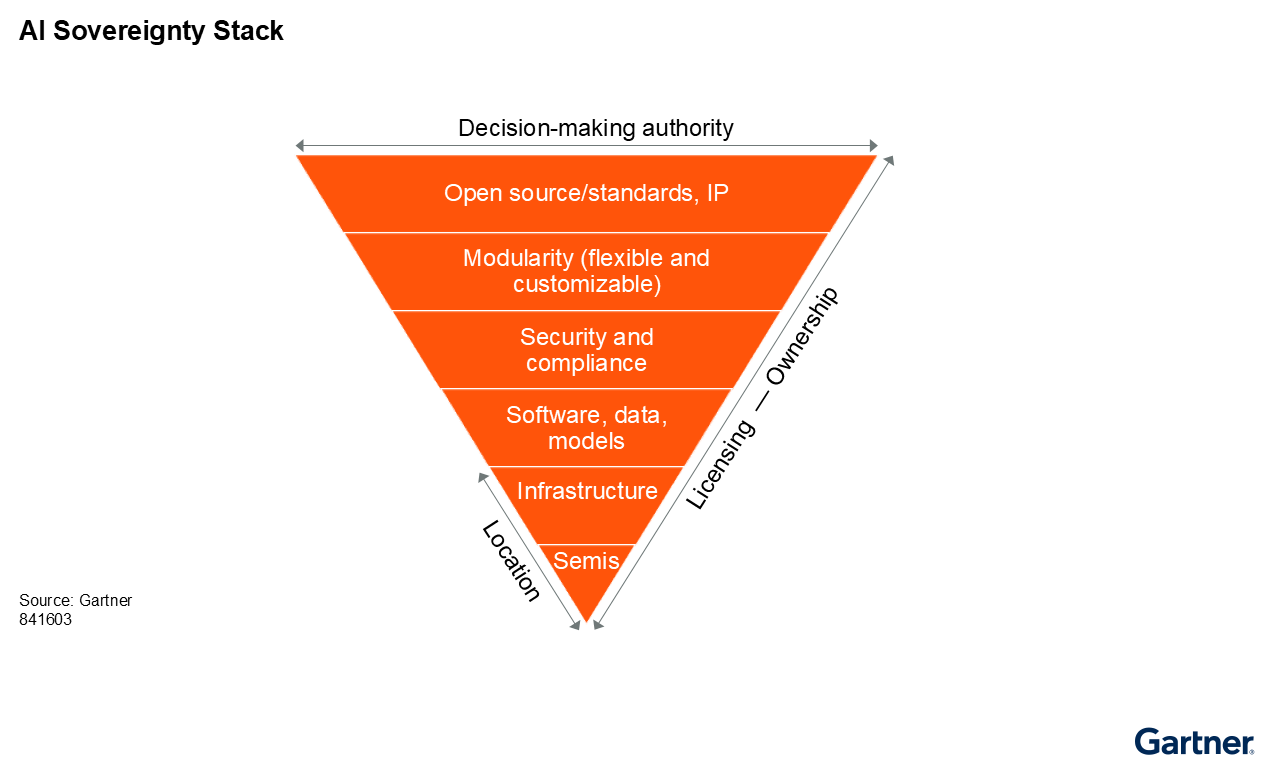
Strategic Planning Assumptions
Strategic Planning Assumption: By 2027, 35% of countries will be locked into region-specific AI platforms using proprietary contextual data.
Analysis by: Mukul Saha and Ran Xu
Key Findings:
- Region-specific AI platforms are becoming part of the strategic national infrastructure. Countries with digital sovereignty goals are increasing investment in domestic AI stacks, including computing, data centers, infrastructure and domestically aligned models that abide by local laws, culture, and region.
- Platform lock-in will rise from 5% to 35% by 2027. Governments will pressure major cloud providers to regionalize their platforms through partnerships with local players to align with regulatory priorities and national interests.
- Localized models deliver up to 30 percent more contextual value: Regional LLMs outperform global models in applications such as education, legal compliance, and public services, especially in non-English languages.
- Geopolitical competition and national security are fragmenting the global AI landscape. The United States, China, and a coalition of European countries are advancing three distinct AI ecosystems. Several nations in the Global South are becoming contested zones of influence.
- Trust and cultural fit are emerging as key criteria. Decision makers are prioritizing AI platforms that align with local values, regulatory frameworks, and user expectations over those with the largest training datasets.
Market Implications:
Developers, start-ups, and system integrators will increasingly choose dominant regional AI platforms, driving divergent standards for training, deployment and optimization. The AI landscape will fragment as technical and geopolitical factors force organizations to localize solutions, responding to strict regulations, linguistic diversity, and cultural alignment.
Multinational companies will face complex challenges deploying uniform AI across global markets and will have to manage multiple platform partnerships, each with unique compliance and data governance demands. Buyers will prioritize regional platforms that offer strong performance and local compliance, while vendors will forge alliances with sovereign cloud providers and open-source models to remain competitive.
Global model vendors must prove their contextual value or risk losing market share, especially in regulated or culturally sensitive sectors. Emerging markets in Africa, Southeast Asia, and Latin America will be key battlegrounds, as major platforms compete for influence. As talent and innovation cluster around regional leaders, the global AI ecosystem will be transformed into a mix of distinct regional standards and strategies
Recommendations:
- Design model agnostic workflows using orchestration layers that enable switching between LLMs across regions. Use abstraction, routing, and standardized prompt templates to reduce vendor dependence and adapt to local compliance.
- Ensure your AI governance, data residency, and model tuning practices can meet country-specific legal, cultural, and linguistic requirements.
- Establish relationships with national cloud providers, regional LLM vendors, and sovereign AI stack leaders in priority markets such as the U.S., China, India, the UAE and the EU, and build a vetted list of partners.
- Monitor AI legislation, data sovereignty rules, and emerging standards that may affect where and how you can deploy AI models and process users data.
Related Research:
Strategic Planning Assumption: By 2029, nations establishing a sovereign AI stack will need to spend at least 1% of their GDP on AI infrastructure.
Analysis by: Gaurav Gupta
Key Findings:
- Regulatory pressure, competitive ambition, geopolitical tensions, and national security concerns are driving governments to accelerate investments in sovereign AI — ensuring they can develop and control AI systems independently, without reliance on foreign platforms or providers.
- Non-Western customers will change alignment due to concerns of overly Western influence. AI sovereignty will lead to reduced collaboration and duplication of effort.
- Data center/AI factory infrastructure, which is the critical backbone of the AI stack in enabling sovereignty, will see an aggressive roadmap and investment, propelling a few companies that control that stack to achieve double-digit trillion dollar valuations.
Market Implications:
- Ecosystem growth pressure: Explosive AI data center investments mandate massive energy and power demand to propel other supporting industries. Additionally, power requirements would lead to higher energy prices that would have a broader impact.
- Infrastructure overcapacity: Exploding data center build-up is based on long-term anticipated demand, a pursuit driven by myth or fear of AI sovereignty.
- Market hype: Companies will push to sell their solutions for the AI stack to enable AI sovereignty and find new frontiers where entities are ready to invest.
- Talent: Governments will prioritize building out domestic skill and expertise in AI to support the secure deployment of local AI that adheres to national laws and policies.
- Unicorn start-ups: The pursuit of developing national AI capabilities would create a dynamic ecosystem of AI start-ups across various fields, with several achieving Unicorn status, fueling a “virtuous cycle” of growth and investment.
- Financing: While direct government funding might fuel initial establishments, with high stakes, private-public partnerships will become key. State-owned initiatives to stifle innovation and potential corruption, leading to capital wastage, are also possible.
Recommendations:
- Engage early with regulators by scheduling joint workshops with legal and risk to test AI product road maps, as sovereign AI requirements will evolve frequently.
- Implement layered AI TRiSM (Trust, Risk, and Security Management) to enforce governance policies across all AI use cases and ensure compliance with evolving AI regulations.
- Adopt a sovereign-by-design architecture with AI observability by mapping workloads to jurisdictions and using enhanced/controlled routing protocols for APIs and models. Test AI solutions for regional positive and negative regional biases.
- Restrict stack choices to portable and open models to reduce lock-in risk and facilitate compliance audits, while continuing to adopt evolving methodologies, such as model compression and sparse techniques.
Related Research:
Strategic Planning Assumption: By 2030, concerns over private satellite networks will drive at least three government-backed satellite Internet services for national access.
Analysis by: Katja Ruud
Key Findings:
- In an uncertain geopolitical environment, the public and private sectors are developing growing concerns about data sovereignty, infrastructure resilience, and reliance on privately owned infrastructure, including ensured internet access.
- Concerns over U.S. and Chinese dominance through SpaceX’s Starlink and Amazon’s Kuiper constellation, and the Tiantong and Hongyun projects, have raised concerns in Europe.
- To mitigate the risk of internet access being disrupted or intentionally withdrawn, nations choose to actively make direct investments in the provision of satellite internet access for their citizens, businesses, and militaries.
- Finance options for a public investment include revising the nation’s fiscal policies, which would likely increase taxes, and redirecting planned spending. However, the necessary cost is deemed to be less than the risk of reliance on private alternatives.
- That publicly backed infrastructure will (once again) become the guarantor for infrastructure such as communication services will require a significant shift in mindsets that have long been encouraged to endorse private ownership over public alternatives.
Market Implications:
- Satellite ecosystems are beginning to split along geopolitical lines, with supply chains shifting toward onshore or allied-country manufacturing. These changes may lead to fragmented internet access, with users in different regions relying on separate satellite networks and standards.
- Government investments are boosting domestic satellite start-ups, while strategic consolidations and acquisitions are helping secure controlling stakes in key assets.
- Sovereign satellite integration and edge computing are enhancing secure, high-speed internet access.
- Tighter licensing, export controls, and data-localization rules are increasing compliance demands for satellite and internet providers. New standards for supply-chain transparency and potential cross-border data restrictions could fragment global connectivity.
These changes encourage satellite providers to adopt transparent governance and open standards, building trust and interoperability. A shift toward integrated space-security ecosystems blurs the line between defense and commerce, making internet access a strategic asset. Users may gain more secure connectivity but face limitations (such as service prioritization, censorship) shaped by geopolitical interests.
Recommendations:
Private Enterprises:
- Diversify connectivity and partnerships by adopting multivendor, multiorbit (LEO, MEO, GEO) satellite strategies and considering investments in sovereign or consortiumbased networks to reduce reliance on single providers and ensure service continuity.
- Enhance compliance, risk management, and resilience by preparing for stricter regulations — such as data localization and supply-chain transparency by investing in cybersecurity, antijamming, and encryption for all communications.
- Leverage dual use satellite service opportunities by exploring partnerships with public and defense sectors to unlock new revenue streams and further strengthen operational resilience.
Public Organizations and Defense
- Secure and modernize satellite and communications infrastructure by prioritizing public investment and ownership—individually or via regional consortia — to guarantee national security, resilience and access.
- Strengthen partnerships and regional cooperation by fostering regional dialogues to form allied satellite consortia, especially for smaller nations, and align standards, protocols, and security frameworks for interoperability and trusted vendor partnerships.
Related Research:
A Look Back
In response to your requests, we are taking a look back at some key predictions from previous years. We have intentionally selected predictions from opposite ends of the scale — one where we were wholly or largely on target, as well as one we missed.
This report is too new to have on-target or missed predictions.