Infographic: CIO’s Map to the Factory of the Future
25 March 2025 - ID G00826700 - 1 min read
By Sudip Pattanayak, Mike Ramsey, and 1 more
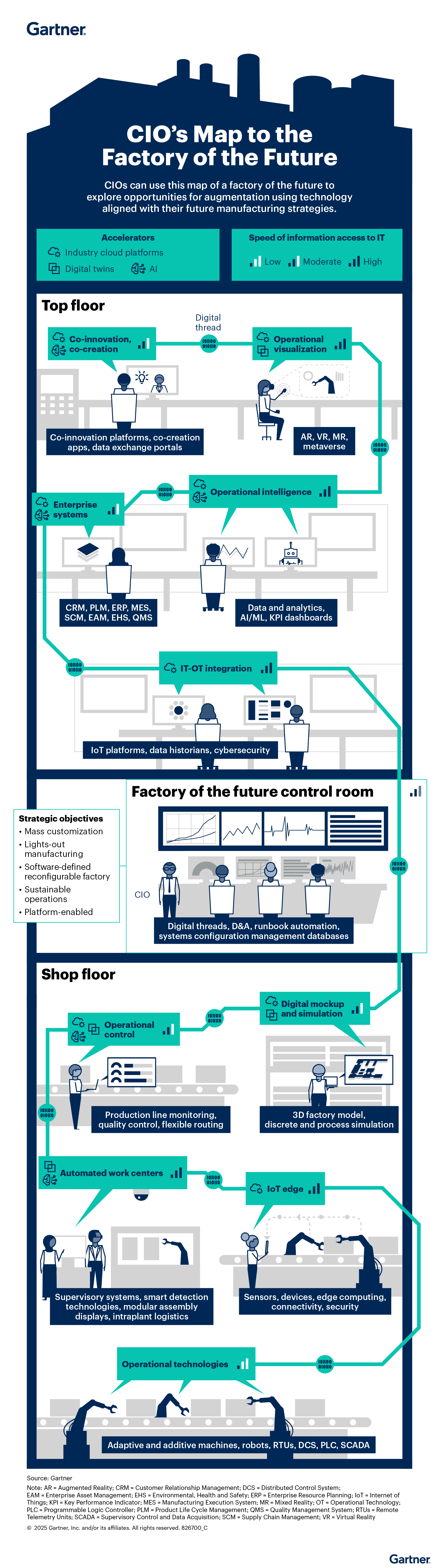
Technology and software assets are increasingly playing a crucial role in making manufacturers’ factories reliable, agile and sustainable. CIOs can use this research to augment a smart factory strategy by leveraging technology elements in accordance with their future manufacturing strategies.
Overview
Existing and newer technologies need to coexist to accelerate the vision of a factory of the future. CIOs are the enablers of digital technologies and must structure, invest and adopt them with respect to a digitally optimized factory model.
We’ve evolved this infographic from its previous version to place the control room in a central location. This is because shop floor data will increasingly go directly to the control room, enhancing communication speed and automation by leveraging edge computing and AI.
The essence of the infographic remains the same, whereby future factories will focus on mass customization and sustainability, and become more customer-centric through the use of advanced technologies and software. To achieve this, chief information officers (CIOs) and technology leaders need to create a clear vision and plan for the factory’s technology architecture. This involves standardizing technology, processes and data, and using tools like industry cloud platforms, digital threads, AI and digital twins.
The factory of the future will integrate technology across various layers to support a data-driven manufacturing strategy. Reference architectures can help speed up these initiatives. A central control room will manage and monitor all technology, improving visibility and efficiency. This setup will allow CIOs to automate network, security, data and service management, using IT services like DevOps, DataOps and SecOps to scale technology effectively.1
This infographic can guide investments in digital technologies across different layers of the factory. It doesn’t cover specific business cases or performance metrics but helps compare current factory setups to future visions.
This research is based on factory-of-the-future references from different industry standards such as Purdue University’s Purdue Model and Reference Architecture Model Industrie 4.0 (RAMI 4.0).
1 What Is Runbook Automation? PagerDuty.