Market Guide for IT Asset Disposition
24 February 2026 - ID G00842768 - 39 min read
By Rob Schafer, Christopher Dixon, and 1 more
The rapid adoption of AI-enabled ITAD holds great promise to alleviate ITAD’s ongoing costs and risks. Sourcing, procurement and vendor management leaders can leverage this market guide to navigate the ITAD market, assess AI’s benefits and potential risks and identify representative ITAD providers.
Overview
Key Findings
- The ITAD industry has not been immune to the increasing ubiquity of AI as an enabler of greater efficiency, accuracy and innovation, and as a growing competitive differentiator. While still in its early days, most ITAD vendors are developing an “AI-first” mentality, as they explore, develop, deploy and integrate AI-enabled functions across the end-to-end ITAD process.
- ITAD processes and service providers have gained CxO attention as sustainability and the reuse of IT assets and components helps mitigate Scope 3 emissions and attain sustainability/e-waste targets. Sustainability’s focus on reuse is extending the lives of IT assets, to the benefit of IT budgets and the environment.
- IT asset managers who manage ITAD continue to struggle with the two material ITAD risks to their brand: Lax data security (inadequate or inconsistent data sanitization of all data-bearing assets) and improper environmental recycling.
- Organizations struggle to find the optimal “make/buy” balance between which ITAD services are most efficiently handled internally and which are best executed by an external ITAD service provider.
Recommendations
As sourcing, procurement and vendor management (SPVM) leaders responsible for ITAD, you should:
- Incorporate into your ITAD RFI/RFP explicit questions on how your prospective ITAD supplier is leveraging the rapidly expanding capabilities of AI-enabled ITAD, and how those AI innovations will translate directly to minimizing your ITAD costs and risks.
- Collaborate with your infrastructure stakeholders — before choosing an ITAD service provider — to identify the ITAD processes and characteristics required for your specific business environment. Then, decide whether to “make” (i.e., develop in-house) or “buy” (i.e., engage an ITAD service provider) for each process/characteristic that you’ve identified.
- Engage with your business stakeholders and ITAD service provider(s) to leverage the superior environmental sustainability (and budget) characteristics of asset reuse as your primary disposition process.
- Focus your ITAD process not only on direct cost, but also on the dual and material risks to your brand equity of improper ITAD-related data security and recycling.
Market Definition
Gartner defines the IT asset disposition (ITAD) market with three service categories: core disposition services, secondary hardware services and ancillary life cycle services. Core disposition services are essential to ITAD processes and evaluated on a make-or-buy scale. Secondary hardware services involve acquiring used equipment from ITAD providers. Ancillary life cycle services, such as software harvesting and redeployment, are offered by full-service ITAD providers. ITAD is crucial for IT sustainability, mitigating Scope 3 emissions and supporting the circular economy.
ITAD’s primary objective is to minimize the dual material business risks to your brand: data sanitization (wiping or physical destruction of all data-bearing assets) and environmentally sound reuse or recycling of the asset. The former should be executed according to the NIST 800-88 standard by a NAID AAA-certified ITAD service provider. The latter should ideally be done within the ITAD service provider’s facility that is certified to either the R2 (SERI) or e-Stewards standard.
ITAD is increasingly focused on the environmental sustainability benefits of extending the life cycle of technology assets to reduce greenhouse gas (GHG) emissions and e-waste. Organizations are prioritizing asset reuse over recycling, with refurbished devices performing comparably to new ones in typical work settings. Sustainable ITAD practices represent an opportunity to maximize the useful life of technology through a second or, potentially, a third deployment of the same asset.
Those responsible for ITAD are now key players in reducing GHG emissions and e-waste. Reuse and recycling differ in their ability to limit GHG emissions. Recycling provides only nominal GHG offsets, whereas asset reuse can significantly reduce GHG emissions compared to recycling.
Focusing on upgrading and refurbishing assets through cosmetic restoration and parts replacement ensures that the system retains its integrity, making them look and function nearly as well as a new asset. As a result, many organizations are now rethinking the traditional stigma associated with using refurbished devices.
Mandatory Features
IT leaders developing their ITAD strategies must assess whether they have the right processes and services to support their specific environments, budgets and risk appetites. The primary priority is to minimize risks to your brand, specifically from poor data security and environmentally harmful recycling.
The mandatory functionality that every provider in this market must address includes:
- Transportation logistics/chain of custody: This means managing transportation logistics from the customer’s site to the provider’s processing facility. While large organizations may prefer using their own logistics network, this remains a mandatory offering for ITAD service providers.
- Data sanitization: This involves data sanitization and actual hard-drive destruction/shredding. This should be executed according to the NIST 800-88 standard by a NAID AAA-certified ITAD service provider.
- Recycling and component recovery: This includes reclaiming of any serviceable components and recycling raw materials from the asset in compliance with local and national regulations. This should be done within the ITAD service provider’s facility that is certified to either the R2 (SERI) or e-Stewards standard.
- Remarketing/resale: IT leaders with ITAD responsibilities should ensure that the ITAD service provider separates and clearly delineates services fees from resale proceeds. A transparent consignment model charges the customer an explicit refurbishment fee, and revenue from each item sold is shared at the contractual reimbursement percentage of the gross sales price.
Market Description
ITAD service providers have become an important link in the overall technology life cycle management of IT equipment. As depicted in Figure 1, it is important to put the ITAD process in the context of the end-to-end technology life cycle. Without a thorough, detailed, end-to-end process that is consistently executed throughout your enterprise, ITAD too often becomes an afterthought that carries significant risks.
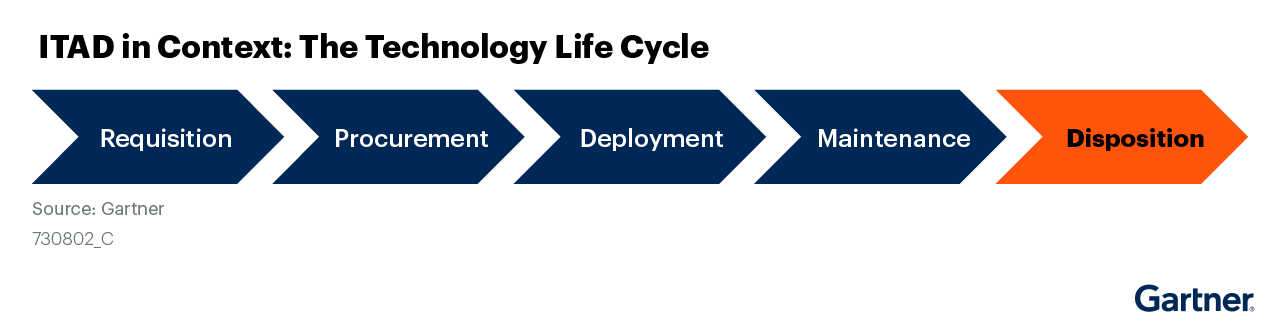
This market guide is designed to help IT leaders who are developing their ITAD strategies assess whether they have the right processes and services to support their specific environments, budgets and risk appetites.1 When using this market guide to evaluate the ITAD market, your bottom-line priority must always be to minimize risks to your business. Specifically, the two paramount risks are:
- Poor data security (i.e., improperly sanitized drives)
- Environmentally harmful recycling
Market Direction
AI-Enabled ITAD: Just the Beginning …
The ITAD industry has not been immune to the increasing presence of AI as an intended enabler of greater efficiency, accuracy, innovation, and as a growing competitive differentiator. While still in its early days, we see most ITAD vendors developing an “AI-first” mentality, as they explore, develop, deploy and integrate AI-enabled functions across the end-to-end ITAD process landscape. A sample of some of the many areas of AI deployment includes:
- Asset intake and grading: Leveraging AI-enabled analytics to streamline triage, identify asset types, and predict remarketing potential based on hardware specifications and historical resale trends.
- Pricing and remarketing optimization: Using machine learning models to evaluate secondary market data, demand signals, and commodity trends to optimize resale timing and value recovery.
- Predictive logistics and scheduling: Applying AI-driven routing and fleet analytics to reduce carbon footprint, optimize collection schedules, and improve vehicle utilization within a secure logistics network.
- Data verification and audit validation: Utilizing automated anomaly detection to cross-check asset records, destruction events, and downstream audit data for compliance accuracy.
- ESG data modeling and carbon analysis: Incorporating AI to enhance carbon analysis, and refine calculations of avoided Scope 3 emissions across different asset categories.
AI ROI is also being tracked through metrics such as assets reused, output per employee and throughput per square foot. AI also is enabling more efficient analysis of how it can directly improve high-potential metrics such as flow rate, efficiency, and decision accuracy while enabling workforce expansion and through higher-value roles.
These and many other AI-enabled ITAD processes hold great promise for more efficient and lower cost ITAD and logistics, driving direct benefits to customer budgets and sustainability initiatives. Clients are encouraged to include in their ITAD RFPs & RFIs questions on the specifics of the vendors’ AI capabilities and — in the interest of cost and price transparency — if they come with any hidden/added costs.
IT Sustainability
ITAD has become a growing focal point for IT sustainability initiatives and the circular economy (see Note 1). Those responsible for ITAD are now key players in the reduction of greenhouse gas (GHG) emissions and e-waste.2 ITAD processes and service providers are gaining CxO attention as the reuse of IT assets and components has become one of the top initiatives organizations are currently pursuing to mitigate Scope 3 emissions and attain their e-waste targets.3
Sustainable ITAD practices represent an opportunity to maximize the useful life of technology through a second, or potentially a third, deployment of the same asset. The asset’s underlying upgradability and refurbishment through cosmetic restoration and parts replacement are prioritized to maintain the integrity of the system in a way that makes it appear “like new” and almost indistinguishable from a truly new asset. This has significantly increased the viability of redeployment, or possibly even the outright purchasing, of used products for commercial customers.
The redeployment trend will continue to grow as organizations become increasingly aware that there is a hierarchy of effectiveness to the “circular” disposition of IT assets (see Figure 2). The two ends of that spectrum — reuse versus recycling — differ significantly in their ability to limit GHG emissions. Of the two, recycling provides only nominal GHG offsets (least beneficial to sustainability objectives), whereas asset reuse can deliver as much as 20 times the GHG avoidance of recycling (most beneficial).4
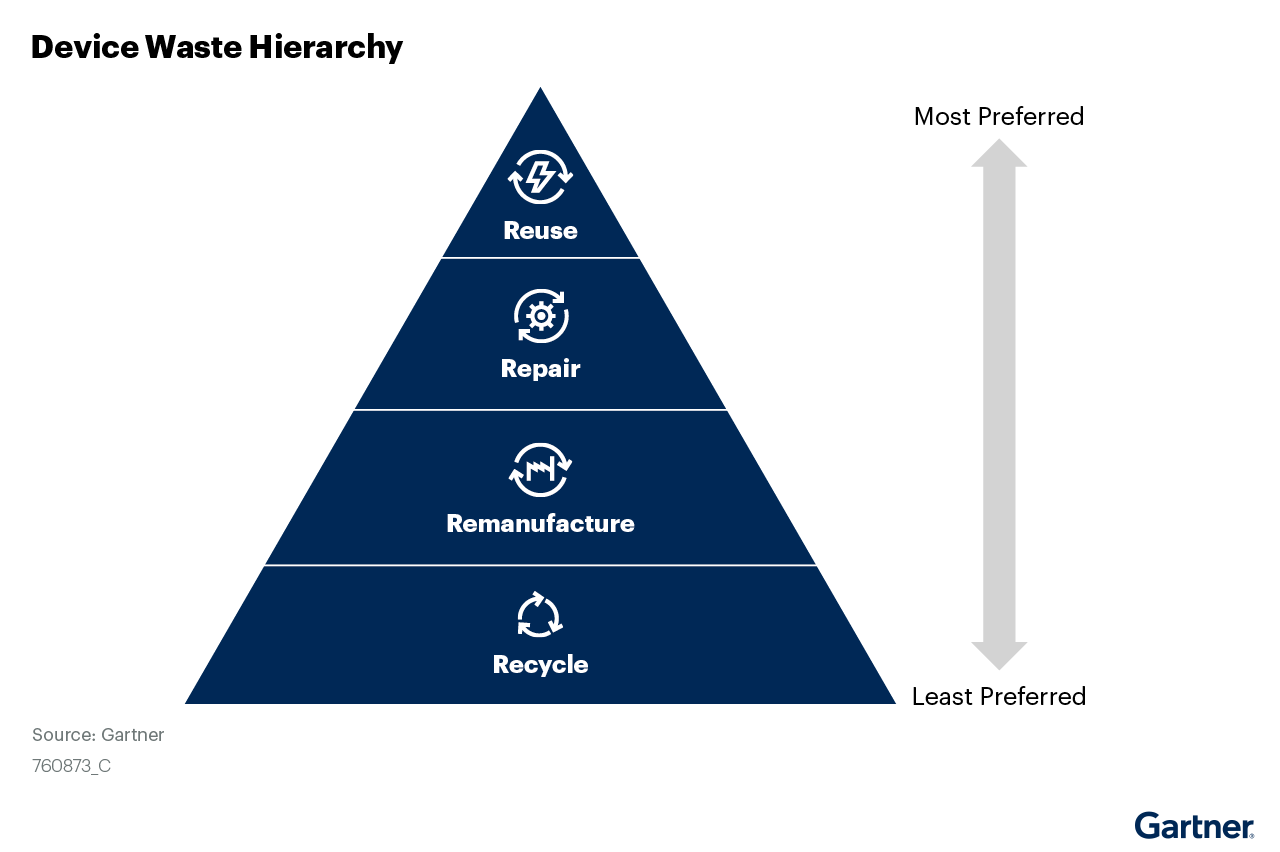
Of the 40 to 50 distinct materials composing most modern electronics, only about 12 to 15 of them (e.g., aluminum, steel, copper, plastic, precious metals) are typically recovered by current recycling technologies. Components recovered/recycled from electronics are often inferior to those from other sources due to commingled materials that, for example, embed metals in plastics, mix plastic types or use toxic flame-retardant materials. While recycling is certainly a positive alternative to landfill, there are limitations to its ability to support full circularity and reduce GHG emissions.
On the other end, reuse of IT assets is rapidly losing its traditional stigma. Indeed, the COVID-19 pandemic’s sudden and unanticipated demand for remote worker PCs drove many organizations to reevaluate and, ultimately, extend the useful lives of existing assets. These circumstances have, in turn, driven many organizations to rethink the typical taboo of using refurbished devices and focus on both the financial and sustainability benefits of longer useful lives for IT assets.
Growth in Cloud
On the data center side, the number of customer owned-and-operated data centers is shrinking, often migrating to cloud-based providers. In contrast, the number of large data centers operated by hyperscale service providers and leading the investments to support AI workloads will grow 48% from 2024 to 2029 to 2,880 sites.6
As organizations migrate more workloads to the cloud, traditional data center ITAD requirements are also shifting from many smaller data centers to fewer, but far larger, megacenters of the major cloud-hosting providers.6 This dynamic concentrates data-center-centric ITAD into a relatively few highly competitive, high-volume, low-price/low-margin megacenter deals. Indeed, when engaging cloud providers, it is important to require explicit details/reports on their ITAD processes to ensure that both data sanitization and recycling and component recovery are consistently executed properly (see Core Disposition Services section below).
Market Analysis
The activities generally associated with the removal and disposal/disposition of IT assets are listed below in typical chronological order. Most ITAD providers offer to perform some or all of these activities with varying degrees of efficiency and at varying costs. IT leaders responsible for ITAD must understand their specific needs and prioritize them against these comprehensive ITAD services to optimize the negotiation of an effective ITAD contract that meets their financial, geographical, security and risk requirements.
We recommend that IT leaders with responsibility for ITAM and ITAD use the three categories illustrated in Figure 3 as a checklist for tracking make-or-buy decisions about each category’s associated tasks. IT leaders should evaluate whether ITAD tasks apply to their environment and, if it does, whether it is best handled internally or via outsourcing to a specialist ITAD service provider. For cost transparency, consider requesting itemized pricing for specific services (e.g., transportation logistics) that could be done internally.
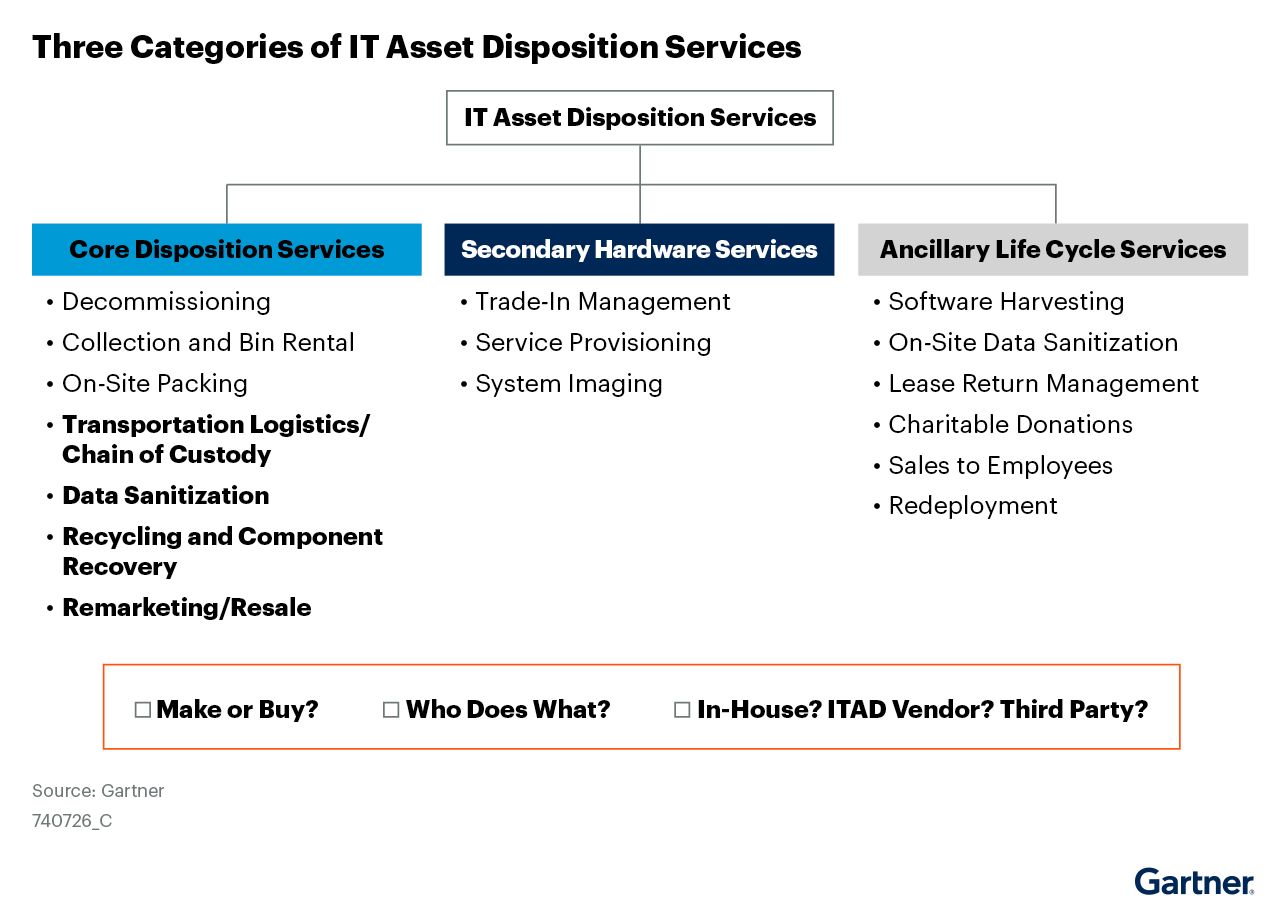
Make-or-Buy Checklist for IT Asset Disposition Services
Core Disposition Services
All of the following activities must be performed to dispose of IT assets properly. However, many of them — including decommissioning, collection and bin rental, and on-site packing — are often accomplished using internal resources. The three most important tasks to execute correctly, and to which ITAD executives should pay special attention, are transportation logistics/chain of custody, data sanitization and recycling. These three tasks represent the greatest risk in the ITAD process, and they should be handled by an experienced, well-vetted ITAD service provider.
Decommissioning: This task includes all activities associated with the physical removal of hardware and software from the existing site in preparation for packing and shipment. An example is software harvesting (see the Ancillary Life Cycle Services section below). These activities can be labor-intensive and may require specific packaging to preserve the condition of the asset and any remaining remarketing value. Although most ITAD providers offer decommissioning, our research indicates that these activities are typically handled by in-house personnel as part of their organizations’ standard ITAM process.
Collection and bin rental: Weatherproof bins or lockable storage areas are often used to segregate and accumulate IT assets for disposal, and they should be secured to prevent theft. In addition, it may be necessary to provide a staging area or storage room for asset packaging and shipment.
On-site packing: If space is available at the customer’s site, on-site packing offers greater security and protection for resalable assets than does transporting unpackaged equipment to an alternative off-site packing area. However, packing must be done properly to minimize the risk of in-transit damage and the consequent effect on the equipment’s resale value. Indeed, to minimize this risk, many organizations have the ITAD provider do the on-site packing. At this stage, security ID tags or serial numbers should be assigned for chain-of-custody tracking and control.
Transportation logistics/chain of custody: There can be significant security and cost advantages to having an ITAD provider handle transportation logistics from the customer’s site to the provider’s processing facility. However, ITAD managers must ask questions to gain a clear understanding of the provider’s precise transportation process and logistics. For example:
- Is the vehicle sealed and tracked?
- Will the asset shipment go directly from the user’s site to the provider’s, or will there be subsequent collections from other clients or an overnight stop en route?
- Does the ITAD provider use its own vetted employees and fleet of trucks or multiple third-party carriers? If the latter, do these carriers specialize in IT-specific assets and have their employees been through rigorous and routine background checks that extend beyond the initial hiring?
Depending on the answers to such important chain-of-custody questions, different logistics risk profiles will emerge. Additionally, although retired equipment may often have only minimal scrap value, in-transit insurance coverage for theft protection is still important to manage security and environmental compliance liabilities.
Data sanitization: Regardless of the targeted end state of decommissioned IT hardware, data sanitization and actual hard-drive destruction/shredding are crucial activities to ensure compliance with both internal and external privacy and security requirements. The specialized software and appliances required for this process are often most efficiently and effectively used by an experienced ITAD provider. You should require certification that the data was sanitized to common industry standards — such as the U.S. National Institute of Standards and Technology (NIST) Special Publication 800-88 or the U.K.'s Asset Disposal and Information Security Alliance (ADISA). (See Note 2 for a brief explanation of ITAD-related standards and certifications.)
To minimize chain-of-custody security risks (such as loss in transit to the ITAD provider’s facility), many ITAD managers, especially in the financial and healthcare sectors, require that some form of data sanitization be performed on-site. Organizations not requiring on-site data sanitization should, at a minimum, enforce data encryption on all data-bearing devices to minimize chain-of-custody security risks.
Recycling and component recovery: This crucial “demanufacturing” function reclaims any serviceable components and recycles any raw materials from the asset in compliance with local and national regulations. The growing visibility of corporate social responsibility — especially in large multinational organizations — is driving requirements for zero-landfill and zero-incineration solutions, as well as for information on recycling to appear in the annual report.
Remarketing/resale: Finally, as one of the primary functions of ITAD providers, remarketing/resale can be a source of ITAD revenue for organizations and for many ITAD providers. It is the critical denominator in the core ITAD cost-benefit equation, and it often determines whether the provider writes the client a check or sends an invoice. (This also depends on the equation’s numerator: the extent and cost of the ITAD services being rendered.)
The organization’s remarketing revenue will depend on many factors, including:
- The type, age and condition of the asset (e.g., is it still eligible for the manufacturer’s maintenance?)
- The ITAD provider’s remarketing network, experience and contacts
- The percentage returned to the client (typically 60% to 70%)
- The general market conditions
It is important to understand that the two most common financial models for the refurbishment and remarketing of used IT assets have very different financial outcomes, despite the fact that fees and revenue-share numbers may appear similar:
- Fair market value (FMV) — This model shifts the residual value risk to the ITAD service provider, which typically pays the customer an upfront and conservative (i.e., low) estimate of the projected proceeds for the sale of the refurbished asset. The fact that the estimate is based on the ITAD vendor’s market risk inherent in the above variables will inevitably mean that the customer receives less revenue than the more transparent consignment model.
- Transparent consignment — Ideally, this model charges the customer an explicit fee for repairs and refurbishment, which will depend on the type, age and condition of the asset. Revenue from every item sold is shared at the contractual reimbursement percentage of the gross sales price that the buyer actually pays, as documented by the ITAD vendor. The refurbishment fees are then clearly deducted post sale. Reporting should be fully transparent, detailing sales revenue and fees at the asset level.
Bottom line: IT leaders with ITAD responsibilities should insist that the ITAD service provider separate and clearly delineate services fees from resale proceeds.
Secondary Hardware Services
As a natural outgrowth of their asset disposition business, many ITAD providers also offer customers and partners the opportunity to acquire used equipment, often to replace disposed assets. They may offer the following services in tandem with their hardware disposition services:
- Trade-in management: Management of replacement assets as part of the standard asset life cycle
- Service provisioning: Services associated with warranties provided as a part of the acquisition and support services provided independently of the acquisition
- System imaging: System imaging services for server, PC and mobile assets
Ancillary Life Cycle Services
Some services are considered ancillary to the core ITAD business of asset disposition, and not all ITAD providers offer all of them. ITAD managers should consider each as an optional service that may or may not add material value within their specific environment:
- Software harvesting: Specialist software and AI tools can help identify any software licensed with an asset that may still have value and can be removed. This allows licenses to be redeployed elsewhere within the customer’s organization. If required, the ITAD provider may also help to ensure that any remaining data is backed up and returned to the end user prior to secure deletion of all data on all storage media.
- On-site data sanitization: While wiping data-bearing assets before they leave your physical site is more costly, it minimizes/eliminates any data security chain-of-custody risk incurred by transporting the assets from your site to the ITAD provider’s processing facility. On-site data sanitization is not uncommon in certain highly regulated industries (e.g., healthcare and finance). However, most organizations with robust, comprehensive encryption and chain-of-custody processes are content with the ITAD provider doing certified data sanitization at its processing facility.
- Lease return management: This service helps clients with lease return logistics, such as proper decommissioning to ensure ongoing maintenance eligibility, packaging, condition assessments, shipping and data cleansing.
- Charitable donations and sales to employees: This service helps clients prepare assets for charitable donations or sales to employees (e.g., packaging, value determination, shipping and data cleansing). Security and compliance concerns are fueling a trend away from both of these disposition alternatives.
- Redeployment: This service helps clients with internal redeployment of their assets (e.g., decommissioning, inventory, data sanitization, reimaging, packaging, shipping and installation). During the initial onslaught of the pandemic, when the demand for asset redeployment in employee homes grew dramatically, this quickly became a mission-critical service that many ITAD service providers delivered at significant scale.
Representative Vendors
The vendors listed in this Market Guide do not imply an exhaustive list. This section is intended to provide more understanding of the market and its offerings.
Vendor Selection
Unlike a Gartner Magic Quadrant, the market guide includes a “representative” sample of a variety of providers in the ITAD market. As such, we have profiled a mix of large service providers with a strong global presence and smaller, more regional — though nonetheless credible — suppliers of a variety of ITAD services.
The range of providers reviewed here will interest a wide variety of organizations with diverse requirements, from geographically specific ITAD services to truly global solutions. In our selection, we have tried to satisfy the needs of both multinational clients looking for a single global provider and clients looking for a more regional provider.
Representative Providers
Providers | Ownership | Corp. HQ | Fiscal Yr. End | Yr. in ITAD | Estimated ITAD Revenue | Revenue by Geography | ITAD Employees | Owned & Op’d (sq. ft.) | ||
NA & SA | EMEA | APAC | ||||||||
Private | Georgia U.S. | Dec | 2001 | $80M-$90M | 100% | — | — | 104 | 152K | |
Private | Arizona U.S. | Dec | 1996 | $30M-$40M | 88% | 8% | 4% | 112 | 54K | |
Private | Wisconsin U.S. | Mar | 2007 | $110M-$120M | 83% | 11% | 6% | 264 | 453K | |
Private | California U.S. | Dec | 2002 | $240M-$250M | 70% | 18% | 12% | 1,060 | 1,700K | |
Public | Massachusetts U.S. | Dec | 2011 | $340M-$350M | 84% | 13% | 3% | 1,600 | 2,317K | |
Private | North Carolina U.S. | Dec | 2001 | $90M-$100M | 68% | 24% | 6% | 201 | 50K | |
Private | Ohio U.S. | Dec | 2014 | >$100M | 95% | — | — | 514 | 420K | |
Public | California U.S. | June | 2005 | $265M-$300M | 64% | 29% | 7% | 974 | 1,142K | |
Private | Singapore | Dec | 2009 | $300M-$350M | 30% | 40% | 30% | 2,496 | 2,747K | |
Private | North Carolina U.S. | Dec | 2014 | $190M-$200M | 77.5% | 20% | 2.5% | 269 | 298K | |
Private | U.K. | May | 2001 | $20M-$25M | 12% | 82% | 6% | 124 | 56K | |
APAC = Asia/Pacific; EMEA = Europe, the Middle East and Africa; K = thousand; M = million; NA = North America; SA = South America; sq. ft. = square feet | ||||||||||
Source: Gartner (February 2026)
Provider Profiles
Apto Solutions
Based in Atlanta, Georgia, privately held Apto Solutions (Apto) was founded in 2001 and has about 100 direct ITAD employees. ITAD is Apto’s only business and Gartner estimates its current revenue ranges from $80 million to $90 million. Apto’s ITAD business and facilities are highly North-America-centric, with 100% of its revenue derived from North America. Apto has about 152,000 sq. ft. of ITAD processing space in its three U.S. ITAD facilities, located in Atlanta, Georgia (100,000 sq. ft.); Austin, Texas (25,000 sq. ft.); Oakland, California (27,000 sq. ft.). All three are certified for e-Stewards, ISO 9001, ISO 14001, ISO 27001, ISO 45001 and NAID AAA (its Atlanta facility is also R2v3 certified).
Apto is focused on four main ITAD markets: Data center-centric large enterprises (specifically compliance-driven sectors such as financial and healthcare), OEM take-back, IT lease returns, and managed service providers. Apto’s innovative AI-driven remarketing process is a weekly timed auction with hundreds of vetted global bidders that is viewable by its ITAD customers to ensure an “arm’s-length” fair market value. Apto claims its auction approach can recover 50%+ more value versus traditional remarketing. Through its Pulse customer portal and global asset tracking/reporting system, Apto tracks and reports on reuse/recycling of customers’ retired IT assets and consequent GHG emissions reduction.
DMD Systems Recovery
Headquartered in Tempe, Arizona, privately held DMD Systems Recovery (DMD) is a rapidly growing (about 40% revenue growth in FY2024) ITAD service provider. Gartner estimates that its 2024 revenue ranged from $30 million to $40 million, with the significant majority coming from ITAD services delivered in North America. DMD has three owned-and-operated ITAD facilities, in Tempe, Arizona (29K sq. ft.), Austin, Texas (10K sq. ft.), and recently Palo Alto, CA, (15K sq. ft.). All three are certified for ISO 9001, ISO 14001, ISO 27001 (except for Palo Alto), ISO 45001, R2 v.3 and NAID AAA. DMD is a B Corp and has partnerships with R2- and NAID AAA-/ADISA-certified ITAD service providers in the Americas, EMEA and APAC. While DMD supports physical destruction when required, it encourages minimizing unnecessary shredding by prioritizing secure reuse, redeployment, or resale whenever possible.
DMD views the ITAD process as having four dimensions: physical, data, financial, and virtual. DMD’s “virtual” layer connects directly to clients’ ITSM or asset systems, which can enable automated, touch-free updates and close the loop between disposition and digital recordkeeping. DMD prefers clients that have a “Reuse First” policy to extend the life of IT assets through redeployment or resale. While DMD supports physical destruction when required, it encourages minimizing unnecessary shredding by prioritizing secure reuse, redeployment, or resale whenever possible.
Dynamic Lifecycle Innovations
Founded in 2007, privately held Dynamic Lifecycle Innovations’ (Dynamic’s) fiscal year 2025 (March) ITAD-related revenue was in the range of $110 million to $120 million (Gartner estimate). Dynamic is North America-centric, with the significant majority of its revenue coming from ITAD services delivered to about 700 customers. Dynamic has two owned-and-operated facilities — its main headquarters location in Wisconsin (378,000 sq. ft.) and a facility in Nashville, Tennessee (75,000 sq. ft.). Both facilities are certified for ISO 9001, 14001, 45001, 2700, and SOC 2 and NAID AAA. Dynamic is among the few ITAD service providers whose facilities are both R2- and eStewards-certified. It also has a new 8,500 sq. ft. Virginia facility focused on data center decommissioning and ITAD logistics.
Dynamic believes its differentiation stems from the combination of its resale capabilities, its in-house, “closed-loop,” end-of-life processing/materials recovery capabilities, and its strong sustainability offerings. Dynamic is also developing and deploying AI-enhanced capabilities across the end-to-end ITAD life cycle, including operational automation to enhance resale forecasting and value recovery, AI-driven analytics to deliver real-time, validated environmental impact reporting, and predictive logistics modeling to optimize fleet utilization.
ERI
Privately held, California-headquartered ITAD service provider ERI is a major player in the North American ITAD market, with about 1,000 employees and 2025 ITAD revenue in the range of $240 million to $250 million (Gartner estimate). ERI has among the largest owned-and-operated ITAD processing footprints in North America, with nine processing facilities (about 1.7 million sq. ft.) across eight U.S. locations. The facility distribution minimizes logistics costs and carbon footprint. ERI indicates that all nine owned and operated facilities are certified to ISO 9001, ISO 14001, ISO 27000, ISO 45001, NAID AAA, SOC 2 and SOC 3, and CO2 neutral. ERI is also among the few ITAD providers whose facilities are both R2v3- and eStewards-certified.
Although ERI’s revenue and customer base are heavily North America-centric, the company currently delivers ITAD services in over 140 countries through its network of over 100 certified partner facilities. ERI also leverages AI in its proprietary SOAR system that automates and streamlines asset intake and identification of over 45,000 IT assets, and Optech, its cloud-based client portal and central hub for asset management and chain of custody tracking. The Optech portal enables real-time transparency into the customer’s account activity, and asset details from receipt through final disposition.
Iron Mountain
Iron Mountain is a $6.5 billion publicly held global storage and information management services business headquartered in Boston, Massachusetts. Gartner estimates that 2024 revenue of its asset life cycle management (ALM) division which includes ITAD is in the range of $340 million to $350 million. Since 2022, Iron Mountain has made six ITAD acquisitions including ITRenew, Regency Technologies, and Wisetek, giving it the largest U.S. (1.8 million sf/14 facilities) and second largest global (2.3 million sf/29 facilities) owned and operated ITAD footprint. Certifications of its 30 global facilities: ISO 9001: 21; 14001: 30; 27001: 12; 45001: 22; RIOS: 9; NAID AAA: 12; and all but 3 are e-Stewards- and/or R2v3-certified. As with all ITAD providers, clients are encouraged to verify the certifications of the specific facilities in which their assets will be processed.
Among Iron Mountain’s ITAD differentiators are its strong, company-owned global chain-of-custody logistics and transportation network (global 3,500 truck fleet) and its growing use of AI to improve operational efficiency, accuracy, compliance assurance, and value recovery. It has become a major global player for the deployment, management, decommissioning and disposition of technology assets, with particular focus on hyperscale, corporate data center and end-user device segments, as well as robust, secure data sanitization via its proprietary Teraware software.
PlanITROI
Privately held PlanITROI, founded in 2001, is headquartered in North Carolina and has a single owned-and-operated 50,000 sq. ft. ITAD processing facility in New Jersey. It is certified to ISO 9001, 14001, 27001 and 45001, R2v3, NAID AAA, and MAR (Microsoft Authorized Refurbisher). PlanITROI has about 200 employees and approximately 200 customers that generated 2024 revenue of about $90 million to $100 million (Gartner estimate). About 70% is from North America, a quarter from EMEA and the remainder from APAC. PlanITROI delivers ITAD and life cycle services globally through 14 certified global partners. It audits its partners twice annually on-site and virtual observation as needed, and its downstream service providers once annually on-site and via virtual observation, all to R2v3 standards.
PlanITROI believes one of its key differentiators is its AI-driven Center of Excellence (COE), which combines robotics, automation, AI, and human expertise in support of its Reuse-as-Intended-Use operating model. Its COE drives intelligent ITAD processes designed to prioritize reuse and maximize recovery value, helping offset and fund compliant ITAD and broader life cycle service programs. This capability extends across ITAM systems (e.g., ServiceNow) with automated intake and audit processes, logistics, data security, repair, refurbishment, resale, and ESG reporting, creating a more predictive, data-driven approach to value recovery.
Sage Sustainable Electronics
Founded in 2014, Columbus, Ohio based Sage Sustainable Electronics (Sage) continues its rapid growth (doubling every two to three years). This was further accelerated by its 2025 acquisitions of ITAD provider Cascade Asset Management and electronics repair provider, Relectro. Gartner estimates Sage’s 2025 revenue exceeded $100 million, derived almost exclusively from North America. Sage has over 500 employees, and increased its owned and operated ITAD capacity by about 60% to 420,000 sq.ft. over seven facilities. Its largest facilities are in Ohio, Wisconsin, and Nevada, with four others in Pennsylvania, Indiana, and Florida. Six are certified e-Stewards, NAID AAA, ISO 9001, 14001 and 45001 standards, and the Relectro repair facility is certified R2 and ISO 9001.
Sage’s main focus continues to be on the financial and sustainability benefits of extending reuse and delaying the recycling of IT equipment (it includes an unusual one-year warranty on all refurbished IT assets). Sage’s core metric — “Reusable Yield” — is the percentage of total assets received that are repurposed for a second user, which drives better financial and sustainability results than recycling. Sage believes asset reuse can deliver about 20 times the GHG avoidance vs. recycling, and offers certified carbon credits derived from their ITAD programs. Sage’s approach merits consideration for users looking for the environmental and financial benefits of repurposing versus recycling.
Sims Lifecycle Services
Founded in 2002 and headquartered in Irvine, CA, Sims Lifecycle Services (SLS) is a subsidiary of Australia-based Sims Limited (AU$7.5 billion/US$5.0 billion, FY25/June). SLS has a global ITAD customer base of about 3,000 and an ITAD workforce of about 975. Gartner estimates the company’s FY24 (June) ITAD and recycling revenue ranged from AU$400 million to AU$450 million (US$265 million to US$300 million). We believe about 65% of this revenue was derived from North America, about 30% from EMEA and about 5% from APAC.
SLS has over 1 million sq. ft. of global ITAD processing capacity, about 65% of which is based in its seven U.S. and two South American ITAD facilities. About 25% is in its five EMEA facilities and about 10% in its four APAC facilities. Most facilities are certified for ISO standards 9001, 14001, 27001 and 45001, and 12 are R2-certified (seven U.S. facilities, three in EMEA, and two in Australia and Singapore).
SLS’s significant global scale can help reduce the cost and carbon emissions associated with transportation logistics. Indeed, SLS has stated that in FY25 (June), its owned ITAD facilities became 100% carbon neutral and are all powered by renewable energy.
SK tes
Acquired in 2022 and privately owned by SK ecoplant, SK tes is part of the $150 billion South Korean SK Group. We estimate SK tes’s 2024 revenue was over $400 million, ITAD representing significantly more than half. It derives about 40% of its ITAD revenue from EMEA, and 30% each from APAC and the Americas.
SK tes has 38 global owned-and-operated ITAD facilities totaling about 2.7 million sq. ft., the largest of the profiled ITAD providers. About 70% of its global ITAD processing space is concentrated in its 22 APAC facilities (14 are R2-certified), about 20% is in 12 EMEA facilities (7 are R2-certified), and about 10% is in its 4 U.S. facilities, all R2-certified. Most of its global facilities are certified to ISO standards 9001, 14001 and 45001. As with all ITAD providers, clients are encouraged to verify the certifications of the specific facilities in which their assets will be processed.
SK tes views its significant global scale of owned-and-operated facilities as its primary ITAD differentiator, from economies of scale to globally standard ITAD processes to its logistics sustainability efficiencies, to managing the compliance risks inherent to that scale. SK tes is also leveraging AI to enhance its predictive pricing models, dynamic price forecasting, and intelligent asset placement to maximize value recovery.
Sprout
Founded in 2014 Sprout is headquartered in Charlotte, North Carolina and as of December 2024, is majority owned by private equity firm Recognize. Sprout’s ITAD revenue is North America-centric (75%) and is estimated to have closed FY2025 (December) with strong 50% growth in the range of $190M-$200M (Gartner estimate). EMEA accounts for about 20% of revenue and APAC 5%. Sprout’s four owned-and-operated ITAD processing facilities, totaling 300,000 sq. ft., are well-distributed across the U.S. (Charlotte, North Carolina, 105,000 sq. ft.); Dallas, Texas, 65,000 sq. ft.; Sacramento, California, 63,000 sq. ft.; and Boston, Massachusetts, 65,000 sq. ft. All four are certified for R2v3 and ISO standards 9001, 14001, 27001, and 45001. Sprout’s 350 employees support an expanding customer base of more than 325 enterprises.
Sprout’s proprietary, bidirectional AI-enabled platform, SmartERP, gives customers a single, real-time global view and enables management of end-to-end ITAD processes, services, reporting, reconciliation and billing. Sprout has also integrated AI into many of its core processes such as asset and inventory valuation, pricing, tracking, and management, and automated workflows and ESG reporting. Given the explosion in AI infrastructure, Sprout has also developed an AI infrastructure-specific ITAD specialization for the processing and resale of AI infrastructure (e.g., GPU servers, AI accelerators, etc.).
Vyta
Founded in 2001, privately held Vyta is headquartered in the U.K. Gartner estimates that Vyta’s FY24 (May) ITAD revenue was $20 million to $25 million, with almost all coming from EMEA. Vyta currently has about 500 customers, supported by about 125 ITAD-dedicated employees. Vyta has four EMEA-based ITAD processing facilities totaling 56,000 sq. ft., 46,000 sq. ft. in three U.K. facilities and a 10,000 sq. ft. facility in Germany. All are certified for R2, ADISA and ISO standards 9001, 14001, 27001 and 45001. Vyta indicates that it audits its downstream service providers and ITAD partners at least annually to ensure ongoing compliance with ADISA and R2v3 standards.
All three of Vyta’s U.K. and Ireland facilities are certified carbon neutral to ISO 14068-1 and its newest site in Germany will be certified carbon neutral in early 2026. Vyta has also committed to being net zero by 2050, in line with the U.K. government mandated targets. Vyta leverages its ITAD sustainability report analytics to identify refresh cycles that optimize both residual value and reuse potential. Vyta’s circular economy/reuse initiatives include managing/facilitating charitable donations and its retail site which can give customer employees a wide product range whose discount can be partially client-funded.
Market Recommendations
Before evaluating the market and its providers, ITAM and ITAD executives, as well as those of security and risk management, should perform their own detailed due diligence by evaluating and identifying their ITAD priorities and business and geographical requirements. Only then should they examine the ITAD service offerings of specific providers and compare them with their requirements to draw up a list of potential providers.
This approach is especially important when organizations are evaluating a solution for global ITAD services. ITAM and ITAD executives should consider these two principal approaches when contracting for global ITAD services and determine which option is more appropriate for their companies’ culture and organization:
- Single-source supplier for all geographies
- Best-of-breed supplier by major geography (North and South America, EMEA and Asia/Pacific)
Option 1: Single-Source Supplier for All Geographies
This approach transfers ultimate responsibility for global ITAD coordination and process standards to a single provider. Note that no provider delivers global ITAD services without using at least some partners. Therefore, the extent to which providers use partners is an important factor. Current choices range:
- From large global players, such as Ingram Micro, Sims Lifecycle Services and SK tes, which deliver much of their ITAD processing services through facilities that they own and operate
- To Dell Technologies, which neither owns nor operates any ITAD processing facilities, but has a robust process for vetting and regularly auditing partners
As demonstrated by the poorly executed exit of Arrow Electronics from the global ITAD market in July 2019,7 such sole-sourcing of global ITAD services can clearly entail significant business risk. Indeed, part of standard ITAD supplier due diligence should be to gain a clear understanding of where the supplier owns and operates facilities and where they use partners — and how those partners are vetted.
Option 2: Best-of-Breed Supplier by Major Geography
This approach acknowledges that most ITAD suppliers have a “home” advantage and are strongest in their native geography, often outsourcing ITAD support and services to other specialists in other geographies. For a client organization that is already highly segmented by geography, this may prove the most efficient approach, with global ITAD managed as the enterprise is organized — by major geography. Such a localized approach can also help deal with the maze of different regulations in different geographies.
This is not to say that adopting a best-of-breed/best-in-region/best-in-country approach by major geography will necessarily result in three to five different ITAD suppliers, one per geography. Depending on the requirements, the same ITAD provider may be chosen in multiple geographies. Our research indicates that a three- to five-geography RFP will typically yield one to three winning providers, with one or two ITAD providers winning in multiple geographies.
Although a potential drawback to this approach is the need to manage multiple providers in different regions, it can, nevertheless, be a good choice for multinationals that are already organized by major geography. We believe the best-of-breed approach should at least be considered, with the understanding that requirements may ultimately necessitate a sole-source supplier for all regions.
1 For this market guide, we evaluated information from a wide range of sources, including:
- Questionnaires completed by all 11 providers profiled in this market guide
- Hundreds of discussions about ITAD market issues and ITAD providers with users of Gartner’s client inquiry service
- ITAD certification and standards bodies (e.g., R2, e-Stewards, NAID AAA)
- Basic research on providers’ details sourced from D&B Hoovers and S&P Capital IQ
- Research by an extended team of Gartner analysts who also collaborated on and vetted findings
In addition, all the providers were given the opportunity to review a draft of their profile section of the Market Guide for factual accuracy.
2 According to the Greenhouse Gas Protocol Corporate Accounting and Reporting Standard, emissions are divided into three scopes:
- Scope 1 (direct emissions): Emissions created from company-owned assets or controlled resources (e.g., the combustion of fossil fuel to run a vehicle owned by the organization).
- Scope 2 (indirect emissions): Emissions from the generation of energy that is purchased by the organization (e.g., the procurement of electricity or steam to be used in a manufacturing facility).
- Scope 3 (upstream and downstream emissions): All indirect emissions (not included in Scope 2) that occur in the value chain (both upstream and downstream from the organization):
- Scope 3 upstream emissions are supply chain emissions, covering procured products, transport of suppliers and business travel. An example is the emissions generated during the production of steel used in a car that an automotive original equipment manufacturer (OEM) produces.
Scope 3 downstream emissions cover transport of products, usage of sold products and product disposal. For the same automotive OEM, this refers to the emissions from its cars being driven by customers.
The Scope 3 emissions for one organization are the Scopes 1 and 2 emissions of another organization.
3 The Global E-Waste Monitor 2024, United Nations Institute for Training and Research (UNITAR).
4 2023 Gartner Sustainable IT Opportunities Survey. This survey was conducted to assess the actions and impact of IT to reduce greenhouse gas emissions within IT and the enterprise. The research was conducted online from 6 November through 18 December 2023. In total, 200 respondents were interviewed across North America (n = 68), Europe (n = 82) and Asia/Pacific (n = 50). Respondents represented qualifying enterprises in more than 20 industries with reported enterprisewide annual revenue for fiscal 2022 of at least $500 million. Qualified enterprises also were currently engaged in sustainability-related activities within the IT organization. Respondents were leaders or executives in either IT roles or mixed business and IT roles and were directly involved in making sustainability-related decisions. Disclaimer: Results of this survey do not represent global findings or the market as a whole, but reflect the sentiments of the respondents and companies surveyed.
7 Arrow: Shifting industry realities drove ITAD closure, Resource Recycling, August 8, 2019
Note 1: Circular Economy Defined
A circular economy is an economic system of closed loops in which raw materials, components and products lose their value as little as possible, and systems thinking is at the core. It is based on three principles:
- Design out waste and pollution.
- Keep products and materials in use.
- Regenerate natural systems.
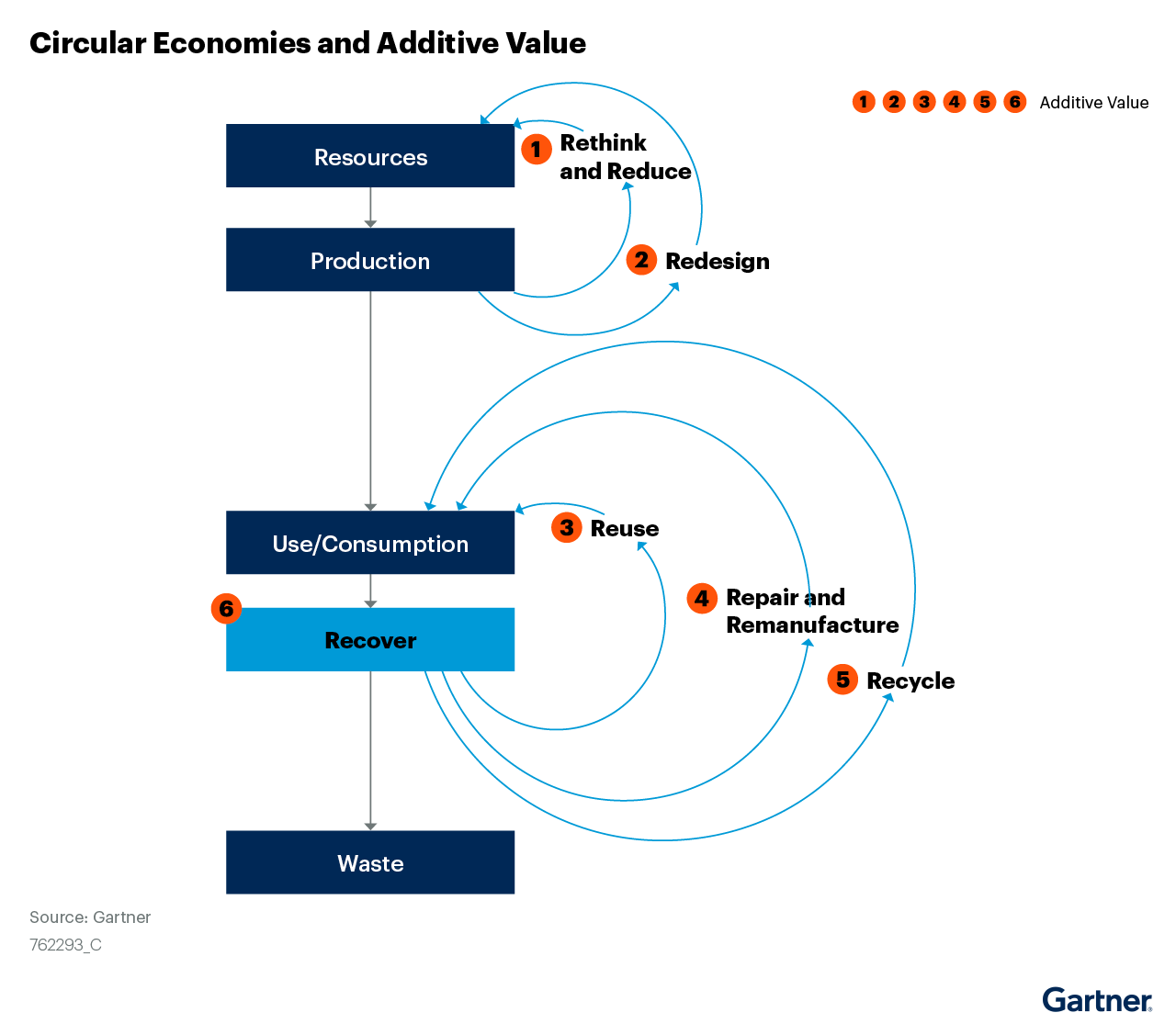
The energy required to fuel this cycle should be renewable by nature, with the purpose of decreasing resource dependence and increasing systems’ resilience. Figure 4 depicts the additive value of the six steps of the circular-economy value chain. IT asset disposition must play a key role in Steps 3, 4 and 5, where the sustainability benefit is maximized in Step 3 (asset reuse) and diminishes significantly in Steps 4 and 5. (See the Market Direction section above and Best Practices for Device Sustainability in End-User Computing.)
Note 2: Brief Explanation of ITAD-Related Standards and Certifications
Electronic Recycling:
- R2: Managed by Sustainable Electronics Recycling International (SERI), the R2 standard provides a common set of processes, safety measures and documentation requirements for businesses that repair and recycle used electronics. R2 is rigorously and independently audited, emphasizing quality, safety and transparency. More than 800 facilities are currently R2-certified in 31 countries.
- e-Stewards: The e-Stewards initiative is an electronics waste recycling standard created by the Basel Action Network. It defines and promotes responsible electronics reuse and recycling best practices worldwide.
International Organization for Standardization (ISO):
- ISO 9001: This quality management standard is based on quality management principles, including a strong customer focus, the motivation and implication of top management, the process approach and continual improvement. ISO 9001 is the only ISO 9000 standard that can be certified.
- ISO 14001: This environmental management standard intends to help an organization achieve the following outcomes for its environmental management system:
- Enhancement of environmental performance
- Fulfillment of compliance obligations
- Achievement of environmental objectives
- ISO 27001: This is an information security management standard for an organization’s information security management system. It facilitates the management of assets, such as financial information, intellectual property, employee details or information entrusted by third parties.
- ISO 45001: This occupational health and safety management standard helps improve employee safety, reduce workplace risks, and create better, safer working conditions.
- OHSAS 18001: This was an international standard for best practices in occupational health and safety management. Note that OHSAS 18001 has been replaced by ISO 45001. Organizations certified to OHSAS 18001 needed to migrate to ISO 45001 by 12 March 2021, when all OHSAS 18001 certificates expired.
- SOC 2: Service Organization Control 2 reports provide detailed information and assurance about the controls at a service organization, relevant to:
- The security, availability and processing integrity of the systems the service organization uses to process users’ data
- The confidentiality and privacy of the information processed by those systems
Data Security:
- NAID AAA: National Association for Information Destruction AAA certification verifies that service providers that supply secure data destruction services comply with all known data protection laws through scheduled and surprise audits by trained, accredited security professionals, fulfilling customers’ regulatory due diligence obligations.
- ADISA: The Asset Disposal and Information Security Alliance provides an industry accreditation for companies that provide ITAD services, and offers product approvals for companies with products that sanitize data.