Magic Quadrant for Financial Close and Consolidation Solutions
9 March 2026 - ID G00835009 - 49 min read
By Jeffrin Francis, Renata Viana
Financial close and consolidation solutions leverage AI-driven automation, ensure compliance and enhance collaboration during group close, consolidation and financial reporting. CFOs can use these findings to evaluate vendors that fit their accounting transformation strategies.
Market Definition/Description
Gartner defines financial close and consolidation solutions (FCCS) as tools that help CFOs manage group close, consolidation, and reporting. FCCS enables organizations to (1) manage financial close with collaborative, auditable workflows and dashboards, (2) consolidate financials across multiple legal entities and geographies, (3) comply with accounting standards for currency translation, intercompany elimination, and adjustments, and (4) generate reports meeting generally accepted accounting principles (GAAP), International Financial Reporting Standards (IFRS), and regional requirements.
CFO and their teams are increasingly challenged by the growing complexity of organizational structures, stricter financial regulations, multiple systems of record, and hybrid or remote work models. These factors impact their ability to deliver a compliant, efficient, and collaborative consolidation process. The FCCS market enables finance teams to manage and execute their group close activity with a centralized cloud-based application that leverages machine learning and AI to optimize performance.
Finance teams typically use these solutions across three business challenges: (1) assist with the goal of a more efficient controllership function; (2) support the increasingly regulated environment, enabling teams to reach compliance faster; or (3) simplify complex environments in which they operate. The solutions reduce risk and redundancy in the consolidation process, achieve faster group close times, and generate compliant financial statements for external and management reporting.
Mandatory Features
The mandatory features of the FCCS market include:
- Delivered as a cloud-based application
- Financial consolidation — The ability to collect and aggregate financial information from various general ledger sources with multiple chart of accounts, apply currency translation rules, execute intercompany eliminations in multiple dimensions, and make adjustments to provide an organization’s consolidated financial results at the group and subgroup levels.
- Financial reporting — The ability to provide financial statements (i.e., balance sheet, income statement, and cash flow) that are compliant with the accounting standards of both the entity and group company’s respective country.
Common Features
The common features of the FCCS market include:
- Workflow management — The ability to create, monitor, escalate, and respond to consolidation tasks in order to manage the consolidation process.
- Self-service reporting — The ability for end users to find and create the reports they need, saving time and increasing organizational efficiency.
- Finance administration — The ability for finance teams to set up and manage configuration within their teams, reducing dependency on IT teams and third-party vendors.
- Audit trail — The ability to ensure traceability of all entries, eliminations, adjustments, and approvals throughout the close and consolidation process, thereby supporting transparency, accountability, and compliance in financial reporting.
Magic Quadrant
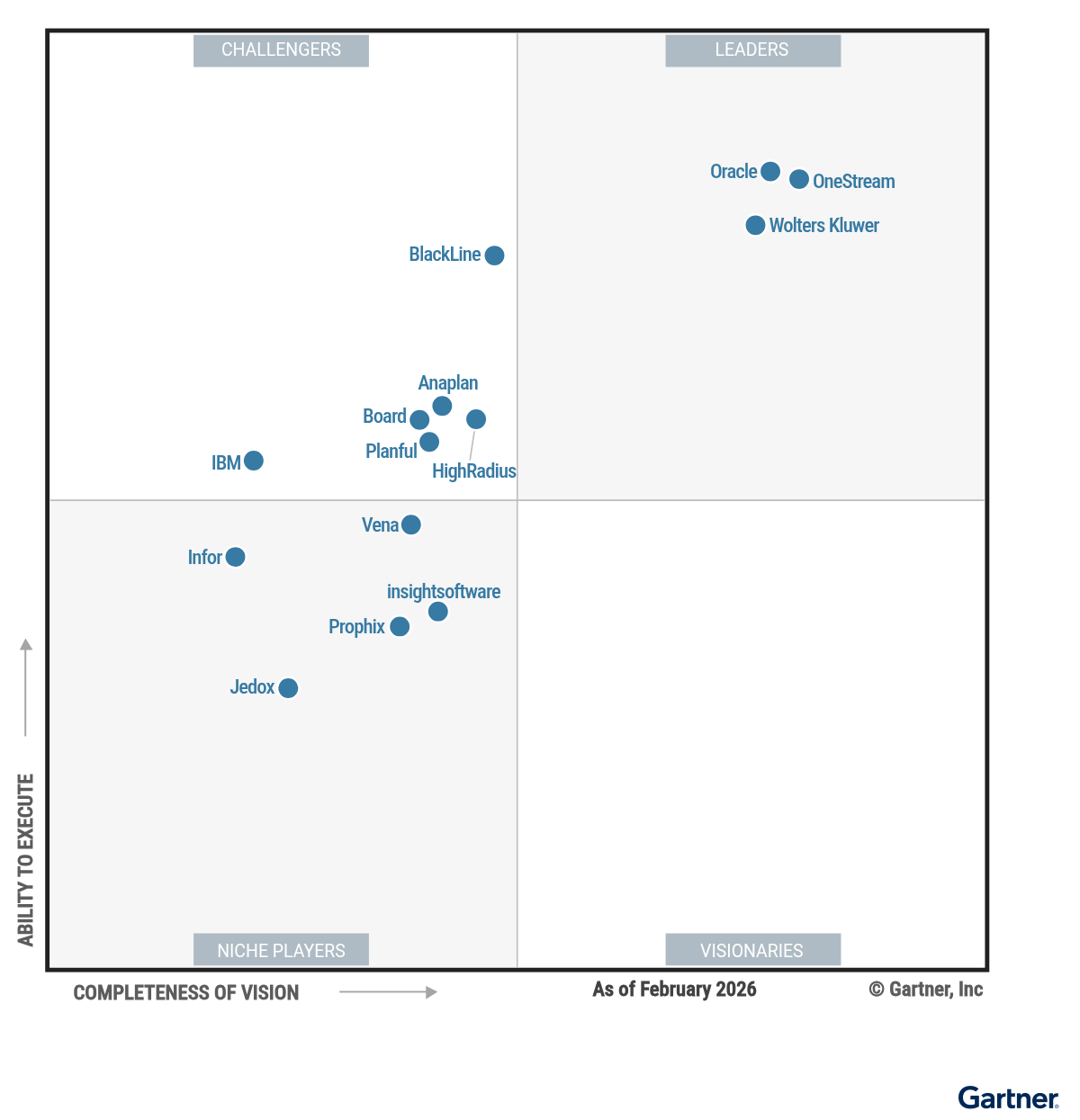
Vendor Strengths and Cautions
Anaplan
Anaplan is a Challenger in this Magic Quadrant. Its product, the Financial Consolidation and Reporting Application, offers end-to-end financial consolidation, automated intercompany matching, eliminations and intricate ownership management. Anaplan has specialized solutions for complex accounting requirements with its IFRS Accelerator kit and out-of-the-box rules for U.S. GAAP and IFRS, which enable rapid deployments.
A key innovation is its time-based ownership offering, which uses effective-dated relationships to automatically calculate accurate ownership percentages for complex periods and noncontrolling interests. Over the next 12 months, Anaplan aims to rearchitect its journal entry module to support automated foreign exchange (FX) conversion and rule-based validations and to deploy AI agents for conversational investigation and governance to increase journal entry transparency.
- Automated data mapping: Anaplan uses an AI-assisted engine that predicts target mappings via semantic pattern analysis, providing confidence scores and proactively detecting invalid mappings to prevent load failures. This automation accelerates mergers and acquisitions (M&A) onboarding by eliminating manual translation tables and reducing setup time.
- Platform roadmap: Anaplan plans to integrate its Financial Consolidation and Reporting Application into its core platform through its Anaplan Application Framework. This integration will improve user experience and ensure data synchronization with a finance-owned environment for complex statutory and management consolidations.
- Ownership structure: Anaplan’s platform handles complex ownership structures using Time-Based Entities and Ultimate Rate calculations. These automate financial adjustments when hierarchy positions change and calculate control percentages, ensuring accurate M&A reporting without manual workarounds.
- Solution architecture: Following the Fluence acquisition, Anaplan’s native planning suite is now paired with an application that is optimized for consolidation. While Anaplan’s Data Orchestrator synchronizes these components for a seamless experience, organizations wanting a single, unified codebase for all financial processes may need to adapt to this integrated, dual-engine framework.
- Journal entry: Customers cite limitations in the Anaplan journal module, specifically the lack of FX translation for details and impact previews. While it plans a rearchitecture in 2026, these functional gaps currently require manual workarounds, increasing administrative effort for teams managing multicurrency adjustments.
- AI pricing: While generative and agentic AI are currently free to drive adoption, Anaplan intends to move to usage-based or additive pricing as adoption increases. As organizations expand their use of these AI capabilities, this shift may introduce cost variability and uncertainty.
BlackLine
BlackLine is a Challenger in this Magic Quadrant. Its product, Close and Consolidation Solution, offers a unified platform for financial close, intercompany governance and reporting and analysis activities. BlackLine has specialized solutions and initiatives for data-intensive sectors facing specialized reporting and governance needs with its library of industry-specific blueprints and the high frequency reconciliations solution.
A key innovation is Verity AI, a governed agentic AI framework that provides verifiable intelligence embedded directly into finance workflows. Over the next 12 months, BlackLine plans to launch Verity Prepare to automate reconciliation tasks and Verity Match for probabilistic transaction matching, alongside Verity Insights for conversational querying.
- Process traceability: BlackLine provides end-to-end traceability, enabling users to drill from consolidated reports to source transactions. This seamless audit trail eliminates data silos, ensuring CFOs and their teams have a single, verifiable version of the truth for confident, audit-ready reporting.
- AI framework: BlackLine’s Verity framework offers a governed AI architecture that exposes the full chain of thought and data lineage. CFOs and their teams can trust that all AI-driven insights are verifiable, auditable and compliant, supporting confident adoption of intelligent automation.
- Data integration: BlackLine’s Studio360 platform delivers a governance-by-design model by embedding preventive controls to ensure data integrity at the source. Built on Snowflake, this fabric harmonizes disparate systems into a central control hub, improving downstream accuracy and reducing IT reliance for data transformation.
- Pricing: BlackLine has simplified its pricing, but some midmarket customers view it as high, particularly those with budgetary limitations or lower feature utilization. While a new revenue and complexity-based model aims to improve predictability, the cost remains a barrier to adoption and value realization.
- XBRL filing: BlackLine lacks a native feature for the automatic transfer of reports to global regulatory bodies like the U.S. Securities and Exchange Commission (SEC). The solution relies on third-party partners to handle iXBRL tagging and final submissions, which adds vendor relationships and process complexity for regulatory compliance.
- Platform flexibility: Customer feedback indicates that adopting BlackLine often requires process reengineering, as the platform’s Governance by Design framework enforces standardized controls compared with flexible legacy workflows. While accelerators like Verity can help streamline adoption, this process restructuring may face a longer path to value, particularly for midmarket companies.
Board
Board is a Challenger in this Magic Quadrant. Its product, Financial Close, Consolidation and Reporting (FCCR), offers end-to-end financial consolidation, close workflow and multistandard reporting such as GAAP and IFRS on a single platform. Board has specialized solutions and initiatives for organizations facing diverse sector and regulatory reporting requirements with its industry accelerators like the IFRS Starter Kit and modules for ESG and Pillar 2.
A key innovation is the GCR Controller Agent, which uses domain-aware AI to help detect and triage intercompany mismatches and identify the likely root causes and support resolution. Over the next 12 months, Board plans to introduce matrix consolidation and modernized Excel and Google Sheets add-ins to support more flexible reporting.
- AI agents: Board’s Controller Agents shift manual diagnostics to supervised automation. Embedded in the workflow, these context-focused assistants continuously monitor data, diagnose root causes and propose governed fixes for approval, accelerating the close and improving quality.
- External market data integration: Board natively integrates economic intelligence via its Foresight and Signals modules, pairing internal data with real-time indicators like inflation. This enables CFOs and their teams to automate macroeconomic context in narratives, ensuring reports accurately reflect current market conditions.
- Ownership management: Board uses an event-driven investment register to automatically recalculate goodwill and noncontrolling interests as group structures evolve. The engine handles complex circular interests without hierarchy redesigns, enabling finance teams to manage M&A activity and historical restatements with high precision.
- Reconciliation controls: Board lacks native bank and subledger account reconciliation capabilities, requiring reliance on external tools or spreadsheets. Although it has plans for a partnership strategy, this gap can force finance teams to manage separate systems and increase administrative burden during the close process.
- AI pricing: Although Board plans to release advanced AI agents for FCCS in 2026, the pricing model for these capabilities is not yet finalized. This creates uncertainty regarding the future total cost of ownership for customers intending to adopt these emerging AI-driven automation features.
- Reporting localization: Board supports major accounting standards but relies on manual configuration for specific local jurisdiction templates and hyperinflation nuances. This approach requires customers to build custom rules during implementation, which can increase setup complexity when seeking full statutory compliance.
HighRadius
HighRadius is a Challenger in this Magic Quadrant. Its product, Record-to-Report Suite, offers end-to-end financial consolidation, close management and account reconciliation on a single cloud-based platform. HighRadius has specialized solutions and initiatives for organizations facing vertical-specific acceleration requirements with prebuilt industry frameworks for sectors like manufacturing, healthcare and insurance.
A key innovation is the Anomaly Detection Agent, which uses machine learning (ML) algorithms to monitor general ledger (GL) transactions in real time, helping users reduce close cycles. Over the next 12 months, HighRadius plans to launch Gen AI for Journal Creation and additional prebuilt agents to automate reconciliation as well as integrate iXBRL tagging for statutory reporting.
- Anomaly detection: HighRadius uses over 20 ML algorithms to monitor general ledger transactions in real time for errors and omissions. This continuous monitoring identifies risks before the close begins rather than relying on reactive checks, ensuring data integrity and reducing manual exception handling time.
- Outcome-driven engagement model: HighRadius offers its customers guarantees on meeting operational KPIs when generative AI (GenAI) and agentic capabilities are adopted. This strategy shifts the focus to business-outcome-driven performance measures that support CFOs realizing ROI from AI adoption.
- Automation orchestration: HighRadius offers a wide range of prebuilt LiveCube agents that automate specialized tasks like intercompany clearing on a no-code platform. These agents mimic Excel, allowing users to automate processes by uploading existing models and enabling finance teams to scale automation across diverse workflows without heavy IT reliance.
- Compliance features: HighRadius’ advanced compliance and audit tools remain in development. Key features like the Compliance Manager for dynamic risk determination, GenAI-powered reporting for mandates like Base Erosion and Profit Shifting (BEPS) and enhanced audit visibility are roadmap items scheduled for release in 2026.
- Global reach: HighRadius’ FCCS has a strong presence in North America but a comparatively limited client base globally. Customers with complex international operations should further evaluate this vendor for its ability to provide user support outside of North America.
- Collaboration features: HighRadius provides disclosure dashboards, but real-time collaborative editing features for narratives are yet to be released. While users can link live data, simultaneous tagging and in-report commenting are not yet fully integrated, which can necessitate preparation through offline channels, increasing version control risks.
IBM
IBM is a Challenger in this Magic Quadrant. Its product, IBM Controller, offers financial consolidation, close workflow and reporting. IBM has specialized solutions and initiatives for complex multinational groups with its flexible handling of global ownership structures and investment eliminations, using minimal scripting for efficient complexity management and compliance with accounting standards.
A key innovation is the refactored Carbon web interface, which enhances financial consolidation workflows and introduces self-service database administration to reduce IT dependency. Over the next 12 months, IBM plans to launch Excel-based web data entry forms to streamline data collections and add AI assistants for natural language support, anomaly detection and automated audit capabilities.
IBM declined requests for supplemental information of this document. Gartner’s analysis is therefore based on other credible sources.
- Consolidation support: IBM manages intricate global ownership structures, such as minority interests and cross-holdings, through automated journal mechanisms rather than complex scripting. This capability enables multinational enterprises to handle eliminations and statutory reporting requirements without a heavy reliance on IT.
- User interface: IBM supports personalized landing pages and is reintroducing Excel-based data entry forms within the web client to align with specific user roles. This allows finance teams to maintain productivity by accessing data and tasks through a familiar spreadsheetlike experience directly in the browser.
- Partner ecosystem: IBM uses its global partner network and embedded software agreements to support a stable client base across diverse industries and regions. This extensive ecosystem helps to enable customers to have easy access to localized expertise.
- Cloud migration pace: A vast majority of IBM’s customer base remains on-premises, with only a modest segment currently using the cloud version. This slow migration suggests that new cloud customers may still be joining a community predominantly focused on maintaining legacy on-premises deployments.
- Innovation: IBM has adopted a follower approach for AI features that competitors already market. Organizations seeking immediate access to the latest automation or GenAI capabilities may find the current offering lags behind leaders.
- Reconciliation controls: IBM Controller lacks native account reconciliation functionality, such as ledger-to-bank matching, often necessitating the use of third-party tools. Organizations must manage separate vendor contracts and integrations to realize a comprehensive and fully automated financial close process.
Infor
Infor is a Niche Player in this Magic Quadrant. Its product, Infor EPM Financial Consolidation, provides unified financial consolidation, automated intercompany matching and configurable close workflows built on the Infor OS platform. Infor has specialized solutions and initiatives for accelerating statutory compliance and audit readiness with its tax reporting accelerator for deferred tax and country-by-country reporting.
A key innovation is Open Ad-Hoc Analysis, which allows users to launch data exploration directly from reports via right-click to investigate variances without IT support. Over the next 12 months, Infor plans to redesign capital consolidation with GenAI-based suggestions, launch a centralized comment register and integrate GenAI into ad hoc reporting for automated variance interpretation.
- Platform integration: Infor EPM connects to its own and third-party ERPs via a unified operating system and shared data model. This architecture eliminates data silos and ensures validated information across business units, giving customers a single source of truth that accelerates the overall financial close process.
- Customer support: Infor made notable investments in its Success Program, available free of cost to all customers and partners. The program provides dedicated Customer Success Managers, design reviews, ongoing consultative advice and health checks to ensure best practice adoption and mitigate risks during deployment.
- Ownership management: Infor employs a time-dependent engine that automatically calculates effective and noncontrolling interests, handling complex circular holdings without manual hierarchy remapping. Customers can efficiently manage structural changes and acquisitions while maintaining a verifiable audit trail.
- AI pricing: While AI capabilities are included in the base subscription, Infor’s usage operates on a token-based model measured in millions of tokens per tenant. Organizations with high usage that exceed their initial token allocation must purchase additional tokens, potentially introducing variable costs as AI adoption scales.
- XBRL filing: Infor lacks native iXBRL tagging and direct automatic transfer capabilities for regulatory bodies like the SEC or ESMA. Users must export data to third-party tools for final filing and compliance, adding administrative steps and increasing process complexity for regulatory compliance.
- Business model: Infor has not implemented or announced any major changes to its business model recently. Customers seeking vendors with a clearly articulated and adaptive business proposition may find Infor’s approach rigid, because it shows fewer proactive refinements and strategic evolution seen in competitors who regularly reassess and update their value delivery to align with market needs.
insightsoftware
insightsoftware is a Niche Player in this Magic Quadrant. Its product, JustPerform, offers financial consolidation, close workflow, reconciliation, tax and disclosure management. insightsoftware has specialized solutions and initiatives for diverse global regulatory mandates and industry-specific challenges with its Consolidation Hub with prebuilt IFRS scenarios, ESG and CSRD modules and insurance and public sector accelerators.
A key innovation is Lineos AI, which uses agentic matching to learn user patterns and automate complex reconciliations and sophisticated scenarios with reduced reliance on manually configured rules. Over the next 12 months, insightsoftware plans to launch agentic AI workflows for autonomous consolidation and a marketplace for localized GAAP templates to address compliance across diverse regulatory environments.
- Hybrid configuration: insightsoftware’s platform uses a sheet-based consolidation layer that operates alongside the rule-based engine, enabling custom calculations via no-code formulas. It flexibly handles complex, industry-specific scenarios while maintaining the strict governance of a traditional model-based approach.
- Platform unification: insightsoftware has pivoted to a unified EPM strategy via JustPerform, integrating consolidation, reconciliation, tax, disclosure and planning into a single solution to eliminate legacy data silos. This architecture supports future agentic AI capabilities designed to enable autonomous close workflows and reduce manual effort.
- Agentic AI-driven reconciliation: insightsoftware deploys agentic AI to replace manual rules with autonomous matching, handling complex many-to-one scenarios and generating adjusting journals via confidence scoring. By analyzing user approval trends, the system is able to independently confirm high-confidence matches, streamlining the process and allowing finance teams to focus on anomalies.
- Risk control: insightsoftware does not provide a native risk control matrix (RCM) to handle frameworks like SOX. While JustPerform offers audit trails and validation rules, it lacks dedicated modules for automated control testing, requiring customers to use external tools for broader internal control documentation.
- Legacy migration: insightsoftware is migrating its existing legacy technology offerings to its JustPerform platform. This architectural shift requires customers using these legacy products to manage transition complexities and may impact alignment with the vendor’s consolidated innovation strategy.
- General ledger synchronization: insightsoftware’s connectors focus on data extraction rather than bidirectional synchronization of consolidation journals. While reconciliation supports write-back, consolidation adjustments reside within the platform, and finance teams must manually synchronize data to ensure consistency with source records.
Jedox
Jedox is a Niche Player in this Magic Quadrant. Its product, Jedox Financial Consolidation, offers financial consolidation and reporting with AI-driven automation and data integration. Jedox has specialized solutions and initiatives for global organizations managing complex structures with its configurable rules for multiple accounting standards, accelerating the close-to-report cycle.
A key innovation is its integration of the Merge Equity feature, which automatically pulls historic rates for equity accounts directly from the centralized investment register. Over the next 12 months, Jedox plans to deploy the Jedox Reporting Agent for narrative reporting, which uses natural language processing to help clients automatically generate concise summaries and actionable insights from lengthy documents like year-end reports.
- User interface: Jedox supports customizable canvas dashboards and offers spreadsheet-based data entry templates within its web client, tailored to distinct user roles. This allows finance teams to maintain productivity by leveraging a familiar, Excel-like environment directly in the browser, ensuring rapid adoption and shortening learning curves.
- AI investments: Jedox is investing a large proportion of its research and development into JedoxAI to scale its team of AI data engineers and scientists. This reinforces the vendor’s trajectory toward hyperautomation and supports clients in moving away from manual and demanding close cycles.
- Configurable business rules: Jedox designs its consolidation logic and configurable framework to manage complex consolidation requirements, including multitiered ownership structures, cross-holdings and dynamic noncontrolling interest calculations. This enables CFOs and their teams to manage evolving group hierarchies.
- Disclosure management: Jedox’s solution has limited options for financial disclosures, which can constrain organizations requiring end-to-end financial reporting automation. As a result, companies seeking comprehensive integrated disclosure management may find the platform less suitable for their needs.
- Transaction matching: Jedox only offers intercompany reconciliation as part of its FCCS, but competitors already include full transaction matching and reconciliation controls as part of their offerings. Organizations requiring full-scale account reconciliation functionality may need additional solutions.
- Industry strategy: While Jedox enables vertical-specific acceleration programs, it does so primarily via its partner network rather than through direct, vendor-led campaigns. Companies with complex, or highly specific industry needs, would have less direct insight and support from the vendor compared with competitors.
OneStream
OneStream is a Leader in this Magic Quadrant. Its product, the OneStream Platform, offers unified financial close, consolidation and reporting. OneStream has specialized solutions for organizations by managing multiple reporting standards and complex intercompany structures along with built-in AI and analytics for tasks such as anomaly detection, transaction matching and narrative generation.
A key innovation is its SensibleAI Agents, which automate complex, high-volume financial tasks and large numbers of document analysis, enhancing workflow efficiency, transparency and insight extraction while reducing manual effort. Over the next 12 months, OneStream will introduce Cube-Based Anomaly Detection for real-time risk monitoring, enabling customers to scan thousands of transactions for structural, statistical and behavioral anomalies, and ensuring cleaner, more accurate reporting.
- Integrated data quality: OneStream’s Integrated Data Quality Engine embeds data quality management directly into the core workflow, using configurable preload and postload validations to check for errors or anomalies. This ensures that customers can trust their financial data, because only clean and certified information advances through the consolidation process, reducing the risk of errors.
- GAAP and IFRS accelerator: OneStream’s Express for GAAP and IFRS accelerates onboarding for international reporting, bridging statutory trial balances to IFRS standards, using a multidimensional model and a single auditable source. This supports efficient handling of complex IFRS requirements and regulatory compliance transparency for global enterprise customers.
- Market understanding: OneStream demonstrates a strong market understanding through upskilling its teams not just on technical features, but also on accounting standards and regulations. This has enabled it to elevate to strategic discussions with CFOs playing an advisory role capable of addressing both operational and financial challenges.
- AI pricing: Unlike some competitors who include AI features within their standard subscription, OneStream uses a separate pricing model for its advanced AI capabilities. This can increase the total cost of ownership for organizations seeking to fully automate their close and consolidation processes, potentially limiting adoption.
- Amortization schedules: While OneStream offers extensible dimensions for specific schedules, there are limitations in automating prepayments and deferred revenue in the solution. This can result in increased manual configurations or reliance on custom implementations.
- XBRL filing: OneStream does not provide native iXBRL tagging or filing capabilities required by regulators, instead relying on a third-party partner under an additional agreement. This approach adds cost and operational steps for organizations seeking to meet statutory reporting and compliance obligations.
Oracle
Oracle is a Leader in this Magic Quadrant. Its product, Oracle Fusion Cloud Enterprise Performance Management (EPM), offers a unified suite for financial close, consolidation and reporting. Oracle has specialized solutions and initiatives for complex, global and high-volume organizations with its automation of cash flow reporting for labor-intensive close activities and its advanced insights capability, which leverages AI to detect anomalies and trends.
A key innovation is GenAI in its reporting solution, which automatically creates narratives for reports and packages, saving time for both internal management and statutory reporting. Over the next 12 months, Oracle will deliver an AI Journal Agent to automatically detect the need for a journal and create it based on conditions such as required accruals and reclassifications for faster impact on consolidated and local ledgers.
- Automated charts of accounts mapping: Oracle fully automates chart of accounts mapping and eliminations to streamline data harmonization across disparate ERP systems during the consolidation process. This gives customers, especially large enterprises, faster and more accurate global consolidation.
- Process traceability: Oracle enables end-to-end traceability, permitting drill-through from EPM reports back to source transaction systems in a controlled, auditable manner. This unified data source management enhances integrity and delivers a single source of truth, ensuring that CFOs have a verifiable view of financial reports.
- AI use cases: Oracle embeds advanced AI for anomaly detection and automated narrative generation directly into the close workflow. These capabilities proactively identify financial errors and generate summaries, enabling CFOs and their teams to make data-driven decisions.
- XBRL filing: Oracle provides iXBRL capabilities through a partnership, which requires a separate contract outside the core software license. This structure can increase complexity and cost for customers who need integrated solutions for reporting and regulatory compliance.
- Customizability: Oracle’s strategic emphasis on standardized, out-of-the-box functionality is explicitly designed to reduce the need for customization. While this accelerates standard deployments, configuring specialized functionalities like transaction matching may not always offer the same level of adaptability to unique business needs for some organizations.
- Pricing model: Oracle’s pricing for enterprise edition includes all modules, deployment environments and AI features in a single per-user subscription, regardless of the specific functionality used. While this simplifies licensing and is cost effective with expanded usage, organizations needing only limited modules or capabilities can face higher per-user costs than with modular alternatives.
Planful
Planful is a Challenger in this Magic Quadrant. Its product for FCCS offers close management, consolidation and financial reporting. Planful has specialized solutions powered by AI and targeted initiatives that empower finance-owned, low-code administration, enabling finance teams to configure and manage processes with minimal IT involvement, allowing the platform’s scalability for global enterprises with thousands of concurrent users.
A key innovation is its Analyst Assistant, which leverages GenAI functionality for key reporting and analysis, providing intelligent insights and automation for the consolidation process. Over the next 12 months, Planful intends to add the Controller Assistant, an AI tool for rule auditability and automated adjustment reviews to support autonomous close orchestration, streamlined review processes and consolidation efficiency.
- Configurable business rules: Planful provides an intuitive user interface for building and managing consolidation structures and ownership hierarchies, with flexibility for handling complex scenarios such as partial, indirect and cross-holding interests. It can also automatically calculate noncontrolling interests and equity pickups as group structures change.
- IT dependency: Planful’s low-code FCCS enables faster deployment with minimal IT involvement, supporting an office of the CFO-led approach. This accelerates time to value, lowers total cost of ownership and empowers finance and accounting teams to independently manage and evolve the platform.
- Market understanding: Planful aligns with evolving CFOs priorities by investing in AI-driven close orchestration, unified real-time visibility on the close and integrated ESG and regulatory reporting. These innovations address compliance and data integrity, reflecting strong market insight.
- Transaction matching: Planful offers native reconciliation features for intercompany transactions, but comprehensive transaction matching is not natively available within its FCCS solution. These capabilities are currently supported through third-party partnerships managed under a single contract, which may limit process automation and traceability specific to reconciliation.
- External tool integrations: Planful does not currently offer native integrations with external communication or scheduling tools like Microsoft Teams to synchronize group close workflows and notifications. Integrations are on the roadmap, but the current lack of these native links can limit task coordination and approval management within existing communication channels.
- Global reach: Planful maintains a large concentration of clients in North America, where 78% of its customer base is located. Despite recent investments, its presence in other markets like Asia/Pacific and Latin America is still emerging and relatively small.
Prophix
Prophix is a Niche Player in this Magic Quadrant. Its product, Prophix One, offers financial close, consolidation, intercompany management and account reconciliation. Prophix has specialized solutions and initiatives for organizations managing complex consolidation rules and multi-GAAP reporting without IT dependency by supporting groups with large-scale operations and hundreds of legal entities.
A key innovation is the Prophix One Consolidation Agent, an AI-powered teammate that automates intercompany eliminations, ownership calculations and currency translations while recalculating results in real time and monitoring for anomalies. Over the next 12 months, Prophix plans to unify financial controls with an integrated RCM for predictive orchestration of bottlenecks and real-time risk monitoring.
- Intercompany accounting: Prophix offers an easy-to-use intercompany engine with intuitive dashboards that provide users with automatic options for matching and reconciling transactions, as well as configurable rules for eliminations. This transparency and automation help accelerate the close cycle and support compliance and auditability.
- AI pricing: In 2025, Prophix moved from a user-based pricing model to an application usage-based approach, with all AI capabilities included at no additional cost. This change enables CFOs to access advanced AI features without extra fees, supporting greater flexibility, cost efficiency and enhanced value from the platform.
- Global reach: Prophix has accelerated its global expansion strategy through the acquisition of localized vendors Forest Grove in Australia and All Strategy in Brazil. These moves strengthen its regional depth and provide deep in-market expertise in Asia/Pacific and South America.
- External tool integrations: Prophix, in contrast to certain competitors, lacks built-in integration with external communication or calendar platforms, such as Microsoft Teams or Outlook, for synchronizing group close workflows and notifications. This limitation can reduce efficiency in coordinating tasks, sending real-time alerts and facilitating collaboration.
- Governance: Prophix plans to unify financial controls and close governance by releasing an integrated RCM for SOX attestation and control testing in 2026. However, since these features are not yet available, organizations with strict audit requirements may need to use alternative tools or manual processes until the integrated capabilities are released.
- Client retention: Prophix has improved its client retention rate compared to previous years but is still below the industry average, lagging competitors. This suggests there may still be opportunities to further enhance customer satisfaction and long-term partnerships.
Vena
Vena is a Niche Player in this Magic Quadrant. Its product, Vena Financial Close and Consolidation Solutions, part of its Complete Planning Platform, offers financial consolidation, close workflow management, account reconciliation and regulatory reporting. Vena has specialized solutions and initiatives for organizations facing multiple statutory consolidation levels and complex intercompany eliminations with its intelligent and configurable intercompany framework, which automates validation.
A key innovation is Vena Copilot, which enables interactions with consolidated data through natural language queries to analyze variances and generate executive-ready narrative summaries. Over the next 12 months, Vena plans to launch an AI-first workflow intended to orchestrate end-to-end consolidation processes in which human users and AI agents collaborate to further reduce cycle times and enhance scalability.
- Configurable business rules: Vena’s product allows customers to dynamically adjust their group ownership structures by defining effective dates for ownership changes. This helps automate the recalculation of noncontrolling interests and equity pickups as hierarchies evolve, while ensuring that parent-child relationships are updated automatically.
- Ready-to-use connectors: Vena offers a library of ready-to-use, native connectors that use bidirectional APIs and Open Data Protocol (OData) feeds for secure data ingestion from multiple ERPs. This technical versatility enables real-time data connectivity for customers.
- Pricing model: Vena provides a transparent, subscription-based pricing model categorized into two primary tiers differentiated by bundled add-ons: the Professional and the Complete Platform, the latter of which includes premium support. This gives clients predictable costs and simplifies the decision-making and negotiation process.
- Reconciliation controls: Vena’s product currently provides an engine for intercompany reconciliation, while multiple competitors offer comprehensive transaction matching across all balance sheet accounts. This can limit end-to-end reconciliation capabilities for organizations with complex requirements.
- Global reach: Vena continues to have a concentration of clients in North America, despite recent strategic efforts to expand its presence in other regions, which have yet to fully materialize. This limited geographic focus can constrain support for organizations with global operations.
- Agentic AI offering: Several of Vena’s advanced agentic AI capabilities, such as the OpEx Agent and AI-first workflows, are scheduled for release in 2026 and are not generally available today. CFOs seeking immediate, autonomous features across their close process may face delayed time-to-value until these planned updates are deployed.
Wolters Kluwer
Wolters Kluwer is a Leader in this Magic Quadrant. Its product, CCH Tagetik, offers close management, consolidation, transaction matching and financial reporting. Wolters Kluwer has specialized solutions and initiatives for financial and nonfinancial disclosures and industry-specific regulations with its starter kits approach, which streamlines compliance for complex sectors like banking and insurance.
A key innovation is Ask AI, a GenAI assistant, that acts as an agent understanding user intent and orchestrating subagents to automate financial close tasks for greater efficiency. Over the next 12 months, Wolters Kluwer plans to further enhance its close-to-disclose workflow with advanced agentic AI capabilities and expand regulatory coverage for CSRD and IFRS Japan.
- Disclosure management: Wolters Kluwer’s platform includes integrated tools for preparing and filing financial disclosures, helping organizations meet complex regulatory requirements such as IFRS and GAAP standards. The platform uses AI to review draft reports and suggest improvements, for example, flagging inconsistencies, recommending clearer wording or identifying missing disclosures, allowing CFOs to produce more accurate and compliant financial statements.
- Industry-specific starter kits: Wolters Kluwer offers preconfigured starter kits and accelerators tailored to industries such as banking and insurance, including solutions for asset encumbrance, Solvency II and IFRS 17. These kits ensure faster implementation and streamlined compliance for clients.
- Market understanding: Wolters Kluwer understands the challenges CFOs face with multiple and dynamic regulatory requirements, such as the new accounting standard IFRS 18. The vendor demonstrates this foresight by proactively planning enhanced revenue disclosure and actuals validation within its close-to-disclose workflow.
- Federal agency support: Despite broad regulatory capabilities, Wolters Kluwer’s FCCS does not possess FISMA certification, which may restrict its accessibility to U.S. federal agencies. FISMA certification is essential for ensuring compliance with federal security standards for protecting government information and operations from cyberthreats.
- Platform flexibility: Wolters Kluwer’s platform has a highly configurable architecture, which can be more demanding than those of many competitors. While this complexity allows for robust customization, it may also introduce challenges for midsize and smaller businesses, particularly those with limited technical expertise, potentially impacting the overall deployment experience.
- User forums: Wolters Kluwer’s networking and knowledge sharing among customers and partners lags some competitors who offer more comprehensive and innovative forums for user collaboration. This may result in missed opportunities to strengthen a customer’s ability to collaborate and improve product utilization.
Vendors Added and Dropped
We review and adjust our inclusion criteria for Magic Quadrants as markets change. As a result of these adjustments, the mix of vendors in any Magic Quadrant may change over time. A vendor's appearance in a Magic Quadrant one year and not the next does not necessarily indicate that we have changed our opinion of that vendor. It may be a reflection of a change in the market and, therefore, changed evaluation criteria, or of a change of focus by that vendor.
Added
Infor
Dropped
Lucanet no longer appears in this Magic Quadrant because it does not actively market and sell products to organizations with at least 25% of their customers having annual revenues above $250 million over the last year.
Solver no longer appears in this Magic Quadrant because it does not meet the market presence criteria.
Inclusion and Exclusion Criteria
Inclusion Criteria
In addition to Gartner client relevance, as determined by analyst expertise and opinion, providers need to meet the following criteria to qualify for inclusion:
Meet ALL of the following product capabilities:
- Support the mandatory financial close and consolidation solution features as defined in the Market Definition section. These features must be developed and managed by the vendor available within the native solution and not offered through a partnership.
- Be deployed as a cloud service. On-premises-only solutions will not be included within the assessment. If a vendor offers both on-premises and cloud options, the capabilities of the on-premises offerings and any hosted on-premises options will not be considered in the evaluation process.
- Must have released its financial close and consolidation solution for general availability before 31 December 2023. Actively market, sell and deploy the product on a stand-alone basis, independent of any additional bundling with broader ERP suites or other solutions.
Market Presence:
The vendor must meet either of the following conditions:
- Have booked cloud subscription revenue of at least $15 million USD (or the corresponding amount in foreign currency) for the subscription revenue for the stand-alone cloud FCCS between 1 October 2024 and 30 September 2025.
- Have at least 300 active customers within the live system.
OR
- Have at least 75 active customers within the live system, with a minimum 10% year-over-year customer count growth.
The vendor must meet ALL of the following criteria for its financial close and consolidation solution:
- Actively market and sell products to organizations with at least 25% of their customers having annual revenues above $250 million over the last year. The definition of a customer is a single legal entity paying for a stand-alone financial close and consolidation solution.
- Support customers with legal entities in at least two of the following regions: North America, Latin America, EMEA or Asia/Pacific.
- Must service financial close and consolidation solution clients across at least five of the following major industries and must also have at least a 2% client portfolio representation in at least five of those industries, ensuring a diverse industry mix:
- Banking, finance and insurance
- Communications and telecom
- Education
- Energy and utilities
- Government
- Healthcare
- Life sciences
- Manufacturing
- Media and entertainment
- Professional services
- Retail
- Technology
- Transportation and logistics
Exclusion Criteria
This Magic Quadrant excludes vendor’s on-premises-only solutions and any cloud solutions that do not meet the following cloud service attributes:
- Hosts within the vendor’s or a third-party public cloud environment (e.g., Amazon Web Services, Google, Microsoft Azure).
- Implements upgrades directly as part of the cloud service, not through a third party or managed service provider.
- Licenses the cloud service on a subscription or metered pay-for-use basis.
- Prohibits modification of its source code. Configuration via citizen developer tools and extension via platform as a service (PaaS) — by partner, vendor or user — is allowed.
- Uses a single code line for all customers of the cloud service to enable rapid deployment of new functionality by the vendor.
- Offers self-service provisioning capabilities for the software (at least for development and test instances) without requiring vendor involvement.
Honorable Mentions
- Workday Financial Management and Workday Adaptive Planning and Consolidation enable customers to consolidate financial results across multiple entities and integrate with non-Workday financial systems. They offer robust capabilities in global consolidation, real-time financial reporting and close process, with account reconciliation and automatic certification, as well as AI, to detect journal anomalies continuously. Workday does not qualify for inclusion in this Magic Quadrant because it did not meet the market presence criteria as a stand-alone close and consolidation solution.
- Oracle NetSuite is a cloud ERP that has a global footprint and is sold primarily to midsize enterprises. Its ERP functionality provides foundational administrative ERP capabilities, plus financial consolidation capabilities that deliver centralized oversight of accounting processes, data and reporting across multiple business units, subsidiaries and regions on a single platform. Oracle NetSuite has financial close and consolidation capabilities, including AI-based Exception Management. It does not qualify for inclusion in this Magic Quadrant because it does not provide a stand-alone close and consolidation solution.
- SAP Cloud ERP group reporting unifies operational and group reporting to streamline financial consolidation and close processes. It provides midmarket to enterprise-class consolidation functionality by supporting process control, data collection, data quality control, consolidation and reporting, while leveraging AI to analyze commentary and financial results, and creating management summaries. Additional task automation can be added by SAP Advanced Financial Closing. SAP does not qualify for inclusion in this Magic Quadrant because it does not provide a stand-alone solution for all components of the solution.
Evaluation Criteria
Ability to Execute
Gartner evaluates each vendor’s Ability to Execute by assessing their product’s services, sales execution, market responsiveness, customer experience, overall viability and operations. Analysts evaluate how these criteria enable vendors to be competitive and effective in the market, support their ability to retain and satisfy customers, assist in creating a positive perception and help them adequately respond to market changes.
In this Magic Quadrant, the product or service, customer experience and sales execution/pricing criteria are particularly important:
Product or service encompasses the vendor’s ability to deliver robust close and consolidation capabilities across a comprehensive feature set, including group close management, consolidation, intercompany eliminations and reporting, with a strong emphasis on automation, accuracy and regulatory compliance.
Sales execution/pricing assesses the vendor’s capability to provide transparent and adaptable pricing structures, ensuring close and consolidation customers have a clear understanding of costs and offerings at every stage of the purchasing process.
Customer experience evaluates the vendor’s capability to enable finance and accounting teams to achieve anticipated results with the close and consolidation product, focusing on collaboration and user adoption.
The criteria for overall viability, market responsiveness/record and operations receive medium weightings. These assess the vendor’s financial health, their ability to adapt to changing market dynamics and the effectiveness of their organizational support structure. Marketing execution is not rated in this evaluation. CFOs prioritize the solution’s functionality, reliability and value over the effectiveness of a vendor’s promotional activities and brand awareness.
Ability to Execute Evaluation Criteria
| Evaluation Criteria | Weighting |
|---|---|
Product or Service | High |
Overall Viability | Medium |
Sales Execution/Pricing | High |
Market Responsiveness/Record | Medium |
Marketing Execution | NotRated |
Customer Experience | High |
Operations | Medium |
Source: Gartner (March 2026)
Completeness of Vision
Gartner assesses vendors’ Completeness of Vision by examining their ability to articulate insights on the market’s current and future trajectory, anticipate customer needs and technology trends and respond to competitive pressures. Analysts also evaluate Completeness of Vision by gauging vendors’ understanding and articulation of how they leverage market dynamics to create new opportunities for themselves and their clients. Notably, in this Magic Quadrant, a vendor’s marketing strategy and sales strategy are not evaluated as part of the criteria.
In this Magic Quadrant, market understanding, product strategy and innovation are particularly important:
Market understanding focuses on the vendor’s ability to understand the unique needs of finance and accounting teams during the financial close and consolidation process and translate them into its product.
Offering strategy assesses the vendor’s approach to developing close and consolidation solutions and emphasizes a customer’s needs, market differentiation and functionality.
Innovation focuses on the vendor’s commitment to advancing close and consolidation technology, developing forward-looking features that not only address current industry trends but also anticipate future needs, providing CFOs with tools to meet growing regulatory demands with efficiency.
The business model criterion is weighted as medium. Vertical/industry strategy and geographic strategy receive low weightings because most cloud platforms now offer standardized global capabilities, making regional differentiation less impactful. Marketing strategy and sales strategy are not rated in this evaluation. CFOs focus on the solution’s business value, performance and support rather than the vendor’s internal sales tactics or marketing messaging.
Completeness of Vision Evaluation Criteria
| Evaluation Criteria | Weighting |
|---|---|
Market Understanding | High |
Marketing Strategy | NotRated |
Sales Strategy | NotRated |
Offering (Product) Strategy | High |
Business Model | Medium |
Vertical/Industry Strategy | Low |
Innovation | High |
Geographic Strategy | Low |
Source: Gartner (March 2026)
Quadrant Descriptions
Leaders
Leaders demonstrate a market-defining vision for how a financial close and consolidation solution empowers CFOs and finance teams to execute group close and consolidation objectives through an integrated platform with advanced automation of repetitive tasks, effective risk management and compliance. Leaders have a strong awareness of the challenges CFOs and their teams encounter, from evolving legislation and accounting standards to internal pressures such as the demand for greater operational efficiency, and adjust their strategies accordingly.
Alongside in-depth market knowledge, Leaders demonstrate a strong track record and excel in handling complex, multiregional operations and maintaining high customer retention rates. Leaders both continuously enhance core capabilities like group closing, consolidation and reporting and expand capabilities to meet emerging regulatory pressure, driven by mandates such as the EU’s CSRD, IFRS S1/S2 and OECD Pillar Two.
Leaders are at the forefront of innovation, integrating advanced technologies such as AI, ML and GenAI into their close and consolidation solutions. GenAI, in particular, is transforming the financial close process by generating insightful commentary, automating disclosure drafting and providing predictive analytics to support decision making. By leveraging these cutting-edge tools, Leaders empower CFOs and finance teams to streamline workflows, enhance data quality and respond proactively to regulatory changes and business demands.
However, being a Leader does not necessarily make a vendor the best fit for every organization. Smaller or more specialized vendors may deliver higher levels of personalized support or offer unique capabilities, such as expertise in risk and compliance or in specific regions that are crucial for certain industries, markets or business needs.
Challengers
Challengers deliver robust product capabilities that address diverse close and consolidation needs, empowering CFOs to embed operational efficiency with workflow automation and anomaly detection. These vendors have earned market credibility and recognition by focusing on strengthening the value of data through improved integrations, validation and visibility. They typically possess a solid customer base and a proven ability to support core financial processes.
Challengers bring other technology providers capabilities into a partnership, that allow them to broaden their offerings, for instance, with iXBRL tagging solutions and to expand into new verticals through relationships with system implementers.
Though Challengers exhibit strong execution capabilities, their vision and pace of innovation often remain behind the transformative advancements introduced by Leaders and Visionaries. They are well suited for organizations that prioritize reliable execution and proven product support over rapid product innovation.
A Challenger can move to the Leader quadrant by demonstrating exceptional insight into the market’s direction or shift to a Niche Player by focusing on segment-specific features.
Visionaries
Visionaries demonstrate a well-articulated roadmap for delivering solutions tailored to group financial close and consolidation, aligning with market trends in automation, predictive insights and user experience. They invest in research and development to drive innovation and enhance these processes, often deploying enhancements that help CFOs address evolving regulations and achieve greater financial transparency.
These vendors excel in identifying and responding to emerging trends, using advanced technologies to streamline collaboration and improve financial reporting. Their strategies emphasize adapting to new demands, though they may face challenges in scaling execution and expanding market reach compared with Leaders.
Though Visionaries exhibit a strong and differentiated vision, they may be limited in execution, track record and market presence, often emphasizing specific geographies or industries. Visionaries may be an appropriate choice for organizations seeking innovation from vendors with growing momentum.
A Visionary can move to the Leader quadrant if it further develops its go-to-market strategy and execution capabilities or a Niche Player if it limits its target market to core competencies. There are no Visionaries in this year’s Magic Quadrant.
Niche Players
Niche Players excel within targeted segments of the market, concentrating on specific product functionality or target industry verticals and regions. They provide CFOs with specific support in areas such as disclosure management with iXBRL tagging, deployment accelerators and country-specific regulations. Their solutions often focus on incremental enhancements rather than broadening into new capabilities like financial reporting risk management.
Niche Players emphasize customer-driven strategies by closely aligning their offerings with the specific needs of their target segments. Their focus is on tailoring solutions and enhancements based on direct input from clients, ensuring that their products remain highly relevant and effective for their core user base. Their sales approach often centers on cross-selling to existing clients, which can restrict broader market reach. However, some may have limited advanced analytics capabilities, such as AI, in their current roadmap compared with vendors in other quadrants.
While vendors in other quadrants might seem better suited for broad close and consolidation needs, Niche Players can be an excellent choice for CFOs with specific complexity, organization size or industry vertical requirements. CFOs evaluating Niche Players should consider their geographic focus and solution specialization to determine alignment with functional objectives.
A Niche Player can move to the Challenger quadrant by expanding execution capabilities or into the Visionary quadrant by developing differentiating innovations.
Context
In the financial close and consolidation market, the focus has shifted from simple cloud migration to the adoption of a unified platform that supports an autonomous close. As organizations seek greater efficiency, there is an increasing emphasis on leveraging AI-driven automation and advanced analytics to streamline close and consolidation processes.
This change means CFOs and their teams can stop spending time correcting financial numbers and start using real-time data to guide business strategy. In addition, embedded AI features like anomaly detection, together with advancements in generative narrative reporting, empowers CFOs to provide more precise, data-driven insights that address regulatory demands.
The following are key considerations and recommendations for assessing vendors in this market.
Evaluate vendors product roadmaps:
- Consider how the vendor’s solution addresses the unique challenges of multientity consolidation, intercompany eliminations and complex ownership structures.
- Ensure the vendor’s roadmap is aligned with expected changes in regulatory standards and consolidation methodologies.
- Examine both current and future advanced analytics capabilities within the close and consolidation solution, including agentic AI for workflow efficiency and GenAI for enhanced financial and regulatory reporting.
Identify pricing models that balance affordability and functionality:
- Understand pricing factors, including user type and volume.
- Evaluate any additional costs for AI features, extra workspace beyond allocated limits and the use of platforms and system connectors.
- Select a pricing model that aligns with your business needs and growth projections to ensure cost-effectiveness and scalability.
Assess ongoing support and user engagements:
- Explore with your IT stakeholders how to take advantage of product updates for FCCS in cloud-based environments to maximize the benefits of new features.
- Evaluate user adoption strategies, including onboarding processes, training programs and ease of use to ensure sustained engagement.
- Consider the time zone compatibility and the availability of vendor resources.
- Inquire about self-service learning and development materials.
- Explore forums or communities to connect with other users, gain valuable insights and foster collaboration with peers.
For further guidance, a more detailed analysis of the service providers’ capabilities with scoring based on different use cases is available in Critical Capabilities for Financial Close and Consolidation Solution.
Market Overview
The financial close and consolidation market has undergone significant changes, driven primarily by the shift toward autonomous accounting and the need for greater agility and insight within finance organizations. FCCS is the third-most valuable core finance technology as per Gartner’s 2026 Finance Technology Bullseye Report, further highlighting its importance in the evolving landscape of financial close and consolidation.
Organizations worldwide continue to accelerate their migration to cloud-based close and consolidation solutions. This evolution is driven by the end-of-life of legacy on-premises systems and the critical need to modernize financial close and consolidation processes in the face of increasing regulatory demands and operational complexity.
While many ERP systems offer basic close and consolidation capabilities, dedicated close and consolidation solutions are often chosen because they provide more robust, purpose-built functionality, enhanced controls and scalability to meet the complex and evolving needs of today’s finance organization.
Close and consolidation solutions deliver embedded AI and ML for intelligent task automation, anomaly detection and predictive reconciliation. Enhanced integration capabilities enable real-time data exchange across ERP, subledgers and reporting systems, supporting faster close cycles and more accurate consolidated financial statements.
Market Trends
Rise of Agentic AI in Financial Close and Consolidation
Vendors are doubling down their investments in agentic AI. The introduction of autonomous agents brings new capability to orchestrate end-to-end workflows, such as intercompany matching, journal entry posting and reconciliation, rather than just identifying anomalies. These agents have started acting as digital workers, proactively resolving discrepancies and guiding human users only when necessary.
AI-Powered Integration and Improved Data Visibility
The increasing complexity of financial operations and the growing volume of both financial and nonfinancial data are driving the need for more intelligent and unified data management within the financial close. This shift is transforming FCCS platforms into holistic data management hubs, where vendors are embedding AI-powered integration capabilities directly into their architectures, minimizing manual intervention and elevating data quality.
Vendors are responding by releasing advanced integration modules and leveraging low-code and no-code tools that empower finance teams to take ownership of data mapping and transformation without heavy IT involvement. Streamlined integration workflows ensure greater data consistency and visibility across the organization, allowing for real-time insights and faster close cycles. Robust data integration is especially critical for AI-driven FCCS platforms, as high-quality, unified data is the foundation for effective automation, advanced analytics and GenAI capabilities.
Embedded Regulatory Compliance
Regulatory pressure, driven by mandates such as the EU’s CSRD, IFRS S1/S2 and OECD Pillar Two, is driving the integration of financial and nonfinancial data into the financial close. This trend transforms FCCS into comprehensive corporate reporting hubs, where vendors are embedding specialized modules to ensure that sustainability and tax disclosures are subject to the same rigorous controls, validations and audit trails as financial statements.
Vendors are increasingly releasing specific starter kits and modules to handle these disparate data types within the same governance framework used for financial data. However, a gap remains in the end-to-end reporting process because many platforms still lack native XBRL/iXBRL tagging and filing capabilities. Consequently, organizations often rely on third-party partners for regulatory filing, adding operational complexity despite the promise of a unified solution.
Collaborative Solution Development
Vendors are increasingly collaborating closely with their customers to investigate their business and process challenges and further understand their objectives and expectations of where their close and consolidation solution needs to support them further. This partnership leads to vendors working together with additional technology partners to craft customized solutions, often driven from regulatory requirements or industry needs.
These solution co-creation efforts allow the vendors to initially build software capabilities for one customer and scale these offerings on platform marketplaces allowing other users with similar needs to extend their functionality without enduring the wait for core product updates.
Acronym Key and Glossary Terms
| AI | Artificial intelligence |
| EPM | Enterprise performance management |
| ERP | Enterprise resource planning |
| ESG | Environment, social and governance |
| ESMA | European Securities and Market Authority |
| FCCS | Financial close and consolidation solution |
| FX | Foreign exchange |
| GAAP | Generally Accepted Accounting Principles |
| GL | General ledger |
| IFRS | International Financial Reporting Standards |
| iXBRL | In-line eXtensible Business Reporting Language |
| ML | Machine learning |
| RCM | Risk control matrix |
| SEC | U.S. Securities and Exchange Commission |
| SKU | Stock-keeping unit |
| SOC | System and Organization Controls |
| SOX | Sarbanes-Oxley Act |
| UI/UX | User interface/user experience |
| XBRL | eXtensible Business Reporting Language |
Ability to Execute
Product/Service: Core goods and services offered by the vendor for the defined market. This includes current product/service capabilities, quality, feature sets, skills and so on, whether offered natively or through OEM agreements/partnerships as defined in the market definition and detailed in the subcriteria.
Overall Viability: Viability includes an assessment of the overall organization's financial health, the financial and practical success of the business unit, and the likelihood that the individual business unit will continue investing in the product, will continue offering the product and will advance the state of the art within the organization's portfolio of products.
Sales Execution/Pricing: The vendor's capabilities in all presales activities and the structure that supports them. This includes deal management, pricing and negotiation, presales support, and the overall effectiveness of the sales channel.
Market Responsiveness/Record: Ability to respond, change direction, be flexible and achieve competitive success as opportunities develop, competitors act, customer needs evolve and market dynamics change. This criterion also considers the vendor's history of responsiveness.
Marketing Execution: The clarity, quality, creativity and efficacy of programs designed to deliver the organization's message to influence the market, promote the brand and business, increase awareness of the products, and establish a positive identification with the product/brand and organization in the minds of buyers. This "mind share" can be driven by a combination of publicity, promotional initiatives, thought leadership, word of mouth and sales activities.
Customer Experience: Relationships, products and services/programs that enable clients to be successful with the products evaluated. Specifically, this includes the ways customers receive technical support or account support. This can also include ancillary tools, customer support programs (and the quality thereof), availability of user groups, service-level agreements and so on.
Operations: The ability of the organization to meet its goals and commitments. Factors include the quality of the organizational structure, including skills, experiences, programs, systems and other vehicles that enable the organization to operate effectively and efficiently on an ongoing basis.
Completeness of Vision
Market Understanding: Ability of the vendor to understand buyers' wants and needs and to translate those into products and services. Vendors that show the highest degree of vision listen to and understand buyers' wants and needs, and can shape or enhance those with their added vision.
Marketing Strategy: A clear, differentiated set of messages consistently communicated throughout the organization and externalized through the website, advertising, customer programs and positioning statements.
Sales Strategy: The strategy for selling products that uses the appropriate network of direct and indirect sales, marketing, service, and communication affiliates that extend the scope and depth of market reach, skills, expertise, technologies, services and the customer base.
Offering (Product) Strategy: The vendor's approach to product development and delivery that emphasizes differentiation, functionality, methodology and feature sets as they map to current and future requirements.
Business Model: The soundness and logic of the vendor's underlying business proposition.
Vertical/Industry Strategy: The vendor's strategy to direct resources, skills and offerings to meet the specific needs of individual market segments, including vertical markets.
Innovation: Direct, related, complementary and synergistic layouts of resources, expertise or capital for investment, consolidation, defensive or pre-emptive purposes.
Geographic Strategy: The vendor's strategy to direct resources, skills and offerings to meet the specific needs of geographies outside the "home" or native geography, either directly or through partners, channels and subsidiaries as appropriate for that geography and market.