The Next-Gen Supply Chain: Why You Must Invest Now In Supply Chain Orchestration Platforms?
20 November 2025 - ID G00839208 - 6 min read
By Balaji Abbabatulla, Christian Titze
Supply chain orchestration platforms enable agile, decisive action with agentic AI to impact key organizational goals. Supply chain leaders must invest now in such platforms to facilitate the transformation of the supply chain from an operational engine into a strategic powerhouse.
Insights at a Glance
- Chief supply chain officers (CSCO) and other senior supply chain leaders require new software capabilities to enable the transition of the supply chain from an efficient operations execution engine to a strategic asset that impacts the performance of the entire business and its ecosystem.
- Such leaders need to anticipate and visualize potential scenarios, analyze the impact of such scenarios on strategic business outcomes, and execute decisions consistently across the supply chain life cycle, using AI agents where appropriate.
- Existing SCM software capabilities are not designed to fulfill these expectations, as they are designed to improve operational efficiency.
- The next generation of supply chain software will be underpinned by supply chain orchestration platforms (SCOPs), which include core capabilities required to fulfill the expectations of senior supply chain leaders, either as discrete capabilities or as a composite package.
- The business impact of supply chain orchestration platforms depends on the maturity of the underlying supply chain data, software, and processes. Therefore, investments should be phased incrementally, with each stage aligned with the organization’s process and technology maturity to ensure demonstrable business impact
- Such orchestration platforms cover processes across the supply chain management life cycle, including adjacent processes such as finance and product life cycle management.
Strategic Planning Assumption
- By 2029, annual spend on supply chain orchestration platforms will double from the current level to reach $8 billion.
Issue Context
- Why invest in supply chain orchestration platforms?
- How to invest in supply chain orchestration platforms?
Impact Brief
- Supply chain orchestration platforms elevate the role of the supply chain from a traditional operations engine to a strategic powerhouse in the boardroom.
- CSCOs and their senior leadership teams can analyze the impact of operational supply chain decisions on organizational goals to ensure the fulfillment of such goals amid unanticipated disruptions.
- Supply chain leaders can optimize the impact of their operational decisions across the entire supply chain life cycle and adjacent functions like finance and product life cycle management.
More Detail
Why Invest in Supply Chain Orchestration Platforms?
The role of the supply chain in a business, measured by its impact on critical organizational outcomes such as profitability and customer loyalty, has been changing over the past few years. This transformation will continue over the next five to 10 years as more businesses realize the strategic impact of the supply chain.
Every supply chain organization is already on a transformation journey, either by design or by default. Flexible and resilient supply chains have been instrumental in enabling organizations to survive and grow their business amid ongoing business uncertainties. The extent of supply chain transformation has determined the degree of success of an organization in navigating or even monetizing such uncertainties.
Figure 1 illustrates this ongoing transformation in the supply chain across three dimensions:
- Process convergence to process orchestration
- Functional enhancement to functional extension
- Enterprise-centricity to network-centricity
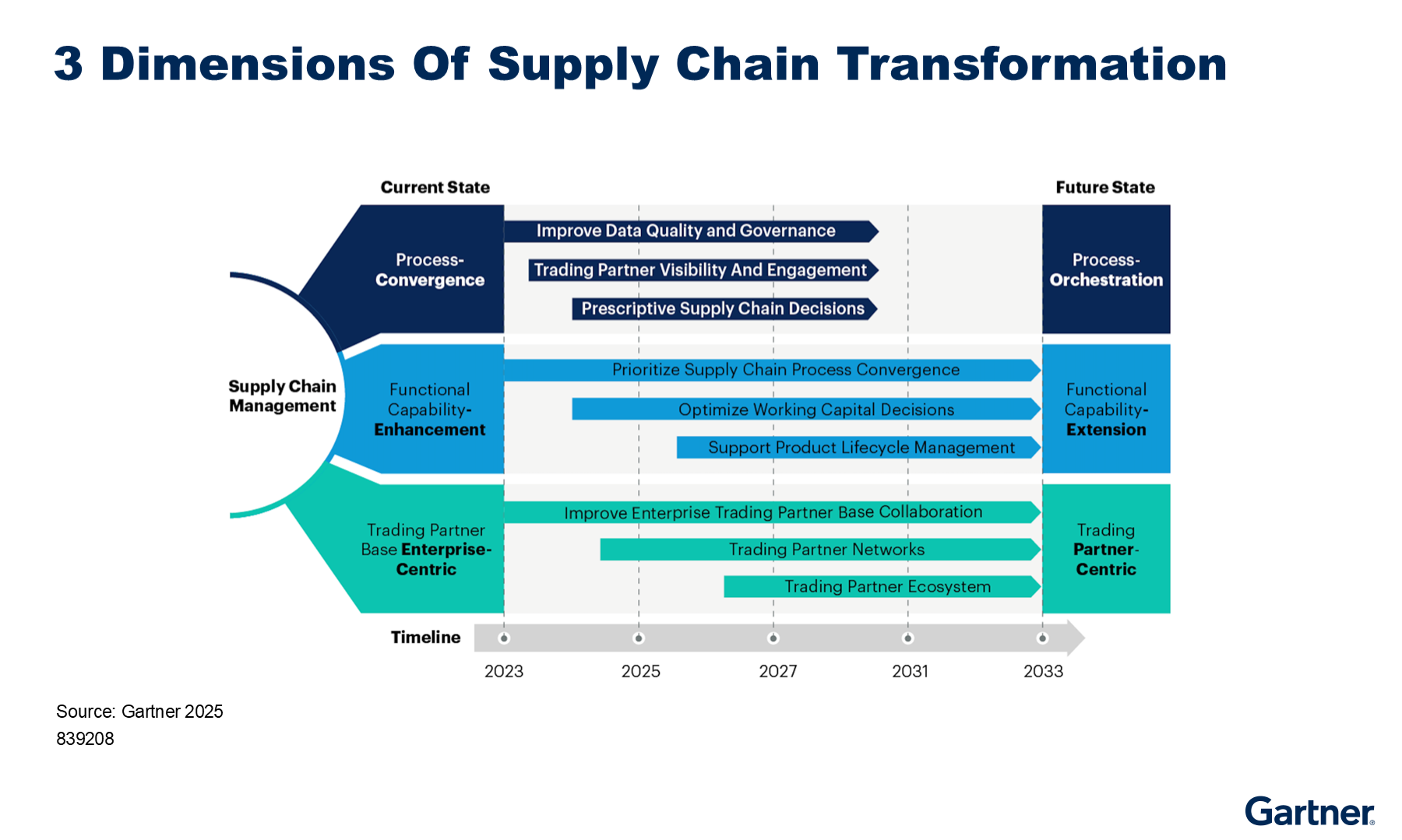
While supply chain leaders can invest in discrete capabilities to help them navigate this transformation across each dimension, investing in a composite supply chain orchestration platform will synchronize the transformation across all three dimensions. Such a synchronized transformation will equip supply chain leaders with the right tools for the next-generation supply chain.
A supply chain orchestration platform is a composite package of core capabilities that enables senior supply chain leaders, such as CSCOs or heads of supply chain strategy, to anticipate, visualize, navigate, and even monetize events in the business ecosystem that could impact their target strategic business outcomes.
The three core capabilities of a SCOP are:
- Supply chain data governance
- Supply chain network enrichment
- Supply chain decision simulation, optimization, and execution
SCOP can cover one or more of the traditional supply chain processes illustrated in the graphic above:
- Planning
- Procurement
- Production
- Logistics and fulfillment
SCOP investments are additive to current and ongoing investments in modernizing supply chain process operations software. They do not replace supply chain process operations software.
How to Invest in Supply Chain Orchestration Platforms?
Supply chain orchestration platforms require a foundational base of composable, modular supply chain process operations software and connected supply chain processes.
Supply chain leaders should modernize their operations software and processes to realize the full benefits of supply chain orchestration platforms.
Supply chain leaders who are using monolithic software and manual processes should upgrade to modular and ideally, composable, software platforms and digitized, or automated, if not autonomous, processes. However, such modernization initiatives are complex, multiyear initiatives that span several supply chain processes. Instead of waiting for the completion of such modernization projects, supply chain leaders should start a phased, incremental SCOP investment journey. The goals for SCOP investments in each phase of this journey should be aligned with the underlying process and technology maturity to deliver demonstrable returns on such investments. The graphic in Figure 2 illustrates an indicative, phased SCOP journey.
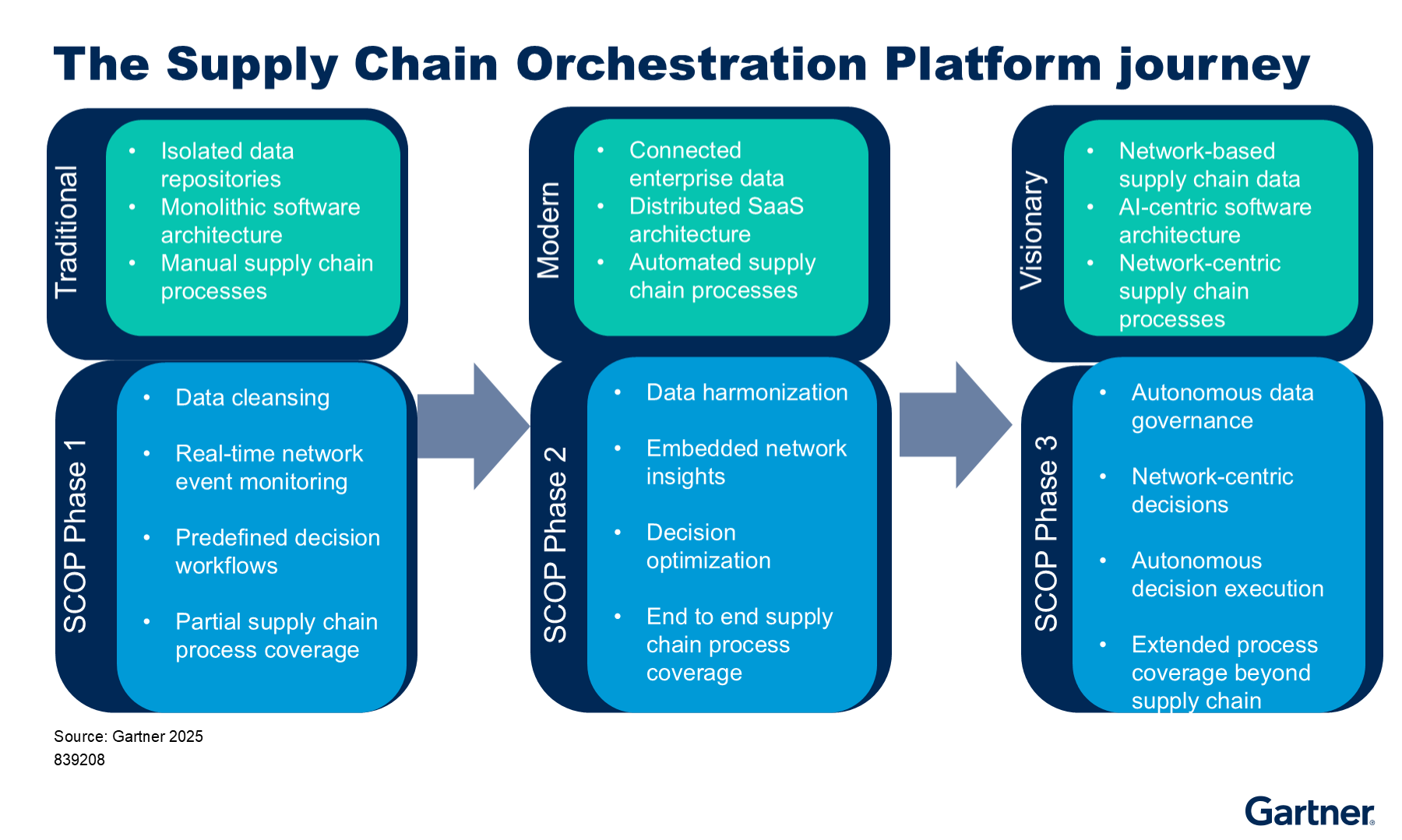
While these phases may not be applicable to all organizations, this illustrative journey provides a starting point for each supply chain leader to craft their own phased SCOP journey.
SCOP journey phase 1 is appropriate for traditional supply chain organizations, characterized by:
- Isolated data repositories.
- Monolithic process operations software for specific supply chain functions like warehousing.
- Predefined decision workflows that are made manually within the enterprise context.
The goals for this phase of the journey include:
- Data cleansing, deduplication, and integrity checks.
- Monitoring supply chain network events and analyzing their impact on ongoing supply transactions.
- Embedding SOP-based decision workflows within each monolithic supply chain process operations application to assist manual decisions.
- Achieving business impact through higher compliance with policy, better governance, and automated decisions.
SCOP journey phase 2 is appropriate for modern supply chain organizations, characterized by:
- Distributed data repositories.
- Modular, SaaS process automation applications.
- Configurable workflows that are designed to support agile and context-aware decisions.
The goals for this phase of the journey include:
- Aggregating and harmonizing data to ensure consistency across distributed internal and external data repositories.
- Embedding contextualized supply chain network insights within the relevant SaaS process automation software.
- Analyzing the impact of decisions across one or more adjacent supply chain process clusters, such as logistics and planning.
- Achieving business impact through consistent, network-aware decisions that cover multiple supply chain process clusters.
SCOP journey phase 3 is appropriate for visionary supply chain organizations, characterized by:
- Network-centric data.
- Agentic-AI-powered process automation applications.
- Network-based, dynamic decision workflows with varying degrees of agentic autonomy.
The goals for this phase of the journey include:
- Autonomous data governance.
- Flexible, balanced, and diversified supply chain networks.
- Extended coverage beyond the supply chain, including finance and product life cycle management.
- Achieving business impact through an agile supply chain that drives organizational goals.
The progress of each phase of the SCOP investment journey, as highlighted above, is not necessarily sequential. For instance, data harmonization for certain high-priority transaction categories can be initiated even while data cleansing continues for the remaining categories.
Conclusion
CSCOs should consider the following while prioritizing their software investments:
- Supply chain orchestration platforms underpin next-generation supply chain software, enabling the transition of the supply chain’s role from an operational tool to a strategic asset for monitoring, navigating, and monetizing ongoing business uncertainties.
- The business impact of SCOP platforms depends on the maturity of the process and technology within the supply chain organization. Supply chain leaders should ensure that they set and measure the returns on their SCOP investment based on the underlying supply chain process and technology maturity.
- SCOP investment is a multiphased journey that requires a phased, incremental approach. Supply chain leaders should carefully define the data, networks, and decision-making goals, as well as the process and business impact of each phase of their SCOP journey.