Emerging Tech: AI Agent Management Platforms Are Required for Agentic Cybersecurity Success
25 February 2026 - ID G00838356 - 7 min read
By Tom Powledge
AI agent management platforms will replace traditional automation tools by unifying multiagent systems for security. Cybersecurity leaders must shift from isolated tools to integrated control planes or risk obsolescence in autonomous operations.
Overview
Key Insights
- C-level executives must pivot from single-agent tools to hierarchical control planes, as monolithic agents are architecturally incapable of navigating the multidimensional reasoning required for enterprise-scale autonomy.
- Autonomous agents are the new privileged insiders. Product success requires a governance layer that treats agents as NHIs and replaces manual intervention with human-on-the-loop supervision.
- To avoid being locked out of the AI agent enterprise ecosystem, vendors must adopt universal interoperability standards like the Model Context Protocol (MCP), enabling their agents to securely interact with third-party tools.
Key Recommendations
Product leaders of agentic security platforms should:
- Rearchitect product roadmaps to support hierarchical multiagent systems using a “hybrid” workflow model, combining deterministic code for master control flows with probabilistic agents for reasoning, to ensure reliability and cost control.
- Integrate robust agent governance and observability layers that treat agents as privileged insiders, implementing short-lived credentials, memory protection against poisoning, and preexecution validation using digital twins.
- Adopt the Model Context Protocol (MCP) as the standard semantic layer, transforming the control plane into a “universal translator” that eliminates friction between proprietary agents and the customer’s heterogeneous security stack.
Analysis
Technology or Trend Description
An AI agent management platform is the centralized control plane designed to deploy, coordinate, govern, and observe the behavior of multiple autonomous AI agents. Unlike traditional security orchestration, automation, and response (SOAR) tools, which rely on rigid, linear playbooks, these platforms manage probabilistic agents that reason through problems, plan multistep workflows, and adapt to real-time feedback.
In the context of cybersecurity, these platforms address the “symphony” problem: organizations have deployed individual AI agents (specialized “virtuosos” for malware analysis, identity verification, etc.), but without a conductor, they operate in silos. AI agent management platforms provide this orchestration by handling state management (tracking investigation progress), conflict resolution (when agents disagree), and tool governance (controlling API access). Leading examples of this architectural shift take the form of security mesh which coordinates a workforce of role-based AI analysts and supervisor agents which manage specialized subagents.
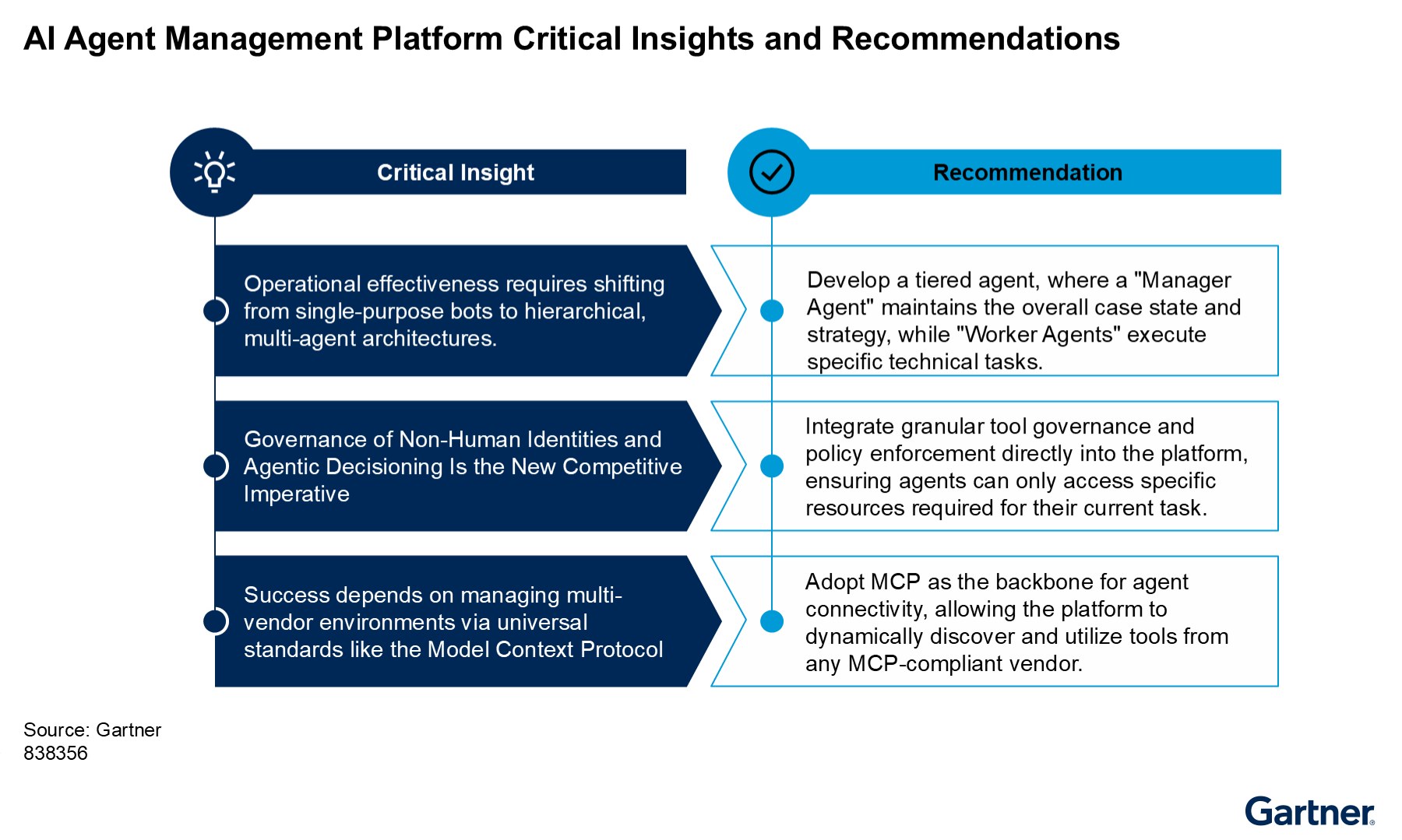
Critical Insight: Operational Effectiveness Requires Shifting From Single-Purpose Bots to Hierarchical, Multiagent Architectures.
Near-Term Implications for Product Leaders
The initial wave of single-agent deployments is failing to scale in complex enterprise environments. Single agents often succumb to context overload or “hallucination loops” when assigned too many tools or complex reasoning tasks. Evidence from practitioners indicates that uncontrolled agentic loops can lead to spiraling costs — up to $10,000/month for a single use case if not properly managed. To deliver production-grade reliability, cybersecurity vendors must transition to multiagent systems (MAS) managed by a central platform. In this model, a “supervisor” or “orchestrator” agent breaks down high-level goals and delegates subtasks to specialized agents (e.g., a “forensics agent” or “identity agent”).
Recommended Actions for the Next 6 to 18 Months
- Develop a tiered agent hierarchy within the platform, where a persona-aligned “manager agent” maintains the overall case state and strategy, while “worker agents” execute specific technical tasks.
- Implement a “hybrid agent” workflow that wraps probabilistic LLM reasoning within deterministic control structures (e.g., state machines) to prevent infinite loops and ensure predictable outputs.
- Invest in pretrained “AI workforces” specific to security domains (e.g., Tier 1 triage, GRC compliance, threat hunting) that can be deployed as modular units within the management platform.
Critical Insight Analysis
The shift from single agents to MAS is driven by the need for specialization. Vendors are implementing “AI analyst workforces,” which include distinct agents like a zero day analyst, vulnerability analyst, and remediation agent. These agents function autonomously but are coordinated by the platform to handle specific aspects of the security life cycle, sharing context to build a unified threat narrative.
Practitioner insights highlight the practical necessity of this approach. SOC architects are moving to a “hybrid agent” model where a deterministic outer shell controls the master flow, while inner loops use agentic reasoning. This structure allows for “differentiated governance,” where the platform can enforce hard guardrails (e.g., “do not contain a production server”) while allowing the agent flexibility in investigation tactics. This modularity mirrors human operational teams, ensuring that no single agent is overwhelmed by context.
Critical Insight: Governance of Nonhuman Identities and Agentic Decision Making Is the New Competitive Imperative.
Near-Term Implications for Product Leaders
As agents gain “agency” — the discretion to act within boundaries — they effectively become nonhuman identities (NHIs) with high-level system access. This introduces significant risks, including prompt injection, memory poisoning, and unauthorized tool use. Enterprise buyers will block adoption of autonomous platforms that cannot prove rigorous governance. Product leaders must build management platforms that treat agent identity and authorization as core features, enforcing least privilege and providing immutable audit trails for every autonomous decision.
Recommended Actions for the Next 6 to 18 Months
- Integrate granular tool governance and policy enforcement directly into the management platform, ensuring agents can only access specific APIs and datasets required for the current task.
- Implement mandatory human-in-the-loop (HITL) checkpoints for high-impact actions (e.g., isolating a domain controller), allowing the agent to recommend actions but requiring human authorization to execute.
- Embed “digital twin” simulation capabilities to validate agent actions before execution. By simulating a remediation step in a virtual twin, the platform can verify the outcome and prevent the threat without disrupting business operations.
Critical Insight Analysis
Security for agents is becoming as critical as the security provided by agents. Research highlights risksrisk such as model hijacking, where a malicious prompt tricks an agent into executing unauthorized commands via its connected tools. The OpenID Foundation warns that existing identity frameworks are insufficient for autonomous agents that may spawn subagents or operate across organizational boundaries.
To mitigate this, some vendors employ a “digital twin” simulation to validate agent actions. Before an agent executes a remediation (such as blocking a port), it simulates the action in the digital twin to confirm it mitigates the risk without breaking business processes. This “validate before acting” capability is a prime example of the governance features required in next-generation management platforms. Additionally, using “LLM as a judge” to evaluate agent decisions before final disposition provides a critical quality control layer, ensuring precision in automated responses.
Critical Insight: Success Depends on Managing Multivendor Environments Via Universal Standards Like the Model Context Protocol.
Near-Term Implications for Product Leaders
Cybersecurity environments are notoriously fragmented, consisting of disparate tools (SIEM, EDR, and IAM) that do not natively communicate. Building custom-made integrations for every tool is unscalable. To survive, AI agent management platforms must adopt the Model Context Protocol (MCP), which acts as a “USB-C for AI,” providing a standardized way for agents to connect to data and tools. In a multivendor security mesh, the value proposition has shifted from who has the most built-in integrations to who possesses the most capable reasoning engine for the customer’s existing stack. Vendors who fail to support MCP will find their agents isolated and unable to access the real-time context required to eliminate autonomous friction and to execute reliable, grounded reasoning, to be effective in enterprise environments.
Recommended Actions for the Next 6 to 18 Months
- Adopt MCP as the backbone for agent connectivity, allowing the platform to dynamically discover and use tools from any MCP-compliant vendor without custom coding.
- Develop an open ecosystem strategy that encourages customers and partners to build their own MCP servers, expanding the platform’s capabilities beyond what the vendor natively supports.
- Architect the management platform to support secure RAG (retrieval-augmented generation) via MCP, enabling agents to fetch live, authenticated data (e.g., ticket status, threat intel) to ground their reasoning in current reality and prevent hallucination loops.
Critical Insight Analysis
The Model Context Protocol (MCP) is rapidly becoming the industry standard for connecting AI models to external systems. It allows an agent to query a SIEM, pull threat intel, or update a ticket through a unified interface, abstracting away the underlying complexity of individual APIs. This abstraction is crucial for multivendor orchestration, as seen in leading AI SOC platforms that normalize telemetry from over 150 tools into a unified “security mesh,” effectively creating a semantic layer that agents can reason over.
Similarly, vendors are leveraging MCP to connect agents to real-time enterprise data in a secure, auditable manner. By adopting MCP, a management platform essentially future-proof itself; as clients add new tools that are MCP-compliant, the agents can immediately use them. This shifts the value proposition from “who has the most built-in integrations” to “who has the best management and reasoning engine” for the diverse ecosystem of tools a client already owns.
Acronym Key and Glossary Terms
| AAMP | AI agent management platform: The control plane managing multiple autonomous AI agents. |
| HITL | human-in-the-loop: A governance mechanism requiring human approval for specific agent actions. |
| MAS | multiagent system: A network of specialized agents working collaboratively to solve complex problems. |
| MCP | Model Context Protocol: An open standard for connecting AI models to external data and tools. |
| NHI | nonhuman identity: Digital credentials used by autonomous agents, requiring specific security controls. |
| RAG | retrieval-augmented generation: Enhancing AI responses by retrieving relevant data from external sources. |
| TDIR | threat detection, investigation, and response |