Magic Quadrant for Integration Platform as a Service
16 March 2026 - ID G00836353 - 57 min read
By Andrew Humphreys, Keith Guttridge, and 2 more
AI is changing expectations for the iPaaS market, driving innovation and creating demand for new capabilities to support integration requirements coming from AI initiatives. This evaluation reviews 18 leading vendors to help buyers identify platforms best aligned with their business goals.
Market Definition/Description
Gartner defines integration platform as a service (iPaaS) as a vendor-managed cloud service that enables users to implement integrations between applications, services and data sources, both internal and external to their organization.
iPaaS enables users of the platform to integrate a variety of internal and external applications, services and data sources for at least one of the three main patterns of integration technology use:
- Data consistency: The ability to monitor for or be notified by applications, services and data sources about changes, and to propagate those changes to the appropriate applications and data destinations (for example, “synchronize customer data” or “ingest into data lake”)
- Multistep process: The ability to implement multistep processes between applications, agents, services and data sources (for example, to “onboard employee” or “process insurance claim”)
- Composite services: The ability to create composite services exposed as APIs or events and composed from existing applications, services and data sources (for example, to create a “credit check” service or to create a “generate fraud score” service)
These integration use cases are most commonly implemented via intuitive low-code or no-code developer environments or AI augmented experiences like chatbots or assistants, though some vendors provide more complex developer tooling.
Mandatory Features
- A control plane that is provided to the customer as a cloud service
- A runtime data plane that is provided to the customer as a cloud service or on the customer’s infrastructure fully managed by the vendor for all software patches and updates
- Low- or no-code visual development tools and integrated development environments (IDEs) to design and implement integration flows for data consistency, multistep processes and composite services use cases
- Software development life cycle (SDLC) tooling to enable SDLC management, including versioning, testing and deployment
- Role-based access control (RBAC) tools to control access to platform resources
- Tools to enable operational monitoring, alerting, reporting and auditing of integrations, processes, pipelines and services in production environments
Common Features
- AI augmentation to help generate documentation, and build and test integrations
- Catalogs to discover integration assets such as APIs, events and connectors
- Packaged integration processes (PIPs) to accelerate integration delivery
- AI augmentation to help operate the platform. For example, self-healing or resource provisioning
- Features to support integration requirements from AI initiatives. For example, accelerators for retrieval-augmented generation (RAG) and fine-tuning of AI models, and tools for building and managing AI agents
- Support for emerging AI protocols like Model Context Protocol (MCP) and Agent2Agent (A2A)
- Secure connectivity to applications, services and data sources outside of the vendor-provided cloud
- Intelligent document processing (IDP) features for processing scanned documents and file attachments
- Task or process mining
- Service discovery
- Data discovery
Magic Quadrant
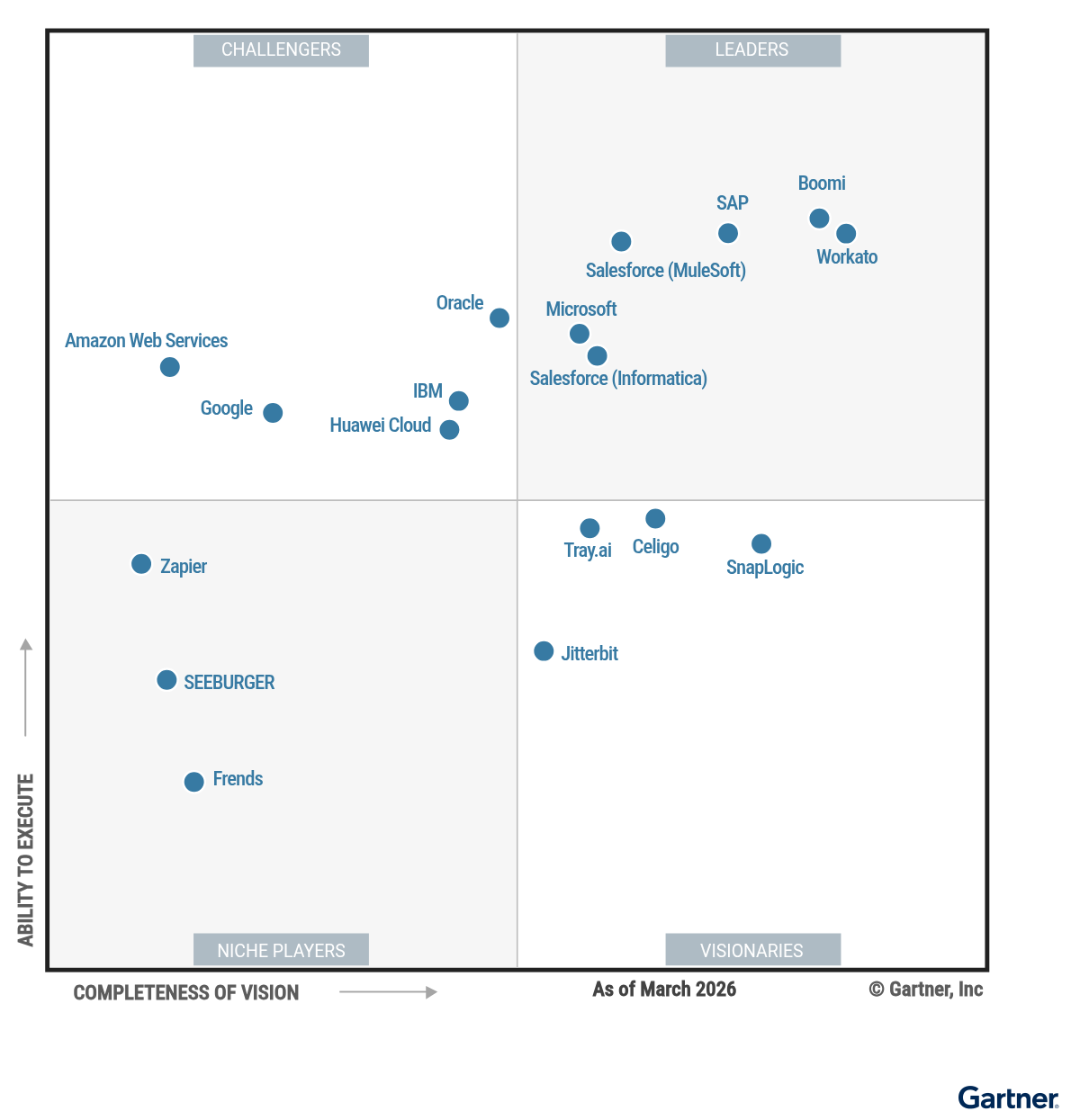
Vendor Strengths and Cautions
Amazon Web Services
Amazon Web Services (AWS) is a Challenger in this Magic Quadrant. It offers a broad set of pay-as-you-go and subscription‑based integration services that can be combined to support diverse integration needs. Key offerings include Amazon API Gateway, Amazon AppFlow, Amazon EventBridge, Amazon Kinesis, AWS AppSync, AWS Glue, AWS Lambda, AWS Step Functions and AWS Transfer Family.
AWS operates globally, with customers across many industries. Its integration services are primarily used by software developers working on applications hosted within an AWS cloud environment to address connectivity challenges coming from those applications.
AWS did not respond to requests for supplemental information. Gartner’s analysis is therefore based on other credible sources.
- Geographic strategy: AWS operates a large, global network of data centers and delivers its integration services in virtually all regions, though it has a smaller presence in China. It supports this infrastructure with worldwide sales teams and an extensive partner ecosystem that provides localized customer support. Buyers can use the publicly available AWS services by region site to validate local availability of services.
- Operations: AWS’ global cloud infrastructure offers high-availability, low‑latency performance and resilient workloads across multiple AWS Availability Zones. It supports regional deployments, enabling buyers to design their implementations to meet regulatory and data sovereignty requirements.
- Sales execution/pricing: AWS uses a transparent pay‑as‑you‑go pricing model with no long‑term commitments, and it offers cost management tools such as AWS Pricing Calculator and AWS Cost Explorer.
- Offering (product) strategy: AWS delivers an inconsistent developer experience across its integration service, resulting in limited cohesion and difficulty in tracking costs across multiple services, although it does provide AWS Cost Explorer to assist with this. Some capabilities, such as advanced electronic data interchange (EDI) and certain connectors, depend on third‑party AWS Marketplace offerings, adding implementation complexity
- Market understanding: AWS offers limited support for business technologists and citizen developers compared to leaders in this Magic Quadrant. Its integration experience is primarily designed for application developers working on AWS, which restricts its appeal to broader integration teams.
- Marketing strategy: AWS’ marketing focuses on broad, horizontal cloud capabilities, rather than integration-specific use cases and outcome‑driven messaging. This focus makes it harder for buyers to quickly assess its iPaaS value.
Boomi
Boomi is a Leader in this Magic Quadrant. It offers the Boomi Enterprise Platform, which includes Boomi AI, Boomi API Management, Boomi B2B/EDI Management, Boomi Data Hub, Boomi Data Integration, Boomi Event Streams, Boomi Flow, Boomi Managed File Transfer, Boomi Integration & Automation, and Boomi Task Automation.
Boomi operates primarily in North America, with some presence in Europe. Latin America and Asia/Pacific. It has customers across all industries. Its integration platform is primarily used by integration specialists to address a wide range of enterprise integration requirements. In May 2025, Boomi acquired Thru to improve its managed file transfer (MFT) capabilities.
- Product or service: Boomi has expanded its AI‑native integration features to make building integrations easier. It added capabilities to create and manage MCP servers to support its new Boomi AI Agent Management platform, Boomi Agentstudio. Boomi also enhanced its runtime to improve operations and has unified the user experience with single sign-on and streamlined interoperability.
- Marketing strategy: Boomi is a well‑known iPaaS vendor that demonstrates a deep understanding of integration and related markets. Its product marketing reflects themes that buyers care about, such as API management, data management, integration and automation, and AI agent management. Boomi tailors its messaging to align with the needs of diverse industries and use cases.
- Vertical/industry strategy: Boomi continues to improve its industry-specific services, especially for energy, higher education, manufacturing and retail. Its dedicated teams and large partner network also cater to buyers seeking industry-specific solutions.
- Customer experience: In Gartner Peer Insights, Boomi received relatively lower overall customer satisfaction ratings compared to some of the other Leaders in this evaluation. Customers cited evaluation and contracting, and service and support as two areas where Boomi could improve.
- Operations: Boomi has acquired several companies to improve its integration capabilities, resulting in a fragmented portfolio of cloud services that run in different data centers. The control planes for its services are not available locally in all regions. For example, the Boomi Enterprise Platform control plane is currently only hosted in the U.S. Buyers should validate in what data centers their chosen Boomi services are running.
- Geographic strategy: Boomi’s customers and revenue continue to be concentrated in North America, especially compared to other Leaders in this evaluation. This is despite Boomi’s continued investment to expand in other regions, including its recently announced partnerships with AWS and DXC Technology. Buyers outside of North America should ask Boomi how such partnerships will provide localized implementation and operational support in their region.
Celigo
Celigo is a Visionary in this Magic Quadrant. It offers Celigo Intelligent Automation Platform, which provides application and data integration, API management, and B2B and EDI management capabilities.
Celigo’s operations are primarily in North America, with some presence in Europe and Asia/Pacific. Its integration platform is primarily used by citizen integrators in lines of business. Its clients tend to be midsize and large organizations in the e-commerce sector.
- Market understanding: Celigo’s integration platform is designed to help line-of-business users autonomously integrate data and applications, with features such as governed self-service and AI-native error resolution. Its recent rebranding as an intelligent automation platform reflects an understanding of the trend toward AI-ready integration.
- Offering (product) strategy: Celigo Intelligent Automation Platform includes AI features and proactive monitoring to support business users in creating reliable automations, making data-driven decisions and automatically resolving exceptions.
- Marketing strategy: Celigo’s marketing targets business unit buyers in midsize organizations, with an emphasis on e-commerce companies and departmental leaders in finance and go‑to‑market teams. Celigo tailors its messaging to focus on the use cases and capabilities that most strongly resonate with its primary buyers.
- Sales execution: Celigo is a smaller organization than the Leaders in this Magic Quadrant. Its relatively limited sales coverage and smaller partner ecosystem may constrain support for complex deployments and access to local services.
- Marketing execution: Celigo has not yet clearly differentiated its iPaaS platform from larger competitors outside its midmarket focus. As a result, enterprise buyers may be unaware of Celigo’s strengths and capabilities, limiting its ability to expand beyond its core market.
- Product or service: Celigo is optimized for cloud-native and API-driven patterns. Organizations with extensive legacy, non-web-standard protocol requirements (e.g., mainframes or niche industrial hardware) may require complementary partner solutions.
Frends
Frends is a Niche Player in this Magic Quadrant. It offers Frends iPaaS, a unified low-code experience for delivering integration, business process automation, API development and API management that is built on and integrates deeply with Microsoft Azure. It also offers Business Automation Portal and API Portal as add-ons.
Frends’ operations are primarily in Europe, with some presence in Asia/Pacific and the Middle East. Its end users are primarily business process experts and integrators looking for a low-code iPaaS platform, especially those in the energy and utilities, manufacturing, healthcare, technology and government sectors.
- Vertical/industry strategy: Frends continues to effectively target energy and utilities, healthcare and manufacturing industries with tailored accelerators and frameworks. This focus resonates with buyers who have industry-specific constraints.
- Operations: Frends provides a control plane hosted on Microsoft Azure across every major region except Latin/South America and provides sovereign cloud support for EU deployments. Frends also supports hybrid and self-managed deployment models, including air-gapped deployments.
- Market understanding: Frends demonstrates a good understanding of enterprise integration challenges. It provides a cost-effective, low-code platform with a unified set of capabilities and a consistent Business Process Model and Notation (BPMN)-based user experience across all capabilities. Its newly released capabilities align with this vision, including improved support for long-running processes, the addition of an API portal and AI orchestration via Intelligent AI Connector.
- Sales execution/pricing: Frends lacks the robust sales force and resources of its larger competitors. Its smaller size limits its ability to expand and reach new buyers across diverse regions and industries.
- Geographic strategy: Frends’ commercial and support presence is primarily in Europe, as are its customers. It continues to have a limited presence in Asia/Pacific and the Middle East and Africa, and no commercial or support presence in North America or Latin/South America. Buyers outside of Europe should assess the vendor’s ability to provide localized support in their region.
- Marketing execution: As in previous years, Frends’ marketing efforts have not sufficiently differentiated the capabilities of its iPaaS platform from those of larger competitors, apart from its campaign in the Nordic countries. Also, it has not significantly improved its market visibility outside Europe. Buyers in other regions may lack awareness of Frends’ strengths and capabilities.
Google is a Challenger and a new entrant in this Magic Quadrant. It offers a range of integration-focused products, including Apigee API Management, Application Integration, Cloud Composer, Dataflow, Cloud Data Fusion, Datastream, Document AI, Integration Connectors, Managed Service for Apache Kafka, Pub/Sub and Workflows.
Google operates globally, and it supports customers across all industries. Its integration capabilities are primarily used by software developers to address integration challenges for applications built on Google Cloud.
Google did not respond to requests for supplemental information. Gartner’s analysis is therefore based on other credible sources.
- Operations: Google embeds compliance capabilities directly into Google Cloud. Services such as Assured Workloads, Sovereign Cloud, and Compliance Reports Manager enable buyers to enforce data residency, personnel access and audit requirements. Google publishes detailed certifications and attestations in its centralized compliance portal, allowing buyers in regulated industries to easily verify eligibility of its integration services.
- Geographic strategy: Google has regionally aligned sales and support and an extensive partner ecosystem that provides localized expertise in most regions. Its integration services are hosted across Google Cloud regions to support data residency and latency-sensitive requirements. It is transparent about what integration services are available in each region.
- Innovation: Google has added AI-native features across many of its integration services. For example, Application Integration uses AI to assist with flow design and data mappings, and Apigee API Management applies ML and AI for API analytics. These features have improved the usability of its services and better enable buyers to create AI-ready integrations.
- Sales execution/pricing: Google prices each of its integration services separately, using a mix of pay-as-you-go and subscription-based pricing. While this provides granularity, accurately estimating the cost of using multiple services can quickly become complicated, and buyers may need to leverage Google’s pricing calculator or engage with Google sales experts to map out the costs associated with using multiple services.
- Offering (product) strategy: Google’s strategy is to deliver a collection of integration-focused tools rather than a unified iPaaS offering. While this provides flexibility, buyers seeking a cohesive integration solution may find the collection of services to be complex.
- Customer experience: In Gartner Peer Insights, while customers have rated some of Google’s individual services highly, other services score less well. There is an opportunity to enhance the user experience across the full suite of tools, particularly in simplifying the debugging process across services.
Huawei Cloud
Huawei Cloud is a Challenger in this Magic Quadrant. It offers a range of integration services, including ROMA Connect, Huawei API Gateway, Huawei EventGrid and Huawei Distributed Message Service.
Huawei Cloud’s operations are mainly in Asia/Pacific, with some presence in Europe, the Middle East and Africa, and Latin America/South America. Its customers are primarily integration specialists and application developers across most industries.
- Vertical/industry strategy: Huawei Cloud has deep experience in delivering industry-specific solutions for energy, manufacturing, retail, finance and government. Its iPaaS provides tailored connectors and strong solution templates for specific use cases in these industries.
- Product or service: Huawei Cloud’s integration products enable buyers to address a wide variety of integration and automation use cases. They provide a range of integration-related services for API management, application integration, B2B/EDI integration, data integration, event streaming and messaging. Huawei Cloud also offers the ROMA Connect AI Assistant, which provides flow generation and mapping features; and ROMA MCP, which helps integrators deploy their existing APIs as MCP servers.
- Overall viability: Gartner estimates that ROMA Connect grew by 60% in 2025, doubled its annual revenue and substantially expanded its customer base. The strong growth rate of ROMA Connect, along with Huawei Cloud’s continued investment in R&D, demonstrates the vendor’s long-term commitment to iPaaS.
- Marketing strategy: Buyers looking for a stand-alone integration vendor may lack awareness of Huawei Cloud’s iPaaS offering. Huawei Cloud’s messaging focuses on its reputation as a hyperscaler and on broader themes like digital transformation and AI enablement. It positions iPaaS as one of the many services it offers to deliver that value.
- Market understanding: ROMA Connect is geared toward integration specialists and technical users. Huawei Cloud lags its competitors in terms of capabilities that empower business users and citizen integrators to support integration testing, optimization and operations.
- Geographic strategy: Huawei Cloud’s customers are concentrated in Asia/Pacific and the Middle East and Africa, and it has a growing presence in Latin America. It does not operate in the U.S. Buyers should determine if Huawei Cloud can provide local technical expertise, implementation partners and support in their region.
IBM
IBM is a Challenger in this Magic Quadrant. Its primary iPaaS offering is IBM webMethods Hybrid Integration, which supports application, data, and B2B/EDI integration, along with API management and message/event processing. IBM also offers integration capabilities as stand-alone SaaS offerings, including IBM App Connect, IBM API Connect, IBM Event Automation, IBM MQ, IBM Sterling B2B Integration Suite, IBM StreamSets and IBM watsonx Orchestrate. IBM Red Hat also provides integration capabilities, but these features were not assessed in this Magic Quadrant.
IBM operates globally across all major industries. Its integration portfolio is primarily used by integration specialists to address enterprisewide, mission‑critical integration requirements.
- Product or service: IBM provides a broad range of integration capabilities designed to support complex requirements. Its products enable buyers to implement diverse integration patterns with enterprise-grade reliance, performance and scalability.
- Operations: IBM supports flexible deployment models, including managed services on AWS and Microsoft Azure, as well as hybrid, self‑managed and self-hosted environments, giving buyers broad choice and control over their operational architecture.
- Geographic strategy: IBM delivers global coverage through its extensive sales, support and partner ecosystem, providing localized expertise across most major regions. The company continues to expand its data‑center footprint and cloud deployment options, offering broader regional availability and multilingual tooling to support worldwide adoption.
- Market responsiveness: In the last few years, IBM has consistently delivered new capabilities at a slower pace than the Leaders in this Magic Quadrant. It can take multiple release cycles for new features to reach production readiness. Buyers should expect steady, incremental evolution rather than immediate access to cutting‑edge innovations.
- Sales strategy: IBM sales prioritizes large, complex enterprise initiatives, positioning integration within broader IBM‑led transformation programs. Buyers in small organizations with simpler integration needs or without existing IBM relationships may find that this focus does not align with their priorities.
- Marketing execution: IBM’s iPaaS marketing primarily targets existing IBM customers with complex integration needs. This approach limits its market reach and has not expanded awareness among buyers outside the IBM ecosystem.
Jitterbit
Jitterbit is a Visionary in this Magic Quadrant. It offers Jitterbit Harmony, which delivers a unified platform for application, data and B2B/EDI integration, API creation and management, AI enablement and agent building, low-code application development, cloud data storage, and message queueing.
Jitterbit operates globally and primarily has customers across manufacturing, retail and professional services industries. Jitterbit’s broad set of integration capabilities are used by both business technologists in lines of business and integration specialists in IT teams.
- Market understanding: Jitterbit displays a strong understanding of integration needs, providing a unified, low-code platform with capabilities for application integration, API management, B2B/EDI, messaging, and building AI agents and applications.
- Customer experience: Jitterbit performs well in terms of overall customer satisfaction based on Gartner Peer Insights reviews and other customer review sites. Clients consistently cite its ease of use and the high quality of its support services.
- Offering (product) strategy: Jitterbit has added AI assistants for integration, API management and app building to simplify building, managing and maintaining integrations, APIs and web/mobile applications, respectively. Jitterbit plans to deliver AI assistance capabilities for B2B/EDI and operational needs.
- Operations: Jitterbit has expanded its data plane coverage by introducing data centers to cover all geographic regions. However, it does not have local control plane options for Latin America/South America or the Middle East and Africa. Buyers in those regions should validate if Jitterbit meets their operational and compliance requirements.
- Marketing execution: Jitterbit remains a smaller organization than the Leaders in this Magic Quadrant in terms of revenue and customer numbers, despite having a direct commercial presence across all regions. It also lags competitors in brand recognition for its iPaaS offering, which limits its ability to reach new buyers.
- Vertical/industry strategy: Jitterbit offers fewer industry-specific solutions compared to its competitors, although industry-specific AI agents are on its product roadmap. Buyers with stringent industry-specific needs should validate if Jitterbit meets their requirements.
Microsoft
Microsoft is a Leader in this Magic Quadrant. It offers Azure Integration Services (AIS), a suite of cloud-based tools that includes Azure API Management, Azure Event Grid, Azure Logic Apps and Azure Service Bus. It also offers Microsoft Power Automate, a low-code/no-code option for rapid development and full-code extensibility in Azure Functions and Visual Studio for complex scenarios, all of which integrate with Azure’s integration and AI services.
Microsoft’s operations are global, and it has customers across most industries. AIS is most commonly used by customers looking to integrate applications and ERP systems running on Azure or wanting integration to be hosted on Azure as part of their cloud strategy.
- Geographic strategy: Buyers in all regions can be confident that Microsoft offers local deployment and support options. It has more than 400 data centers across 70 regions and continues to expand, having added data centers in Belgium, Austria, Chile, Indonesia and Malaysia in 2025, and also supports sovereign cloud and regulated industry environments. It has an extensive partner network of system integrators.
- Customer experience: Microsoft provides a wide range of tools that cater to different personas. Azure Logic Apps offers a visual, low-code interface with more than 1,400 connectors for business analysts, while Azure Functions and Visual Studio integration provide a pro-code environment for professional developers. This allows teams to collaborate on the same project using the level of abstraction that fits their skill set.
- Sales execution/pricing: AIS offers flexible pricing with hybrid consumption and tier-based pricing models. This approach provides an affordable entry point for small projects, while also offering predictability for enterprise-scale projects. It offers pay-per-use execution for services like Azure Logic Apps and Azure Event Grid, complemented by fixed-fee premium tiers and provisioned capacity for Azure API Management and Azure Service Bus.
- Offering (product) strategy: AIS remains a collection of discrete services. While this modularity offers flexibility, it places the burden of security hardening, networking configuration, and state management on the user, and organizations may need to architect cohesive integration patterns across services to achieve unified governance.
- Vertical/industry strategy: While AIS provides more than 1,400 prebuilt connectors across SaaS, enterprise applications, and data services, its portfolio focuses primarily on horizontal integration scenarios. Organizations with specialized or niche vertical requirements may find they need to use third-party connectors or develop their own.
- Product or service: AIS’ governance capabilities are less mature than other Leaders in this Magic Quadrant. In particular, buyers that use a multicloud strategy and specialized SaaS solutions will need to adopt a third-party governance layer to manage integrations in non-Azure environments.
Oracle
Oracle is a Challenger in this Magic Quadrant. It offers Oracle Integration Cloud (OIC), a core component of Oracle Cloud Infrastructure that underpins all its application offerings. OIC delivers application, data, and agent integration, business process automation, and a low-code development tool in a single unified platform that also provides agent building, agent management, MCP and human-in-the-loop support for AI integration requirements.
Oracle’s operations are globally distributed, though most of its customers are in the U.S. and Europe and are spread across most industries. OIC is most commonly used by integration specialists in organizations that are invested in the Oracle stack, as it simplifies handling of complex data objects and security across Oracle applications.
- Sales execution/pricing: OIC’s pricing is highly elastic, as it is structured around three tiers of message packs: Standard, Enterprise and Healthcare. The model allows buyers to pay in proportion to usage, starting small and growing with demand, while the tiers also enable predictable budgeting for enterprise governance.
- Operations: OIC provides high availability across North America, Europe, the Middle East, Asia/Pacific and Latin America, with additional regions being built out. Oracle also provides government and sovereign cloud regions in the U.S., U.K., Australia and the EU. The platform provides strong disaster recovery capabilities, zero downtime upgrade and patching, and high-volume message throughput.
- Geographic strategy: Oracle offers OCI across 51 public cloud regions and 26 countries. It also has an extensive partner network of system integrators, software vendors and hardware companies.
- Customer experience: Oracle provides a single support organization for all its offerings; however, in Gartner Peer Insights, Oracle customers have cited challenges with documentation and in resolving cross-product issues. Support for OIC is often siloed from support for the Oracle SaaS applications it connects to, forcing customers to coordinate with multiple internal Oracle teams to resolve a single integration failure.
- Offering (product) strategy: Oracle provides deep, metadata-rich adapters and accelerators for Oracle SaaS applications. However, buyers trying to integrate non-Oracle platforms may find OIC lacks the same level of deep prebuilt content compared to other vendors in this Magic Quadrant.
- Marketing strategy: Oracle’s marketing focuses on large‑scale transformation initiatives, positioning integration as part of those broader programs. This limits visibility and adoption among smaller organizations with more basic integration needs and no existing Oracle relationship.
Salesforce (Informatica)
Informatica is a Leader in this Magic Quadrant. It offers the Intelligent Data Management Cloud (IDMC) platform, a data-focused integration platform that includes Cloud API and Application Integration, Cloud B2B Gateway, Cloud Integration Hub, API Manager, API Center, Cloud Data Integration, and Cloud Data Ingestion and Replication.
Informatica operates globally and across all industries. It is primarily used by integration specialists to address data-centric integration patterns.
Salesforce acquired Informatica on 18 November 2025, which was after our research cutoff date. In this section, we analyze Salesforce (Informatica). In the next section, we analyze Salesforce (MuleSoft). Gartner will provide further insight into the implications for Salesforce’s combined roadmap and strategy as more details emerge.
- Customer experience: Informatica provides robust post‑sales support, with customer success managers and architects engaged in solution design, architecture reviews and health checks. Its strong partner ecosystem, as well as first‑ and third‑party consulting services, help accelerate customer deployments.
- Innovation: Informatica has a strong track record of AI‑driven innovation, including early support for AI agent orchestration, MCP support and capabilities that enable AI‑ready data. Its CLAIRE AI capabilities provide conversational interfaces for generating, documenting and troubleshooting integration workflows.
- Product or service: IDMC is a cohesive, enterprise‑grade platform that supports a wide range of integration requirements, delivering strong reliability, performance and scalability. It offers flexible deployment options across AWS, Google Cloud, Microsoft Azure and hybrid environments.
- Offering (product) strategy: Salesforce’s acquisition of Informatica introduces uncertainty around the long‑term positioning and investment priorities of Informatica IDMC. Buyers should monitor Salesforce’s roadmap for IDMC to ensure it aligns with their long-term integration strategy, and to understand how Salesforce will manage potential redundancies in capabilities across IDMC and MuleSoft.
- Marketing execution: Informatica’s data‑centric heritage may limit its appeal for buyers seeking application‑led, event‑driven or lightweight integration capabilities. Buyers in organizations with broader integration requirements should assess Informatica’s roadmap and suitability for their use cases.
- Sales execution/pricing: Informatica primarily serves large enterprises with complex, data‑centric integration needs, and Gartner clients report that entry‑level adoption costs are high. This limits its appeal to smaller organizations or buyers with limited initial scope looking for lower entry costs.
Salesforce (MuleSoft)
MuleSoft is a Leader in this Magic Quadrant. Its MuleSoft Anypoint Platform provides integration, API management, B2B partner management, and automation capabilities. Anypoint also provides agent integration and management capabilities. Salesforce also offers MuleSoft Agent Fabric and Agentforce MuleSoft that target AI use cases.
Salesforce operates globally across all industries, with its customers mainly being midsize and large organizations. It is primarily used by integration specialists for enterprise integration and API management.
Salesforce acquired Informatica on 18 November 2025, which was after our research cutoff date. Thus, Informatica is assessed separately in this evaluation. Gartner will provide further insight into the implications for Salesforce’s roadmap and strategy as more details emerge.
- Marketing execution: Salesforce’s iPaaS marketing has consistently shaped the direction of the market, first with API‑led integration and now with a clear pivot toward AI agent‑native integration platforms. Salesforce has attained global brand recognition for MuleSoft, and its messaging effectively conveys MuleSoft’s strengths in API‑first delivery, AI governance, A2A/MCP support, and management of APIs and agents.
- Customer experience: Salesforce continues to invest heavily in supporting its user community. Its AI‑powered Salesforce Help tool recommends deployment improvements, while its Signature Success Plan tier includes dedicated customer success managers, health checks, architect access and accelerated support. Salesforce customers also benefit from a large community of certified MuleSoft partners for support and services.
- Vertical/industry strategy: Salesforce includes MuleSoft in its Industry Clouds to provide prebuilt integration templates specific to industries like financial services, healthcare, retail, communications and manufacturing, as well as for key functions like sales, service, marketing and commerce.
- Offering (product) strategy: Salesforce’s acquisition of Informatica introduces a second major iPaaS into its portfolio, creating uncertainty around its future positioning and investment priorities for MuleSoft Anypoint Platform. Clients should monitor Salesforce’s roadmap for Anypoint Platform to ensure it aligns with their long‑term integration strategy.
- Innovation: Salesforce has focused on strengthening its agent‑native integration and management capabilities. Aside from these developments, it has delivered relatively fewer new capabilities compared to other Leaders. In particular, Gartner clients report that MuleSoft Anypoint Platform lags behind competitors in usability improvements.
- Sales execution/pricing: Gartner client inquiries and Peer Insights reviews continue to indicate that Salesforce’s pricing structure for MuleSoft is complex, and overage charges can lead to unexpected costs.
SAP
SAP is a Leader in this Magic Quadrant. It offers SAP Integration Suite, which is part of the SAP Business Technology Platform (SAP BTP). It provides application, data, events, process, AI and business integration capabilities that support both SAP and non-SAP environments across hybrid and multicloud architectures.
SAP’s operations are global, with customers across most industries. Most of its customers are large and midsize organizations, frequently with complex manufacturing and logistics needs. Its primary users are integration specialists and business technologists.
- Product or service: SAP Integration Suite features a full set of iPaaS capabilities, and an extensive library of more than 4,000 prebuilt integration flows and 250 third-party adapters. The platform provides API management, event-driven architecture and AI-assisted development tools in a single environment that supports both SAP-native and non-SAP ecosystems. Buyers can scale the platform across diverse deployment models, as the Edge Integration Cell supports hybrid and on-premises requirements.
- Vertical/industry strategy: SAP continues to offer a strong portfolio of prepackaged integration flows and specialized business accelerators that are maintained and updated to reflect evolving regulatory and operational requirements for more than 25 industries.
- Geographic strategy: SAP has an extensive sales and support ecosystem that enables consistent delivery across regions. SAP Integration Suite is offered in more than 40 data centers across major hyperscalers and regulated environments, with strong options for in-region processing and sovereignty. SAP reinforces this with broad compliance coverage and enterprise-grade reliability targets that support buyers who require regional control and consistent global operations.
- Market responsiveness: While competitors have moved quickly to introduce agentic AI features, SAP’s recent roadmap has emphasized integration modernization, platform consolidation, and migration of legacy customers to SAP Integration Suite. As a result, some advanced users perceive SAP’s delivery of AI-driven features to lag behind other Leaders that have prioritized earlier roll outof agentic capabilities.
- Offering (product) strategy: The SAP platform’s architecture and terminology remain heavily rooted in and optimized for the SAP ecosystem. Teams that primarily use non-SAP applications often experience a steeper learning curve and find that the UI is less intuitive than low-code alternatives.
- Sales execution/pricing: SAP’s consumption-based pricing model can be difficult for customers to forecast accurately. Buyers sometimes struggle to estimate their message volumes and API calls, which can lead to higher-than-expected costs as data throughput scales across global hybrid landscapes and the message volume of event-driven architectures unpredictably increases.
SEEBURGER
SEEBURGER is a Niche Player and a new entrant in this Magic Quadrant. It offers several iPaaS services, including E-Invoicing and Peppol Integration Services, Integration Services for API, Integration Services for B2B/EDI, Cloud Integration Services for MFT, Integration for SAP GTS, and Cloud Integration Services for various industries, such as utilities. These services all run on the SEEBURGER Business Integration Suite (BIS).
SEEBURGER operates primarily in Europe, with a smaller presence in North America, China and the rest of Asia/Pacific. Its customers are mostly in manufacturing, followed by transportation and logistics, banking and finance, energy and utilities, and retail. Its users are mostly integration specialists.
- Vertical/industry strategy: SEEBURGER focuses on B2B/EDI use cases and has developed a deep understanding of industry ecosystems, the challenges that industry standards bring to integration, and the core industry applications that are critical for success. SEEBURGER appeals to buyers looking for industry-focused integration services where B2B integration is a core requirement.
- Operations: SEEEBURGER offers multiple deployment options and provides the ability to choose what responsibilities clients wish to take control of and what to delegate to SEEBURGER. Buyers have a high level of flexibility in how they want the iPaaS to operate.
- Product or service: SEEBURGER’s capabilities for complex B2B use cases, combined with its application integration features, are well-regarded by its customer base.
- Innovation: SEEBURGER is a historical B2B player but a relatively new entrant in the wider iPaaS market, and its current offering does not yet include some features such as event broker support. Buyers should ensure the platform delivers all the functionality required for their specific use cases.
- Geographic strategy: Most of SEEBURGER’s customers are in Europe, as are most of its sales and operations teams. Buyers outside of Europe should assess the vendor’s ability to provide localized implementation and operational support in their region.
- Marketing execution: SEEBURGER has lower brand awareness in the iPaaS market than the Leaders in this Magic Quadrant. Buyers often associate it with B2B/EDI software and overlook its general-purpose iPaaS solution.
SnapLogic
SnapLogic is a Visionary in this Magic Quadrant. It offers the SnapLogic Intelligent Integration Platform, which provides application integration, data integration, API management, AI orchestration and agent builder capabilities.
SnapLogic’s operations are mainly in North America, but it also has a strong presence in Europe and some presence in Asia/Pacific and the Middle East. Its customers are mainly in the technology, retail, financial services, manufacturing and healthcare sectors. It provides broad support for integration specialists and business technologists and is used by both IT and line-of-business teams.
- Market understanding: SnapLogic demonstrates a strong understanding of application- and data-centric integration requirements, different user personas, and the need for flexible deployment options. It also identifies data readiness as a key driver of AI success. This understanding makes it attractive to buyers seeking a unified integration tool that can address multiple use cases (including AI), be used by multiple personas and be deployed in hybrid environments.
- Innovation: SnapLogic has built on its strong AI-augmented platform capabilities (SnapGPT) by delivering the SnapLogic Intelligent Modernizer (SLIM). This AI-powered tool enables buyers to migrate integrations from legacy integration platforms. SnapLogic aims to use this capability as a marketing lever to help buyers tackle the common pain of migration.
- Market responsiveness: SnapLogic continues to evolve its product in response to the emerging trends around AI. It has enhanced its AgentCreator offering to support agentic use cases and introduced comprehensive native support for MCP.
- Operations: SnapLogic requires more hands‑on operational oversight in hybrid or customer-managed deployments to maintain platform stability, performance and compliance than Leaders in this Magic Quadrant. This may limit its appeal to buyers that prefer a SaaS-only, fully managed iPaaS solution.
- Geographic strategy: The majority of SnapLogic’s customers are concentrated in North America and Europe, which is where its cloud-hosted control planes are deployed, though customers can deploy their own managed deployments locally. Customers outside of these two regions should assess the vendor’s ability to provide localized support in their regions.
- Sales execution/pricing: SnapLogic remains relatively small compared to the Leaders in this market. It lacks the robust sales force and resources of its larger competitors, which limits its ability to reach new buyers across diverse regions and industries.
Tray.ai
Tray.ai is a Visionary in this Magic Quadrant. It offers the Tray AI Orchestration Platform, which combines process automation, integration, API management, an MCP gateway, and AI agent development and management in a single platform.
Tray.ai’s operations are primarily focused in North America, with an expanding presence in Europe and the Asia/Pacific region. The platform is used by customers across multiple industries. Its primary users are integration specialists and business technologists supporting enterprisewide and departmental integration use cases.
- Marketing strategy: Tray.ai continues to position its platform as an AI-focused integration solution, emphasizing speed, flexibility, and safety in AI adoption. Tray.ai differentiates itself from more established vendors with clear messaging centered on rapid innovation and hands-on enablement for AI‑centric use cases.
- Offering (product) strategy: Tray.ai continues to focus on AI‑ready integration and agent development, and routinely releases new features that align with this focus. Its unified architecture and integrated development environment enable rapid prototyping while supporting a clear path to production deployment and scale.
- Innovation: Tray.ai was an early adopter of AI‑ready integration capabilities and, in 2025, expanded its platform with enhanced agent development and collaboration features, AI gateway and MCP support, and AI‑generated data pipelines. This makes it an attractive option for organizations seeking to build and orchestrate AI agents and AI‑ready integrations on a single platform.
- Product or service: Tray.ai offers limited support for traditional integration requirements related to EDI, message brokering, and event management, and it has not announced plans to expand support for these capabilities. Buyers should assess whether Tray.ai sufficiently supports their core integration use cases.
- Geographic strategy: Tray.ai’s operations are concentrated in North America, with a smaller presence in Europe and Asia/Pacific. The vendor does not currently offer runtime support in South America, the Middle East, or Africa. Buyers should evaluate Tray.ai’s ability to meet data residency, regional availability and localized support needs.
- Sales execution/pricing: As a smaller vendor, Tray.ai has relatively limited sales coverage and a narrower partner ecosystem than larger competitors. This constrains its ability to support large or complex deployments, and customers may have fewer choices for certified implementation partners and local services.
Workato
Workato is a Leader in this Magic Quadrant. It offers Workato Data Hub, Workato Data Orchestration, Workato B2B/EDI, Workato Enterprise MCP and Workato Intelligent Document Processing as integration services.
Workato’s operations are primarily in North America, Europe and parts of Asia/Pacific, with customers across all major industries. Workato is primarily used by integration specialists to address a wide range of enterprise integration requirements. Workato acquired Deep Converse in March 2025 and xMAD.ai in August 2025 to expand its AI capabilities.
- Product or service: Workato made several updates to its platform in 2025. It added Workato Enterprise MCP, an updated API management offering with new AI and agentic enablement features; and Workato Intelligent Document Processing, a new service for unstructured data. Workato also updated its EDI service and embedded Orderful, a B2B management SaaS platform, to improve partner management. These new features broaden its support for core integration use cases.
- Customer experience: Workato has consistently been one of the most frequently reviewed iPaaS vendors over the last few years, reflecting its popularity with customers. In Gartner Peer Insights, Workato customers reported high satisfaction with both the product and the vendor, especially for customer support and ease of use.
- Innovation: Workato has continued to invest in AI-native features within its iPaaS offerings. Its release of Workato AIRO in 2025 supports AI-native integration across the Workato portfolio, as does its increased investments in Workato Genies. It has also opened Workato AI research labs in San Francisco and Singapore to support AI agent development.
- Offering (product) strategy: Workato’s product strategy is evolving to address an expanded set of adjacent markets and technologies. Buyers should monitor the evolution of the offerings to ensure continued alignment with their core iPaaS requirements.
- Marketing strategy: Workato has adjusted its go-to-market messaging for Workato ONE to focus on it providing Enterprise MCP for Agentic AI to address the AI agent orchestration market. Buyers should evaluate what capabilities are provided in Workato ONE and how they meet their integration and agentic AI requirements.
- Operations: Workato has less deployment flexibility than other Leaders. It is available on AWS only, and it only supports six data center regions across North America, Europe and Asia/Pacific. Workato provides Virtual Private Workato edition to address location and compliance requirements, but this requires an extra investment. Buyers should press Workato about its plans to expand its data centers into more regions in 2026.
Zapier
Zapier is a Niche Player in this Magic Quadrant. It offers Zapier Automation Platform for cloud integration and Zapier Enterprise for improved SLA and support options. Zapier also bundles additional services such as Tables for data storage, Interfaces for portals and dashboards, Admin Center for governance, and AI-focused services like Zapier Agents and Zapier MCP.
Zapier’s operations are in North America, and it has customers in multiple regions across all industries. Its typical buyers tend to be line-of-business teams with nontechnical users building simple to medium-complexity integrations and automations.
- Sales execution/pricing: Zapier offers a relatively low-cost option for getting started with simple integration use cases. It is a popular tool for business technologists and citizen integrators and, as a result, and is among the most widely adopted platforms in terms of number of users. Zapier provides a publicly accessible pricing guide detailing product tiers and task volumes, as well as a forever freemium version, so buyers can evaluate both costs and platform functionality.
- Market responsiveness: Zapier continues to evolve its product in response to the emerging AI trends. It was quick to deliver MCP support (through its Zapier MCP offering), capabilities for AI orchestration, and Zapier Agents (conversational, adaptive agents automating tasks autonomously). Zapier also enhanced its product to deliver citizen governance capabilities via Enterprise workspaces.
- Marketing execution: Zapier has built strong brand recognition for its platforms as enablers of citizen integration and automation. Its marketing messaging focuses on citizen integration, governance and AI orchestration, making it attractive to buyers looking to empower line-of-business teams for integration and automation initiatives.
- Product or service: Zapier lacks some of the capabilities required for more complex integration use cases, such as API management, event streaming and EDI processing, and it has not announced plans to close these gaps. Its focus remains on capabilities for citizen integration and AI orchestration.
- Operations: While Zapier’s customer base is spread globally, its data centers are only present in North America, and it does not offer support for prebuilt on-premises or hybrid deployments. Clients with specific data residency requirements may find that Zapier does not fully support their needs.
- Vertical/industry strategy: Unlike some of its competitors, Zapier does not offer tailored, industry-specific capabilities. Buyers with industry-specific needs should verify whether the vendor can meet their requirements.
Vendors Added and Dropped
We review and adjust our inclusion criteria for Magic Quadrants as markets change. As a result of these adjustments, the mix of vendors in any Magic Quadrant may change over time. A vendor's appearance in a Magic Quadrant one year and not the next does not necessarily indicate that we have changed our opinion of that vendor. It may be a reflection of a change in the market and, therefore, changed evaluation criteria, or of a change of focus by that vendor.
Added
- Google
- SEEBURGER
Dropped
No vendors were dropped in this year’s Magic Quadrant.
Inclusion and Exclusion Criteria
Inclusion Criteria
To qualify for inclusion, each provider must:
- Meet the market definition of iPaaS.
- Have a clear history of selling and marketing a generally available iPaaS licensed product for at least one complete year as of 30 September 2025.
- Sell and market iPaaS as a stand-alone product with no requirement to purchase or subscribe to any other services.
- Enable end users to implement integrations directly and not mandate the use of vendor- or partner-provided professional services.
- Implement at least two of the following use cases for integration technology:
- Data consistency
- Multistep process
- Composite service
- Provide secure connectivity for on-premises applications and data sources.
Providers must also meet one of the following criteria:
- At least $60 million annual revenue between 30 September 2024 and 30 September 2025 from iPaaS subscription licensing sold as a stand-alone SKU (OR) At least 3,000 unique paid customer organizations or logos subscribed, not individual users
Providers must operate in at least two of the following geographies:
- North America
- Latin/South America
- Europe
- Middle East and Africa
- Asia/Pacific, including Japan and China
Exclusion Criteria
Gartner excludes vendors that:
- Require a specific third-party component or product to support core iPaaS capabilities that is not already repackaged into the vendor’s platforms (i.e., branded, sold and supported directly by the vendor)
- Only sell their iPaaS software along with development or professional services where the tool is used exclusively by the vendor’s consultants or service providers
- Require the purchase or subscription of other unrelated products or platforms offered by the same vendor (for example, a CRM application or data management system)
Honorable Mentions
Gartner tracks more than 150 vendors that provide iPaaS products. We recognize the following vendors with Honorable Mentions. Although they did not meet the inclusion criteria for this Magic Quadrant, they have an active presence in the market. Their iPaaS offerings serve as alternatives that may solve unique challenges for some customers.
The vendors are:
- Digibee: Digibee is an iPaaS provider that targets software developers and integration specialists. Its customers are typically in central IT teams. Digibee did not meet the revenue and customer number criteria for inclusion in this Magic Quadrant.
- Infor: Infor Intelligent Open Network (ION), an iPaaS solution in Infor OS, offers event-driven integration, API life cycle management, workflow orchestration, message transformation, monitoring/error handling and prebuilt adapters to Infor and third-party systems. It did not meet the Magic Quadrant inclusion criterion to be available as a stand-alone product.
- n8n: n8n is an open‑source workflow automation platform that connects apps, APIs, and services to automate tasks. It saw strong adoption for AI-driven workflows in 2025 but did not meet the revenue and customer number criteria for inclusion in this Magic Quadrant.
- Scheer PAS: Scheer PAS combines iPaaS with business process automation in a unified platform. Scheer PAS did not meet the revenue and customer number criteria for inclusion in this Magic Quadrant.
- ServiceNow: ServiceNow offers Integration Hub as part of the Workflow Data Fabric offering, as an iPaaS. Built on the ServiceNow AI Platform, Integration Hub is used by the vendor’s customers to integrate ServiceNow with third-party data and applications. Integration Hub is not available as a stand-alone product, so it does not meet the inclusion criteria for this Magic Quadrant.
- Workday: Workday’s core product includes an integrated iPaaS and a library of prebuilt connectors, enabling customers to integrate Workday with their enterprise ecosystem, including applications from the Workday Marketplace. It is not available as a stand-alone product so does not meet the inclusion criteria for this Magic Quadrant.
- WSO2: WSO2 offers WSO2 Integration Platform as an iPaaS and in 2025 added functionality for building and integrating AI agents. It is predominantly used by software developers looking to simplify their integration delivery. WSO2 did not meet the revenue and customer number criteria for inclusion in this Magic Quadrant.
Evaluation Criteria
Ability to Execute
We evaluate vendors’ Ability to Execute in the iPaaS market using the following criteria.
Product or Service: Assesses how competitive the core offering is in the iPaaS market based on its current product and service capabilities. This includes the quality and breadth of features and the expertise supporting that offering, whether delivered natively or through OEM partnerships. It encompasses not just functional capabilities but also platform flexibility, productivity enhancements for different user personas, and support for multicloud and hybrid environments.
Overall Viability: Assesses the financial stability and operational success of the vendor, focusing on its ability to sustain and enhance the product over time. Key indicators include revenue, profitability, customer base, R&D investment, and the mix of direct and indirect revenue.
Sales Execution/Pricing: Assesses the vendor’s effectiveness in presales activities including deal management, pricing strategy, negotiation, and sales channel performance. It is assessed through factors like pricing transparency, flexible pricing models, ease of product evaluation, and customer growth trends.
Market Responsiveness/Record: Assesses the vendor’s agility in adapting to market changes. We are looking at its track record of responsiveness in delivering new features, alignment of those features with customer needs and awareness of market trends.
Marketing Execution: Assesses how effectively the organization communicates to shape market perception, build brand awareness, and influence buyer behavior. We consider factors such as publicity, promotions, thought leadership, word of mouth, and sales efforts, with particular focus on how well the organization differentiates its buyer journeys and shows differentiation.
Customer Experience: Assesses how well the organization supports customer success through its products, services, and relationships. This includes technical and account support, customer programs, tools, user communities, and SLAs. Key indicators are customer satisfaction and willingness to recommend the offering.
Operations: Assesses the organization’s operational effectiveness in meeting goals and commitments. It considers factors like organizational structure, skills, systems, disaster recovery, release management, support models, and partner networks.
Ability to Execute Evaluation Criteria
| Evaluation Criteria | Weighting |
|---|---|
Product or Service | High |
Overall Viability | Medium |
Sales Execution/Pricing | Medium |
Market Responsiveness/Record | Medium |
Marketing Execution | Medium |
Customer Experience | High |
Operations | High |
Source: Gartner (March 2026)
Completeness of Vision
We evaluate vendors’ Completeness of Vision in the iPaaS market using the following criteria.
Market Understanding: Ability to understand customer needs and translate them into products and services. Vendors that show a clear vision of their market — they listen, understand customer demands, and can shape or enhance market changes with their added vision. We are looking for a clear understanding of how the market is evolving, the various integration personas and their respective buyer journeys, the expanding range of integration use cases, the increasing complexity of deployment models, and the ability to identify, define, and leverage emerging market opportunities.
Marketing Strategy: Clear, differentiated messaging consistently communicated internally and externalized through social media, advertising, customer programs, and positioning statements.
We are looking for the ability to clearly communicate and execute marketing strategies tailored to diverse iPaaS buyer segments, while showcasing a distinct understanding of industry dynamics and differentiation with competitors.
Sales Strategy: A sound strategy for selling that uses the appropriate networks, including direct and indirect sales, marketing, service, and communication. Partners that extend the scope and depth of market reach, expertise, technologies, services, and their customer base. We are looking for how vendors differentiate in the market, for tailored strategies for IT and business buyers, and their distinct approaches to marketplaces, ISV/OEM channels, and SI partnerships.
Offering (Product) Strategy: An approach to product development and delivery that emphasizes market differentiation, functionality, methodology, and features as they map to current and future requirements.
Key indicators include enterprise-grade capabilities, platform flexibility, and productivity features for different iPaaS user personas. Differentiators also include AI-driven development and operations, enterprise AI enablement, prebuilt integrations, hybrid multicloud support, event processing, and metadata management.
Business Model: The design, logic and execution of the organization’s business proposition to achieve continued success.
Vertical/Industry Strategy: The strategy to direct resources (sales, product, development), skills and products to meet the specific needs of individual market segments, including verticals. We are looking for how well the vendor has capabilities, marketing and sales strategies that are aligned to application domains (e.g., ERP, CRM), industry verticals (e.g., healthcare, manufacturing, financial services), line-of-business processes (e.g., marketing, sales, support), major cloud platforms (e.g., Alibaba, AWS, Google), and a strategic vendor ecosystem.
Innovation: Direct, related, complementary, and synergistic layouts of resources, expertise or capital for investment, consolidation, defensive or preemptive purposes. We are looking for innovative features that target new use cases, such as supporting AI implementations, tools that foster collaboration across integration personas, and support for adjacent use cases like RPA, digital integration hubs, event stream analytics, and application composition. We also assess innovations aligned with market trends, including novel pricing, go-to-market, and sales strategies.
Geographic Strategy: The provider’s strategy to direct resources, skills and offerings to meet the specific needs of geographies outside the “home” or native geography, either directly or through partners, channels and subsidiaries, as appropriate for that geography and market. Key indicators include the vendor’s direct commercial and support footprint across regions, along with the geographic distribution of iPaaS control planes (for development, governance, and operations) and runtime planes (for integration execution).
Completeness of Vision Evaluation Criteria
| Evaluation Criteria | Weighting |
|---|---|
Market Understanding | High |
Marketing Strategy | Medium |
Sales Strategy | Medium |
Offering (Product) Strategy | High |
Business Model | Low |
Vertical/Industry Strategy | Medium |
Innovation | High |
Geographic Strategy | Medium |
Source: Gartner (March 2026)
Quadrant Descriptions
Leaders
Leaders demonstrate strong execution and shape the direction of the iPaaS market. They combine a clear vision with deep market understanding, supporting a wide range of integration use cases and addressing emerging business challenges, particularly about the role iPaaS plays in the AI era.
Their platforms are cohesive, feature-rich, and updated frequently to meet evolving demands. With robust product roadmaps, extensive partner ecosystems, and global reach, Leaders help customers protect their investments and achieve long-term success. While well-positioned for continued dominance, maintaining focus is critical in this fast-moving market and their status cannot be taken for granted. Vendors that lose focus will fall out of the Leaders quadrant.
Challengers
Challengers deliver competitive iPaaS platforms that provide solid value across multiple integration scenarios, but their focus may be limited to specific industries, domains, or use cases. They demonstrate financial stability and commitment to the market, and typically execute well within their core areas of strength.
However, their vision for the market’s future often lags behind Leaders, due to narrower product strategies, limited innovation, or constrained marketing and sales reach. Many Challengers operate as part of a larger vendor ecosystem, which can restrict visibility beyond their existing customer base. To advance to the Leaders quadrant, Challengers must accelerate innovation, expand their roadmap, and adopt forward-looking strategies that anticipate future integration challenges.
Visionaries
Visionaries demonstrate a strong grasp of emerging integration requirements and business trends. They align their iPaaS capabilities with evolving market needs through creative approaches to product design, delivery models, and go-to-market strategies. Their platforms are highly innovative and often introduce advanced features and support forward-looking use cases such as AI-ready integration, automation, and accelerated development. However, Visionaries may lack the scale, sales execution, or marketing reach needed to compete broadly. To advance to the Leaders quadrant, Visionaries must strengthen market visibility, expand customer adoption, and improve execution to match their innovation.
Visionaries are often popular targets for acquisition because their products complement the broader integration strategies and platforms of larger vendors.
Niche Players
Niche Players typically concentrate on a specific industry, region, or functional area, addressing only a segment of the iPaaS market. This often reflects deliberate specialization. These vendors may be startups, emerging providers, or established companies focused on targeted use cases.
While their overall market reach and vision may trail larger competitors, they often deliver strong technology and high customer satisfaction within their chosen segment. Niche Players are well-suited for organizations seeking localized support, close vendor relationships, or solutions tailored to unique industry requirements.
Niche Players can be attractive acquisition targets due to their specialized capabilities. To progress to other quadrants, these vendors must broaden their vision, strengthen marketing and sales execution, and invest in innovation to expand their appeal.
Context
An iPaaS is a provider‑managed cloud platform that offers a unified control plane to support multiple integration styles, including application, data, API, event, process, B2B/EDI and managed file transfer integration. Most platforms provide low-code and no-code development experiences alongside extensibility for professional developers, enabling organizations to serve multiple user personas within a governed framework.
An iPaaS helps to reduce architectural complexity and operational costs while making it easier to enforce consistent governance, security, and resilience across integration workloads (see How to Manage and Reduce Integration Technical Debt).
Leading iPaaS platforms deliver:
- Transformation, routing and orchestration capabilities
- Centralized monitoring, life cycle management and policy enforcement
- Prepackaged integrations and templates that accelerate common and industry‑specific use cases
- Hybrid deployment options that support execution across public cloud, multicloud and on‑premises environments
Increasingly, iPaaS is also a critical enabler of successfully implementing AI initiatives at scale. AI adoption depends on reliable access to high-quality, governed data and the ability to orchestrate actions across systems in near real time. iPaaS platforms play a critical role by:
- Connecting disparate data sources across SaaS, on‑premises and cloud platforms
- Cleaning, normalizing and enriching data for analytics, machine learning and generative AI use cases
- Orchestrating data flows, events and actions required to operationalize AI‑driven decisions
See How to Combine AI and Integration to Deliver Business Value for more details.
While most iPaaS offerings support a common set of baseline integration use cases, they vary significantly in:
- The personas they target (professional developers, integration specialists, business technologists and citizen integrators)
- Deployment architectures, particularly hybrid and multicloud execution models
- Support for advanced integration styles such as event streaming, B2B/EDI at scale, API product management and AI‑oriented orchestration
These differences are increasingly important as organizations shift from tactical integration projects to long‑term platform strategies. Buyers must clearly define their integration priorities and architectural intent before initiating an iPaaS selection process (see Gartner’s Integration Capabilities Framework for guidance on how to approach this).
To evaluate and select iPaaS vendors effectively, software engineering leaders should assess:
- Platform intent and scope. Whether the platform is intended for short‑term, point-integration projects or as a long‑term strategic system of integration
- Connectivity requirements. The types and volumes of endpoints to be supported, including SaaS applications, packaged and custom applications, data sources, data warehouses and lakes, file systems and event sources
- Industry and domain alignment. The vendor’s experience in the organization’s industry, including availability of industry‑specific templates, standards and partner ecosystems
- User personas and required skills. Alignment between the platform’s development tooling and the skills of professional developers, integration specialists and business technologists
- Reliability and operational maturity. SLAs, quality‑of‑service guarantees, monitoring capabilities, and support for recovery time objectives (RTO) and recovery point objectives (RPO)
- Security, governance and compliance. Support for enterprise security controls, regulatory requirements, data residency and auditability
- Geographic considerations. Locations of control planes, runtime environments and support centers
- Hybrid and multicloud deployment. Ability to deploy runtimes across iPaaS public clouds, hyperscaler infrastructure and customer‑managed data centers
- Ecosystem and skills availability. Availability and cost of skills from the vendor, system integrators and the broader partner ecosystem
- Total cost of ownership and sustainability. Pricing transparency, consumption models, long‑term cost expectations and budget predictability
While many software engineering leaders seek to standardize on a single strategic iPaaS to reduce complexity and improve governance, this approach is not universally optimal. In practice:
- Multiple iPaaS offerings may be justified to address distinct requirements, such as lightweight SaaS automation, high‑volume B2B integration or advanced event processing.
- Domain‑specific or purpose‑built iPaaS solutions can deliver faster ROI for constrained projects or business‑led initiatives where speed and usability outweigh architectural consistency.
Balance the benefits of standardization against the risk of overloading a single platform with conflicting requirements. A portfolio‑based approach, anchored by a strategic iPaaS and complemented by targeted specialized platforms where justified, often delivers the best combination of agility, governance and cost control.
Market Overview
As organizations embrace AI, low-code/no-code platforms, and SaaS solutions to deliver software faster, technology leaders need a way to connect this expanding ecosystem of applications, services and data. Integration platform as a service (iPaaS) remains the most commonly used tool to accomplish this task.
The iPaaS market continues to rapidly expand, with year-over-year revenue growing by 23.4% in 2024 to $8.5 billion, up from $6.9 billion in 2023. Gartner forecasts that the iPaaS market will continue on this trajectory and will exceed $18 billion in revenue by 2029 (see Market Share Analysis: Integration Platform as a Service, Worldwide, 2024 and Forecast: Enterprise Infrastructure Software, Worldwide, 2023-2029, 4Q25 Update).
The leading vendors in the iPaaS market are quickly evolving their strategies and platforms in response to changing customer requirements and use cases. We have identified five trends that buyers should understand when selecting an iPaaS vendor.
iPaaS Is Essential for AI-Ready Integration
AI‑ready integration is a strategic capability that aligns architecture, integration, and governance to enable AI applications and agents to effectively access enterprise data and operate within business processes. This capability is critical to realizing value from AI initiatives, driving increased demand for iPaaS platforms that can deliver AI‑centric integration capabilities.
Support for emerging AI protocols. Integration teams need iPaaS solutions that support emerging AI protocols such as MCP. For example, an iPaaS should expose integrations as MCP tools to provide AI with secure access to enterprise data and applications.
Access to AI-ready data. An iPaaS should be able to provide access to AI‑ready data by implementing data transformation patterns that provide connectors and pipelines for both structured and unstructured data sources, convert raw data into AI‑required formats, and support real‑time and batch data delivery (see How to Integrate AI Agents With Your Enterprise Applications).
An AI control layer. An iPaaS should provide capabilities that control how agents can safely interact with enterprise applications by enabling the implementation of an AI control layer that enforces policies on what AI can propose, applies confidence thresholds, enables human-in-the-loop decision points, and provides full auditability of AI-driven actions (see Transforming Integration Governance for the AI-Native Era).
Agentic AI capabilities. Several vendors are investing in agent builders, AI orchestration frameworks, retrieval-augmented generation (RAG) pipelines and AI governance layers. However, implementation remains uneven. Most vendors are still positioning agentic capabilities as strategic near-term differentiators, roadmap items or experimental extensions. Expect increasing maturity in agentic capabilities among iPaaS vendors over the next 12 to 24 months, alongside a growing emphasis on AI governance.
AI-Infused Integration Features Are Now Standard
Nearly every iPaaS vendor in this evaluation has embedded AI features into their platform to assist with integration development (flow generation, mapping, testing and documentation) and to optimize runtime operations (anomaly detection, predictive scaling and performance insights). AI-infused integration features are no longer a differentiator. However, iPaaS vendors do vary in terms of the depth, governance and enterprise readiness of their AI features.
iPaaS buyers should treat AI capabilities as mandatory and evaluate the suitability of these features for their target users. Key considerations include ease of use, seamless integration into the user experience, and skills requirements.
iPaaS Has Become a Unifying Integration Fabric
iPaaS vendors position their offerings as a unified control plane for designing, executing, monitoring, and governing multiple integration styles. This focus reflects buyer demand for a single platform that combines application integration, data integration, API management, event-driven architectures, B2B/EDI, managed file transfer (MFT), and, increasingly, AI and agentic workflows.
iPaaS will continue to converge with adjacent markets. The most successful vendors will deliver a cohesive, extensible platform experience that balances flexibility with governance, supports diverse integration personas and enables enterprises to operationalize AI safely at scale.
Data Sovereignty and Deployment Patterns Are Key Buyer Considerations
Data sovereignty. Buyers are increasingly prioritizing data sovereignty to comply with stringent regulations, mitigate geopolitical risks, and maintain trust. Cloud adoption has amplified concerns over cross-border data flows and foreign jurisdiction laws, leading buyers to favor vendors who have data centers in their home region or country. For iPaaS vendors, having data centers distributed across multiple regions and countries (and from different hypervisors) has become a significant differentiator.
Deployment patterns. Organizations continue to run a mix of SaaS applications, on-premises systems, hyperscaler services, and industry platforms. This creates sustained demand for hybrid and distributed execution models. While iPaaS is by definition a cloud-hosted service, many iPaaS vendors now support lightweight runtimes or agents that can be deployed across customer-managed environments while remaining centrally governed via a cloud-based control plane.
iPaaS Vendors Target Different Integration Personas and Operating Models
Outside of features that support AI-ready integration, the iPaaS vendors in this evaluation provide similar functionality in their platforms. Vendors differentiate their offerings by focusing on nonfunctional requirements such as integration personas and operating models.
Integration personas. In many organizations, numerous roles are responsible for integration, including integration specialists, software developers and citizen integrators. Each of these personas has a different level of integration expertise, and vendors tailor the user experiences of their offerings to suit these personas. Ensure that the vendor you choose supports the right user experiences for your organization’s needs.
Operating models. Organizations have different approaches to integration governance, processes, team structures, and technology support. Their operating model may be centralized, with a single team owning integration; distributed, with integration responsibility embedded within business or product teams; or hybrid. Ensure that the vendor you choose provides a solution that aligns with your operating model.
iPaaS vendors that have always focused on integration technologies will often target integration specialists and centralized integration teams. Vendors that started as system integrators or SaaS providers tend to target citizen integrators and smaller, departmental teams.
See Gartner’s Integration Maturity Model for more details on implementing integration.
Ability to Execute
Product/Service: Core goods and services offered by the vendor for the defined market. This includes current product/service capabilities, quality, feature sets, skills and so on, whether offered natively or through OEM agreements/partnerships as defined in the market definition and detailed in the subcriteria.
Overall Viability: Viability includes an assessment of the overall organization's financial health, the financial and practical success of the business unit, and the likelihood that the individual business unit will continue investing in the product, will continue offering the product and will advance the state of the art within the organization's portfolio of products.
Sales Execution/Pricing: The vendor's capabilities in all presales activities and the structure that supports them. This includes deal management, pricing and negotiation, presales support, and the overall effectiveness of the sales channel.
Market Responsiveness/Record: Ability to respond, change direction, be flexible and achieve competitive success as opportunities develop, competitors act, customer needs evolve and market dynamics change. This criterion also considers the vendor's history of responsiveness.
Marketing Execution: The clarity, quality, creativity and efficacy of programs designed to deliver the organization's message to influence the market, promote the brand and business, increase awareness of the products, and establish a positive identification with the product/brand and organization in the minds of buyers. This "mind share" can be driven by a combination of publicity, promotional initiatives, thought leadership, word of mouth and sales activities.
Customer Experience: Relationships, products and services/programs that enable clients to be successful with the products evaluated. Specifically, this includes the ways customers receive technical support or account support. This can also include ancillary tools, customer support programs (and the quality thereof), availability of user groups, service-level agreements and so on.
Operations: The ability of the organization to meet its goals and commitments. Factors include the quality of the organizational structure, including skills, experiences, programs, systems and other vehicles that enable the organization to operate effectively and efficiently on an ongoing basis.
Completeness of Vision
Market Understanding: Ability of the vendor to understand buyers' wants and needs and to translate those into products and services. Vendors that show the highest degree of vision listen to and understand buyers' wants and needs, and can shape or enhance those with their added vision.
Marketing Strategy: A clear, differentiated set of messages consistently communicated throughout the organization and externalized through the website, advertising, customer programs and positioning statements.
Sales Strategy: The strategy for selling products that uses the appropriate network of direct and indirect sales, marketing, service, and communication affiliates that extend the scope and depth of market reach, skills, expertise, technologies, services and the customer base.
Offering (Product) Strategy: The vendor's approach to product development and delivery that emphasizes differentiation, functionality, methodology and feature sets as they map to current and future requirements.
Business Model: The soundness and logic of the vendor's underlying business proposition.
Vertical/Industry Strategy: The vendor's strategy to direct resources, skills and offerings to meet the specific needs of individual market segments, including vertical markets.
Innovation: Direct, related, complementary and synergistic layouts of resources, expertise or capital for investment, consolidation, defensive or pre-emptive purposes.
Geographic Strategy: The vendor's strategy to direct resources, skills and offerings to meet the specific needs of geographies outside the "home" or native geography, either directly or through partners, channels and subsidiaries as appropriate for that geography and market.