Predicts 2026: Agentic AI Reshapes Competitive Advantage in Life Sciences
16 December 2025 - ID G00840609 - 18 min read
By Animesh Gandhi, Reuben Harwood, and 2 more
Agentic AI adoption by life science stakeholders is disrupting traditional life science processes, forcing CIOs to accelerate adoption even further. Use this research to understand external AI deployment patterns and scenario-plan your organization’s response strategy.
Overview
Key Findings
- AI adoption by external stakeholders, including providers, payers and patients, is reshaping how life science organizations (LSOs) must operate. This demands automated system-to-system integration for medical evidence, market access, stakeholder engagement and regulatory submissions.
- Regulatory agencies are piloting AI-assisted review capabilities for specific submission components, indicating increasing expectations for submissions structured for algorithmic processing. Examples include automated literature review, safety signal detection and submission summarization.
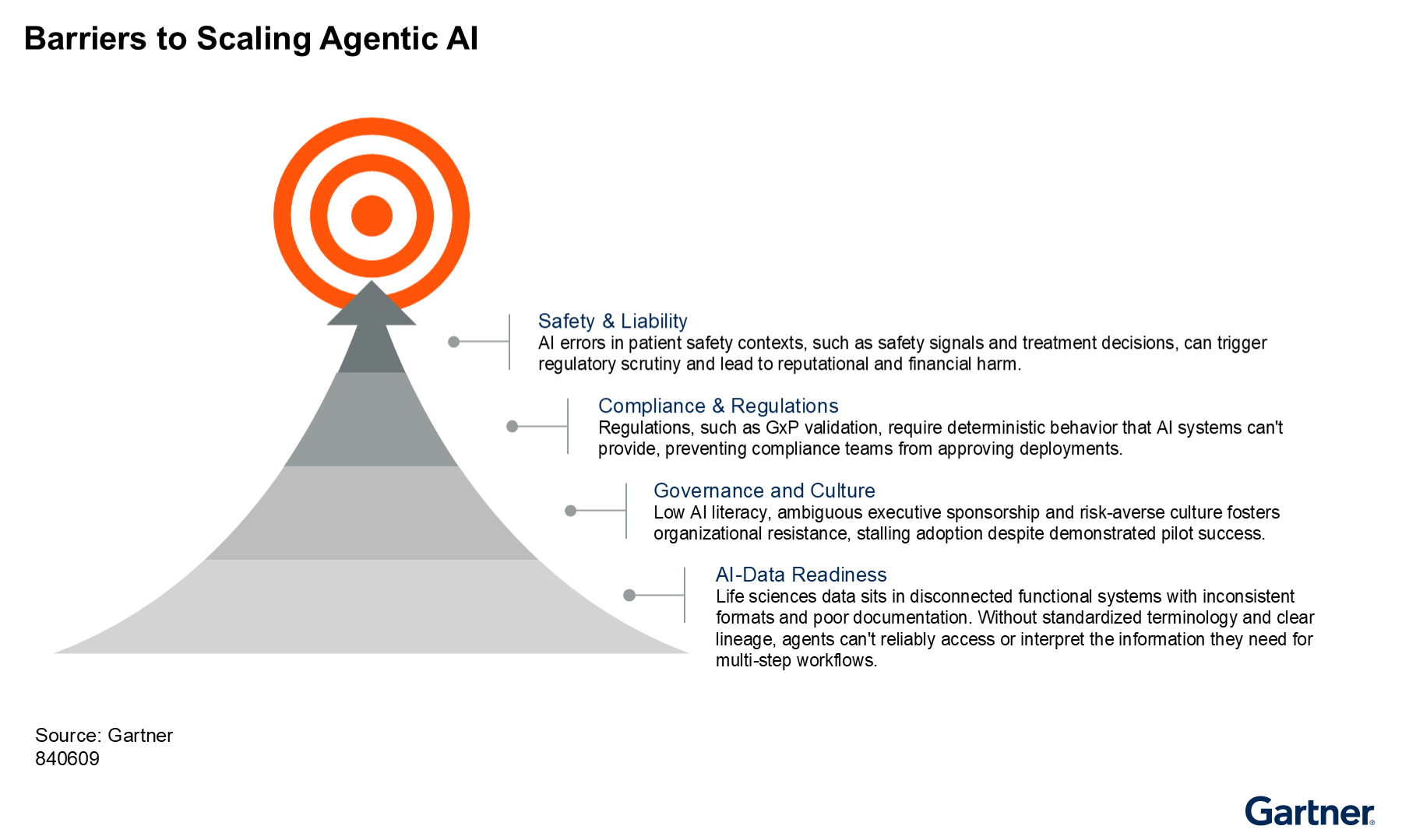
- GxP validation requirements remain a significant barrier to AI adoption, as many systems and processes must operate under deterministic conditions. Regulations require full system traceability and change control, clear evidence of agent behavior, and high-quality results, particularly in high-risk systems.
- LSOs are piloting LLMs beyond prompt-based execution, experimenting with human-supervised agents that can sequence multistep tasks such as summarizing medical literature, reviewing promotional content or generating regulatory submission drafts.
Recommendations
- Invest in cross-functional AI literacy to help teams to design for how payers, providers and patients are embedding AI into their workflows. Align medical evidence generation, engagement strategies and regulatory submission processes to these digital exchanges to support scaling and reduce barriers to access and approval.
- Prepare regulatory submissions for AI consumption by adding semantic layers that current eCTD standards lack, such as standardized terminology across all documents, explicit data linkages and machine-interpretable clinical rationale. Pilot these knowledge-grounded, AI-readable formats on noncritical submission modules first, partnering with regulatory affairs and clinical writing teams to refine the approach before risking pivotal studies.
- Partner with quality leaders, regulators and technology vendors to build a strategy and roadmap to agentic and GenAI GxP validation, leveraging risk-based approaches and novel technology solutions to enable adoption and harvest the benefits of these new solutions.
- Identify high-value use cases for agentic AI and select platforms that support their specific implementation requirements, focusing on capabilities like agent behavior monitoring, knowledge grounding and process orchestration. As patterns emerge, establish common standards for observability, integration and regulatory compliance.
Strategic Planning Assumptions
By 2028, over 70% of healthcare payers, providers, and consumers will adopt AI, rendering traditional pharma commercial models and supporting technologies obsolete.
By 2030, China’s regulatory body (NMPA) will formalize a scoped agentic AI-powered pathway, reducing drug development timelines by 40% and catalyzing AI review pilot programs globally.
By 2028, 30% of LSOs will implement new software testing frameworks to GxP validate AI-augmented solutions, optimizing processes by 20%.
Analysis
What You Need to Know
Breaking Down Barriers to Agentic AI Adoption
LSO CIOs face a fundamental question: how do you deploy AI systems that make autonomous decisions in an industry demanding deterministic validation and regulatory certainty, without introducing unacceptable risk?
The shift from generative AI to agentic AI marks a stepwise change, not incremental progress. Generative AI creates content on demand and surfaces information, such as summarizing literature, drafting protocols and generating marketing copy. Agentic AI operates differently. These systems perceive their environment, decide on actions, execute across multiple systems and achieve goals with varying degrees of oversight, from requiring human approval at every step to autonomously operating within defined parameters. This transforms AI from passive tools to active agents capable of multi-step goal pursuit, which introduces new categories of operational and compliance risk.
— GartnerMany life sciences workflows, ranging from literature review and protocol drafting to regulatory document generation, contain repeatable, multistep tasks suitable for agent automation — though not with the same level of autonomy.
Despite heavy investments in generative AI, where LSOs increased funding 34% from 2024 to 2025, with similar growth expected through 2026, organizations report minimal business impact (see 2026 CIO Agenda for Life Sciences: Technology Priorities and IT Strategy Shifts and Benchmarks for Generative AI ROI and Adoption for Life Sciences, 2Q25). Nearly half of the respondents lacked required data readiness and ROI measurement frameworks — and report purely nonfinancial benefits. These foundational barriers with generative AI will intensify as organizations attempt the leap to agentic systems, which add autonomous decision making and multisystem orchestration. While the technology is available and capable, structural barriers block the path from pilot to production (see Figure 1).
Against this backdrop of industry barriers and internal and external pressures, three trends will reshape life sciences AI strategy over the next four years:
- AI adoption by external partners and stakeholders will become more prominent, forcing restructuring of LSO commercial operations and technology platforms.
- China’s regulatory body will aggressively pursue AI-native submission pathways, compressing development timelines and pressuring Western regulators to follow suit.
- Early-adopting LSOs will develop novel validation frameworks that enable AI at scale while others face escalating compliance costs.
Taken together, these shifts enable pioneering LSOs to create a meaningful competitive differentiation across their value-chain.
Strategic Planning Assumptions
Strategic Planning Assumption: By 2028, over 70% of healthcare payers, providers and consumers will adopt AI, rendering traditional pharma commercial models and supporting technologies obsolete.
Analysis by: Animesh Gandhi
Key Findings:
- Ambient clinical AI solutions, such as Ambience and Microsoft, are becoming deeply embedded in EHR workflow across health systems. These platforms aim to expand beyond documentation and administrative automation to function as real-time clinical assistants, retrieving drug information, processing prior authorization requests, initiating autonomous clinical coding processes and surfacing patient support resources within existing provider workflows.
- Payers are implementing algorithm-assisted utilization management solutions, such as Basys.ai and Cohere, that reduce human review requirements and drive decisions through automated approvals. Approval decisions will increasingly favor therapies with structured, machine-readable evidence that aligns with automated coverage criteria.
- Consumer-facing AI health platforms, such as Lark Health and Onvy, are rapidly scaling as trusted health companions. They integrate data from wearables, labs and sensors to provide continuous behavioral guidance and adherence support. These comprehensive platforms position themselves to compete directly with the narrower, product-specific digital health tools offered by LSOs.
- Collectively, these AI adoption patterns signal a gradual, but irreversible, shift in pharmaceutical commercial engagement. While human intermediaries will remain essential for complex clinical discussions and relationship management, information about medical products and therapies will increasingly be accessed and exchanged through automated channels. This creates a hybrid operating model requiring LSOs to maintain current capabilities while simultaneously building AI-to-AI communication infrastructure.
Market Implications:
- Field force effectiveness will continue to decline as AI-optimized clinics place barriers for promotional interactions. Competitive advantage will shift to companies whose evidence-rich content appears prominently in provider-facing AI assistants, creating a visibility competition similar to search engine rankings. Brand differentiation will weaken as AI assistants deliver synthesized answers, shifting influence from LSOs to provider-facing platforms.
- While medical science liaisons will retain value for complex interpretation, routine scientific exchange will increasingly occur through algorithms that summarize trial data and real-world evidence for clinicians. EHR platforms and ambient AI providers will function as new intermediaries, requiring LSOs to compete for visibility through technology partnerships rather than direct field engagement.
- Payers’ automation of utilization management will reduce coverage exceptions. Competitive advantage will favor therapies not only with clinical efficacy evidence, but that integrate seamlessly into payers’ AI approval workflows to accelerate decision making.
- As patient loyalty and engagement shift toward consumer health AI platforms, they will weaken LSOs’ brand influence and frustrate direct patient engagement efforts. Big tech and digital health vendors will emerge as gatekeepers of patient engagement data, forcing LSOs to choose between costly platform integration or marginalized patient companions tools.
Recommendations:
- Preserve commercial influence in clinical decision-making by establishing direct integration partnerships with EHR platforms (such as Epic, Oracle Health, Meditech) to embed structured product evidence within ambient AI clinical workflows. Prioritize integration points where treatment decisions occur, such as e-prescribing interfaces, clinical decision support modules and drug information lookups.
- Stop treating evidence as static documents and collaborate with internal teams to establish a unified evidence engine that generates machine-readable RWE, translates it into payer-required formats and standards, and continuously adapts to evolving coverage criteria.
- Develop a therapeutic area strategy for consumer AI health coaching platforms: engage where patients self-manage chronic conditions, such as diabetes and hypertension, through formal partnerships that maintain content control and attribution rights.
Strategic Planning Assumption: By 2030, China’s regulatory body (NMPA) will formalize a scoped agentic AI-powered pathway, reducing drug development timelines by 40% and catalyzing AI review pilot programs globally.
Analysis by: Reuben Harwood
Analysis by: Reuben Harwood
Key Findings:
- AI is shifting from a supplementary tool to a foundational pillar of the regulatory process. The NMPA has already initiated AI pilot programs — such as automated review of submissions and post-market surveillance and risk management — indicating a clear readiness to embrace AI-driven changes. Potential areas for application of AI in drug supervision were detailed by NMPA in 2024.1,2 This strategic imperative, combined with the country’s massive datasets, positions China to lead this transformation.
- China’s national strategy, outlined in the “14th Five-Year Plan,” explicitly prioritizes AI and biotechnology leadership.3 This translates to concrete regulatory innovation by empowering the NMPA with the mandate and resources to directly implement an “AI-first” agenda. This top-down strategic push provides a clear directive for regulatory bodies to modernize their processes. A key example is the NMPA’s 2024 “List of Typical Artificial Intelligence Application Scenarios in Drug Administration,” which details 15 areas where AI will be integrated into drug governance processes.4
- Agentic AI — with its capacity to autonomously plan, execute and make decisions — can function as the primary author of regulatory submissions, with human oversight checkpoints as needed. It elevates AI’s role from augmenting human work to autonomously creating the regulatory dossier (see AI Agents in the Life Sciences: Use Case Examples).
- Primary counterarguments to an agent-first pathway are concerns about product quality and risk of therapies being fast-tracked to market with unforeseen, and potentially serious, health consequences. However, new agentic models are available that provide robust audit-and-explain layers, addressing concerns about safety and bias. New GxP validation approaches are expected to appear that solidify the reliability of agentic approaches and end product quality, while human regulators will retain decision-making authority for key milestones.
Market Implications
- The agentic AI-powered pathway will be initially implemented as a tightly scoped pilot. This means it will be limited to a specific set of high-need therapeutic areas, such as oncology and rare diseases, and to a defined class of drugs. It could also be scoped to focus on drug repurposing or on areas with a massive amount of existing safety and efficacy data, such as biosimilars. The predicted 40% reduction in drug development timelines will be realized within this framework, giving participating companies a substantial first-mover advantage.
- This will create a global competitive dynamic with regulators in the rest of the world (ROW). While regulatory bodies will maintain requirements for population-specific safety data and may initially resist compressed timelines, the competitive pressure from China’s faster pathway will be difficult to ignore.
- If China’s NMPA demonstrates that AI-driven reviews can maintain safety standards while dramatically reducing timelines, regulators in ROW will face mounting pressure from industry, investors and policymakers to modernize their processes or risk losing innovative therapies to earlier market entry elsewhere.
- This compressed timeline will give Chinese companies an early-market dominance, potentially capturing market share and therapeutic dominance before global competitors complete their Phase II trials. If pilots achieve upper-range gains and the major risks are convincingly addressed, FDA and EMA are likely to announce their own limited AI-driven pathways for restricted drug categories, building on initiatives like FDA’s GenAI assistant “Elsa” and EMA’s “Scientific Explorer” tool.5,6
Recommendations
- Discard outdated views of China as a market for generics with a slow, unpredictable regulatory system. Today, China has the world’s second-largest pharmaceutical market and is an AI innovation powerhouse. Collaborate with local legal and regulatory experts to navigate distinct requirements of this evolving market.
- Reimagine your data infrastructure for an AI-first future. Go beyond basic modernization by building a unified data fabric with rich, machine-readable metadata.
- Engage in key industry forums and pursue advisory meetings with regulatory bodies currently developing AI guidance.
- Partner with executive leadership to develop a comprehensive strategy that fundamentally transforms R&D. By championing the adoption of explainable AI and building robust audit trails, you will not only meet future regulatory scrutiny but also build the trust essential for the widespread adoption of AI-driven drug development.
Strategic Planning Assumption: By 2028, 30% of LSOs will implement new software testing frameworks to support the GxP validation of AI-augmented solutions, optimizing processes by 20%.
Analysis by: Jeff Smith
Key Findings:
- CIOs face mounting pressure to validate AI-augmented systems using older frameworks designed for conventional solutions. Using these older frameworks risks escalating project validation costs, with IT leaders often attempting to retrofit older processes for use when validating more complex, AI-augmented solutions.
- AI-augmented systems differ significantly from legacy solutions, particularly solutions leveraging commercial-LLMs via RAG-based approaches. These LLMs can be prone to hallucinations, and currently lack observability and explainability features needed to trace decision logic, adding to practitioner challenges during GxP validation projects.
- The current AI regulatory framework is immature, with regulations inconsistent between global regulators and federal and regional governments. This inconsistency, combined with the instability of regulations that can change at any time, makes a confusing environment for developing new computer system validation (CSV) approaches.
- Solution vendors are rapidly maturing GenAI-augmented solutions as investment continues (see 2026 CIO Agenda for Life Sciences: Technology Priorities and IT Strategy Shifts), leaving CIOs in the difficult position of leaving GenAI-augmented features disabled if they cannot be made compliant.
Market Implications:
- CIOs that drive new approaches to GxP validation supporting AI solutions will realize benefits from these solutions more rapidly. Early adopters will gain operational efficiency advantages while late adopters face increasing validation backlogs. Current approaches to validation already lead to 30% more in project cost, which will increase when validating more complex AI systems.
- GenAI-augmented systems differ significantly from traditional software solutions, and will consequently be difficult to GxP validate using legacy approaches. However, CIOs who develop new approaches to validate GenAI-augmented solutions can help chart a path forward for the industry, keeping their organizations in the leader category — and leveraging agentic and GenAI at scale to improve organizational productivity and automation.
- The current regulatory framework is immature, which will delay the adoption of new GxP validation methods for AI-driven technologies. For example, the European Union high-level summary of the AI Act provides concrete guidance around risk assessment, but it is broad in scope and nonspecific to GxP compliance activities. Other types of guidance from regulators include the European Medicines Agency’s Reflection paper, and the Food and Drug Administration’s draft guidance Considerations for the Use of Artificial Intelligence to Support Regulatory Decision-Making for Drug and Biological Products. These support scoping for impacted processes, stressing the need for risk assessment, but generally provide only high-level summary guidance.1,2,3
- Solution vendors are rapidly incorporating AI augmented capabilities into existing solutions, and the majority of future software innovations are closely linked to the build-out of these new AI capabilities (see Tech CEO Insight: CIO Adoption Rates for AI, GenAI, and Agentic AI Across Verticals). This will raise business team expectations that GenAI-augmented features will be built into new product capabilities — increasing the pressure on IT leaders to build an approach to validate these solutions.
- Vendors with marketed CSV solutions that leverage AI-augmented technologies are available, which will provide a path to new technology-driven validation approaches when these capabilities mature. Vendors including Sware, Tricentis, Valgenesis and XLM have already built GenAI components to accelerate these processes, and other vendors have included these features on their near-term roadmap.
Recommendations:
- Champion revising existing GxP validation methods to accommodate AI’s more complex, non-deterministic behavior. Develop an approach to risk evaluation of validation projects, systems, and testing as an essential first step in enabling AI-augmented solutions. Partner with quality and validation colleagues to develop an organizational computer software assurance approach.4
- Build a path to compliance by collaborating with regulators to develop a pragmatic approach to verifying and validating agentic and GenAI-augmented solutions. Remain informed about regulatory changes by engaging in key industry forums with experts currently developing AI guidance.
- Ensure AI-augmented vendor solutions meet compliance requirements. Partner with solution vendors to support agentic AI development, appropriate system checks and controls, and ensure solution components can be GxP validated.
A Look Back
In response to your requests, we are taking a look back at some key predictions from previous years. We have intentionally selected predictions from opposite ends of the scale — one where we were wholly or largely on target, as well as one we missed.
On Target: 2023 Prediction — By 2025, 20% of new life science technology solutions will leverage low-code application platforms (LCAP), diversifying business-facing offerings and speeding innovation.
Low-code application platforms (LCAP) are gaining rapid traction in life sciences. While initially seen as difficult to validate and slow to adopt, proof-of-concept projects have demonstrated clear value, driving uptake across functions. By enabling business users to directly shape workflows, analytics, and internal applications, LCAP reduces reliance on scarce IT resources. Adoption has accelerated further through the integration of LCAP into RPA platforms, the rise of generative AI interfaces and improved digital GxP validation tools. As a result, life sciences companies are beginning to view LCAP as a core enabler of agility.
Low-code application platforms (LCAP) are gaining rapid traction in life sciences. While initially seen as difficult to validate and slow to adopt, proof-of-concept projects have demonstrated clear value, driving uptake across functions. By enabling business users to directly shape workflows, analytics, and internal applications, LCAP reduces reliance on scarce IT resources. Adoption has accelerated further through the integration of LCAP into RPA platforms, the rise of generative AI interfaces and improved digital GxP validation tools. As a result, life sciences companies are beginning to view LCAP as a core enabler of agility.
Toward the end of 2025, 47% of life science organizations have actively deployed LCAP platforms. An additional 12% expect to deploy within the next 12 months, and 29% expect to be deployed within three years. (See 2026 Gartner CIO and Technology Executive Survey.)
Missed: 2022 Prediction — By 2025, 75% of the top 20 life science organizations will suffer digitalization-related cybersecurity issues resulting in $10 billion in lost revenue.
Our initial prediction centered on rapid digitalization and legacy security vulnerabilities creating systemic risks that would disrupt research and development, manufacturing and supply chain operations. We anticipated that even a 1% revenue impact could result in $13 billion in annual losses, given the industry’s $1.27 trillion global revenue base in 2022. While cybersecurity incidents occurred as predicted, they resulted in third-party data exfiltration and response costs rather than direct revenue impact. For example, the 2024 Cencora breach triggered notifications from companies, such as Bayer and Novartis, without disclosure of revenue impact.7 Additionally, breaches like Enzo Biochem’s ransomware event produced regulatory settlements rather than direct revenue loss.8
Our initial prediction centered on rapid digitalization and legacy security vulnerabilities creating systemic risks that would disrupt research and development, manufacturing and supply chain operations. We anticipated that even a 1% revenue impact could result in $13 billion in annual losses, given the industry’s $1.27 trillion global revenue base in 2022. While cybersecurity incidents occurred as predicted, they resulted in third-party data exfiltration and response costs rather than direct revenue impact. For example, the 2024 Cencora breach triggered notifications from companies, such as Bayer and Novartis, without disclosure of revenue impact.7 Additionally, breaches like Enzo Biochem’s ransomware event produced regulatory settlements rather than direct revenue loss.8
The prediction missed the revenue impact but correctly identified expanding threat vectors. Digital transformation has expanded vulnerabilities across cloud-based research labs, IoMT devices in clinical trials and partner networks, such as CROs and CDMOs, with cybersecurity ranked as the top category for increased funding over the past several years (see 2026 CIO Agenda for Life Sciences: Technology Priorities and IT Strategy Shifts). The threat landscape has evolved to include AI-driven disinformation campaigns using deepfakes and synthetic media that target intellectual property and trust in scientific processes (see Top Technology Trends for Life Science CIOs for 2025). These disinformation attacks bypass cybersecurity defenses entirely to target market confidence directly, for example, when a fake Twitter account claimed Eli Lilly would offer free insulin, its stock dropped 4% within hours.9
6 Artificial intelligence, European Medicines Agency
7 Nearly a Dozen Drug Firms Impacted by Cencora Breach, SC Media, a CRA Resource.
9 Eli Lilly Issues Rare Apology as Fake Twitter Blue Account Proclaims Free Insulin for All, FIERCE Pharma.
European Union Artificial Intelligence Act, February 2024.
Considerations for the Use of Artificial Intelligence to Support Regulatory Decision-Making for Drug and Biological Products, Food and Drug Administration, FDA-2024-D-4689, January 2025.
The Use of Artificial Intelligence (AI) in the Medicinal Product Lifecycle, European Medicines Agency, September 2024.
Computer Software Assurance for Production and Quality System Software, Food and Drug Administration, FDA-2022-D-0795, September 2025.
2025 Gartner Life Sciences Generative AI Survey. The main objective of this survey was to learn how life sciences organizations are deploying and governing generative AI initiatives. This survey was conducted online from 16 April through 12 May 2025. In total, 34 executives at life sciences organizations participated. All 31 participants were members of Gartner’s Life Sciences Payer Research Panel, a Gartner-managed panel. Respondents were located in the United States (n = 17), Western Europe (n = 10), Japan (n = 2), the Middle East and Africa (n = 2), and other geographies (n = 3). Disclaimer: Results of this survey do not represent global findings or the market as a whole, but reflect the sentiments of the respondents and companies surveyed.
2026 Gartner CIO and Technology Executive Survey. This survey was conducted online from 1 May to 30 June 2025 to help CIOs and technology executives benchmark their priorities and investment plans against those of peers worldwide. Qualified respondents led a digital/technology function and were accountable for running or improving/growing a specific area of their enterprise. In total, 2,501 CIOs and technology executives participated, with representation from all geographies, revenue bands and industry sectors (public and private).