Magic Quadrant for Supply Chain Planning Solutions: Discrete Industries
18 March 2026 - ID G00840021 - 61 min read
By Joe Graham, Pia Orup Lund, and 4 more
To thrive in today’s dynamic market, discrete industry companies need advanced supply chain planning technology for greater agility and responsiveness. This Magic Quadrant helps leaders identify and implement top SCP solutions to drive strategic and operational success.
Market Definition/Description
Gartner defines supply chain planning (SCP) solutions as platforms that provide technological support to help companies manage, link, align and share planning data across an extended supply chain. SCP solutions support a wide range of planning activities, from demand planning and detailed supply planning, to strategic and execution-level planning. They establish a single version of the truth for planning data and decisions, regardless of the underlying execution technology environment.
Organizations use SCP solutions to enhance the quality and efficiency of their supply chain planning decisions and to achieve higher levels of maturity. These solutions enable and streamline planning decision making by providing access to planning data, applying advanced analytics, business rules and prioritization logic, and enforcing process governance across the planning cycle. When utilized optimally, the result is improved end-to-end supply chain planning decisions, including strategic priorities aligned with resource allocations to drive improved business outcomes.
Some of the common business problems that SCP solutions are designed to address include:
- Aligning plans end to end — This involves creating plans that are aligned and feasible across all tiers of the supply chain, from suppliers to customers and further tiers out. It also focuses on connecting plans across the different planning layers, from strategic-level planning to execution-level planning.
- Improving visibility — This involves providing insights into the status of the supply chain, partners and key metrics used for decision making. By having information readily available, organizations are better equipped to assess situations and deliver actionable insights based on data. Users can then identify areas where improvements can be made to increase efficiency and drive value creation for the organization.
- Fostering decision-making speed and quality — This involves meeting the need for faster and higher-quality decision making in supply chain operations. Strong technology support and process automation enable greater efficiency and reduce human bias in decision making. The collaboration capabilities of SCP solutions allow planners and partners to work together directly on the platform, increasing confidence in both the inputs and outputs used to make decisions.
Mandatory Features
- Demand planning, such as demand forecasting and consensus demand planning.
- Supply chain planning, such as inventory planning, replenishment planning, order promising, production planning and production scheduling.
- Support for the alignment of planning decisions across the enterprise and multiple planning decision layers.
- Support for financial impact analysis and planning.
Optional Features
The optional features for this market include:
- Advanced analytics and AI, such as machine learning and predictive/prescriptive analytics to enhance forecast accuracy, detect anomalies and optimize planning decisions.
- Digital supply chain twin — creating a real-time, virtual representation of the end-to-end supply chain to simulate scenarios and assess impacts before execution.
- Supply chain design, modeling and segmentation to support network optimization, segmentation strategies and network modeling to align supply chain structure with business goals.
- Continuous planning to enable dynamic, always-on planning cycles that adapt to real-time changes in demand, supply and business constraints.
- Multienterprise planning to facilitate synchronized planning across internal teams and external partners, ensuring visibility and collaboration across the extended supply network.
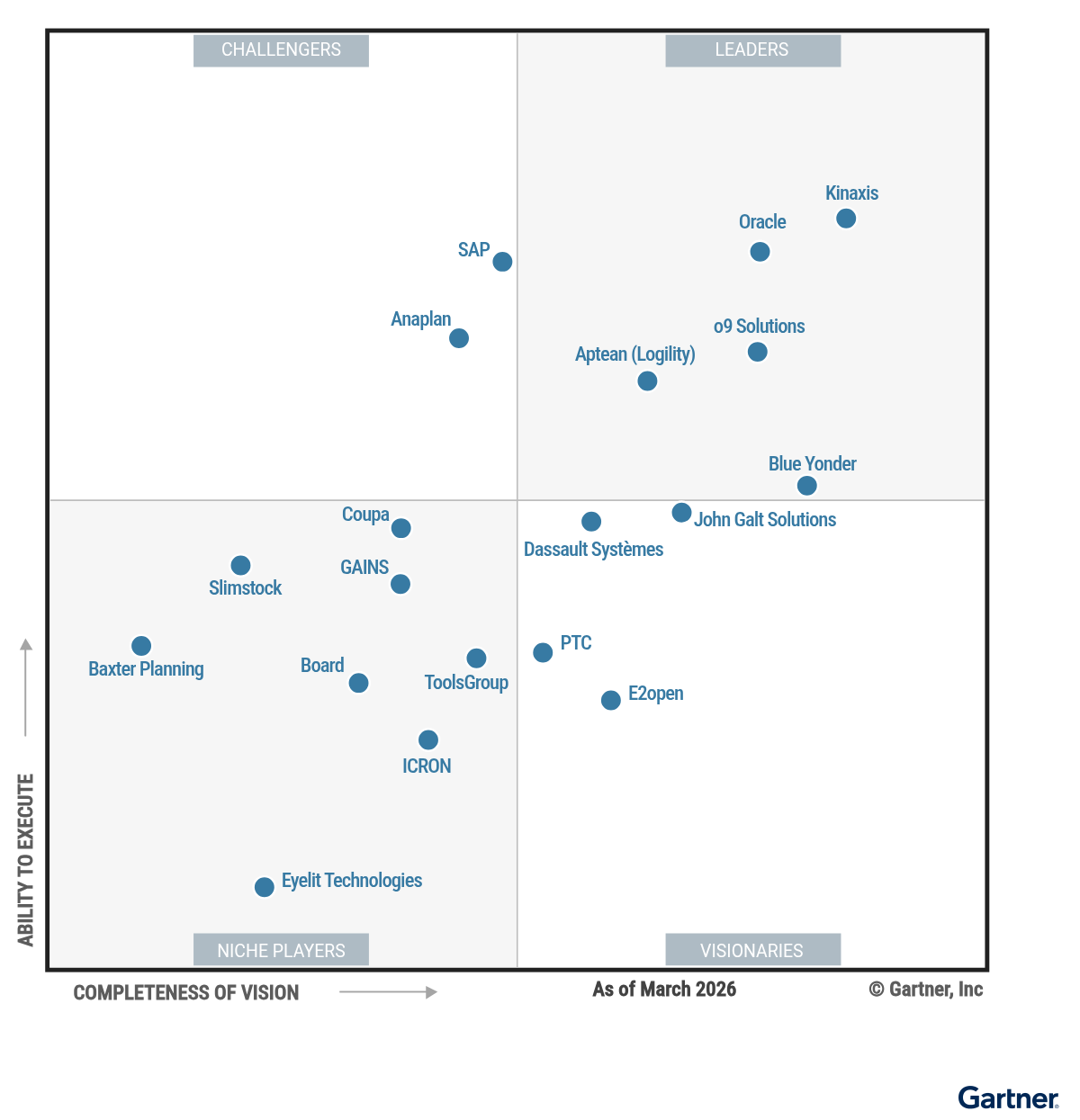
Magic Quadrant
Vendor Strengths and Cautions
Anaplan
Anaplan is a Challenger in this Magic Quadrant. Anaplan’s cloud-native Connected Planning Platform delivers capabilities across demand planning, supply planning, sales and operations (S&OP), and procurement planning. Anaplan also has deep expertise in finance, sales and workforce planning. Anaplan’s solution is designed to facilitate extended planning and analysis (xP&A) by tightly integrating operational and financial planning processes. The vendor maintains a strong presence in North America, Western Europe, and the Asia/Pacific region, serving a diverse client base that spans midsize to large enterprises across multiple industries within discrete and process manufacturing. Anaplan continues to invest in AI and advanced analytics from natively developed capabilities like Anaplan Forecaster as well as acquired machine learning (ML) and demand planning capabilities from its acquisition of Syrup Tech in September 2025.
- User experience: Anaplan’s vision for user experience is strong when compared to other vendors in this Magic Quadrant. It is supported by a clean, modern, configurable role-based user interface, explainability and guidance supported by GenAI functionality, and enablement of collaboration across business functions.
- Platform extensibility: Anaplan distinguishes itself in the market with a highly extensible platform, enabled by an open and modular architecture. Its unified environment supports no-code/low-code configuration, allowing for rapid customization. Developers and partners can leverage the Anaplan Application Framework to build extensions, connectors, and custom applications, further enriching the platform’s capabilities.
- Customer enablement: Anaplan excels in engaging with its customer base, leveraging customer advisory boards. It offers a number of certification options and an array of training options, enabling customers to be self-sufficient.
- Digital supply chain twin modeling: While Anaplan supports real-time constraint modeling, users need to leverage integrated AI tools for predictive outcomes. Anaplan continues to invest in automation of model maintenance via its data orchestration layer to further reduce manual intervention.
- Industry templates: Anaplan’s strategy places less emphasis on delivering prescriptive, industry‑specific best‑practice templates than some other vendors in this Magic Quadrant. While Anaplan’s configurable applications and partner ecosystem have helped improve overall implementation timelines, customers may still need to rely on configuration or partner‑led extensions to achieve industry‑tailored functionality.
- Pricing level and transparency: Anaplan’s pricing transparency is lower, and its price level higher, when compared to other vendors in this Magic Quadrant. While recent efforts to simplify the pricing model may improve clarity over time, customers may still experience higher license fees.
Aptean (Logility)
Aptean (Logility) is a Leader in this Magic Quadrant. Its Logility Decision Intelligence Platform delivers end-to-end SCP capabilities, including IBP, S&OP, network design and optimization, demand and supply planning, and detailed scheduling. Logility’s customers are found in a variety of discrete and process manufacturing industries. The company maintains a global operational base, with the majority of its workforce and sales presence in North America and Western Europe. Recent innovations include Intelligent Order Response, continuous network optimization, AppCentral 2.0, agent-based automation, and Aptean’s acquisition of Germanedge for production scheduling. Logility was acquired by Aptean in April 2025.
- AI and analytics: When compared to other vendors in this Magic Quadrant, Aptean (Logility) has a strong vision for AI and analytics, leveraging techniques including ML, deep learning, simulation, and agent-based automation. Customers benefit from scenario-driven planning, explainable recommendations, and adaptive forecasting that improve decision quality and supply chain agility.
- Planning decision automation: When compared to other vendors in this Magic Quadrant, Aptean (Logility) has a strong vision for decision automation, with embedded AI supporting automation across demand, inventory, supply and network planning. Configurable automation thresholds, continuous network optimization, and evolving agent-based features help streamline routine planning tasks and improve responsiveness.
- Customer experience: Aptean (Logility) demonstrates a strong commitment to customer service with quarterly customer councils, extensive training and certification programs, and fee-based postimplementation support. Issue resolution times for critical incidents are quicker than others in this Magic Quadrant, while their customers report high satisfaction with service responsiveness and contract negotiations.
- Industry templates: Compared to other vendors in this Magic Quadrant, Aptean (Logility) lacks industry-specific planning templates, instead offering a library of general business process models and ERP integration templates. This may require customers to invest additional time and resources in creating best-practice process templates.
- Platform complexity: Aptean (Logility’s) platform comprises a broad set of modules, some with overlapping functionality due to recent acquisitions such as Germanedge. This complexity can create integration and consistency challenges for customers.
- Tendency to be used on an enterprise level: Despite Aptean (Logility’s) positioning as an end-to-end SCP platform, many customers deploy only select modules rather than the full set of capabilities, particularly outside North America and Western Europe. This pattern may limit the realization of enterprisewide value for organizations seeking a fully integrated SCP solution.
Baxter Planning
Baxter Planning is a Niche Player in this Magic Quadrant. Headquartered in the U.S., it serves large, complex service supply chain environments, including high tech/electronics, medical equipment and life sciences, industrial manufacturing, and telecom/utilities. Its BaxterPredict platform delivers end-to-end visibility and control, encompassing service parts planning and service order execution. The core planning module, BaxterProphet, offers demand and inventory planning, supply order automation, logistics network optimization, planning analytics, and AI-driven insights. Real-time supply chain visibility is enabled through BaxterLynX. Its Planning as a Service support model enables customers to augment their in-house planning team with dedicated planning expertise at Baxter Planning.
- Customer enablement and resolution times: Baxter Planning demonstrates a differentiated approach to customer enablement through regular customer advisory boards that inform product strategy and investments. Its Planning as a Service support model is a key differentiator, offering specialized planning support with low customer overhead. Baxter Planning also reports industry‑leading issue resolution times, which contributes to reliable and responsive platform support.
- Platform simplicity: Baxter Planning offers a streamlined platform, with BaxterProphet consolidating core service parts planning functions and BaxterLynX delivering service and spare parts visibility, resulting in reduced complexity compared to other vendors in this Magic Quadrant.
- Decision automation: Baxter Planning has a solid vision on automating many demand planning and replenishment planning activities within the solution, enabling planners to focus on exceptions and higher value-add activities.
- Geographic strategy: Baxter Planning’s geographic coverage is more limited than other vendors in this Magic Quadrant. Its footprint is concentrated in North America, APAC and Western Europe and its partner ecosystem is also largely North America‑centric. As a result, organizations that require broad multiregional presence may find Baxter’s geographic coverage too narrow for their needs.
- Speed and scalability: Baxter Planning’s approach to speed and scalability remains more traditional than some peers, with BaxterProphet relying on batch‑based recalculation rather than continuous, real‑time scenario generation or action‑triggering capabilities. Its commercial model also applies incremental costs for larger data models, which can influence total cost of ownership for organizations operating complex or high‑volume environments.
- Planning functionality coverage: Baxter Planning’s solution is entirely focused on operational capabilities for service and spare parts industries, resulting in comparatively limited coverage of tactical and strategic planning decisions relative to other vendors in this Magic Quadrant. Organizations seeking broader, end-to-end planning manufacturing planning capabilities for the finished goods supply chain should evaluate alignment with their specific requirements.
Blue Yonder
Blue Yonder is a Leader in this Magic Quadrant. Its suite of planning applications, with the Cognitive Planning platform as the main component, delivers end-to-end multienterprise planning capabilities to support complex supply chain environments. Blue Yonder’s operations are geographically diverse, with a primary focus on North America, Western Europe, and the Asia/Pacific region (excluding Japan), and its client base consists mainly of large enterprises across a variety of industries. The company’s ongoing investments are aimed at enhancing platform scalability and advanced capabilities to support trends such as agentic AI and autonomous planning. In addition, Blue Yonder’s 2024 acquisitions of One Network Enterprises and flexis expand its ecosystem visibility and production scheduling capabilities within automotive.
- Decision automation: Blue Yonder’s platform automates planning tasks across strategic, tactical and operational levels using ML, optimization engines and intelligent agents. End-users will benefit from automated scenario generation, exception handling and dynamic workflows.
- Speed and scalability: Blue Yonder’s vision for speed and scalability is strong compared to other vendors in this Magic Quadrant. Its distributed in-memory architecture enables real-time scenario analysis and rapid, efficient plan recalculation, including incremental optimization of affected network segments.
- Breadth of coverage: Blue Yonder offers one of the most comprehensive portfolios in this Magic Quadrant, with native and acquired solutions spanning all planning layers, enabling end-to-end SCP for complex, global organizations.
- Platform complexity: Blue Yonder’s portfolio comprises multiple acquired products and applications, resulting in a complex landscape for customers to navigate. While the Cognitive Planning platform aims to unify capabilities and is transitioning them, some areas, such as scheduling and supplier collaboration, remain largely outside the core platform, with a roadmap to transition. Deployment options, user experience and integration approaches vary across products, which may require additional effort for overall harmonization.
- Pricing: Blue Yonder has taken steps to simplify its pricing structure. However, Gartner data indicates that the model remains less transparent than some competitors. Additionally, the total subscription price remains among the highest in this Magic Quadrant.
- Data Management Strategy: Blue Yonder provides robust data validation and anomaly detection through configurable business rules and validation processes. However, data correction tools prioritize governance by customers, requiring them to carefully configure guardrails for automatic updates from system alerts.
Board
Board is a Niche Player in this Magic Quadrant. Its SCP solution, Board Enterprise Planning Platform, is centered on demand, inventory, and replenishment planning, serving a diverse client base in Western Europe and North America across industries such as footwear/apparel, industrial manufacturing, and automotive. Board’s strengths in FP&A underpin its integrated business planning (IBP) and S&OP capabilities, which are delivered in a dedicated application, but on the same unified platform. Following its acquisition of Prevedere in November 2024, Board continues to advance its use of external data and analytics to enhance demand forecasting through AI-driven correlation analysis. Recent product enhancements include the introduction of Board Foresight for predictive analytics and econometric forecasting.
- Platform simplicity: Board offers a simple platform with natively built capabilities; the platform unifies its SCP solution with financial planning. It offers several modules across areas such as demand planning and S&OP that use the same underlying platform, making it a simple and intuitive architecture for customers.
- Global reach and partnership ecosystem: Board has strengthened its international presence and partner network, enabling delivery and support of SCP solutions across all major regions. Customers benefit from access to local expertise and global standards, supporting multinational and cross-regional SCP needs.
- Vertical/industry-specific roadmap: Compared to other vendors in this Magic Quadrant, Board offers strong industry-specific roadmaps for discrete manufacturing across its core focus industries. Recent and planned enhancements, including structured forecast overrides, external indicator integration, and master production scheduling, address the complex requirements of discrete verticals such as automotive, footwear/apparel, and industrial manufacturing.
- AI and analytics: Board’s SCP solution incorporates machine learning, generative AI, scenario analysis and anomaly detection. However, its vision and capabilities remain less advanced than leading vendors in this Magic Quadrant, with limited support for techniques such as deep learning, nonlinear optimization, knowledge graphs, reinforcement learning and process mining.
- Digital supply chain twin: Board offers a continuously updated digital supply chain twin with real-time data integration and basic constraint modeling. However, it lacks advanced features such as dynamic pegging, robust order-based and scheduling constraints, and fully probabilistic modeling, making its digital twin vision less-advanced than other leading vendors in this Magic Quadrant.
- Strategy for upgrades: Board delivers two major platform releases per year, with support limited to more recent versions. While immediate upgrades are not required, backward compatibility can vary and user testing is often necessary, especially for customized implementations.
Coupa
Coupa is a Niche Player in this Magic Quadrant. Its Supply Chain Design & Planning solution is broadly focused on strategic network design, S&OP and procurement. Its operations are geographically diversified, serving large enterprises and a wide range of industries. The vendor is investing in autonomous, AI-driven decision orchestration, industry-specific blueprints, and ESG capabilities to enable continuous supply chain optimization.
- Solution flexibility: Coupa’s platform delivers flexibility through a microservices architecture, low- and no-code extensibility, and a marketplace for third-party apps. This approach allows clients to tailor and extend SCP capabilities to fit evolving business needs.
- Customer sentiment: Coupa receives a positive reputation among its customer base, with users frequently citing high satisfaction across service, support and ease of engagement. Many organizations express confidence in the platform’s value and indicate a strong willingness to recommend Coupa to others.
- Customer engagement and enablement: Coupa actively promotes customer engagement through annual user conferences in North America and Europe, complemented by quarterly advisory board meetings across regions. Ongoing support is provided via newsletters, webinars, and white papers, while the Coupa University training and certification program offers both online and in-person courses, ensuring customers have a broad choice for skill development and renewal.
- Industry template strategy: Coupa’s industry-specific templates are limited in both number and functional scope, with no clear vision for broader expansion. While the platform offers a variety of layered templates and configurable building blocks, organizations seeking deep, ready-made industry solutions may find the available options insufficient for specialized requirements.
- Functional coverage: Coupa’s strengths lie in supply network design and aggregated planning, but its coverage of detailed and operational planning is limited. The platform lacks native capabilities for areas such as detailed scheduling and order promising, which restricts its ability to support end-to-end, decision-centric processes and may limit value for organizations seeking comprehensive SCP solutions.
- Priority on SCP: Supply chain planning is one of several focus areas within Coupa’s broader platform, which also emphasizes procurement, spend management and treasury management. As a result, SCP shares strategic focus and investment with other areas of the Coupa platform, which may influence the pace of innovation and the breadth of functionality available to SCP customers.
Dassault Systèmes
Dassault Systèmes is a Visionary in this Magic Quadrant. Its DELMIA solutions, powered by the 3DEXPERIENCE platform, are broadly focused on connecting engineering, manufacturing and SCP through a unified environment. Dassault Systèmes operates globally, serving large enterprises across multiple industries within discrete and process manufacturing. The vendor is investing in industrial AI and virtual twin technology extending across industry ecosystems to enable sustainable and continuously adaptive supply chain networks.
- Vertical focus: Dassault Systèmes demonstrates strong discrete vertical focus by offering comprehensive solutions that address the diverse needs of discrete manufacturing industries. Its DELMIA platform supports complex requirements across verticals such as automotive, aerospace, industrial equipment and high tech.
- Global reach: Dassault Systèmes demonstrates significant global reach. Its extensive international presence and robust partner ecosystem enable consistent deployment, support and innovation for complex, multisite SCP initiatives worldwide.
- Overall viability: Dassault Systèmes exhibits strong overall viability, underpinned by solid financial performance and high employee satisfaction. This enables sustained innovation and reliable service delivery, reinforcing the company’s long-term commitment to its customers.
- Decision-centric planning: Dassault Systèmes’ DELMIA solutions support event-driven planning by integrating real-time data, detecting disruptions and enabling reoptimization through virtual twins and predictive analytics. However, its broader vision for decision-centric planning is still evolving, particularly in embedding broader ecosystem signals and fully composable process workflows.
- Pricing: Dassault Systèmes’ pricing is generally at a premium compared to peers, and the flexibility of its pricing model can introduce complexity — particularly for broad or highly customized deployments, where total cost of ownership may be difficult to estimate early in the process. Prospective customers should engage with Dassault Systèmes to clarify pricing specific to their requirements.
- Issue resolution times: Dassault Systèmes provides clear priorities and response times for support requests, but guaranteed resolution timelines are generally limited to urgent issues and select DELMIA Quintiq contract tiers. For nonurgent cases, resolution times may not be provided and the vendor encourages customers to use the self-service 3DEXPERIENCE platform knowledge base, which can impact expectations for timely problem resolutions for nonurgent issues.
E2open
E2open is a Visionary in this Magic Quadrant. Its SCP platform focuses on integrated planning, supporting demand planning, supply network planning, and multienterprise collaboration. E2open serves especially large enterprises in high tech, electronics and industrial manufacturing, with operations concentrated in North America, Western Europe and APAC (excluding Japan). Following its August 2025 acquisition by WiseTech Global, e2open is accelerating investments in unified data models, connected workflows and AI-driven automation to advance end-to-end SCP.
- AI and analytics: When compared to other vendors in this Magic Quadrant, e2open has a strong vision to support an AI-first approach to planning, leveraging deep learning, machine learning (supervised and unsupervised), process mining, and generative AI, including agentic AI.
- Digital supply chain twin: E2open demonstrates a clear strategy for digital supply chain twin capabilities, leveraging its integrated data model and extensive multienterprise network. Its use of probabilistic analytics enables customers to assess variability and risk across planning scenarios, supporting more resilient supply chain decision making.
- Pricing and transparency: E2open offers a highly transparent pricing model, with clear, module-based fees that scale by revenue and application scope. While positioned at a premium price point relative to peers, the elimination of user, data volume and connection fees provides customers with straightforward cost predictability and simplifies evaluation of total cost of ownership.
- Planning decision alignment: Alignment of data and experience across e2open’s acquired solutions may present challenges because some advanced functions, such as detailed scheduling, spare parts planning, and network design, are supported primarily through partner solutions. As a result, customers may experience complexity in achieving seamless decision alignment across all planning horizons and business units.
- Executive team’s priority on SCP: As e2open is now part of WiseTech’s broader portfolio, SCP is not the only strategic focus for the executive team. With SCP representing a lower portion of overall revenue and WiseTech’s emphasis on a comprehensive suite spanning planning, logistics, global trade and optimization, customers may experience less executive prioritization and investment in core planning capabilities, compared to vendors with a dedicated SCP focus.
- Critical issue resolution: E2open provides tiered support levels with defined incident response and resolution times, but rapid resolution for critical issues requires the highest Elite support tier, which comes at a cost. Standard support tiers offer longer target times for incident resolution and root cause analysis.
Eyelit Technologies
Eyelit Technologies (Eyelit) is a Niche Player in this Magic Quadrant. Headquartered in the U.S., Eyelit delivers SCP capabilities that build on its acquisitions of Optessa and Adexa, achieving its coverage of SCP capabilities that range from S&OP and demand planning to supply-side planning and detailed scheduling. The company primarily operates in North America, Western Europe, and Asia/Pacific, serving midsize and large enterprises with a focus on discrete manufacturing. Eyelit’s strategy emphasizes industry-specific planning and continues to advance toward autonomous planning, leveraging intelligent software agents to support users and optimize end-to-end supply chain processes.
- Decision automation: Eyelit leverages machine learning for self‑correction of models and continuous refinement of business rules and policies across tactical and operational planning decisions. Its solution employs RPA-based sensing, acting and learning behaviors to automate routine decision steps, support operational efficiency, and provide explainability and prescriptive guidance.
- Pricing: Eyelit’s pricing is all-inclusive and based on plant-level consumption, providing customers with predictable costs tied to actual usage. This approach positions Eyelit as a cost-effective option relative to peers, with a straightforward and transparent pricing structure.
- Planning decision alignment: Eyelit aligns tactical and operational planning decisions closely with execution by leveraging tightly integrated MES data and real‑time production signals. This integration supports more accurate scheduling, constraint visibility and plan‑to‑execution coherence within the discrete manufacturing environments it targets.
- User experience: Eyelit lags behind other vendors in this Magic Quadrant for its vision for user experience, with no unified UI, limited adaptability and a lack of demonstrated support for digital adoption. Modern usability features, such as chatbot functionality and explainability, are less mature compared to other vendors in this Magic Quadrant.
- Customer enablement: Eyelit’s customer enablement approach is less comprehensive than many other vendors in this Magic Quadrant. Ongoing engagement is primarily limited to annual check-ins and a yearly customer advisory board meeting. Training and certification options are available but must be scheduled in advance, which may limit flexibility and ongoing skill development for customers.
- Partner implementations: Eyelit has a more limited ecosystem of third-party implementation partners compared to other vendors in this Magic Quadrant. This may reduce customer flexibility and choice when selecting external partners to support implementation and broader transformation initiatives.
GAINS
GAINS is a Niche Player in this Magic Quadrant. Headquartered in the U.S., the company’s GAINS DEO (Decision Engineering and Orchestration) platform delivers end-to-end planning capabilities, including demand planning, inventory optimization, supply planning, and network design, across a diverse set of industries such as industrial manufacturing and medical devices. GAINS maintains a strong customer and personnel base in North America, with additional presence in Western Europe and Eastern Europe. The DEO platform enables integration of decisions across strategic, tactical, and operational horizons, with recent investments in GenAI, machine-learning-driven demand prediction, risk-adjusted planning, and discrete event simulation, all aimed at delivering higher-quality decisions and a simplified user experience.
- Composability: When compared to other vendors in this Magic Quadrant, GAINS demonstrates a strong commitment to composability through its API strategy, modular service design and containerized architecture. The GAINS DEO platform enables flexible integration and extension via open APIs and webhooks.
- Decision-centric planning: GAINS’ emphasis on decision-centric planning is stronger than other vendors in this Magic Quadrant, with structured workflows, configurable business rules and event-driven updates. The platform enables planning across all layers, real-time event capture, and scenario analysis.
- Customer enablement: GAINS performs comparatively strong in customer enablement, with a quarterly customer advisory board, structured co-development opportunities, and comprehensive training delivered by both GAINS and partners. The company offers regular health checks, and a continuous improvement subscription with dedicated customer success management.
- Industry strategy: GAINS provides core data integration templates and role-based UI templates, but does not offer detailed industry-specific roadmaps or templates beyond these foundational elements. Compared to other vendors in this Magic Quadrant, customers seeking highly tailored, industry-focused solutions may find fewer out-of-the-box options to address unique industry vertical requirements.
- User experience: GAINS’ UI remains only partly unified despite recent redesigns, and adaptability is largely manual rather than system‑driven. Explainability and GenAI capabilities are progressing, with the current AI assistant focused on augmenting planner analysis and exception review.
- Partner implementation strategy: GAINS has a limited network of consulting and implementation partners, with most deployments being conducted directly by the company rather than through or with third-party firms. Organizations seeking a vendor with an extensive ecosystem of consulting partners or preferring partner-led implementations may find fewer options and less flexibility compared to vendors with broader partnership networks.
ICRON
ICRON is a Niche Player in this Magic Quadrant. The ICRON Customer Centric Supply Chain Planning solution delivers end-to-end planning capabilities, including demand planning, supply planning, detailed scheduling, network design and scenario management, with particular strengths in complex discrete manufacturing. ICRON primarily operates in Eastern and Western Europe, with a growing presence in APAC, serving clients across automotive, industrial manufacturing, high tech/electronics and consumer durables, and spare parts planning. ICRON’s recent investments include a shift to microservices, improving platform scalability, modularity and flexibility to better support evolving customer requirements in SCP.
- AI and analytics: ICRON demonstrates a strong vision for AI and analytics compared to other vendors in this Magic Quadrant. The platform applies a broad range of techniques to support machine learning, predictive analytics, anomaly detection and simulation. Deep learning models are used for multivariate forecasting.
- Platform simplicity: When compared to other vendors in this Magic Quadrant, ICRON delivers a unified platform architecture, with all SCP modules developed natively and deployed on a common technology stack. There are no overlapping or acquired solutions, and all functional areas are built and maintained on the same platform. This approach simplifies integration, deployment and ongoing support for customers.
- Planning decision alignment: ICRON demonstrates a strong vision for aligning strategic, tactical and operational planning decisions within a unified, decision-centric platform. The roadmap emphasizes a single data and model backbone to ensure processes are synchronized across planning layers.
- Industry strategy: Compared to other vendors in this Magic Quadrant, ICRON’s strategy for discrete manufacturing is focused on a select set of subindustries. Its product roadmap and template strategy offer limited discrete-specific enhancements and few out-of-the-box industry templates.
- User experience: Compared to other vendors in this Magic Quadrant, ICRON’s user experience capabilities are evolving, but remain limited in several areas. While the platform offers self-service visualization, explainability features and natural language support, advanced features such as UI adaptability and comprehensive digital adoption metrics are missing. GenAI-powered capabilities are still at an early stage.
- Customer enablement: Compared to other vendors in this Magic Quadrant, ICRON offers flexible training options and postimplementation support through customer success teams and consultancy services. However, the company does not provide formal product certification, and its customer advisory approach is based on co-development with select clients, rather than a structured advisory board. Adoption audits and usage tracking are also limited.
John Galt Solutions
John Galt Solutions is a Visionary in this Magic Quadrant. Its Atlas Planning Platform is broadly focused on delivering SCP capabilities to support decision making from demand and S&OP to production planning. John Galt Solutions operates with a geographically diverse footprint, particularly in North America, Western Europe, and the Asia/Pacific region, serving primarily midsize organizations and large enterprises across a wide range of industries. The vendor continues investing in AI, decision intelligence and sustainability-driven planning to help customers accelerate digital transformation and adapt to evolving market demands.
- Vision for decision automation: John Galt Solutions has a strong vision for decision automation focusing on no-code/low-code tools, intelligent workflows and AI-driven analytics. This approach supports automation across several types of planning decisions, helping organizations accelerate decision making, reduce bias and enhance agility.
- Platform simplicity: John Galt Solutions offers a straightforward platform with several applications across areas such as demand planning, supply planning, inventory optimization and S&OP that use the same underlying platform and data model. Its harmonized architecture makes it easy for customers to navigate its platform portfolio.
- Customer experience: John Galt Solutions is recognized for strong customer satisfaction, particularly in areas such as service, support, and the evaluation and contracting process. Clients also report a high willingness to recommend the solution, resulting in an overall customer experience that exceeds industry averages.
- Global coverage: John Galt Solutions’ global coverage is limited compared to larger competitors, with the majority of direct staff and resources concentrated in North America, Western and Eastern Europe, and select Asia/Pacific markets such as Japan. In other regions, such Sub-Saharan Africa, the Middle East and North Africa, the company relies more heavily on partners. This may impact the consistency of implementation.
- End-to-end functional coverage: The Atlas Planning Platform offers narrower native functional coverage compared to some other vendors in this Magic Quadrant. To address gaps in areas such as network design and detailed scheduling, John Galt Solutions relies on strategic partnerships, making customers dependent on third-party providers for a fully comprehensive solution. This reliance may impact integration, support, and overall solution cohesion for organizations seeking a single-vendor approach.
- Support hours and languages: John Galt’s help desk operates 24 hours a day Monday through Friday, with 24/7 support available for an additional fee through its Premium Support offering. The help desk supports a limited range of languages, and while users can select different languages within the solution, some interface elements, such as help functions and tables, default to English.
Kinaxis
Kinaxis is a Leader in this Magic Quadrant. Its Maestro platform is focused on end-to-end concurrent SCP covering S&OP, demand, supply, inventory, production planning and scheduling. Kinaxis operates globally with its largest footprint in North America, Western Europe and the Asia/Pacific region, serving primarily midsize to large enterprises across discrete and process manufacturing. The vendor continues to invest in Maestro’s capabilities to orchestrate enterprisewide planning and agentic AI frameworks, integrating financial metrics, risk, sustainability and operations.
- Vision for user experience: Kinaxis Maestro delivers a modern, intuitive user experience with an emphasis on explainability, natural language interaction, and guided workflows. The platform incorporates generative AI and conversational agents to help users understand, navigate and adopt new features and drive improved decision making, while embedded onboarding tools and in-app guidance support continuous learning. Kinaxis’s focus on usability and transparency helps drive engagement and collaboration across planning roles.
- Partnership ecosystem: Kinaxis has established a broad partner ecosystem, with numerous distribution and certified implementation partners across all major regions. Many customer deployments are delivered in collaboration with these partners, enabling Kinaxis to scale implementations globally and provide localized expertise and support for diverse customer needs.
- Overall viability: Kinaxis demonstrates strong overall viability, supported by solid financial performance, high employee satisfaction, and a balanced customer base spanning various geographies and company sizes. This foundation underpins the company’s dedication and long-term commitment to the SCP market.
- Customer sentiment: Kinaxis receives below-average customer sentiment in areas such as service, support, and the evaluation and contracting process. Additionally, clients report a lower willingness to recommend the solution compared to peers, which may impact overall satisfaction and long-term customer advocacy. However, Kinaxis has made significant recent investments in customer success and support.
- Pricing: Kinaxis is positioned at the higher end of the market in terms of pricing, with a model that varies based on company size and includes multiple factors such as user counts and applications licensed. While Kinaxis offers some transparency into the pricing elements, the complexity and variability of the pricing structure may make it challenging for organizations to estimate and compare options.
- R&D investment: Kinaxis’ investment in research and development is lower compared to peers. This may affect the pace of innovation and the speed at which new capabilities and enhancements are introduced. However, Kinaxis continues to release new or enhanced functionality on a monthly cadence.
o9 Solutions
o9 Solutions is a Leader in this Magic Quadrant. The o9 Digital Brain platform delivers comprehensive SCP capabilities, including demand forecasting, supply response modeling, scenario management and integrated business planning. Its customer base is concentrated among large enterprises, with a strong presence in footwear and apparel and high tech/electronics. o9 Solutions maintains a significant presence in North America, Western Europe, and the Asia/Pacific region (including Japan), with a growing footprint in Latin America. Recent enhancements include touchless planning, agentic-AI-driven analytics, advanced MRP, campaign planning optimization and sustainability dashboards.
- Industry roadmap/templates: o9 Solutions’ support for tailored industry capabilities and templates is strong. The company delivers frequent enhancements for discrete verticals such as automotive, industrial manufacturing, footwear and apparel, and electronics, and continues to broaden its offerings for discrete industries.
- Composability: When compared to other vendors in this Magic Quadrant, o9 Solutions demonstrates strong composability through its API-first, microservices-based architecture and extensible platform. Customers benefit from self-service configuration, no-code/low-code tools, and a plug-in framework that supports integration with external algorithms and applications.
- Platform simplicity: Unlike many vendors in this Magic Quadrant, o9 Solutions delivers nearly all its SCP capabilities natively on a unified platform, minimizing integration challenges and supporting a seamless user experience across functional areas. The platform’s architecture enables consistent deployment and upgrades, with only limited reliance on external partnerships, such as MangoGem for advanced scheduling.
- Pricing: Relative to other vendors in this Magic Quadrant, o9 Solutions’ pricing model is less transparent and tends to be above average in annual subscription costs. Pricing is based on the number of decision blocks, business size and other components for certain modules, which may require customers to invest additional time in understanding and achieving transparency in how to scale costwise with the solution.
- Data management: o9 Solutions provides tools for data ingestion, harmonization and semantic modeling of structured and unstructured data. While AI-assisted mapping and profiling are available, most data governance and cleansing activities still require customer involvement.
- Vendor implementation services: o9 Solutions’ growth in consulting and implementation resources has not kept pace with its expanding customer base. Organizations may experience challenges in securing sufficient vendor-led support during deployment, particularly as new customer growth outpaces investment in implementation capacity. This may increase reliance on third-party partners or internal resources.
Oracle
Oracle is a Leader in this Magic Quadrant. The Oracle Fusion Cloud Supply Chain Planning suite delivers a unified, cloud-native platform supporting demand management, supply and inventory planning, S&OP, and production scheduling. Oracle’s primary industry focus is very broad including many verticals in discrete and process manufacturing industries. The solution is predominantly adopted by large and upper midmarket enterprises, with its SCP customer base mostly concentrated in North America, and further presence in Latin America, Western Europe, the Middle East and North Africa, and the Asia/Pacific region. Recent enhancements emphasize GenAI-powered decision intelligence, autonomous planning agents, and continued investments in the Redwood user experience to streamline the user interface across applications.
- AI and analytics: Oracle’s vision for AI and analytics is stronger compared to other vendors in this Magic Quadrant. The platform leverages supervised and unsupervised ML, deep learning, simulation, and other advanced analytics. GenAI-powered capabilities produce natural language insights into planning models. Autonomous agents, developed through Oracle’s Fusion AI Agent Studio, further support exception analysis and data quality assessment.
- Digital supply chain twin strategy: When compared to other vendors in this Magic Quadrant, Oracle offers a robust foundation for digital supply chain twin enablement by modeling a comprehensive range of constraints within its native planning environment. The platform supports dynamic, time-phased pegging, enabling planners to trace and synchronize decisions across the network.
- Customer sentiment: Many of Oracle’s customers report high satisfaction with areas such as customer service, support, evaluation and contract negotiation. This is further reflected by a strong customer recommendation rate.
- Platform complexity: Not all planning capabilities reside within Oracle Fusion Cloud Supply Chain Planning; some functions may require use of analytics or other modules across the broader Oracle Fusion Cloud suite. Customers may encounter complexity when navigating product selection, integration and deployment.
- Customer enablement: Postimplementation support for tracking user adoption relies primarily on self-service tools and community forums, with limited in-platform metrics to monitor feature utilization. Enablement events and conferences typically address the broader Oracle portfolio, rather than focusing specifically on SCP.
- Data management: Oracle’s approach to data management in SCP is primarily rule-based, relying on governed ingestion, validation and correction workflows. While the platform supports scheduled and incremental data loads, REST APIs, and file-based imports, advanced autonomous data management capabilities, such as automated cleansing, enrichment and synthetic data generation, are limited.
PTC
PTC is a Visionary in this Magic Quadrant. The Servigistics platform delivers a purpose-built solution for service SCP, supporting advanced forecasting, multiechelon inventory optimization, and service network design. PTC’s primary industry focus is on asset-intensive sectors, with particular strength in automotive, industrial manufacturing, high tech/electronics and aerospace/defense. The solution is predominantly adopted by large enterprises, with its customer base distributed globally and notable concentrations in North America, Western Europe and the Asia/Pacific region. Recent enhancements include advanced automation and LLM-powered planner-assisted workflows, supporting diverse enterprise deployment strategies.
- User experience: When compared to other vendors in this Magic Quadrant, PTC demonstrates a notably advanced vision for user experience, emphasizing explainability, visualization and AI‑assisted interaction. Its roadmap highlights natural‑language explanations, agentic AI support and automated identification of underutilized features, which strengthen planner trust and adoption.
- Platform simplicity: PTC has a simple platform structure when compared to other vendors in this Magic Quadrant, offering a single, unified solution without parallel products or acquisitions affecting PTC. This consolidated footprint can lower integration effort and may help limit architectural sprawl, enabling customers to deploy and expand capabilities with fewer dependencies, less administrative overhead and more predictable long‑term costs.
- Digital supply chain twin: When compared to other vendors in this Magic Quadrant, PTC shows a strong strategy for supporting a digital supply chain twin, centered on probabilistic modeling and broad constraint representation across service networks. Its approach supports dynamic model updates and risk‑aware simulation.
- Pricing: Compared with other vendors in this Magic Quadrant, PTC presents a pricing model with limited transparency and a higher level of complexity, driven by value‑based or volume‑based variables and tier‑based contracts; its overall pricing is also higher than the average vendor in this Magic Quadrant.
- Geographic strategy: Relative to other vendors in this Magic Quadrant, PTC shows limited geographic scale, with dedicated SCP staff concentrated in North America and Western Europe and minimal coverage in other regions. Its selective partner ecosystem, while deep, provides limited regional breadth. These gaps may constrain customers that require locally available resources, broader global delivery coverage, or region‑specific implementation expertise.
- Partner ecosystem: Compared with other vendors in this Magic Quadrant, PTC has a limited bench of third‑party implementation partners and no certified partner program, resulting in a low availability of external resources. Its ecosystem focuses on a small set of selected global partners.
SAP
SAP is a Challenger in this Magic Quadrant. Its SAP Integrated Business Planning (IBP) platform is broadly focused on enabling end-to-end SCP and decision making across areas such as demand planning, S&OP and inventory optimization for a wide variety of industry verticals. SAP’s operations are globally diversified, serving organizations of all sizes. It continues to invest in autonomous planning, industry-specific capabilities and deeper integration between planning and execution, with a roadmap emphasizing decision intelligence and a role-based user experience.
- Geographic strategy: SAP benefits from a vast and mature global partner ecosystem and many of these partners are SAP-certified. As a result, a significant proportion of SAP deployments are delivered in collaboration with or entirely by partners, ensuring customers have access to experienced resources, local market knowledge and scalable implementation support across all regions.
- Customer diversity: SAP demonstrates significant customer diversification, serving both midsize and very large enterprises across a wide range of discrete industry verticals. Its customer base spans sectors such as automotive, industrial manufacturing and more. This breadth enables SAP to address complex and varied SCP requirements, leveraging its experience with organizations of different sizes and industry needs.
- Technical support: SAP delivers strong global technical support through its 24/7 Customer Interaction Center (CIC). The CIC offers assistance in English year-round and provides multilingual support, including German, Mandarin, Japanese, Spanish, French and more, during regional office hours. Extensive self-service resources and knowledge base articles in multiple languages are available.
- Speed and scalability: Recalculation of plans is after manual intervention, primarily user-triggered, with limited automation and no true continuous planning. While planners can choose to do subnetwork planning on a limited part of the network, scenarios are typically recalculated in full rather than locally, which may affect speed in complex environments. Planned enhancements like local plan repair are not yet available and remain aspirational.
- Decision-centric planning: SAP’s decision-centric planning capabilities remain largely user-defined, with priorities and workflows that require manual configuration and lack automation. Impact analysis is limited to KPI measurement and root cause analysis without a comprehensive framework or clear definition for impact, and the process for composing decision workflows appears less flexible.
- Platform complexity: SAP’s SCP platform requires the deployment and integration of multiple solutions, such as SAP IBP, S/4HANA Advanced Available-to-Promise, Manufacturing Planning & Scheduling, and others, to achieve full functional coverage across the broad scope of SCP. This multiproduct landscape can increase platform complexity, implementation effort and ongoing management requirements.
Slimstock
Slimstock is a Niche Player in this Magic Quadrant. Its Slim4 platform delivers SCP capabilities such as IBP, S&OP, scenario planning, and inventory and replenishment planning. Slimstock primarily targets discrete industries such as automotive, mining and construction, and aftermarket parts. Its customer base is highly concentrated among midmarket and large enterprises, with global reach and its largest footprint in Western Europe. Recent investments include AI/ML-driven promotion planning and advanced scenario planning, which supports greater automation and visibility across planning horizons.
- Vendor implementation services: Slimstock demonstrates a strong implementation services capability compared to other vendors in this Magic Quadrant, with consulting and delivery resource growth outpacing the rate of growing new customer acquisition. This investment supports consistent project execution across regions and ensures customers have access to experienced delivery teams.
- Global reach: When compared to other vendors in this Magic Quadrant, Slimstock demonstrates a solid geographic strategy, with dedicated sales and support staff across six major regions and a continental support structure. The vendor continues to deepen its presence in established markets while expanding into high-potential areas, investing in local offices and partnerships to ensure proximity, regional expertise and responsive support for diverse customer needs.
- Platform simplicity: Slimstock offers a single, natively built Slim4 platform with all planning capabilities integrated into a unified data model. This straightforward architecture reduces complexity and enables intuitive navigation, supporting rapid user adoption and lower total cost of ownership.
- AI and analytics: Slimstock offers primarily foundational AI capabilities centered on statistics, heuristics, ML and optimization. Agentic AI and GenAI remain in early stages and most other advanced elements, including deep learning, probabilistic planning, process mining and simulation, remain roadmap items rather than operational features.
- Capability breadth: Slimstock offers relatively limited functional breadth across core SCP domains, with strengths concentrated in IBP, demand planning, S&OP, inventory optimization and replenishment planning. Capabilities in areas such as network design, long‑term demand sensing, capacity and production planning, reverse SCP, and procurement planning remain minimal or absent.
- Digital supply chain twin support: Slimstock offers a limited strategy for developing and evolving an end-to-end digital supply chain twin. Its approach is based on static models with constrained, non-time‑phased parameters and no probabilistic modeling nor pegging. These missing factors may challenge organizations seeking more advanced planning driven by digital supply chain twins.
ToolsGroup
ToolsGroup is a Niche Player in this Magic Quadrant. Its Service Optimizer 99+ (SO99+) platform delivers SCP capabilities such as demand forecasting, inventory optimization, service-level-driven supply planning, S&OP, replenishment, and transportation planning. ToolsGroup primarily serves discrete industries, with a customer base concentrated in industrial manufacturing, spare and service parts, and footwear/apparel. Customers span small to very large enterprises, with deployments supporting complex portfolios and distribution networks. ToolsGroup’s operations are globally distributed, with the largest presence in Western Europe and significant resources in North America and Latin America. Recent investments include AI-driven explainability, real-time KPI monitoring and advanced scenario analysis to support autonomous, outcome-driven planning.
- Decision-centric planning: ToolsGroup articulates a strong vision for decision‑centric planning, aiming to unify automated replanning, continuous event monitoring and structured impact evaluation into a more proactive decision framework. Its SO99+ engine, Decision Hub and Data Hub underpin this direction, supporting faster responses to internal and external events and enabling more consistent, policy‑driven planning across horizons as the vision matures.
- User experience: ToolsGroup articulates a strong vision for a unified, role-based user experience that prioritizes guided workflows, integrated dashboards and explainability to reduce decision friction. The roadmap emphasizes agent-enabled assistance for natural-language interaction, proactive task prioritization and more contextual decision support.
- Pricing: ToolsGroup provides a transparent and easy‑to‑understand pricing model based on licensed modules, named users and SKU/location counts. Its straightforward structure supports predictable budgeting and reduces complexity during evaluation and scaling. This approach is particularly appealing to midmarket and enterprise organizations.
- Industry strategy: ToolsGroup has a more limited industry strategy than other vendors in this Magic Quadrant. While it serves several discrete segments, its approach is not strongly differentiated by subsector requirements. The vendor also lacks robust, productized industry templates, increasing reliance on services‑led tailoring during deployment.
- Customer sentiment: ToolsGroup’s customer feedback indicates room to improve in areas such as service, support and evaluation experiences, which has contributed to lower recommendation levels, comparatively.
- Geographic strategy: ToolsGroup has a more limited geographic strategy, with minimal direct presence across Eastern Europe, Sub‑Saharan Africa and most of the Asia/Pacific region. These regions are primarily supported through partners, rather than in‑region employees.
Inclusion and Exclusion Criteria
In addition to Gartner client relevance, as determined by analyst expertise and opinion, vendors must also meet the following criteria to qualify for inclusion in the Magic Quadrant:
- The vendor must have a stand-alone SCP solution that can operate independently of ERP and other executional technologies as part of its application portfolio. All of the following SCP solution capabilities must have been commercially available (in general availability) as of 20 November 2025. Eligibility for initial consideration is determined by reviewing publicly available sources of information, including the vendor’s website, for mentions of the following capabilities as part of a standard product offering:
- Collaborative demand planning
- Constraint-based multienterprise supply planning
- Flexible and extensible solution architecture
- User experience and workflow orchestration
- AI-driven planning and decision automation
- Unified data integration
- Scenario management and financial impact modeling
- Scalable high-performance planning
The solution must also be able to do manufacturing/capacity planning.
- The vendor must have an official office, branch or affiliate in at least three of the following eight regions considered for this market:
- North America
- Latin America
- Western Europe
- Eastern Europe
- Middle East and North Africa
- Sub-Saharan Africa
- Asia/Pacific region (comprising mature Asia/Pacific, China, emerging Asia/Pacific and Eurasia)
- Japan
One of the three offices had to be in North America or Western Europe.
- The vendor must have the following industry coverage:
- The vendor must have at least 25 customers within the discrete industry vertical and customers from the discrete industry vertical must account for at least 50% of the total customer base across both the discrete and process industry verticals, OR
- The vendor must have at least 80 customers within the discrete industry vertical and customers from the discrete industry vertical must account for at least 20% of the total customer base across both the discrete and process industry verticals.
For reference, the discrete industry vertical consists of the following industries:
- Automotive
- Industrial manufacturing
- High tech/electronics
- Aerospace and defense
- Mining and construction
- Medical devices
- Footwear/apparel
- Consumer durables
Honorable Mentions
The following vendors have reasonably capable, and in some cases, strong SCP solutions for discrete industries but did not qualify for inclusion in this Magic Quadrant. This does not mean that their solutions might not be viable alternatives for some customers:
- Arkieva is a privately held vendor headquartered in the U.S. with deployments in discrete industries such as automotive, high tech/electronics, and aerospace and defense. Its solution includes cloud-native demand planning, supply planning, IBP and inventory optimization (IO) modules, along with scheduling, merchandising and retail planning offerings. An incremental approach facilitates customer maturity, based on a digital twin and supported by prebuilt templates.
- Blue Ridge is a privately held vendor headquartered in the U.S. with deployments in discrete industries such as automotive, food and beverage, industrial manufacturing, and consumer durables. Its solution includes demand planning, IBP, replenishment and supply planning modules driven by predictive, generative and agentic AI on a cloud-based platform. An emphasis on speed of implementation drives time to value for its enterprise and midmarket customers, supported by its postimplementation adoption team.
- Infor is a privately held vendor headquartered in the U.S. with deployments in discrete industries such as industrial manufacturing, consumer durables, and apparel and footwear. It has a large portfolio of solutions with a variety of supply chain (SC) planning capabilities, including trade and promotion planning and detailed scheduling. Infor SCP is ERP-agnostic, but integration between Infor’s CloudSuite ERP and its SCP modules enables embedded real-time synchronization across planning and execution.
- Netstock is a privately held vendor headquartered in the U.S. with a presence in discrete industries such as automotive, building supplies and industrial manufacturing. Its Predictor Integrated Business Planning and Inventory Advisor solutions provide demand planning and inventory optimization capabilities, enhanced with AI-based analytical tools that provide insights and explanations to augment planner performance.
- OMP is a privately held vendor headquartered in Belgium with deployments in discrete industries such as medical devices, aerospace and defense, and mining and construction. Its Unison Planning platform includes a wide variety of SCP capabilities, enhanced by its industry-specific expertise. OMP’s vision for integrating AI, ML and agentic technologies to solve complex operational challenges for its customers reflects its commitment to value delivery.
- RELEX is a privately held vendor headquartered in Finland with deployments in discrete industries such as industrial manufacturing, process manufacturing and retail distribution. Its RELEX Retail & Supply Chain Planning includes core SC planning functionality, as well as a variety of demand planning, merchandising, assortment, price and promotion planning capabilities. Its cloud-based solution leverages AI and ML technologies to solve complex supply planning challenges with flexible scalability and unique configurability.
- River Logic is a privately held vendor headquartered in the U.S. with deployments in discrete industries such as automotive, industrial manufacturing and consumer durables, among others. In addition to IBP, production and capacity planning, and order promising and allocation functionality, its Value Chain Optimization solution transforms network design optimization, aligning financial and operational goals.
- sedApta operates as part of Elisa Industriq, a European software provider, headquartered in Finland. It specializes in solutions for discrete industries such as automotive, industrial manufacturing, and machine builders. sedApta offers functionalities encompassing areas such as demand planning and sensing, S&OP, inventory management and distribution requirements planning, as well as production planning and scheduling. It has a strong focus on Industry 4.0 technologies, enabling smart manufacturing transformation through real-time data utilization, KPI monitoring and manufacturing execution system integration.
- Sunstice (formerly FuturMaster) is a privately held vendor headquartered in France with deployments in discrete industries such as automotive, industrial manufacturing and medical devices. Leveraging AI-driven insights from big data, decision making is optimized and data models adapt to complexity across time horizons. Its Sunstice platform includes the standard demand and supply functionality, along with detailed scheduling and network design and optimization modules, among other capabilities.
- Syncron is a privately held supply chain vendor headquartered in Sweden with deployments in discrete industries such as automotive, industrial manufacturing, and mining and construction. Demand planning, inventory optimization and replenishment planning are fully supported in its Syncron Parts Planning solution. Its exclusive focus on the aftermarket business enables OEMs to capture value from optimized planning of spare parts.
Evaluation Criteria
Ability to Execute
Gartner evaluates vendors on their ability to offer and support an SCP solution that enables customers to achieve the goals of their existing and future SCP processes. This evaluation covers features available in a vendor’s portfolio of products that support SCP, including how it’s delivered to market. It also includes methods used by a vendor to help customers deploy, maintain and develop SCP solutions. The evaluation examined opportunities for a vendor’s customers to be educated on, and to use, best practices and emerging practices for SCP, including how to enable customers to manage the solution independently. It also evaluated the techniques and features to increase overall user adoption of the solutions.
Vendors are also evaluated on how well their efforts to market and communicate their vision for their product resonate with the market. This is reflected in the blend of customers using the current instance of the product, as well as recognition by customers in the market. It is also reflected in the likelihood that customers will extend their use of a vendor’s product in terms of functionality, as well as across geographies, as they execute their strategies to move toward higher levels of SCP maturity.
The evaluation criteria for product or service, market responsiveness/record, customer experience and operations represent the primary drivers for vendor selection among the Ability to Execute criteria. As shown in the following table, the evaluation criteria for product or service, market responsiveness/record, customer experience, and operations have High weightings. They represent the primary drivers for vendor selection among the Ability to Execute criteria. Buyers are most interested in product functionality, vendors’ tendencies to act on the vision set out in their roadmap, the level of satisfaction expressed by vendors’ customers, and how vendors operate during and after implementation.
The criteria for overall viability, sales execution/pricing and marketing execution assess the overall health of vendors, their ability to deliver software that will return a fast ROI at an affordable price and their recognition in the market.
Ability to Execute Evaluation Criteria
| Evaluation Criteria | Weighting |
|---|---|
Product or Service | High |
Overall Viability | Medium |
Sales Execution/Pricing | Medium |
Market Responsiveness/Record | High |
Marketing Execution | Medium |
Customer Experience | High |
Operations | High |
Source: Gartner (March 2026)
Completeness of Vision
Gartner evaluates a vendor’s Completeness of Vision by applying criteria that assess its to understand current market trends and transform these into roadmap initiatives, as well as its vision for how emerging technologies can further the goals of SCP and ensure adoption of the software. The criteria also assess the vendor’s responses to customer needs and competitive forces, as Gartner views them.
Vendors are evaluated on their ability to articulate — to Gartner and to the market — a “statement of direction” for the next two to three years that matches (or surpasses) Gartner’s vision for the evolution of the SCP solution market. They should demonstrate an understanding of the major technological and architectural shifts that this market will require, and be able to communicate a believable, tangible roadmap to exploit these and to deliver appropriate solutions. Furthermore, they should understand what drives the industry verticals they target, to deliver solutions that address those particular needs.
The criteria for market understanding, offering (product) strategy, vertical/industry strategy (see Note 1) and innovation assess how vendors support a company’s digital SCP aspirations and how they envision planning will transform the future planning concepts. Also assessed is how they converge with cross-enterprise functions beyond the supply chain, taking into account industry specifics.
The criteria for marketing strategy, business model and geographic strategy indicate vendors’ investment and growth strategies, and focus on evolving their SCP solution, including their vision for supporting customers across geographies.
Completeness of Vision Evaluation Criteria
| Evaluation Criteria | Weighting |
|---|---|
Market Understanding | High |
Marketing Strategy | Medium |
Sales Strategy | Medium |
Offering (Product) Strategy | High |
Business Model | Medium |
Vertical/Industry Strategy | High |
Innovation | High |
Geographic Strategy | Medium |
Source: Gartner (March 2026)
Quadrant Descriptions
Leaders
Leaders in the SCP market demonstrate exceptional vision and execution capabilities, offering comprehensive, differentiated functionality that meets a wide spectrum of user requirements, including industry-specific requirements. Their solutions deliver robust support across all key areas of SCP, providing a balanced mix of features that address both current needs and future developments.
These vendors empower organizations throughout their maturity journeys, with a strategic vision for enabling advanced planning environments that aligns closely with Gartner’s perspective. Leaders are forward-thinking, anticipating shifts in customer demands and market dynamics, and clearly articulating how innovative technologies can enhance planning processes. Their strategies are designed to support emerging requirements, ensuring their SCP solutions remain future-proof, drive high-quality decision making and foster strong user adoption.
Leaders are typically well-established in complex, leading-edge environments, benefiting from engaged user communities that keep them attuned to evolving needs and foster ongoing innovation. They also demonstrate solid financial performance and sustainability, with strong market penetration and widespread usage among their customer base. Many organizations rely on a single instance of a Leader’s SCP software to support large-scale planning models and manage significant supply chain complexity.
Challengers
Challengers demonstrate strong execution capabilities and a solid track record of successful implementations. Their solutions reliably support Level 3 maturity SCP processes and are often deployed as single, global instances. While their product features and technical strengths are well-suited for current planning needs within the relevant industry verticals, other aspects of their offerings are still evolving.
However, Challengers tend to lag in aligning their product roadmaps with Gartner’s vision for the future of SCP solutions and in adopting emerging technologies. This may limit their ability to help organizations advance to higher levels of planning maturity. Nonetheless, customers are generally satisfied with the value and performance these vendors deliver across their supply chains.
Challengers are typically favored by organizations that prioritize strong execution over visionary innovation — particularly when the SCP solution is already part of the enterprise’s technology landscape or there is an existing vendor relationship. These vendors have demonstrated long-term viability, with stable financial performance and reliable products. They provide an adequate customer experience, enabling clients to independently manage and sustain their SCP environments with minimal vendor support.
Prospective buyers should carefully assess Challengers based on their current capabilities and limitations, and consider how any gaps might affect their near-term goals for advancing SCP maturity.
Visionaries
Visionaries present a compelling and forward-thinking vision for their SCP solutions, setting themselves apart through their innovative approach and strategic outlook. Their product roadmaps demonstrate a thoughtful balance between anticipating where user requirements are heading and leveraging key technological advancements, such as AI, digital supply chain twins and multienterprise planning, to address those evolving needs.
Visionaries are often recognized as thought leaders within the SCP technology landscape, frequently pioneering new concepts and capabilities that shape the direction of the industry. Their management teams are committed to advancing the state of SCP technology, prioritizing research and development efforts that push the boundaries of what is possible technologywise.
Despite their strengths in vision and innovation, Visionaries may currently face certain limitations. These can include functional gaps in their SCP solutions, a lack of live customer references, lower brand recognition, or relatively weaker financial resources compared to more established competitors. In some cases, their solutions may exhibit exceptional depth in a specific functional area, such as demand planning or S&OP, while still building out broader capabilities required for a comprehensive SCP suite.
Visionaries tend to attract organizations that are looking for cutting-edge capabilities and are willing to partner closely with vendors to co-develop or pilot new features. Early adopters that choose Visionaries often benefit from access to the latest technological innovations and the opportunity to influence product direction. However, these organizations should also be prepared for potential risks associated with adopting solutions that are still maturing or lack the extensive support infrastructure of more established vendors. For organizations seeking to stay ahead of the curve and invest in the future of SCP, Visionaries represent an exciting and influential segment of the vendor landscape.
Niche Players
While it may be tempting to assume that vendors positioned in the other quadrants are always the best choices for new SCP buyers, the reality is more nuanced. Depending on an organization’s specific circumstances, a Niche Player can be just as effective — or even superior — to a Leader, Challenger or Visionary. This is especially true when a Niche Player’s focus aligns closely with the buyer’s unique requirements, such as specialized support for a particular geography, industry vertical, or functional area like finished goods planning. Their deep expertise and tailored offerings can provide significant value where broader solutions may fall short.
Niche Players are often recognized as specialists within the SCP landscape. They excel at delivering point solutions that address targeted aspects of SCP, such as demand forecasting, inventory optimization or network design. In many cases, their solutions are highly refined and purpose-built, offering advanced capabilities that cater to the specific needs of their chosen market segments. This specialization can result in superior performance and a better fit for organizations with distinct requirements that may not be fully addressed by more generalized platforms.
Moreover, Niche Players are frequently leveraged as part of a best-of-breed strategy, where organizations integrate their solutions alongside those from other SCP vendors to achieve comprehensive, end-to-end planning capabilities. This approach allows companies to combine the strengths of multiple providers, ensuring that each aspect of their supply chain is supported by the most appropriate technology.
For prospective buyers, it is important to carefully consider the unique advantages that Niche Players offer. Their focused expertise, agility and commitment to serving specific market needs can make them invaluable partners — especially for organizations seeking tailored solutions or operating in specialized environments. Ultimately, the best choice of SCP vendor depends on the alignment between the provider’s strengths and the buyer’s strategic goals, operational context and long-term vision.
Context
Companies increasingly seek to invest in SCP solutions that enable them to achieve higher levels of maturity and seamlessly scale as their planning requirements evolve. While some organizations still assess SCP solutions based on specific functional needs, such as demand planning or sales and operations planning, they often do so with the goal of leveraging the broader capabilities offered by these tools. Historically, these functional requirements were addressed through a patchwork of disparate SCP applications. However, this fragmented approach made it difficult to achieve the end-to-end visibility necessary for effective enterprisewide planning across various time horizons.
As a result, SCP solutions have evolved toward unified data model environments, where a single, integrated model supports all planning activities. Consequently, buyers are now more inclined to partner with a single vendor offering a comprehensive SCP suite that addresses the majority, if not all, of their sCP technology needs.
The trend toward unified SCP platforms continues to shape the market, but we are now witnessing another wave of transformation. End-user organizations are increasingly prioritizing flexibility and choice in their planning solutions, seeking to avoid being constrained by the limitations of a single technology provider — especially when those capabilities fall short in specific areas. In response, vendors are opening up their platforms, enabling organizations to embed custom algorithms or integrate third-party solutions, all while maintaining a strong focus on governance, adaptability and user experience.
Although this evolution is still in its early stages, it is clearly the direction in which the SCP technology landscape is heading. Additionally, we are seeing a surge in acquisitions within the SCP space, as vendors seek to expand their offerings and deliver broader, more comprehensive capabilities to meet the evolving needs of their customers.
Recommendations
Supply chain technology leaders and SCP leaders looking to invest wisely in SCP technology:
- Clearly articulate your business strategy, taking into account the key factors that influence your supply chain’s success.
- Establish a direct connection between your business strategy and both your supply chain and SCP strategies. Determine the specific capabilities your SCP solution must deliver to drive meaningful business value.
- Assess the current (“as is”) maturity level of your core SCP processes, such as S&OP, demand planning, and supply planning, to understand your starting point.
- Define the desired (“to be”) maturity level for each relevant SCP process to ensure alignment with your overarching business strategy. Consider phasing the journey toward your target state, allowing adequate time for stabilization and optimization at each stage.
- Develop a comprehensive SCP technology vision and roadmap that addresses existing gaps and positions your organization for future growth.
- Identify and evaluate technology solutions that support both current and anticipated capability requirements. Leverage insights from this Magic Quadrant and the associated Critical Capabilities for Supply Chain Planning Solutions: Discrete Industries to inform your decision making. Engage Gartner analysts for expert guidance throughout the selection and implementation process.
Market Overview
The SCP market was worth $8.4 billion in 2025 and is forecast by Gartner to exceed $15.1 billion through 2029, resulting in a compound annual growth rate (CAGR) of around 15% (in constant currency terms). This market includes a large array of planning solutions, ranging from products that provide foundational planning capabilities to those that enable business differentiation and innovation across a variety of industries covering discrete manufacturing, process manufacturing and those that are distribution-intensive.
SCP capabilities are highly critical for companies, as supply chains face growing disruptions, uncertainties, and variability. This heightened complexity has driven significant market attention and investment in SCP solutions. The SCP landscape is highly competitive, featuring a wide array of providers, from large, established technology vendors to agile, privately funded software firms. Many of the leading vendors initially specialized in specific aspects of planning, such as inventory management, production scheduling or S&OP. Over time, they have broadened their offerings across multiple SCP disciplines through both internal development and strategic acquisitions.
Meanwhile, new entrants, often leveraging expertise in big data and artificial intelligence, are targeting specific, short-term planning challenges to address gaps in incumbent solutions and deliver rapid ROI. This influx of innovation is pushing traditional SCP vendors to integrate advanced capabilities, including AI/ML, generative AI, intelligent agents, cognitive computing, and enhanced support for big data and simulation.
In recent years, the market has also seen a rise in partnerships, ranging from technology collaborations for broader functional coverage to implementation alliances for expanded deployment resources, and data partnerships for access to broader data sources. Additionally, there has been a notable increase in acquisitions, with vendors seeking to enhance their functional breadth and deliver more comprehensive solutions.
Reflecting the evolving needs of customers, research in this space has become increasingly industry-specific, recognizing that different sectors require tailored SCP capabilities to address their unique challenges. As a result, this Magic Quadrant provides a multiregional, industry-focused analysis designed to meet the needs of Gartner’s clients in North America and Western Europe. The SCP solution vendors featured in this Magic Quadrant are evaluated not only on their overall capabilities, but also on their ability to address industry-specific requirements and to serve multinational organizations headquartered in these regions and beyond.
Note 1: Industries/Verticals
The vertical/industry strategy criterion examines a vendor’s strategy to direct resources, skills and offerings to meet the needs of individual vertical markets. Key for SCP solutions is a focus on three industry groups:
- Discrete manufacturing:
- Automotive
- Industrial manufacturing
- High-tech/electronics
- Aerospace and defense
- Mining and construction
- Medical devices
- Footwear/apparel
- Consumer durables
- Process manufacturing:
- Consumer goods
- Food and beverage
- Pharmaceuticals
- Paper and pulp
- Oil and gas
- Metals
- Chemicals
- Distribution-intensive:
- Telco/utilities
- Aftermarket
- Retail
- Retail (excluding grocery)
- Wholesale/distribution
Ability to Execute
Product/Service: Core goods and services offered by the vendor for the defined market. This includes current product/service capabilities, quality, feature sets, skills and so on, whether offered natively or through OEM agreements/partnerships as defined in the market definition and detailed in the subcriteria.
Overall Viability: Viability includes an assessment of the overall organization's financial health, the financial and practical success of the business unit, and the likelihood that the individual business unit will continue investing in the product, will continue offering the product and will advance the state of the art within the organization's portfolio of products.
Sales Execution/Pricing: The vendor's capabilities in all presales activities and the structure that supports them. This includes deal management, pricing and negotiation, presales support, and the overall effectiveness of the sales channel.
Market Responsiveness/Record: Ability to respond, change direction, be flexible and achieve competitive success as opportunities develop, competitors act, customer needs evolve and market dynamics change. This criterion also considers the vendor's history of responsiveness.
Marketing Execution: The clarity, quality, creativity and efficacy of programs designed to deliver the organization's message to influence the market, promote the brand and business, increase awareness of the products, and establish a positive identification with the product/brand and organization in the minds of buyers. This "mind share" can be driven by a combination of publicity, promotional initiatives, thought leadership, word of mouth and sales activities.
Customer Experience: Relationships, products and services/programs that enable clients to be successful with the products evaluated. Specifically, this includes the ways customers receive technical support or account support. This can also include ancillary tools, customer support programs (and the quality thereof), availability of user groups, service-level agreements and so on.
Operations: The ability of the organization to meet its goals and commitments. Factors include the quality of the organizational structure, including skills, experiences, programs, systems and other vehicles that enable the organization to operate effectively and efficiently on an ongoing basis.
Completeness of Vision
Market Understanding: Ability of the vendor to understand buyers' wants and needs and to translate those into products and services. Vendors that show the highest degree of vision listen to and understand buyers' wants and needs, and can shape or enhance those with their added vision.
Marketing Strategy: A clear, differentiated set of messages consistently communicated throughout the organization and externalized through the website, advertising, customer programs and positioning statements.
Sales Strategy: The strategy for selling products that uses the appropriate network of direct and indirect sales, marketing, service, and communication affiliates that extend the scope and depth of market reach, skills, expertise, technologies, services and the customer base.
Offering (Product) Strategy: The vendor's approach to product development and delivery that emphasizes differentiation, functionality, methodology and feature sets as they map to current and future requirements.
Business Model: The soundness and logic of the vendor's underlying business proposition.
Vertical/Industry Strategy: The vendor's strategy to direct resources, skills and offerings to meet the specific needs of individual market segments, including vertical markets.
Innovation: Direct, related, complementary and synergistic layouts of resources, expertise or capital for investment, consolidation, defensive or pre-emptive purposes.
Geographic Strategy: The vendor's strategy to direct resources, skills and offerings to meet the specific needs of geographies outside the "home" or native geography, either directly or through partners, channels and subsidiaries as appropriate for that geography and market.