Market Guide for Manufacturing Execution Systems
23 March 2026 - ID G00841604 - 40 min read
By Jake Cunningham, Christian Hestermann
MES vendors have started to deliver on their roadmap, offering end users an opportunity to bring AI to the shop floor. CSCOs should use this research to support their MES strategy and where AI can bring new value.
Overview
Key Findings
- Buyers are eager to enhance or augment their current MES functionality with AI but remain cautious about data privacy, driving demand for MES AI solutions with tighter security controls. They should request that vendors prioritize robust privacy controls and flexible deployment models to mitigate adoption barriers.
- AI deployment within MES is in its nascent stage, with only one-third of vendors able to reference live production use cases. Early adopters face limited proof points, underscoring the need for vendors to accelerate real-world implementations and showcase tangible value, such as automating system configuration.
- Interoperability and composability are top priorities for buyers, catalyzing a shift toward platform-based MES offerings. This has also led to some vendors prioritizing model context protocol (MCP) in their roadmaps to support long-term AI initiatives.
Recommendations
- Build trust in AI by addressing data privacy and governance. Ensure your MES vendor’s AI capabilities are aligned with your corporate AI strategy, and confirm that observability — continuous monitoring and transparency — is embedded, especially within their AI offerings.
- While AI deployments are still emerging, valuable use cases — such as leveraging AI to automate system configuration — are beginning to demonstrate clear productivity gains. Clients should proactively pilot these value-driven use cases, focusing on measurable outcomes to build internal momentum and justify further investment in AI-driven MES solutions.
- Recognize that MES is no longer the sole connector between IT and OT environments. Prioritize solutions that offer strong interoperability and composability to enable scalable integrations, future-proof your architecture and ensure alignment with vendor AI roadmaps — particularly those incorporating MCP for seamless data and process orchestration.
Strategic Planning Assumption
Gartner predicts over 50% of GenAI models used by enterprises will be industry or function specific by 2027. Larger MES vendors will distinguish themselves in the AI race by offering better insights with their own manufacturing-specific models.
Market Definition
Gartner defines manufacturing execution systems as a specialist class of production-oriented software that manages, monitors and synchronizes the execution of real-time physical processes involved in transforming raw materials into intermediate and/or finished goods. These systems coordinate the execution of work orders with production scheduling and enterprise-level systems like ERP, product life cycle management and quality management systems. MES applications also provide feedback on process performance, and support component and material-level traceability, genealogy and integration with process history, where required.
Manufacturing execution systems are vertical-industry-specific, meaning that they are designed for, and marketed to, customer organizations in specific industries or types of manufacturing. However, in general terms, they provide a set of capabilities that assist in the manufacturing production process at the point of use, including:
Production execution:
- Dispatching work to specific work areas
- Managing the production process for frontline workers
- Enforcing manufacturing standards and processes (best practices), including industry-specific regulatory compliance
- Enabling in-process quality management
Production orchestration:
- Providing manufacturing process workflow capability
- Integration to enterprise applications (ERP, product life cycle management [PLM], supply chain)
- Integration to production equipment and other streaming sources of manufacturing data
- Acting as a hub for manufacturing data and documentation
Production monitoring:
- Tracking part numbers, lot numbers, batch numbers, serial numbers and other product genealogy information
- Collecting, reporting on and analyzing production data
- Monitoring and tracking asset utilization
- Enabling other constituents and stakeholders to see manufacturing data for production metrics; and advanced analytics, AI and machine learning (ML) applications
Must-Have Capabilities
The must-have capabilities of this market include:
- Manufacturing data management: This is the capability of managing data collected manually from end users, at regular intervals from a data storage source (e.g., data historian), directly from equipment or some combination thereof. This data covers various aspects of manufacturing, including quality, process status, job/order status, regulatory compliance, labor collection and tracking/product genealogy, to name a few. This may also include master data management functions in support of the manufacturing domain.
- Production management, execution and in-process quality monitoring: This involves managing the production process, from order release to work in process to finished goods.
Standard Capabilities
The standard capabilities of this market include:
- Operational data store: An operational data store can be anything from a simple relational database for transaction-based operational data or integration capabilities to a data historian or industrial Internet of Things platform for time series, streaming and transactional data.
- Dispatching: This is the ability to dispatch work based on global authorization from ERP, often supplemented by production scheduling systems and work instruction authoring systems, and adapted to meet resource availability, schedule requirements and capacity.
- Manufacturing-related quality management processes: This function involves in-process quality management via human- and machine-driven quality data collection and quality tracking. For regulated environments, this includes corrective and preventive action and nonconformance workflows that are inextricably linked to the production process.
- Procedural enforcement: This ensures that all manufacturing process steps are performed in the correct order, at the right time, by the correct trained/certified resource and in conformance with quality requirements.
- Tracking and genealogy: These capabilities include the ability to track by lot, batch, serial number or other unique identifier where each item is in the production process. And, as required per industry, it includes the source and unique identification of the parts and materials that compose the item being tracked. It also includes information on the equipment and personnel, in support of regulatory compliance, field service and product recall management.
- Integrated analytics and reporting: These are tools and techniques for generating KPI results, performing advanced analytics and providing dashboard displays and datasets for performance monitoring and reporting.
- Sophisticated integration capability: This is the use of modern integration architecture and platforms supporting a mix of data-, application- and event-centric styles to integrate:
- Production equipment (process historians, robots, programmable logic controllers, supervisory control and data acquisition [SCADA] systems, edge devices, data collection systems).
- Enterprise systems (ERP and supply chain management [SCM] for materials management, inventory, order status, completions, tracking and logistics).
- Engineering/PLM (model-based planning with automated routing, work instruction and related data flowing to the MES environment, as well as bill of materials/recipe management and engineering change management).
Optional Capabilities
The optional capabilities for this market include:
- Production scheduling
- Maintenance management
- Electronic work instruction creation and management
Market Description
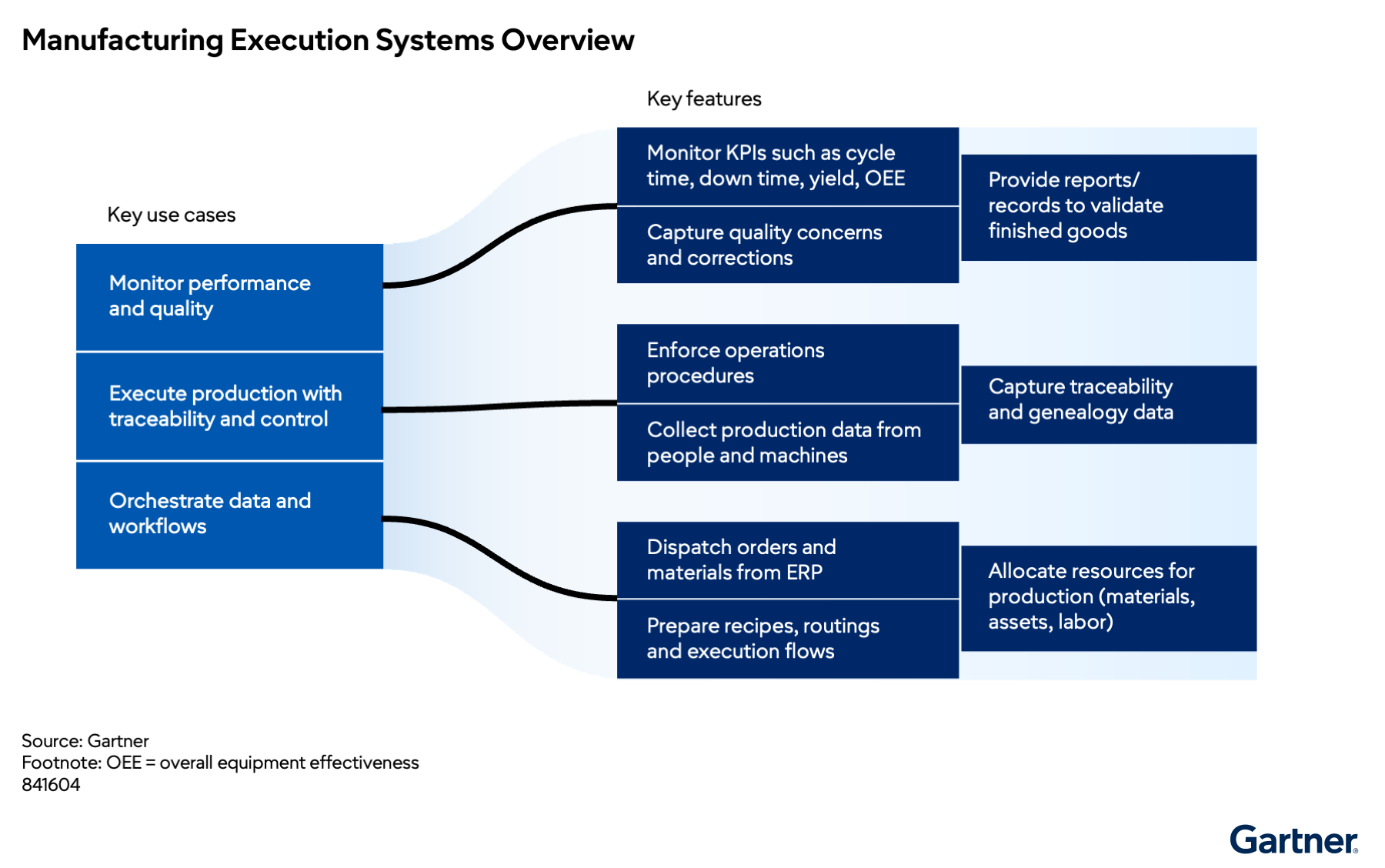
The core of MES continues to focus on three key areas (see Figure 1):
- Monitoring production through data collection and reporting of KPIs
- Executing production orders with full traceability and process quality enforcement
- Orchestrating production orders, recipes and resources
In recent years, there has been an emphasis on giving more ownership to the buyer through methods such as composability, enabled by low-code extensions and open APIs. This not only eases the burden of costly customizations but also improves integrations with adjacent systems, such as ERP, product life cycle management (PLM) and quality management systems (QMS).
As vendors begin to embed AI into their solutions, buyers will be looking for agentic integration as well. This has led to many vendors embracing MCP as one option to support these agentic workflows. Vendors are also enabling more manufacturing operations management (MOM) functionality, such as detailed scheduling through partnerships.
Additionally, MES vendors continue to move to a micro or miniservice architecture, which will enable scale and a better deployment experience for its customers. This also helps support AI initiatives as some AI functions may need to run at the edge, per the customer’s privacy requirements.
Model context protocol (MCP) | MCP enables seamless integration between LLM-based applications and external data sources and tools. It provides a standardized way for applications to discover and access contextual information, tools and capabilities that can be used with LLM “function-calling” features. |
MES vendors differentiate by industry and manufacturing style. Industries such as aerospace and defense, pharmaceutical and high tech (semiconductor, medical device, etc.) often have unique requirements or require strict regulation compliance. When industry focus is not emphasized, buyers should look for systems that support their manufacturing style, such as process or discrete manufacturing. Figure 2 depicts vendor coverage for process manufacturing, which often includes industries with high volume and low mix or batch production.
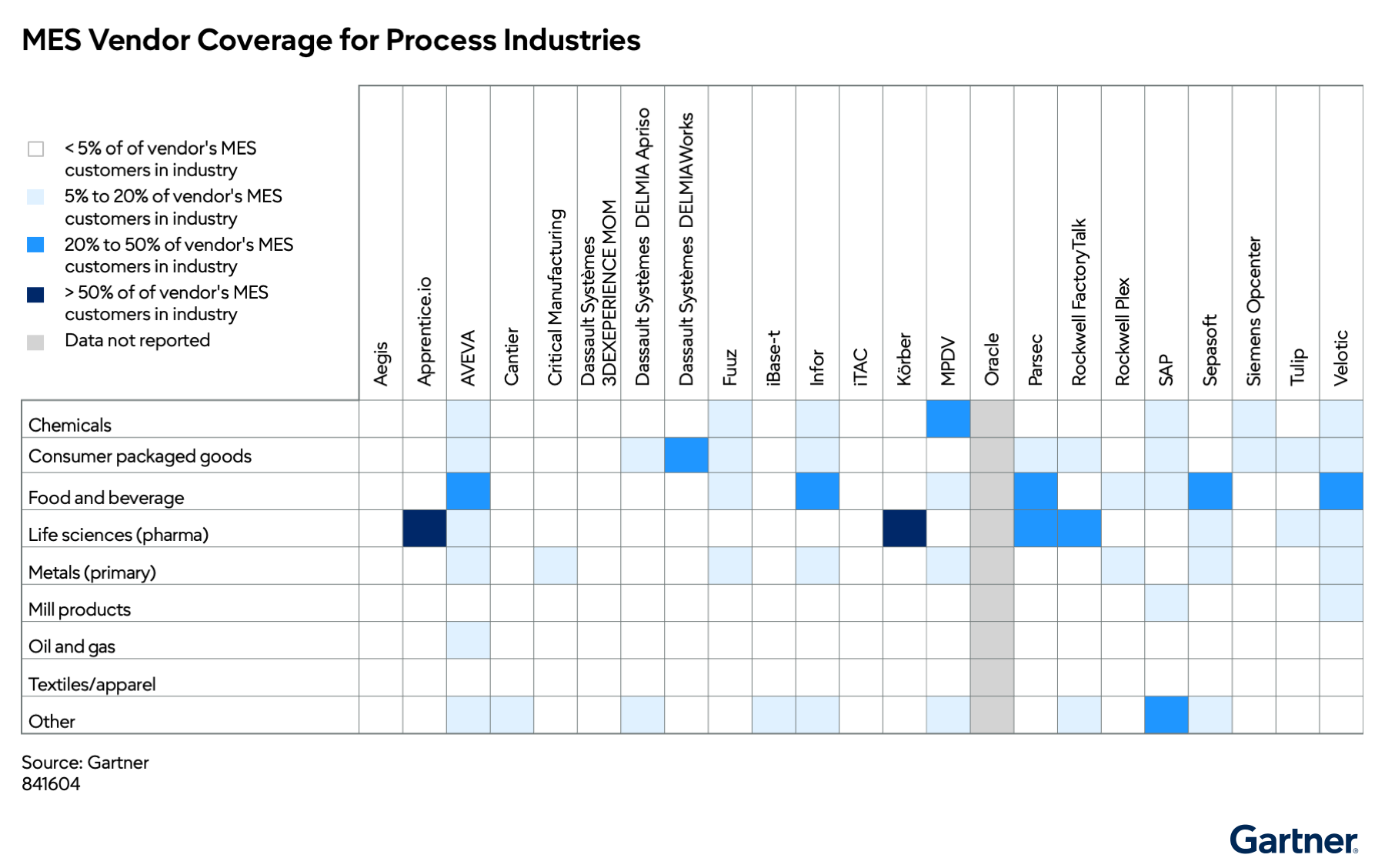
Figure 3 depicts vendor coverage for discrete manufacturing, which often includes industries with lower volume or more-complex assembly production.
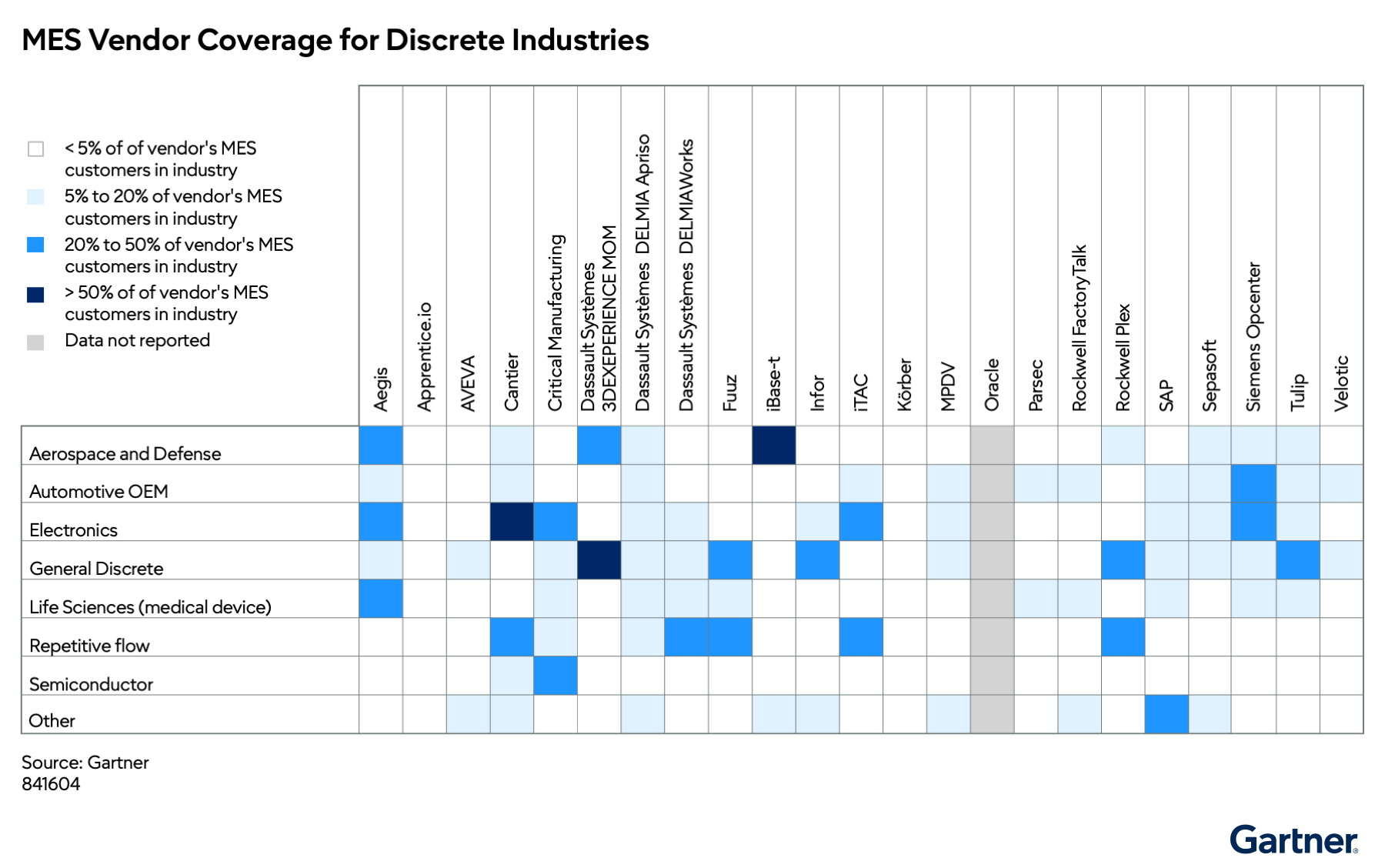
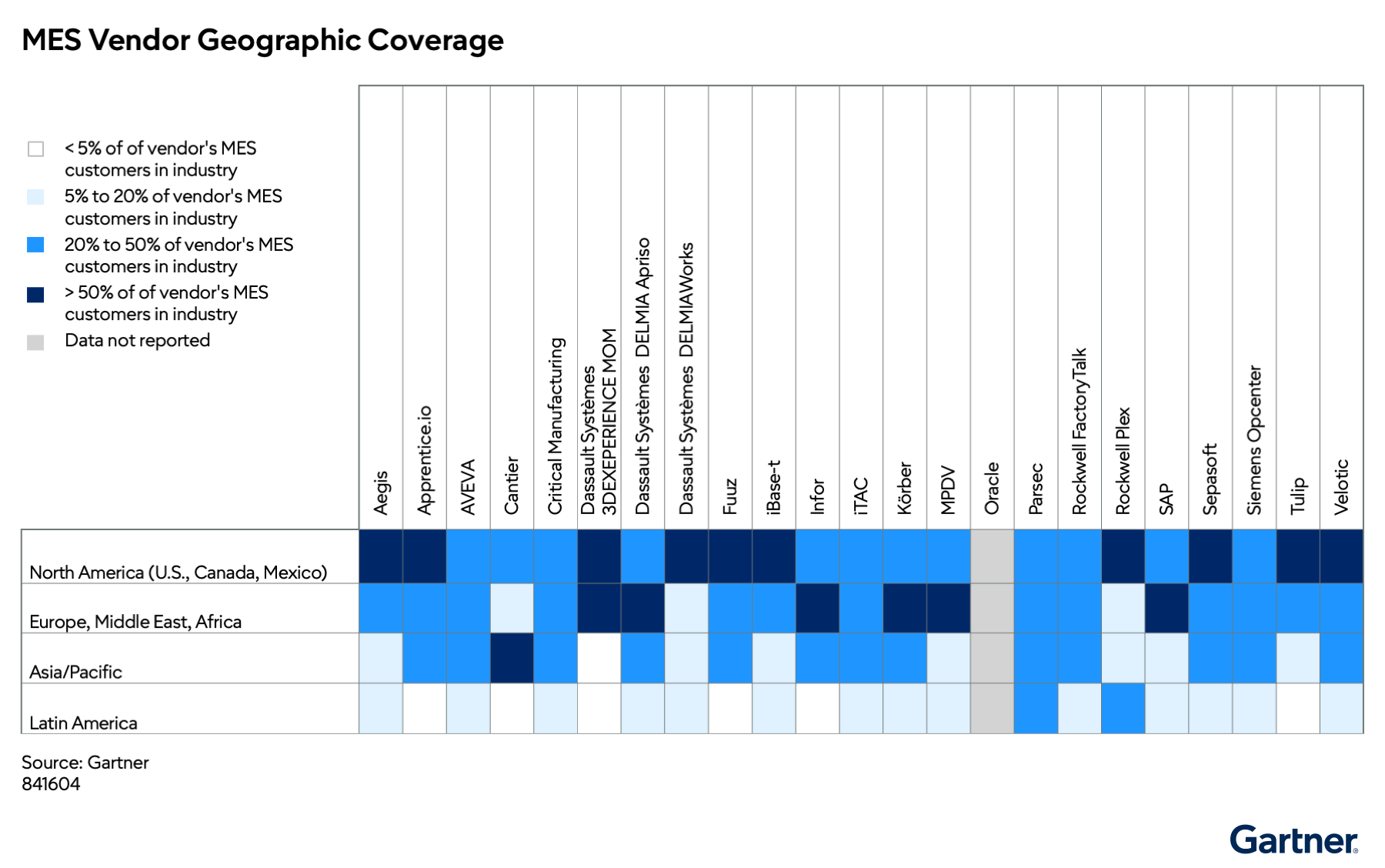
Figure 4 shows the geographic coverage of installations by region.
Market Direction
The potential of AI in MES is high in how it can remove barriers to MES adoption such as complex configurations and poor operator experience, but the direction and ROI are unclear. AI chat assistants are table stakes for the future. The next priorities for embedded AI are improving the configuration of a complex set of master data and process workflows. Others are investing in MCP with the expectation of eventual agentic workflows in the full manufacturing systems ecosystem. Ultimately, their biggest barrier to adoption will be their customers.
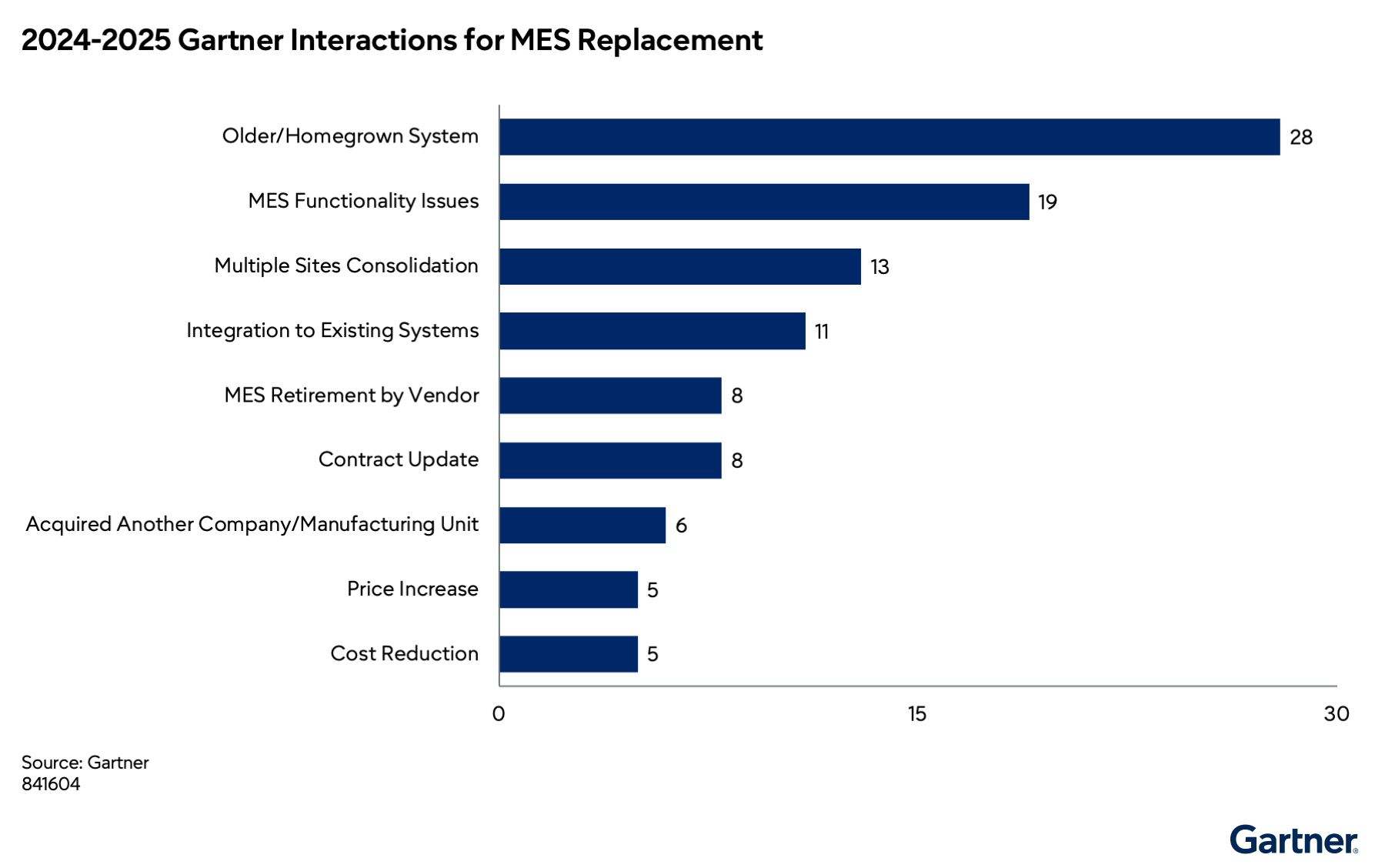
Gartner research analyzed the past two years of inquiry on MES vendor selection. The top two reasons for entering the MES market were to replace older or homegrown systems and lack of functionality with their current system, as illustrated in Figure 5.
To realize any potential benefits from AI, MES clients must first modernize their environments.
While new customers can immediately leverage AI-enabled features, those operating on legacy platforms must recognize that upgrading is a necessary step to even evaluate or implement AI capabilities. These capabilities must align with the client’s enterprise AI strategy. In this context, AI can serve as a catalyst for building a stronger business case for modernization, even if its full value remains to be demonstrated.
Market Analysis
The MES market consists of an ecosystem of vendors and partners. Investment remains strong both from the continued growth in the market, as well as MES vendor investments that embrace new technology, such as GenAI, augmented reality and digital twins. This was further evident in 2025 as two larger MES vendors were acquired by private equity firms to accelerate their growth.
Now, with AI enhancements becoming generally available, MES buyers and existing customers will need to evaluate their current state and whether the vendor AI strategy aligns with their own strategy and goals.
Trust Through Strategy, Security and Observability
Like many vendor platforms, buyers will demand data privacy and transparency in their AI solutions. MES vendors know they need to include these guardrails in their systems to assure adoption and customer value, particularly in sectors like aerospace, defense, and life sciences where data sovereignty and validation are mandatory. Vendors are enabling this trust by implementing “zero-retention” architectures, explicitly guaranteeing that customer data is never used to train foundation models and is processed only at inference time. Buyers should also expect an observable outcome to build trust with the shop floor operations team. Without a mechanism to explain the AI output, humans in the loop may not feel comfortable accepting the result, especially as they will be held accountable for the outcome. Some vendors will implement configurable guardrails to prevent hallucinations as well.
Buyers also expect a secure solution. Vendors offer private tenant or air gapped options by allowing the AI tools to be run in the customer’s environment, eliminating the need to rely on public cloud infrastructure or shared hosting environments. As internal AI strategies evolve, more emphasis will be placed on leveraging AI platforms to enhance systems such as MES. Those looking to expand on an internal strategy should look to vendors who use “bring your own model” approaches or offer an MCP server that can be accessed in the customer’s internal environment.
Buyers need to treat AI as a skill set and not a feature because the technology is rapidly changing, and the users will need to adapt. Those who want to take advantage of the AI offerings now will build skills and be able to earn trust faster over time. Humans in the loop and validating outputs from MES AI features will remain a critical component for some time.
Value-Driven AI Use Cases Focus On Productivity
Identifying value-driven use cases will still be challenging in today’s MES market, especially for customers on older versions of the software. While some of the insights offered by AI-driven chat assistants is helpful, productivity may only see small increases. Customers looking to embrace AI in their MES can target two key areas:
- Accelerated digitization and configuration: Vendors are leveraging LLMs to construct a domain-specific model that can generate configurations and settings based on natural language requests or ingestion of existing documents (PDF, DOCX). Some vendors are also using vision language models (VLMs) to use video as a source for these builds. In complex environments, these features can enable rapid deployment for new products or recipes, which provides a strong business case for the buyer. Buyers should also consider whether this will better enable their entire manufacturing organization to become builders in MES and not be bottlenecked by expert resources. In this scenario, they will also need to consider the governance and guardrails to ensure the outcome is productive and validated.
- Agentic workflows: As more vendors — not just MES — embrace agentic AI, buyers can evaluate the potential impact to their current value streams. Some of the more manual interactions with MES such as master data entry, BOM changes or schedule updates from planning systems can be streamlined with agents. Traditional integrations or robotic process automation (RPA) work well in structured environments but are brittle when the source data changes frequently. With an agentic approach, data can be ingested and reasoned in multiple forms, while guardrails from MCP servers ensure the destination data source is sanitized and validated.
Interoperability Enables Future-Proof Integration
With constant changes in macroeconomic conditions, manufacturing leaders must build agile, flexible systems in their overall ecosystem, or else they risk having legacy technology be a barrier to their business outcomes. MES vendors know they must support this ecosystem and their strategies of adding interoperability and adopting open architecture support this. Buyers should prioritize vendors whose strategy aligns with their capabilities and future plans, especially with regards to AI.
More platforms are emerging in the market as well. They offer more flexibility compared with off-the-shelf solutions in configuring the data model, as well as business logic and user interfaces through low-code tools. Because of this, they are typically more interoperable compared with monolithic systems, but they also have a steeper learning curve. Strong governance and design strategy are needed to prevent application sprawl. Buyers should ensure they have the skills and competencies to be successful with a platform and not purchase flexibility they don’t need. The flexibility supports future capabilities, yet being successful with standard MES functionalities is a challenge in itself. A monolithic system with REST API endpoints and publish/subscribe architecture will suffice for some.
Additionally, as more vendors adopt MCP in their roadmaps, the potential for orchestrated enterprise systems is in sight. MES customers that are running an old system that lacks interoperability will remain stagnant and risk introducing low-value AI outcomes as connectivity or adequate data are restricted behind closed systems.
Representative Vendors
The vendors listed in this Market Guide do not imply an exhaustive list. This section is intended to provide more understanding of the market and its offerings.
Vendor Selection
Vendors were selected for this Market Guide based on client end-user interest, market presence and the ability to cover the core MES use cases and features (see Table 1).
Representative Vendors in Manufacturing Execution Systems
Vendor | Product name |
FactoryLogix | |
Tempo Manufacturing Cloud | |
AVEVA MES | |
MES X.0 | |
Critical Manufacturing MES | |
DELMIA Apriso, DELMIAWorks, 3DEXPERIENCE MOM | |
Fuuz MES Platform | |
Solumina MES | |
Infor MES | |
iTAC.MOM.Suite | |
PAS-X MES Suite | |
MES HYDRA X | |
Oracle MES | |
TrakSYS | |
Plex, FactoryTalk Production Centre | |
SAP Digital Manufacturing | |
Sepasoft MES | |
Opcenter, Opcenter X | |
Tulip MES | |
Proficy Smart Factory | |
Source: Gartner (March 2026)
Vendor Profiles
Aegis Software
Aegis Software’s MES is titled FactoryLogix. The solution has been developed over many years, starting primarily in the electronics industry. Their customers are in the discrete assembly industries (electronics, aerospace and defense, medical device, automotive) and offer advanced functionality for these markets such as maintenance repair and overhaul (MRO), PLM integration and extensive quality management. Aegis Software was recently acquired by Peak Rock Capital Private Equity to invest in its further growth. Customers are located in all major regions, with most in North America and EMEA.
Recent additions to the software include technical enhancements across analytics, quality enforcement, traceability, and IIoT connectivity. Updates feature new analytics data generators for automated reporting, expanded enforcement of operator certifications, and improved genealogy for multilevel assemblies. They also introduced performance optimizations for high-volume environments, expanded BOM capabilities, and new integrations for equipment like laser marking. Additionally, platform-level improvements were implemented to support replicated databases and scalable deployment architectures. In December 2025, Aegis Software acquired Simio, adding simulation-based digital twin and advanced production planning and scheduling (APS) capabilities to its portfolio
Aegis Software’s approach to AI involves a strategic partnership with Arch Systems to provide the ARIA offering, which applies machine learning to contextualized manufacturing data. These embedded capabilities focus on predictive quality, downtime classification, and root cause identification while keeping execution under human supervision. They aim to identify emerging defect patterns and quality risks, expose bottlenecks and microstoppages, and augment traditional analytics with actionable insights for its customers.
Apprentice.io
Apprentice.io’s MES is titled Tempo Manufacturing Cloud. Their customers are primarily in the life sciences industry, although their solution would fit other batch industries as well. They offer extended functionality as part of their platform, such as a laboratory execution system (LES) and digital work instructions. Customers are located in North America, EMEA and APAC.
Recent additions to the platform include enhancements to recipe authoring with visual builder improvements and dynamic text, alongside expanded web execution capabilities for material consumption and manual dispenses. Quality management was strengthened with granular exception settings, bulk override management, and improved audit trails. They also introduced advanced time formulas, multiproduct recipe variations, and deeper integration with external content like Veeva SOPs. Furthermore, the platform improved data management with extensive new columns for batch/procedure runs and optimized report generation tools.
Apprentice’s approach to AI involves the release of validated agentic AI tools, including an authoring agent for prompt-based procedure generation and migration, a quality agent for automated exception grouping and approval, and a process agent for real-time operator support. These capabilities are embedded directly into the software with a centralized configuration system to manage user permissions and audit trails. They aim to provide faster recipe development time, reduce batch review time, and improve quality control and effectiveness of operators for its customers.
AVEVA
AVEVA offers a portfolio of software products in the manufacturing systems landscape, from edge to cloud. AVEVA Manufacturing Execution System (MES) is mostly used in batch and continuous production industries, such as food and beverage, consumer packaged goods, and chemicals. However, it also supports many adjacent industries, including general discrete, mining and energy. Customers are well spread among all four major regions, with most in EMEA and North America.
Recent additions to AVEVA MES include a series of incremental composable MES content releases and the successful validation of deployments on Amazon Web Services (AWS) infrastructure. They have expanded integration with the CONNECT cloud platform to include inventory, material events and quality data for better multisite visibility. Additionally, the release of version 2023 R2 introduced enhanced high availability and improved store-forward capabilities for reliable data collection when disconnected.
AVEVA’s approach to AI involves embedding intelligent capabilities directly into the CONNECT platform, featuring the Industrial AI Assistant for natural language interaction and AVEVA Advanced Analytics for no-code modeling. They are also actively developing an agentic AI architecture using MCP servers to create a controlled execution layer for autonomous workflows. They aim to increase the reliability of production processes to minimize downtime, improve quality control to reduce variation, and dynamically optimize production setups for “golden batch” replication for its customers.
Cantier
Cantier’s MES is titled Cantier MES X.0. The MES X.0 platform provides core MOM functionality extending into quality, maintenance and advanced analytics, while also providing flexibility in the user interface to offer a catered solution to their customers. They are primarily deployed in discrete industries such as automotive and electronics. Customers are located primarily in the APAC region, with recent growth in North America and EMEA.
Recent additions to the software include material flow management, control tower capabilities and digital twin functionality that includes an immersive AR/VR experience for improved operator training. These additional capabilities help enable their customers in lights-out factory implementations. New microservice architecture updates offer an improved core-edge component to enable functionality near the factory devices. This has also enabled an edge to cloud offering through their partnership with AWS.
Cantier’s approach to AI involves using generative AI for operational query responses and machine learning for predictive maintenance, while developing knowledge graphs to provide agentic decision support as extended modules. They aim to enable faster detections of anomalies, continuous operation effectiveness improvement, and predictive capabilities for its customers.
Critical Manufacturing
Critical Manufacturing offers an MES that is primarily used in discrete manufacturing. Its emphasis on the electronics, semiconductor and medical device industries have led to significant growth in this space, and its roadmap continues to deliver specialized features for these industries. Customers are located in all four major regions, with most in APAC, EMEA and North America.
Recent additions to the software include enhanced batch management with lot matching and resource cluster services for multichamber equipment, alongside granular labor management for activity-level tracking. The latest release also introduced flexible BOM management, allowing for material deviations during processing, advanced substrate mapping, and smart bar code scanning. Furthermore, improvements were made to line clearance and maintenance management for reusable spare parts. The technology stack continues to evolve with new reporting tools like Grafana and Stimulsoft. Finally, they implemented Unified Namespace (UNS) streaming via MQTT and a centralized enterprise data platform for multisite reporting.
Critical Manufacturing’s approach to AI involves a multistage roadmap progressing from foundational machine learning and generative AI for contextual understanding to advanced agentic intelligence and cooperative multiagent ecosystems. These capabilities are embedded directly into the MES and data platform, utilizing RAG and MCP-based retrieval to support everything from prompt engineering to autonomous cognitive workflows. They aim to empower the frontline workforce, provide operational intelligence for predictive insights, and accelerate value through faster development of production artifacts for its customers.
Dassault Systèmes
Dassault Systèmes offers multiple products in the MES space. DELMIA Apriso is its enterprise offering that is highly configurable and caters to larger customers in the discrete and mixed-mode manufacturing spaces. It also offers DELMIAWorks, which focuses on small to midsize manufacturers and offers ERP functionality. It also continues to focus on its full SaaS offering, titled 3DEXPERIENCE MOM, which includes traditional MES functionality in a slow-build, complex-assembly environment and can also be used for material synchronization and warehouse management. Because of its wide coverage, Dassault Systèmes supports many industries in discrete and batch/continuous flow, such as aerospace and defense, automotive, consumer packaged goods, electronics, and medical devices. Customers are well located in all four major regions, with most in EMEA and North America.
Recent additions to 3DEXPERIENCE MOM include enhancements to Production and Warehouse Supervisor roles with improved quality workflows, 3D work instruction integration, and better material tracking. A new Manufacturing Operations Analyst role was introduced to consolidate analytics and leverage 3D data contextualization. In DELMA Apriso, through the acquisition of ASCON Cube, they added virtual PLC and commissioning capabilities, alongside a new configurable DELMIA Apriso Portal and simplified licensing models. In DELMIAWorks, they introduced ShopWorks, a web-native user interface designed specifically to empower machine operators with a widget-driven experience. This interface streamlines tasks by presenting them in intuitive formats, ranging from simple instructions to guided sequences for secondary operations and inspections.
Dassault Systèmes’ approach to AI involves native integration with the 3DEXPERIENCE Platform to provide “Virtual Companions” for execution assistance and voice-controlled guidance. They utilize Generative Experiences for predictive quality and Configuration Virtual Companions to accelerate process building and automated testing using LLMs. They aim to provide predictive analytics for a reduced cost of quality, process optimization for faster implementation, and workforce onboarding optimization for improved efficiency for its customers. In DELMIAWorks, they are incorporating Dassault Systèmes’ Aura AI technology to support workflow agents, analytics, and predictive tools while ensuring data remains within a secure environment. Additionally, they maintain an open database architecture that allows customers to leverage third-party AI platforms to create custom scripts, alerts, and external analytics. They aim to enable a more effective use of skilled staff, improve visibility into operational data, and ensure better utilization of MES information for predictive insights.
Fuuz
Fuuz offers a platform approach to their software, which allows them to extend into other manufacturing systems such as warehouse management (WMS), quality management (QMS) and transportation management (TMS). Their NoSQL back-end includes a low-code, object-relation mapper (ORM) that enables customers to develop purpose-built data models and applications. Fuuz has customers spread across batch and discrete industries, including automotive, general discrete, consumer package goods and metals. Customers are primarily in North America and EMEA, with support for APAC and LATAM as well.
Recent additions to the software include “Hybrid extensibility using Fuuz Gateway,” which enables cloud enterprise modeling with site-level deployment that can operate without internet for short durations. They have greatly enhanced screen design capabilities, allowing for both no-code and pro-code dashboard creation to provide flexibility without security risks. Additionally, their custom ORM was implemented on top of MongoDB to enable strict enterprise data governance. This includes fully built-in audit tracking, authentication logging, IP restrictions, and granular access control policies.
Fuuz’s approach to AI involves incorporating the MCP into both their cloud and hybrid solutions to act as a central data layer across all enterprise systems. This enables customers to create their own MCP tools and plug in any commercial or private LLM to access their entire ecosystem. They aim to provide real-time analytics across applications, enable the code-free generation of data models and dashboards, and identify solutions to manufacturing bottlenecks for its customers.
iBase-t
iBase-t offers an MES for the aerospace and defense industry, called Solumina MES, and currently supports and maintains their iSeries product. The complex assembly of this industry and its suppliers are supported by features that fit the market, such as Solumina Maintenance, Repair and Overhaul (MRO) and Solumina Supplier Quality Management (SQM). Customers are primarily in the A&D market, as well as the nuclear, satellite payload and space launch markets. Customers are located in all four major regions but are mostly in North America.
Recent additions to the software include the Solumina i120 release featuring MBE Pro for advanced model-based MES capabilities and the Solumina Web Configurator for frontend tailoring without back-end modification. The Solumina i130 release introduced material out time tracking (MOTT) for freezer-dependent materials and a centralized Solumina Admin Portal. Further enhancements include the migration of major features to a configurable web UI and deeper integration with smart tools for automated data collection.
iBase-t’s approach to AI introduces a companion intelligence layer, Solumina AI, which augments the MES with governed generative AI capabilities for knowledge retrieval, contextual data analysis, and insight generation through tools such as Digital SME and ScanAI. This layer builds on Solumina Intelligence and PulseAI to enhance operational visibility across quality, production, and maintenance data, while preserving auditability, traceability, and human-in-the-loop governance required in regulated A&D environments.
Infor
Infor MES offers industry-specific process types that clients can start with as well as full configuration capabilities to finalize their unique requirements. Out-of-the-box integration with Infor CloudSuite and Infor OS allows clients to work directly with their ERP data in the MES and keep ERP updated with relevant shop floor information. Infor supports both batch and discrete industries, with customers in general discrete, food and beverage, consumer packaged goods, and automotive, among others. Customers are primarily located in EMEA, North America and APAC.
Recent additions to the software include a refreshed dashboard design that provides a consistent visual experience across various devices and a new no-code dashboard builder for customer-configured visualizations. Additionally, they released a skills matrix module, which integrates with existing modules to enforce operator skill validation across production, quality, and maintenance tasks.
Infor’s approach to AI involves leveraging the Infor OS platform to provide machine learning capabilities and developing an operator knowledge assistant for natural language interaction with work instructions and history. They are also progressing toward an agentic model using MCP APIs to support autonomous process coordination and feedback loops. They aim to provide predictive analytics and quality control, facilitate process optimization and automation, and support workforce training and knowledge assistance for its customers.
iTAC Software
iTAC.MOM.Suite (MES/MOM solution) has an industrial focus designed for series and mass production, high-mix/low-volume, repetitive flow, and discrete manufacturing. Partnering with its parent company Dürr Systems AG, it continues to support electric vehicle battery manufacturing, including functionality specific to the high data demands of battery quality. Customers are in the electronics, automotive and medical device industries, but many are also in the general repetitive flow market. Customers are located in all four major regions, with most in EMEA, North America and APAC.
Recent additions to the software include the smart connector and iTAC.SMT.Edge for rapid machine connectivity, which reduces integration complexity and cost. They introduced a new downtime tracker module within the iTAC.Asset.Analyzer to detect real-time issues and provide guided actions. Enhancements to iTAC.IIoT.Edge ensure industrial-grade security and governance for safe data flow from the shop floor to the cloud.
iTAC’s approach to AI involves the solution iTAC.CATi, which offers context agents for natural language documentation queries, semantic data linking for root cause analysis, and a digital assistant for production employees. Additionally, they implemented an Integration framework using the MCP to facilitate seamless connectivity between the MES and large language models. These features support both local and cloud deployments and utilize MCP for cross-system integration and contextual AI access. They aim to provide downtime time reduction, improved quality control, and workforce training and knowledge retention for its customers.
Körber
Körber offers an MES for the life sciences market called PAS-X MES Suite. Their MES offers a process flow recipe builder that includes industry-specific modules, such as MBR Design & Execution, Weighing & Dispensing, Equipment Management, and Track & Trace. Customers are in the life sciences industry, predominantly pharmaceuticals. Customers are located in all four major regions, with most in EMEA, APAC and North America.
A major development is the “Next-Generation MES” web-based front-end, designed to run in parallel with the existing interface for responsive execution and reduced TCO. Additionally, technical modernization efforts focused on replacing legacy components and improving SaaS capabilities for faster delivery and integration. Recent additions to the software include the introduction of GraaIVM to reduce memory usage and a Kubernetes Operator to automate deployment and maintenance efforts. They have delivered new functional features such as extended public APIs, bulk scanning support, and improved ERP integration.
Korber’s approach to AI involves deploying “PAS-X K.AI,” a GenAI CoPilot for documentation support, and an “MBR AI Designer” to automate the creation and maintenance of Master Batch Records. These solutions leverage an agentic AI architecture built on the MCP and retrieval-augmented generation (RAG) to ensure standardized, auditable, and compliant interactions with manufacturing data. They aim to provide reduced on-call rates and 24/7 support, design and maintenance effort reduction for MBRs, and democratized data access for operational efficiency for its customers.
MPDV
MPDV offers MES HYDRA X, built on its proprietary Manufacturing Integration Platform (MIP). The solution contains microservices called mApps, which can be provided by MPDV or one of its approximately 50 partners. HYDRA X is available as on-premises, hybrid or full cloud (SaaS) deployment, with about two-thirds of customers using it on-premises. HYDRA X supports both discrete and process manufacturing operations, and its customers are distributed across all industries with many in chemicals, metals and automotive. Customers are located in all four major regions, with most in EMEA and North America.
Recent additions to the software include a new “Compliance” product for regulated industries and the launch of MIP version 2.1, which lowers ownership costs through license-free database support. They also introduced a “Detailed Project Management” solution and a “KPI Cockpit” for centralized visualization, along with updates to core modules like order management and detailed scheduling. Furthermore, significant usability enhancements were implemented across the user interface.
MPDV’s approach to AI involves the “AI Suite” for ML-driven insights into OEE and quality, and the “Smart Guide” Generative AI companion, while actively developing an agentic AI architecture with an MCP Server for autonomous workflows. They aim to enable optimal production planning via reinforcement learning, enhanced manufacturing optimization through pattern detection, and early prediction of product quality for its customers.
Oracle
Oracle’s MES solution is part of its Fusion Cloud Supply Chain & Manufacturing (SCM) suite. It is exclusively used as part of wider Fusion Cloud deployments, but Oracle does not share detailed data about its industry presence or its geographic presence. It is 100% deployed as SaaS-only with quarterly updates.
Recent additions to the software include expanded mixed-mode capabilities allowing for advanced flow manufacturing and synchronized batch execution for process industries. They improved the operator point-of-use experience with streamlined navigation, while enhancing mobility solutions for real-time reporting on industrial handheld devices. Additionally, connected production execution was expanded to support bidirectional communication with equipment for automated set points and parameter tracking. Finally, they introduced supervisor-driven orchestration for workforce scheduling and better coordinated manufacturing-warehouse workflows using License Plate Number tracking.
Oracle’s approach to AI involves deeply embedding “Fusion-native” AI agents directly into business workflows to support factory floor intelligence, maintenance automation, and quality planning. An AI Agent Studio deploys preconfigured and custom agents that can orchestrate multiagent teams and integrate with external systems via APIs and the MCP. Customers also can use the AI Agent Studio to develop and deploy contextualized agents to the appropriate UIs using Journeys, a simplified feature that helps organizations design and deliver guided, step-by-step experiences for employees and managers across key processes in their everyday work. They aim to provide improved productivity, cycle time reduction, and process flow automation for its customers.
Parsec
Parsec offers an MES titled TrakSYS. Its software is primarily used in batch production, with a majority of its customers in food and beverage, pharmaceutical, and consumer packaged goods. Its template architecture approach is well suited for multisite rollouts and most of its customers have deployed to 10 or more sites. Customers are well distributed across the four major regions, with most in North America and EMEA.
Recent additions to the software include the release of TrakSYS 14, which expanded its focus on global scalability, applied intelligence, and cloud enablement. Major enhancements include Solution Studio and Template Transfer tooling, which provide life cycle governance for developing, versioning, and deploying MES templates across global operations. Connectivity enhancements include structured MQTT with Sparkplug B for state-aware, scalable IIoT data exchange, along with continued expansion of containerized services to support flexible, cloud-ready, and hybrid deployment models. The platform also supports high-availability architectures and subscription-based licensing with centralized management capabilities to facilitate enterprise administration.
Parsec’s approach to AI involves TrakSYS IQ, a suite of embedded capabilities featuring a conversational assistant for natural language querying and contextualized insights. Leveraging Microsoft Azure OpenAI through a secure gateway, their roadmap includes generative AI for diagnostics and agentic automation to orchestrate workflows directly within the interface. They aim to enable faster and more confident decision making, provide scalable workforce enablement and knowledge capture, and transform the MES into an intelligence layer for performance optimization for its customers.
Rockwell Automation
Rockwell Automation provides an MES portfolio that includes cloud-based and on-premises options, allowing manufacturers to choose based on operational requirements. Plex is delivered as a single-instance, multitenant SaaS MES designed to support manufacturing operations with resilient, real-time capabilities that extend beyond traditional MES solutions. It supports both discrete and process manufacturing. FactoryTalk ProductionCentre is their on-premises solution, used across various sectors including regulated industries. The portfolio has customers in all four major regions, with Plex primarily in North America and APAC, while ProductionCentre is primarily in North America, EMEA and APAC.
Recent additions to PLEX include the launch of FTResilientEdge, designed to support deterministic execution and operational continuity at the edge while leveraging cloud-based governance, analytics, and enterprise-scale visibility to support resilient operations across sites. They have added new industry capabilities like tank management and hazard analysis critical control point (HACCP) support. They enhanced the Connected Worker suite with advanced Digital Work Instructions and an Activity Manager, while also introducing a UI Builder for custom applications and refreshing the Plex Analytics platform. Furthermore, they improved API usability and delivered automated process flows to support rule-based task automation.
Rockwell PLEX’s approach to AI involves embedding agentic and generative capabilities, including work instruction authoring agents, generative corrective actions, and predictive tools like VisionAI and OEE forecasting. They utilize the MCP to unify agent interactions and expose MES context securely to support autonomous workflows. They aim to improve production performance and predictability, ensure stronger process stability and quality assurance, and automate routine work for its customers.
Recent additions to ProductionCentre include a shift toward a modern hybrid edge and cloud architecture, where products are containerized and deployed into Kubernetes clusters for faster infrastructure management. They have also focused on cyber hardening with IEC62443-4-1 certification and simplified update processes to help customers stay current with less downtime. Additionally, functionality was enhanced to allow for more capability regarding expiry dates in recipes.
Rockwell ProductionCentre’s approach to AI involves offering independent AI products for tasks like visual inspection that integrate with the MES, as well as AI services for building solutions on customer-owned data. They are actively exploring proofs of concept to provide natural language support for operators, configuration assistance, and access to product documentation. They aim to reduce time to value, reduce total cost of ownership, and reduce the cost of data for its customers.
SAP
SAP offers Digital Manufacturing (SAP DM) as part of its Supply Chain Management portfolio. Other than its predecessor, SAP Manufacturing Suite, which consisted of SAP Manufacturing Execution (ME) and SAP Manufacturing Integration & Intelligence (MII), it targets various discrete and process industries, with approximately half in discrete and the rest in process and other industries. SAP DM is purely offered as a SaaS solution on top of the SAP Business Technology Platform (SAP BTP). It is integrated with SAP’s ERP solutions but rarely used by companies running other vendors’ ERP solutions. Customers are located in all four major regions, with most in EMEA and North America.
Recent additions to SAP DM include issue resolution to support continuous improvement processes like 5Y, 8D, and Ishikawa. They enhanced employee experience capabilities through SAP SuccessFactors integration and introduced a dedicated low-cost workforce scheduling solution. For life sciences, they matured Electronic Batch Record (EBR) and Master Batch Record (MBR) frameworks to support pharmaceutical needs. Additionally, they released the POD 2.0 Beta for a modernized worker UI and improved the Production Process Designer to enable “Quick Deploy” updates that avoid downtime.
SAP’s approach to AI involves leveraging SAP Joule for conversational guidance and navigation, alongside “Base AI” for issue resolution and SAP Signavio for process intelligence. They are also developing agentic capabilities, such as a shop-floor supervisor agent for automatic production rebalancing, and partnering with Microsoft to integrate Co-Pilot and Cloud Fabric technologies. They aim to identify hidden value through enterprise data visibility, extend ownership of the enterprise to operations for easier multisite adoption, and leverage ecosystem differentiation for its customers.
Sepasoft
Sepasoft MES offers a series of production modules built on top of Inductive Automation’s Ignition software. Customers are spread in both discrete and batch industries such as food and beverage, automotive and life sciences. Sepasoft uses a modular approach to system configuration and licensing. Customers are located in all four major regions, with most in North America, EMEA and APAC.
Recent additions to the software include the evolution of the Batch Module into a modern, workflow-centric orchestration engine suitable for batch, hybrid, and discrete manufacturers. They introduced “Execution Point” to allow users to start or restart a batch at any step and “Permissive Interlock” to automatically hold a batch, if equipment interlocks are tripped. Across the product suite, “Change Sets” were added to provide a controlled method for bundling and applying updates with full traceability. Additionally, they are launching a new Finite Capacity Scheduling/APS product in Q1 of 2026.
Sepasoft’s approach to AI involves the SepaIQ platform, which provides data aggregation and contextualization alongside multiple ML models and LLM integration. They plan to embed these AI and ML capabilities across all modules, including OEE and SPC, within the next year. They aim to answer complex manufacturing questions through enterprise-level data aggregation, enable low-/no-code natural language interaction, and drive real-time floor efficiencies for its customers.
Siemens
Siemens Digital Industries Software includes a portfolio of manufacturing software products. Its MES offering is titled Opcenter and is widely used across batch, continuous and discrete manufacturing. Customers are primarily in the automotive, electronics, aerospace and defense, medical device, and semiconductor industries, as well as chemicals and consumer packaged goods. Siemens also offers Opcenter X, which is a SaaS MES. Customers are located in all four major regions.
Recent additions to the software include the release of the modernized Opcenter application within the Opcenter X ecosystem to support customers looking to transition to Opcenter X. They also included new Industrial Metaverse capabilities via Intosite. They have expanded digital thread integrations with Teamcenter and Opcenter X ecosystems (APS, Intra-Plant Logistics, Quality, Interoperability, etc.), while introducing enterprise recipe management and model-based enterprise support. Furthermore, they deepened the integration between Opcenter X and Insights Hub for data-driven manufacturing and continued to modernize the operator UI/UX through Mendix embedded.
Siemens’s approach to AI involves a three-pillar strategy that embeds AI capabilities directly into applications, leverages Insights Hub for analytics on MOM and asset data, and uses Mendix for custom AI-infused solutions. Additionally, they leverage their newly acquired Rapidminer platform to provide a knowledge graph-powered data fabric and a comprehensive toolset for developing and operationalizing AI agents. They aim to ensure faster digitalization of customer processes, increase process efficiency at the shopfloor to reduce waste, and enable faster development and delivery of MES projects for its customers.
Tulip
Tulip’s Composable MES solution is built on a low-code/no-code application platform and a dynamic customizable data model, which offers flexibility and extensibility. It is a multitenant PaaS architecture, which most customers deploy via Tulipʼs public cloud on Amazon Web Services (AWS) or Microsoft Azure. It can also be deployed in AWS GovCloud (US), or a private cloud. Tulip’s main industry presence is in discrete industries, followed by life sciences and consumer packaged goods. Other industries include aerospace and defense, automotive OEMs, electronics, food and beverage, and bulk and specialty chemicals. Customers are located primarily in North America, EMEA and APAC.
Recent additions to the software include the launch of composable MES app suites specifically for regulated industries like Aerospace & Defense and Medical Devices, offering compliance-ready workflows aligned with standards such as ISO 9001, AS/EN 9100, FedRAMP Moderate for Aerospace & Defense and FDA 21 CFR Part 11 for Life Sciences. They enhanced governance capabilities with app diagrams and reusable functions to strengthen system integrity and standardization across multisite deployments. A new enterprise observability layer, OpsMoto, was introduced to provide cross-site dashboards and insights into automation activity and app adoption. Additionally, they significantly expanded their connectivity ecosystem with new edge drivers that facilitate no-code integration for over 700 industrial devices.
Tulip’s approach to AI involves a composable, LLM-agnostic strategy that embeds generative, agentic, and machine learning capabilities directly into the core platform rather than offering them as a separate product. This includes features like AI Composer for rapid app generation, AI Chat for querying documentation, and Composable AI Agents for orchestrating multistep operational tasks. They aim to build faster and reduce development cycle time, augment operators and improve operational efficiency, and unlock actionable, contextualized insights for its customers.
Velotic (formerly GE Vernova)
Velotic offers the Proficy portfolio of manufacturing systems, with Proficy Smart Factory MES being its core MES. Proficy Smart Factory is used in batch industries, such as food and beverage, consumer packaged goods, and specialty chemicals. The platform also includes functionality for discrete industries, such as machine builders and aerospace and defense, giving customers a mixed manufacturing mode for large enterprises that have a combination of requirements. Proficy was previously part of GE Vernova and as of March 2026 became part of a new independent industrial software company called Velotic, which is owned by TPG Private Equity. Customers are located in all four major regions, with most in North America, EMEA and APAC.
Recent additions to the software include a new 64-bit cloud-native Kubernetes back-end that supports multiple sites, alongside zero-downtime updates for their SaaS offering. They expanded capabilities in discrete work order execution, nonconformance management, qualifications, tool consumption and route management, while introducing a site-wide document management system. Furthermore, they migrated system administration to the web-based Proficy Configuration Hub and established GraphQL as the primary method for data access to support future AI agents.
Velotic’s approach to AI involves offering ML starter templates for predictive downtime detection and utilizing generative AI to automate configuration and dashboard building. They are actively developing agentic AI using the MCP to facilitate autonomous interactions for dynamic rescheduling and third-party agent integration. They aim to enable faster implementation, predictive analytics, and process optimization for its customers.
Market Recommendations
As MES begins to mature its AI offerings, buyers must evaluate how they can unlock additional value instead of just using AI to achieve similar outcomes. With increased emphasis on industrial data management and AI, interoperability becomes more important, and aligning to your overall AI strategy is pivotal.
When evaluating AI in MES:
- Ensure you have an auditable, accountable system through observability, zero-retention and human in the loop mechanisms.
- Applying already successful AI tactics to MES should be top of mind, such as ingesting operating procedure documents into digital work instructions. This is often a barrier to full MES adoption. AI is well suited to address this concern and is a low-risk win for the end user.
- As more vendors embrace open architecture and MCP, agentic workflows will become possible. Consider training your MES product owners in this technology as they will be able to map the process to the toolset, while also ensuring the right governance and controls are in place.
The gap between what vendors offer with AI versus what end users need will always be present. Rushing into the latest AI toolset is not always optimal and poor outcomes could lead to distrust in AI. Manufacturing strategy leaders must understand the technology and how to apply it to their specific needs, so that they can ensure trust and adoption on the shop floor, while also being able to clearly communicate the value proposition to senior leadership.
2026 Gartner MES Market Guide Survey. The information in this Market Guide is based on data collected from MES software providers (n = 31 vendors). This was achieved through an RFI process and supplemented with information available to Gartner from vendor briefings delivered by the firms and publicly available sources of information.