Critical Capabilities for Global WAN Services
19 March 2026 - ID G00834998 - 48 min read
By Gaspar Valdivia, Katja Ruud, and 1 more
Heads of I&O responsible for the enterprise WAN face challenges with network performance, security, cloud and AI traffic demands. Use this research to evaluate global WAN providers’ capabilities across network services, cloud connectivity and managed services for resilient global operations.
Overview
Key Findings
- Network service providers (NSPs) are building network-as-a-service (NaaS) platforms that emulate cloud models to allow for near-real-time, on-demand service modifications and flexible consumption. However, offers vary in maturity, depth and breadth of services, capabilities and commercial conditions, and often do not provide price predictability.
- To varying degrees, providers are investing in AI and automation within their network management systems to speed up circuit provisioning and improve the detection of network issues.
- WAN access options have diversified to include new wireless options, such as 5G fixed wireless access (FWA) and low Earth orbit (LEO) satellite services. These are viable solutions, particularly to serve remote and temporary locations and to provide path diversity, offering lower latency than 4G LTE and geo satellite alternatives.
Recommendations
Heads of infrastructure and operations (I&O) responsible for WAN services procurement should:
- Choose WAN services delivered via NaaS platforms that embed advanced AI and automation for WAN use cases requiring agile, automated, and scalable services such as cloud connectivity and seasonal peaks. Ensure that selected NaaS platforms allow for API-driven integration with your IT service management (ITSM) software, streamline the full service life cycle, and offer both fixed-rate and usage-based billing with tools to predict or cap variable costs.
- Prioritize providers that commit to measurable outcomes — such as reduced provisioning lead times and faster incident resolution — by embedding these metrics into service-level agreements (SLAs), regardless of the underlying AI or automation capabilities. Focus on holding providers accountable for results, rather than the specific technologies or methods they employ.
- Develop a comprehensive network resilience strategy by integrating both wireline and wireless access technologies, especially for hard-to-serve locations. When evaluating 5G FWA and LEO satellite providers, prioritize enterprise-grade solutions with substantial credit-backed SLAs.
Strategic Planning Assumptions
By 2030, 70% of enterprise private connections to cloud services will leverage multicloud programmable connectivity fabrics, up from 20% in 2025.
By 2030, at least five leading enterprise network service providers will be offering AI-based fully autonomous, closed-loop network service assurance capabilities, up from none in 2025.
What You Need to Know
Gartner has identified 10 critical capabilities providers must support to meet enterprises’ end-to-end WAN needs:
- Private WAN
- Internet services
- Network on demand and automation
- Cloud connectivity services
- Managed software-defined WAN (SD-WAN)
- Managed security
- Customer portals and application programming interfaces (APIs)
- Geographic coverage: Asia/Pacific
- Geographic coverage: Europe
- Geographic coverage: North America
Based on these capabilities, we analyze seven use cases:
- Complex WAN. Services offering a mix of Multiprotocol Label Switching (MPLS), internet, Ethernet and wavelength connection types with a broad range of data speeds from sub-10 Mbps to more than 10 Gbps.
- Internet-first WAN. Services that focus on internet connectivity, including dedicated internet access (DIA) and fixed or wireless broadband.
- Cloud-first WAN. Services that offer internet and private cloud connectivity to support on-premises and cloud applications.
- Security-first WAN. Services that offer private networking options and security enhancements, such as distributed denial of service (DDoS) and managed secure access service edge (SASE).
- Three regional WAN use cases. One for each of the three major regional markets — North America, Europe and Asia/Pacific — that typically need to support midsize enterprises or larger organizations with 50 to 200 sites.
Analysis
Critical Capabilities Use-Case Graphics
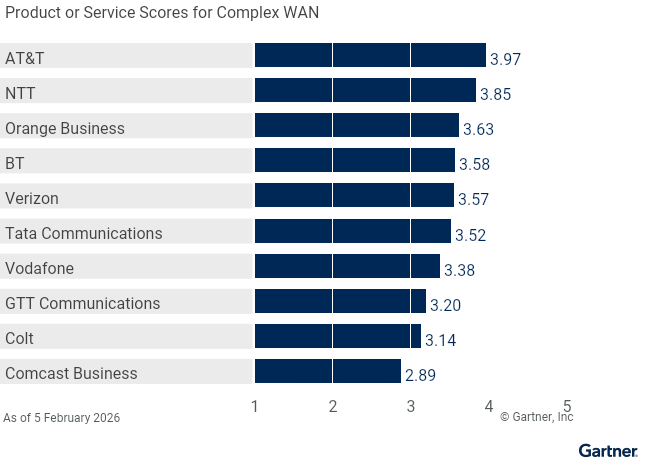
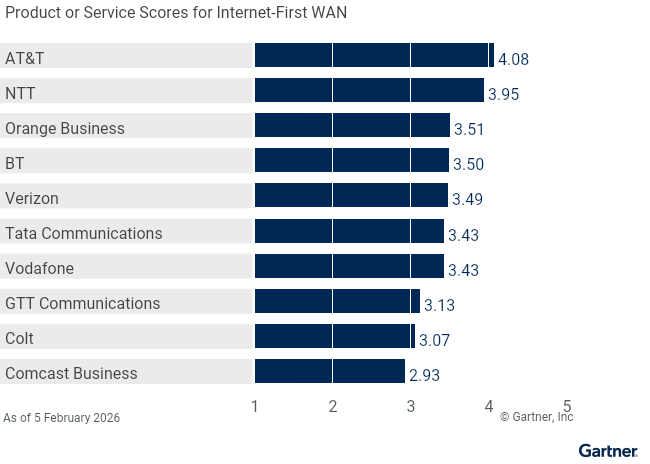
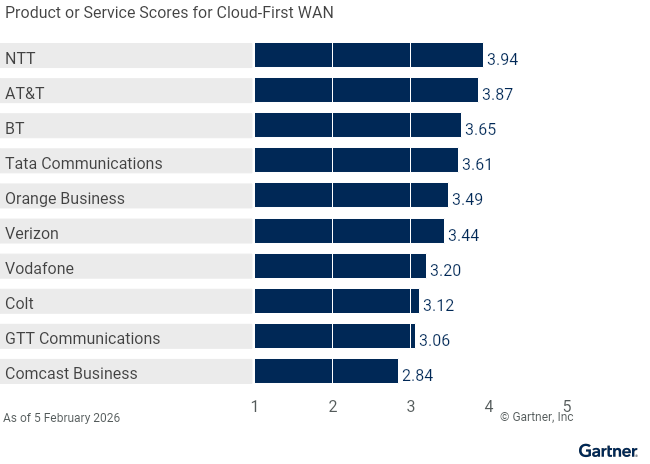
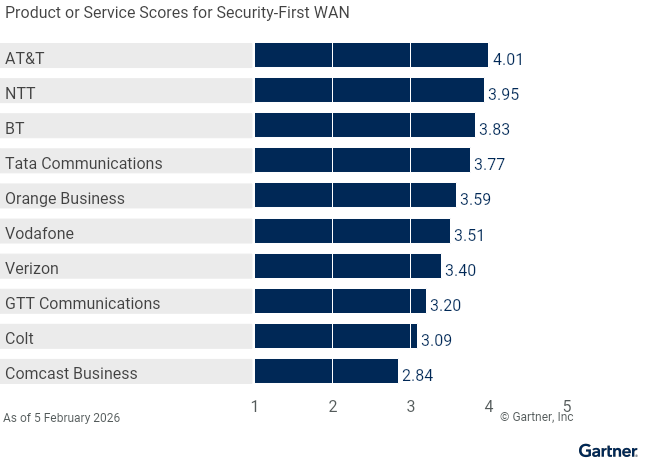
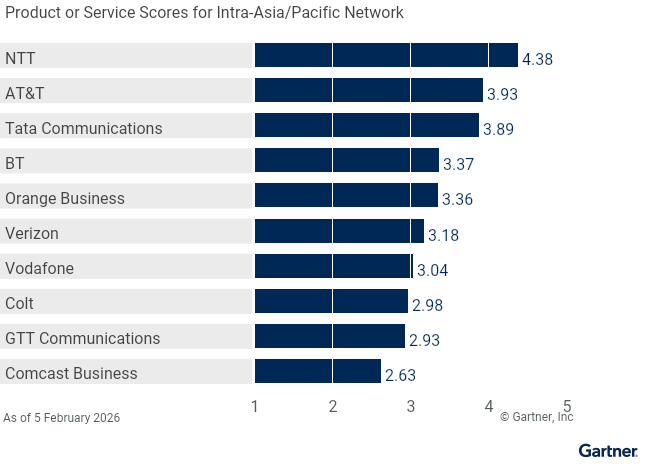
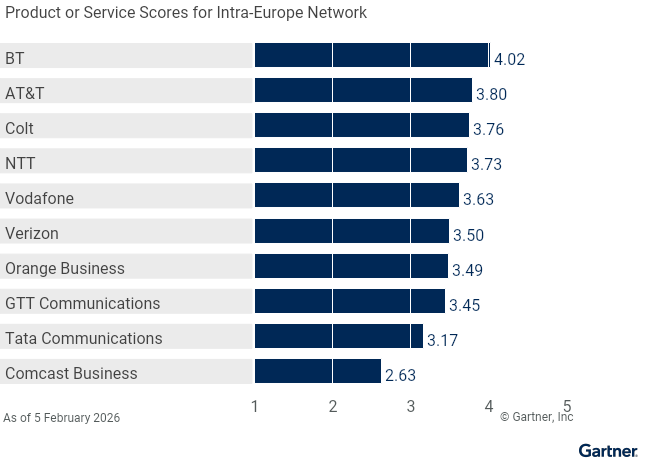
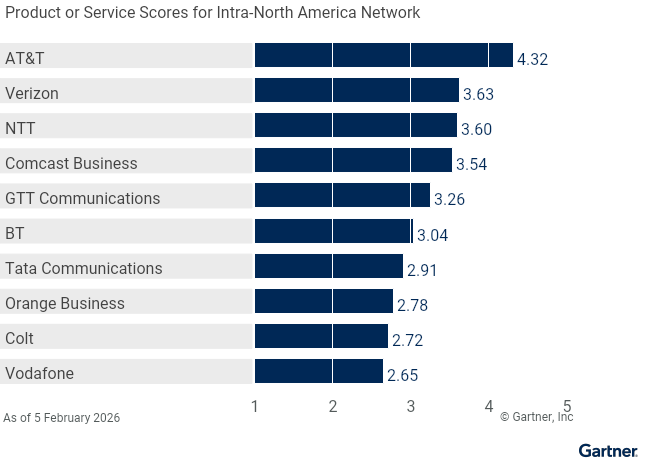
Vendors
AT&T
AT&T is based in Dallas, Texas, U.S, and provides enterprise connectivity and managed network services globally. It has MPLS POPs in 57 countries, internet POPs in 46 countries and Ethernet POPs in 57 countries. AT&T offers wavelength services only in the United States. It offers WAN services in all regions but has limited presence in the Middle East and Africa.
AT&T improvements include:
- Business center inventory enhancements, including a more intuitive interface, greater system speed and better service management through advanced filtering, search and reporting.
- Bulk Dynamic Defense ordering (available in the U.S.) for dedicated internet access customers, allowing them to order and customize security for multiple sites.
- Improved user-friendly, automation-backed service ordering page designs to cut order times.
AT&T’s cloud services offer Ethernet and MPLS connectivity in 53 countries. It offers wavelength as a cloud connectivity option in the continental United States only. AT&T supports seven top cloud service providers (CSPs) and myriad SaaS application providers, although availability varies widely by POP. It has 26 direct cloud interconnect POPs in North America, 70 in Europe, 73 in Asia/Pacific and three in Latin America. About 82% of its cloud interconnect POPs are via exchanges, totaling 809 nodes across all regions, including two in the Middle East and four in Africa. In addition, AT&T offers NetBond Advanced, a software-defined cloud connectivity service that offers added management and monitoring support for multicloud connectivity.
The provider’s managed SD-WAN offerings include vendor options from Arista (VeloCloud), Cisco (Catalyst and Meraki), Palo Alto Networks, Fortinet, and HPE (Aruba Networking EdgeConnect SD-WAN). SD-WAN gateway support is strong across Asia/Pacific, Europe and North America, limited in Latin America, and absent in the Middle East and Africa. AT&T’s SASE portfolio includes Arista (VeloCloud), Cisco, Fortinet, Palo Alto Networks, and Zscaler vendor options.
AT&T SLAs for DIA and MPLS include availability, latency, jitter, packet loss, mean time to repair, and on-time provisioning. AT&T NetBond cloud connectivity SLAs include availability, latency, jitter, mean time to repair, and on-time provisioning, but do not include packet loss and incident response metrics. Key managed SD-WAN and SASE SLAs include metrics for availability, latency, packet loss, jitter, mean time to repair, applications performance, on-time provisioning and monitoring availability, but do not include wireless access performance metrics.
AT&T scores excellent in the Intra-North America network, internet-first, and security-first WAN use cases, and good in all other use cases. AT&T is a good fit for enterprises with diverse global connectivity needs, and in particular those with needs in the Americas.
BT
Headquartered in London, U.K., BT serves large enterprises and multinational corporations through its BT International division and offers WAN services in all regions. BT has MPLS POPs in 74 countries, internet POPs in 29 countries, and Ethernet POPs in 71 countries. However, its presence in Africa is limited.
BT’s most remarkable investment is the build out of Global Fabric, a new API-first, NaaS platform designed to be cloud-centric and preconnected to approximately 700 data centers and to 74% of the locations of the top three CSPs. In 2025, BT launched Global Fabric Internet, which is available in over 45 POPs globally and includes a managed DDoS security overlay to protect internet traffic. Additionally, BT has launched a multiregion network fabric in partnership with Cisco to support distributed teams and multicloud strategies. Service improvements in the overlay include the integration of the Global Fabric and SD-WAN customer journeys to streamline the provisioning process across both portfolios.
Global Fabric is the core of BT’s cloud connectivity services, offering Ethernet and MPLS connectivity in 39 countries. It provides interconnections to 29 CSPs and SaaS providers through 23 direct cloud interconnect POPs in Europe,19 in Asia/Pacific,14 in North America, five in Latin America, and two in Africa. It also leverages 49 cloud exchange nodes, including one in the Middle East.
BT’s managed SD-WAN portfolio offers vendor options that include Cisco (Catalyst and Meraki), Fortinet, Palo Alto Networks (Prisma), and Arista (VeloCloud). BT’s network integrates Arista’s SD-WAN gateways across the six regions. The provider supports managed SASE via single-vendor and dual-vendor options leveraging Cisco, Fortinet, Palo Alto Networks, Netskope, and Zscaler. Recent service updates include the addition of a “Thin Edge” solution to the Fortinet SASE offering to support the SMB segment, and the migration of SD-WAN from CloudGenix to Strata Cloud Manager for unified management. BT has also integrated ServiceNow with its SD-WAN and security platforms to automate some of the most frequent simple service requests.
BT has integrated a vendor-assisted AIOps framework to drive predictive remediation. It has also launched generative and agentic AI tools within its ITSM platform — such as “NowAssist” for case summarization and natural language performance querying — to automate incident management and reduce event noise. BT is currently undertaking a comprehensive overhaul of its SLA framework, which it intends to make available in 2026.
BT scores excellent in the intra-Europe network use case and good in all others. BT is a good fit for enterprises seeking WAN services in Europe, Asia/Pacific, and Latin America. For those seeking services in North America, Africa, and the Middle East, BT should be evaluated based on service needs.
Colt
Colt is based in London, U.K. Colt’s On Demand NaaS platform offers on-net coverage in 30 countries across Europe, North America, and Asia/Pacific. The acquisition of Lumen EMEA has extended its IP footprint to South Africa and Kenya, and its backbone to the UAE, Türkiye and Norway. Colt has MPLS POPs in 36 countries, internet POPs in 31, Ethernet POPs in 30, and offers wavelength service in 33 countries. It has no network presence in Latin America.
Colt improvements include:
- Launch of a managed LEO satellite service in 57 countries, offered as primary or backup connection.
- Introduction of 100 Gbps and 400 Gbps transatlantic optical connectivity.
- Extension of 100 Gbps Ethernet point-to-point services to 11 additional European cities, including Paris, Zurich, and Milan.
The provider supports 145 direct cloud interconnect POPs in 26 countries (92 in Europe, 27 in Asia/Pacific, 22 in North America and two in the Middle East), offering connections to top CSPs including Alibaba, AWS, Microsoft, Google, IBM, Oracle, and OVHcloud. Through eight cloud exchanges, it also offers interconnections to 10 popular SaaS providers. Colt has increased resiliency for Microsoft ExpressRoute. Colt does not have cloud interconnect POPs in Africa and Latin America.
Colt offers managed SD-WAN with Versa Networks, leveraging the vendor’s SD-WAN gateways in 23 countries across all regions. It also offers Arista (VeloCloud) SD-WAN, leveraging the vendor’s gateways in 16 countries, but none in Latin America. Colt supports managed SASE via single- and dual-vendor options, leveraging HPE Aruba Networking, Cisco, Fortinet, Juniper, Palo Alto Networks, Netskope, and Zscaler.
Additionally, it has added data loss prevention (DLP) capabilities and digital experience monitoring (DEM) as a standard feature. Colt has expanded SD-WAN and SASE service reach through additional partner gateways in Latin America, Asia/Pacific, and Europe.
Colt has introduced a single, harmonized SLA document that applies across all supported SD-WAN products, ensuring consistent targets and credits regardless of the vendor. On-net SLAs include metrics for availability, performance, on-time delivery, and time to repair. SLAs for off-net services cover availability and time to repair. The provider also offers credit-backed SLAs for its global managed LEO satellite services.
Colt leverages AI/ML analytics for anomaly detection and predictive insights, and has started to use AI in support of streamlining provisioning and troubleshooting.
Colt’s highest use-case score is in intra-Europe network, where it scores good. It scores fair in the other two regional network use cases and good in all other use cases. Colt is a good fit for customers seeking WAN services in Europe. Customers seeking services in North America, Asia/Pacific, Africa, and the Middle East should evaluate Colt based on service needs. Colt is not aligned well with customers seeking network service in Latin America.
Comcast Business
Comcast Business is based in Philadelphia, Pennsylvania, U.S. It has MPLS POPs in 19 countries, internet POPs in 18 countries and Ethernet POPs in 17 countries. Comcast offers wavelength services in 20 countries. It offers WAN connectivity services in North America, Europe, and Asia/Pacific, with limited presence in South America. In the Middle East and Africa, Comcast Business WAN services reach is only through aggregators, not with the provider’s own POPs. Comcast Business can use virtual POPs for extended reach.
Comcast’s most notable improvements include:
- A new customer user interface that offers improved network telemetry and performance data across virtually any underlay access type, as well as most OEM SD-WAN, SASE, MDR, DDoS, and next-generation firewall vendors.
- Addition of a service bridge connecting multiple ServiceNow instances to improve efficiency, visibility, control, and service response.
- An upgraded Starlink LEO service portal, allowing customers to see performance and connection utilization.
The provider’s cloud services offer Ethernet, MPLS and wavelength connectivity to five CSPs (AWS, Google, IBM, Microsoft, and Oracle) and multiple other cloud services via Equinix and Megaport exchanges in 64 countries across all regions. Comcast does not offer direct cloud interconnects from its network.
Comcast’s SD-WAN portfolio includes Cisco (Catalyst and Meraki), Fortinet, HPE Aruba Networking, Versa, CradlePoint, and Arista (VeloCloud) vendor options. It has a strong SD-WAN gateway footprint in North America and adequate presence in Europe, Asia/Pacific, and South America. It supports no SD-WAN gateways in the Middle East or Africa. Its SASE offerings include Fortinet, Cisco, HPE Aruba Networking, Versa, CradlePoint and Arista (VeloCloud) vendor combinations.
Comcast offers availability SLA commitments across its WAN connectivity services and, depending on the service, provides either SLA or SLO targets for latency, jitter, packet loss, mean time to respond and proactive incident notification, but lacks on-time provisioning metrics. Key managed SD-WAN and SASE SLAs include service credits for availability and broadband access. Application performance and mean time to repair are offered as SLO metrics within managed SD-WAN services.
Comcast scores good in the intra-North America use case and fair in all the other use cases. It is a good fit for customers with network service needs in North America. Customers seeking networking services in Europe or Asia/Pacific should evaluate Comcast based on service needs. It is not a good fit for customers seeking services in Latin America, the Middle East, or Africa.
GTT Communications
GTT Communications (GTT) is based in Arlington, Virginia, U.S. It has MPLS POPs in 51 countries, internet and Ethernet POPs in 42 countries, and offers wavelength services in 23 countries. GTT offers network services in all regions, but has limited presence in Latin America, the Middle East, and Africa.
GTT improvements include:
- GTT EnvisionDX automatic configuration and price quote capabilities for managed connectivity, secure SD-WAN/firewall, professional services, and equipment shipping and installation.
- AI-powered multisite automation, allowing sales teams to generate complete proposals with improved address validation and circuit diversity options in minutes.
- New APIs that allow customers to quote and order services directly from their systems. This includes port and connection type, SD-WAN, firewall, professional services, and equipment.
GTT’s cloud services include Ethernet and MPLS connectivity in 22 countries. It does not support wavelength cloud connectivity. GTT supports seven top CSPs and multiple regional and SaaS application providers, with direct cloud interconnections that include nine POPs in North America, six POPs in Europe, four POPs in Asia/Pacific and one POP in Africa. It also leverages cloud interconnections in 44 exchange nodes, including one in Latin America. GTT has no cloud interconnections in the Middle East.
GTT-managed SD-WAN services vendor options include Arista (VeloCloud), Fortinet, HPE Aruba Networking, and Palo Alto Networks in all regions, although its gateway options in Latin America, the Middle East, and Africa are limited. Its managed SASE offerings are based on vendors Palo Alto, Fortinet, HPE Aruba Networking, Arista (VeloCloud), and Zscaler.
GTT SLAs offer MPLS metrics for availability, latency, packet loss, jitter, on-time provisioning, and mean time to repair, but lack proactive incident notification. DIA SLAs include metrics for availability, latency, packet loss, on-time provisioning, mean time to repair, and on-time provisioning, but do not include jitter, applications performance, and proactive incident notification. Managed SD-WAN and SASE SLAs include availability, latency, packet loss, jitter, mean time to repair, on-time provisioning, and proactive incident notification, but do not include commitments for monitoring availability.
GTT’s highest use-case score is intra-Europe network, where it scores as good. It scores fair in intra-Asia/Pacific network and good in all other use cases. It is a good fit for customers seeking WAN services in Europe and North America. Customers seeking services in other regions should evaluate GTT based on service needs.
NTT
NTT is based in Tokyo, Japan. In 2025, NTT further expanded its Ethernet, VPLS and wavelength service coverage. It has MPLS POPs in 50 countries, internet POPs in 44 countries and Ethernet POPs in 38 countries, and offers wavelength services in 21 countries. NTT network services are available in all regions, but the provider has limited network presence in Latin America and the Middle East.
NTT’s main improvements include:
- The introduction of a new NaaS function for automating connections between major cloud providers via the NTT Service Portal.
- Enhancement of its management platform with AI-enabled automated run book execution and ticket triage.
- Commercial launch of All Photonics Network in Hong Kong and India, to connect data centers and major business hubs with ultra-low latency.
NTT’s cloud services offer MPLS, Ethernet, and wavelength connectivity options. The provider relies solely on direct interconnections at POPs in 31 countries (22 POPs in Asia/Pacific, 19 in Europe, 18 in North America, one in Latin America, and one in the Middle East), ensuring independence in network management. It offers direct interconnections to top CSPs including Alibaba, AWS, Microsoft, Google Cloud, Oracle, and IBM, and to multiple SaaS providers including Salesforce, SAP, ServiceNow, Workday, and Zoom. Beyond automated intercloud connectivity, NTT has implemented API integrations with cloud-native networking stacks, such as AWS Transit Gateway and Azure Virtual WAN, and has enabled automated discovery of cloud resources for unified hybrid management.
NTT supports a wide portfolio of SD-WAN vendors, including Arista (VeloCloud), Cisco (Catalyst and Meraki), Fortinet, HPE Aruba Networking, Juniper, Palo Alto Networks, and Versa Networks, with SD-WAN gateways in all six regions. Single-vendor options for managed SASE include Palo Alto Networks, Cisco, Fortinet, Zscaler and, as new options in the portfolio, Cato Networks and Netskope. Dual-vendor options include SSE vendors such as Zscaler, Netskope, Palo Alto Networks, Cloudflare, and Broadcom (Symantec). NTT has added new SD-WAN network gateways and SASE nodes, implemented AI-driven intelligent traffic steering, and introduced agentless session-based SSE and AI-driven vulnerability intelligence.
NTT’s SLAs are comprehensive, offering metrics for availability, latency, packet delivery, and response times across its global network. Its standardized global SLAs cover underlay connectivity types including MPLS, DIA, and broadband. Notably, NTT recently introduced a 99.9% uptime SLA for customer-facing APIs to support automation and digital integration.
NTT scores excellent in the intra-Asia/Pacific network use case and good in all other use cases. NTT is a good fit for customers seeking networking services in Asia/Pacific, Europe, or North America. Those seeking networking services in Africa, Latin America, or the Middle East should consider NTT selectively for its ability to meet service needs.
Orange Business
Orange Business is based in Paris, France. The provider offers WAN services in all regions leveraging MPLS, internet, and Ethernet POPs in 71 countries. Recent footprint expansions include new POPs in countries such as Bangladesh, Madagascar, and the United States, alongside coverage extensions for International Ethernet Link. Orange’s wavelength services, offered in 12 countries, have been enhanced with resilience options.
The provider continues the rollout and ecosystem enhancement of its NaaS capability (Evolution Platform), which integrates connectivity, cloud, and cybersecurity. Other main improvements in Orange Business’s WAN capabilities include:
- The introduction of automated On Demand Cloud Connect for Azure ExpressRoute and AWS Direct Connect, reducing provisioning time to minutes.
- The introduction of bot-assisted, zero-touch quoting and ordering automation for access lines.
- Standardization of Starlink and OneWeb LEO satellite solutions.
Orange’s cloud services, including the legacy Galerie and the newer On Demand Cloud Connect, offer MPLS interconnections in 15 countries and Ethernet in five European countries. Orange has 24 direct cloud interconnect POPs (eight in Asia/Pacific, seven in Europe, six in North America and one each in Africa, Latin America, and the Middle East). It also leverages seven cloud exchange nodes for further geo reach. Orange provides interconnections to the top cloud service providers. In addition to automations in On Demand Cloud Connect, the provider has launched Aviatrix managed services for multicloud networking and extended its legacy Galerie service to include access to the French sovereign cloud Bleu.
Managed SD-WAN services include vendor options from Cisco Catalyst, Fortinet, Palo Alto Networks, and Arista (VeloCloud). Orange has introduced a new “light” one-box solution with Ekinops SD-WAN and Cisco SD-Routing. The provider’s managed SASE portfolio supports single- and dual-vendor options, including Palo Alto Networks, Fortinet, Netskope, Zscaler, and Cato Networks, a new option recently introduced. Orange hosts SD-WAN gateways in Evolution Platform’s POPs, enabling service chaining to firewalls, SSE, or cloud connectors. Also, Orange’s Virtual Network Edge service allows customers to deploy VNFs in Evolution Platform’s POPs.
Orange has strengthened its incident management capabilities with generative AI support for the service desk, as well as AI-driven observability and digital twin technologies to support root cause analysis. It has simplified its SLAs by aligning site availability metrics for MPLS and internet. Managed SASE SLAs now include change management commitments.
Orange’s highest use-case score is in complex WAN, where it scores as good. It scores fair in the intra-North America network use case and good in all other use cases. Orange Business can be considered for customers seeking networking services in any region. However, customers with a strong footprint in North America should evaluate the provider’s service and support levels to ensure they meet organizational needs.
Tata Communications
Tata Communications is based in Mumbai, India. It has MPLS POPs in 65 countries, internet POPs in 43 countries, Ethernet POPS in 49 countries, and offers wavelength services in 47 countries. Its network services are available in all regions, although its presence in Latin America is limited.
Main improvements include:
- 400 Gbps internet ports and dynamic 100 Gbps Ethernet capabilities, global LEO satellite coverage, self-serve API-based quotations and ordering for internet services, and self-service bandwidth scaling for MPLS and multicloud environments.
- Enhanced customer experience through a digital twin platform for validating network changes, and upgrades to its premium support package to accelerate change management and incident resolution.
- Initial value-based pricing offerings, where pricing reflects availability and resiliency SLAs, complexity of delivery, and managed service levels.
Tata Communications has MPLS interconnections to cloud providers in 18 countries, and Ethernet in 11 countries. Its cloud POP footprint supports seven top cloud service providers, with 61 POPs in Asia/Pacific, 15 POPs in North America and 18 POPs in Europe. It has just three Latin American cloud POPs (in Brazil), three in the Middle East, and two in Africa. About 63% of its MPLS POPs and all of its Ethernet POPs are direct, with the remainder via third-party exchanges. Offerings of IZO MCC and MCN provide multicloud interconnection and observability.
The provider’s managed SD-WAN offers Versa Networks, Fortinet, Cisco (Catalyst and Meraki), and HPE Aruba Networking vendor options, with gateways in Asia/Pacific, Europe, Brazil, and the United States. Managed SASE offerings include Versa Networks, Fortinet, Palo Alto Networks, and Zscaler vendor options. Tata Communications has enhanced its premium managed SD-WAN support packages with AI-driven operations, proactive KPIs, and predictive capacity planning.
Tata Communications’ SLAs for underlay connectivity services are in line with standards in the industry. Its repair target for MPLS Priority 1 incidents and cloud interconnects, set at two hours, is aggressive. It has introduced faster service turnup SLAs, with credits for activation delays and formalized uptime guarantees for stand-alone broadband, offering higher availability commitments for customers utilizing 4G, 5G, or LEO backup options. Additionally, the vendor has strengthened operational support with new SLAs for change management, incident management, and time-to-quote, as well as time-to-repair guarantees for broadband links. Managed SD-WAN and managed SASE SLAs cover availability, on-time provisioning, mean time to repair, proactive notification, and monitoring availability.
Tata Communications’ highest use-case score is in intra-Asia/Pacific network, where it scores good. It scores fair in the intra-North America network use case and good in all other use cases. Customers seeking global connectivity with strong capabilities in India, Asia/Pacific, and emerging markets should consider Tata Communications. Those seeking services in all other regions should evaluate the provider based on service needs.
Verizon
Headquartered in New York City, New York, U.S., Verizon owns MPLS POPs in 52 countries, internet POPs in 33 countries, and Ethernet POPs in 48 countries. It offers wavelength services in 13 countries across North America, Europe, and Asia/Pacific. Verizon has pivoted its expansion strategy from an infrastructure-led approach to a partnership-led aggregation model, partnering with key providers to serve markets in Africa, Latin America, and Asia/Pacific. Verizon’s network services are available in all regions, but it has limited presence in the Middle East and Africa.
Verizon improvements include:
- The launch of Global Business Internet, leveraging vetted third-party carriers to provide global dedicated internet and carrier diversity in off-net markets.
- The introduction of a global burstable aggregation billing model for Private IP and Dedicated Internet, allowing bandwidth pooling across multiple circuits to share capacity as well as transport-agnostic ports.
- Expansion of the AI Connect portfolio, including 400G wavelength services and dark fiber routes to support high-bandwidth AI workloads and hyperscaler connectivity.
Verizon offers MPLS and Ethernet connectivity to six major CSPs in 14 countries, with 26 POPs in North America, 10 POPs in Europe, eight POPs in Asia/Pacific, and two POPs in Latin American (in Brazil). It does not have cloud POPs in the Middle East or Africa. About 56% of its POPs are direct and the remainder via third-party exchanges. It offers wavelength cloud connectivity in 13 countries in North America, Europe, and Asia/Pacific.
Managed SD-WAN services include Arista (VeloCloud), Cisco (Catalyst and Meraki), Fortinet, HPE Aruba Networking, and Versa Networks vendor options, with 25 SD-WAN gateways across North America, Europe, Asia/Pacific, and Latin America. Verizon also offers private SD-WAN nodes. It includes AIOps insights — root cause of SD-WAN outages — as a standard feature at no additional charge for all managed service levels. Verizon’s managed SASE portfolio supports single-vendor solutions from Versa Networks and Palo Alto Networks, while offering dual-vendor flexibility by combining Cisco Catalyst or Versa SD-WAN with Zscaler or Palo Alto Networks SSE capabilities.
Verizon offers competitive SLAs for underlay connectivity services, with most customers doing custom adjustments. In NaaS contracts, Verizon has transitioned to site-based SLAs, instead of underlying product-specific SLAs, that include wired and wireless broadband access. SLAs for managed SD-WAN services cover jitter, time to repair, and proactive notification, while for SASE, Verizon leverages the SLA offered by the vendor.
Verizon scores good in all use cases, with its highest score in the intra-North America network use case. Verizon should be considered by enterprise customers seeking connectivity services in North America, Europe, Asia/Pacific, and Latin America. Those seeking network services in the Middle East and Africa should assess Verizon based on service needs.
Vodafone
Vodafone is headquartered in Newbury, U.K. It has MPLS and Ethernet POPs in 77 countries, internet POPs in 55 countries, and offers wavelength services in 40 countries, although its presence in Latin America is limited.
Vodafone improvements include:
- The launch of Dedicated Internet Access (DIA) On Demand and Ethernet On Demand via its NaaS portal, enabling real-time bandwidth adjustments with consumption-based billing and rapid optical Ethernet delivery between data centers.
- Enhancements in cloud connectivity offerings, such as launching software-defined cloud interconnections via POPs at colocation facilities, securing status as a Google Gold Verified Peering Partner, and expanding its Microsoft Azure Peering Service (MAPS) locations.
- Tasks automation in the procurement process and deployment of AI-driven anomaly detection within its NaaS portal to automate diagnostics.
The provider’s cloud services offer MPLS (13 countries), Ethernet (16 countries), and wavelength options (19 countries). It has 66 direct cloud interconnect POPs (11 in Asia/Pacific, 38 in Europe, 15 in North America, and two in South Africa, but none in Latin America and the Middle East). It also leverages 21 cloud exchange nodes. It supports connectivity to major CSPs including AWS, Microsoft Azure, Google Cloud, Oracle, IBM, and Alibaba.
Vodafone’s managed SD-WAN portfolio includes Arista (VeloCloud), Cisco (Catalyst and Meraki), Fortinet, and HPE (Juniper) — the HPE (Juniper) offering will be discontinued in June 2026. The portfolio features 17 gateways across Europe, Asia/Pacific, and North America, with one in South Africa. The SD-WAN offering is integrated into Vodafone’s NaaS portal, which provides a single pane of glass for management and control, visibility, and application health insights at no additional charge. Vodafone has introduced carbon reporting to help meet decarbonization targets. For SASE, the vendor offers solutions from Fortinet and Cisco, while SSE from Palo Alto Networks and Zscaler.
Vodafone’s standard SLAs for global WAN services include metrics for availability, performance, on-time provisioning, and mean time to repair, but do not include incident response time (except for DIA) or proactive notification (except in cloud connectivity). Vodafone has introduced a 5ms latency SLA (from POPs to the cloud). SLAs for managed SD-WAN and SASE services are among the most comprehensive from vendors in this research, with guarantees for availability, performance, on-time delivery, changes, repair, monitoring, notification, and software changes. The provider has reduced committed SD-WAN incident detection time to under one minute and offers a 99.9% API availability for core SD-WAN and SASE functions.
Vodafone’s highest use-case score is in intra-Europe network, where it scores good. It scores fair in the intra-North America network use case and good in all other use cases. Enterprise customers seeking WAN services in Europe, Africa, and the Middle East should consider Vodafone. Customers in North America and Asia/Pacific should assess Vodafone based on service needs. Vodafone is not well-aligned with customers seeking WAN services in Latin America.
Context
Although global WAN underlay connectivity is a mature market, enterprise cloud application adoption, increasing WAN complexity, and emerging AI traffic needs are driving significant market shifts in enterprise demand and NSP offerings.
As enterprises transition from on-premises to cloud applications to support critical operations, their traditional private, hub-and-spoke WANs based on MPLS services become less efficient in managing user data traffic. Also, pricing for private MPLS circuits has flattened or started to increase in many regions, further driving many enterprises to replace private MPLS circuits with DIA and broadband internet alternatives that offer more cost-effective bandwidth. Increasingly, NSPs are adding 5G FWA and LEO satellite services as WAN access options. Yet a significant number of enterprises — concerned about stable performance, data privacy, or compliance — maintain MPLS and other private connections such as Ethernet and wavelength to support on-premises, private applications, and connections between critical locations. These locations include data centers and headquarters locations, which require stronger security and better routing performance.
To better manage this more complex, decentralized network topology, a majority of enterprises have adopted SD-WAN overlay technology. SD-WAN provides dynamic path selection based on business or application policy, routing, centralized orchestration of policy and management of appliances, as well as VPN and zero-touch configuration. However, enterprise reliance on public internet transport infrastructure raises the risk of cyberattacks, prompting the adoption of network security services such as SASE. SASE delivers converged network and security capabilities, including SD-WAN with integrated secure internet access, secure SaaS access, firewall, and zero-trust network access capabilities.
Global NSPs are capitalizing on these trends by positioning themselves as “one-stop shops” for all enterprise WAN service needs. They have expanded their service portfolios beyond underlay circuits to include a range of managed SD-WAN and managed SASE offerings. Although enterprises can and do self-manage SD-WAN and SASE overlay environments, the resulting IT staffing requirements can be a challenge. As a result, an increasing number of enterprises are turning to managed SD-WAN and SASE from a network or managed service provider.
On the offering side, the WAN market is undergoing a profound transformation, with NSPs building out NaaS platforms to deliver more agile and flexible services that emulate cloud commercial and delivery models. Typically, these platforms support near-real-time, on-demand modifications to underlay connectivity services, a choice of cloud connect, and optional network-hosted networking and security functions. Although the depth and breadth of services in most providers’ NaaS platforms are still limited, these capabilities are the cornerstone of NSPs’ strategies to support demanding and variable cloud and AI workload traffic. To that aim, NSPs are preparing these NaaS platforms to integrate with enterprise IT and network estates through APIs and enlarging the ecosystem of destinations and technologies offered. In addition, NSPs continue to invest in data analytics, AI/ML, and automation for service agility, quality, and cost efficiency in network operations. Automated processes tend to speed up tasks such as new circuit provisioning, configuration, and activation. AI and ML upgrades to network monitoring and management systems support faster detection of network traffic anomalies and potential security issues. NSPs are gradually incorporating generative AI and agentic AI into their network processes, although these remain in the early stages of realizing their full potential.
Despite these improvements and NSPs’ overall good levels of service, individual service quality varies within providers’ WAN portfolios. Most importantly, no single network provider can claim ubiquitous global WAN service availability. Where network providers cannot directly supply access circuits, they rely on wholesale partnerships to offer enterprise customers “off-net” connections that are typically more expensive and can include less robust SLAs.
Similarly, in regions where they lack local technicians and equipment distribution resources, global WAN providers often rely on third-party resellers or vendor partners for circuit installation and managed services support. Consequently, enterprise customers may face higher prices, variable support, and weaker availability and response time SLAs.
For this reason, enterprises must evaluate not only individual service quality among providers, but also their capabilities to deliver services to locations in specific regions. This process involves evaluating the trade-off: easier contract management with a single global provider versus potentially higher costs and limited service support in certain regions or markets when relying on a single provider.
Market Definition
Gartner defines global WAN services as POP-based services supporting multiregional corporate networks. These services address enterprise challenges such as hybrid working practices, accelerating digital and cloud transformations and improving enterprise network agility. Providers own and operate their own global core networks and sell directly to the client. Services include transport-centric/unmanaged, managed, co-managed network services, or network as a service via a monthly fixed or usage-based fee model. Core transport services are often complemented by ancillary services like carrier-based cloud interconnect, SD-WAN, SASE or managed services. Services are measurable and consumable through web-based customer interfaces via portals and programmable APIs.
As digital business initiatives increase demands on the enterprise network, the need for reliable bandwidth continues to grow. Growing cloud workloads and the rise in application-specific traffic are the main drivers for increases in bandwidth. Gartner has also observed AI and machine learning (ML) being used in network monitoring, optimization and provisioning to quickly address shifting requirements, such as SaaS and evolving infrastructure as a service (IaaS) and platform as a service (PaaS)-based applications. As a result, SaaS and these associated applications are putting pressure and a level of criticality never before seen to ensure optimal performance and unfailing support.
Enterprises rely on global WAN services to deliver global and regional fixed, wide-area networking connectivity. These services consist of backbone network transport and last-mile access connections to deliver connectivity to individual enterprise sites, such as large or remote/branch office locations. Although these are core to the offer, service providers also offer more transformational capabilities enabled by the underlay service network.
Mandatory Features
Gartner’s view of the market is focused on foundational technologies or approaches delivering on the future needs of end users.
The mandatory features for this market include:
- Ability to sell internet services to enterprise customers globally, including dedicated internet access (DIA) and broadband/DSL: DIA should be offered as the provider’s own service, which can be supplemented by DIA from partners. Broadband internet can be a resold solution but must be generally available on a global basis. Internet service points of presence (POPs) are provider-owned network equipment located at the provider’s own facilities, colocation facilities or a third-party facility.
- Ability to sell Multiprotocol Label Switching (MPLS) to enterprise customers globally: MPLS should be offered as the provider’s own service, with POPs in either a colocation facility or in the provider’s own buildings (leased or owned real estate). MPLS service POPs are provider-owned network equipment located at the provider’s own facilities, colocation facilities or a third-party facility.
- Offer WAN services portals: Provider portals and APIs must be available to enterprises to view network status and performance metrics.
- Offer carrier-based cloud interconnect (CBCI): This is a private connection, such as MPLS and/or Ethernet, between a service provider’s network and the point of presence of one or more cloud service providers (CSPs). CBCI requires an interconnection between the network service provider (NSP) and the cloud provider at a provider-owned or third-party location, such as a data center or colocation facility. CBCI also must be available on a global basis to the major cloud providers.
- Offer managed SD-WAN services: Management of enterprise software-defined WAN (SD-WAN) can be delivered either by edge devices or through providers’ network-based SD-WAN gateways globally. SD-WAN gateways can terminate SD-WAN connections from on-site appliances close to external resources such as cloud services. SD-WAN is augmented with network-based security capabilities to offer secure access service edge (SASE). SD-WAN is now nearly always secure SD-WAN with at least a firewall and offered as part of a long-term SASE adoption plan.
- All WAN services must be generally available and offer global coverage (North America, Europe and Asia/Pacific at a minimum). They may not be offered on an individual customer (one-off) basis or only in limited countries and territories. This market segment does not include wholesale or services sold to other providers.
Common Features
The common features for this market include:
- Managed SASE: Managed SASE with single-vendor or dual-vendor SASE combining SD-WAN and security service edge (SSE) security from two integrated partners.
- 4G/LTE and 5G cellular WAN access: Cellular services can be used as a type of WAN transport that enables rapid deployment of new locations, supporting temporary locations and providing diversified backup links.
- LEO satellite access: Low Earth orbit (LEO) satellite services can also be used for primary or backup WAN connections in locations where wireline services are limited or unavailable.
- Network on demand (NoD): NoD services from NSPs enable enterprises to make near-real-time changes to access/port bandwidth, change the WAN service types delivered over a network port, and add and remove endpoints (for example, connections to cloud providers). This capability is available through provider-supplied customer web portals or APIs.
- Advanced portal features: Provider portals offering advanced analytics, including real-time and historical circuit utilization, circuit performance, incident/trouble tickets and SLA compliance. This can also include predictive analytics such as circuit configuration recommendations to improve performance. Other advanced features can include tools allowing customers to configure circuits, change network or security policies, or order new services, as well as a GenAI chat interface allowing customers to request analytics information or request service changes.
- Enhanced internet services: Enhanced internet backbone services or other approaches — including deterministic routing, ISP federations and network-based SD-WAN gateways — are designed to improve and stabilize the performance of purely internet-based global networks.
- Network function virtualization (NFV): NFV is an architecture to deliver multiple network functions — including routing, firewall, SD-WAN, WAN optimization and visibility — as software, called virtual network functions (VNFs). NFV can be implemented on universal customer premises equipment (uCPE) — typically via industry-standard x86 devices used in place of function-specific appliances — and in NFV service nodes located in the provider’s network or in colocation facilities. NFV enables network functions to be activated on demand, deactivated when no longer required and consumed on an as-a-service basis.
Product/Service Trends
Gartner’s view of the global WAN services market focuses on how network providers are evolving their core services to meet current and future needs of enterprise customers.
Notable trends that shaped our evaluation of service providers in this market are:
- Continued enterprise transition to internet-centric WAN architectures, with reduced reliance on private MPLS services.
- Increased enterprise interest in switched Ethernet and wavelength connectivity options to supply higher-quality, higher-speed connections between locations such as company headquarters and data centers.
- Integration of LEO satellites and 5G FWA as connectivity options alongside terrestrial fiber.
- Demand for higher-quality SLAs for network services to improve service availability and performance.
- Continuing enterprise adoption of managed SD-WAN services to control and monitor their networks, with an increased focus on integrated security features.
- Expansion of network providers’ managed SASE portfolios, delivering converged network and security capabilities.
- Demand for trusted cloud connectivity, as well as network designs and functionality for performance, data sovereignty, and compliance with local and regional regulations.
- Increased application of automation and AI/ML to improve service quality and response times.
- Improvements in network providers’ customer-facing portals, such as enhanced network visibility plus network configuration, service ordering tools, and incident management tools.
- A shift in commercial and delivery offerings toward NaaS with near-real-time, on-demand service delivery, and change and flexible consumption-based billing.
- The introduction of generative AI in network processes and nascent use of agentic AI in operations.
- Increased investment in high-bandwidth optical wavelength services and postquantum cryptography (PQC) to future-proof infrastructure against quantum threats.
Critical Capabilities Definition
Private WAN
This critical capability rates a provider’s ability to deliver private WAN connectivity, including MPLS, Ethernet and wavelength connection types. We assess private networking services that include a provider’s core backbone and associated access circuits for geographic availability and performance, including service-level agreements.
Internet Services
This critical capability rates a provider’s strength in internet services. We assess internet-based connectivity services offered via providers’ IP backbone services, as well as associated access services for performance and geographic availability.
It includes dedicated internet access (DIA), wireline broadband, cellular 4G LTE/5G, and satellite LEO and VSAT options. We assess the quality, geographic availability, service-level agreements and pricing of these services.
NoD/NaaS and Automation
This critical capability rates a provider’s ability to deliver flexible network services that allow customers to make real-time or near-real-time changes to service elements such as access and port bandwidth.
These services also can include the ability to configure and add new endpoint connections, disconnect an endpoint service or change quality of service class. Also, we evaluate the provider’s degree of automation and AI leverage in NoD/NaaS capabilities.
Cloud Connect
This critical capability rates a provider’s cloud connectivity options, including cloud interconnect offerings that provide private connections from the carrier node to the data center of a public cloud service provider, such as Amazon Web Services, Google Cloud Platform and Microsoft Azure.
We assess the provider’s ability to provide these services supporting a wide range of cloud provider services, as well as their geographic reach and service-level agreements.
Managed SD-WAN
This critical capability rates a provider’s strength in managed SD-WAN services globally. We assess the providers’ ability to provide vendor options, managed services, geographic points-of-presence (POP) availability and service-level agreements.
Managed Security
This critical capability rates a provider’s strength in providing managed SASE, which combines SD-WAN with a tightly integrated package of security features that include a next-generation firewall (NGFW), zero-trust network access (ZTNA), secure web gateway (SWG), cloud access security broker (CASB), plus antimalware and intrusion detection/prevention.
We assess providers’ ability to deliver SASE as either a single-vendor or tightly integrated dual-vendor solution, as well as any service-level agreement offered by the provider.
Service Portal, APIs
This critical capability rates a provider’s ability to communicate with the customer, primarily via its customer services web portal or API. We evaluate the portal/API’s ability to provide real-time or near-real-time views of network status, incident management/resolution, billing and usage analytics, as well as value-adds such as ability to make configuration changes, add/change/drop connections, or add new services directly via the portal.
We also assess the use of AI and automation in the digital front-end offered to customers.
Geographic Coverage: North America
This critical capability rates the breadth of the provider’s network, including backbone and access segments in North America, as well as the provider’s network points of presence and other factors such as internet aggregation nodes.
Geographic Coverage: Europe
This critical capability rates the breadth of the provider’s network, including backbone and access segments in Europe, as well as the provider’s network points of presence and other factors such as internet aggregation nodes.
Geographic Coverage: Asia/Pacific
This critical capability rates the breadth of the provider’s network, including backbone and access segments in Asia/Pacific, as well as the provider’s network points of presence and other factors such as internet aggregation nodes.
Use Cases
Complex WAN
This use case is for enterprises that require MPLS, internet, Ethernet, and wavelength connection types with data speeds from sub-10 Mbps to more than 10 Gbps.
We examine how well global NSPs’ WAN services support this use case, including connection options and bandwidth availability by region, as well as strong SLAs for availability, performance, on-time delivery, service assurance, monitoring, and proactive notification. We evaluate providers’ managed services, cloud connectivity options, service portals, APIs, and associated SLAs for these services. In addition, we evaluate NSPs’ level of service automation, which correlates with improved circuit visibility and availability.
Internet-First WAN
This use case is for enterprises requiring primarily internet connectivity, including DIA and fixed or wireless broadband circuits.
We examine how well global NSPs’ internet services support this use case, including the range of connection options, SLAs for dedicated and broadband wired or wireless internet, circuits, managed SD-WAN, security, service portals, and APIs across geographic regions.
Cloud-First WAN
This use case is for enterprises requiring primarily internet cloud connectivity services with some private connectivity to support on-premises and cloud applications.
We examine how well global NSPs’ WAN services support this use case, including cloud connectivity options, service portals, APIs, NaaS and NoD functionality, service automation and associated SLAs.
Security-First WAN
This use case is for enterprises requiring primarily private networking options and also security enhancements, such as DDoS and managed SASE.
We examine how well global NSPs’ WAN services support this use case, including the range of managed firewall and single-vendor and dual-vendor SASE options, strength of managed security service SLAs, cloud onramp capabilities, and strength of customer portals.
Intra-Asia/Pacific Network
This use case is for enterprises that have most of their business locations in countries within Europe.
We examine how well global NSPs’ WAN services support this use case, including private WAN and internet connection options in the region, cloud connectivity, managed SD-WAN and security services, service portals, APIs, and SLAs in this region.
Intra-Europe Network
This use case is for enterprises that have most of their business locations in countries within Europe.
We examine how well global NSPs’ WAN services support this use case, including private WAN and internet connection options in the region, cloud connectivity, managed SD-WAN and security services, service portals, APIs, and SLAs in this region.
Intra-North America Network
This use case is for enterprises that have most of their business locations in Canada and the United States.
We examine how well global NSPs’ WAN services support this use case, including private WAN and internet connection options in the region, cloud connectivity, managed SD-WAN and security services, service portals, APIs, and SLAs in this region.
Vendors Added and Dropped
We review and adjust our inclusion criteria for Critical Capabilities as markets change. As a result of these adjustments, the mix of vendors in any Critical Capability may change over time. A vendor’s appearance in a Critical Capability one year and not the next does not necessarily indicate that we have changed our opinion of that vendor. It may be a reflection of a change in the market and, therefore, changed inclusion criteria, or of a change of focus by that vendor.
Added
Comcast Business was added to this Critical Capabilities research.
Dropped
No vendors were dropped from this Critical Capabilities research.
Inclusion Criteria
To qualify for inclusion, providers must:
- Demonstrate global network reach and coverage for both private and public WAN services:
- Must own a core backbone network, composed of MPLS and internet in Asia/Pacific, Europe and North America regions at a minimum, while Africa, Latin America and the Middle East are desirable. Providers must operate their own global core backbone with a minimum number of POPs in all three major regions. “Ownership” requires that the provider own the rack and the equipment/Border Gateway Protocol (BGP)/etc., versus a lease arrangement.
- Must offer and include access as part of the solution (bring your own access [BYOA] solely offered does not meet inclusion criteria). WAN services must include end-to-end SLAs, regardless of access provider.
- Must have physical MPLS POPs in a minimum of five different cities in each of the following geographic regions: Asia/Pacific, Europe and North America. These POPs can be located either in owned or leased buildings or in colocation facilities. Providers must fully identify where POPs are located for inclusion.
- Must have physical internet POPs in a minimum of 10 different cities in each of the following geographic regions: Asia/Pacific, Europe and North America. These POPs can be located either in owned or leased buildings or in colocation facilities. Providers must fully identify where POPs are located for inclusion.
- Must offer broadband access services (minimum 100/10 megabits per second) that are either inherent to the provider’s core WAN offerings or offered in a resale model in all three major regions (Asia/Pacific, Europe and North America).
- Must offer 4G/LTE and/or 5G cellular WAN access connectivity in each region (Asia/Pacific, Europe and North America) either directly or through partners for a comprehensive offering.
- Offer a WAN service customer portal for its enterprise private and public WAN services. Providers’ online service portals should give customers a view into provider performance, and offer visibility into network operations and performance to support service modifications and verify SLAs for key performance metrics.
- Offer managed SD-WAN services globally with a minimum of five physical SD-WAN gateways in five different cities in each of the following major geographic regions: Asia/Pacific, Europe and North America, from at least two different vendors.
- Have a minimum of five physical SASE nodes in five different cities in each of the following geographic regions: Asia/Pacific, Europe and North America. These nodes may be self-owned, via partner SASE services, or resold third-party security service edge services. Further, the provider must offer both single- and dual-vendor SASE options and support at least four of the following functions: SD-WAN (with or without embedded security functions), secure web gateway, cloud access security broker, network access control and network firewalling (with or without an intrusion detection system/intrusion prevention system).
- Have a minimum of five physical cloud interconnect nodes to the three leading cloud providers (Amazon Web Services, Google Cloud Platform and Microsoft Azure) in the three major regions (Asia/Pacific, Europe and North America), either directly or via third-party exchanges.
- Have a minimum of five access aggregation nodes in each of the following geographic regions (Asia/Pacific, Europe and North America), and these must include fiber, DIA, DSL/wireline broadband, and optional FWA 4G, 5G and LEO/Geostationary Earth Orbit (GEO) services based on either owned or third-party access services.
- Operate their own global network services (rather than simply reselling the services of other global or regional network providers) and provide last-mile connectivity in all three major regions (Asia/Pacific, Europe and North America). They must also have availability in at least one of the following areas: Latin America, the Middle East or Africa.
- Demonstrate active global sales activity by having signed at least one new contract (signed in the last 12 months) for global enterprise network services in each major region (Asia/Pacific, Europe and North America) as a net-new account for global WAN services. These should include provisioned sites in a minimum of three of these six regions (Africa, Asia/Pacific, Europe, Latin America, Middle East and North America).
Weighting for Critical Capabilities in Use Cases
| Critical Capabilities | Complex WAN | Internet-First WAN | Cloud-First WAN | Security-First WAN | Intra-Asia/Pacific Network | Intra-Europe Network | Intra-North America Network |
|---|---|---|---|---|---|---|---|
Private WAN | 20% | 0% | 5% | 20% | 5% | 5% | 5% |
Internet Services | 20% | 35% | 10% | 5% | 5% | 5% | 5% |
NoD/NaaS and Automation | 5% | 5% | 25% | 10% | 5% | 5% | 5% |
Cloud Connect | 10% | 5% | 35% | 10% | 5% | 5% | 5% |
Managed SD-WAN | 10% | 20% | 0% | 5% | 5% | 5% | 5% |
Managed Security | 0% | 10% | 0% | 40% | 5% | 5% | 5% |
Service Portal, APIs | 20% | 10% | 10% | 10% | 5% | 5% | 5% |
Geographic Coverage: North America | 5% | 5% | 5% | 0% | 0% | 0% | 65% |
Geographic Coverage: Europe | 5% | 5% | 5% | 0% | 0% | 65% | 0% |
Geographic Coverage: Asia/Pacific | 5% | 5% | 5% | 0% | 65% | 0% | 0% |
As of 5 February 2026 | |||||||
Source: Gartner (March 2026)
This methodology requires analysts to identify the critical capabilities for a class of products/services. Each capability is then weighed in terms of its relative importance for specific product/service use cases.
Critical Capabilities Rating
Each of the products/services that meet our inclusion criteria has been evaluated on the critical capabilities on a scale of 1.0 to 5.0; a rating of 1.0 = poor (most or all defined requirements are not achieved), while 5.0 = outstanding (significantly exceeds requirements).
Product/Service Rating on Critical Capabilities
| Critical Capabilities | AT&T | BT | Colt | Comcast Business | GTT Communications | NTT | Orange Business | Tata Communications | Verizon | Vodafone |
|---|---|---|---|---|---|---|---|---|---|---|
Private WAN | 3.7 | 3.5 | 3.1 | 2.6 | 3.3 | 3.4 | 3.6 | 3.6 | 3.8 | 3.6 |
Internet Services | 4.1 | 3.3 | 2.8 | 2.7 | 2.8 | 3.7 | 3.4 | 3.1 | 3.5 | 3.3 |
NoD/NaaS and Automation | 4.1 | 3.7 | 3.0 | 2.4 | 2.9 | 4.4 | 3.9 | 4.1 | 3.5 | 3.3 |
Cloud Connect | 3.5 | 3.7 | 3.2 | 3.1 | 3.0 | 3.7 | 3.1 | 3.5 | 3.3 | 3.1 |
Managed SD-WAN | 4.1 | 3.2 | 3.3 | 3.3 | 3.5 | 4.2 | 3.6 | 3.5 | 3.7 | 4.1 |
Managed Security | 4.2 | 4.1 | 3.0 | 2.9 | 3.2 | 4.1 | 3.4 | 3.9 | 3.1 | 3.6 |
Service Portal, APIs | 4.2 | 4.2 | 3.4 | 3.1 | 3.5 | 4.2 | 4.6 | 4.0 | 3.6 | 3.4 |
Geographic Coverage: North America | 4.5 | 2.7 | 2.5 | 3.9 | 3.3 | 3.4 | 2.3 | 2.5 | 3.7 | 2.2 |
Geographic Coverage: Europe | 3.7 | 4.2 | 4.1 | 2.5 | 3.6 | 3.6 | 3.4 | 2.9 | 3.5 | 3.7 |
Geographic Coverage: Asia/Pacific | 3.9 | 3.2 | 2.9 | 2.5 | 2.8 | 4.6 | 3.2 | 4.0 | 3.0 | 2.8 |
As of 5 February 2026 | ||||||||||
Source: Gartner (March 2026)
Table 3 shows the product/service scores for each use case. The scores, which are generated by multiplying the use-case weightings by the product/service ratings, summarize how well the critical capabilities are met for each use case.
Product Score in Use Cases
| Use Cases | AT&T | BT | Colt | Comcast Business | GTT Communications | NTT | Orange Business | Tata Communications | Verizon | Vodafone |
|---|---|---|---|---|---|---|---|---|---|---|
Complex WAN | 3.97 | 3.58 | 3.14 | 2.89 | 3.20 | 3.85 | 3.63 | 3.52 | 3.57 | 3.38 |
Internet-First WAN | 4.08 | 3.50 | 3.07 | 2.93 | 3.13 | 3.95 | 3.51 | 3.43 | 3.49 | 3.43 |
Cloud-First WAN | 3.87 | 3.65 | 3.12 | 2.84 | 3.06 | 3.94 | 3.49 | 3.61 | 3.44 | 3.20 |
Security-First WAN | 4.01 | 3.83 | 3.09 | 2.84 | 3.20 | 3.95 | 3.59 | 3.77 | 3.40 | 3.51 |
Intra-Asia/Pacific Network | 3.93 | 3.37 | 2.98 | 2.63 | 2.93 | 4.38 | 3.36 | 3.89 | 3.18 | 3.04 |
Intra-Europe Network | 3.80 | 4.02 | 3.76 | 2.63 | 3.45 | 3.73 | 3.49 | 3.17 | 3.50 | 3.63 |
Intra-North America Network | 4.32 | 3.04 | 2.72 | 3.54 | 3.26 | 3.60 | 2.78 | 2.91 | 3.63 | 2.65 |
As of 5 February 2026 | ||||||||||
Source: Gartner (March 2026)
To determine an overall score for each product/service in the use cases, multiply the ratings in Table 2 by the weightings shown in Table 1.
Gartner developed this research based on the following sources of information:
- Gartner client inquiry data on network services that was collected over a 12-month period. This includes more than 5,200 Gartner client inquiries on the topic of enterprise network services.
- Analyst-reviewed Gartner Peer Insights data for this market.
- Provider responses to detailed questionnaires, as well as a demo of their portals.
- Periodic provider briefings.
- Generally available information, news, and data in financial and industry publications.
Critical Capabilities Methodology
This methodology requires analysts to identify the critical capabilities for a class of products or services. Each capability is then weighted in terms of its relative importance for specific product or service use cases. Next, products/services are rated in terms of how well they achieve each of the critical capabilities. A score that summarizes how well they meet the critical capabilities for each use case is then calculated for each product/service.
"Critical capabilities" are attributes that differentiate products/services in a class in terms of their quality and performance. Gartner recommends that users consider the set of critical capabilities as some of the most important criteria for acquisition decisions.
In defining the product/service category for evaluation, the analyst first identifies the leading uses for the products/services in this market. What needs are end-users looking to fulfill, when considering products/services in this market? Use cases should match common client deployment scenarios. These distinct client scenarios define the Use Cases.
The analyst then identifies the critical capabilities. These capabilities are generalized groups of features commonly required by this class of products/services. Each capability is assigned a level of importance in fulfilling that particular need; some sets of features are more important than others, depending on the use case being evaluated.
Each vendor’s product or service is evaluated in terms of how well it delivers each capability, on a five-point scale. These ratings are displayed side-by-side for all vendors, allowing easy comparisons between the different sets of features.
Ratings and summary scores range from 1.0 to 5.0:
1 = Poor or Absent: most or all defined requirements for a capability are not achieved
2 = Fair: some requirements are not achieved
3 = Good: meets requirements
4 = Excellent: meets or exceeds some requirements
5 = Outstanding: significantly exceeds requirements
To determine an overall score for each product in the use cases, the product ratings are multiplied by the weightings to come up with the product score in use cases.
The critical capabilities Gartner has selected do not represent all capabilities for any product; therefore, may not represent those most important for a specific use situation or business objective. Clients should use a critical capabilities analysis as one of several sources of input about a product before making a product/service decision.