Magic Quadrant for Banking Payment Hub Platforms
20 January 2026 - ID G00825042 - 56 min read
By Peter Ryan, Debbie Buckland
This Magic Quadrant assesses global banking payment hub platforms based on market position and strategies aligned with crucial trends such as composable architecture, ISO 20022, real-time processing and AI. Bank CIOs can use this research to select a platform meeting their medium- and long-term payment processing requirements.
Market Definition/Description
A banking payment hub is a configurable platform that enables financial institutions to centrally process incoming and outgoing payments. Banking payment hubs are deployed with a software-only on-premises model or in the cloud as software only, software as a service (SaaS), or payments as a service (PaaS). They have three layers: an input layer, a processing layer and an output layer.
A banking payment hub provides payment processing for financial institutions, such as banks or credit unions. It centralizes payment processing, which reduces the effort to comply with payment regulations. Thus, financial institutions can reduce the effort to support periodic scheme updates required by settlement authorities.
A banking payment hub is integrated with multiple back-end and front-end (that is, customer-facing) solutions. It removes silos created by legacy banking systems that separately generated their own payments. This facilitates innovation at financial institutions by centrally introducing new payment methods, such as real-time payments or blockchain payments, instead of each banking product doing it independently.
A payment hub architecture has three layers:
- Input layer — This layer accepts a payment request for an incoming or outgoing payment and performs basic validation, such as checking whether the debit account, credit account, currency and amount are valid. If the payment request is not in a format that the payment hub can process, or the accounts are not processed by the payment hub, then the request can be rejected or corrected.
- Processing layer — Once the payment request has been accepted, it is processed in the processing layer. Processing includes reachability checks, routing of payment, duplicate payment check and balance check. The processing layer will also calculate fees and charges, calculate the date the payment will be processed, and call external systems for fraud and sanctions checking.
- Output layer — The output layer formats outgoing payment messages and sends them to the central settlement authority. When the payment is between two accounts at the same bank, the output could create an account transfer, rather than generate an outgoing payment message. The output layer generates the accounting entries — for example, outgoing payments will debit the payer account and credit the nostro account.
Mandatory Features
- Acceptance of payment requests from multiple sources, including core banking system, digital banking, mobile banking and payment files
- Ability to ingest, transform and route both incoming and outgoing payment messages
- Generation of formatted outbound payment messages and routing to supported clearing systems
- Validation of payment messages against a payment scheme format
- Fee processing to calculate and post payment fees
Common Features
- Definition and modification of payment formats to allow incoming and outgoing market-specific payment formats to be processed
- Production of accounting entries for incoming and outgoing payments to update available balances on linked core banking systems in real time
- Validation of funds available from the system of record to ensure no outgoing payments are processed where insufficient funds are available
- Dashboard showing payments processed by payment queue, payments with errors, duplicate payments or files, payments that have failed, and the ability to drill down to view audit trails
- Definition of reachability of banks to route a payment request to a payment scheme, based on elements such as the currency and value of the payment, combined with the payment schemes supported by the creditor agent
- Cut-off definition and automatic rescheduling of payments to the next working day
- The ability to repair incoming payment messages (manually or automatically) to allow the processing of incomplete payment requests based on standard rules
- Calculation of foreign currency amounts for cross-currency payments
- ISO 20022 formatted database to store payment messages
- Banking payment hubs that can be hosted on the cloud
- Composable architecture to simplify updates and extend functionality
Magic Quadrant
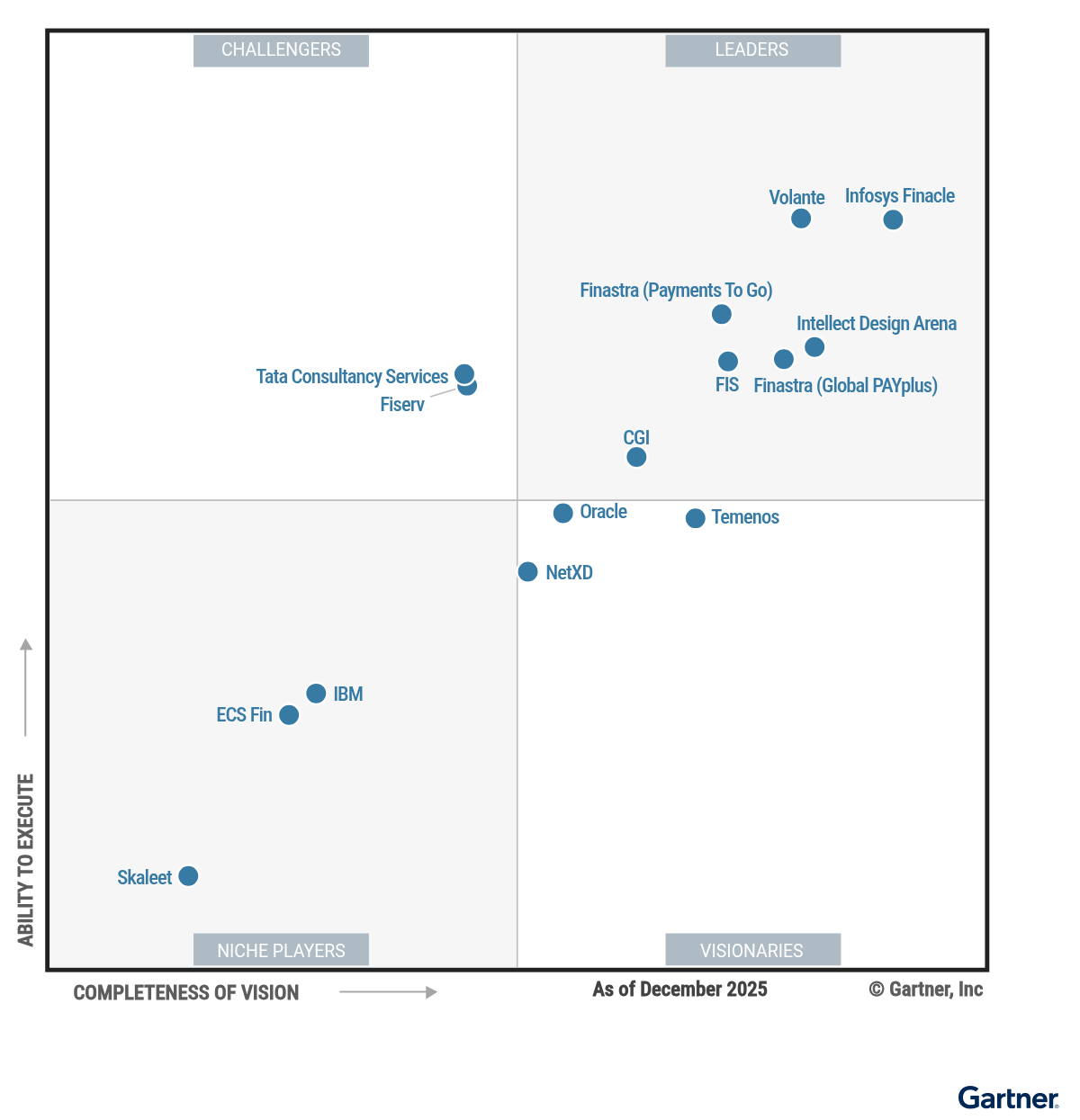
Vendor Strengths and Cautions
CGI
CGI is a Leader in this Magic Quadrant. Its CGI All Payments hub offers end-to-end support for payment processing. It not only provides the software, but also runs the implementation, provides a service to customize the product and provides consultancy to get the best from the payment hub.
It has live customers in most global regions, with the majority of its customers being Tier 1 and Tier 2 banks in North America, Europe and Asia. A typical CGI All Payments customer is a bank that wants a payment hub that can be customized by the payment hub vendor to provide additional functionality to its customers.
CGI All Payments is ISO 20022-native and has a composable architecture with modules such as the Bulk Payment Engine, Immediate Payment Engine, CLS Manager, etc. that can be deployed independently. CGI provides an end-to-end service, carries out the implementations, customizes the product, and provides operational support.
- Market understanding: CGI has contributed to the design and build of payment market infrastructure for CHAPS payments in the U.K., the Continuous Linked Settlement payment system and Project Nexus. This has led it to have a deep understanding of these payment markets, enabling it to build products to support these markets.
- Vertical/industry strategy: CGI has a long-standing customer base of large (usually Tier 1) banks where it offers products as payments as a service (PaaS) and provides additional consultancy designed to meet its customers’ needs. This gives customers access to proven solutions and expert guidance for complex payment needs.
- Geographic strategy: CGI provides compliance with local payment requirements of the markets in which it operates and supports ISO 20022-based payment schemes across jurisdictions. This enables customers to operate smoothly and remain compliant with regional standards.
- Innovation: CGI does not have support for stablecoins and other alternative payment methods that are provided by other payment hubs.
- Market responsiveness: CGI’s investment in the product is driven by regulatory requirements. CGI has relied on its existing customer base (many of whom are on older releases), and meeting payment scheme changes to move the product forward rather than responding to changes in the market.
- Operations: Customers are reliant on CGI to make changes to the payment hub, as the product does not have user-accessible tools to configure payment scheme updates. As a system integrator, it prefers to implement the payment hub itself and does not have a system integrator program.
ECS Fin
ECS Fin is a Niche Player in this Magic Quadrant. Its IMS Payments hub supports high-value corporate, domestic real-time and cross-border payments. It has SWIFT certifications and a SWIFT service bureau.
The majority of its customers are Tier 1 and Tier 2 banks in North America, Latin America, the Middle East and Asia. A typical ECS Fin IMS Payments customer is a bank that wants a payment hub for corporate high-value, cross-border and trade settlement transactions.
ECS Fin IMS Payments is available on-premise or in the cloud, and its modular architecture allows the modules to be deployed independently.
- Operations: As IMS Payments is SWIFT-certified, and deployed as a working payment hub, banks can reduce testing time and thereby reduce time to market for SWIFT payment services.
- Customer experience: IMS Payments offers strong payment dashboard functionality covering the end-to-end payment life cycle. Its customers can customize dashboards to stay in control of payment processing.
- Vertical industry strategy: In addition to payment support, IMS Payments has modules for treasury management, cash management, compliance and sanctions screening.
- Offering (product) strategy: ECS Fin is less effective in conveying its payment hub product roadmap than others in the market. Prospective clients need to evaluate whether the IMS Payments roadmap provides the required functionality within the regulatory timeline to meet the banks’ payment strategy.
- Product or service: ECS Fin’s “transaction-centric” product goes beyond payment message processing with each system being a service provider to the transaction. Bank CIOs should analyze the compatibility of IMS Payments with their existing message-based systems technology architecture.
- Marketing execution: There is a lack of clarity in the marketing of ECS Fin regarding what it does and does not support. The messaging focuses on technology rather than the capabilities of the solution and the solutions it offers.
Finastra (Global PAYplus)
Finastra (Global PAYplus) (GPP) is a Leader in this Magic Quadrant. Finastra GPP offers all-around support for payment processing, with a particular emphasis on high-value and complex cross-border payments.
The vendor has customers in all global regions except Latin America, with the majority of its customers being Tier 1 and Tier 2 banks in North America and Europe. A typical Finastra GPP customer is a Tier 1 bank that wants a payment hub that can be configured to support its complex payment requirements.
The majority of Finastra GPP customers have implemented the payment hub on-premises, but it can also be deployed in the cloud. It is ISO 20022-native.
- Product or service: Finastra GPP has the functionality to process complex, high-value and cross-border payments. This functionality is rule-based, allowing banks to modify the processing to meet the outcomes they need.
- Overall viability: Finastra GPP is trusted by many Tier 1 and Tier 2 banks who are unlikely to switch, even if the vendor does not quickly respond to market change, due to their significant investments. This implies that the vendor’s viability is high and customers benefit from a stable and well-supported platform.
- Geographic strategy: Finastra has leveraged its large global office presence and local system integrators to sell and support GPP globally. Customers can use this existing network to connect with local payment knowledge and scheme support.
- Business model: The Finastra GPP business model is based on banks having a single large payment platform. For banks looking for an agile payment platform with payments outsourced to multiple processors, this product is not the best fit.
- Market responsiveness: As payments become more real-time, with stablecoins replacing complex high-value payments and fintechs offering alternatives to correspondent banking, some of the functionality that Finastra GPP is built on may soon become redundant.
- Innovation: Finastra GPP is an older product. The vendor’s modernization efforts mostly focus on delivering functionalities that are already available from other payment hubs. So, customers should review the upgrade roadmap to ensure it meets their needs.
Finastra (Payments To Go)
Finastra (Payments To Go) is a Leader in this Magic Quadrant. It offers market-specific, SaaS-only payment processing on the cloud for banks looking to modernize and outsource payment processing or reduce operating costs.
Payments to Go only has customers in the U.S. and Europe. Its target market is Tier 3 and smaller banks that want to outsource payment processing to a vendor that supports their market-specific payment methods.
Finastra Payments To Go is ISO 20022-native. It can be configured but is not customizable, which means that customers cannot make software changes. Finastra manages the infrastructure as well as software, maintenance and implementation.
- Market understanding: Finastra’s Payments To Go is designed for banks seeking to outsource payment processing, reducing their infrastructure and maintenance costs. Customers will experience lower operational burden, as Finastra manages everything on its secure SaaS infrastructure.
- Overall viability: Finastra is an established name in the payment software market, and the SaaS model offered by the product is attractive to financial institutions that want to modernize and reduce costs. Therefore, financial institutions are likely to continue using the product long term.
- Business model: The business model of providing a packaged SaaS offering for a clearly identified market segment is a strong one. This is particularly attractive as the package includes the payment functionality developed for Global PAYplus (GPP), which its target financial institutions would not otherwise be able to afford.
- Innovation: As a tightly controlled SaaS solution aimed at smaller banks, this product limits customers’ ability to innovate or request new features, so customers should ensure its functionality aligns with their long-term needs.
- Market responsiveness: Payments To Go requires complex configuration to modify workflows, which may challenge some financial institutions seeking a simple, outsourced SaaS payment solution; customers should assess if their teams can manage this complexity.
- Product or service: Payments To Go supports only a limited range of payment schemes, such as FedNow, RTP and Fedwire, and does not support ACH in the U.S. Similarly, in Europe, it supports T2 and TIPS but not RT1. Customers may need additional software to route payments to unsupported payment clearing schemes, increasing integration complexity.
FIS
FIS is a Leader in this Magic Quadrant. Its FIS Open Payment Framework (OPF) offers all-around support for payment processing with particular focus on real-time, ACH and cross-border RTGS payments.
The vendor has customers in most global regions, with the majority of its customers in Europe and North America. A typical FIS OPF customer is a bank looking for a flexible payment process that combines elements of a hosted SaaS payment hub with the ability to customize.
FIS OPF is a cloud and ISO 20022-native payment hub that has a composable architecture that can be deployed progressively. FIS has a flexible approach to implementation and support. It can provide the service directly to the customer or work with a number of system integrator partners.
- Business model: FIS OPF’s payment solution is packaged differently for different market segments, ensuring each segment receives the most relevant features and pricing. It has a customizable framework package for Tier 1 and Tier 2 banks, and a separate PaaS offering for Tier 3 and Tier 4 banks hosted in the public cloud.
- Innovation: FIS is investing in its OPF, with particular emphasis on stablecoin investment initially through its partnership with the stablecoin issuer Circle. This enables customers to access cutting-edge digital payment options alongside support of more mature rails/schemes.
- Product or service: The product is a composable payment hub that provides both SaaS and the ability to customize payment processing. The payment hub will suit financial services companies that want more than a basic payment hub without having to be responsible for payment scheme compliance and maintenance.
- Customer experience: OPF supports real-time payments, however; in Gartner end-user surveys, some customers have expressed dissatisfaction with processing speeds. This has come from scalability challenges for single instant payments, as the market rapidly evolves from batch to instant payment processing.
- Operations: Due to the product’s complexity, adding payment methods in a new market takes longer compared to other payment-hub platforms. Also, customers have reported longer implementation times for enhanced offerings in existing markets.
- Marketing execution: Though FIS has a clearly defined business model, it does not communicate it effectively to the market. Banks engaging with FIS should ensure they are clear about the provider’s ability to customize or the degree of standardization banks will get from the product being sold.
Fiserv
Fiserv is a Challenger in this Magic Quadrant. Its Enterprise Payments Platform (EPP) offers all-around support for payment processing, including high-value, low-value, batch and real-time payments. Its single codebase is used by all its customers to simplify updates and compliance.
The vendor has customers in Asia and the Middle East, but the majority of its customers are banks in North America and Europe. EPP is suited for banks that want a managed payment hub that meets all the regulatory and compliance requirements.
The majority of EPP customers have on-premise installations, but it is also available on the cloud, with new implementations generally being made on the public cloud. While Fiserv can work with any system integrators chosen by the bank, Fiserv generally implements the product itself.
- Customer experience: The single codebase approach simplifies compliance requirements and scheme changes for the payment schemes that EPP supports. This has led to strong customer satisfaction indicators when Gartner surveyed end users.
- Market understanding: EPP’s strong market share in Europe and the U.S. means that it knows these markets very well. This approach, along with its single codebase, enables it to provide a solid, reliable service in those markets.
- Product or service: EPP delivers reliable real-time, high-value and large-volume batch payment processing, making it ideal for banks that expect a managed solution that need not be highly differentiated or extensively customized.
- Innovation: EPP lacks modern features like composable architecture, AI, and alternative payment options though it supports traditional bank payment methods. Therefore, customers may miss out on future innovations and flexibility.
- Offering strategy: The platform’s regulation and compliance-led strategy focuses on meeting the needs of existing customers in existing markets. This means it may not support payment methods needed for new customers or new markets.
- Sales execution: With a sales strategy focused on a single codebase and on upgrading existing customers, customers may find limited differentiation in payment processing features, so they should assess if the platform meets their unique requirements.
IBM
IBM is a Niche Player in this Magic Quadrant. Its IBM Financial Transaction Manager (FTM) supports the processing of all types of payments with a particular emphasis on huge payment volumes.
IBM FTM is a payment hub targeted at the largest commercial and central banks in Europe and North America. A typical customer is a Tier 1 bank that wants a customizable payment hub that can support large noncard payment volumes.
The product is usually deployed on-premise or in the public cloud since IBM FTM is cloud-agnostic. It uses an internal data format based on ISO 20022 for processing payments and leverages the wider IBM group for technical innovation and consulting purposes.
- Product or service: FTM is able to process the largest payment volumes that Tier 1 banks need to support. Customers benefit from a robust, scalable solution tailored to their most demanding transaction needs.
- Marketing strategy: IBM uses a whole solution approach to marketing, emphasizing its product, consultancy and advanced technology. This demonstrates its ability to safely process payments and handle the complex requirements of Tier 1 banks.
- Innovation: IBM has used watsonx to provide a series of AI agents for FTM. These include operations agents to investigate problems and resolve payment problems, a knowledge agent and a customer agent.
- Market responsiveness: IBM tends to add payment features only after competitors have launched them in the market. Due to the lack of timely release of forward-looking products, customers may experience delays in accessing the latest innovations and should consider their need for cutting-edge capabilities.
- Market understanding: IBM FTM lacks emerging standard features like low-code/no-code payment message configuration and a fully composable architecture framework, which may limit customers’ ability to quickly adapt and customize solutions to evolving business needs.
- Geographic strategy: The vendor has a strong focus on the needs of the European and North American markets. Banks looking for support outside these regions will need to confirm that the vendor can meet their market requirements.
Infosys Finacle
Infosys Finacle is a Leader in this Magic Quadrant. It is the unit as well as the brand under which EdgeVerve Systems, an Infosys company, sells its product, Finacle Payments. The product offers all-around support for payment processing, with a particular emphasis on high-value, cross-border and real-time payments.
The vendor has customers in most regions, with the majority of its customers being banks in Africa, Asia and the Middle East. It also has a particularly large market share in India. A typical Finacle Payments customer is a Tier 1 to Tier 4 bank that wants a payment hub that can be deployed progressively.
The payment hub can be deployed on-premise or in the cloud. It is ISO 20022-native and has a composable architecture with microservices that can be deployed independently. Customers can use the payment hub as a SaaS offering or can use the template mapper to configure it themselves.
- Product or service: The payment hub comes with a no-code template mapper that allows banks to update and maintain payment messages based on the ISO 20022 standard. This enables faster adaptation to customer needs and regulatory changes without technical complexity.
- Innovation: Finacle Payments is fully composable. The system is delivered with only the modules needed by the customer, with the option of adding more functionality later using a blue/green deployment model. This ensures that customers get tailored solutions with minimal disruption during upgrades.
- Offering strategy: The payment hub has been designed to handle high volumes of real-time retail payments, using the lessons learned from supporting Unified Payments Interface (UPI) payments in India. It has been designed to provide resilient processing by reducing the need to be taken offline for routine maintenance.
- Marketing execution: It offers the payment hub as a SaaS, but it does not have a clear definition of what markets it will support as SaaS or which segments of customers it will target. This uncertainty may impact customers looking to adopt a SaaS solution.
- Geographic strategy: There are some markets (such as India) where Finacle Payments has a dominant position. However, there is less support in markets such as the U.S. and Latin America, where it does not have a significant customer base. Therefore, customers should validate the availability of local support.
- Operations: Due to the flexibility of Finacle Payments, implementation timescales can be longer. Customers need to focus on the business benefit of going live with the payment hub.
Intellect Design Arena
Intellect Design Arena is a Leader in this Magic Quadrant. Its eMACH.ai Payments supports the full range of high-value, domestic low-value, real-time and cross-border payments. It supports retail payments but has a particular emphasis on corporate payments.
The vendor has customers in all global regions, but it is particularly strong in Africa, Asia and the Middle East. A typical Intellect eMACH.ai Payments customer is a Tier 2 or Tier 3 bank that wants a payment hub to support their corporate customers.
eMACH.ai Payments supports deployment in the cloud and has a number of live customers with its SaaS offering. It has a canonical data model based on the ISO 20022 standard. The vendor has its own deployment methodology to implement the payment hub, and prefers to do the work itself rather than use system integrators, though customers have an option of using system integrators.
- Innovation: eMACH.ai Payments has strong AI functionalities provided by its Purple Fabric product. They include AI agents for payment repair, a co-pilot for relationship managers, and agents for operations managers to derive insights from payment data.
- Market understanding: eMACH.ai Payments targets the corporate payment business and offers a number of add-on features to centralize bulk payment processing and manage payment limits across corporate groups.
- Product or service: eMACH.ai Payments is a composable payment hub with an ISO 20022 canonical model that allows a no-code payment rail configurator to configure new payment schemes. It enables customers to quickly adapt to market changes and launch new payment schemes with minimal technical effort.
- Market responsiveness: It does not support stablecoin payments, nor does it have support for alternative cross-border payment methods. This may limit customers’ ability to offer innovative or cost-effective international payment options to their clients.
- Operations: The majority of its customers have on-premise installations, and any customer adopting their cloud-based SaaS service will need to ensure they have SaaS experience in their market.
- Vertical/industry strategy: Much of its strategy has been based on corporate payments. Customers looking for a universal payment solution need to validate that eMACH.ai Payments can meet all their payment requirements.
NetXD
NetXD is a Visionary in this Magic Quadrant. Its XD Payments offers all-around support for market-specific payment processing in the markets where it operates and a cross-border solution that is market-agnostic.
The vendor has customers in most global regions, but is particularly strong in Latin America, North America and the Middle East. A typical XD Payments customer is a Tier 3, Tier 4 or Tier 5 bank that wants to outsource their payment processing to a third-party using a PaaS or SaaS model.
XD Payments is an ISO 20022-compliant, cloud-based payment hub. As XD Payments is sold as a service, NetXD tightly controls the codebase. Customers can configure individual payment rails and choose which to deploy, but NetXD does not allow customization of the product.
- Business model: XD Payments offers an API connection to its payment hub, which includes a real-time ledger. This allows banks without a real-time core banking system to support real-time payments without replacing their core banking system.
- Innovation: XD Payments supports stablecoin payments. NetXD can also supply complementary software for financial services institutions to mint and burn stablecoins. It also offers custody wallets.
- Offering (product) strategy: NetXD has designed a strategy that supports its target market by offering a cloud-native SaaS product. With this product, customers can go live with real-time payments in around two months compared to the six to eight months typically quoted.
- Product or service: Some features, like the payment dashboard and formatting ISO 20022 payment messages using a no-code tool, are less advanced than those of other payment hubs and cannot be customized. Customers should carefully assess whether the available functionality meets their operational requirements before selecting this product.
- Geographic strategy: NetXD does not have plans to expand its full PaaS or SaaS offering outside of the regions where it already has customers. So, XD Payments may not be suitable for financial services companies that want payment processing outside of Latin America, the Middle East or North America.
- Customer experience: NetXD does not use customer user groups, instead taking feedback from individual customers to help build its product roadmap. Therefore, customers will need to build an individual case for product features not provided as standard.
Oracle
Oracle is a Visionary in this Magic Quadrant. Its Oracle Banking Payments offers all-around support for payment processing, with a particular emphasis on high-value and cross-border payments.
The vendor has customers in all global regions, with the majority of its customers being Tier 2 and Tier 3 banks in Africa, Europe, and Oceania within APAC. A typical Oracle Banking Payments customer is the overseas branch of a larger bank, and the payment hub is often used to link overseas branches together.
Oracle Banking Payments has mostly been implemented on-premises, but it is beginning to be deployed in the cloud. It is ISO 20022-native. As many installations are on-premises, the normal implementation method is for Oracle to manage the integration and customization on-site; however, it also has a number of implementation partners.
- Innovation: Oracle Banking Payments supports blockchain functionality. Customers can use an internal blockchain to make cross-border payments between branches of the same bank, and the company also supports payments using stablecoins.
- Overall viability: As part of Oracle, it benefits from strong technology development and resources, giving customers access to innovative solutions and the assurance of long-term stability. Its strong sales record and high customer satisfaction further demonstrate reliable performance.
- Product strategy: It is investing strongly for the future in areas such as AI augmentation (auto repair, liquidity forecasting and error detection), composability of the solution and is also moving to a microservices architecture.
- Market responsiveness: It can be slow to respond to market changes. For example, much of its functionality is rule-based; it lacks a strong SaaS offering, and scheme updates are a mixture of customer-controlled and Oracle-controlled.
- Product or service: The product lacks composability, limiting customers’ ability to modify or reorder process flows — only allowing removal of certain steps. This may restrict customers from fully tailoring the solution to their specific operational needs.
- Business model: Over 90% of its customers have on-premise deployments. Oracle may not be the best option for customers looking for a public cloud deployment, whether for SaaS or to support real-time payments.
Skaleet
Skaleet is a Niche Player in this Magic Quadrant. Its Skaleet Payment Engine supports payment processing for fintechs, corporates, as well as banks.
It has a defined geographic focus. The vendor has customers in Europe, Africa and some French overseas territories, and has no plans to sell into other regions. A typical Skaleet Payment Engine customer is a payment service provider, e-money institution or Tier 5 bank (either an independent institution or a subsidiary of a larger banking group) that wants an outsourced payment service for a European or African market.
Skaleet Payment Engine is a cloud-based payment hub that is ISO 20022-native and is provided on a PaaS basis. There is a single codebase that is developed, maintained and augmented by Skaleet, but limited customization is possible through configurable workflows, rules and APIs.
Skaleet declined requests for supplemental information. Gartner’s analysis is therefore based on other credible sources.
- Business model: It has a business model that offers a cloud-based SaaS solution for smaller banks, payment solution providers, fintechs, and e-money providers in a clearly defined market. This enables customers to quickly deploy cost-effective, market-specific payment solutions that suit their unique needs.
- Operations: Given its single codebase multitenant approach, it can go live in months in markets that the vendor already supports, allowing customers to benefit from faster implementation and quicker access to new payment capabilities.
- Market understanding: The Skaleet Payment Engine is sold either as a stand-alone product or along with the Skaleet core banking product. This positions it well for the increased use of instant payments in Europe.
- Innovation: Skaleet Payment Engine is designed to support a controlled set of payment methods, so customers cannot independently introduce new payment instruments without vendor involvement.
- Product: The product has limited support for payment schemes, supporting SEPA payments, SWIFT and some African payment schemes. Customers operating across multiple regions will require integration with additional payment processing.
- Market responsiveness: The vendor adopts a cautious approach to developing packaged solutions aimed at clearly defined market segments. Consequently, it is slower to respond to market changes compared to some of the larger competitors in this Magic Quadrant.
Tata Consultancy Services
Tata Consultancy Services (TCS) is a Challenger in this Magic Quadrant. Its TCS BaNCS for Payments offers a payment hub with strong processing technology, the ability to support high transaction volumes and full end-to-end processing.
The vendor has customers in most global regions. Its customers are a mixture of Tier 1 and Tier 2 banks with technically complex payment requirements or Tier 4 and Tier 5 banks using its SaaS offering. Its strongest markets are Asia, Europe and the Middle East.
TCS BaNCS for Payments is a cloud-native payment hub that is ISO 20022-native. Since it is a part of the TCS group, the implementation of the product is typically carried out directly by TCS.
- Product or service: TCS BaNCS for Payments benefits from a scalable design that means it can support huge real-time payment volumes. This support has been demonstrated in multiple regions, including Europe and Asia.
- Geographic strategy: TCS BaNCS for Payments is live globally, with a particularly strong presence in Africa, Asia, Europe and the Middle East. Therefore, the product has experience with various payment schemes and provides them out of the box. Given the wide geographic presence, many new customers find that the payment schemes they need are already supported.
- Overall viability: TCS BaNCS for Payments has a strong market presence, ensuring reliable long-term support. Customers also benefit from dedicated TCS teams for ongoing maintenance, minimizing operational risk and ensuring consistent service quality.
- Business model: The vendor looks to provide payment processing technology rather than building a product with a clear identity, target customer base and market strategy. TCS’ approach is to build support for its customer’s current payment needs rather than applying a longer-term strategy.
- Offering (product) strategy: The implementation time for TCS BaNCS for Payments is longer than the average of eight months for other vendors in this research. This is typically due to the technical complexity of the implementation approach.
- Market understanding: Compared to other providers, TCS is less proactive and looks to its customers to drive the product roadmap. Any bank using TCS BaNCS for Payments will need to clearly communicate their requirements and make sure the vendor is capable of supporting them.
Temenos
Temenos is a Visionary in this Magic Quadrant. Its Temenos Payments Hub (TPH) offers all-around support for a broad range of payment methods and payment schemes, thanks to its presence in a large number of live markets.
The vendor has customers in all global regions, with the majority of its customers being Tier 2, Tier 3 and Tier 4 banks. A typical TPH customer is a bank that wants a payment hub that can be customized, but does not want the complexity of a payment hub aimed at Tier 1 and Tier 2 banks.
TPH is a payment hub that can be deployed in the cloud or on-premise. It has a neutral data format that supports ISO 20022 messages. Temenos typically outsources implementation to certified system Integrator partners but implements it directly when it is sold as SaaS.
- Geographic strategy: TPH’s presence in multiple markets means that many payment schemes are already supported, enabling new customers to quickly access required schemes without additional integration effort.
- Innovation: The Temenos Exchange fintech marketplace offers ready-made connections to fintechs for cross-border payments, account validation and alternative payment rails. Customers benefit from faster access to new services without the need for custom development.
- Customer experience: The modern, intuitive interface and AI-driven payment repair make it easy for users to manage and fix payments efficiently. Customers benefit from faster issue resolution and improved user experience.
- Product or service: TPH lacks the composability offered by many of the other payment hubs featured in this Magic Quadrant. It is not possible to deploy separate parts of the payment hub, and it is often not possible to upgrade individual microservices while continuing to run the payment hub. This may make the product unsuitable for banks with the largest volumes of real-time payments.
- Market responsiveness: As TPH has a neutral data format instead of being ISO 20022-native, it does not offer customers low- and no-code functionality to configure ISO 20022 payment messages. This means that customers are reliant on partners or their own resources to support new payment schemes.
- Offering (product) strategy: As Temenos do not manage the implementation of TPH, implementation times can vary according to the quality of the implementation partner.
Volante
Volante is a Leader in this Magic Quadrant. Its Volante Payments Platform offers full support for payment processing, and banks can deploy parts of the payment hub alongside legacy payment software.
The vendor’s largest customer base is in North America. It also has significant numbers of customers in Europe, Latin America and Africa, and smaller numbers in Asia and the Middle East. Volante Payments Platform customers are typically either Tier 1 or Tier 2 banks that want a composable payment hub that can be deployed progressively or Tier 2, Tier 3 or Tier 4 banks that take the whole payment hub as a single implementation.
Volante Payments Platform is a payment hub that can be deployed on-premise or on the cloud. It is available as a SaaS model for banks that want to outsource payment processing. It supports ISO 20022 messages and has a composable architecture with modules that can be deployed independently.
- Innovation: Volante Payments Platform is a technically advanced payment hub. The vendor has introduced a number of AI features into its payment hub. These include deploying AI to enrich payment messages, repair payment messages, and identify problems with the routing of payments.
- Market understanding: Volante’s deep payments market expertise drives a technically innovative product. Customers benefit from cutting-edge solutions aligned with industry trends and best practices.
- Product or service: Volante Payments Platform is highly composable with modules that can be deployed alongside a bank’s legacy payment software.
- Sales strategy: Volante supports all payment offerings without providing a guided approach to payment hubs and expects customers to choose features according to business needs. This may not be suitable for customers looking for a vendor to treat payments as a commodity and simply process them.
- Customer experience: The look and feel of Volante Payments Platform is suited to technical teams rather than operations personnel. Users will require a higher level of training for optimal use of the product.
- Geographic strategy: The vendor has a strong focus on the needs of its large customer base in North America and Europe. Banks looking for support outside this region will need to confirm that the vendor can support their market requirements.
Vendors Added and Dropped
We review and adjust our inclusion criteria for Magic Quadrants as markets change. As a result of these adjustments, the mix of vendors in any Magic Quadrant may change over time. A vendor's appearance in a Magic Quadrant one year and not the next does not necessarily indicate that we have changed our opinion of that vendor. It may be a reflection of a change in the market and, therefore, changed evaluation criteria, or of a change of focus by that vendor.
Added
As this is a new Magic Quadrant, no vendors were added.
Dropped
As this is a new Magic Quadrant, no vendors were dropped.
Inclusion and Exclusion Criteria
The inclusion criteria are the specific attributes that a banking payment hub product must have to be included in this Magic Quadrant.
To qualify for inclusion, providers need to have:
- At least three banking payment hub implementations in two or more global regions
- Over 12 live customers globally
- Support for the following payment methods: Batched payment files, corporate payment files, direct debits, high-value RTGS payments, real-time (instant) payments and SWIFT payments
The count of live customers is a count of separate banking organizations. If the same bank has implemented a particular payment hub in multiple sites or regions, it is counted as a single customer.
Some regional banking payment hubs have not been included because they only provide functionality within one region, which does not satisfy the inclusion criterion. Some of these have been included in the Honorable Mentions section below.
Honorable Mentions
Gartner tracks more than 45 vendors that offer banking payment hub platforms. In addition to the banking payment hub platforms included in the Magic Quadrant, we recognize four vendors with Honorable Mentions. Although these vendors did not meet the inclusion criteria for this Magic Quadrant, they offer banking payment hubs that either have new innovative functionality or are used widely in a single market. The vendors are:
- Finzly: It has a banking payment hub platform called Payment Galaxy. It is a cloud-based payment hub that supports the U.S. market. It allows banks to connect to the payment hub via an API and provides payment processing on a SaaS basis. Finzly has recently launched support for stablecoins and tokenized deposits. Finzly missed inclusion because it only has live customers in one region.
- MVI Technologies: It has a banking payment hub product called M^Dynamics Payment Hub. Its product is composable, and has a real-time ledger, which can provide a stand-in account balance if the core banking system is unavailable. MVI is based in Singapore and has live customers in Asia. MVI Technologies missed inclusion because it only has customers in one region.
- ProgressSoft: It has a banking payment hub platform called PS-PayHub. ProgressSoft has offices in Jordan, Qatar, UAE, Kuwait, Oman and Nepal. Its payment hub is generally installed on-premise, and it has been deployed in a number of banks in the Middle East and Africa. ProgressSoft missed inclusion because it didn’t have sufficient live customers in a second region.
- Thought Machine: It has a real-time, cloud-native banking payment hub product called Vault Payments. It is ISO 20022 native and offers vendor-independent payment flow configuration. It can coexist with a bank’s existing payment infrastructure. It is offered as a SaaS, or a self-hosted option and it has live customers in Europe and a single live customer in the U.S. Thought Machine missed inclusion because it didn’t have sufficient live customers in a second region.
Evaluation Criteria
The evaluation criteria used in this Magic Quadrant reflect the requirements of financial services institutions for banking payment hub platforms. They are informed by the evolving payments market, which is increasingly real-time in nature and based on ISO 20022 message standards. This has led to an evolution of banking payment hub platforms from monolithic design to an increasingly composable, microservice-based architecture processing payments using ISO 20022 format messages and databases.
The scoring not only reflects where the different vendors are on that journey but also how they support and manage the payment hub software delivered to their customers. The delivery methods often reflect the market segments to which their products are marketed. For example, large Tier 1 banks may want more of a framework approach, whereas smaller Tier 3 and Tier 4 banks may want a SaaS model where they could outsource payment processing to a third-party vendor. Similarly, given the national and regional nature of payments, the geographic strategy and how the banking payment hub platform is marketed are reflected in the evaluation scores.
For this Magic Quadrant, Gartner formally and extensively surveyed the vendors about their banking payment hubs. In addition to this survey, vendor briefings were conducted, a recorded demo of the system was reviewed, and a survey of their customers was conducted.
Ability to Execute
The evaluation criteria for Ability to Execute focus on the ability of a vendor to deliver scheme-compliant payment processing, and on how the vendor and product are positioned to sustain support for near-term banking payment hub market requirements and commitments.
Gartner has analyzed and compared 60 criteria for each vendor’s banking payment hub product to map the vendors based on their Ability to Execute.
This Magic Quadrant axis includes the following criteria:
Product/Service: The capabilities, features and overall quality of the payment hub platform and services that compete in and or serve the defined market. We specifically looked at the description of the banking payment hub platform and the services that the vendor offers alongside it; the format and use of data within the banking payment hub product, particularly the vendor’s use of the ISO 20022 format; the companion systems the vendor can supply to complement its banking payment hub platform, along with the systems it has connections to.
Overall Viability: The organization’s overall financial health, as well as the financial and practical success of the relevant business unit. This includes the likelihood that the vendor can continue to offer and invest in the banking payment hub platform, as well as the product’s position in the vendor’s portfolio. We specifically looked at the financial structure of the company that owns the banking payment hub product; the importance of the banking payment hub to the overall company; the investment being made into the future of the banking payment hub product, and whether it is growing or decreasing in importance within the company.
Sales Execution/Pricing: The organization’s capabilities in all presales activities and the structures that support these activities. This includes deal management, pricing and negotiation, presales support and the overall effectiveness of the sales channel. We specifically looked at the average deal size for the banking payment hub and the licensing models used in selling the banking payment hub product; the size of the sales team and the approaches they take in selling the banking payment hub; the term lengths that the vendor’s customers typically take for the banking payment product.
Market Responsiveness and Track Record: The ability to respond, change direction, be flexible and achieve competitive success as opportunities develop, competitors act, customer needs evolve and market dynamics change. This includes the vendor’s history of responsiveness to changing market demands. We specifically looked at the trends the vendor identifies in the banking payment hub market; the ways in which the vendor monitors and tracks changes to the banking payment hub market; the changes the vendor has made to the banking payment hub platform in response to market trends over the last 12 months.
Marketing Execution: The ability to deliver clear, high-quality, creative and effective messaging via publicity, promotional activity, thought leadership, social media, referrals and sales activities. This includes the organization’s ability to influence the market, promote the brand, increase awareness of products and establish a positive reputation among customers. We specifically looked at the typical personas that the vendor targets with its marketing and compared these to the personas of the people who actually make the decision to buy the banking payment hub platform; the size of the vendor’s marketing team and the approaches they take in marketing the banking payment hub; the description of the marketing strategy for the banking payment hub and the ways in which it has been successful.
Customer Experience: The degree to which a vendor’s products, services and programs enable customers to achieve their desired results. This includes the quality of supplier/buyer interactions, technical support or account support, as well as ancillary tools, customer support programs, availability of user groups and service-level agreements. We specifically looked at details of any customer user group or customer advisory board; the way the vendor measures the experience of its customers with the banking payment hub; information about any problems or issues that have impacted the experience of the vendor’s last 12 months.
Operations: The ability of the organization to meet its goals and commitments. This includes the quality of its organizational structure, skills, experiences, programs and systems that enable the organization to operate effectively and efficiently. We specifically looked at the number of employees who are dedicated to supporting the banking payment hub product; the ways in which the vendor maintains compliance with payment scheme updates and the time scale to perform regulatory updates; where the organization has employees who support the banking payment hub.
Ability to Execute Evaluation Criteria
| Evaluation Criteria | Weighting |
|---|---|
Product or Service | High |
Overall Viability | High |
Sales Execution/Pricing | Medium |
Market Responsiveness/Record | High |
Marketing Execution | Low |
Customer Experience | High |
Operations | High |
Source: Gartner (January 2025)
Completeness of Vision
The evaluation criteria for Completeness of Vision are based on the effectiveness of the vendor product strategies linked to the market. Gartner has analyzed and compared 54 variables for each vendor’s product to map the vendors based on their Completeness of Vision.
This Magic Quadrant axis includes the following criteria:
Market Understanding: The ability to understand customer needs and translate that understanding into products and services. Vendors with a clear vision of the market listen to and understand customer and regulatory demands, and they can shape or enhance market changes with their vision. We specifically looked at where the vendor sits in the banking payment hub market and who its closest competitors are; the capabilities that the vendor believes make its banking payment hub unique and how it differentiates itself in the market; and the vendor’s understanding of how the market will evolve over the next 12 months.
Marketing Strategy: The ability to clearly communicate differentiated messaging, both internally and externally, through social media, advertising, customer programs and positioning statements. We specifically looked at how the vendor identifies its target customers; the way in which the vendor’s marketing will change over time; and the vendor’s approach to building effective marketing for its banking payment hub product.
Sales Strategy: The ability to create a sound strategy for selling that uses the appropriate networks, including direct and indirect sales, marketing, service and communication. This includes partnerships that extend the scope and depth of a provider’s market reach, expertise, technologies, services and customer base. We specifically looked at the way in which the vendor’s sales strategy will evolve over the next 12 months, and whether it is planning to do anything differently; the regions the vendor is targeting for sales over the next 12 months and whether the regions are new or markets where the vendor is already strong; and any changes to the licensing and pricing models that the vendor is planning to make to reflect changes to its sales strategy.
Offering (Product) Strategy: The ability to approach product development and delivery in a way that meets current and future requirements, with an emphasis on functionality, methodology and features. We specifically looked at the vendor’s plans to evolve the banking payment hub over the next 12 months; its approach to delivering and implementing the banking payment hub platform, including the use of implementation partners; and the time typically taken to implement the banking payment hub platform, and the risks and success factors it encounters most frequently.
Business Model: The design, logic and execution of the organization’s business proposition. We specifically looked at the vendor’s business model for the banking payment hub platform. This included aspects such as SaaS or PaaS and the delivery of a payment framework for the bank to customize; the vendor’s plans to evolve the business model for its banking payment hub over the next 12 months; the value proposition of the banking payment hub.
Vertical/Industry Strategy: The ability to strategically direct resources (sales, product, development), skills and products to meet the specific needs of verticals and market segments. We specifically looked at parts of the banking industry that the vendor targets when selling or marketing the banking payment hub. For example, cross-border payments, business customers, retail payments, etc., where the vendor sees opportunities for growth in the banking payment hub market; and how the vendor meets the requirements of industry standards and its approach to developing the banking payment hub product while meeting the payment scheme standards.
Innovation: Marshaling of resources, expertise or capital for competitive advantage and investment. We specifically looked at the vendor’s innovation roadmap for 2025 and which innovations it is planning to build into its banking payment hub; the amount of investment in research and development; and the vendor’s software development and testing methodologies.
Geographic Strategy: The ability to direct resources, skills and offerings to meet the specific needs of markets outside the providers’ home region, either directly or through partners, channels and subsidiaries. We specifically looked at which geographic regions are most profitable for the vendor’s banking payment hub product; the regional payment standards and regulatory initiatives that the vendor believes will most impact its banking payment hub product; and the regions where the vendor believes it will see the fastest growth for its banking payment hub product in 2025.
Completeness of Vision Evaluation Criteria
| Evaluation Criteria | Weighting |
|---|---|
Market Understanding | High |
Marketing Strategy | Low |
Sales Strategy | Low |
Offering (Product) Strategy | High |
Business Model | High |
Vertical/Industry Strategy | Medium |
Innovation | High |
Geographic Strategy | High |
Source: Gartner (January 2025)
Quadrant Descriptions
Leaders
Leaders in the banking payment hub platform market have a strong understanding of the requirements of the banking payment market. They have products that are able to support the complexities of different payment schemes in the payment market, while at the same time providing a resilient payment hub that will support the requirements of 24/7 real-time payments.
They are typically ISO 20022-native and have taken advantage of the ISO 20022 message format to provide added value by introducing low-code/no-code payment message formatting. In addition, they are able to use the structured message format to derive value from the messages. This can be from the use of structured data to improve fraud and sanctions checking, or to store the transactions in a format to provide extra value from the payment data.
While some are not making full use of AI, they are beginning to introduce AI to their payment hubs.
Challengers
Challengers in the banking payment hub platform market can execute within the market but lack the vision of the leaders in this Magic Quadrant. They can implement their product and can support payment processing required by their customers, but they typically lack the vision required to be Leaders in a fast-changing market.
They have products that are not fully grasping the opportunities in this market, presented both by innovative technologies such as AI and blockchain, and the impacts of regulatory changes, such as the introduction of ISO 20022 and the global introduction of real-time payment, both in domestic markets and for cross-border payments.
Visionaries
Visionaries in the banking payment hub platform market have the vision to understand where the market is heading, but are not yet able to execute as well as the largest vendors. They know the value of providing a composable product to support real-time payment processing while allowing innovation. They understand the opportunities presented by ISO 20022 structured messages, but are not able to act on all the opportunities presented by the banking payment hub market. They understand there are opportunities from AI in payment routing, operational co-pilots and payment repair.
This is typically due to the size of the vendors in this category compared to the largest vendors that are among the Leaders in this Magic Quadrant. Often, they have roadmaps that reflect this future vision of the market, but they have not executed their vision.
Niche Players
Niche Players in the Banking Payment Hub Platform market tend to have a narrow market focus. This could be through a narrow business model or a product ideally suited to a particular bank segment.
These products often have happy customers whose banking payment requirements align with the processing services and functionality offered by the niche player.
They are defined as Niche Players in this Magic Quadrant because they lack the breadth and depth of processing, market understanding or payment vision required to be a Leader in a Magic Quadrant aimed at global banking payment support.
Context
Payment processing is a critical capability for a financial services institution. It is how money is moved in and out of the institution. A banking payment hub platform needs to be resilient, as any problems are amplified by customers unable to make payments or receive money. However, this visibility also means that customers can use payment processing to compare financial institutions. It is easy to identify the institutions that do or do not support real-time payments, stablecoins or innovative low-cost cross-border payment methods.
These conflicting requirements add pressure to banking payment hub platform selection. The success or failure of the banking payment hub platform selection can be very visible. For this reason, many institutions use a progressive renovation, progressively implementing payment method by payment method, as described in How CIOs Can Safely Modernize Their Payment Infrastructure, and the implementation methods used by different vendors need to be understood in this context.
To pick the right product, financial services institutions need to be clear on the banking payments they are planning to support, what their payment processing requirements are, and how any banking payment hub aligns with those requirements. Are payments a differentiating product, or does the bank just need market and regulatory alignment? The answer to this question will lead a financial institution to consider whether it needs a framework that can be customized or a SaaS product that is maintained by a vendor. Is the financial institution comfortable outsourcing the payment processing to reduce the cost of payment scheme updates and infrastructure maintenance, or do they want to keep more of it in-house?
It is also important to evaluate the total cost of a banking payment hub platform and compare the commercial offerings from different vendors with the bank’s expectations. Building an infrastructure to meet the peak of real-time payment processing may not be cost-effective if the peak is a once-a-year event. Similarly, all payment schemes have regular updates: a decision must be made regarding whether to maintain these or outsource the maintenance.
When selecting vendors, bank CIOs need to consider vendors with proven expertise in the regions where their bank processes payments. They should also consider additional vendors that may be relevant to the bank, such as those with preexisting relationships. For example, many of the vendors also offer core banking systems, and implementation and support may be easier if both the core banking system and banking payment hub platform are supplied by the same vendor.
Gartner has focused its evaluation of the banking payment hub platforms on their ability to sell a product aligned with five key market trends examined in more detail in the Market Overview section:
- Composable architecture
- Support for the ISO 20022 payment format
- Payment hub resilience and support
- The ability to address payments in a global context
- The support for new innovative payment methods
Nearly all financial transactions involve payments, and Bank CIOs and other IT and business leaders need to identify both their customers’ existing payment expectations and the opportunities that are opening up in payments. They should use this Magic Quadrant to identify a shortlist of payment hubs that will be able to meet these requirements. They then need to carry out forensic due diligence, including a proof of concept and gathering of customer references, before picking a banking payment hub platform to meet their medium and long-term banking payment processing requirements.
Market Overview
The payments market has moved on from the time when all payments could be processed together in a single monolithic product. Much of this change has been driven by the adoption of real-time payments, which require processing 24/7, so it is not possible to take a payment hub offline to carry out maintenance or upgrades.
Also, the increasing use of the ISO 20022 format for payment messages globally allows banks to move away from relying on vendors for every small scheme format change and instead look for tools to manage the process themselves.
Finally, AI is providing opportunities for innovation to repair failed payments, improve payment routing or provide co-pilots to allow operations staff to understand why a payment failed.
All of these trends in payment processing are impacting the design of banking payment hub platforms. The following sections give a more detailed analysis of these changes.
Composability
Real-time payments need to be received, sent and processed within seconds. Customers can initiate them 24 hours a day, seven days a week. There are no cut-off times or holidays for processing real-time payments. This means financial institutions cannot take an entire payment hub offline for maintenance or scheme updates. Instead, they want to update the payment hub while continuing to keep the payment processing going.
This has led to banking payment hub platforms’ increasingly composable design, using a microservices architecture. This design allows platforms not only to scale to meet the processing requirements of real-time payments but also to update individual components.
SaaS
One trend for many Tier 3 and Tier 4 banks is to outsource payments technology to a vendor. Increasingly, we are seeing vendors offering payment processing on the cloud using a SaaS model. This means that payment scheme updates are taken care of by the bank payment hub vendor, taking the compliance responsibility off the bank’s own technology team. The SaaS model typically uses blue/green deployment models to meet the always-on requirements of real-time payments.
ISO 20022
Most payment schemes now use the ISO 20022 format, which allows for interoperability between different payment schemes and increased value from the ISO 20022 structured data. Increasingly, banking payment hub platforms are becoming ISO 20022-native with both the payment messages and resulting transactions using the ISO 20022 format. This in turn has allowed bank payment hub platform vendors to provide low-code/no-code payment message formatting based on the standard. Not only does this reduce the risk of not meeting payment scheme updates but it also allows financial institutions to add additional optional data to messages without relying on a vendor making software changes.
AI
AI in the form of machine learning has been used to detect fraud in payments for a number of years. Now, AI is being introduced to banking payment hub platforms in the following ways:
- Co-pilots are being used to inform operations staff of the reason a payment has failed or has been delayed.
- It is also being introduced to repair payments, particularly where the same data is missing on a number of occasions.
- Finally, AI is being introduced to control payment routing with the possibility of increasing the speed or reducing the cost of payments and redirecting payments in real-time if there are problems with a particular payment scheme.
The rate of adoption of AI is not consistent across vendors. Originally, many vendors were nervous about introducing AI due to potential problems with hallucinations causing payments to fail. However, we are now seeing a trend to adopt AI for the use cases described across the market.
This is the first version of Magic Quadrant for Banking Payment Hub Platforms. It replaces the Market Guide for Banking Payment Hub Platforms.
Acronym Key and Glossary Terms
| ACH | Automated Clearing House (ACH) is an electronic payment system used to transfer funds between bank accounts domestically in the U.S. The term is more broadly used to describe bulk money movement generically. |
| AI agents | Autonomous or semiautonomous software entities that use AI techniques to perceive, make decisions, take actions and achieve goals in their digital or physical environments |
| Alternative Payment Methods | These are methods of payment used by banks, but are not standard methods such as ACH, SWIFT or real-time payments. Examples include stablecoin payments, the use of fintechs or integration with card companies such as Mastercard Send or Visa Direct. |
| Blue-Green Deployment | This is a software deployment approach designed to minimize downtime by running two environments, “blue” (current version) and “green” (new version). The new version is deployed to the idle “green” environment, and then, when the bank wants to start using the new version of the software, payments start to be routed to the new “green” environment. |
| ISO 20022 | ISO 20022 is a multipart international standard prepared by ISO Technical Committee 68 (ISO/TC 68). It describes a common platform for developing messages for financial initiatives. This is the messaging standard used by most modern payment schemes. |
| ISO 20022-compliant | A payment hub that can support payment messages in the ISO 20022 format. |
| ISO 20022-native | A payment hub that formats payment messages in the ISO 20022 format internally. This is both the in-flight payment image during processing and the transaction data recorded on the transaction database. |
| PaaS | Payment as a service (PaaS) is where the provider not only manages the software and infrastructure but also offers its customers payment processing as a service. |
| Payment Integration Middleware | Software that sits in front of the payment hub to receive payment requests from upstream systems and route payment requests to the correct payment hub for processing. |
| SaaS | SaaS enables financial institutions to access payment hub functionality as a service with the vendor taking responsibility for the infrastructure or maintenance of the payment software. The software provider also takes care of regular message format changes. |
| SEPA | The Single Euro Payments Area (SEPA) is a transaction system created by the European Union. It harmonizes the way cashless payments are transacted between euro countries. |
| Stablecoin | Stablecoins are cryptocurrencies. Their value is pegged to a second asset or basket of assets, a fiat currency, a publicly traded commodity or another cryptocurrency, or relies on an algorithm attempting to replicate the actions of a central bank’s open market operations. |
| SWIFT | Society for Worldwide Interbank Financial Telecommunication (SWIFT). Swift is a global member-owned cooperative and the world’s leading provider of secure financial messaging services. |
| Tier | The bank tier definitions used in this document follow the Gartner Bank tiers defined here: Definition of Bank Tiers |
Ability to Execute
Product/Service: Core goods and services offered by the vendor for the defined market. This includes current product/service capabilities, quality, feature sets, skills and so on, whether offered natively or through OEM agreements/partnerships as defined in the market definition and detailed in the subcriteria.
Overall Viability: Viability includes an assessment of the overall organization's financial health, the financial and practical success of the business unit, and the likelihood that the individual business unit will continue investing in the product, will continue offering the product and will advance the state of the art within the organization's portfolio of products.
Sales Execution/Pricing: The vendor's capabilities in all presales activities and the structure that supports them. This includes deal management, pricing and negotiation, presales support, and the overall effectiveness of the sales channel.
Market Responsiveness/Record: Ability to respond, change direction, be flexible and achieve competitive success as opportunities develop, competitors act, customer needs evolve and market dynamics change. This criterion also considers the vendor's history of responsiveness.
Marketing Execution: The clarity, quality, creativity and efficacy of programs designed to deliver the organization's message to influence the market, promote the brand and business, increase awareness of the products, and establish a positive identification with the product/brand and organization in the minds of buyers. This "mind share" can be driven by a combination of publicity, promotional initiatives, thought leadership, word of mouth and sales activities.
Customer Experience: Relationships, products and services/programs that enable clients to be successful with the products evaluated. Specifically, this includes the ways customers receive technical support or account support. This can also include ancillary tools, customer support programs (and the quality thereof), availability of user groups, service-level agreements and so on.
Operations: The ability of the organization to meet its goals and commitments. Factors include the quality of the organizational structure, including skills, experiences, programs, systems and other vehicles that enable the organization to operate effectively and efficiently on an ongoing basis.
Completeness of Vision
Market Understanding: Ability of the vendor to understand buyers' wants and needs and to translate those into products and services. Vendors that show the highest degree of vision listen to and understand buyers' wants and needs, and can shape or enhance those with their added vision.
Marketing Strategy: A clear, differentiated set of messages consistently communicated throughout the organization and externalized through the website, advertising, customer programs and positioning statements.
Sales Strategy: The strategy for selling products that uses the appropriate network of direct and indirect sales, marketing, service, and communication affiliates that extend the scope and depth of market reach, skills, expertise, technologies, services and the customer base.
Offering (Product) Strategy: The vendor's approach to product development and delivery that emphasizes differentiation, functionality, methodology and feature sets as they map to current and future requirements.
Business Model: The soundness and logic of the vendor's underlying business proposition.
Vertical/Industry Strategy: The vendor's strategy to direct resources, skills and offerings to meet the specific needs of individual market segments, including vertical markets.
Innovation: Direct, related, complementary and synergistic layouts of resources, expertise or capital for investment, consolidation, defensive or pre-emptive purposes.
Geographic Strategy: The vendor's strategy to direct resources, skills and offerings to meet the specific needs of geographies outside the "home" or native geography, either directly or through partners, channels and subsidiaries as appropriate for that geography and market.