Magic Quadrant for Global WAN Services
16 March 2026 - ID G00834997 - 50 min read
By Gaspar Valdivia, Karen Brown, and 1 more
WAN services are undergoing a transformation driven by cloud-centered architectures, virtualization, NaaS platforms, automation and AI integration to deliver more agile, flexible and future-proofed networks. This research helps I&O leaders select optimal global network service partners.
Strategic Planning Assumptions
By 2030, 70% of large enterprise private connections to cloud services will leverage multicloud programmable connectivity fabrics, up from 20% in 2025.
By 2030, at least five leading enterprise network service providers will be offering fully autonomous, closed-loop network service assurance capabilities by leveraging AI and automation advancements, up from none in 2025.
Market Definition/Description
Gartner defines global WAN services as points-of-presence (POP)-based services supporting multiregional corporate networks. Service providers own and operate their own global core networks and sell directly to the client. Services include transport-centric/unmanaged, managed, and co-managed network services, or network as a service via a monthly fixed or usage-based fee model. These services are measurable and consumable through customer-facing web portals and programmable APIs.
As digital business initiatives place greater demands on the enterprise network, the need for reliable bandwidth continues to grow. Increasing cloud workloads and the rise in application-specific traffic are the main drivers for this heightened bandwidth requirement. These trends are adding pressure and a level of criticality to ensure optimal performance and unfailing support. Enterprises rely on global WAN services to deliver fixed global and regional wide-area networking connectivity. These services address enterprise challenges such as hybrid working practices, accelerating digital and cloud transformations, and improving enterprise network agility.
Global WAN services consist of backbone network transport and last-mile access connections, providing connectivity to individual enterprise sites such as large offices or remote branches. WAN service providers are also offering more transformational capabilities, such as cloud fabrics and enhanced visibility enabled by the underlay service network, and adding more network-based security functions to their offerings. Ancillary services such as cloud interconnects, managed SD-WAN and secure access service edge (SASE) are now commonly offered. Gartner also sees providers increasingly investing in AI and automation to support more service processes across the WAN service life cycle, from network design to service assurance.
Mandatory Features
Gartner’s view of the market is focused on foundational technologies or approaches delivering on the future needs of end users.
The mandatory features for this market include:
- Ability to sell internet services to enterprise customers globally, including dedicated internet access (DIA) and wired or wireless broadband: DIA should be offered as the provider’s own service, which can be supplemented by DIA from partners. Broadband internet can be a resold solution, but it must be generally available on a global basis. Internet service POPs are provider-owned network equipment located at the provider’s own facilities, colocation facilities, or a third-party facility.
- Ability to sell Multiprotocol Label Switching (MPLS) to enterprise customers globally: MPLS should be offered as the provider’s own service. MPLS service POPs are provider-owned network equipment located at the provider’s own facilities, colocation facilities, or a third-party facility.
- WAN services portals and APIs: Provider portals and APIs must be available to enterprises to view network status and performance metrics.
- Cloud interconnects: These are direct private interconnections between a service provider’s network and the POP of one or more cloud service providers (CSPs), typically over MPLS and/or Ethernet services. Cloud interconnects to major cloud providers must be available globally.
- Managed SD-WAN services: Management of enterprise software-defined WAN (SD-WAN) can be delivered either by edge devices or through providers’ network-based SD-WAN gateways globally. SD-WAN gateways can terminate SD-WAN connections from on-site appliances close to external resources such as cloud services. SD-WAN is augmented with network-based security capabilities with at least a firewall and/or as part of an enterprise customer’s SASE adoption plan.
- All WAN services must be generally available and offer global coverage (North America, Europe and Asia/Pacific at a minimum). Services may not be offered on an individual customer (one-off) basis or only in limited countries and territories. This market segment does not include wholesale or services sold to other providers.
Common Features
The common features for this market include:
- Managed SASE: A platform, managed by the service provider, that delivers SASE using a single-vendor or dual-vendor approach, combining SD-WAN and security service edge (SSE) capabilities from two integrated partners.
- 4G/LTE and 5G cellular WAN access: Cellular services can be used as a type of WAN transport that enables rapid deployment of new locations, supports link diversity and temporary locations, and provides diversified backup links.
- LEO satellite access: Low Earth orbit (LEO) satellite services can also be used for primary or backup WAN connections for link diversity, or in locations where wireline services are limited or unavailable.
- Network on demand (NoD): NoD services from network service providers (NSPs) enable enterprises to make near-real-time changes to access/port bandwidth, change the WAN service types delivered over a network port, and add and remove endpoints (for example, connections to cloud providers). This capability is available through provider-supplied customer web portals or APIs.
- Advanced portal features: Provider portals offer advanced analytics, including real-time and historical circuit utilization, circuit performance, incident and trouble tickets, and SLA compliance. They may also include predictive analytics, such as circuit configuration recommendations to improve performance. Other advanced features can include tools that allow customers to configure circuits, change network or security policies, or order new services, as well as a GenAI chat interface that enables customers to request analytics information or request service changes.
- Network function virtualization (NFV): NFV is an architecture to deliver multiple network functions — including routing, firewall, SD-WAN, WAN optimization and visibility — as software, called virtual network functions (VNFs). VNFs can be instantiated on universal customer premises equipment (uCPE) — typically via industry-standard x86 devices in place of function-specific appliances — and in NFV service nodes located in the provider’s network or in colocation facilities. Often, service providers enable VNFs to be activated on demand, deactivated when no longer required, and consumed on an as-a-service basis.
- Ethernet WAN: Ethernet WAN is a Layer 2 network service that extends Ethernet connectivity over a service provider’s infrastructure, enabling geographically dispersed locations, such as offices in different cities, to communicate as if on the same local-area network (LAN). Typically, it delivers scalable bandwidth, low latency, and simplified management using Ethernet protocols. Common Ethernet WAN services include Ethernet Private Line (EPL), Ethernet Virtual Private Line (EVPL) and Ethernet LAN (E-LAN).
- Wavelength services: These are Layer 1 optical network solutions that provide dedicated, high-capacity point-to-point connectivity by transmitting data using specific light wavelengths (lambdas) on a fiber-optic infrastructure. They enable ultra-high bandwidth, low latency, high security, and predictable performance for applications like data center interconnect and cloud connectivity. Typical services include 10 Gbps, 100 Gbps, and 400 Gbps wavelengths.
Magic Quadrant
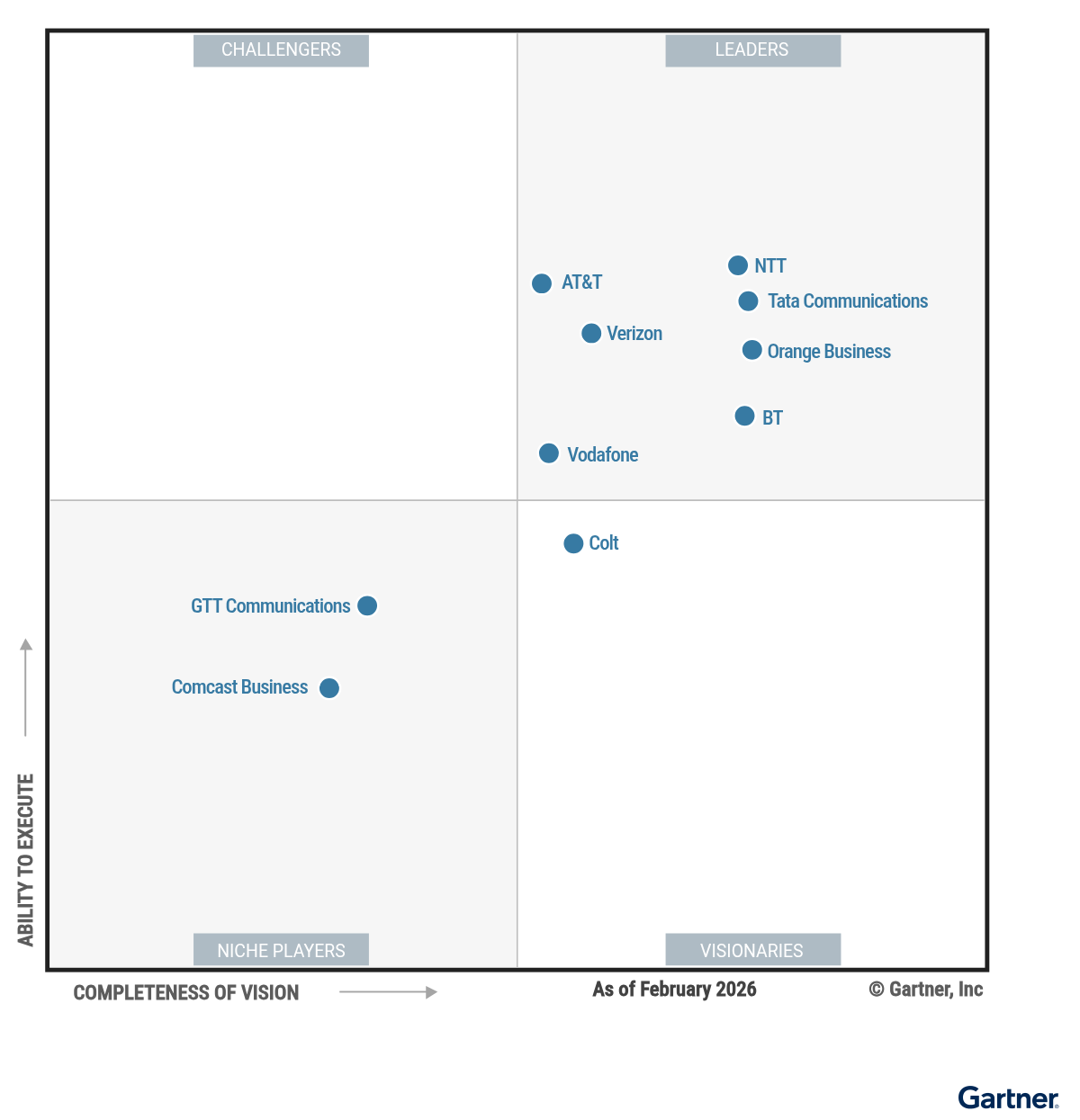
Vendor Strengths and Cautions
AT&T
AT&T is a Leader in this Magic Quadrant. It provides enterprise connectivity and managed network services globally. Headquartered in the U.S., it targets public sector clients and enterprises, with particular expertise in finance, manufacturing, transportation, retail and healthcare. Its operations are concentrated in North America, with significant reach in Europe and Asia/Pacific.
AT&T’s roadmap investments prioritize software-defined networking, enhanced security and AIOps for performance of fiber and fixed wireless access (FWA). AT&T is a strong fit for enterprises with global networking requirements, particularly those seeking services in North America and Asia/Pacific, where its WAN coverage is extensive.
- Security offering: AT&T’s managed security offerings include strong security policy management services supported by its partnership with LevelBlue. Its secure access service edge (SASE) products delivered in partnership with LevelBlue have widescale geographic availability.
- Pricing: The vendor’s global dedicated internet access (DIA) pricing is among the lowest of the service providers evaluated in this Magic Quadrant.
- Operations: AT&T has made key AI and automation enhancements to its global WAN service offerings, including AIOps upgrades for managed software-defined WAN (SD-WAN) and SASE offerings, improved dynamic local price quoting and AI agent workflows for change requests, customer contacts and service delivery date management.
- Cloud connectivity SLAs: AT&T’s cloud connectivity SLAs lag behind others in this research, lacking guarantees for packet loss, incident response and proactive notification of service issues.
- Innovation: AT&T’s service roadmap lacks innovations, such as quantum-safe encryption and data sovereignty, compared with other providers evaluated in this Magic Quadrant.
- Regional coverage: AT&T’s geographic coverage is weaker in Africa and the Middle East compared with other service providers in this Magic Quadrant. AT&T wavelength service offerings are only available in the United States.
BT
BT is a Leader in this Magic Quadrant. It provides connectivity and managed services to multinational corporations globally through BT International. Headquartered in the U.K., the vendor targets public-sector customers and multinational enterprises with vertical expertise in finance, manufacturing, logistics and retail. Its operations are concentrated in Europe and India, with a presence in North America, Asia/Pacific and the Middle East.
BT has made divestitures in vertical markets (BT Radianz, BT Federal in the U.S.) and domestic assets in France, Ireland, Italy, Spain and Latin America. This is part of a strategic shift to a platform business model that leverages Global Fabric and Global Voice and adds managed services. BT is well-suited for large enterprises that need secure global WAN and multicloud solutions.
- NaaS platform: BT has deployed a greenfield multiservice international core network (BT Global Fabric) designed as a network as a service (NaaS) platform, densely interconnected with leading hyperscaler locations, and present in approximately 700 data centers worldwide.
- Market understanding: BT demonstrates acute awareness of critical trends like data sovereignty and sustainability, designing its network specifically to route traffic based on geographic boundaries and carbon intensity.
- Pricing: BT offers highly flexible WAN pricing through a pay-as-you-go model, where the physical port is often free (for shared cloud ports) and customers can scale bandwidth up or down with high granularity.
- Sales execution: Strategic realignments and key ongoing investments in BT continue to concentrate the vendor’s commercial efforts in international markets on serving its existing customer base. As a result, the vendor is less focused on acquiring new customers during this transformative time.
- Offering: Within Global Fabric, critical components such as Layer 3 IP VPN over the fabric and intent-based routing are not scheduled for general availability until late 2026, meaning that early adopters are limited to internet-only use cases.
- Geographic coverage: BT has continued disposing of vertically focused units and international assets. Customers with operations in these industries and geographies should clarify with BT any potential impact to commercial and service support models.
Colt
Colt is a Visionary in this Magic Quadrant. It provides infrastructure and connectivity services to enterprise and wholesale clients. Its portfolio focuses on automation, NaaS, access aggregation and managed services. Based in the U.K., Colt targets MNCs and offers specialized solutions for data-intensive sectors such as hyperscalers and capital markets (via PrizmNet, its managed financial extranet). The vendor’s operations span Asia/Pacific, Europe and North America, reinforced by the Lumen EMEA acquisition.
Colt’s roadmap focuses on sovereign and AI-neocloud routing, carbon visibility, quantum-safe WAN and AI traffic optimization. Colt is well-suited for organizations that require high-bandwidth optical solutions and infrastructure control, particularly in Europe and Asia/Pacific.
- Pricing: Colt offers highly flexible commercial models, including hourly billing for ports and bandwidth, and no minimum term commitments on its NaaS portfolio.
- Market understanding: Colt shows deep insight into future enterprise needs, specifically targeting AI workload traffic, sovereignty and sustainability (carbon transparency features) as core product pillars.
- Expanded Tier 1 internet backbone: Following the acquisition of Lumen EMEA, Colt co-manages one of the world’s most connected Tier 1 internet backbones. This integration has significantly expanded their IP footprint and direct internet access offering.
- Geographic coverage: Colt does not have full-time WAN employees in Africa, Latin America and the Middle East, relying entirely on partners. This total dependence on third parties may reduce control in these regions and complicate support chains.
- Operations: In the past few months, Gartner clients have reported network reliability and operations support issues with Colt’s network more often than average. Customers assessing Colt for WAN services should ensure they secure strong SLA coverage from the provider.
- SLAs: Colt’s standard SLAs are less comprehensive than those of market leaders, lagging behind in commitments for proactive notification, monitoring availability and DIA performance.
Comcast Business
Comcast Business is a Niche Player in this Magic Quadrant. It provides connectivity and managed network services internationally, and U.S. mobile services through mobile virtual network operator agreements. Headquartered in the U.S., the vendor targets SMBs and global enterprises with vertical expertise in retail, hospitality, food/beverage, finance, manufacturing and healthcare. Its operations focus on North America, with smaller footprints in Asia/Pacific, Latin America and Europe.
Planned investments include quantum networking, AI-based optical amplifiers, agentic AI and network fabric technology for improved performance and energy efficiency. Comcast Business is a good fit for enterprises seeking connectivity in North America.
- Access aggregation: Comcast Business has relatively strong access aggregation in North America and Europe. It also works with a broad range of access aggregators in Europe, Asia/Pacific, Latin America and the Middle East.
- Quoting: Comcast can now provide instant multivendor quotes for global customers thanks to its acquisition of Nitel and integration of its AI-enhanced automated quoting platform.
- CSP availability: Comcast Business offers worldwide availability for interconnections to five top CSPs via exchanges, all of which support multiprotocol label switching (MPLS), Ethernet and wavelength connectivity options.
- Geographic strategy: In the Middle East and Africa, Comcast Business offers MPLS, internet, Ethernet, wavelength, SD-WAN and SASE services through exchange and NNIs only. Also, Comcast Business’ footprint in Latin America is limited.
- Limited SASE offerings: Comcast’s managed single-vendor SASE offerings are limited to two vendors (Fortinet and Cisco). Its SASE SLAs also are limited, with no guarantees for latency, jitter, packet loss, application performance or monitoring availability.
- Port speeds: Outside of Asia/Pacific, Europe and North America, Comcast’s maximum port speeds for MPLS, Ethernet and wavelength services are limited to a maximum of 10 Gbps.
GTT Communications
GTT Communications (GTT) is a Niche Player in this Magic Quadrant. It offers global connectivity and managed services via an asset-light, access aggregation model. Based in the U.S., it targets large enterprises with deeper expertise in hospitality, manufacturing, finance and the federal government. Its operations focus on Europe and North America, with more limited presence in all other regions.
GTT’s roadmap prioritizes digital experience via its GTT EnvisionDX platform, network-on-demand, self-service features, expanded wireless and low Earth orbit (LEO) options, enhanced cloud connectivity, and network expansion in Asia/Pacific and Latin America. GTT is a good fit for enterprises whose WAN coverage requirements are concentrated in Europe and North America.
- Access aggregation: GTT leverages a large ecosystem of more than 3,000 access partners to deliver connectivity in 170 countries across regions, including some hard-to-serve geographies. GTT owns a Tier 1 global IP backbone, ensuring that most of the client traffic remains on its network.
- Geographic strategy: The vendor has expanded its MPLS, DIA and Ethernet connectivity footprint in Asia/Pacific and Latin America to address limitations in these regions, with added presence in China, Malaysia, Thailand, South Korea, the Philippines, Argentina, Colombia and Chile.
- Operations: GTT has added AI and automation-driven features such as quote address validation via its EnvisionDX portal, automated virtual network function (VNF) activation and customer core router configuration.
- Cloud connect: Outside of North America and Europe, GTT’s cloud connectivity footprint is more limited than others in this Magic Quadrant, particularly in Africa. It does not offer cloud points of presence (POPs) in the Middle East and only resells wavelength connectivity in all regions.
- Connectivity SLAs: GTT’s standard SLAs for MPLS and DIA lag behind Leaders for availability, performance and service assurance. Prospective customers, therefore, must ask for and select GTT services with upgraded SLAs to ensure they meet business needs.
- Network on demand: GTT’s customers can burst their MPLS and DIA bandwidth to the full port capacity at the same price per megabit, but broader network on demand functionality is currently a roadmap item.
NTT
NTT is a Leader in this Magic Quadrant. It provides connectivity, managed networks and a global data center footprint. In Japan and a few other Asian markets, NTT has rolled out Layer 1 network — end-to-end optical (All Photonics Network) — that provides wavelength-based paths to deliver ultra-low latency and high-bandwidth to support AI traffic in data center interconnections. Headquartered in Japan, the vendor targets large enterprises and has deep expertise in manufacturing, automotive and healthcare.
The vendor continues to invest in its NaaS platform. Its roadmap also includes integrating predictive and agentic AI via a real-time digital twin for autonomous management. NTT is well-suited for MNCs requiring global connectivity and managed services across Asia/Pacific, Europe and North America.
- Operations: NTT is embedding predictive AI into its delivery and assurance process, including digital twins of customers’ networks, and is integrating agentic AI into its operations to automate complex workflows and reduce mean-time-to-repair.
- SLAs: NTT offers a unique formal SLA guaranteeing 99.9% availability for its customer-facing APIs, providing assurance for enterprises that rely on ITSM integration.
- Wide OEM ecosystem: NTT supports a wide ecosystem of SD-WAN partners, including Cisco, Fortinet, Palo Alto Networks, HPE Aruba Networking and four others. Also, it has expanded its SASE ecosystem by adding single-vendor options like Cato Networks and Netskope to its portfolio.
- Geographic coverage: NTT maintains a significantly smaller direct staff presence and network footprint in Latin America and the Middle East than in its core markets.
- Sales strategy: NTT has strategically repositioned MPLS so that it is no longer a stand-alone offering but rather a component within its broader NaaS framework, which may force customers seeking traditional, simple MPLS contracts into a more complex, platform-based engagement model.
- Service portal: NTT’s generative AI-powered chatbot for portal interactions is currently deployed for internal use only and is not available as a customer-facing function.
Orange Business
Orange Business is a Leader in this Magic Quadrant. It provides a broad portfolio of services spanning connectivity, cloud services and cybersecurity. Headquartered in France, the vendor has teams in 65 countries and network reach spanning over 200 countries and territories. Orange offers NaaS supported by Evolution Platform, built on SDN POPs and VNFs, and has started to gradually reduce its on-net MPLS footprint.
Investments target efficiency, enhanced performance and advanced threat protection through the use of open-source technologies, quantum-safe security and AI-driven autonomous operations. Orange is well-suited for global enterprises requiring scalable global WANs and, particularly in France, organizations with strict data-sovereignty requirements.
- Global network presence: Orange remains one of the global WAN providers with a broader network presence, including harder-to-reach regions like Africa and the Middle East.
- NaaS offering: Orange’s NaaS, Evolution Platform, allows customers to compose their network by chaining underlay connectivity and virtualized functions (SD-WAN, firewalls, cloud connect) via a service portal or APIs. The platform introduces a consumption-based commercial model for services like cloud connect and virtual network edge.
- European digital sovereignty: Orange articulates an offering of sovereign SASE (“trusted SASE”) and private access to sovereign clouds (like Bleu and S3NS) to ensure strict compliance with EU regulations. This architecture guarantees data residency and management within trusted jurisdictions.
- Regional coverage: Orange Business’ local teams, product capabilities and service levels vary significantly by region, with customers outside of Europe potentially receiving reduced sales engagement and support. Enterprises should verify service availability and support capabilities in their specific locations to ensure alignment with their needs.
- Service portfolio simplification: Orange Business is executing a major simplification and reduction of its service portfolio. Customers should request clear and timely communications about any changes or discontinuation of services, assess impact on their own operations, plan migrations and engage support teams.
- Operations: Orange Business is undertaking an ambitious multiyear transformation of its IT stack that supports services and operations. Orange Business customers should be aware of potential service impacts from migrating services to the new IT stack and demand appropriate remediation measures.
Tata Communications
Tata Communications is a Leader in this Magic Quadrant. It provides global connectivity and managed network services. Headquartered in India, it serves MNCs with particular vertical expertise in finance, manufacturing, retail, media and IT service providers.
Tata is investing in an AI suite for its cloud connect service to optimize visibility and performance in hybrid environments. The vendor also is investing in 800G wavelength technologies to support AI traffic in data center interconnects, and is developing managed Quantum Safe Encryption services. Tata is a strong fit for enterprises requiring global connectivity, particularly in Africa and Asia/Pacific, as well as a unified fabric that integrates deterministic routing, multicloud networking and security.
- Network on demand: The vendor’s network on demand offers more options than most providers evaluated in this Magic Quadrant, including Ethernet on demand, multicloud connectivity and a zero-based bandwidth option for temporary WAN links.
- Operations: Tata is utilizing AI, automation and digital twin technologies to model networks before implementation, significantly increasing its first-time-right deployment rate. Tata’s operation model also has been enhanced with automated tracking and escalation mechanisms.
- Market understanding: Tata demonstrates strong market insight, anticipating rapid AI adoption and proactively addressing the associated risks, such as unauthorized data uploads. By evolving its SASE offerings to protect against emerging AI-driven threats, Tata positions itself to align security solutions with market needs.
- Regional support: Tata’s headcount for WAN services is significantly lower in regions like Latin America and the Middle East than in India and Asia/Pacific.
- Vertical/industry strategy: Tata offers vertical-specific solutions for media companies, but vertical-specific needs in other industries are typically addressed by bundling horizontally focused products. Customers with highly demanding vertical-specific needs should ensure that Tata can deliver to expectations with measurable outcomes.
- Premium costs for enhanced support: Access to advanced capabilities such as proactive management KPIs, flexible severity matrices and enhanced change management requires purchasing a premium support package.
Verizon
Verizon is a Leader in this Magic Quadrant. It provides WAN services globally, integrating wireline connectivity with a strong U.S. wireless underlay and international mobile partners. For managed network services, it uses HCLTech. Based in the U.S., Verizon targets MNCs with greater reach in manufacturing, distribution, retail, life sciences and finance. Its network footprint is deeper in North America and Europe, and it uses aggregators to reach over 150 countries.
Verizon’s roadmap focus is on the AI Connect portfolio (wavelength/dark fiber), agentic AI for self-healing operations, LEO satellite connectivity and a software-defined NaaS platform. Verizon is well-suited for organizations requiring robust hybrid networking with 5G/satellite redundancy.
- Simplified global procurement: Verizon bundles up to 16 distinct products (including SD-WAN, security and cloud) under a single global contract. This framework is supported by a unified global NOC/SOC that offers flexible co-management, allowing enterprises to either fully offload operations or retain granular control.
- Product/service: Verizon’s AI Connect portfolio offers purpose-built 100G/400G wavelength and dark fiber routes designed to eliminate bottlenecks for massive AI model training and hyperscaler connectivity. This infrastructure supports bandwidth on demand, allowing enterprises to programmatically scale capacity for bursty AI workloads.
- Pricing: Verizon offers a differentiated commercial model that allows enterprises to pool bandwidth commitments across multiple international circuits to share capacity. This consumption-based structure minimizes overage fees and aligns costs with aggregate peak usage rather than fixed per-circuit commitments.
- Geographic strategy: Verizon’s geographic footprint includes few FTEs providing and selling WAN services in Africa and the Middle East, and with only a small number based in Latin America.
- Improvement rollouts limited: Several recent and planned enhancements to the WAN underlay have been U.S.-centric only, or with international rollout to come later. These include programmable networks with consolidated hardware for fewer points of failure on the next-gen IP backbone.
- Operations: Verizon is migrating its internal Hosted Network Services for network function virtualization (NFV) services entirely to AWS infrastructure. Customers utilizing Verizon’s proprietary platform for virtual network functions must plan for a mandatory architectural migration to this public cloud-hosted environment.
Vodafone
Vodafone is a Leader in this Magic Quadrant. It provides connectivity and managed services, and offers converged access blending fixed, 5G FWA and LEO satellites. Headquartered in the U.K., the vendor targets MNCs via Vodafone Business, with expertise in finance, manufacturing, retail, transport and logistics, and EU/U.K. public sector. Following divestments in Italy, Spain and other markets, its Group operations remain focused on Europe and Africa.
Vodafone’s roadmap prioritizes its NaaS platform supported on new POPs, sovereignty and quantum-safe security. It is investing in GenAI and agentic AI for automation. Vodafone is well-suited for enterprises requiring converged fixed/mobile connectivity, as well as strict data sovereignty, particularly in EMEA and Asia/Pacific.
- Product/service: Vodafone utilizes an expanding network of new POPs that host virtualized network and security functions delivering low latency to major public clouds. This architecture allows for the on-demand insertion of virtual services like firewalls and application optimization.
- SLAs: Vodafone enables bundling fixed, 5G FWA (with eSIM) and LEO satellite connectivity, stand-alone or with SD-WAN technology to offer up to 100% availability SLAs for small sites and branches.
- Market understanding: Vodafone identifies the increasing importance of sovereignty and enforceable geofencing, leveraging its strong foundation of local European subsidiaries (OpCos) to address these evolving market needs.
- Geographic strategy: Vodafone relies heavily on third-party aggregators and partners for access in North America and Asia/Pacific. Buyers should scrutinize service capabilities and SLAs in these regions, as they may differ from the performance guarantees of Vodafone’s on-net footprint.
- Operations: Vodafone operates as a federation of local operators (OpCos) rather than a single global entity, which can result in variations in service experience and delivery consistency across different countries. Global customers must ensure the “Lead Market” governance model provides sufficient control and accountability for sites located outside of their contract’s originating region.
- Offering: Vodafone is discontinuing its HPE Juniper Networking SD-WAN offering and making adjustments to its SD-WAN support model, indicating a period of portfolio consolidation. Customers should validate the long-term roadmap of their chosen technology stack to avoid the risk of disruptive forced migrations during their contract term.
Vendors Added and Dropped
We review and adjust our inclusion criteria for Magic Quadrants as markets change. As a result of these adjustments, the mix of vendors in any Magic Quadrant may change over time. A vendor's appearance in a Magic Quadrant one year and not the next does not necessarily indicate that we have changed our opinion of that vendor. It may be a reflection of a change in the market and, therefore, changed evaluation criteria, or of a change of focus by that vendor.
Added
Comcast Business
Dropped
No vendors were dropped from this Magic Quadrant.
Inclusion and Exclusion Criteria
To qualify for inclusion, providers must:
- Demonstrate global network reach and coverage for both private and public WAN services:
- Must own a core backbone network, composed of MPLS and internet in Asia/Pacific, Europe and North America regions at a minimum, while Africa, Latin America and the Middle East are desirable. Providers must operate their own global core backbone with a minimum number of POPs in all three major regions. “Ownership” requires that the provider own the rack and the equipment/Border Gateway Protocol (BGP)/etc., versus a lease arrangement.
- Must offer and include access as part of the solution (bring your own access [BYOA] solely offered does not meet inclusion criteria). WAN services must include end-to-end SLAs, regardless of access provider.
- Must have physical MPLS POPs in a minimum of five different cities in each of the following geographic regions: Asia/Pacific, Europe and North America. These POPs can be located either in owned or leased buildings or in colocation facilities. Providers must fully identify where POPs are located for inclusion.
- Must have physical internet POPs in a minimum of 10 different cities in each of the following geographic regions: Asia/Pacific, Europe and North America. These POPs can be located either in owned or leased buildings or in colocation facilities. Providers must fully identify where POPs are located for inclusion.
- Must offer broadband access services (minimum 100/10 megabits per second) that are either inherent to the provider’s core WAN offerings or offered in a resale model in all three major regions (Asia/Pacific, Europe and North America).
- Must offer 4G/LTE and/or 5G cellular WAN access connectivity in each region (Asia/Pacific, Europe and North America) either directly or through partners for a comprehensive offering.
- Offer a WAN service customer portal for its enterprise private and public WAN services. Providers’ online service portals should give customers a view into provider performance, and offer visibility into network operations and performance to support service modifications and verify SLAs for key performance metrics.
- Offer managed SD-WAN services globally with a minimum of five physical SD-WAN gateways in five different cities in each of the following major geographic regions: Asia/Pacific, Europe and North America, from at least two different vendors.
- Have a minimum of five physical SASE nodes in five different cities in each of the following geographic regions: Asia/Pacific, Europe and North America. These nodes may be self-owned, via partner SASE services, or resold third-party security service edge services. Further, the provider must offer both single- and dual-vendor SASE options and support at least four of the following functions: SD-WAN (with or without embedded security functions), secure web gateway, cloud access security broker, network access control and network firewalling (with or without an intrusion detection system/intrusion prevention system).
- Have a minimum of five physical cloud interconnect nodes to the three leading cloud providers (Amazon Web Services, Google Cloud Platform and Microsoft Azure) in the three major regions (Asia/Pacific, Europe and North America), either directly or via third-party exchanges.
- Have a minimum of five access aggregation nodes in each of the following geographic regions (Asia/Pacific, Europe and North America), and these must include fiber, DIA, DSL/wireline broadband, and optional FWA 4G, 5G and LEO/Geostationary Earth Orbit (GEO) services based on either owned or third-party access services.
- Operate their own global network services (rather than simply reselling the services of other global or regional network providers) and provide last-mile connectivity in all three major regions (Asia/Pacific, Europe and North America). They must also have availability in at least one of the following areas: Latin America, the Middle East or Africa.
- Demonstrate active global sales activity by having signed at least one new contract (signed in the last 12 months) for global enterprise network services in each major region (Asia/Pacific, Europe and North America) as a net-new account for global WAN services. These should include provisioned sites in a minimum of three of these six regions (Africa, Asia/Pacific, Europe, Latin America, Middle East and North America).
Evaluation Criteria
Ability to Execute
Gartner analysts evaluate WAN service providers on the breadth of their network service portfolio in terms of features, quality and processes to deliver the services. These criteria enable service providers’ performance to be competitive, efficient and effective, and to improve revenue, retention and reputation in Gartner’s view of the market.
Product or Service: Gartner evaluates the ability to offer a broad range of network services, including breadth of WAN services, managed SD-WAN and SASE services, cloud connectivity, NaaS, network on demand and virtualized services. We consider offering capabilities and differentiation across service breadth, vendor support, global reach and consistency, competitive SLAs, service portals and APIs, and use of AI and automation.
Overall Viability: Viability includes an assessment of the vendor’s overall financial health, as well as its financial and practical success and the likelihood that the individual business unit will continue investing in the overall portfolio of services.
Sales Execution/Pricing: We evaluate the vendor’s capabilities in all presales and sales activities and the structures that support them. This includes deal management, pricing options, contract negotiations, presales support and the overall effectiveness of sales channels.
Market Responsiveness/Record: We look at the vendor’s ability to respond, change direction, be flexible and achieve competitive success as opportunities develop, competitors act, customer needs evolve and market dynamics change. This criterion also considers the vendor’s history of responsiveness to changing market demands.
Marketing Execution: We evaluate the clarity, quality, creativity and efficacy of programs designed to deliver the vendor’s message to influence the market, promote the brand, increase awareness of offers and establish a positive identification in the minds of customers. This mind share can be driven by publicity, promotions, thought leadership, social media, referrals and sales activities.
Customer Experience: This criterion assesses how customers view this provider and the quality of customer experience delivered. The key components in this category are the provider’s portal, service support responsiveness for enterprise customers (regardless of size or industry), customer feedback and SLA quality. We also evaluate providers’ use of AI and automation for enhanced customer experiences.
Operations: This criterion refers to the ability of the service provider to meet delivery commitments globally. Factors include quality of the organizational structure, skills, experiences, programs, systems, partnerships and other vehicles that enable the vendor to operate effectively and efficiently, such as AI and automation.
Ability to Execute Evaluation Criteria
| Evaluation Criteria | Weighting |
|---|---|
Product or Service | High |
Overall Viability | Medium |
Sales Execution/Pricing | High |
Market Responsiveness/Record | High |
Marketing Execution | Low |
Customer Experience | High |
Operations | High |
Source: Gartner (March 2026)
Completeness of Vision
Gartner analysts evaluate vendors on their ability to convincingly articulate logical statements. This includes current and future market direction, innovation, customer needs and competitive forces, and how well these map to Gartner’s view of the market.
Market Understanding: This criterion assesses whether the vendor can drive or influence the direction of the market through development of roadmaps and offerings. It also looks at whether providers are focusing on building their core competencies with strategic enhancements, or if they are investing in random technologies.
Marketing Strategy: We assess whether the vendor’s messaging and marketing campaigns effectively communicate how it differentiates in functionality and value proposition. We also evaluate whether the issues communicated meet the trends in the market and the needs of end users, and whether they communicate a vision of the future of information and communication technology (ICT) and the provider’s role in it.
Sales Strategy: This criterion evaluates whether the vendor has a sound sales strategy, including direct and indirect sales, marketing and communications. We also evaluate whether the vendor has partners that extend the scope and depth of its market reach, expertise, technologies, services and customer base.
Offering (Product) Strategy: We evaluate whether the current and planned future offerings meet buyers’ needs now with differentiated functionality and how the vendor will do so in the future. We also evaluate whether the provider is building additional features and expanding the offers that buyers are seeking, or if it is lagging behind in this area. In addition, we look at whether the vendor is anticipating the issues that the buyer will face and allocating resources to address them. Specific items we assess include, among others, WAN underlay services innovation, access diversity, cloud connectivity services evolution and managed SD-WAN and SASE services.
Business Model: This criterion assesses whether the design, logic and execution of the vendor’s business proposition demonstrate the ability to achieve continued success, along with evaluating whether the business model meets the needs of the target market and enables the provider to grow.
Vertical/Industry Strategy: We evaluate whether the provider’s strategy, dedicated resources, skills and offerings meet the specific needs of different vertical industries. In the network service market, we assess whether the vendor can differentiate itself with services that are specifically developed for the unique requirements of targeted verticals, such as healthcare, logistics, manufacturing, retail, hospitality and others.
Innovation: This criterion looks at what the provider does to address the future requirements of network services, including the need for product breadth, additional vendor support, AI and automation investments, consistent portals, and ubiquitous offerings globally to solve clients’ business problems. We also assess what innovations the provider invests in to successfully differentiate its products and offerings to address customer requirements, both now and two to five years out.
Geographic Strategy: We look at whether the provider’s strategy to direct resources, skills and offerings meets the specific needs of geographies outside its “home” or native geography, as well as assessing if the provider meets the needs of global enterprises for product and support.
Completeness of Vision Evaluation Criteria
| Evaluation Criteria | Weighting |
|---|---|
Market Understanding | High |
Marketing Strategy | Low |
Sales Strategy | Medium |
Offering (Product) Strategy | High |
Business Model | Medium |
Vertical/Industry Strategy | Low |
Innovation | High |
Geographic Strategy | High |
Source: Gartner (March 2026)
Quadrant Descriptions
Leaders
Providers in the Leaders quadrant are performing well and maintaining a stable organization, with a clear vision of the market direction. They deliver comprehensive portfolios of quality network services across the broadest geographies. They address the global networking needs of a broad range of enterprises in terms of size, geographic distribution and vertical industry. Leaders shape the direction of the market by extending their coverage, developing new class-leading capabilities and commercial models, and deploying them at scale.
Challengers
Challengers are strong in execution globally, but narrower than Leaders in their vision for taking market leadership. They focus more on established network services and geographies, and are typically followers of the market innovations created by Leaders and Visionaries.
Visionaries
Visionaries have market-leading plans for the future in terms of geographic and network service innovation. However, their current capabilities are not class-leading in terms of scope and/or quality.
Niche Players
Providers in the Niche Players quadrant may focus on a particular segment of the market, as defined by characteristics such as size, vertical sector, geographic coverage or technology, and they may be strong providers for those requirements. However, they are shorter in capabilities to address the needs of the broader range of enterprises and do not show a vision to shape the direction of the market.
Context
A reliable, agile, secure and high-performing WAN is critical to support enterprise business operations. Digital business initiatives, particularly with the emergence of AI workloads and autonomous agents, place increasing demands on the enterprise network to ensure reliability, low latency and massive data ingestion. Enterprises struggle to design and operate networks to support dynamic business requirements, including autonomous operations, accelerated digital and cloud transformations, and hybrid work.
Internet managed by SD-WAN continues to be the predominant offering for new network deployments and major refreshes, but SASE adoption is growing to secure blurred enterprise network perimeters. Service providers are adding managed SASE offerings that integrate SD-WAN with security packages, including firewall, cloud access security broker (CASB), secure web gateway (SWG) and zero-trust network access (ZTNA), and often additional security services (such as data loss prevention [DLP], remote browser isolation [RBI], managed detection and response [MDR] and extended detection and response [XDR]). Meanwhile, service providers continue to invest in the virtualization of network edge functions, particularly using nodal NFV, NaaS platforms and networking capabilities that stitch together disparate cloud environments into a unified fabric.
Client adoption of these new capabilities, however, has been limited so far. In a context of growing geopolitical risk and data-sovereignty regulations, Gartner sees enterprises relocating workloads to sovereign or regional clouds, and several network service providers (NSPs) are building sovereignty-first network propositions. Also, Gartner predicts postquantum cryptography protections will be required by 2030 (see Postquantum Cryptography: Why You Need to Be Ready by 2030).
Enterprises with global networking needs have the option to work with a single global network provider or to use different providers in various regions (for example, choosing one provider for Asia/Pacific and another for Europe). Using multiple regional providers often results in better price and performance compared with relying on just one global provider, but it does make vendor management more complex. Organizations can select from managed, co-managed or unmanaged network service options, and now have more flexibility to source underlay transport services separately from overlay SD-WAN and security. This approach is especially beneficial for customers that prefer their WAN transport sourced regionally while using a global provider for overlay network management.
When it comes to pricing, the downward trend that has prevailed for years is changing, depending on services and markets, with more moderate price declines, or even price increases for some services, such as MPLS. Still, since there are no standard price lists in this market, enterprises should use competitive bidding and strong negotiation strategies to secure the best pricing, favorable SLAs and flexible contract terms.
Market Overview
Gartner forecasts that the market for enterprise fixed data networking services in 2026 will exceed $132 billion, an increase of 2.4% from 2025 and a 2.5% compound annual growth rate (CAGR) in constant currency from 2024 through 2029.1 Although the number of global network service providers that qualified to be included in this research is limited, many more providers are operating in the broader market, including aggregators, smaller or regional providers, and new alternative network backbone providers (see Market Guide: Private Connectivity for Cloud Services, Global). The market also includes pure-play managed service providers that own little or no network infrastructure but resell network services to enterprise customers.
Network as a Service
NSPs are building out NaaS platforms to deliver more agile and flexible services that emulate cloud commercial and delivery models. Typically, these platforms support near real-time, on-demand modifications to underlay connectivity services, and a choice of cloud connect and optional network-hosted networking and security functions. Although depth and breadth of services are still limited in most providers’ NaaS platforms, these capabilities are the cornerstone of NSPs’ strategies to support demanding and variable cloud and AI workload traffic. To that aim, NSPs are preparing these NaaS platforms to integrate with enterprise IT and network estates through APIs, and enlarging the ecosystem of destinations and technologies offered. In addition, NSPs continue to invest in data analytics, AI/machine learning (ML) and automation for service agility, quality and cost-efficiency in network operations. Automated processes tend to speed tasks such as new circuit provisioning, configuration and activation. AI and ML upgrades to network monitoring and management systems support faster detection of network traffic anomalies and potential security issues. NSPs gradually are incorporating generative AI and agentic AI into their network processes, although they remain at early stages and have not yet realized their full potential.
Underlay Network Transport Trends
Gartner sees enterprises continuing to prioritize internet-based connectivity, with DIA and broadband increasingly serving as the default choice and often replacing MPLS. Internet connectivity allows direct access to SaaS and other internet-centric sites, and can be sourced from multiple providers, while MPLS typically must be sourced from a single provider. To support resilience and agility, FWA — including 5G cellular and LEO satellite as a new option — is being introduced as a backup connection to primary wireline, as a primary connection in areas where wireline alternatives or pop-up locations are limited. Gartner estimates that enterprise internet service spend will grow globally at a 3.3% five-year CAGR in constant currency from 2024 through 2029,1 while spending on MPLS will decline at a 7.6% CAGR over the same period.
Although enterprise spending on MPLS is in decline, MPLS is not obsolete. It remains a preferred option for niche use cases such as connecting legacy on-premises applications, meeting strict security requirements, or ensuring reliability in regions where internet performance is poor, such as parts of Latin America, Africa and Asia/Pacific. Also, some clients still prefer MPLS as the primary link for critical locations, such as between a traditional data center and a cloud provider. MPLS offers high availability and stable performance benefits, depending on the geography and port size, but is priced at a premium compared with equivalent dedicated internet services. Meanwhile, Ethernet and wavelength services are gaining ground to address private WAN requirements, offering reliability, low latency and high bandwidth necessary to support data center interconnects and emerging AI workloads.
Consequently, modern WAN architectures rely heavily on the internet, supplemented by a smaller volume of high-capacity private connections. Despite this evolution, NSPs have not fully kept up, and most still have deployed MPLS POPs in considerably more countries than dedicated internet.
This shift to internet connections also brings additional challenges not found in private MPLS networks. These include the risk of suboptimal routing and congestion due to oversubscription by some ISPs as the traffic traverses multiple providers. Geopolitical context and regulatory compliance requests may also generate routing requirements that basic internet services do not satisfy, such as avoiding certain jurisdictions. There are several ways of overcoming this, including:
- Sourcing all internet services from a single provider.
- Sourcing from federations of ISPs that offer controlled routing among their members.
- Network-based SD-WAN gateways terminating the SD-WAN tunnels and passing the traffic over the provider’s backbone.
- Enhanced internet services optimizing routing through an ISP’s backbone or using overlay routing on top of the public internet (for example, Anapaya and Teridion).
- Evaluating service providers to ensure their internet POP footprint matches local access needs and verifying potential oversubscription levels as well as historic performance.
More NSPs rely on colocation facilities (such as Digital Realty and Equinix) to host some or all of their POPs instead of owning or leasing facilities. To ensure greater resiliency, clients working with providers that use POP colocations should verify that the carrier partners with multiple, diverse colocation providers within each market.
No provider has last-mile, on-network connectivity throughout the world. NSPs rely on local access providers for last-mile connections, and the degree of automation for ordering, installation, changes and trouble resolution can vary widely depending on the combination of global and local providers in each country. Gartner advises clients to request specific information on this, especially for sites of medium- to high importance. Higher levels of automation typically lead to more reliable performance and are often reflected in the specifics of SLAs.
Enterprises’ rapid adoption of cloud services is foundational to WAN architecture transformation. In response, global NSPs have expanded their cloud connectivity offerings (see Market Guide: Private Connectivity for Cloud Services, Global). All providers in this Magic Quadrant offer private cloud connect services to the top three CSPs (Amazon Web Services, Google Cloud Platform and Microsoft Azure) directly from their MPLS and Ethernet networks, through third-party exchanges, or combining both for greater reach and/or location diversity. The key differentiators are the number of individual cloud providers and cities where interconnections have been preestablished, and the ability to add virtualized services (such as security) into the cloud connection points. Some NSPs have added software-defined cloud interconnect capabilities to their offerings. These software-defined cloud interconnect (SDCI) services typically allow for capacity adjustments and the addition of new cloud endpoints on demand via a portal or API control. Gartner estimates that enterprise spend on cloud connect services will grow globally at an 18.1% five-year CAGR in constant currency from 2024 through 2029.1
Overlay Network Trends
Today, global WAN proposals are predominantly based on managed SD-WAN services, typically featuring either a hybrid architecture that combines MPLS and internet underlay links, or leveraging exclusively internet-based connectivity. Global NSPs commonly present a portfolio encompassing three to five SD-WAN vendors to accommodate client preferences and requirements. However, NSPs supporting a broad variety of SD-WAN vendors — five or more — often have limited integration with some or all of those vendors. In this case, there is limited incremental value when selecting these NSPs for SD-WAN management versus working with alternative over-the-top managed network service providers.
Many NSPs and SD-WAN providers (such as Aryaka and Cato Networks) now offer network-based SD-WAN gateways, allowing for easier SD-WAN migration, improved scalability and streamlined integration with third-party entities such as CSPs. These gateways connect internet access with the provider’s higher-quality, long-haul backbone network infrastructure, significantly improving reliability and performance. As an alternative, enterprises can use stand-alone, enhanced internet backbone services on ISP federations. Managed SD-WAN offerings typically include the option of direct local internet breakout at each site, which is particularly useful for access to SaaS applications such as Microsoft 365, Salesforce, Webex by Cisco, Zoom and many others. This approach avoids tromboning effects in SaaS traffic routing, reducing latency and minimizing potential performance degradation. In addition, a “coffee shop networking” approach is emerging for cloud-first enterprises; this architecture leverages lightweight SD-WAN or no SD-WAN and internet-only connections to support distributed users accessing cloud workloads directly. This minimizes reliance on complex on-premises hardware.
Perimeter security can be provided on-site or as a cloud-based service, and increasingly delivered with SASE services. Enterprise overlay strategies are consolidating, with SD-WAN increasingly viewed as a functional component within broader SASE platforms rather than a stand-alone technology. While many organizations still use dual-vendor configurations, the market gradually will shift toward single-vendor SASE platforms to unify management consoles and simplify security policy enforcement. Consequently, global WAN service providers continue to enhance their managed SASE offerings, leveraging either dual-vendor or single-vendor best-of-breed platforms. This approach eliminates the need for enterprises to service chain and orchestrate SD-WAN with network security functions, simplifying management and, usually, offering better overall performance due to less complexity. However, NSP SASE-specific SLAs are highly variable and can differ significantly depending on the chosen SASE vendor. Currently, organizations opting for these services from NSPs are motivated primarily by convenience rather than superior solutions. It is important to note that this convenience often comes with a higher price point.
To support hybrid work models, universal zero trust network access (uZTNA) is gaining traction, extending consistent identity-based access controls to both remote users and on-premises campus environments. Furthermore, integrated digital experience monitoring (DEM) and advanced observability have become standard requirements to ensure application performance and rapid root cause analysis across these complex, encrypted overlay fabrics.
Infrastructure delivery continues to evolve through the use of network function virtualization. Network functions such as edge routing, SD-WAN, security, WAN optimization and visibility can be delivered through traditional dedicated, built-for-purpose on-site appliances, but also are increasingly available as uCPE-based or POP-based virtual network functions. Universal CPE employs x86 whitebox hardware to run multiple vendors’ software instances, such as combining Arista (VeloCloud) routing with Palo Alto Networks security. Given the level of feature interaction between multiple software vendors, this option is most often offered as a managed service. Some providers also give customers the flexibility to run their own software, including edge compute applications, on SD-WAN appliances and uCPE devices. In contrast, POP-based VNFs run in the provider’s network infrastructure, allowing for rapid deployment of network functions and easier changes. These are typically consumed as a service, with a per-function monthly subscription fee. Common examples of VNFs include virtual session border controllers (vSBCs), performance monitoring and security functions.
Operational Trends
The complexity of global WANs continues to rise, particularly as organizations integrate a mix of MPLS and internet transport, cloud endpoints, different backbone options, and technologies such as SD-WAN and NFV. In addition, the shift to the internet, especially using broadband or cellular access, inherently yields less predictable service than MPLS or Ethernet. To address these challenges, enhanced visibility solutions — often termed performance analytics — are increasingly critical as they empower enterprises to monitor real-time network and application performance. In response, NSPs have strengthened their offerings with sophisticated performance reporting tools and portals that offer enterprises improved visibility at both the network and application layers and, in some cases, observability and DEM. Nevertheless, while these visibility enhancements provide valuable operational intelligence, they do not immediately translate into improved performance SLAs, which continue to fall short of evolving enterprise expectations and requirements.
Increased use of AI and ML is another key operational trend. NSPs seek to improve service responsiveness and quality as well as their cost base by leveraging AI and ML to streamline processes across the entire life cycle, including in design, ordering, provisioning, monitoring and billing. Some have made progress in integrating network AI assistants, backed by generative AI and ML, to support mostly Day 0 and Day 1 operations via conversational, natural language chat interfaces.
A major nascent trend is the shift toward agentic NetOps, in which autonomous AI agents handle operational tasks with minimal human intervention. While GenAI is rapidly being adopted for initial configuration (Day 0 and Day 1) tasks, the industry is poised for a transformation in Day 2 operations, where agents will autonomously detect and resolve incidents (see AI Will Transform Managed Network Services in the Next Three Years). Currently, providers with higher levels of automation are achieving better “zero-touch” first-contact resolution rates, distinguishing themselves from those still reliant on manual engineering resources.
NSPs continue to strive to reduce installation and service activation lead times, but their progress is often limited by timelines imposed by third-party or local access providers. Advancements in cellular data speeds have enhanced the viability of mobile solutions as an effective interim option for rapid deployment until permanent, fixed infrastructure is established. In addition, cellular connectivity provides a truly diverse backup option and, eventually, a primary connection for temporary locations and areas with poor wireline infrastructure. However, when considering 5G cellular for fixed connectivity replacement, enterprises must be mindful that coverage and SLA gaps remain.
Sourcing Trends
Providers are shifting their focus toward providing the managed network service overlay platform, typically using SD-WAN and, increasingly, SASE. These services are usually offered through cloud-native platforms but also can be delivered, though less frequently, using NFV/uCPE solutions. All providers in this Magic Quadrant support BYOA and flexible sourcing for underlay transport, but they still prefer bundling transport services to maintain revenue. In addition, many enterprises continue to source connectivity directly from their overlay provider to centralize accountability, especially when using a mix of MPLS and internet access.
Global WAN service providers are evolving toward software-based network services that emphasize visibility and self-service via portals and APIs. NaaS offerings are maturing gradually, allowing customers to consume bandwidth, SD-WAN ports and VNFs on a short-term subscription basis rather than three- to five-year fixed contracts. These on-demand capabilities allow companies to flex networking resources up for seasonal peaks or short-term projects and scale down afterward, aligning network costs directly with business usage. However, enterprise adoption remains limited (see NaaS Transformation of Enterprise WAN Backbone).
Gartner continues to observe ongoing enhancements in provider agreements, particularly concerning provisions for termination in cases of persistent noncompliance, enforceable on-time delivery assurances, and more rigorous obligations for proactive communication and prompt execution of change requests. A provider’s responsiveness and flexibility in negotiating terms and conditions frequently serve as key differentiators during the vendor-selection process.
Managed Service Trends
Most NSPs deliver global WANs as a managed service, typically supplying and managing on-site devices such as SD-WAN and security appliances alongside the underlay transport. While the majority of enterprises still source transport links directly from their overlay provider to ensure complete operational responsibility, there is increasing demand for carrier-agnostic support, particularly for internet and hybrid network designs.
The binary choice between fully managed and do-it-yourself (DIY) is disappearing. The dominant sourcing model is now co-management, in which the provider handles the heavy lifting (patching, hardware logistics, 24/7 monitoring), while the enterprise retains granular control over security policies and routing rules via a self-service portal. This hybrid approach gives enterprises greater agility without heavy operational burden. Co-management options vary by provider and are usually not priced substantially less than fully managed offers.
Gartner sees a trend of technology vendors integrating more sophisticated agentic NetOps capabilities into their products. This trend holds the potential to further disrupt the market as autonomous AI agents handle more complex network operations and management tasks. Over time, this capability may prompt some enterprises to shift budgets away from traditional managed services and back toward AI-enabled DIY models (see Why Agentic NetOps Will Move Enterprises Away From Managed Network Services).
1 Forecast: Communications Services, Worldwide, 2023-2029, 4Q25 Update.
Gartner developed this research based on the following sources of information:
Gartner developed this research based on the following sources of information:
- Gartner client inquiry data on network services that was collected over a 12-month period. This includes more than 5,200 Gartner client inquiries on the topic of enterprise network services.
- Analyst-reviewed Gartner Peer Insights data for this market.
- Provider responses to detailed questionnaires, as well as a demo of their portals.
- Periodic provider briefings.
- Generally available information, news and data in financial and industry publications.
Ability to Execute
Product/Service: Core goods and services offered by the vendor for the defined market. This includes current product/service capabilities, quality, feature sets, skills and so on, whether offered natively or through OEM agreements/partnerships as defined in the market definition and detailed in the subcriteria.
Overall Viability: Viability includes an assessment of the overall organization's financial health, the financial and practical success of the business unit, and the likelihood that the individual business unit will continue investing in the product, will continue offering the product and will advance the state of the art within the organization's portfolio of products.
Sales Execution/Pricing: The vendor's capabilities in all presales activities and the structure that supports them. This includes deal management, pricing and negotiation, presales support, and the overall effectiveness of the sales channel.
Market Responsiveness/Record: Ability to respond, change direction, be flexible and achieve competitive success as opportunities develop, competitors act, customer needs evolve and market dynamics change. This criterion also considers the vendor's history of responsiveness.
Marketing Execution: The clarity, quality, creativity and efficacy of programs designed to deliver the organization's message to influence the market, promote the brand and business, increase awareness of the products, and establish a positive identification with the product/brand and organization in the minds of buyers. This "mind share" can be driven by a combination of publicity, promotional initiatives, thought leadership, word of mouth and sales activities.
Customer Experience: Relationships, products and services/programs that enable clients to be successful with the products evaluated. Specifically, this includes the ways customers receive technical support or account support. This can also include ancillary tools, customer support programs (and the quality thereof), availability of user groups, service-level agreements and so on.
Operations: The ability of the organization to meet its goals and commitments. Factors include the quality of the organizational structure, including skills, experiences, programs, systems and other vehicles that enable the organization to operate effectively and efficiently on an ongoing basis.
Completeness of Vision
Market Understanding: Ability of the vendor to understand buyers' wants and needs and to translate those into products and services. Vendors that show the highest degree of vision listen to and understand buyers' wants and needs, and can shape or enhance those with their added vision.
Marketing Strategy: A clear, differentiated set of messages consistently communicated throughout the organization and externalized through the website, advertising, customer programs and positioning statements.
Sales Strategy: The strategy for selling products that uses the appropriate network of direct and indirect sales, marketing, service, and communication affiliates that extend the scope and depth of market reach, skills, expertise, technologies, services and the customer base.
Offering (Product) Strategy: The vendor's approach to product development and delivery that emphasizes differentiation, functionality, methodology and feature sets as they map to current and future requirements.
Business Model: The soundness and logic of the vendor's underlying business proposition.
Vertical/Industry Strategy: The vendor's strategy to direct resources, skills and offerings to meet the specific needs of individual market segments, including vertical markets.
Innovation: Direct, related, complementary and synergistic layouts of resources, expertise or capital for investment, consolidation, defensive or pre-emptive purposes.
Geographic Strategy: The vendor's strategy to direct resources, skills and offerings to meet the specific needs of geographies outside the "home" or native geography, either directly or through partners, channels and subsidiaries as appropriate for that geography and market.