Predicts 2026: Toward an AI-First Finance Function
22 December 2025 - ID G00841845 - 20 min read
By Marco Steecker, Brian Stickles, and 10 more
Progressive CFOs are seeking AI value beyond undifferentiated efficiency gains in routine finance operations. This research explores four medium-range predictions for how AI-first finance functions will disrupt the status quo in finance talent, financial planning, the controllership and ERP.
Overview
Key Findings
- Fifty-nine percent of finance leaders expect the level of function AI spend to increase by 10% or more in 2026. This increase is primarily driven by the need to improve efficiency, support decision making, and enable new finance capabilities.1
- AI implementation and adoption requirements are prompting CFOs to focus investment away from upskilling basic technology users and toward building more sophisticated technical capabilities within their already digitally literate workforce.
- AI-enabled simulation is enabling the integration of forecasting, scenario planning, and decision making into a singular predictive planning and budgeting approach.
- AI’s ability to facilitate automation and extract insights from large quantities of data is leading CFOs to set goals for their transactional processes (e.g., AR, AP, etc.) to not only be touchless, but also sources of frontline business insights.
- Cloud ERP vendors are embedding AI assistants (a subset of agentic AI technology) to orchestrate end-to-end finance processes, speed up the financial close and improve audit readiness. Early adopters report substantial efficiency and data governance gains, yet must weigh possible short-term vendor lock-in against long-term flexibility, positioning themselves for a competitive advantage as finance shifts to higher-value activities.
Recommendations
- Pilot AI agents to automate more complex finance and organization-specific workflows that are not currently automated within established finance systems and platforms.
- Rebalance finance’s talent composition through the hiring of dedicated data science and AI roles in finance (for example, developers, data scientists, data engineers, and AI and automation experts) and mitigating the attrition of nondigital staff.
- Focus organization attention on data through a holistic evaluation of the strengths and weaknesses of current data structures, locating and addressing integration and governance gaps and boosting quality control in anticipation of accelerating pilots and scaling deployments.
Strategic Planning Assumption(s)
- By 2028, 20% of finance organizations will stop hiring and developing nondigitally literate talent and allocate all talent-related investments toward advanced digital capabilities.
- By 2029, 40% of FP&A teams at large enterprises will deploy AI-enabled simulation to replace bottom-up manual financial planning, up from 5% today.
- By 2029, 30% of finance teams will primarily deploy AI in transactional processes for predictive risk and revenue insights, having maximized available efficiency gains.
- By 2028, finance organizations using cloud ERP applications with embedded AI assistants will drive a 30% faster financial close.
Analysis
What You Need to Know
Table 1
Source: Gartner (December 2025)
As of mid-2025, 59% of finance teams reported using AI tools for finance-specific use cases, roughly in line with 2024 observations.2 While the stability of these adoption percentages may suggest that forward momentum for AI in finance is slowing, the truth is more nuanced and arguably better seen as a short pause or reset between waves.
Early adopters, who started with AI automation of routine rule-based finance processes, such as cash application and account reconciliation, now see that impact as a basic requirement. Forward progress will require laying the groundwork to pursue new, differentiated value through an expanding variety of AI tools and applications ahead of a second burst of adoption in the next several years.
This time frame will mark a significant divergence in finance AI maturity, wherein a subset of organizations will separate themselves from peers by positioning artificial intelligence at the core of addressing every business challenge and opportunity (see Figure 1). These “AI-first” finance functions will distinguish themselves by:
- Reshaping their workforce to ingrain AI capabilities in daily tasks.
- Using AI-enabled simulations in financial planning.
- Deriving always-on insights from transactions.
- Leveraging AI assistants to orchestrate ERP workflows.
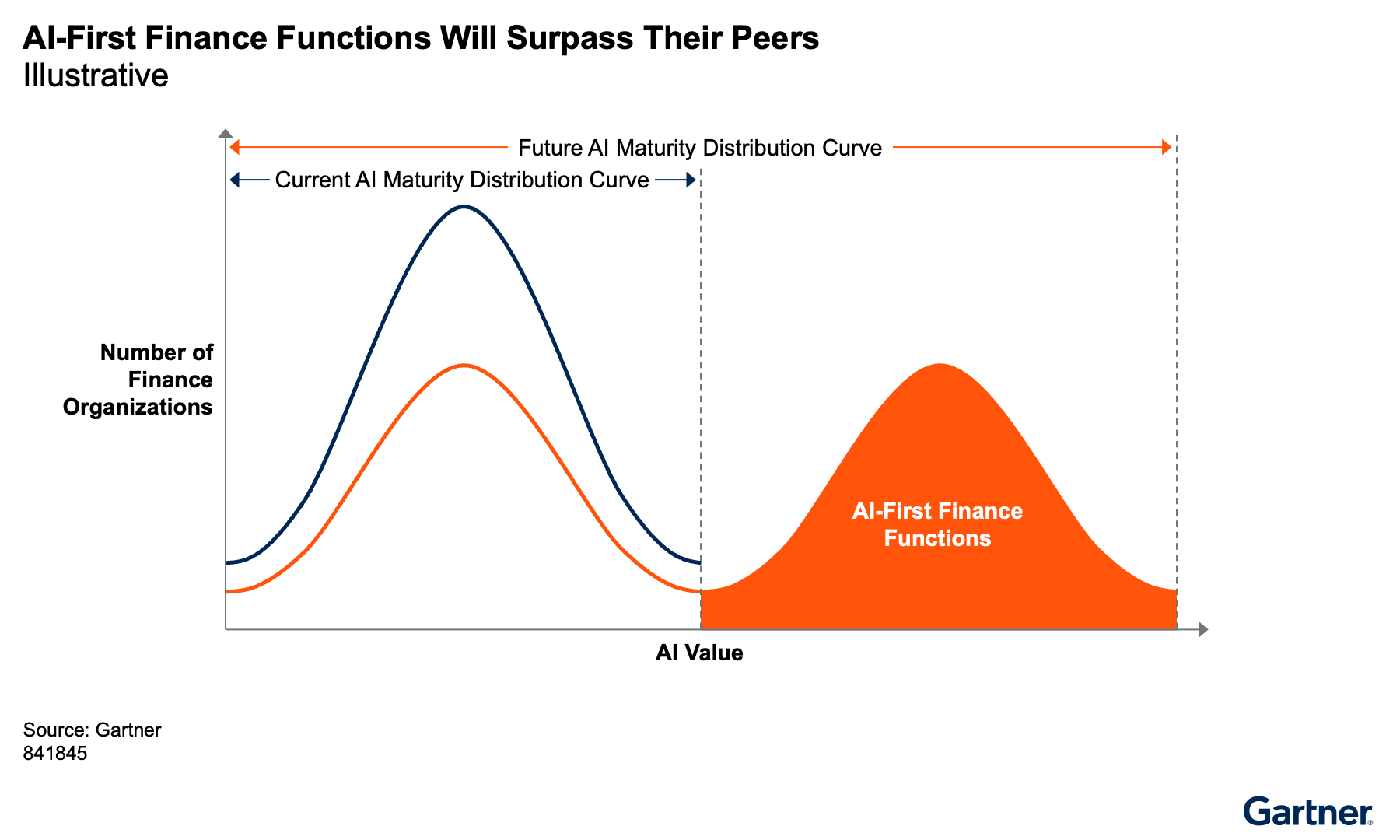
AI’s composite and additive nature will drive this phenomenon; though each new AI solution on the market may appear unique, it is a product of evolution and synthesis. For example, agentic and causal AI are already combining with (and building upon) legacy AI techniques, such as generative AI and machine learning, to create novel capabilities.
AI-first finance functions, with ample experience deploying more traditional forms of AI, will find these emerging innovations incrementally easier to absorb and will have a head start building the organizational capability to leverage them. They will accelerate and continually learn from their experiences with AI, pushing their horizons ever forward into new and more innovative capabilities.
Meanwhile, those who have yet to start may find themselves overwhelmed with the pace of AI innovation, potentially to the point of paralysis. There is still time to catch up, but the barriers to progress will become increasingly steep as leaders break away.
This report explores four compelling predictions for the next 3 to 5 years from Gartner’s finance experts that will help CFOs anticipate the direction and pace of change necessary to fully embrace an AI-first future.
Strategic Planning Assumptions
Strategic Planning Assumption: By 2028, 20% of finance organizations will stop hiring and developing nondigitally literate talent and allocate all talent-related investments toward advanced digital capabilities.
Analysis by: Emily Connelly, Hilary Richards, Marco Steecker
Key Findings:
- Finance is currently composed of three broad categories of staff:
- Basic technology users who perform recurring tasks using provided technologies (50% of finance staff).
- Digitally literate and advanced technology users with the expertise required to leverage available technologies’ more advanced capabilities (35% of staff).
- Digital talent who modify and produce new digital capabilities for finance and enterprise (15% of staff).
- Finance needs significantly more digital talent, as a lack of data science and AI skills is cited by finance leaders as the second biggest challenge to achieving their AI goals.2
- Finance’s most basic technology users are not developing at the pace finance leaders require, lacking the aptitude and attitude to advance past basic digital literacy.
- Leading CFOs are concentrating hiring efforts and development resources only on employees with the necessary aptitude and attitude to meet the function’s digital skills targets.
- Finance staff who are not upskilling to learn AI are being managed out or naturally attriting, while large layoffs of basic technology users is mostly a rare occurrence.
Market Implications:
AI serves as one of the greatest catalysts for finance to fundamentally reshape its workforce. It enables finance to produce better insights while simultaneously reducing headcount to control costs. As AI becomes a dominant tool for executing and orchestrating finance processes, most transactional roles will either be eliminated or redesigned. Remaining roles will require digitally savvy individual contributors, technologists and managers whose contributions to the finance systems environment will be held to a higher standard.
The CFOs who are able to navigate this transition will oversee teams that build new or modify existing technology capabilities, integrate data and create new, scalable decision-support tools. It will not be easy to achieve this future state, as most CFOs are still searching for greater clarity on required skills and the ideal scope of new roles. Finance functions also lack comprehensive development programs for making finance subject matter experts proficient in data engineering, data management and model building. These challenges must be addressed to kick-start finance’s transformation.
Finance functions that continue to invest in training employees who have not yet become digitally literate will find themselves without adequate resources to develop the digitally savvy talent required to meet their ambitions. They will either have to spend even more to hire talent with the necessary skills or increase spending on contract labor and consultants to support automation and technology development.
Recommendations:
- Set digital development performance objectives. Identify employees’ digital development gaps and specific skills to acquire as part of annual performance goals. Align development goals to match the timing of AI deployment within staff’s workflows.
- Regularly reassess digital talent needs. Given that roles tied to pre-AI processes may be retained until the workflow changes, CFOs should reassess roles and hiring needs semiannually in conjunction with the deployment of new AI initiatives or updates to the technology roadmap.
- Structure on-the-job development opportunities. Create a digital employee development program that promotes on-the-job experimentation with tools, delivers microlearning modules tied to real finance tasks and nominates digital champion peer mentors.
- Target hiring for necessary digital skills. Prioritize hiring for dedicated technology roles in finance, such as developers, data scientists, data engineers, and AI and automation experts with proficiency beyond what can be effectively developed in the department.
Related Research:
Strategic Planning Assumption: By 2029, 40% of FP&A teams at large enterprises will deploy AI-enabled simulation to replace bottom-up manual financial planning, up from 5% today.
Analysis by: Matthew Mowrey, Brian Stickles, Ash Mehta
Key Findings:
- CFOs rank improved forecast and analysis accuracy as the second most important driver of AI adoption. Yet only 18% of organizations realize this benefit,2 highlighting a clear opportunity for new solutions to better align forecasting, scenario planning and decision making.
- Early adopters of AI-enabled simulations in finance are already generating explainable event-driven forecasts and scenarios and using them to optimize strategic business decisions.
- Vendors are fast-tracking development of new AI-powered solutions specifically designed to support integrated financial planning, such as automated machine learning and analytics, and business intelligence platforms.
- Organizations are accelerating the integration of financial, operational and external data sources to address critical data sourcing and lineage barriers that would otherwise hobble AI-enabled simulation.
Market Implications:
The rise of AI-enabled simulation will fundamentally transform FP&A and shift the competitive landscape. Early adopters (representing less than 4% of finance teams today) are already using simulation to generate real-time, event-driven forecasts and rapidly model the financial impact of market shifts, regulatory changes and geopolitical events.3
As more finance teams race to embrace these tools, they will enable data-driven decisions at speed and deliver step-change improvements in budgeting, planning agility, forecast accuracy and market responsiveness. In contrast, finance teams that rely on manual, spreadsheet-based processes risk slower decision making, missed opportunities and diminished stakeholder confidence. Over time, the gap between digital leaders and everyone else will widen with implications for market share, investor perceptions and talent attraction.
The vendor ecosystem is evolving rapidly to meet growing demand, with established players and new entrants launching sophisticated AI-powered planning platforms. Vendors will differentiate themselves through features such as AI explainability, integration with operational and external data sources, scalability and robust security. Recent survey data shows that 30% of finance organizations aim to boost spending on big data analytics and autoML — key technologies that underpin simulation-based planning.4 New partnerships among finance organizations, technology providers and consulting firms will emerge to support companies’ pursuit of broader digital transformation agendas.
The success of AI-enabled simulation will ultimately depend on modernizing the data architecture and improving data accessibility. Early adopters with well-integrated data platforms have already generated actionable scenarios, while others remain hampered by fragmented systems and inconsistent data. To close this gap, CFOs must invest in data infrastructure, system integration and strong data governance, working closely with IT and analytics teams to ensure transparency and compliance.
Organizations will need to address ethical considerations, such as ensuring the responsible use of AI and mitigating model bias, to build stakeholder trust in simulation as a foundational financial planning capability. Those that successfully navigate these challenges will be better positioned to deliver integrated, data-driven insights to the business, communicate more effectively with investors and demonstrate resilience in the face of market disruptions.
Recommendations:
- Make probabilistic thinking the default. Develop a targeted upskilling plan for FP&A teams that emphasizes data science, statistics and scenario modeling skills. Empower finance professionals to apply probabilistic approaches, work with multiple scenarios and effectively leverage simulation tools for integrated forecasting and decision making.
- Build the foundation for AI simulation. Enhance simulation processes by (1) establishing a scalable and well-integrated data architecture that ensures data quality, accessibility and interoperability across systems, and (2) developing driver-based machine learning models that leverage internal and external data sources.
- Redesign planning workflows. Automate as many spreadsheet-driven tasks as possible, for example, adopt accessible time-series and linear forecasting methods, implement event-based scenario planning instead of traditional case-based approaches.
- Partner with technology vendors. Use in-depth demos to gain more tangible knowledge of how AI-enabled simulation platforms deliver event-driven, real-time planning before pursuing limited-scope POCs and pilots. Lean on vendor deployment expertise to accelerate integration, early adoption and refinement before scaling to wider use.
Related Research:
Strategic Planning Assumption: By 2029, 30% of finance teams will primarily deploy AI in transactional processes for predictive risk and revenue insights, having maximized available efficiency gains.
Analysis by: Tamara Shipley, Renata Viana, Twisha Sharma
Key Findings:
- Eighty-five percent of all finance leaders name greater efficiency or productivity as their top goal when pursuing AI Furthermore, two-thirds of those with use cases in production report that it is the top realized benefit.2 The most frequently adopted AI use cases associated with efficiency gains are accounts payable (AP) process automation (43%), account reconciliations (32%) and accounts receivable (AR) process automation (27%).
- Suppliers of AP, AR and financial close and consolidation (FCC) solutions are focusing innovation and product development efforts on composite AI, automated and assisted AI agents and industry-specific use cases that will help finance derive better insights from their transactional data.
- The convergence of traditional AI and advanced analytics underscores the predictive power of AI and is shifting leadership focus away from rote efficiency gains toward enhanced financial risk management, revenue optimization and actionable insights in key process areas:
- AP: Optimizing cash flow and working capital for revenue insights; analyzing payment timing risk; predicting invoice errors; detecting fraudulent and duplicate invoices.
- AR: Predicting the risk of customer nonpayment, blocked orders, the validity of customer claims and the likelihood of keeping payment promises; recommending changes to customer credit limits; reviewing contracts to generate billing and revenue schedules.
- Close and consolidation: Recommending journal entries based on historic data; predicting risk exposure based on financial insights and macroeconomic data before they impact the P&L.
- Organizations that delay or fail to pursue predictive risk and revenue insights through AI do so at their own risk. Consequences could include loss of cost competitiveness, weakened operational agility and diminished support of business growth.
Market Implications:
AI’s integration into transactional processes, such as AP, AR and close and consolidation, enables faster and more accurate financial operations, as well as broader enterprise impact through the proactive mitigation of risk and identification of new revenue opportunities.
Finance organizations with longer histories deploying traditional AI in these processes will find that eking out incremental efficiency gains, driving out costs or resolving process errors simply will not return similar levels of value as before. These teams want to move beyond traditional productivity-focused value and instead seek out new upside measures to capture the full value of what finance, assisted by AI, can deliver back to the business.
Additionally, CFOs will rewrite finance’s relationship with key software providers. They will partner closely and critically to review the promised ROI of prepackaged industry models, as well as the under-the-hood setups of more sophisticated AI deployments touching on comprehensive activities ranging from data ingestion to ongoing learning and optimization.
In one marker of this shift, AI-first CFOs will increasingly pressure-test the data governance, risk and control practices that are insufficient in current form to address emerging risks and use cases. First, can AI offerings meet explainability and auditability requirements when generating predictive risk outcomes and revenue insights? Second, can technology providers offer real clarity on how data is governed?
For example, when source information such as customer or vendor invoices contain sensitive commercial data that underpin competitive advantages, CFOs will demand to understand where and how this data is being modeled and transformed to generate new insights. The market will then need to “prove it” to gain traction, resulting in a virtuous cycle of sorts. The most successful vendors at meeting these expectations will be rewarded with more durable partnerships with the most critical, sophisticated customers, as they work together to continue driving AI value forward.
Recommendations:
- Accelerate investment in AI-driven predictive risk management and revenue insights. Initiate targeted investments in pilots focused on forward-looking risk forecasts and working-capital recommendations to help build momentum for broader AI adoption.
- Redefine success metrics. Establish new KPIs that measure value from AI use cases related to the types and amounts of risk identified and avoided, new revenue identified and realized and the accuracy of AI-driven predictions. Sample metrics might include:
- Revenue leaks mitigated (i.e., the total value of credits, bonuses and recoveries triggered by AI-flagged contract clauses, billing audits or performance thresholds).
- Compliance breach frequency (i.e., the prevalence of findings of noncompliance in contracts, communications or reports).
- Implement robust AI governance. Determine whether the governance frameworks offered by vendors to monitor AI performance, validate model outputs, and ensure compliance meet evolving regulatory standards.
- Press vendors on insight generation capabilities. Conduct a comprehensive review of the AI capabilities, innovation roadmaps and proven outcomes of both incumbent and emerging technology vendors aligned with key transactional processes. Request in-depth visibility and hands-on demos to vet predictive analytics functionality and AI governance transparency, ensuring that desired finance capabilities match the finance’s tech roadmap.
Related Research:
Strategic Planning Assumption: By 2028, finance organizations using cloud ERP applications with embedded AI assistants will drive a 30% faster financial close.
Analysis by: Mike Helsel, Alex Levine, Aharon Logue
Key Findings:
- Embedded AI assistants in cloud ERP applications redefine financial close automation by acting as orchestrators that coordinate the activities of simple agents responsible for handling discrete tasks, exceptions and aggregation.
- AI assistant adoption is nascent but accelerating, with most automation capabilities tightly embedded in vendor ecosystems. Organizations must weigh a desire for quick automation benefits and the avoidance of vendor lock-in against maintaining long-term flexibility.
- Early deployments show that embedded AI assistants can accelerate cloud ERP adoption; organizations with strong data quality, mature processes and effective change management are achieving a faster financial close and improved audit readiness.
- Leading cloud ERP vendors are expanding the scope and sophistication of embedded AI assistants in the financial close, with a focus on specific cloud offerings and customer segments.
Market Implications:
Embedded AI assistants in ERP applications enable CFOs to orchestrate the discrete contributions of simple and specialized agents in delivering end-to-end process automation within a multiagent framework. These assistants can initiate actions, automate routine tasks and connect insights across the cloud ERP application via seamless integration. However, the ability of these assistants to centralize process oversight and provide transparent, auditable records does not negate the need for clear human-in-the-loop mechanisms.
As cloud ERP applications evolve and adoption of embedded AI accelerates, CFOs will face both acute integration challenges and increased difficulty distinguishing between market hype and proven vendor capabilities backed by customer success stories. Finance staff may also resist or reject emerging capabilities as new AI-driven workflows disrupt established routines and sow future role uncertainty. These challenges underscore the criticality of good change management techniques to build trust in emerging functionality and realize the full value of AI-driven automation. Upskilling, fostering a culture of continuous improvement and clearly communicating new responsibilities will build the engagement and impact of finance teams.
Finance organizations using embedded AI assistants for orchestration within their ERPs will see measurable improvements in financial close durations, cycle time predictability and a reduction in manual processes. As embedded AI becomes a standard feature, durable competitive advantage will accrue to those that can tailor, integrate and continuously adapt AI capabilities to fit their unique business models, data assets and talent strategies.
Most applications remain tightly bound to proprietary vendor environments, which limits interoperability and complicates migration or integration. While ERP vendor investment in partner enablement and low-code tools is growing, end-user configurability is still limited — a constraint CFOs must factor into plans. The relationship between ERP applications and point solutions for transactional processes such as AP and AR will become more dynamic and interconnected. Functional capabilities, including advanced interoperability, standardized open APIs and enhanced modular architecture support, will extend across the enterprise.
Recommendations:
- Diagnose current capabilities. Evaluate cloud ERP applications for embedded AI capabilities, prioritizing those with autonomous close orchestration backed by current customer success stories and data. Seek vendor solutions that support the assistant-as-orchestrator model, where process-specific assistants coordinate multiple agents to deliver end-to-end process automation.
- Evaluate openness and configurability. Prioritize cloud ERP applications that offer robust APIs, support for data portability and end-user configuration of AI-driven workflows. This reduces reliance on vendor or partner expertise, mitigates vendor lock-in risk and ensures flexibility as business needs evolve.
- Emphasize transparency. Prioritize cloud ERP applications that deliver AI capabilities with robust audit trails and explainability. Select solutions validated in live production environments to achieve compliance and mitigate risk.
- Prioritize data quality. Define stewardship roles and policies that ensure reliable finance data. Combine these with regular audits, automated profiling and improved master data management to quickly resolve inconsistencies and enhance process accuracy downstream.
Related Research:
A Look Back
In response to your requests, we are taking a look back at some key predictions from previous years. We have intentionally selected predictions from opposite ends of the scale — one where we were wholly or largely on target, as well as one we missed.
This report is too new to have on-target or missed predictions.
1 2026 Gartner Budget and Headcount Changes in Finance and the Enterprise Survey. This study was conducted to understand how budgets and spending are changing in 2025. The research was conducted online from September through October 2025 among 303 respondents across multiple industries and geographies. Respondents were CFOs or other senior finance leaders (including heads of financial planning and analysis, controllers, and finance transformation leaders). Disclaimer: The results of this study do not represent global findings or the market as a whole, but reflect the sentiment of the respondents and companies surveyed.
2 2025 Gartner AI in Finance Survey. This survey was conducted to understand the level of AI planning, adoption and investment within the finance organization and the most frequent and most valuable AI use cases for finance. The survey also sought to identify the most significant and unexpected barriers to AI success and to capture lessons learned from early AI adopters. The survey was conducted from May through June 2025 among 183 respondents across North America, EMEA and Asia/Pacific. The questionnaire required the respondents to have certain job roles, such as CFO, financial planning and analysis leader, or transformation leader, and to have at least some involvement or responsibility in decision making about finance function technology. Disclaimer: The results of this survey do not represent global findings or the market as a whole, but reflect the sentiments of the respondents and companies surveyed.
3 2024 Gartner Financial Planning Software Utilization Survey. This survey was conducted online from 2 April through 15 April 2024 to better understand how clients are using financial planning software. In total, 45 people participated, with 15 members sourced from Research Circle (a Gartner-managed panel) and 30 from an external research panel. Members from North America (n = 18), EMEA (n = 21) and Asia/Pacific (n = 6) responded. Disclaimer: Results of this survey do not represent global findings or the market as a whole, but reflect the sentiments of the respondents and companies surveyed.
4 2024 Gartner Finance Technology Landscape (Bullseye) Survey. This survey was conducted to understand finance teams’ technology portfolios and investment strategies. Data from finance technology experts was gathered from August through October 2024 from 383 responding organizations headquartered across the globe. Respondents represent key industries, with 67% of organizations reporting more than $1 billion in revenue. Disclaimer: The results of this survey do not represent global findings or the market as a whole, but reflect the sentiment of the respondents and companies surveyed.