Magic Quadrant for Content Marketing Platforms
2 April 2026 - ID G00832406 - 38 min read
By Jeff Cohen, Rene Cizio, and 1 more
Content marketing platforms orchestrate asset production with automated workflows focused on planning, creating, managing and measuring content to drive engagement, acquisition and efficiency. CMOs can identify vendors capable of scaling their content needs with generative and agentic AI.
Strategic Planning Assumptions
By 2028, over 90% of vendors offering GenAI and agentic AI capabilities will lead with outcome- and consumption-based pricing models.
By 2029, at least 50% of day-to-day work decisions will be made autonomously through agentic AI.
Market Definition/Description
Gartner defines content marketing platforms (CMPs) as software solutions that support the end-to-end content production process. These solutions facilitate creating and curating text, video, images, graphics, audio, e-books, white papers and interactive content assets that are distributed through paid and owned channels. These assets are used to tell connected stories that help brands engage with and nurture multiple audiences with content that drives awareness, demand, purchases and loyalty.
CMPs enable the fundamentals of content marketing — specifically, content strategy, editorial planning, creative workflow, distribution and performance measurement — to drive a coordinated approach and standardized production process at scale.
CMPs collect and analyze data to inform content creation and reuse, streamline operations and iterate on content to improve marketing effectiveness. These platforms can also generate branded iterations of content for different audiences using artificial intelligence and human creators. They enable internal teams, external contributors and agencies involved in content creation to coordinate efforts across projects and campaigns.
As a result, CMPs help connect content marketing efforts to business objectives across channels, ensuring organizational alignment and broad scope for managing content. CMPs also drive iterative content improvements, including capabilities to evaluate and test operating models and governance to drive collaboration across siloed teams. This supports faster time to market at scale.
Many CMP vendors complement their software with optional services, such as content strategy development, editorial services, creative marketplaces, and training to drive adoption and utilization.
Mandatory Features
- Content strategy
- Editorial planning and calendarization
- Creative workflows and approvals
- Content distribution
- Metadata or unstructured data management
- Content performance measurement
- Integrations
Common Features
- Generative AI content creation and AI-augmented workflows
- Modular, structured content creation and management
- Creative talent marketplaces and content sourcing
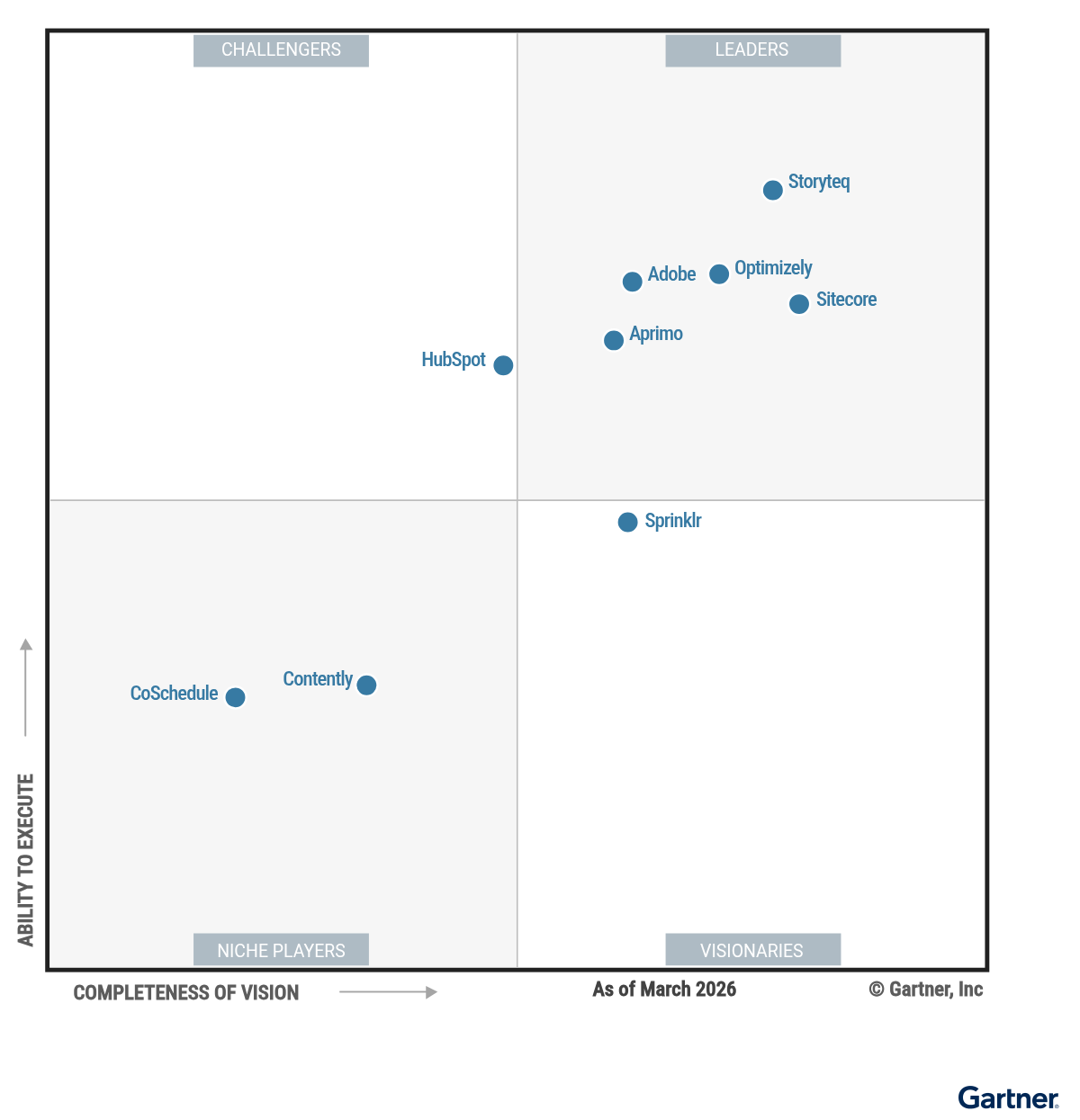
Magic Quadrant
Vendor Strengths and Cautions
Adobe
Adobe is a Leader in this Magic Quadrant. Its GenStudio supports content planning, workflow, creation, delivery and reporting within its Creative and Experience clouds. Adobe’s operations are global, serving enterprise customers in high tech, consumer packaged goods (CPG), retail and financial services. Recently, Adobe released Agent Orchestrator with out-of-the-box AI agents that can be incorporated directly into content and marketing workflows. The company also expanded Firefly GenAI capabilities for high-volume creative work and released Adobe Content Analytics to assess performance. Its roadmap includes conversational assistants to manage tools, agents and orchestrated workflows; and brand intelligence to ensure AI-generated content is on-brand and commercially safe. AI credits are purchased annually, are usable across the Adobe ecosystem and can be replenished as needed.
- Real-world examples: Adobe targets executives with real-world examples that demonstrate how combining creative and planning tools into a single system solves actual business problems. This approach helps large enterprise CMOs by giving them customer approaches for reducing manual work, cutting costs and speeding up their asset production, instead of just selling them software features.
- Enterprise understanding: Adobe demonstrates strong market understanding by identifying how large enterprises struggle to balance the pressure of AI-driven content velocity with mandates for brand safety, compliance and digital provenance. This translates to product releases and upgrades that are in tune with fast-evolving marketing requirements.
- Experience proof points: Adobe experiences the challenges faced by its customers by using its software to run complex global campaigns and sharing those results. This helps large organizations by providing them with recognizable use cases to better navigate the B2B buying process and speed up their adoption.
- Complex product offering: Adobe GenStudio relies on product integrations across its broader ecosystem, including Creative Cloud, Firefly, Workfront and AEM Assets, to serve the operational complexity and scale of large enterprise environments. Without Adobe guidance, it can be challenging for organizations to determine product needs.
- Implementation experience varies by region: Adobe has a large global implementation partner network, though experience with full GenStudio implementations is more established in North America than in some other regions. Prospective buyers should evaluate regional market maturity, local partner readiness and available support resources when planning GenStudio deployments.
- Multiapplication pricing: Adobe does not publish GenStudio list pricing, similar to its approach with other products. Prospective buyers should negotiate carefully with sales to navigate tiers of user licenses and product editions across multiple applications. GenStudio is a collection of applications and not yet a distinct product, creating transparency issues. While GenStudio product SKUs are expected in 2026, published prices are not.
Aprimo
Aprimo is a Leader in this Magic Quadrant. Its Digital Asset Management (DAM) platform provides all CMP functionality and offers composable modules for advanced functionality. Aprimo’s operations are mostly focused in North America and EMEA, and its clients are enterprise businesses in healthcare, financial services, retail and manufacturing. Recent enhancements include specialized agents that orchestrate tasks and act on behalf of users, and intelligent content briefs allowing AI agent-human collaboration. Aprimo’s roadmap focuses on composable AI agent architecture to automate workflows, and on scaling intent-based content personalization following its Personify XP acquisition. Foundational AI is included in the platform’s base price and advanced GenAI features are sold as add-on modules.
- Composable ecosystem architecture: Aprimo’s API-first architecture allows marketers to integrate Aprimo into diverse, best-of-breed technology stacks. These include headless content management systems (CMS), product information management (PIM) systems, and digital experience platforms. This flexible, universal content hub helps organizations avoid vendor lock-in and connect to Aprimo’s broader marketing ecosystem.
- External content insights: Aprimo offers advanced Content Intelligence, with proprietary machine learning models to analyze how content performs against specific audience behaviors. Marketers can conduct automated content gap analyses, predict the impact of new assets and receive prioritized next-best-action recommendations on which content to build, personalize or retire to drive ROI.
- Dynamic delivery: Aprimo programmatically creates scalable content variants to meet scale demands. It uses generative AI, modular content blocks and automated compositing to deliver localized, channel-specific and personalized variations of master assets via its content delivery network. This enables real-time dynamic media transformations (autocropping and format optimization) and intent-based personalization.
- CMP capabilities require add-ons: Aprimo’s core identity and base subscription are rooted in DAM. Customers must purchase optional, separate add-on modules to achieve advanced end-to-end functionality, such as marketing work management, strategic campaign planning, financial/budget management and real-time content personalization.
- Enterprise-level complexity: Because Aprimo requires comprehensive configuration, including custom taxonomy mapping, metadata schema design and workflow building, marketing teams seeking a swiftly deployable out-of-the-box CMP may find Aprimo too resource-intensive and heavy for immediate needs.
- Dependence on third-party integrations: Aprimo’s composable, API-first architectural philosophy allows it to act as a central hub. But it relies heavily on third-party platforms to execute the last mile of content marketing. Downstream execution, such as social media publishing or web content management, requires integrating the platform with tools like social media management or dedicated headless CMS providers.
Aprimo declined requests for supplemental information or to review the draft contents of this document. Gartner’s analysis is therefore based on other credible sources.
Contently
Contently is a Niche Player in this Magic Quadrant. Its Enterprise CMP combines editorial services with AI creation and a global freelance network to support enterprise organizations working at scale. Contently serves B2B enterprises primarily in healthcare, financial services, high tech, and travel and hospitality. It has expanded its AI capabilities with AI Studio, orchestrating multiple out-of-the-box agents to research, create, fact check and optimize assets. Large language model (LLM) optimization adds strategy consultation, content recommendations, channel distribution plans, and enhanced brand visibility tracking and measurement across major LLM platforms. Information about Contently’s roadmap was not available. Contently includes AI capabilities, with no credits or tokens needed.
- Ensures human-in-the-loop AI: Contently’s CMP offers add-on editorial services, which functions as the human-in-the-loop, reviewing AI-generated content assets at every step. It also provides direct access in the platform to a global marketplace of over 165,000 creators, enabling rapid scale, human-based content production.
- Fully embedded LLM optimization: Contently’s AI Search/LLM Optimization is embedded throughout the platform to ensure brand content ranks prominently in emerging AI search interfaces such as ChatGPT and Google AI Overviews. This empowers enterprises to maintain visibility and establish authority as LLMs become the new gatekeepers of content discovery.
- Regulated-industry-focused solutions: Contently’s focused vertical approach enables it to tailor its platform and workflows to the regulatory needs of industries like finance, healthcare and technology. Its distinct market strength in financial services allows customers to achieve faster onboarding and more consistent results because the solution is built around their specific challenges.
- Lagging in AI adoption: Contently’s product lags behind rapidly shifting market expectations, particularly as competitors accelerate innovation and expand capabilities quickly. Its recent release of AI Studio and LLM Optimization represents its recent market adaptation and may limit addressing emerging customer needs quickly.
- Complex pricing: Contently’s overall pricing is quote-based, requiring buyers to navigate a four-component structure that combines platform access with negotiated content funds held for creative freelancers, optional creative services and tiered business adoption packages. Organizations seeking a straightforward, predictable software license may face budget unpredictability and procurement friction.
- Uncertain strategic direction: Contently’s marketing strategy, anchored in a rapid AI pivot, can signal it is layering new technology onto an older, services-dependent model. This mix of AI tools bundled with managing editors and freelancers creates an incoherent platform for enterprise buyers looking to clearly move ahead with AI capabilities.
Contently declined requests for supplemental information or to review the draft contents of this document. Gartner’s analysis is therefore based on other credible sources.
CoSchedule
CoSchedule is a Niche Player in this Magic Quadrant. Its CoSchedule Marketing Suite is a stand-alone marketing calendar-based content and social media solution. CoSchedule operates primarily in North America and EMEA, and serves small and midsize B2B organizations primarily in high tech, healthcare, education, financial services, and travel and hospitality. Recent enhancements include campaign assistance for cross-channel coordination and social media suggestions, branded AI image creation and an expanded AI prompt library with over 1,600 industry-specific prompts. The company’s roadmap focuses on AI-powered calendars with its assistant to help plan, organize and execute. CoSchecule includes all AI capabilities without additional credits or tokens required.
- Consistent market responsiveness: CoSchedule’s frequent platform updates and major new releases, such as Insights Dashboard and Social Inbox, ensure its roadmap meets SMB and midmarket shifting customer and market needs. Mobile-first publishing and expanded social analytics embedded directly into the solution enhance the user experience and provide marketing teams with actionable data.
- Unified product offering: CoSchedule’s Marketing Suite centralizes marketing calendars, social media management, content workflows, AI-powered insights and digital asset management into a unified platform. For enterprise marketers, this consolidation reduces operational complexity, improves cross-team alignment and accelerates execution by providing a single location for planning, scheduling, collaboration and performance measurement.
- Financial stability: CoSchedule has been consistently profitable while supporting B2B organizations. It has registered strong customer growth and is committed to future platform investments.
- Undefined sales approach: CoSchedule’s sales strategy doesn’t demonstrate a commitment to an ideal customer profile or clearly target specific buyer roles. It positions its suite as a “single source of truth” to a marketing team. This suggests a challenge to navigate complex enterprise buying committees or fully understand the nuanced operational needs of large marketing organizations.
- Vertical strategy: CoSchedule does not provide product adaptations for specific vertical industries, relying instead on serving all enterprise buyers with a single solution. The only public-facing industry information available consists of customer case studies from the technology, education, healthcare, and services sectors.
- SMB-focused customer experience: CoSchedule’s customer experience infrastructure is tailored for small and midsize businesses and lacks proven experience with complex, multibrand enterprise deployments. It lacks enterprise-grade standards, with limited business-hour support, while also lacking a robust customer advisory board, diverse global client use cases and transparently priced enterprise services.
CoSchedule declined requests for supplemental information or to review the draft contents of this document. Gartner’s analysis is therefore based on other credible sources.
HubSpot
HubSpot is a Challenger in this Magic Quadrant. Its HubSpot for Marketers bundles its Marketing Hub and Content Hub to create personalized content experiences with customer data stored in its CRM. HubSpot operates in North America, EMEA and APAC, with small and midsize clients in high tech, manufacturing and financial services. It recently released AI-based brand identity features, a native video platform and Marketing Studio — a collaborative AI workspace to generate briefs, recommend assets and create content. HubSpot’s roadmap includes answer engine optimization (AEO) capabilities, embedded agents to automate campaign orchestration, and tools to identify and engage buying groups. It includes limited monthly credits for AI and automated workflows, with the option to buy additional credits.
- New marketing framework: HubSpot has built its marketing strategy around its Loop Marketing framework, a human-plus-AI playbook designed to counteract downward trending traffic and leads. It demonstrates the value of the playbook by amplifying its message through an omnichannel media ecosystem of podcasts, creator programs and customer events. The primary components of the framework (e.g., build awareness, influence deals, scale marketing) guide HubSpot’s product development direction.
- Transparent, bundled pricing: HubSpot for Marketers is an enterprise bundle of Marketing and Content Hubs. Bundle pricing is discounted, with additional fees based on users and contacts in the customer’s database. Its web-based pricing calculator helps estimate pricing. Each plan includes a set number of consumption credits that reset monthly, with additional credits available to buy.
- LLM connections: HubSpot has expanded its technology partnerships, allowing customers to use their own LLMs to ask natural language questions of their HubSpot customer data, and update records or take other actions within HubSpot. Connectors exist for Claude, ChatGPT and Gemini.
- Lagging innovation: HubSpot’s pace of innovation delivery trails that of Leaders in this Magic Quadrant, with its in-demand AEO module still in private beta. This year, HubSpot prioritized rebuilding and enhancing core products based on direct customer feedback. Prospective buyers should consider current and upcoming capabilities against their specific feature requirements.
- Limited enterprise-grade content provenance: HubSpot does not apply advanced technical provenance mechanisms — such as cryptographic signatures, blockchain-based content manifests or persistent watermarking — to AI-generated outputs by default. This could pose problems for large enterprises that require strict, industry-standard content traceability to defend against disinformation.
- SMB and midmarket focus: HubSpot’s sales strategy is anchored in uncovering and solving pain points for smaller companies. Because its core target buyers are resource-constrained SMB and midmarket leaders, large global enterprises might find the sales approach lacks the highly customized, consultative depth required for complex, multibrand deployments.
Optimizely
Optimizely is a Leader in this Magic Quadrant. Its CMP and AI (Optimizely Opal) products unify content production through AI-driven planning, creation and orchestration. Optimizely’s operations are mostly focused in North America and EMEA, serving large global enterprises in banking, healthcare and technology. It recently launched AI agents built on its Opal infrastructure and surfaced via the Opal assistant, which can execute discrete tasks or chain together into multistep workflows. Its roadmap prioritizes autonomous operations by embedding Opal agents into workflows to automate tasks while ensuring enterprise governance and brand safety. Optimizely offers 200 free monthly credits for AI capabilities and paid annual packages for additional credits.
- Performance intelligence: Optimizely aligns well with marketer needs by connecting its CMP with leading experimentation and CMS capabilities through Optimizely One. This enables teams to tie planning and creation to performance outcomes. Its modular content approach further supports reuse and allows agents to assemble and distribute content more consistently across channels.
- Strategic clarity: Optimizely maintains a focused strategy centered on reducing operational overhead through “Autonomous Ops.” Emphasizing simplicity, speed and automation positions the platform to shift AI from assistive support to active execution within content operations.
- Agentic content orchestration innovation: Opal is Optimizely’s embedded AI orchestration layer operating directly within CMP workflows. Opal agents handle tasks, such as drafting and localization, with built-in governance and human approvals. By executing actions natively, rather than via side panel chat, Opal delivers more integrated and reliable workflow automation.
- Refocused engineering resources: Optimizely has redirected CMP engineering capacity to Opal. While Opal investments are additive to Optimizely’s CMP, this shift could moderate the pace of core CMP enhancements and maintenance, which may require buyers to evaluate long-term support for existing workflows.
- Mixed pricing model: Optimizely carries a premium total cost of ownership. Although positioned as seat-based, additional consumption elements with Opal’s AI credits introduce uncertainty for organizations planning to scale.
- Performance over creative production: Optimizely’s experimentation heritage gives the platform an optimization-first orientation, emphasizing performance, governance and measurable outcomes across the content life cycle. As a result, some native creative tooling and social-first capabilities are lighter by design, creating gaps in early ideation, asset development and omnichannel distribution, making the solution less suitable for production-first teams.
Sitecore
Sitecore is a Leader in this Magic Quadrant. Its Sitecore Content Hub product is broadly focused on unifying content planning, production and digital asset management (DAM) within a governed content operation. Sitecore is geographically diversified and its clients tend to be large global enterprises in the manufacturing, retail and travel sectors. Recent enhancements include AI-assisted creative briefs, automated C2PA content credential tracking and an analytics dashboard to track content performance. Sitecore’s roadmap includes building an AI-native knowledge graph to automate content assembly and unifying its portfolio into a single SaaS platform — SitecoreAI. Its AI capabilities are included without additional credits or tokens needed.
- Agentic automation: Sitecore manages operations through its SitecoreAI Agentic Studio. It allows teams to orchestrate autonomous, multiagent workflows for research and localization, while enforcing brand safety via C2PA provenance tracking for regulated industries.
- Governed content operation: Sitecore addresses the needs of complex, global enterprises by positioning its solution as a governed content operation. The SitecoreAI platform embeds automated compliance and provenance tracking directly into its Content Hub.
- Product Portfolio: Sitecore distinguishes itself with a composable, content operations platform that natively combines web content management (WCM), DAM, a marketing resource management module, and product content management capabilities within a single shared model. This approach can help eliminate operational silos, allowing enterprise marketing teams to manage end-to-end content creation, project budgets and asset delivery in a single ecosystem.
- Inconsistent UI/UX alignment: Users may encounter inconsistent interfaces across the suite. Sitecore’s effort to fully unify the UI/UX of its AI modules with Content Hub’s design system won’t be completed until at least the end of 2026. Buyers should plan for potential user friction and adjust training to help navigate the remaining legacy interfaces.
- Organizational structure in flux: Sitecore is undergoing a significant strategic pivot to unify its portfolio under the SitecoreAI platform, which may involve leadership and sales restructuring. It has already made several sales and upper management staffing shifts, which could create short-term go-to-market complexity. Prospective buyers should assess how such restructuring efforts impact them.
- Alternative pricing entries: Sitecore’s transition to SitecoreAI currently anchors pricing on CMS, risking contract misalignment for buyers seeking a stand-alone CMP or DAM without Sitecore’s web CMS. Buyers should evaluate purchasing Content Hub as a stand-alone product with its base-plus-add-on pricing. Alternatively, ask Sitecore about DAM-based pricing options before the planned 2026 packaging model is announced, which will provide standard pricing for SitecoreAI with Content Hub as an entry point.
Sprinklr
Sprinklr is a Visionary in this Magic Quadrant. Its integrated, social-led Marketing Campaign Management platform unifies content planning, creation and distribution across channels, while its AI-powered campaign manager streamlines insights, operations and governance. Sprinklr serves enterprises in North America and EMEA in financial services, healthcare, retail and high tech. It recently integrated AI features to identify duplicate assets and conduct compliance checks. Sprinklr’s roadmap focuses on expanding AI insights to drive strategy, developing agentic workflows for production, and publishing and scaling enterprise-grade workflow depth and governance. Its AI capabilities are included without additional credits or tokens needed.
- Marketing strategy: Sprinklr has refined its focus on enterprises, especially its existing customers, to expand its CMP footprint with marketing teams that lead with both organic and paid social fueled by relevant content. With Sprinklr’s focus on in-person events, especially owned versus third-party events, CMOs can build relationships and engage with the team aligning use cases and product details.
- Strategic partnership-driven value: Sprinklr’s differentiated, segmentation-driven coverage strategy and expanded network of global system integrators and technology partners provide dedicated, cross-functional support and ensure optimized implementations, reduced deal friction and value-driven outcomes.
- Balanced global scalability: Sprinklr’s diversified global footprint includes North America, EMEA, APAC and Latin America, ensuring that no single region excessively dominates its strategic focus. This balanced presence is reinforced by a broad partner network, supporting multinational enterprises and adapting to regional needs.
- Pricing model: Sprinklr employs a tiered, per-user pricing model for Campaign Management, where customers unlock additional capabilities as they progress across tiers. Buyers must define their use cases and capabilities requirements to ensure those features are included in the purchased tier.
- Feature enhancements: Major releases focus on updates such as improvements to campaign task management and a redesigned editorial calendar, rather than bringing new functionality to customers in a fast-changing market. Sprinklr’s updates are limited to a quarterly release cadence, which may frustrate buyers expecting more continuous, agile innovation.
- Vertical Strategy: While Sprinklr targets sectors such as financial services, retail and media, its product development is industry-agnostic, prioritizing cross-industry regulations like the EU AI Act and general privacy laws over specialized vertical legislation. Highly regulated organizations may need to configure niche compliance guardrails and should evaluate Sprinklr’s suitability.
Storyteq
Storyteq is a Leader in this Magic Quadrant. Its AI-driven CMP uses decision intelligence and autonomous agents to orchestrate the content life cycle. Storyteq operates mostly in EMEA, serving enterprises and midmarket clients in retail, healthcare and services. Its new content decision intelligence engine evaluates performance signals, audience insights and operational limits to forecast likely outcomes and recommend priority content. Storyteq’s roadmap plans real-time performance aggregation, deeper predictive forecasting, explainable AI decisions, next best content tips, enhanced AgentConsole automation and a no-code Custom Agent Builder for flexible orchestration. Its usage-based pricing includes AI tokens and consumption units for completed tasks.
- Content operations understanding: Storyteq identifies key enterprise pain points such as fragmented tools, silos and AI trust gaps, and addresses them. It turns insight into a vision that equips marketers with governed agentic AI and content provenance to ensure brand safety, compliance and scalable decision making. The company amplifies this narrative by promoting AI governance thought leadership across global martech events, rapidly building enterprise credibility.
- Responsive product vision: Storyteq elevates the CMP into an intelligent, agent-orchestrated operating system. It uses predictive intelligence to guide content prioritization, and differentiates with transparent AI trust features, stand-alone DAM, and content provenance features. This allows global enterprises to operationalize generative AI at scale while maintaining strict regulatory compliance and brand safety.
- Adaptive marketing execution: Storyteq’s strength in marketing execution comes from a data-driven, multichannel strategy that positions the brand as an AI-native leader. Its transparent pricing and unified CMP-DAM platform clearly demonstrate measurable ROI and improved operational efficiency.
- Complex variable pricing: Storyteq’s token costs are determined through a sophisticated value-based model influenced by nuanced configurations and the breadth of IP used, making the calculation inherently complex. Organizations will need to use the usage dashboard to understand and manage costs.
- Brand awareness: Despite recent acquisitions and increased marketing budget, Storyteq has relatively low brand visibility in the North American market, which may impact its market reach and alignment with its aggressive AI product roadmap.
- Lopsided global support: Despite having a geographically distributed customer base, Storyteq’s implementation partner network remains concentrated in EMEA. Multinational enterprises should evaluate the availability of local system integrator support or the cost of “platform plus” services through Storyteq.
Vendors Added and Dropped
We review and adjust our inclusion criteria for Magic Quadrants as markets change. As a result of these adjustments, the mix of vendors in any Magic Quadrant may change over time. A vendor's appearance in a Magic Quadrant one year and not the next does not necessarily indicate that we have changed our opinion of that vendor. It may be a reflection of a change in the market and, therefore, changed evaluation criteria, or of a change of focus by that vendor.
Added
Aprimo has been added to this Magic Quadrant.
Dropped
Lytho, Skyword and Upland were dropped from this Magic Quadrant because they do not fully meet the inclusion criteria.
Inclusion and Exclusion Criteria
This Magic Quadrant research identifies and analyzes the most relevant providers and their products in the content marketing platforms market as of 31 December 2025. The inclusion criteria represent the specific attributes that analysts believe are necessary for inclusion in this research.
To qualify for inclusion, providers needed to have:
- A minimum of 10% net-new customer acquisition in 2025 compared with calendar year 2024 for the CMP.
- A proven ability to deliver the following CMP mandatory capabilities with a solution in general availability (GA). GA is defined as something a vendor’s clients have in a production environment, rather than something they are testing or evaluating:
- Content strategy: Generate or support an insight-driven content pipeline, focused on the needs of target audiences, that extends beyond foundational content to include engaging stories that drive audience response along the journey.
- Editorial planning and calendarization: Planning tools for idea, calendaring and resource management, with multiple views or visual layers that enable agility in planning and communication across marketing teams.
- Creative workflows and approval management: Oversight of the steps to produce content across teams and geographies, including creative briefs, templates, drafts, revisions and approvals with documented tracking, change management and alerts. Must be content type agnostic with support for all asset formats.
- Multichannel content distribution: Ability to publish content assets and maintain the associated metadata to at least three distribution endpoints (e.g., social media, website, other martech platform).
- Data integration and activation: Ability to manage internal metadata and custom tags, and to utilize customer data from external sources (e.g., customer data platform [CDP], customer relationship management [CRM] system, and marketing automation platform [MAP]).
- Generative and agentic AI: Ability to use either generative AI or autonomous agents to create briefs, templates, campaigns, assets and workflows; and to predict and optimize content performance.
- Content performance measurement and reporting: Data and insights that connect content to the context of the customer journey, including performance measurement across owned and external channels.
Common Capabilities
In addition to the previously described mandatory capabilities, providers in this evaluation may have some or all of these capabilities:
- Modular, structured content creation and management: Modular content components reused across channels and reassembled into targeted content experiences.
- Creative talent marketplaces: Managed access to external content creators via an integrated marketplace.
- Third-party content sourcing: Content that is created or hosted outside of your own organization, such as user-generated content, influencer or partner content, analyst reports and community posts.
Evaluation Criteria
Ability to Execute
This analysis evaluates vendors on the quality and efficacy of the processes, systems, methods or procedures that enable marketing provider performance to be competitive, efficient and effective and positively impact revenue, retention and reputation within Gartner’s view of the market. Operations was not rated because of its limited relevance to CMOs.
Ability to Execute Evaluation Criteria
| Evaluation Criteria | Weighting |
|---|---|
Product or Service | High |
Overall Viability | Medium |
Sales Execution/Pricing | Low |
Market Responsiveness/Record | Medium |
Marketing Execution | Medium |
Customer Experience | High |
Operations | NotRated |
Source: Gartner (April 2026)
Completeness of Vision
Gartner analysts evaluate providers on their ability to convincingly articulate logical statements. This includes current and future market direction, innovation, customer needs, competitive forces and how well they map to Gartner’s view of the market.
Completeness of Vision Evaluation Criteria
| Evaluation Criteria | Weighting |
|---|---|
Market Understanding | High |
Marketing Strategy | Medium |
Sales Strategy | Low |
Offering (Product) Strategy | High |
Business Model | Medium |
Vertical/Industry Strategy | Medium |
Innovation | High |
Geographic Strategy | Low |
Source: Gartner (April 2026)
Quadrant Descriptions
Leaders
Leaders possess capabilities across nearly all product requirements, most notably related to content strategy, editorial planning, workflow and performance metrics. These strengths allow clients to customize the platforms to support unique business processes using AI. Leaders have solidified their market position and possess recognized strengths, each with one or two differentiators that make them competitively distinct. Leaders manage growing businesses and deliver on progressive roadmaps.
Challengers
Challengers in this market are either new entrants with sophisticated capabilities or existing entrants where the pace of innovation delivery is not as rapid. These vendors have the ability to meet the increasingly complex needs of content life cycle management but do not showcase the vision of Leaders.
Visionaries
Visionaries understand the market but may take a differentiated approach serving client needs, as demonstrated by their roadmap. However, their ability to translate innovative ideas into tangible platform features and deliver them consistently is not on par with Leaders.
Niche Players
Niche Players in this market satisfy the required capabilities but lack overall viability and investment in innovation. They are more likely to be stand-alone platforms while integrated suites are becoming the standard in this market. The platforms of Niche Players offer unique features that may be deciding factors for some clients, such as ease of implementation or talent marketplaces.
Context
With the demand for more and diverse assets to answer buyers’ questions and to create authority and visibility in AI answer engines, the need for centralized content orchestration is greater than ever. This supports both brand differentiation and a consistent customer experience across the omnichannel experience.
This research can help CMOs discover the platform that meets their functionality requirements and aligns with their approach. The differences in platforms have grown as vendors pursue differentiated paths toward incorporating generative and agentic AI. In a market where legacy, stand-alone vendors are being outpaced by integrated suites from larger vendors, the question to ask is no longer “What can this vendor do?” but rather “Is this the best vendor for my core use case?”
These are core elements of the decision-making process, but so is how the CMP integrates with the tech stack. It may duplicate capabilities provided by technology already in place (see Create a Content Operations Ecosystem to Deliver Agile Marketing for guidance on avoiding redundancy).
As larger vendors expand their market footprint, buyers must consider more than just integration with the existing elements of the martech stack; they must also evaluate whether the CMP aligns with their preferred technology ecosystem. With customer insights and data more important than ever in content creation, especially by GenAI, native integrations into CRM systems and CDPs are becoming a core feature. The creative tool suite adopted by your team is also a consideration in selection.
As a CMO considering a CMP, you should:
- Study the evaluation criteria by which we determined each vendor’s Ability to Execute and Completeness of Vision.
- Evaluate the vendors’ Strengths and Cautions along with key buying group members, including IT.
- Assess vendors in all of the quadrants, with a focus on those that align with your requirements and goals. A Niche Player’s solution may be best suited for your use cases.
- Leverage this Magic Quadrant research in conjunction with our companion Critical Capabilities for Content Marketing Platforms and Toolkit: Create a Content Marketing Platform RFP research, and our analyst inquiry service. Bolster the rigor of your vendor selection process by using Ignition Guide to Selecting a Marketing Technology Vendor.
Make your first stop a conversation with your existing vendors, as current or impending capabilities for managing content may already be available. This may include some of the vendors featured in this Magic Quadrant or Magic Quadrant for Digital Asset Management Platforms.
Now more than ever, you must be very specific about your use cases. The risk of feature parity driving complexity and cost at this moment in the market is real, particularly as agentic AI propels innovation. Understand your need for support in content marketing, which may include implementation assistance, content auditing and strategy services, among others, to help you fully leverage the technology.
Market Overview
Significant CMP Transformation Over Past Year
It has been a busy year full of seismic shifts for content marketing platform (CMP) vendors. Many have reoriented their platforms around agentic AI capabilities to manage the content production process autonomously. This approach has led the way in transforming manual workflows to orchestration platforms. The external pressure for additional content volume and detail to feed AI answer engines has changed the required structure, format and distribution of content, which has caused a pivot in CMP output. The CMP footprint has expanded to include multiple applications for an integrated solution to managing an enterprise content operation.
Gartner survey data from 2025 shows that 52% of marketing technology leaders are piloting agentic capabilities, and three out of the four top use cases are content production, enrichment and transformation. While generative AI (GenAI) dominated previous versions of this research, this one is dominated by agentic AI, reflecting marketing leaders’ activities.
Agentic AI is not a successor to GenAI, but rather a set of capabilities given transformational potential by the advancements of their forerunners. Complex processes and tasks formerly necessitating direct human involvement can now increasingly be executed autonomously by AI agents, enabling more effective generative outputs (see The Impact of AI Agents on Marketing). The agents are now dominating CMPs and this can spark change in how they are deployed in every marketing organization.
CMOs look to AI as the answer to solve all of their challenges. In fact, according to the 2026 Gartner Chief Marketing Officers Agenda Poll, a significant majority of CMOs (59%) now consider the effective integration of AI into marketing programs and strategies an urgent functional priority for improving performance.
By 2029, at least 50% of day-to-day work decisions will be made autonomously through agentic AI, according to Gartner predictions. Today, agents can handle a project from start to finish, such as researching a topic, writing the initial draft and then adjusting it for specific social networks. Instead of replacing your team, these AI agents tackle the tedious production work and then pause to ask your staff for final review and approval. This setup dramatically speeds up how fast your marketing team can create new campaigns while retaining complete creative control over the final product.
The addition of AI agents often requires credits or tokens to pay for the real costs charged to the vendors from invoking AI models. Consumption pricing is a changing element of CMP pricing, as vendors and customers determine how to better align with customer usage patterns. Some vendors include their AI for free, while others are considering charging based on consumption. AI pricing is far from settled or standardized in this market.
Automated Orchestration Takes Over
The process of orchestration in a CMP has fundamentally shifted from manual task tracking to AI-native, agent-orchestrated operations where platforms coordinate both human and digital actions across the entire content life cycle. This process seamlessly connects planning, creation, distribution and performance optimization into a continuous, automated loop.
The platforms include prebuilt, out-of-the-box agents, each with the skills, knowledge and mandate to complete specific tasks. The most advanced CMPs chain these agents together to complete more complex tasks. This is managed through an agent studio, which also gives users the ability to create their own custom agents through nontechnical interfaces for business users. This agent orchestration gives these CMPs the feel of an AI operating system, rather than a tool to manually coordinate every step of the end-to-end content production process.
All planning — such as goals, budgets and calendars — is combined in one place, using data to automatically set up campaigns and ensure everything links to measurable business results. After planning, the system sets up and routes complex, multistep tasks, letting AI handle routine work and providing decision intelligence to people.
Content generation is automated by AI agents, but the process keeps a human in the loop so marketers supervise and approve the platform’s work. The system automatically enforces company rules, brand checks and legal compliance at every step, creating a complete and verifiable record of every action before content goes live. Approved content is automatically sent to all channels, performance data is tracked back to the system, and AI uses this data to recommend immediate improvements and trigger new optimization cycles.
Automated orchestration has greatly increased the value of content marketing platforms for CMOs. CMPs can autonomously scale content operations and increase the volume of content that resonates with buyers, thereby driving more revenue.
SEO to Answer Engines Optimization
Content is not entirely about keywords anymore, but about broader topics. AI tools find answers from content that is structured in specific ways. Review sites and other third-party content carry even more weight than before. The variability of buyers’ prompts makes the optimization part of the equation harder than it has ever been. All of this must be taken into account when creating content, as it needs to showcase authenticity and build trust to show in the answer engines (see Integrating AEO and SEO: Tactics for Improving Online Search Visibility).
The shift from search engine optimization (SEO) to answer engine optimization (AEO) has forced a major pivot for marketers and CMP vendors. Marketers must adopt changes for the AEO transition, while vendors need to ensure brand visibility as buyers increasingly rely on direct AI answers over traditional search. Platforms now deploy specialized AI agents to audit webpages for LLM visibility and offer optimization recommendations. This transition mandates restructuring content into machine-consumable formats, prioritizing rich metadata, clean taxonomies, modular components and AI-native knowledge graphs. CMOs must ensure AEO recommendations are natively built into platform workflows and not treated as separate modules, so content and its structure can be more easily revised and refreshed to align with AI discovery.
Integrated Suites Are Now the Standard
Although marketing technology leaders slightly prefer the best-of-breed approach over the integrated suite approach (48% vs. 45%, according to Gartner survey results), CMPs have made their offerings more like integrated suites. Historically, CMPs were stand-alone solutions, but as platforms were acquired and expanded, vendor offerings changed and the technology matured, along with its customers.
Last year, this Magic Quadrant introduced a multiproduct CMP solution. In this model of an integrated suite, a series of distinct products provide different CMP capabilities. This contrasts with the traditional notion of an integrated suite in which the CMP provides all of the capabilities in a single application, but it is part of a complementary group of products.
CMPs now exist as a mix of stand-alone products, composable ecosystems and integrated solutions that provide the necessary functions to manage a modern content operation. For example, Sitecore offers its CMP, called Content Hub, as a stand-alone product, but it is typically bundled with its DAM and marketing resource management (MRM) tool. It also has a fully unified, composable, content operations platform that natively combines WCM, DAM, MRM and product content management capabilities within a single shared model.
This is more than just packaging or a go-to-market decision that CMOs need to consider. Vendors build product capabilities into the integration of multiple products as the primary offering, not as an upsell. This unification shifts a platform’s focus from stand-alone content operations to an end-to-end system that connects content creation with customer data and omnichannel delivery. CMOs must ground their vendor selection decisions in clearly defined use cases to validate their platform choice.
2025 Gartner Marketing Technology Survey. This survey aimed to explore the key aspects of marketing technology including utilization, composability, scalability, measurement and collaboration. It also examined the implications of AI and data strategies on marketing technology. Conducted online from June through July 2025, the research included 413 respondents from North America (n = 186), the United Kingdom (n = 91) and Europe (n = 136; including France, Germany, Luxembourg, Denmark, Finland, Netherlands, Norway and Sweden). Qualifying organizations reported enterprisewide annual revenue for fiscal 2024 of at least $100 million, with 77% of the respondents coming from organizations with $1 billion or more in annual revenue. The respondents came from a diverse range of industries: IT and business services (n = 48), manufacturing (n = 48), insurance (n = 38), retail (n = 38), consumer products (n = 37), financial services (n = 36), travel and hospitality (n = 36), healthcare (n = 33), tech products (n = 33), media (n = 33), and pharmaceuticals (n = 33). All the respondents were required to be senior decision makers of their company’s marketing technology strategy, where the majority of their daily responsibilities aligned with either business- or IT-focused marketing. Eighty percent of respondents were aligned to the marketing function, 10% to product marketing and management, 7% to IT and 2% to brand management or other business units. Disclaimer: The results of this survey do not represent global findings or the market as a whole, but reflect the sentiments of the respondents and companies surveyed.
2026 Gartner Chief Marketing Officers Agenda Poll. This poll was conducted to help Chief Marketing Officers understand their functional priorities and challenges for the first half of 2026. The survey was conducted online in Jan-Feb 2026 among 100 Chief Marketing Officers. Disclaimer: The results of this poll do not represent global findings or the market as a whole, but reflect the sentiments of the respondents and companies surveyed.
Gartner Peer Insights reviews for content marketing platforms: We considered Gartner Peer Insights reviews for content marketing platforms posted through 31 December 2025.
Ability to Execute
Product/Service: Core goods and services offered by the vendor for the defined market. This includes current product/service capabilities, quality, feature sets, skills and so on, whether offered natively or through OEM agreements/partnerships as defined in the market definition and detailed in the subcriteria.
Overall Viability: Viability includes an assessment of the overall organization's financial health, the financial and practical success of the business unit, and the likelihood that the individual business unit will continue investing in the product, will continue offering the product and will advance the state of the art within the organization's portfolio of products.
Sales Execution/Pricing: The vendor's capabilities in all presales activities and the structure that supports them. This includes deal management, pricing and negotiation, presales support, and the overall effectiveness of the sales channel.
Market Responsiveness/Record: Ability to respond, change direction, be flexible and achieve competitive success as opportunities develop, competitors act, customer needs evolve and market dynamics change. This criterion also considers the vendor's history of responsiveness.
Marketing Execution: The clarity, quality, creativity and efficacy of programs designed to deliver the organization's message to influence the market, promote the brand and business, increase awareness of the products, and establish a positive identification with the product/brand and organization in the minds of buyers. This "mind share" can be driven by a combination of publicity, promotional initiatives, thought leadership, word of mouth and sales activities.
Customer Experience: Relationships, products and services/programs that enable clients to be successful with the products evaluated. Specifically, this includes the ways customers receive technical support or account support. This can also include ancillary tools, customer support programs (and the quality thereof), availability of user groups, service-level agreements and so on.
Operations: The ability of the organization to meet its goals and commitments. Factors include the quality of the organizational structure, including skills, experiences, programs, systems and other vehicles that enable the organization to operate effectively and efficiently on an ongoing basis.
Completeness of Vision
Market Understanding: Ability of the vendor to understand buyers' wants and needs and to translate those into products and services. Vendors that show the highest degree of vision listen to and understand buyers' wants and needs, and can shape or enhance those with their added vision.
Marketing Strategy: A clear, differentiated set of messages consistently communicated throughout the organization and externalized through the website, advertising, customer programs and positioning statements.
Sales Strategy: The strategy for selling products that uses the appropriate network of direct and indirect sales, marketing, service, and communication affiliates that extend the scope and depth of market reach, skills, expertise, technologies, services and the customer base.
Offering (Product) Strategy: The vendor's approach to product development and delivery that emphasizes differentiation, functionality, methodology and feature sets as they map to current and future requirements.
Business Model: The soundness and logic of the vendor's underlying business proposition.
Vertical/Industry Strategy: The vendor's strategy to direct resources, skills and offerings to meet the specific needs of individual market segments, including vertical markets.
Innovation: Direct, related, complementary and synergistic layouts of resources, expertise or capital for investment, consolidation, defensive or pre-emptive purposes.
Geographic Strategy: The vendor's strategy to direct resources, skills and offerings to meet the specific needs of geographies outside the "home" or native geography, either directly or through partners, channels and subsidiaries as appropriate for that geography and market.