Magic Quadrant for Workplace Experience Applications
6 April 2026 - ID G00839593 - 39 min read
By Sohail Majumdar, Christopher Trueman
Workplace experience applications enhance employee interaction with the office. Enterprise application leaders must select vendors that fit their needs and adopt unified WEX platforms with AI and IoT integration to support hybrid work, streamline interactions and optimize space with data-driven insights.
Strategic Planning Assumption
By 2028, 40% of large enterprises will provide “space as a service” models, giving employees on-demand access to smart, fully equipped workspaces and amenities that adjust in real time to how people actually work.
Market Definition/Description
Gartner defines the workplace experience (WEX) application market as a discrete application or well-defined module, designed to enhance an employee’s interaction with the corporate workplace/office. These applications help workers plan their days in the office by facilitating the booking of individual desks, collaborative workspaces and workplace amenities such as parking or lockers. They offer capabilities that empower workers by making it easier to establish a workplace schedule, navigate the office and find their colleagues. WEX applications offer AI/ML-driven analytics that provide workers with personalized recommendations and workplace managers with insights to optimize their offerings.
WEX applications address several key business challenges related to modern office environments. These tools are designed to optimize space utilization and enhance employee experience.
Business problems and outcomes for WEX applications include:
- Space management: Organizations face challenges in managing office space optimally with a mix of hybrid and full-time on-site workers. Desk and room booking capabilities provide workers with self-service reservations for shared resources and enable space administration and business rules around usage. Space management leads to time and cost savings by optimizing space, potentially reducing real estate costs, and downsizing physical office space for significant savings.
- Employee experience: Irregular office visitors often lose time navigating the workplace, coordinating with colleagues, and finding suitable spaces for collaboration and focused work. WEX applications deliver user-friendly functionalities that accommodate a wide range of work styles and individual preferences. These solutions facilitate seamless resource reservation and automate workplace processes, thereby enhancing the overall employee experience and satisfaction. By minimizing the time employees spend locating available workspaces, WEX applications enable greater focus on core responsibilities, which translates into heightened productivity and more effective collaboration across teams.
- Operational efficiency: Tools that simplify space management and offer insights into space usage patterns reduce administrative burdens. These insights help facility managers ensure efficient and productive workspace utilization, maximizing return on investment. This supports optimized decision making by providing valuable data analytics on space utilization and employee preferences enabling informed decisions about future space planning and workplace policies.
- Work planning: These capabilities support managers in effectively disseminating guidance and enable employees to proactively coordinate their office attendance with that of their colleagues. This enhances organizational flexibility, as the on-demand resource booking empowers agile work practices. As a result, organizations can quickly respond to evolving business requirements and the dynamic expectations of their workforce.
Mandatory Features
- AI: Offer AI capabilities in one or more of the following areas — intelligent recommendations or nudges, generative AI (GenAI) chat assistants, agentic AI workflow automation, predictive analytics, AI-driven insights and reporting, and/or AI governance and transparency.
- Space management: Offer conversion of standard floorplan formats, including JPEG/PNG, PDF, DWG: Drawing (file format developed by Autodesk for AutoCAD), DXF: Drawing Exchange Format, and/or IMDF: Indoor Mapping Data Format, to allow space administration. WEX applications must support rules for space booking, the management of permanent and bookable spaces, and the ability to reject or restrict space usage due to set rules, permissions, or other criteria.
- Prebuilt integrations: Offer prebuilt integrations with integrated workplace management systems (IWMS), identity and access management (IAM), HR systems and/or physical security systems. Bidirectional calendar integration with Microsoft Exchange must also be supported.
- Reservations: Offer desk booking, room booking, and at least one other resource booking type, such as parking or shared spaces (e.g., kitchen/theater/wellness room). Must allow filtering of bookable resources by attributes (e.g., space capacity, location, technology present). Administrators/delegates must be allowed to book on behalf of others and offer no-show cancellations.
- Wayfinding: Offer, at a minimum, a visual representation of floor plans and allow workers to find other people within a space.
- Work planning: Offer features that allow employees to preplan in-office days, view others’ in-office schedules, and enable administrators, delegates, and/or managers to create schedules for in-office time/activity.
- User interface: Offer a browser-based interface and a discrete mobile app available in the app store for iOS and/or Android operating systems.
- Device integration: Offer prebuilt integrations with smart IoT hardware that support utilization sensing using ambient intelligence (e.g., smart badging, desk sensors, smart lockers, room sensors, desk and room displays for check-in, lighting or temperature controls, smart furniture, digital signage displays and desk-occupied sensors), etc.
Optional Features
- Amenities: Reserve parking/shuttle, social spaces (theater) and activities (fitness center); functions to order lunch and see in-office events
- Visitor management: Streamline check-in process, enhance security and provide real-time tracking of visitor activity within the workplace
Magic Quadrant
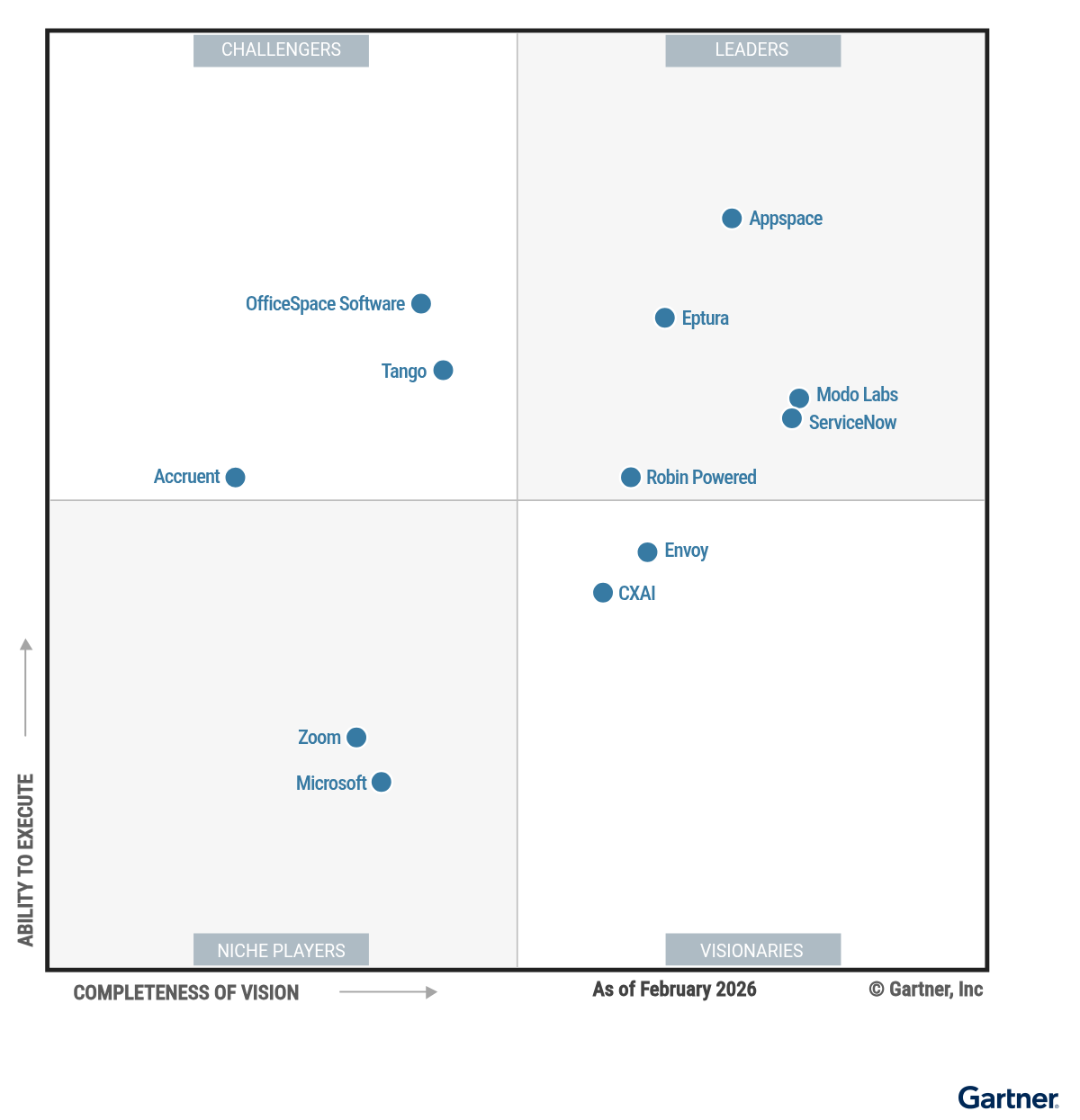
Vendor Strengths and Cautions
Accruent
Accruent is a Challenger in this Magic Quadrant. Its solution, called EMS, is focused on offering flexible desk and room reservations, real-time occupancy, interactive wayfinding, hybrid work coordination, and analytics. Additionally, the solution integrates with Microsoft Outlook, Teams and Exchange; sensors and badges; and enterprise systems. Its operations are primarily in North America, serving clients of various sizes in banking and financial services, retail, higher education, and professional and legal sectors.
Top enhancements of the last 12 months include AI-assisted and mobile-first booking of office resources, improved Microsoft Outlook add-in reliability, and the launch of Direct Spaces with its own conversational AI agent.
Accruent intends to invest in AI-driven automation, a modernized user experience (UX) for hybrid work and deeper platform integrations to improve operability.
- Vertical/industry strategy: Accruent’s strong presence in financial services, retail, higher education, legal and professional services stems from its ability to address each sector’s unique requirements. Its EMS platform enables organizations to streamline complex operations and mitigate industry-specific risks.
- Sales strategy: Accruent leverages its long history in facilities and workplace software to position EMS as part of a broader operational ecosystem. Its investments in AI-enabled booking, modernized UX across multiple platforms and devices, and deeper Microsoft integrations strengthen its enterprise value proposition.
- Marketing strategy: Accruent’s messaging emphasizes a comprehensive, integrated EMS platform with AI-driven automation and an employee-centric experience, giving buyers a clear narrative around simplification and outcomes. It reinforces this positioning with concrete proof points, including deep Outlook and Microsoft 365 integration, and the redesigned, AI-powered Direct Spaces app.
- Geographic strategy: Accruent EMS’s North America-centric operations limit its reach, which may cause gaps in localized deployment, support coverage, regional breadth or data residency alignment.
- Sales execution/pricing: Accruent has inconsistent deal velocity or pricing competitiveness compared to other vendors evaluated in this Magic Quadrant. This results in longer evaluations, increased negotiation needs or challenges when competing with other WEX vendors.
- Innovation: Accruent’s recent enhancements are weighted toward Microsoft 365 integration and the Direct Spaces UX rather than advanced automation and AI-enabled capabilities. Prospective customers prioritizing advanced automation and predictive analytics may find Accruent’s EMS unable to meet their requirements.
Appspace
Appspace is a Leader in this Magic Quadrant. Its solution, also called Appspace, is focused on offering unified WEX that combines desk, room and amenity booking; indoor maps and wayfinding; and broad HR, IT and integrated workplace management system (IWMS) integrations. Its operations are primarily in North America, serving mostly large enterprises (over 1,000 employees) in pharmaceuticals, transportation, logistics, financial services and higher education.
Top enhancements of the last 12 months include cross-channel orchestration, room system integrations, the launch of Workplace Orchestration with Appspace Insights, AI-assisted publishing, and native integrations for Zoom Rooms and Microsoft Teams Rooms.
Appspace intends to invest in AI-driven innovation, partner ecosystem expansion, and scaled customer experience, managed service and global delivery programs.
- Business model: Appspace’s approach combines SaaS licensing, partner enablement and multimodule expansion across digital signage, communications and WEX. Its modular business model enables organizations to easily scale from single use cases to full platform adoption, positively impacting customer lifetime value and reducing reliance on disparate point solutions.
- Vertical/industry strategy: Appspace emphasizes a community-first experience, AI-powered coordination and collaboration, and a digital-physical workplace community that can be adapted to sector-specific branding, governance and engagement needs. This vertical focus makes Appspace a strong option for organizations in financial services, higher education and pharmaceuticals seeking scalable workplace communications and coordination.
- Product or service: Appspace offers a comprehensive suite that unifies reservations, signage, communication and analytics, eliminating the need for multiple tools. This approach streamlines workplace interactions, boosting employee efficiency and contractual flexibility for large enterprises.
- Operations: Appspace has resourcing and scalability constraints regarding in-region delivery capacity, support coverage and localization scale during complex global rollouts outside North America. Enterprises with large, distributed footprints may face operational risks that require additional partner support or dedicated customer service resources.
- Sales execution/pricing: Appspace’s positioning and pricing clarity differ across market segments. Buyers must carefully model total cost of ownership (TCO) for users, devices, signage endpoints and workplace modules to avoid underestimating long-term expenses.
- Sales strategy: Appspace’s sales motion spans across digital signage, intranet and WEX modules, making it complex for large buyers to align on a unified, end-to-end ROI across use cases. Buyers must evaluate whether Appspace’s packaging and pricing approach introduces deal friction and complicates stakeholder alignment.
CXAI
CXAI is a Visionary in this Magic Quadrant. Its solution, also called CXAI, is focused on offering dynamic reservations, blue dot indoor navigation and routing, hybrid attendance coordination, and an agentic multiassistant layer across multiple enterprise integrations. Its operations are primarily in North America, serving mostly global enterprises (over 10,000 employees) in financial services, health sciences, technology, media and entertainment, and consumer and retail.
Top enhancements of the last 12 months include agentic AI workplace automation and spatial intelligence, including rollouts of agentic AI across CXAI Kiosk and CXAI Vu analytics.
CXAI intends to invest in agentic AI, new enterprise-grade modules, and upgrades to space management and platform infrastructure.
- Business model: CXAI’s business model is built around enterprise-grade platform delivery, with strong emphasis on security, scalability and deep integration into customer environments. This approach aligns well with large organizations that require controlled deployments and long-term platform extensibility.
- Vertical/industry strategy: CXAI is built for regulated, multisite enterprises in complex, high-value sectors such as financial services, health sciences and technology. Its offering includes enterprise-grade security and integration, AI assistants, and contextual analytics to support strict data governance and precise coordination across multifacility environments.
- Market understanding: CXAI offers advanced features such as hybrid orchestration, navigation and AI-driven assistance around enterprise workplace requirements. Its understanding reflects both its mapping heritage and deep engagement with customers needing contextual data intelligence.
- Geographic strategy: CXAI has limited geographic presence, with operations only concentrated primarily in North America. Organizations with a global footprint may face gaps in regional support, deployment coverage or localized data handling.
- Sales execution/pricing: Sales execution and pricing maturity lag behind other WEX vendors evaluated in this research, potentially resulting in longer enterprise procurement cycles. Prospective buyers evaluating CXAI should plan for more extensive technical validation and security reviews compared with more established vendors.
- Customer experience: CXAI’s customers may face challenges with onboarding, support workflows and long-term customer success processes. Enterprises seeking prescriptive customer experience frameworks or globalized customer programs will need to validate maturity through references.
Envoy
Envoy is a Visionary in this Magic Quadrant. Its solution, called Envoy Workplace, is focused on offering a unified workplace platform for visitor management and real-time desk, room and parking reservations via interactive maps. Additionally, Workplace features hybrid schedule coordination; co-worker-finding; enterprise messaging with Slack and Teams; and occupancy and usage analytics that unify badge, Wi-Fi and booking data. Its operations are limited to North America, serving enterprises of all sizes, including those with over 5,000 employees, in financial services, healthcare and technology.
Top enhancements of the last 12 months include improved presence accuracy, digital signage and emergency communications. Additional updates include the Presence Control Center for governing Wi-Fi, badge, SSO and geolocation signals; the launch of Envoy Screens; and expanded monthly product updates in safety and notifications.
Envoy declined requests for supplemental information or to review the draft contents of this document. Gartner’s analysis is therefore based on other credible sources.
- Geographic strategy: Envoy demonstrates strong geographical momentum within North America, where it has established broad adoption across midsize and large organizations. This concentrated presence enables Envoy to deliver consistent support, localized deployment expertise and a well-understood operating footprint.
- Market understanding: Envoy shows clear awareness of WEX trends, articulating a vision centered on unified, simplified coordination across the physical workplace. Its focus on integrating check-ins, reservations and workplace insights reflects alignment with customer expectations for seamless hybrid work operations.
- Marketing strategy: Envoy’s marketing approach emphasizes a clean, intuitive workplace narrative that resonates strongly with buyers seeking simplicity and ease of use. Its brand visibility and user-centric positioning differentiate it in the WEX landscape.
- Sales execution/pricing: Envoy’s sales execution and pricing maturity lag behind other vendors evaluated in this research, translating into slower enterprise deal progression or less predictable pricing structures. Organizations evaluating Envoy need more diligence around commercial flexibility and enterprise-class contracting.
- Overall viability: Envoy provides limited transparency into its investment plans, roadmap details and future capability expansion, creating uncertainty for multiyear WEX programs. Customers need to secure documented commitments to ensure long-term platform continuity.
- Operations: Operational depth is not as extensive as that of some enterprise-focused WEX vendors, which will affect large or complex deployments. Buyers must validate Envoy’s ability to support global implementation, scaling and compliance needs before rollout.
Eptura
Eptura is a Leader in this Magic Quadrant. Its solution, called Eptura Engage, is focused on offering AI-assisted resource booking with native Microsoft 365, Teams and Outlook synchronization; wayfinding and occupancy validation via sensors and badges; and service requests. Additionally, Engage features portfolio-level analytics and open APIs/SSO to unify IWMS and WEX. Its operations are primarily in North America and Europe, serving mostly midsize to large enterprises (100 to 2,499 employees) in financial services, insurance, legal and professional services, and pharmaceuticals.
Top enhancements of the last 12 months were in AI-assisted booking and technician and visitor workflows. This includes Copilot in Teams for conversational booking and visitor tasks, facial recognition visitor check-in and Intelligent Booking.
Eptura intends to invest in product architecture improvements for Microsoft 365 integrations and other integrations, and team clustering (anchor points) with machine-learning-powered reservations.
- Vertical/industry strategy: Eptura targets regulated, high-value sectors like financial services, insurance, legal and professional services, and pharmaceuticals, aligning products and services with these industries’ real estate and compliance needs. This focus helps it package repeatable solutions and references that translate across midmarket and enterprise accounts.
- Offering (product) strategy: Eptura brings a broad WEX portfolio that supports complex hybrid programs. Active investments in AI/machine learning and platform unification reinforce differentiation and future readiness.
- Overall viability: Eptura’s large installed base and backing from established investors provide stability for multiyear workplace transformations. This foundation, combined with ongoing product investment, signals its capacity to support global rollouts and sustained innovation.
- Customer experience: The platform introduces administrative complexity for some customers, particularly during reporting and setup. To ensure smooth deployment and mitigate setup risks, prospective customers must work closely with the vendor to create a detailed implementation plan and confirm dedicated post-go-live support before purchasing WEX apps.
- Marketing execution: Uneven marketing momentum can leave prospects seeking clearer adoption playbooks and quantified outcomes. Requesting prescriptive value realization plans and references early in the cycle can mitigate this risk.
- Innovation: Eptura’s pace of innovation does not move as quickly as that of other WEX vendors evaluated in this Magic Quadrant, particularly in emerging areas such as advanced AI, predictive automation and next-generation experience orchestration. Its roadmap investments are still evolving, which means customers need to validate timelines and ensure that planned enhancements will arrive in step with their workplace transformation goals.
Microsoft
Microsoft is a Niche Player in this Magic Quadrant. Its solution, called Microsoft Places, is focused on offering hybrid scheduling and workplace presence directly in Teams and Outlook (e.g., location plans, in-person invites with hybrid RSVP). Places offers map-based desk and room booking on interactive floor plans with colleague seating visibility; admin check-in and autorelease; the Microsoft Places management portal for buildings, floors and desks; and organizational space and attendance insights.
Top enhancements of the last 12 months include embedded workplace coordination inside Teams and Outlook.
Microsoft declined requests for supplemental information. Gartner’s analysis is therefore based on other credible sources.
- Geographic strategy: Microsoft has one of the broadest enterprise footprints globally, enabling rapid distribution and support of workplace capabilities across regions. This presence, combined with entrenched Microsoft 365 and Teams usage, allows clients to seamlessly deploy new features when released.
- Business model: Microsoft’s enterprise licensing motions and partner ecosystem allow Places to benefit from established relationships and programs. This creates multiple paths to entry — suite-attached, partner-led services and independent software vendor integrations — that can compress time to scale.
- Vertical/industry strategy: Microsoft serves a wide range of industries with diverse compliance and workflow contexts from day one. That vertical reach, paired with platform services like identity, security and analytics, supports tailored WEX solutions within existing industry solution stacks.
- Sales execution/pricing: Selling motions for Places often rely on broader Microsoft 365 narratives by building it directly into applications like Outlook and Teams, rather than a stand-alone WEX value proposition. Many of Places’ WEX capabilities are included with a Teams Enterprise or Teams Premium license and are further enhanced by an Microsoft 365 Copilot license. Buyers should seek clearer packaging, TCO transparency and enterprise customer references specific to Places.
- Product or service: Places’ feature depth and production references are still developing, and recent enhancements have not been widely detailed by the vendor. Buyers must seek dated commitments for capabilities, integrations and admin controls aligned to their deployment timeline.
- Marketing execution: Because most Places features are built directly into Microsoft applications like Outlook and Teams, and new functionality is often covered in broader Microsoft 365 collateral as opposed to stand-alone Places collateral. This slows evaluation and internal stakeholder alignment for prospects. Clients evaluating Microsoft must request concrete adoption playbooks and outcome evidence tailored to their size, regions and industry.
Modo Labs
Modo Labs is a Leader in this Magic Quadrant. Its solution, called Modo Workplace, is focused on offering a mobile-first, configurable experience that unifies desk, room and amenity booking; indoor navigation; and hybrid schedule coordination. Workplace also features targeted communications and surveys, analytics, and AI assistance across more than 250 connectors and open APIs. Modo Labs’ operations are geographically diversified, and its clients tend to be of varying sizes, particularly in the financial services and healthcare sectors.
Top enhancements of the last 12 months include agentic AI and stronger system connectors. Highlights include Modo My Agent (Amazon Bedrock-based) for 24/7 role-aware answers and actions, as well as expanded integrations to unify student information systems, learning management systems, HR and IT experiences in mobile and web.
Modo Labs intends to invest in advanced native AI, a secure bring-your-own-agent framework and map-driven experiences with sensor integration.
Modo Labs declined requests for supplemental information. Gartner’s analysis is therefore based on other credible sources.
- Marketing strategy: Modo Lab’s positioning gives it a clear, differentiated story for WEX. Its go-to-market messaging emphasizes rapid configuration and AI-assisted orchestration to help buyers generate value without replacing existing systems.
- Sales strategy: The sales motion leans into modular adoption — leading with mobile experience, wayfinding or reservations — and expands through integrations into customers’ existing stacks. This “Unify, don’t replace” approach lowers change management risk and aligns well to phased, cross-functional rollouts.
- Business model: Modo Labs operates as a platform layer with a large connector catalog and open APIs, enabling service partners and customers to extend use cases without heavy custom development. This model supports repeatability across industries while preserving flexibility to fit into diverse enterprise architectures.
- Sales execution/pricing: Compared with those of full-suite WEX application vendors, Modo Lab’s selling motion and commercial packaging are less standardized, which will lengthen enterprise evaluations. Buyers must press for clear module boundaries, integration scope and multiyear TCO before final selection.
- Operations: For large, global programs, Modo Labs relies heavily on partner capacity for scale, localization and sustained field services. Buyers must validate implementation resources, SLAs and regional support coverage during pilots.
- Overall viability: Modo Labs lacks the breadth and public proof points of other WEX application vendors, which requires closer scrutiny of long-term support plans. Buyers should request dated roadmap commitments, referenceable deployments and clear ownership boundaries with adjacent systems.
OfficeSpace Software
OfficeSpace Software is a Challenger in this Magic Quadrant. Its solution, called OfficeSpace, is focused on offering flexible booking with presence from badges, Wi-Fi and sensors; live wayfinding and team-presence views; and amenity and visitor booking. Its operations are primarily in North America, serving midsize enterprises (100 to 999 employees), especially in professional services, technology, financial services, entertainment and life sciences.
Top enhancements of the last 12 months include the acquisition of Dojo AI, which added patented AI-driven space planning technology and an AI assistant for data-driven insights. Additional updates feature presence-driven utilization dashboards for policy and utilization analysis, along with deeper integrations with the Microsoft, Google and Slack ecosystems.
OfficeSpace Software intends to invest in AI-powered work schedule coordination, real-time presence and sensor integration, and unified WEX and IWMS insights.
- Overall viability: OfficeSpace shows consistent, reliable day-to-day operations and maintains a solid viability posture, supported by mature implementations primarily across midsize customers. Its roadmap and integration stance indicate continued investment in core workflows and admin usability that enterprises rely on for long-term programs.
- Vertical/industry strategy: The platform is used across a range of sectors including corporate offices, healthcare, labs and professional services — where hybrid coordination, presence tracking and localized policies are critical. Its ability to configure use-case nuances (e.g., lab and amenity bookings, targeted announcements) helps it fit industry-specific workplace patterns without heavy customization.
- Offering (product) strategy: OfficeSpace provides robust reservations, wayfinding, visitor handling and practical AI assistant plans that build on existing usage patterns. Deep integrations with HR information systems, access control systems, Teams and Slack, and IT service management (ITSM) endpoints ease manual data transfer efforts and accelerate time to value.
- Geographic strategy: Most traction and customer references are concentrated in North America, with more modest visibility elsewhere. Multinational buyers must confirm regional delivery capacity, localization, and support SLAs prior to global rollout.
- Sales strategy: OfficeSpace Software’s sales motion is pragmatic but can be module-led, which places extra onus on buyers to plan phased scope and value realization across capabilities. Buyers must request clear expansion pathways (e.g., ITSM integrations, analytics add-ons) and align multiyear commercials to OfficeSpace’s roadmap.
- Product or service: ServiceNow and Jira workflow handoffs are still maturing, which may require interim workarounds or targeted services. Enterprises with heavy ITSM dependencies should validate timing and confirm the depth of packaged connectors during evaluation.
Robin Powered
Robin Powered is a Leader in this Magic Quadrant. Its solution, called Robin One Workplace Platform, is focused on offering enterprise-grade office space reservations, meeting service management and visitor management across supported platforms. It also provides analytics powered by presence data from Wi-Fi and badges. Its operations are primarily in North America, serving midsize to large organizations (500 to 10,000 employees), especially in technology, professional services, retail and financial services.
Top enhancements of the last 12 months include AI-driven scheduling and administrative analytics. Notable additions are the AI Scheduling Agent, which autoresolves cascading room conflicts; the Workplace Operations Dashboard; and an Analytics AI Assistant.
Robin Powered intends to invest in AI-powered workplace operations, continuous automated planning, customer evangelism and community building.
- Vertical/industry strategy: Robin One Workplace Platform is used across a broad mix of industries, where hybrid coordination and workplace flexibility are priorities. Its configurable reservation, scheduling and presence-tracking workflows make it adaptable to industry-specific needs without heavy customization.
- Offering (product) strategy: Robin One Workplace Platform provides a highly intuitive booking experience across mobile, web, Outlook, Slack, Teams, kiosks and digital signage, which simplifies hybrid work coordination for end users. Its strong presence integrations enhance real-time occupancy accuracy and analytics.
- Geographic strategy: Robin Powered demonstrates a solid geographic strategy with strong traction across North America, supported by a vision that aligns well with midmarket and enterprise organizations adopting hybrid workplace models. Its ability to serve a wide range of customers positions it effectively for organizations operating multisite environments.
- Sales execution/pricing: Robin Powered’s commercial motion can be less mature than that of larger competitors, which may translate into varying deal velocity and reliance on more tactical sales cycles. Buyers must request clear multiyear pricing structures and contract standardization to reduce uncertainty.
- Overall viability: Robin Powered operates at a smaller scale than other WEX application vendors evaluated in this research, requiring buyers to validate long-term investment and sustainability expectations. Organizations with large global footprints must request evidence of platform durability and enterprise readiness.
- Marketing execution: Marketing programs and buyer-enablement content are still developing, creating gaps in referenceable materials and detailed use-case storytelling. Prospects need more hands-on validation such as pilots, customer calls or proof-of-value exercises to build internal alignment.
ServiceNow
ServiceNow is a Leader in this Magic Quadrant. Its solution, called Workplace Service Delivery (WSD), is focused on offering omnichannel reservations, mapping and wayfinding, as well as hybrid planning dashboards. It also provides close orchestration with IT, HR and facilities via the Now Platform. Its operations are geographically diversified, serving global organizations (5,000 to 9,999 employees), especially in financial services, technology, media and government.
Top enhancements of the last 12 months include space and indoor mapping, as well as agentic workflows. Notable investments include Workplace Space Management, Indoor Mapping, Space Optimization and Now Assist for WSD automations.
ServiceNow intends to shift to an AI-native platform, faster deployment and time to value, and stronger integrations, with a universal orchestration layer via its AI Control Tower.
- Product or service: ServiceNow delivers a workplace platform that natively connects reservations, space management, wayfinding, visitor management and employee requests through a unified workflow engine. Its ability to integrate WEX capabilities directly into enterprise service experiences — such as in HR, IT, legal and facilities — creates powerful cross-departmental automation.
- Offering (product) strategy: ServiceNow’s strategy centers on leveraging its core platform — Employee Center, Integration Hub, workflow orchestration and AI — to unify workplace interactions under one digital front door. This approach allows WEX capabilities to scale consistently across global enterprises while remaining deeply embedded in broader service delivery processes.
- Business model: ServiceNow benefits from a proven enterprise subscription model, supported by a vast global partner ecosystem and long-standing customer relationships across IT, HR and facilities. This model enables WEX to expand as an extension of existing platform investments rather than as a stand-alone point solution.
- Sales execution/pricing: ServiceNow’s sales motion for WEX is less mature than its core ITSM and HR service delivery suites, often requiring customers to navigate complex packaging and premium pricing tiers. Buyers need to validate whether WEX-specific value justifies incremental licensing beyond their existing platform footprint.
- Customer experience: Customer experience indicators suggest that onboarding and adoption can require significant internal alignment due to the breadth of the platform. Buyers must ensure that structured success plans, role-based enablement and measurable adoption milestones are included at purchase.
- Overall viability: ServiceNow does not break out WEX-specific references, metrics or financial contributions, making it harder for buyers to benchmark proven impact in workplace programs. Customers need to request concrete, WEX-focused case studies and roadmap commitments rather than relying on general platform maturity.
Tango
Tango is a Challenger in this Magic Quadrant. Its solution, called Tango Workplace, is focused on offering reservation and occupancy modules with indoor maps, team-day coordination, and amenity and visitor booking. It also provides extensive analytics that unify workplace and corporate real estate decision making. Its operations are mostly focused in North America and its clients tend to be large enterprises (greater than 1,000 employees), particularly in sectors such as banking and financial services, IT and professional services.
Top enhancements of the last 12 months include predictive analytics for market sizing and site forecasting, as well as the expansion of Tango Predictive Analytics with multisource data and machine learning. Additional improvements include new packaging options to broaden access.
Tango intends to invest in generative AI capabilities, predictive analytics, and unifying corporate real estate and workplace life cycles.
- Vertical/industry strategy: Tango has deep traction in industries that require advanced real estate optimization, such as corporate offices, retail and large multisite environments. In these sectors, accurate occupancy planning and space management are critical. Its ability to integrate badge, Wi-Fi, network and sensor data makes it well suited for verticals that need granular, compliance-aligned utilization insights.
- Product or service: Tango provides strong core capabilities in reservations, occupancy tracking, portfolio planning and predictive analytics, enabling organizations to make data-driven workplace decisions. Its real-time utilization engine, built on multiple data sources, gives customers a clearer view of how space is actually used across buildings and teams.
- Offering (product) strategy: Tango’s product strategy emphasizes advanced predictive analytics and AI-assisted workflows, like its Ask Tango chatbot, that streamline everyday planning and reservation tasks. The platform’s alignment with IWMS capabilities (facilities maintenance, capital projects and real estate portfolio management) strengthens its ability to serve hybrid workplace needs while supporting long-term portfolio optimization.
- Geographic strategy: Tango’s presence and customer concentration remain most prominent in North America, limiting global deployment references. International buyers need to validate regional implementation readiness, localization support and partner coverage before scaling.
- Sales execution/pricing: Tango’s commercial motion can be complex for buyers seeking WEX-only deployments. Because pricing is based on square footage or square meters, costs can escalate quickly for large portfolios, requiring prospective customers to conduct careful scenario modeling during procurement.
- Operations: Operational workflows and resource allocation can pose challenges for rapid global rollouts or highly distributed enterprise environments. Buyers must confirm implementation staffing, SLAs and long-term support commitments to ensure smooth adoption across complex portfolios.
Zoom
Zoom is a Niche Player in this Magic Quadrant. Its solution, called Zoom Workplace, is focused on offering AI-assisted desk and room booking in Workspace Reservation, visitor management,and real-time analytics, integrated across Zoom and third-party ecosystems. Its operations are global, serving enterprises of various sizes, including those with over 1,000 employees, particularly in the education and healthcare sectors.
Top enhancements of the last 12 months include workspace-reservation usability and AI-assisted suggestions, bringing AI Companion-powered day/desk recommendations, improved floor map controls and cross-midnight bookings.
Zoom intends to invest in a unified intelligent platform, AI-driven automation and insights, and ecosystem and analytics expansion.
- Business model: Zoom benefits from a highly scalable SaaS business model. This is strengthened by its massive global user base and the cross-suite adoption of Zoom Meetings, Zoom Rooms, Workvivo and Zoom AI Companion. This allows Zoom WEX to enter organizations as an extension of existing contracts and workflows rather than needing a stand-alone WEX procurement cycle.
- Vertical/industry strategy: Zoom Workplace’s capabilities align naturally with industries that depend heavily on collaboration, including technology, professional services, and hybrid-friendly corporate environments. Its integration capabilities fit the verticals that prioritize seamless employee coordination and digital touchpoints.
- Offering (product) strategy: Zoom’s offering strategy brings together meetings, scheduling, visitor management and AI Companion into one coordinated workflow, creating a unified experience that reduces fragmentation across workplace tools. Its roadmap emphasizes deeper AI-driven orchestration, mobile parity and tighter integration with Workvivo, strengthening Zoom’s ability to serve as a holistic workplace experience layer.
- Sales execution/pricing: Zoom’s WEX-specific sales motions lack the maturity of its core collaboration products due to the intentional positioning of its WEX offering as part of an integrated platform bundle, making enterprise evaluations more complex. Customers must communicate their needs precisely, leverage available channels, and negotiate for clear packaging and pricing.
- Marketing execution: Zoom’s marketing for WEX capabilities is still developing, often emphasizing collaboration rather than the full breadth of WEX workflows. Buyers need more specific and detailed case studies, vertical-specific proof points, and usage narratives to understand Zoom’s value in the WEX category.
- Customer experience: Zoom’s WEX offering is still newer compared to other WEX platforms, which means customers will encounter gaps in advanced workflows, administrative depth or end-to-end journey support. Buyers must rely on pilots, reference calls or phased onboarding to validate long-term usability, especially as Zoom continues integrating Workvivo and AI Companion capabilities more tightly.
Inclusion and Exclusion Criteria
The inclusion criteria are the specific attributes that a provider must have to be included in this Magic Quadrant. To qualify for inclusion, vendors must provide a solution that satisfies the following:
- Licensing: WEX application must be sold as a stand-alone product, or well-defined module for existing products, licensed on a per-employee and/or per-resource basis (e.g., desk or room) as of 31 October 2025.
- Geography: The vendor must be active in at least three regions as of 31 October 2025. “Active presence” is defined as having at least 15% of the estimated WEX revenue billable in the specific region. For most vendors, this will be their primary region plus two additional regions in which they do business. Regions are defined as: North America, Europe, the Middle East and Africa, Asia/Pacific, and Latin America.
- Market interest: Gartner client relevance is determined by analyst expertise and guided by public and proprietary information.
Gartner excluded providers that did not meet the specific inclusion criteria listed above. Specifically, products or capabilities that were in beta or limited release as of the cutoff date were not considered. Additionally, vendors that did not meet the geographic threshold of 15% of the estimated WEX revenue in at least three regions were excluded to ensure the analysis reflects solutions with a viable multinational presence.
Honorable Mentions
Johnson Controls is a vendor for smart building, data center and integrated workplace management solutions. It also offers digital solutions aimed at the WEX market under the OpenBlue brand. Johnson Controls did not meet the general availability criterion for inclusion in this research as the mandatory features specified for work planning, AI and user interface (specifically, the requirement for a browser-based interface) were not generally available by the cutoff date.
Korbyt is a digital signage and workplace experience vendor. Gartner required that all mandatory features listed in the Market Definition be generally available by the 31 October 2025 cutoff date for inclusion in this research. Korbyt did not meet this criterion for the specified AI capabilities by the cutoff date.
Ricoh is a workplace technology and digital services vendor with offerings that include workplace analytics, employee experience tools and space reservation. Gartner requires that all vendors included in this research maintain an active presence in at least three global regions, each contributing a minimum share of WEX revenue. Ricoh did not meet this regional-presence criterion as of the 31 October 2025 cutoff date and therefore could not be included in this research.
Evaluation Criteria
Gartner analysts evaluate vendors’ Ability to Execute based on the quality and efficacy of their WEX application; their ability to be competitive, efficient and effective; and their ability to positively impact employee and end-user experience and space efficiency when interacting with the physical office. Ultimately, vendors are judged on their ability to deliver on their vision in a rapidly evolving market.
For this market, assessments are primarily based on the Product or Service, specifically the breadth of functionality across space management, work planning and employee experience, as well as the depth of AI capabilities and prebuilt integrations with IT and operational technology (OT) systems. Overall Viability is weighted highly due to the active consolidation in the market; buyers prioritize partners with strong financial health and a commitment to sustained R&D investment. Market Responsiveness/Record is critical and weighted highly, reflecting a vendor’s agility in adapting to shifting hybrid work patterns and its track record of delivering features that help organizations “earn the commute” for their employees. Customer Experience is also weighted highly, as successful long-term adoption depends on frictionless employee interactions, strong technical support and effective customer success programs. Sales Execution/Pricing and Marketing Execution are weighted Medium, while Operations is weighted Low, as most established vendors leverage standard SaaS operational models.
Ability to Execute
Ability to Execute Evaluation Criteria
| Evaluation Criteria | Weighting |
|---|---|
Product or Service | High |
Overall Viability | High |
Sales Execution/Pricing | Medium |
Market Responsiveness/Record | High |
Marketing Execution | Medium |
Customer Experience | High |
Operations | Low |
Source: Gartner (April 2026)
Completeness of Vision
Market Understanding is weighted highly, as vendors must demonstrate a deep grasp of the strategic shift from simple resource booking tools to comprehensive unified platforms that orchestrate the entire employee workplace journey. Offering (Product) Strategy is a primary differentiator and is weighted highly; it assesses the vendor’s roadmap for delivering advanced capabilities such as agentic AI, unified cross-application platforms and enhanced data-driven space optimization. Innovation is also weighted highly, reflecting the necessity for vendors to lead in emerging areas like generative AI assistants and IoT sensor integration. Geographic Strategy receives a High weighting to address the requirements of multinational enterprises that need global support, localized content and adherence to regional data residency standards. Marketing Strategy and Sales Strategy are weighted Medium. Business Model and Vertical/Industry Strategy are weighted Low, as the core value proposition of WEX applications is currently horizontal across industries and relies on standard per-user or per-resource licensing models.
Completeness of Vision Evaluation Criteria
| Evaluation Criteria | Weighting |
|---|---|
Market Understanding | High |
Marketing Strategy | Medium |
Sales Strategy | Medium |
Offering (Product) Strategy | High |
Business Model | Low |
Vertical/Industry Strategy | Low |
Innovation | High |
Geographic Strategy | High |
Source: Gartner (April 2026)
Quadrant Descriptions
Leaders
Leaders in the WEX application market provide comprehensive, unified platforms that seamlessly integrate core space management with advanced employee experience capabilities. They demonstrate a clear vision for the future of hybrid work, leveraging AI and machine learning for predictive insights, agentic automation and personalized recommendations. These vendors have a proven track record of supporting complex, global enterprise deployments and consistently innovate to address emerging needs like deep integrations with IT and OT ecosystems.
Challengers
Challengers exhibit strong execution in core WEX functionalities like desk and room booking, often with a significant installed base of midsize to large enterprises. However, they may lag behind Leaders in their strategic vision for emerging technologies like agentic AI or broader employee experience features. Their roadmaps might be more reactive to current market demands — focusing on operational efficiency rather than driving the future direction of the digital workplace — or they may target a specific but large segment of the market without offering the full breadth of a unified platform.
Visionaries
Visionaries align closely with Gartner’s view of the evolving WEX market, introducing innovative capabilities in areas like generative AI, advanced analytics and unified work orchestration. These vendors often lead the market in defining new ways to “earn the commute” and improve employee experience. While they offer forward-looking solutions that address the complexities of hybrid work, they may not yet have the global scale, financial resources or comprehensive support infrastructure to fully challenge the Leaders.
Niche Players
Niche Players in the WEX market typically focus on specific segments like particular geographies, industry verticals or an expertise in a limited set of functionalities (e.g., stand-alone visitor management or basic resource scheduling). Their offerings often excel in their specific area of focus but generally lack the breadth of a unified employee experience platform needed by complex, multinational organizations. Niche Players may be a suitable choice for buyers with highly specific requirements or limited budgets that do not need a broad, all-in-one ecosystem.
Context
As the WEX market shifts from siloed point solutions toward unified platforms, application leaders must look beyond basic desk and room booking features to find solutions that truly support hybrid work strategies and “earn the commute.” Key considerations and recommended next steps include the following:
- Assess current vendor capabilities first: Before procuring a new stand-alone solution, examine the WEX features that your current technology vendors already offer. Review existing platforms such as collaboration tools, HR systems and IWMS to determine if they can meet your prioritized requirements.
- Define requirements through employee feedback: Conduct cross-functional workshops or surveys to determine which features are essential to your workforce. Demand is shifting away from simple individual space reservation toward capabilities that support collaboration, such as reserving shared spaces and coordinating schedules with colleagues.
- Scrutinize AI and automation claims: With AI becoming a key differentiator, identify specific areas where AI can drive business goals, such as space optimization or personalized recommendations. Pilot these AI-driven features to ensure they deliver measurable value and align with your organization’s priorities before full deployment.
- Prioritize integration and unified platforms: To reduce application overload and ensure data consistency, focus on vendors that are offering all-in-one solutions that integrate seamlessly with existing IT, HR and OT systems. A unified platform approach simplifies management and provides a more consistent employee experience.
Market Overview
The workplace experience (WEX) application market is rapidly moving beyond basic desk and room booking tools to become a strategic platform for enabling hybrid, remote and in-office work. As organizations strive to balance return-to-office mandates with the need to “earn the commute,” demand is shifting from siloed, fragmented point solutions toward unified platforms that integrate digital applications, IT and OT.
Buyers are increasingly seeking comprehensive ecosystems that support both employees and administrators through a single interface. Consequently, the functional scope of WEX applications is expanding beyond core space reservation to include a broader range of cross-application capabilities. These encompass enhanced employee presence, employee communication, visitor management, appointment scheduling and digital signage, reflecting a move toward a more comprehensive employee experience platform.
AI has emerged as a primary area of differentiation among vendors. WEX applications have evolved from simple rule-based pattern matching to systems leveraging machine learning and behavioral analytics. These capabilities now power intelligent recommendations for the optimal desks, rooms or days to visit the office based on collaboration patterns, team schedules and past preferences.
Over the next year, Gartner predicts the WEX market will be shaped by:
- Greater use of agentic AI: AI is becoming an essential component of WEX solutions, moving beyond basic analytics to power automation and predictive insights. Digital assistants using agentic AI will increasingly handle complex workflows, such as automated scheduling and maintenance, through simple natural language conversations.
- Move toward unified, integrated platforms: Organizations are prioritizing solutions that integrate multiple functions and work seamlessly with existing systems, such as HR, IT and visitor management. This consolidation reduces application overload, ensures data consistency and creates a smoother employee experience.
- Data-driven space optimization: The use of real-time and historical data regarding space utilization will drive decisions on real estate allocation. AI-driven insights will help organizations predict needs, tailor solutions and prove ROI through measurable reductions in operational costs and increased space efficiency.
- Integration with IoT: The integration of IoT hardware, such as occupancy sensors, environmental controls and smart lockers, will continue to grow. This integration supports the demand for frictionless employee experiences and provides administrators with higher-fidelity data on workplace usage.
Research for this Magic Quadrant was informed by:
- Client interactions between WEX vendors and analysts throughout 2025
- Analysis of survey responses completed by the participating vendors
- A vendor briefing and product demonstration from each featured vendor, addressing capability proof points for the Magic Quadrant evaluation criteria
- Publicly available information on each participating vendor
Ability to Execute
Product/Service: Core goods and services offered by the vendor for the defined market. This includes current product/service capabilities, quality, feature sets, skills and so on, whether offered natively or through OEM agreements/partnerships as defined in the market definition and detailed in the subcriteria.
Overall Viability: Viability includes an assessment of the overall organization's financial health, the financial and practical success of the business unit, and the likelihood that the individual business unit will continue investing in the product, will continue offering the product and will advance the state of the art within the organization's portfolio of products.
Sales Execution/Pricing: The vendor's capabilities in all presales activities and the structure that supports them. This includes deal management, pricing and negotiation, presales support, and the overall effectiveness of the sales channel.
Market Responsiveness/Record: Ability to respond, change direction, be flexible and achieve competitive success as opportunities develop, competitors act, customer needs evolve and market dynamics change. This criterion also considers the vendor's history of responsiveness.
Marketing Execution: The clarity, quality, creativity and efficacy of programs designed to deliver the organization's message to influence the market, promote the brand and business, increase awareness of the products, and establish a positive identification with the product/brand and organization in the minds of buyers. This "mind share" can be driven by a combination of publicity, promotional initiatives, thought leadership, word of mouth and sales activities.
Customer Experience: Relationships, products and services/programs that enable clients to be successful with the products evaluated. Specifically, this includes the ways customers receive technical support or account support. This can also include ancillary tools, customer support programs (and the quality thereof), availability of user groups, service-level agreements and so on.
Operations: The ability of the organization to meet its goals and commitments. Factors include the quality of the organizational structure, including skills, experiences, programs, systems and other vehicles that enable the organization to operate effectively and efficiently on an ongoing basis.
Completeness of Vision
Market Understanding: Ability of the vendor to understand buyers' wants and needs and to translate those into products and services. Vendors that show the highest degree of vision listen to and understand buyers' wants and needs, and can shape or enhance those with their added vision.
Marketing Strategy: A clear, differentiated set of messages consistently communicated throughout the organization and externalized through the website, advertising, customer programs and positioning statements.
Sales Strategy: The strategy for selling products that uses the appropriate network of direct and indirect sales, marketing, service, and communication affiliates that extend the scope and depth of market reach, skills, expertise, technologies, services and the customer base.
Offering (Product) Strategy: The vendor's approach to product development and delivery that emphasizes differentiation, functionality, methodology and feature sets as they map to current and future requirements.
Business Model: The soundness and logic of the vendor's underlying business proposition.
Vertical/Industry Strategy: The vendor's strategy to direct resources, skills and offerings to meet the specific needs of individual market segments, including vertical markets.
Innovation: Direct, related, complementary and synergistic layouts of resources, expertise or capital for investment, consolidation, defensive or pre-emptive purposes.
Geographic Strategy: The vendor's strategy to direct resources, skills and offerings to meet the specific needs of geographies outside the "home" or native geography, either directly or through partners, channels and subsidiaries as appropriate for that geography and market.