Predicts 2026: The Future of ERP
8 December 2025 - ID G00842098 - 13 min read
By Johan Jartelius, Tomas Kienast, and 1 more
AI, sovereignty, and ecosystem innovation are transforming the ERP landscape. Application leaders must rethink strategy, prioritize data readiness, evaluate vendor marketplaces, and plan for postimplementation AI adoption to stay competitive and avoid underutilized deployments.
Overview
Key Findings
- AI-driven ERP automation is emerging, transforming ERP systems from transactional to intelligent platforms that provide insights while reducing the need for human intervention in routine tasks.
- ERP vendor marketplaces are becoming critical differentiators as organizations seek specialized functionality beyond core ERP capabilities.
- AI tools are transforming ERP modernization, enabling faster and more cost-effective upgrades and shifting IT roles toward strategic orchestration.
- ERP AI adoption is lagging behind vendor investment, with many capabilities remaining unused due to poor postimplementation planning, change fatigue, and lack of organizational readiness.
- Geopolitical pressures are reshaping ERP deployment strategies for large enterprises and, as a result, driving demand for sovereign cloud solutions to meet compliance and national security needs.
Recommendations
- Define clear business outcomes for AI in ERP and invest in data governance to ensure AI delivers measurable value and reliable automation.
- Formalize ERP governance criteria to include marketplace evaluation, ensuring ecosystem partners are viable, secure, and aligned with long-term business needs.
- Adopt AI-powered modernization tools and retrain IT staff to manage AI orchestration, focusing on strategic problem solving rather than manual execution.
- Treat AI adoption as a distinct project phase by identifying use cases, assigning ownership and resources, and driving post-go-live value realization to avoid shelfware outcomes.
- Establish a sovereignty strategy by assessing legal, industry, and workload-specific requirements, and evaluate cloud vendors based on their ability to meet these needs in a sustainable manner.
Strategic Planning Assumptions
- By 2030, over 50% of foundational ERP tasks will be autonomously executed by AI, reducing human involvement in finance, supply chain, and HR.
- By 2030, one-third of ERP selections will be decided by the business capabilities available in the vendor’s application marketplace, not just the core product.
- By 2030, AI tools will cut ERP modernization costs by 40%, enhancing productivity and transforming IT roles into more strategic ones.
- By 2030, over 70% of acquired ERP AI capabilities will become shelfware, revealing a massive gap between vendor vision and customer adoption capabilities.
- By 2030, geopolitical factors will drive 75% of net-new ERP deployments for large enterprises in Europe and Asia/Pacific to select sovereign cloud for compliance, security, and autonomy.
Analysis
What You Need to Know
ERP is entering a new era — one defined by automation, adaptive experience, sovereignty, ecosystem-driven innovation, and strategic AI enablement. By 2030, over half of routine ERP tasks will be autonomously executed by AI, fundamentally shifting ERP from a transactional system to an intelligent platform. This transformation will require organizations to rethink their people roles, data strategies, reduce customizations, and invest in AI literacy to supervise and trust autonomous outputs.
At the same time, geopolitical tensions and regulatory pressures are reshaping cloud deployment decisions. Sovereign cloud is emerging as a strategic imperative, particularly in regions such as Europe and the Asia/Pacific, where compliance and national security concerns are prompting ERP leaders to reassess their infrastructure choices. This shift introduces trade-offs between innovation and control, forcing organizations to balance digital ambition with sovereignty requirements.
ERP selection itself is evolving. As foundational core capabilities become commoditized, the strength of a vendor’s partner ecosystem and application marketplace is emerging as a primary competitive differentiator. Enterprises are increasingly relying on third-party solutions to fill functional gaps, especially as standardized cloud ERP platforms limit customizations. This requires a more sophisticated evaluation process that encompasses governance, integration, and the long-term viability of partners and ecosystems.
Modernization is also being redefined. AI tools are reducing costs and timelines by automating code migration, testing, data cleansing, automated configuration, and integration. This not only boosts efficiency but also transforms IT roles from manual execution to strategic orchestration. Organizations that fail to embrace these tools risk falling behind in both speed and cost-effectiveness.
Yet, despite the promise of AI, many ERP capabilities are going unused. A significant portion of purchased AI features remains underutilized due to inadequate data, insufficient postimplementation planning, a lack of ownership, and change fatigue. This disconnect between vendor vision and customer readiness is creating a new market for AI value realization services and a new mandate for ERP leaders to treat adoption as a strategic phase, not an afterthought.
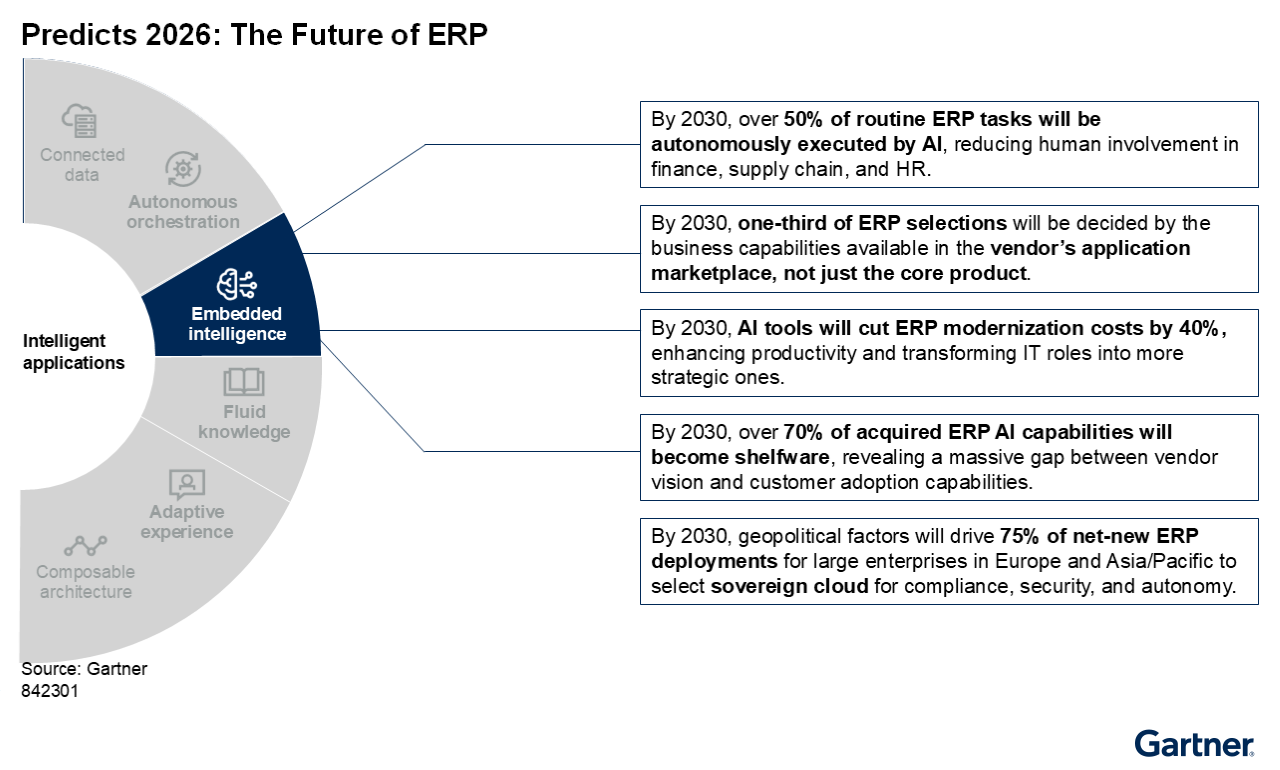
Together, these trends signal a decisive shift in how ERP is planned, deployed, and evolved. ERP leaders must act now to align strategy, architecture, and talent with this future, or risk being locked into legacy approaches that no longer serve the business. See Figure 1.
Strategic Planning Assumptions
Strategic Planning Assumption: By 2030, over 50% of routine ERP tasks will be autonomously executed by AI, reducing human involvement in finance, supply chain, and HR.
Analysis by: Johan Jartelius
Key Findings:
- The trajectory of ERP strategies is being heavily influenced by emerging technologies, particularly AI agents, which are shifting the traditional human-driven, manual planning-focused ERP experience toward a leaner and more automated experience that provides valuable insights from your corporate data.
- AI agents are defined as autonomous or semiautonomous software entities designed to perceive, make decisions, take actions, and achieve goals independently within digital environments. The rapid emergence of agentic AI demonstrates the potential to fundamentally transform ERP.
- Application leaders are driving technology roadmaps and planning significant investments in AI tools and AI platforms for their ERP, recognizing the technology’s potential to enhance operational efficiency and decision making.
Market Implications:
- Data imperative: Organizations will face significant challenges due to the expected scarcity of AI-ready ERP data. By 2027, only 30% of organizations are anticipated to have sufficient data quality to leverage advanced AI capabilities. This deficit will drive high demand for data ecosystem solutions dedicated to cleansing, governance, and integration through an AI-data-ready framework.
- Decoupling customization: To enable the continuous adoption of AI-driven innovations, organizations must pivot from heavily customized ERP systems toward a more standardized architecture complemented by extended capabilities. Highly customized ERP environments will inherently suffer from slower adoption cycles for new AI functionality.
- Monetization and cost risk: The market faces high uncertainty regarding how vendors will monetize this wave of AI innovation. As for most hyped technologies, vendors are primarily looking to capitalize and increase shareholder value to ride the wave of the hype. This is likely to migrate to usage-based costing models, requiring enterprises to gain substantially more insight into specific AI use cases and how they are being monetized to avoid unexpected cost overruns.
- Shift in work skills: The core experience of using ERP applications will become significantly more automated. This shifts human focus away from transactional processing toward managing and supervising the output of the AI agents, requiring investment in AI literacy across the organization
Recommendations:
- Establish an AI-ready data foundation now: To fully capitalize on the autonomous capabilities of AI in ERP by 2030, clients must prioritize building an AI-ready data foundation immediately. This includes investing in data quality, governance, and integration frameworks tailored for AI use. Without high-quality, well-governed data, even the most advanced AI agents will underperform and delay automation benefits and increasing operational risk.
Strategic Planning Assumption: By 2030, one-third of ERP selections will be decided by the business capabilities available in the vendor’s application marketplace, not just the core product.
Analysis by: Tomas Kienast
Key Findings:
- Multitenant cloud ERP solutions drive customers toward standardized processes, highlighting capability gaps for enterprises that require deep, industry-specific functionality previously addressed through customization.
- ERP vendors are increasingly shifting their innovation model, delegating the development of deep industry-specific functions and localizations to partners, getting clients to source these critical capabilities through marketplaces.
- Vendor-certified marketplaces are evolving into viable mechanisms for delivering key last-mile functionality, allowing application leaders to augment the vendor’s core innovation with trusted third-party solutions.
Market Implications:
- ERP vendor competition will expand beyond core product features to the scope, quality, and innovation of the partner ecosystem, with emerging capabilities like AI agent marketplaces becoming key differentiators.
- A critical new governance challenge will emerge for application leaders, who must now evaluate vendor accountability for partner solutions, including the long-term viability, support, and security of formerly core capabilities.
- The growth of robust application marketplace offerings will facilitate the migration of enterprises with highly specialized needs to core cloud ERP platforms, as their specific functional gaps can now be addressed by integrated partner solutions.
Recommendations:
- Define which business capabilities must remain the ERP vendor’s core responsibility versus those you strategically source from the ecosystem, and evolve your selection methodology to formally assess these partner capabilities, specifically evaluating integration depth, long-term accountability, support models, and pricing policies.
Strategic Planning Assumption: By 2030, AI tools will reduce ERP modernization costs by 40%, enhancing productivity and transforming IT roles into more strategic ones.
Analysis by: Johan Jartelius
Key Findings:
- ERP modernization is traditionally costly, complex, and time-consuming, necessitating faster and more affordable approaches.
- AI can significantly improve code migration, accelerate project timelines by reducing manual intervention, shorten lengthy regression cycles, assist with data cleansing, and more.
- Automated integrations powered by AI streamline the traditionally labor-intensive integration phase by discovering, mapping, and maintaining data flows and system architecture changes.
- The integration of AI technologies across these processes delivers concrete operational efficiencies, faster upgrade cycle times, and enhanced resource allocation, supporting the projected cost and timeline reduction.
- Agent-driven configuration streamlines solution setup to meet customer needs, dramatically reducing the time required for this traditionally lengthy process.
Market Implications:
- Organizations will realize substantial operational efficiencies as AI handles the bulk of routine work in implementation projects.
- ERP vendors, service providers, and enterprise technology departments are expected to invest heavily in AI-driven modernization solutions.
- IT roles are set to undergo a significant transformation, evolving toward even more strategic functions. This shift will require the IT workforce to prioritize continuous improvement and effective risk management, rather than focusing on routine coding and manual tasks.
- Organizations must prepare for this shift, as failure to leverage AI-enabled integration platforms will result in sustaining high costs associated with traditional, labor-intensive project timelines.
Recommendations:
- Pilot AI-driven modernization capabilities in low-risk ERP areas: To achieve the projected 40% cost savings by 2030, clients should start experimenting with AI-powered tools in noncritical ERP modernization tasks, such as automated testing, data cleansing, or document generation. This phased approach allows organizations to build internal expertise, validate vendor capabilities, and assess ROI without overcommitting to still-maturing technologies.
Strategic Planning Assumption: By 2030, over 70% of acquired ERP AI capabilities will become shelfware, revealing a massive gap between vendor vision and customer adoption capabilities.
Analysis by: Tomas Kienast
Key Findings:
- Following resource-intensive ERP migrations, organizations prioritize operational stability, leading teams to indefinitely postpone the adoption of complex AI tools that were initially committed to from the onset, which require unallocated time and new skills.
- Fear of missing out (FOMO) drives enterprises to secure access to AI, either through committed consumption add-ons or premium AI-enabled tiers. Without a specific business case, these capabilities remain inactive, creating functional shelfware, where committed spend or subscription premiums result in adoption debt rather than value.
- Adoption stalls after procurement when unforeseen complexity materializes. The unpredictability of scaling AI consumption costs, combined with the unplanned operational overhead of data preparation and customization, forces teams to halt usage to avoid budget overruns.
Market Implications:
- Enterprises will face a new AI value debt, the gap between committed or premium spend and actual usage. This will trigger intense financial scrutiny, as CFOs demand “core only” pricing options to avoid paying for shelfware innovation.
- A new market for AI adoption services will grow, as SIs and specialists fill the gap between possessing AI and applying them to the customer’s business reality to achieve ROI.
- Vendor competition will shift from feature release velocity to proven customer adoption and business value. This will accelerate a change in commercial models, moving from simple consumption pricing to bundled offerings that include adoption support and shared responsibility for success.
Recommendations:
- Shift from a procurement-led approach to a governance-led one. Mitigate shelfware risk by creating a rigorous acquisition framework that requires a clear business case and predictable ROI. Negotiate contract terms that permit thorough testing in nonproduction environments without incurring consumption fees. Then, treat postimplementation adoption as a formal, resourced project phase, not an optional follow-on.
Strategic Planning Assumption: By 2030, geopolitical factors will drive 75% of net-new ERP deployments for large enterprises in Europe and Asia/Pacific to select sovereign cloud for compliance, security, and autonomy.
Analysis by: Neha Ralhan
Key Findings:
- Geopolitical pressures are shaping cloud ERP choices: Increasing geopolitical tensions and regulations are driving organizations to use more local and regional cloud providers, especially in Europe, Asia/Pacific, and Canada, which is having a flow-on effect for ERP selection.
- Diverse client sovereignty requirements: Organizations’ needs for cloud sovereignty are driven not only by regulations but also by specific business and application requirements, which can vary by country, industry, and workload, resulting in an uptick in local vendors.
- Increased vendor maturity: Due to the amplified focus on sovereign cloud requirements for ERP, ERP vendors are increasingly developing their own sovereign service offerings in an effort to both retain market share and capitalize on this emerging market requirement.
Market Implications:
- Emergence of isolated regional cloud offerings: Hyperscale providers are launching cloud services delivered from in-region data centers, often fully owned and operated by hyperscale providers, but isolated from global public cloud regions.
- Research and development dominance: Local vendors, limited by scale, may lack sovereign cloud capabilities and broad localization across diverse landscapes, which drives customers toward larger providers with the resources and partner networks to deliver these at the expense of smaller players.
- Increased variation/numbers of hyperscalers: In an effort to safeguard and expand their market share, large ERP megavendors are expanding their global footprint with local regional hyperscalers. Having access to more infrastructure partners for ERP helps customers navigate uncertain trade and geopolitical relationships and shore up sovereignty concerns.
- Locally owned hyperscale-based clouds: In some regions, domestic entities are launching new cloud offerings using hyperscale technology, aiming to shield clients and their data from foreign government overreach.
- Diversification of ERP deployment models: There has been increased interest in on-premises models as a result of the uncertain geopolitical environment. By remaining on-premises, organizations can retain greater control over their data and bypass sovereignty concerns.
- Strategic trade-offs: Organizations will be required to reevaluate digital ambitions, such as ERP AI innovation delivery, in order to achieve greater compliance. Although ERP vendor offerings on sovereign cloud capabilities are rapidly maturing, application leaders must balance the generally slower release of innovation for sovereign cloud solutions with their security requirements.
Recommendations:
- Identify and define the sovereignty requirements your organization is subject to by country, vertical industry, and workload type by working with your legal counsel and compliance and risk departments. This needs to be done while evaluating the different cloud provider approaches to meet your organization’s defined sovereignty requirements — keeping in mind many vendors are defining sovereignty in their own terms — by quantifying the vendors’ technological limitations that may limit the delivery of your mission-critical solutions.
A Look Back
In response to your requests, we are taking a look back at some key predictions from previous years. We have intentionally selected predictions from opposite ends of the scale — one where we were wholly or largely on target, as well as one we missed.
By 2025, the top four ERP vendors will rebrand themselves as business platform providers.
Analysis by: Tim Faith, Mike Guay
While vendors may not have formally rebranded, they have established distinct strategic positions around composable architecture, marketplace extensibility and enhanced ecosystem integration, effectively fulfilling this prediction.
By 2025, over 65% of postimplementation ERP changes will be made by citizen developers using low-code application platforms.
Analysis By: Paul Schenck
AI adoption is progressing, and citizen development is on the rise, though it has not yet reached the forecast 65%. The proliferation of low-code/no-code applications continues, but these solutions are still primarily developed by IT professionals rather than citizen developers, falling short of the projected benchmark.