Market Guide for Retail Workforce Management Technology
4 March 2026 - ID G00847012 - 15 min read
By Kelsie Marian, Josie Xing
AI-enabled WFM platforms that use real-time data, skills management and associate-manager augmentation help retailers close skills gaps, boost productivity and improve operations. CIOs can use this guide to understand the WFM market and how to deliver better outcomes for associates and customers.
Overview
Key Findings
- AI-driven enhancements to scheduling, labor forecasting and skills-based matching continue to expand as retailers look to increase labor productivity and improve store execution.
- The store’s growing role in unified commerce fulfillment is driving adoption of edge computing and IoT data to improve forecasting accuracy and support real‑time labor optimization across diverse in‑store tasks.
- AI assistants for store associates are available within several WFM solutions, providing real‑time guidance and support for routine tasks in low‑risk, governed scenarios to enhance in‑store execution.
Recommendations
- Invest in AI-enabled labor forecasting, automated scheduling and skills‑based matching to improve scheduling accuracy, responsiveness and associate agility.
- Ensure WFM platforms integrate with POS, IoT and store‑operations systems to support real‑time labor optimization and unified commerce execution.
- Adopt WFM solutions that embed governed AI assistants to provide associates with real‑time task, policy and product guidance while maintaining compliance and control.
Strategic Planning Assumptions
- By 2027, over half of Tier 1 unified commerce retailers will consolidate mobile scheduling, tasking and frontline communications into a single associate-facing experience.
- By 2028, AI-enabled skills management will allow 40% of open shifts to be filled autonomously by matching specific certifications (e.g., bakery, pharmacy) to associate preferences without manager intervention.
- By 2028, AI-driven edge analytics (CV, IoT) will supply more than 40% of the operational signals feeding labor forecasts and intra-day task allocation.
Market Definition
Gartner defines retail workforce management (WFM) applications as solutions that enable retailers to manage the operational deployment and optimization of the in-store retail workforce, thus improving the effectiveness of store managers and associates for unified retail commerce execution. In many cases, WFM can be deployed via mobile, point of sale (POS), tablet and kiosk devices for hourly retail associates, who are full time, part time and contingent workers.
Retail WFM applications support several business outcomes, including increased operational effectiveness, labor optimization and improvements to the overall wellbeing of store associates.
Mandatory Features
The mandatory features for this market include:
- Time and attendance
- Absence management
- Attestation
- Flexible scheduling
- Analytics and reporting
- Task management and communications
Common Features
The common features for this market include:
- Labor forecasting
- AI-led workforce optimization
- Microlearning
- Employee listening
- Rewards and recognition
- Automation of manager experience (e.g., approving time off, intra-day management)
Market Description
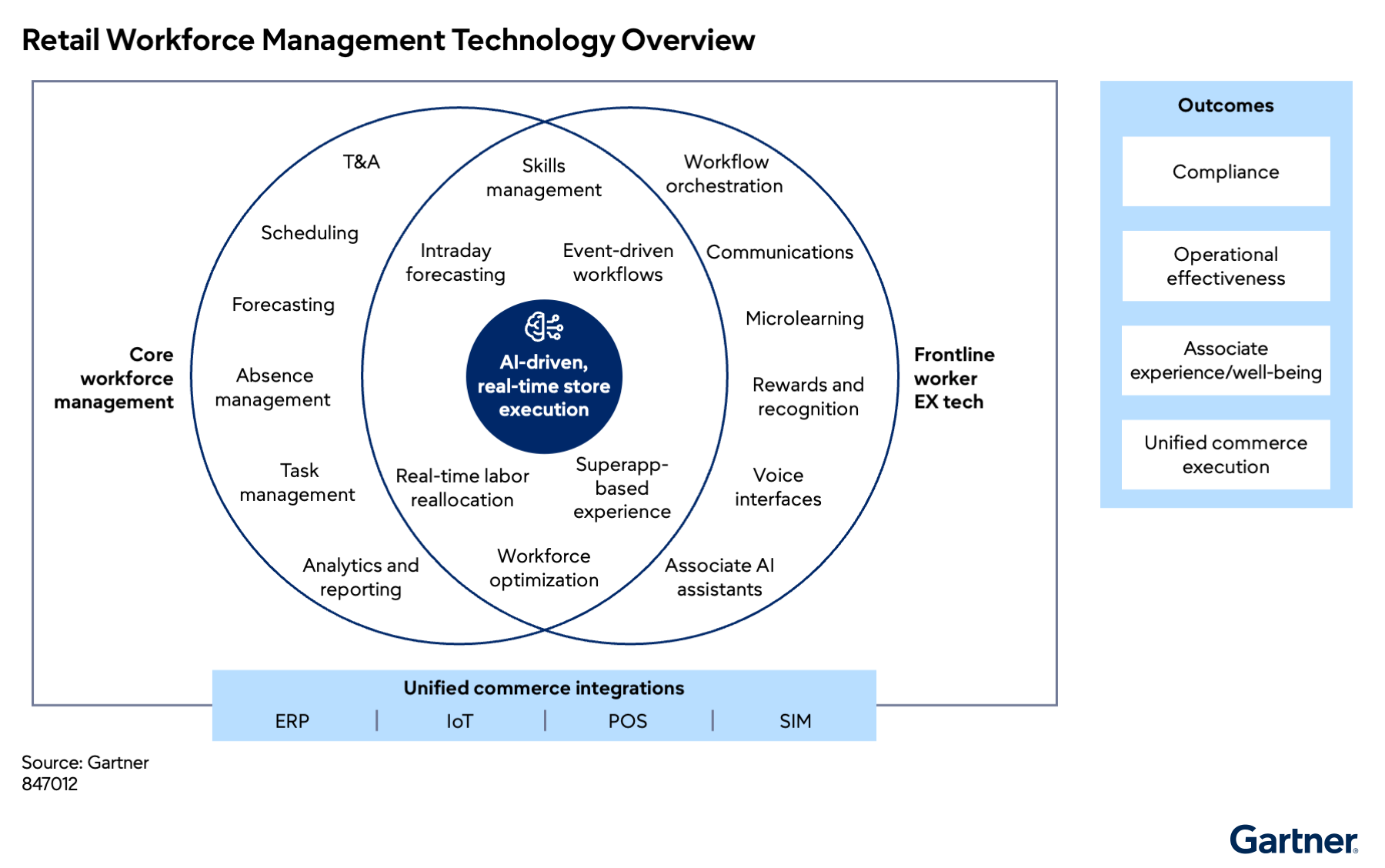
Workforce management (WFM) can be delivered as part of a broader human capital management (HCM) suite, as a stand-alone solution, or as a hybrid of both. The choice of deployment model typically depends on the complexity of the retailer’s WFM needs and the extent to which they require time, attendance and scheduling to be tightly integrated with broader HCM functions such as payroll (see Figure 1).
Additional factors influencing WFM requirements include geographic scope of operations, retail segment, AI and automation strategy, and the specific business outcomes sought from the technology investment. These considerations are critical, as the necessary complexity and flexibility of WFM will determine the most suitable type of solution and vendor for the retailer.
WFM systems are primarily designed to handle time tracking, compliance and schedule creation. In recent years, these suites have expanded to include features that enhance both associate and manager experiences — such as microlearning, communications and task management. In addition, frontline enablement platforms provide complementary tools that are often used alongside core WFM solutions to further improve the daily experience and efficiency of store associates and managers.
In 2026, the market is shifting to include AI scheduling assistants and, in some cases, AI agents that can initiate actions (such as auto-approving routine absences, routing shift offers or rebalancing coverage) within configured guardrails. These capabilities are typically applied to low-risk, predictable scenarios and can be accompanied by skills-aware scheduling that aligns tasks with verified qualifications and preferences.
This research focuses on Tier 1 and Tier 2 providers of retail WFM (see Note 2).
Market Direction
Core functionalities, such as time and attendance, absence management, task management and scheduling remain the foundation of retail WFM technology. However, the market landscape is undergoing transformation. AI‑enabled capabilities — including predictive workforce optimization, guided task execution, skills‑based labor allocation and natural language interfaces — are becoming increasingly common as retailers work to manage rising operational complexity and ongoing labor constraints.
In parallel, adjacent features that were once peripheral are becoming core expectations. Flexible earned wage access (FEWA), previously delivered through third‑party add‑ons, is now being embedded directly into WFM suites. Providing associates with instant access to earned pay and visibility into accrued wages has become a retention lever.
Modern WFM platforms are evolving into intelligent, integrated solutions that unify core workforce functions with advanced AI and integrate real-time data, enabling retailers to achieve greater agility, efficiency and resilience at scale.
At the time of this research, AI within most WFM suites primarily provides nonagentic support to analyze historical data, generate forecasts or recommend staffing plans, but a store or field manager must still finalize decisions and trigger actions. Many of the vendors in this guide support AI‑driven demand forecasting via machine learning, using signals such as foot traffic and point-of-sale (POS) transaction trends to accurately predict hourly staffing needs.
By contrast, emerging agentic capabilities allow the software to autonomously manage aspects of the workflow, such as filling staffing gaps or resolving time‑punch discrepancies without manual intervention. These advanced agents operate within defined guardrails to orchestrate store operations — from reallocating labor during peak periods to automatically approving leave requests — signaling the next stage of WFM maturity.
Market momentum is also shaped by the growing operational complexity associated with unified commerce. As stores take on expanded fulfillment responsibilities, there is heightened demand for WFM solutions that can sense real-time changes in traffic, inventory or order volume and rebalance labor accordingly, often leveraging skills-aware scheduling and integrated task orchestration. However, adoption remains gradual, as many retailers are still working through core modernization efforts and addressing data‑readiness gaps (such as data access, quality, governance and integration issues) and continue to prefer human oversight and well‑defined guardrails around AI‑driven decisions.
Market Analysis
Retailers are currently reevaluating legacy WFM solutions in response to increased operational demands and the ongoing imperative to attract and retain talent in a competitive labor market. Rather than reducing frontline capacity, leading retailers must leverage AI-driven scheduling, task routing and guided workflows to augment and reallocate labor more effectively — maximizing the utilization of multiskilled associates during peak periods without increasing total labor budgets. WFM is central to this transition, orchestrating coordination with POS and edge systems to observe, decide, execute and verify in near real time.
Modern WFM platforms are evolving into intelligent, integrated solutions that unify core workforce functions with advanced AI and integrate real-time data, enabling retailers to operate with greater agility, efficiency and resilience at scale. Capabilities include the following.
AI-Enabled Workforce Optimization (WFO)
AI-led WFO leverages predictive and skills‑based models alongside real‑time operational signals (edge/IoT, POS and fulfillment data) to continuously refine labor deployment across stores. It improves forecast precision, rebalances staffing intraday and aligns work to qualified associates at the moment of need.
Early agentic capabilities for store managers can automate low‑risk or routine exception handling and intraday schedule adjustments within defined guardrails, flag policy conflicts, provide managers with real‑time insights, while explainability and governance features help ensure transparency and compliance.
Before extending agentic capabilities to higher-impact scheduling or pay-related decisions, it will be imperative for vendors and retailers to establish robust governance, transparency and auditability frameworks. These will emphasize explainable AI, versioning and rollback capabilities, and privacy-by-design controls.
Such safeguards ensure that automated execution not only increases operational efficiency and reduces administrative burdens, but also maintains accountability and trust, with human oversight reserved for complex exceptions rather than daily repetitive processes.
Associate-Facing AI Assistants
AI assistants within WFM platforms now support associates and managers by automating routine operational tasks, interpreting data in real time, and executing low‑risk actions such as workflow and task coordination. These assistants also provide associates with instant access to accurate product information and training resources, enabling faster customer support and more informed in‑aisle decisions. Together, these capabilities streamline day‑to‑day execution, enhance task efficiency, and maintain transparency and compliance through built-in governance and explainability features.
The Gartner 2026 CIO and Technology Executive Survey reveals that 67% of CIOs plan to increase their investment in associate-facing GenAI assistants this year.
AI-Enabled Skills Management
AI-powered skills management uses NLP to maintain a dynamic, updated view of associate skills. This enables automated, skills-based scheduling by matching task requirements with workforce qualifications. As flexible, cross-functional roles expand, AI ensures safe, efficient task assignment, boosting workforce utilization and agility.
Voice Enablement
Voice solutions are evolving as an essential interface for AI assistants and agents, allowing associates to work hands-free. Some WFM and other third-party vendors enable task allocation, inventory checks and policy queries via voice, while others let employees request schedule changes verbally, with AI handling approvals per policy.
IoT and Edge Computing Integration
IoT devices such as smart shelves and radio-frequency identification (RFID) along with core systems, such as POS and store inventory management (SIM), all generate valuable in-store data that can feed into task management apps, streamlining workflows and collaboration. By automating repetitive tasks and improving experiences, IoT integration boosts WFM value. Edge computing enables real-time data processing and decisions closer to the point of activity, delivering instant insights and automation to associates.
Beyond operational gains, these capabilities improve the digital employee experience by reducing friction, surfacing clear next‑best actions, and giving people more control over their time. Associates benefit from mobile, in‑flow guidance (e.g., product information, training nudges, voice interactions) and skills‑aware scheduling that better reflects preferences and qualifications, supporting fairness and development opportunities. Managers experience fewer repetitive approvals and cleaner exception queues, with explainable recommendations and audit trails that increase trust and transparency.
Key Adjacent Technologies
Frontline Worker Employee Experience (EX) Tech
Frontline worker EXTech platforms complement (rather than replace) core WFM systems. They serve as the connective layer between corporate strategy and in‑store execution, filling operational gaps that traditional WFM and communication tools do not address. Central to their value is a unified, mobile‑first “superapp” that becomes a single entry point for store teams, reducing context switching and streamlining daily workflows.
Although these platforms strengthen execution, they do not offer advanced WFM capabilities such as AI‑driven labor forecasting or labor standards management. Instead, they integrate with WFM engines to ensure that labor plans and optimized schedules are executed with greater consistency across locations. By capturing frontline execution data (such as task completion, audit outcomes and training compliance) they also create a feedback loop that helps refine future labor planning and operational decision making.
Importantly, these platforms are built to improve the associate experience. By simplifying how associates receive information, complete tasks and access training, they remove friction from daily work. Consolidating communication, tasking, microlearning and resources into a single mobile‑first interface gives associates clearer direction, quicker access to the tools they need and more control over their time — fueling higher engagement, confidence and productivity. Representative vendors include WorkJam, YOOBIC, and Zipline.
Representative Vendors
The vendors listed in this Market Guide do not imply an exhaustive list. This section is intended to provide more understanding of the market and its offerings.
Vendor Selection
This Market Guide provides summary information on representative vendors in the retail WFM market (see Note 1). All vendors listed in this Market Guide, at a minimum, provide the functionality of time and attendance (tracking the working time of hourly paid workers) and workforce scheduling. The following tables provide a summary of representative vendors in retail workforce management by region.
Representative Retail WFM Vendors Headquartered in the Americas
Vendor | Product | HQ | Regional Focus |
ADP | ADP WorkForce Suite | U.S. | North America, global (payroll) |
Blue Yonder | Workforce Management | U.S. | North America, Europe, global |
Dayforce | Dayforce | U.S. | North America, Europe |
Infor | Infor Workforce Management | U.S. | North America, Europe |
Legion | Legion Workforce Management | U.S. | North America, Europe |
Logile | Workforce Management | U.S. | North America, Europe |
StoreForce | WFM+ | Canada | North America, Europe |
TCP Software | TimeClock Plus, Humanity Schedule | U.S. | North America, Europe |
UKG | UKG Pro Workforce Management | U.S. | North America, Global |
WorkAxle | WorkAxle | Canada | Canada, U.S. |
Workday | Workday | U.S. | Global |
Workforce.com | Workforce.com | U.S. | U.S., U.K., Australia |
Zebra Technologies | Workcloud Workforce Optimization Suite | U.S. | North America, Europe |
Source: Gartner (March 2026)
Representative Retail WFM Vendors Headquartered in EMEA
Vendor | Product | HQ | Regional Focus |
ATOSS | ATOSS Staff Efficiency Suite, ATOSS Time Control | Germany | DACH + Europe |
aTurnos | aTurnos | Spain | Spain; LATAM |
Cegid Retail Store Excellence | France | Europe; global (specialty retail) | |
Protime | Premium and myProtime Suite | Belgium | Benelux; France |
Quinyx | Quinyx Workforce Management | Sweden/U.S. | Europe, North America |
SISQUAL WFM | SISQUAL WFM | Portugal | LATAM, EMEA |
Sona Technologies | SchedulingCloud, Engagement Cloud | U.K. | U.K., Europe |
Spica International | Time&Space | Slovenia | Central & Eastern Europe |
tamigo | Workforce Management | Denmark | Nordics, U.K., Europe |
Source: Gartner (March 2026)
Representative Retail WFM Vendors Headquartered in the APAC
Vendor | Product | HQ | Regional Focus |
Deputy | Deputy | Australia/U.S | Australia, U.S., U.K. |
Humanforce | Humanforce | Australia | Australia, U.S., Asia |
Roubler | Workforce Management | Australia | Australia, U.S., Asia |
Source: Gartner (March 2026)
Market Recommendations
- Build a modern labor optimization foundation by deploying AI-driven forecasting, schedule automation and skills‑based matching. For example:
- Require vendors to demonstrate forecast accuracy improvements and automated schedule generation that incorporates skills, certifications and worker preferences.
- Establish data quality and governance standards for historical, POS, seasonal and workforce data used by forecasting engines.
- Use skills‑based matching to improve labor flexibility, allowing associates to safely support more tasks without increasing total labor hours.
- Plan for edge‑aware orchestration. Strengthen interoperability between WFM and store systems to enable real‑time labor reallocation and unified commerce execution. For example:
- Integrate WFM with POS, traffic counters, IoT sensors, inventory updates and fulfillment signals so the system can detect demand shifts and trigger intraday labor adjustments.
- Require vendors to support event‑driven workflows (e.g., spike alerts, replenishment triggers, unexpected shipments).
- Standardize data flows and APIs to ensure WFM can operate as the labor orchestration layer across tasks, fulfillment and service activities.
- Deploy governed AI assistants within WFM to augment associates with real‑time task guidance, policy answers and product information. For example:
- Implement AI assistants with clear guardrails such as human-in-the-loop approvals, explainability and audit logs.
- Configure assistants to provide task‑relevant knowledge in flow-of-work, such as SOP steps, safety guidance, returns policies, or product info for customer interactions.
- Use assistants to reduce low‑value manager interventions (exception triage, timecard fixes, routine approvals) while preserving human review for sensitive decisions.
Acronym Key and Glossary Terms
| Unified commerce (UC) | Unified commerce is a modern dominant business strategy that provides retail consumers with a continuous experience as they browse, transact, acquire and consume, regardless of touchpoints. It relies on three core pillars to support the business strategy: (1) a strong connection between a unified front end (through “one view of the customer”) and a unified back end (through “one view of the retailer”), (2) experience-led, and (3) composability. |
| Real-time Communication | Real‑time communication is increasingly embedded within WFM and frontline platforms, enabling associates and managers to collaborate across stores and access two‑way mobile communication (voice, video and chat) tightly integrated with task management to support accurate, efficient execution. |
| Microlearning | Microlearning modules delivered through frontline platforms provide short, targeted training that helps associates rapidly build skills, adapt to new processes and qualify for additional shift opportunities, supporting workforce agility and retention. |
| Superapp | Retailers are adopting superapps that integrate scheduling, task management, microlearning and communications, along with role-specific miniapps. This unified platform reduces context switching and streamlines workflows, serving as a foundation for scalable AI deployment and real-time operational guidance. |
| Store inventory management (SIM) | Store inventory management (SIM) for Tier 1 unified commerce retailers refers to managing item‑level stock accuracy across all in‑store processes. As stores increasingly serve online order fulfillment, SIM applications must enable associates to efficiently handle daily inventory tasks across core store workflows. These systems must also integrate tightly with enterprise inventory management to support unified commerce execution. |
| AI assistants | An AI assistant is a specialized application designed to augment human capabilities by providing support and facilitating human-led actions. Unlike AI agents, which operate with a degree of autonomy, AI assistants rely on human feedback and interaction. They connect workers with various back-end systems, including AI models, and always involve a user interface. AI assistants can integrate with autonomous systems but do not typically perform self-directed actions. |
| AI agents | AI agents are autonomous or semiautonomous software entities that use AI techniques to perceive, make decisions, take actions and achieve goals in their digital or physical environments. |
Note 1: Representative Vendor Selection
The vendors presented in this retail WFM Market Guide represent a sampling of vendors that demonstrate core WFM capabilities required in the market and predominantly reflect WFM suites or HCM suites with WFM modules. Core functions of retail WFM technology include:
- Accurately tracking employee working time and absences for payroll integration.
- Creating flexible, efficient and fair schedules, with tools to monitor associate productivity.
- Managing, prioritizing and communicating tasks to enhance associate experience and performance through timely, integrated delivery of operational and organizational information.
- Supporting both direct, customer-facing activities (e.g., sales, unified retail commerce execution) and indirect, non-customer-facing tasks (e.g., stocking, cleaning), with interoperability across digital workplace technologies as needed.
- Communicating changes in policies, processes, training, roles and teamwork to help associates understand strategic initiatives, business activities, workplace events and cultural values.
- Ensuring compliance with labor legislation regarding working time and leave.
- Enabling labor provisioning to match demand and generating schedules that optimize costs and work efficiencies tied to revenue-generating activities.
- Providing reporting and analytics on schedule quality, employee performance and decision support to improve engagement and productivity across retail operations.
This list is representative, not exhaustive, and does not imply assessment or ranking.
Note 2: Tier Definitions
- The Tier 1 market consists of large, global unified commerce retailers that conduct business in multiple geographies. They operate extensive store real estate as one of many operating channels and touchpoints, and they generate annual retail revenue of at least $3 billion per year.
- The Tier 2 market consists of midsize unified commerce retailers conducting business in any geography. They operate brick-and-mortar stores as one of many operating channels, and they generate annual retail revenue of $500 million to $2.99 billion.