AI Is Accelerating the Technical Debt You’re Not Tracking
24 February 2026 - ID G00845829 - 11 min read
By Howard Dodd
Most remediation programs are disciplined, but focused on the wrong debt. AI is accelerating the hidden constraints that backlogs never surface. Use this research to detect what's actually limiting your ability to change.
Insights at a Glance
Organizations fail at managing technical debt because they treat it as an engineering cleanup exercise, rather than addressing the systemic and strategic friction that quietly erodes value. 29% of software engineering leaders ranked reducing technical debt among their top five actions to deliver on organizational priorities in the next 12 months.1
These disciplined yet misfocused remediation efforts will improve domain metrics like infrastructure currency or number of vulnerabilities patched, while overall system health continues to erode. Urgent action is required to uncover the hidden systemic debt before it paralyzes strategic progress.
Key Insights
- The highest-impact technical debt is deeply embedded in architecture, integration, data assumptions, and operating models.
- AI amplifies the impact of technical debt by encoding assumptions implicitly through data, models and tasks. This real-time encoding makes it more difficult to detect and fix the debt before it directly affects process or business outcomes.
- Context erosion is the primary driver of recurring debt. When context is hardened in system code, any change in business intent creates architecture coupling, process bottlenecks, and knowledge gaps. These are the symptoms, not the cause of recurring debt.
- Effective debt management connects debt signals across outcomes. The pivot is not better tooling or stricter backlogs. It’s recognizing that specialized teams will create local or siloed solutions. Accepting those conditions, leaders forge ahead with connecting local signals across functional flows, domains and capabilities to surface where debt is actually constraining change.
Recommended Actions
- Collaborate with business and product owners to identify systems that are customer facing, create or deliver products, support large numbers of users and processes and have high thresholds for risk or compliance. Focus on finding technical debt root causes in these critical systems.
- Use existing domain tools to surface debt signals, including dependencies on cross-cutting architecture, skillsets or processes that may indicate root causes that are entangled with other domains.
- Apply value-risk-based decision logic (e.g., PAID) to decide when to plan, address, ignore or delay debt remediation in order to preserve strategic options (see Prioritize Technical Debt With Gartner’s PAID Model).
Issue Context
Traditional technical debt approaches treat technical debt primarily as an engineering backlog. This framing misses the strategic reality:
Unmanaged technical debt limits an organization’s ability to change. The problem is not a lack of discipline, it is that the most damaging debt is invisible.
This blind spot drives the client question: Why does technical debt keep slowing us down in unexpected ways, even after years of modernization and technical debt work?
What makes technical debt strategically dangerous is not its existence. In fact, all systems and organizations carry many forms of debt. The most damaging forms of debt do not appear as defects, backlogs or failed builds. They accumulate quietly in architecture, integration seams, data assumptions and operating models — only becoming visible when they constrain speed, raise transaction costs or block strategic options for change. Teams then compensate locally through architecture exceptions, process workarounds and applying undocumented team knowledge. Over time, these compensations compound into systemic drag and complexity that no amount of cleanup can safely resolve.
In other words, unmanaged technical debt not only slows delivery and drives long-term costs, it silently collapses strategic options as systems harden around misaligned context and assumptions.
Impact Brief
Organizations can be disciplined in managing technical debt and still experience declining system health. The problem is not effort, it is focus. Most remediation targets visible defects while the debt constraining strategic change remains embedded across systems, decisions and teams.
As architectures scale and dependencies harden, AI amplifies hidden weaknesses while shortening detection and recovery windows. Local remediation can improve domain metrics — like infrastructure currency, reduced vulnerabilities, reduced process cycle times — even as overall system health declines, widening the gap between delivery activity and strategic flexibility.
Leaders who treat technical debt as a value-and-risk governance problem rather than a backlog cleanup, shift focus from isolated effects to cross-cutting constraints. They connect domain debt signals, assess debt by value at risk and distinguish between debt that can be tolerated and debt that threatens outcomes.
This is a change in operating logic. In uncertain environments, governing debt systemically preserves the strategic options needed to adapt, change and deliver value.
More Detail
Debt Management Demands Debt Awareness
Technical debt is the accumulation of friction that constrains a system’s ability to meet its desired qualities over time — functional, nonfunctional and organizational. These patterns reflect a failure of debt awareness, rather than execution or decisions. Debt awareness describes whether the organization can detect which systems embed debt, can identify the core debt that drives the highest impacts and can agree on remediation to resolve core causes of debt. Figure 1 shows the entanglements and visibility of debt that drives awareness and action.
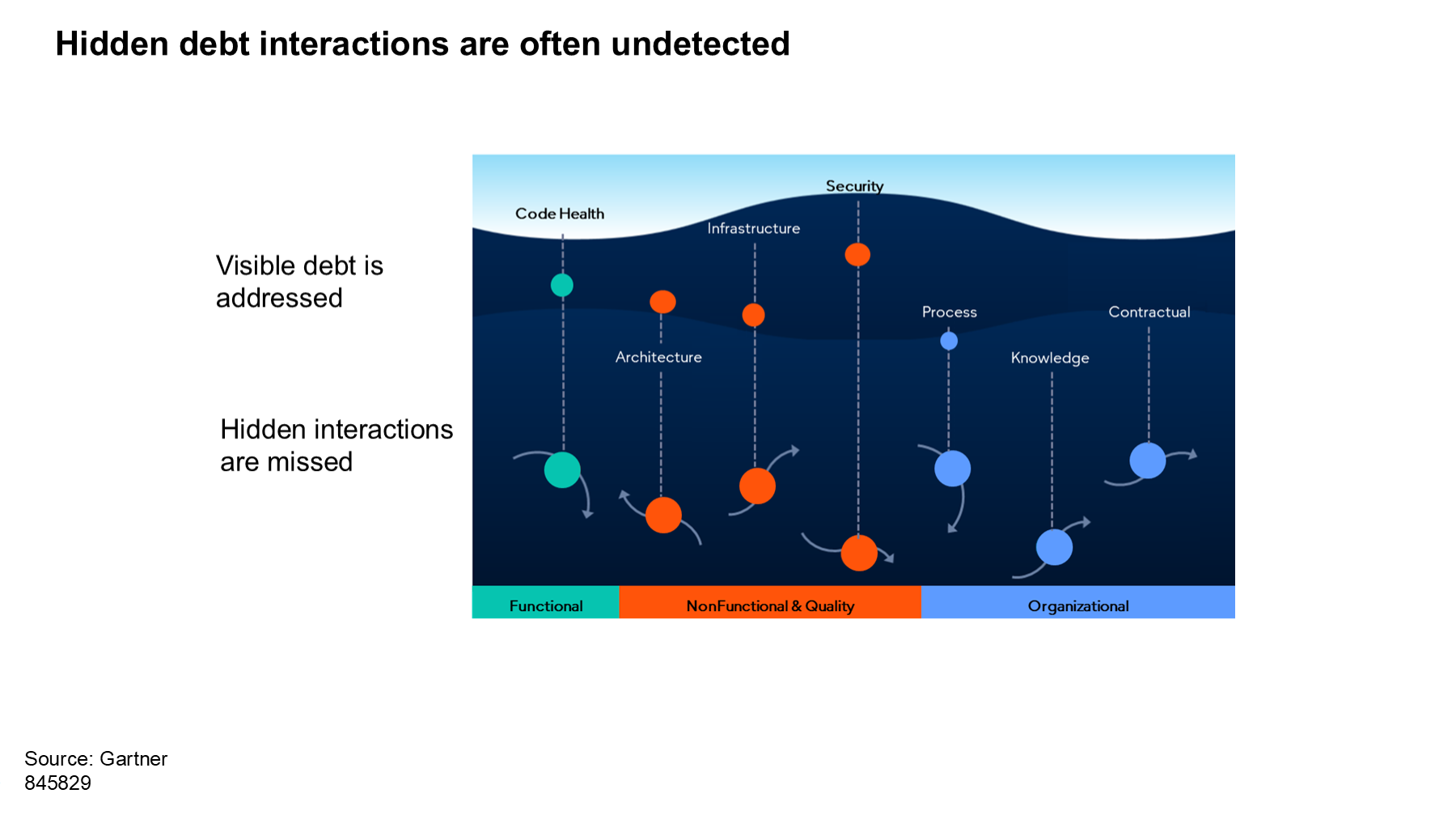
Prioritize Systems With Cross-Cutting Technical Debt Symptoms
Not all technical debt carries equal risk. Prioritize systems where debt backlogs signal cross-cutting friction, with architecture and processes that span multiple teams, encode shared decisions, or require specialized knowledge to change safely. Common examples include policy and rule engines, workflow orchestration, and decision services.
Because intent is embedded directly in their architecture, data models, and rules, these systems are often the first to reflect symptoms of business change. Teams compensate locally through exceptions, workarounds, and manual interventions that relieve immediate pressure, but leave root causes unresolved.
To surface the most consequential technical debt, look for signals that complexity is increasing:
- Multiple teams proposing overlapping or incompatible changes
- Escalating remediation costs or extended delivery timelines
- Reliance on specialized expertise or tribal knowledge
- A pattern of tactical fixes substituting for root cause analysis
These signals indicate that technical debt is no longer localized, but systemic — threatening the organization’s ability to change and create value.
AI can build debt awareness, but also build context debt
The rapid adoption of AI makes these dynamics more visible. AI systems encode intent and assumptions implicitly through data, models, and probabilistic behavior, often without explicit specification or durable traceability. As a result, domain teams can deploy AI systems that meet local outcomes or performance targets while gradually drifting away from business intent.
Building and operating agentic AI systems increases awareness of cross-cutting technical debt because it depends on shared enterprise capabilities and data. At the same time, using AI capabilities dramatically compresses detection and recovery windows. This shortens the time between intent, encoding, and impact — making context erosion visible sooner, and recovery harder once misalignment sets in.
Software engineering leaders should closely monitor AI-related debt symptoms, including shifts in model behavior, declining evaluation scores, rising usage or inference costs, and increased reliance on compensating controls. These signals often indicate that encoded assumptions are diverging from business reality faster than remediation processes can adapt.
Context erosion is the core driver of debt
Organizations with strong debt awareness encounter a consistent pattern: architecture coupling, process bottlenecks, and knowledge gaps that trace back to intent that was weakly specified and then encoded into systems. Over time, these encoded decisions harden into assumptions that no longer reflect how the business operates. Systems remain internally consistent, but become increasingly misaligned with customers, policies, operating models, or decision rights.
Because this misalignment accumulates across systems and teams, remediation focused only on architectural refactoring, process improvement, or knowledge transfer rarely restores adaptability. These efforts address visible symptoms while the underlying context mismatch continues to generate new debt. Figure 2 demonstrates how various forms of debt amplify each other, making the technical debt burden higher, and at the same time making it harder to understand the overall system.
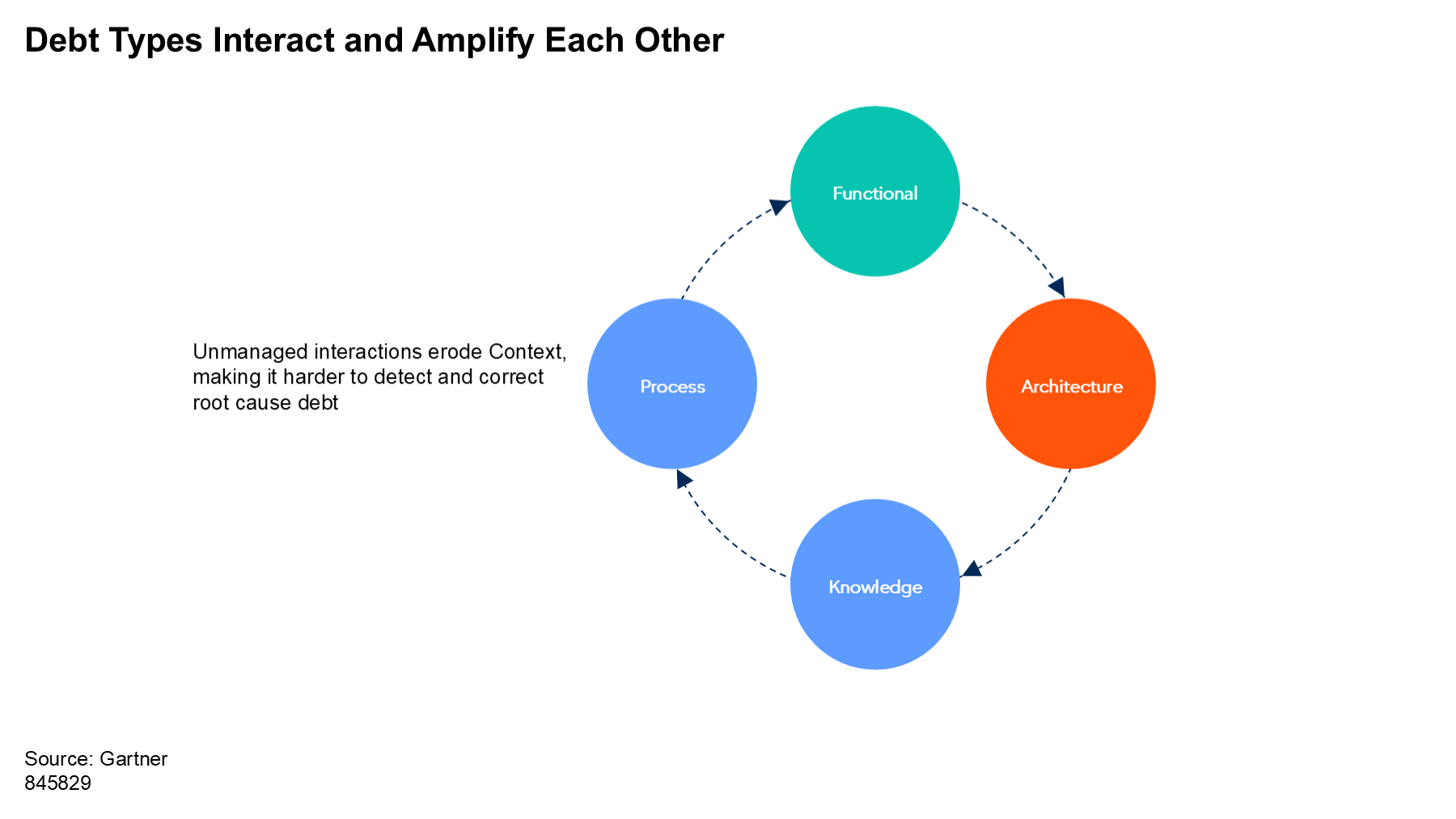
Address context erosion by:
- Monitoring growth in functional and debt backlogs for signals that business intent change such as updates to policy, pricing, decisions, and AI adoption which are outpacing the system’s ability to absorb change.
- Prioritizing systems that require coordination instead of configuration, especially where changes consistently involve multiple teams, manual handoffs, or repeated explanation.
- Watching for compensating behavior, such as rising exceptions, persistent overrides, manual workflow repair, or reliance on specialized knowledge to keep systems functioning.
- Aligning remediation to decision impact, focusing on where misalignment constrains outcomes and recovery time rather than where fixes are easiest to implement.
Debt accumulates unevenly
Software engineering leaders need new models that explain where technical debt concentrates and compounds, so they can identify the most influential drivers and focus remediation on root causes rather than symptoms.
In practice, technical debt surfaces unevenly across three interdependent areas: functional outcomes, system qualities, and organizational capabilities. Organizations often compensate in one area while another erodes — maintaining functional stability through workarounds, for example, while process consistency, architectural coherence, or organizational knowledge degrades.
Over time, these compensations concentrate debt in systems and processes that must coordinate change across teams. As a result, technical debt accumulates unevenly even as local delivery metrics improve, making constraints harder to detect until recovery options narrow.
Most organizations delegate debt detection to specialized domains such as architecture, reliability, security, infrastructure, and process teams. Each domain develops its own tools, language, and signals, optimizing locally against its own risks. While necessary, these localized optimizations rarely surface debt that spans systems, decisions, and teams.
This is the pivot: surface debt signals locally, then connect them across functional outcomes, system qualities, and organizational capabilities to see where debt actually constrains change and value.
Detect (Analyze) and Govern Technical Debt
If the most damaging debt is hidden, then effective technical debt management must begin with making that friction visible and governable, rather than remediating what is already obvious.
Managing technical debt as friction requires integrated capabilities (see Figure 3):
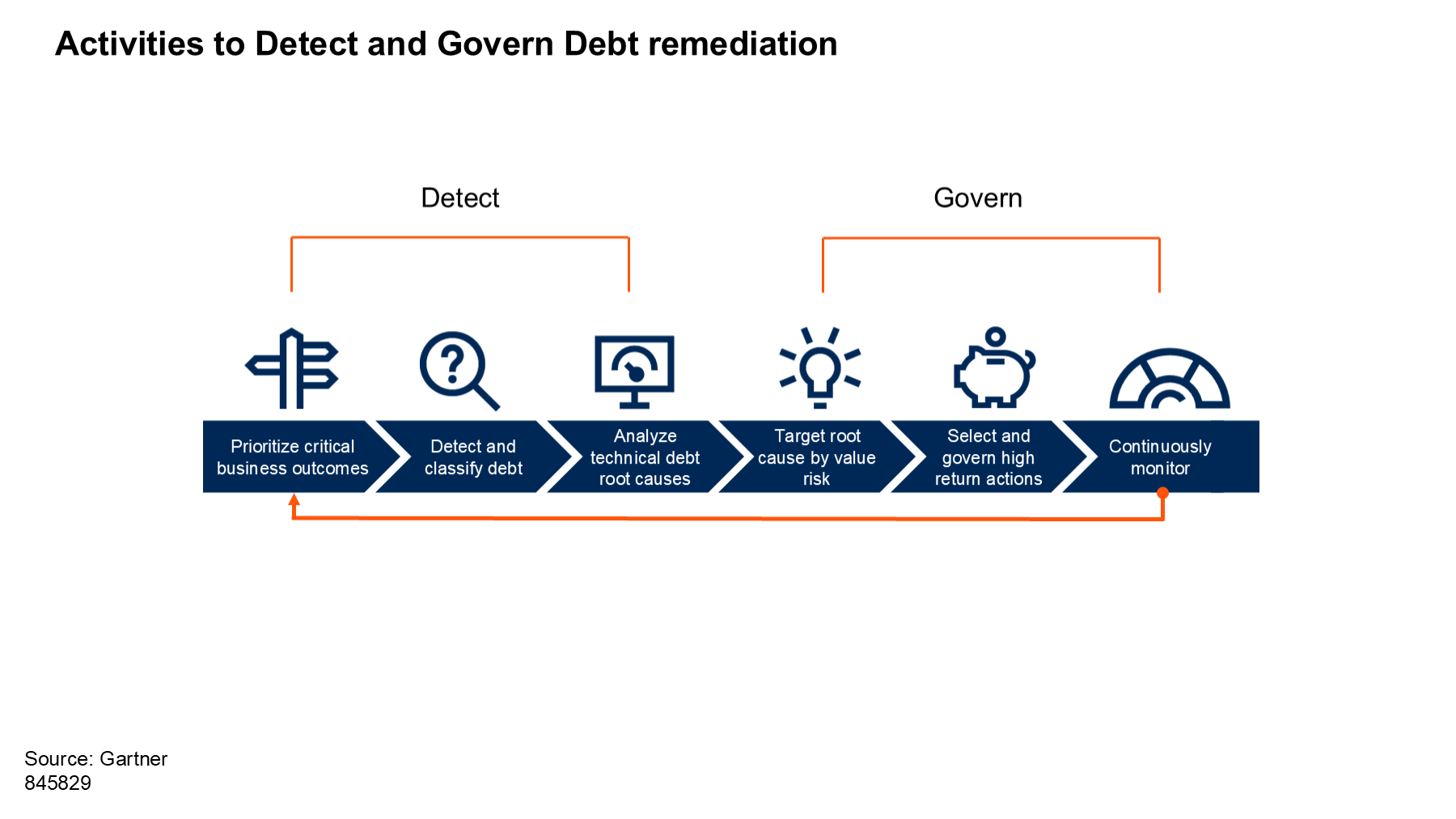
Detection (and Analytical) Activities:
A systematic method to detect, classify, and assess debt:
- Detect where friction accumulates across systems and domains
- Classify friction type (context, architecture, knowledge, process)
- Assess the probability of realization and business impact
- Model remediation economics relative to value at risk
See Focus Technical Debt Reduction Efforts for Greatest Business Impact and Measure and Monitor Technical Debt With 5 Types of Tools.
Governance Activities:
Continuous monitoring of the process to ensure alignment with intervention or remediation. Target interventions based on value at risk, not defect severity:
- Diagnose root causes, typically context friction.
- Decide using value-aligned classification, not binary fix/defer logic.
- Learn from outcomes to refine detection and prioritization.
This approach allows software engineering leaders to focus their debt decisions on classifying strategic choices, rather than brute force ranking of individual debt items.
- Plan: High-potential impact, time available
- Address Now: High-realized impact, clear path
- Ignore: Uncertain realization, monitor context
- Delay: Low impact, better allocation elsewhere
The Gartner PAID framework supports this approach when applied through a value-risk lens rather than technical severity scoring.
See Prioritize Technical Debt With Gartner’s PAID Model and How to Prioritize and Sell Technical Debt Remediation.
Take Focused Action
Organizations must pivot their mindset and processes for managing technical debt to include detection and governance. This pivot requires four actions:
- Establish a value lens
Identify systems like policy and rule engines, workflow orchestration, and decision services that directly encode intent into their components. Map friction in these systems first.
- Integrate domain detection around value
Connect domain-specific signals through shared assessment of value at risk. Follow the signals to the root cause — and address that as a priority. This stops debt from recurring.
- Reframe governance from compliance to investment
Use the PAID qualities of risk, impact and cost to treat debt decisions as portfolio choices aimed at preserving strategic options.
- Measure adaptability, not just debt levels
Track how quickly value-critical systems absorb change. Decision latency and recovery time are more predictive than backlog size.
Debt is unavoidable. The question is whether organizations accumulate it strategically — or discover it too late to respond.
1 Gartner Software Engineering Survey for 2026. This survey was conducted to provide a comprehensive understanding of the current landscape in software engineering, as well as to determine the priorities and strategic challenges of software engineering leaders. It also aims to identify the demand for various roles and skills within software engineering organizations, and assess their budget expectations, team structures and organizational outcomes. Finally, it explores the integration of AI in software engineering workflows and its impact on engineering organizations. The survey was conducted online from August through November 2025 among 482 respondents from the U.S. (n = 360) and U.K. (n = 122). Qualifying organizations operated in multiple industries and reported enterprisewide revenue for fiscal year 2024 of at least $250 million or equivalent. Qualified participants were highly involved in managing software engineering/application development teams and the activities they perform. Disclaimer: The results of this survey do not represent global findings or the market as a whole, but reflect the sentiments of the respondents and companies surveyed.