Guide to Redesigning the IT Procurement Manager Job in the Age of AI
11 March 2026 - ID G00851463 - 16 min read
By Kabeh Vaziri, Yanni Karalis, and 1 more
IT procurement managers must adapt to AI-driven changes by embracing leadership roles, while staying integral to organizational growth. This research guides CIOs and IT SPVM leaders in redesigning the IT procurement manager job to unlock the potential of humans and AI in the future of work.
Insights at a Glance
These insights are part of a series — CIO job guides for IT job redesign in the age of AI. For each IT job, we provide actionable guidance for CIOs and functional heads on how and when to redesign the job in response to AI disruption.
The integration of AI is set to dramatically reshape IT procurement managers’ jobs. Today, they execute orders and use data analytics to shape the procurement process. But as AI capabilities progress, routine tasks, such as sourcing, contracting and analytics will be automated. AI will:
- Reduce traditional manual work, such as documentation, and shift the job toward becoming a steward of oversight, handling exceptions, intervening for high-stakes negotiations, and resolving complex, nuanced risk issues.
- Transform procurement manager teams into lean, multidisciplinary groups that blend digital expertise, business acumen, and advanced collaboration skills.
As AI takes over standard procurement activities, IT procurement managers’ skill sets will need to shift accordingly. Digital process innovation, advanced analytical and AI-assisted sourcing skills will become essential, while traditional transactional buying and procurement support skills will decline in importance. Collaboration will intensify, with IT procurement managers co-creating with IT, security, enterprise architecture, finance and legal teams in AI-driven workflows. Stakeholder engagement will change, as users go through automated channels, limiting direct procurement involvement to strategic needs. Intentional upskilling in AI literacy and digital tools will be crucial for IT procurement managers to remain effective and future-ready in the AI environment.
Impact
IT procurement managers are strategic leaders who align procurement with IT and business objectives. They bridge the gap between operational execution and strategic innovation by adopting risk-tolerant processes and leveraging data analytics to inform outcome-based decisions. Key responsibilities include:
- Alignment with business priorities
- Stakeholder engagement
- Risk-tolerant and data-driven decision making
- Negotiation and contracting
- Strategic sourcing, supplier and cost management
Ultimately, IT procurement managers ensure procurement functions deliver transactional efficiency and strategic business outcomes. IT procurement managers are at risk of being sidelined if they don’t adapt to their organization’s technology change. To stay relevant, they must position themselves as active business partners in formulating sourcing strategy, a function that goes beyond merely executing orders but actively shaping AI-enhanced procurement processes. This requires that they shift from transactional buying to orchestrating and accelerating decision making, redesigning processes to capitalize on automation while maintaining oversight, and become stewards of transformation within their organizations.
Actions
- Prerequisite: Distill the job into measurable, outcome-focused capabilities.
- Step 1: Evaluate how AI changes IT procurement managers’ daily tasks and processes by redesigning workflows to distribute tasks and responsibilities intentionally between humans and AI.
- Step 2: Evaluate the ways in which adoption of AI could change the tasks and activities of the IT procurement manager by identifying tasks AI can and should automate and how human oversight should be exercised.
- Step 3: Build a portfolio of future capabilities to prepare employees for the job’s evolution. Work with IT procurement managers to craft multiple paths to explore and build their capacity to lead in new domains.
- Step 4: Organize teams for high impact. AI-enabled automation allows organizations to shift transaction-focused teams to lean, multidisciplinary groups that blend digital expertise, business acumen, and advanced collaboration skills. Reimagine organizational structures to integrate IT procurement expertise into broader digital, experience, and transformation teams.
- Step 5: Activate capabilities and support change. Train and coach human employees to adapt and grow by providing a safe environment for experimentation and innovation.
Cautions
- Upskilling for jobs of the future is the most predictable path for human workers to build AI-enabled capabilities. However, when AI changes faster than people can adapt, employees may become disengaged. To address this roadblock, CIOs should redesign workflows so human workers embed microskills/microlearning inside tools and use job rotations to build experience and confidence.
- The job risks becoming obsolete unless IT procurement managers adapt to manage risks at the pace of organizational growth.
5 Steps for a Successful Job Redesign
Call to action for CIOs and IT sourcing, procurement and vendor management (SPVM) leaders: Download the attached slide presentation to learn more about redesigning the IT procurement manager job in the new AI world.
Prerequisite: Establish a Common Understanding of the IT Procurement Manager Job
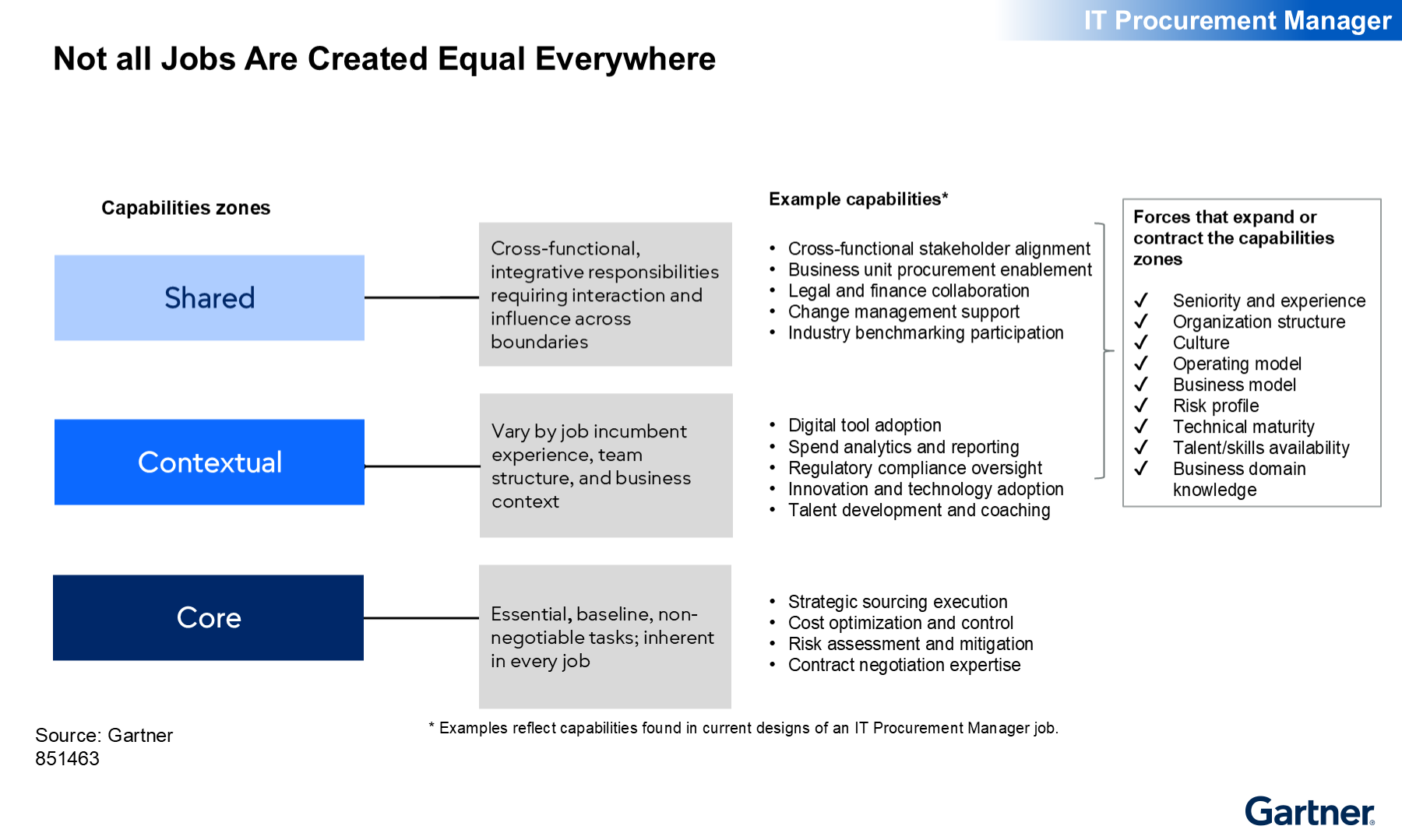
The precise definition and scope of the IT procurement manager’s job may vary by organization. Before redesigning the job, establish a shared understanding among stakeholders of the IT procurement manager’s responsibilities. We have distilled the procurement manager’s job into a concise set of capabilities, grouped into three categories (see Figure 1):
- Core: These are the essential, nonnegotiable capabilities for procurement managers (e.g., strategic sourcing execution and cost optimization and control).
- Contextual: These can vary across organizations and may be included in the ‘core’ of the job, depending on team structure, the capability profiles of job incumbents (e.g., seniority and domain experience), and the organization’s business context (e.g., team size and operating model).
- Shared: These are the cross-functional, integrative capabilities typically required for interaction and influence across boundaries (e.g., cross-functional stakeholder alignment and business unit procurement enablement).
Step 1. Start With the IT Procurement Manager’s Workflows
Your redesign of the IT procurement manager’s job for the AI age should start with the workflows. Determine how tasks and responsibilities will be distributed between humans and AI. Rather than simply layering AI capabilities on top of legacy processes, which often creates extra tasks that lessens efficiency and increases human workers’ frustration, reimagine the IT procurement manager’s job to distribute tasks and responsibilities intentionally. This approach positions AI to deliver capabilities on its promise. Human talent will be deployed where their capabilities matter most, with the key factor in the redistribution being the desired degree of AI autonomy.
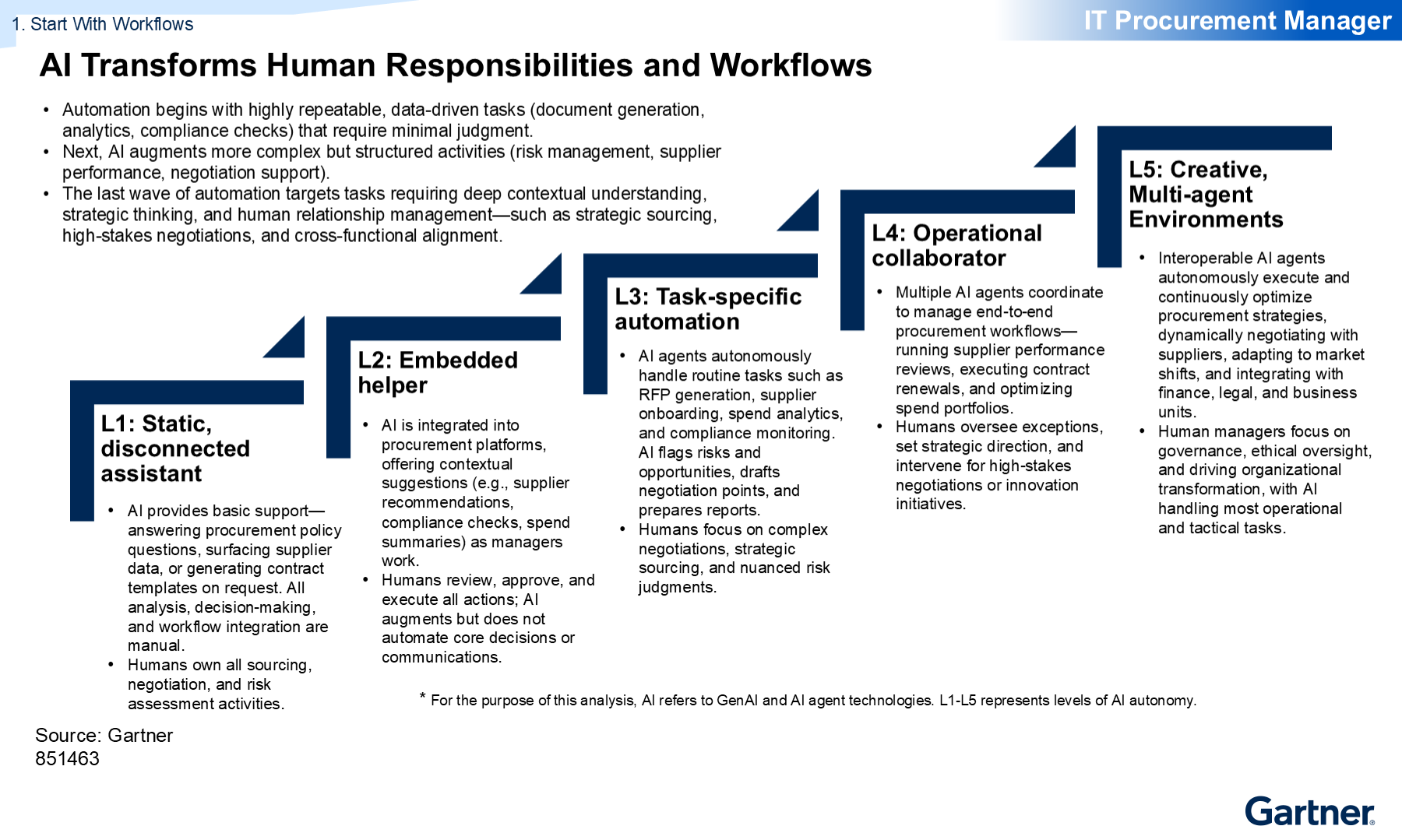
Figure 2 depicts how AI transforms human responsibilities and workflows for IT procurement managers. Each level reflects the extent to which AI can assume tasks within the procurement manager’s job. Here are examples of changes at different levels, ranging from lowest (Level 1) to highest (Level 5):
- Level 1: Automation begins with highly repeatable, routine tasks (e.g., generating contract templates, answering procurement policy questions), that require minimal judgment.
- Level 5: Interoperable AI agents autonomously execute and continuously optimize procurement strategies, dynamically negotiating with suppliers and adapting to market shifts, while integrating with finance, legal and business units.
Step 2. Deconstruct the Job to Assess AI Impact
Next, create a heat map to assess the extent to which AI impacts the core, contextual and shared capabilities of the procurement manager’s job to help determine the needs and scope for redesign. For example, CIOs and SPVM leaders should prepare for developing procurement talent in areas that cannot be easily automated such as cross-functional stakeholder engagement and change management support (see Figure 3).
Ensure that AI investments are tightly integrated into workflows to maximize augmentation, not just automation.
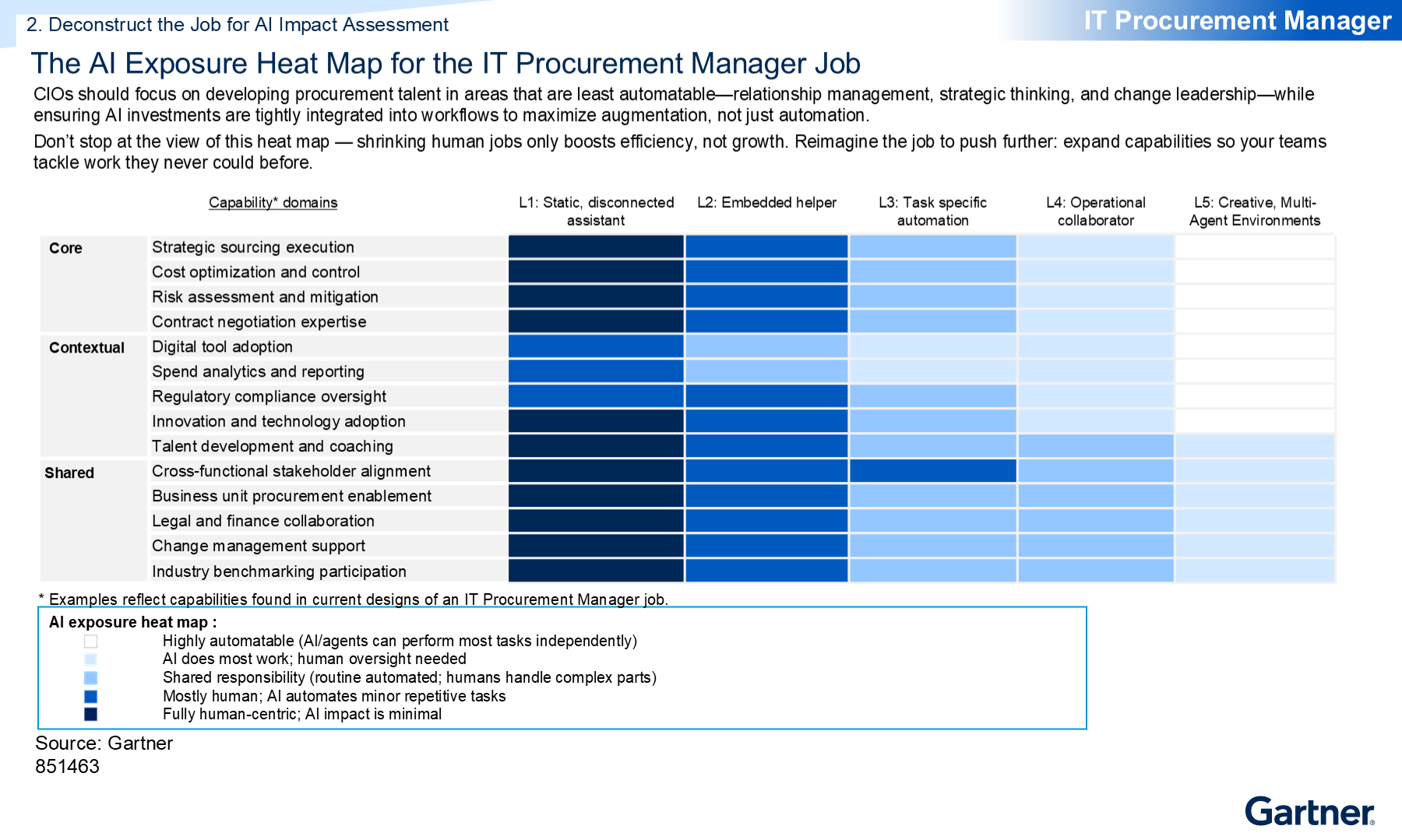
But don’t stop at the view of this heat map. Shrinking jobs boost efficiency, but not growth. Reimagine the job further to expand capabilities so that your teams tackle work they couldn’t do before. Step 3 takes this a step further and emphasizes the importance of building a portfolio of future capabilities.
Step 3: Build a Portfolio of Future Capabilities
As AI is integrated into workflows, human employees will experience a range of emotions, from excitement to doubt, to an existential shift. It is critical for you to be empathetic and support IT procurement managers as they navigate these changes.
Until IT procurement managers reach a more stabilized state, they might not fully support your vision or your promise that they will still have a place in the organization. Without your complete support, their emotional responses may result in quiet resistance and disengagement at a time when you need IT procurement managers to co-create AI-enhanced procurement innovation change with you (see Figure 4).
Develop change reflexes in employees to help teams adapt to ongoing change and uncertainty strengthening their resilience (see Build IT Employees’ Resilience in Response to AI-Triggered Change).
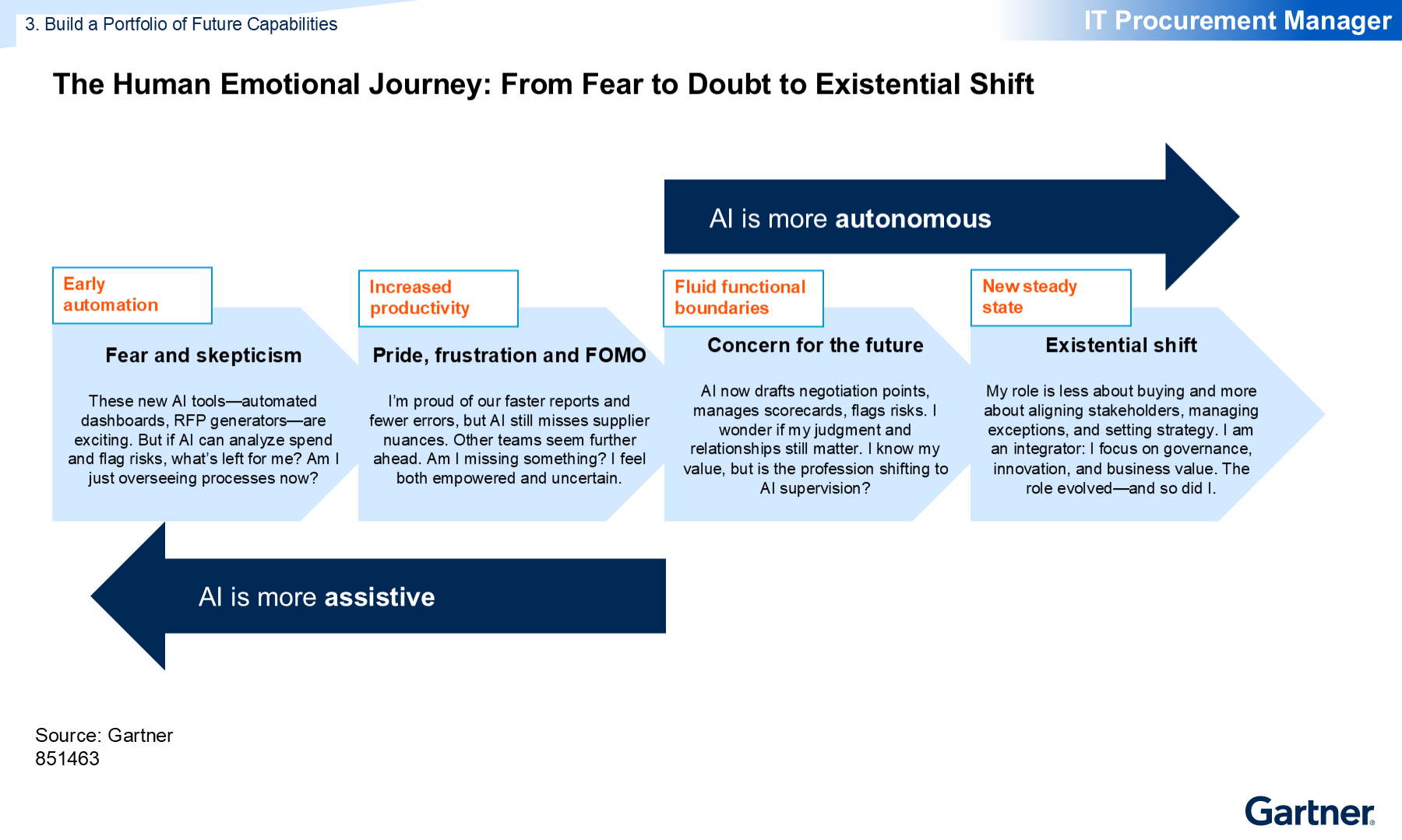
As AI becomes more autonomous, IT procurement managers’ job responsibilities may shrink dramatically as AI now drafts key negotiation points, manages scorecards and flags risk. AI is becoming smarter, while handling more complex tasks, leaving procurement managers wondering where they fit in.
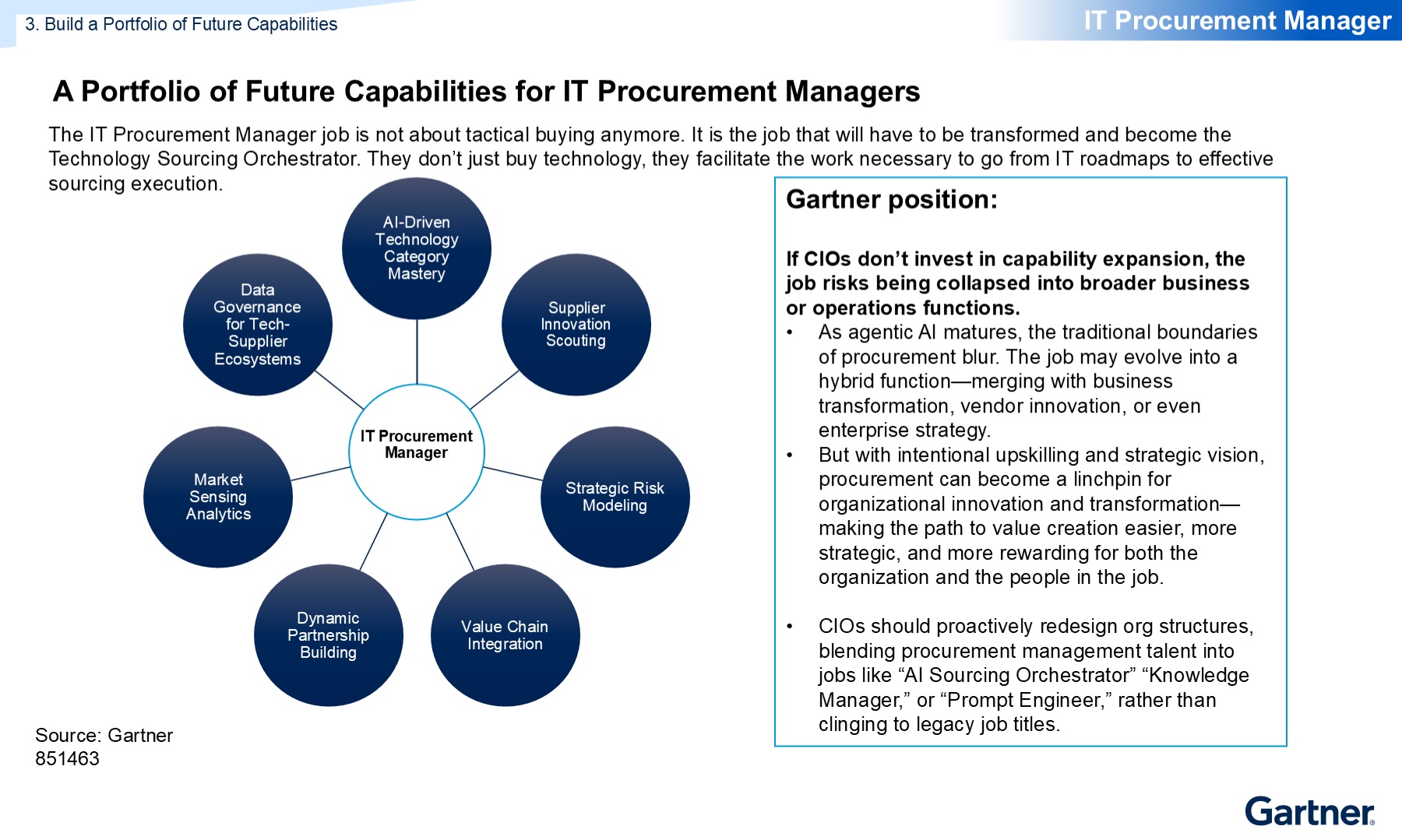
To prepare your teams for this shift, co-create multiple career paths that enable them to explore and strategically build their capacity and readiness to lead new domains. Figure 5 depicts key capability areas where CIOs and SPVM leaders should focus. Lead IT procurement managers to embrace new responsibilities and blend procurement expertise into jobs like technology sourcing orchestrator, knowledge manager and prompt engineer, rather than clinging to legacy job titles (see Figure 5).
Step 4. Organize Teams for Impact
As the IT procurement manager job shifts, so does the work of the IT procurement manager team. We expect the integration of AI into the workforce to bring about the following shifts to IT procurement management teams. The shift entails transaction-focused teams evolving into multidisciplinary groups that blend digital expertise, business acumen with collaboration skills (see Table 1).
Expected Shifts in IT Procurement Management Teams as the IT Procurement Manager Job Changes
| What’s Changing | How It’s Changing |
|---|---|
Who Does The Work |
|
Ways of Working |
|
The Job to be Done |
|
Source: Gartner (March 2026)
Based on these shifts, CIOs and IT SPVM leaders should partner with HR to define and adapt reskilling strategies for IT procurement managers. Here are some elements to consider:
- Headcount compression: Automation of routine support tasks leads to a leaner IT procurement function, concentrating human resources on high-value work.
- Reskilling for digital value: IT procurement teams are being reskilled for advanced analysis, client context stewardship and digital process innovation, sourcing talent from customer success, business analysis and IT operations.
- Organizational design transformation: The evolving job requires reimagined organization structures, integrating IT procurement expertise into broader digital, experience and transformation teams, with new career pathways and feeder jobs.
Step 5. Activate Capabilities and Support Change
As AI capabilities mature and absorb more of the IT procurement manager’s routine tasks, the process will become more efficient. But with AI changing rapidly, the scope of human involvement may become unclear, people may become uncertain about their futures, as new jobs and skills may not be in place when and where they’re needed. To prevent these issues from creating a fragile workforce, time your job redesign for the moment of inflection, set guardrails for changes in human capabilities and manage human behavioral products.
Track Signals to Know When It’s Time to Redesign the Job
Use the following checklist of forward-looking indicators to gauge when the IT procurement manager’s job has shifted to the degree that its new requirements feel more like a stretch (see Table 2). When you have observed many of these indicators, it’s time to formally consider the job redesign.
Inflection Point Signals for When Demand for IT Procurement Managers is Shifting
| Checklist: Inflection Point Signals for When Demand for IT Procurement Managers is Shifting | |
|---|---|
| |
Source: Gartner (March 2026)
Set Guardrails for Changes in Human Capabilities
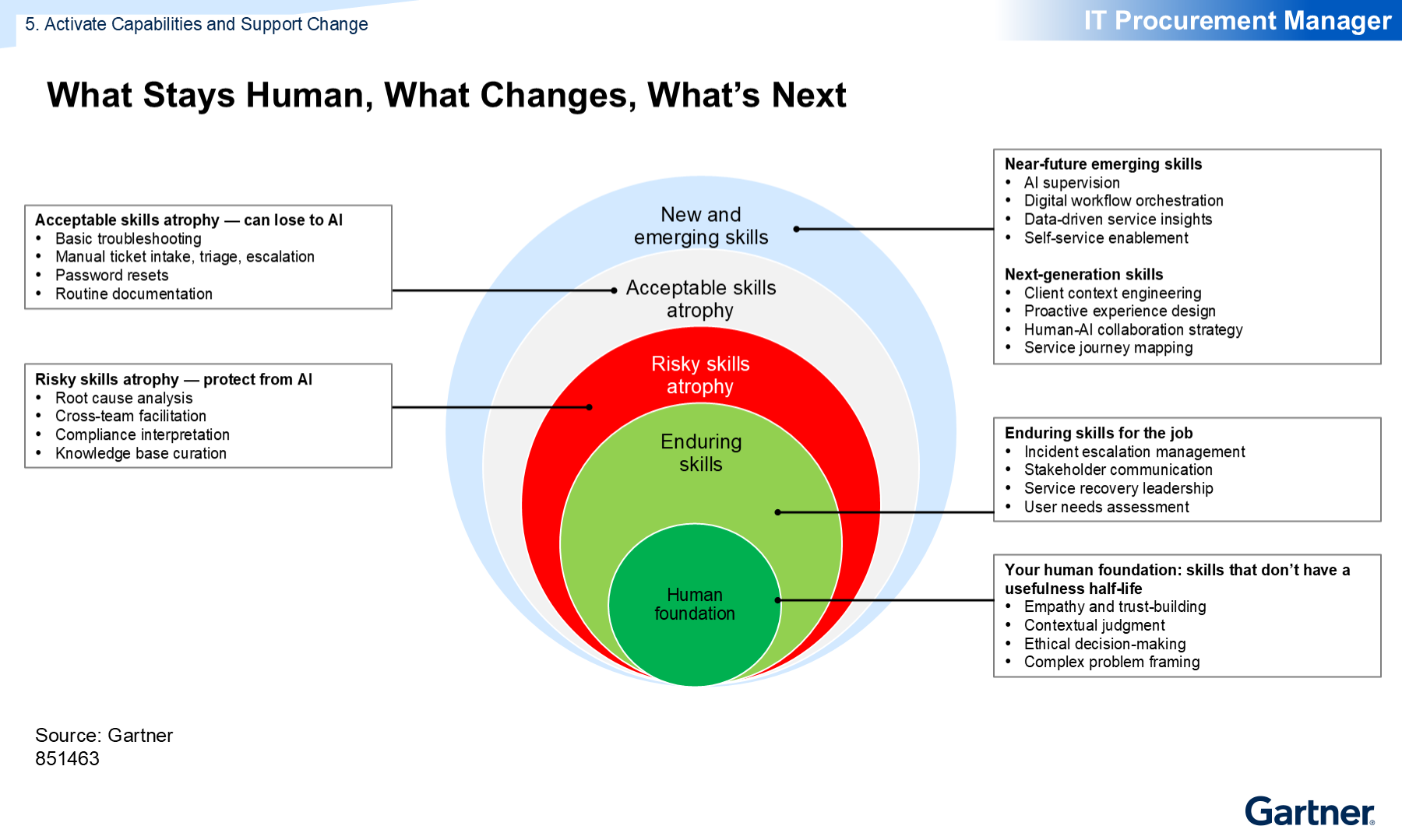
The increasing adoption of AI for routine IT procurement manager’s tasks may lead to unintentional skills atrophy as IT procurement managers perform fewer tasks than before. In addition to just identifying new and emerging skills that IT procurement managers will need for their changing job, CIOs must clearly articulate what skills can be left to atrophy and what skills must be maintained and cultivated.
Skills atrophy is defined as the loss or degradation of human skills and building experiences that occurs when people rely on AI to perform tasks they previously did themselves.
Collaborate with HR to communicate your vision across the organization and be prepared to revisit the discussion as AI technologies mature and business demands for IT procurement managers evolve (see Figure 6).
Manage the Human Behavioral Byproducts of AI Transformation
Human behavioral byproducts are the unintended consequences of actions, decisions and interactions at work.
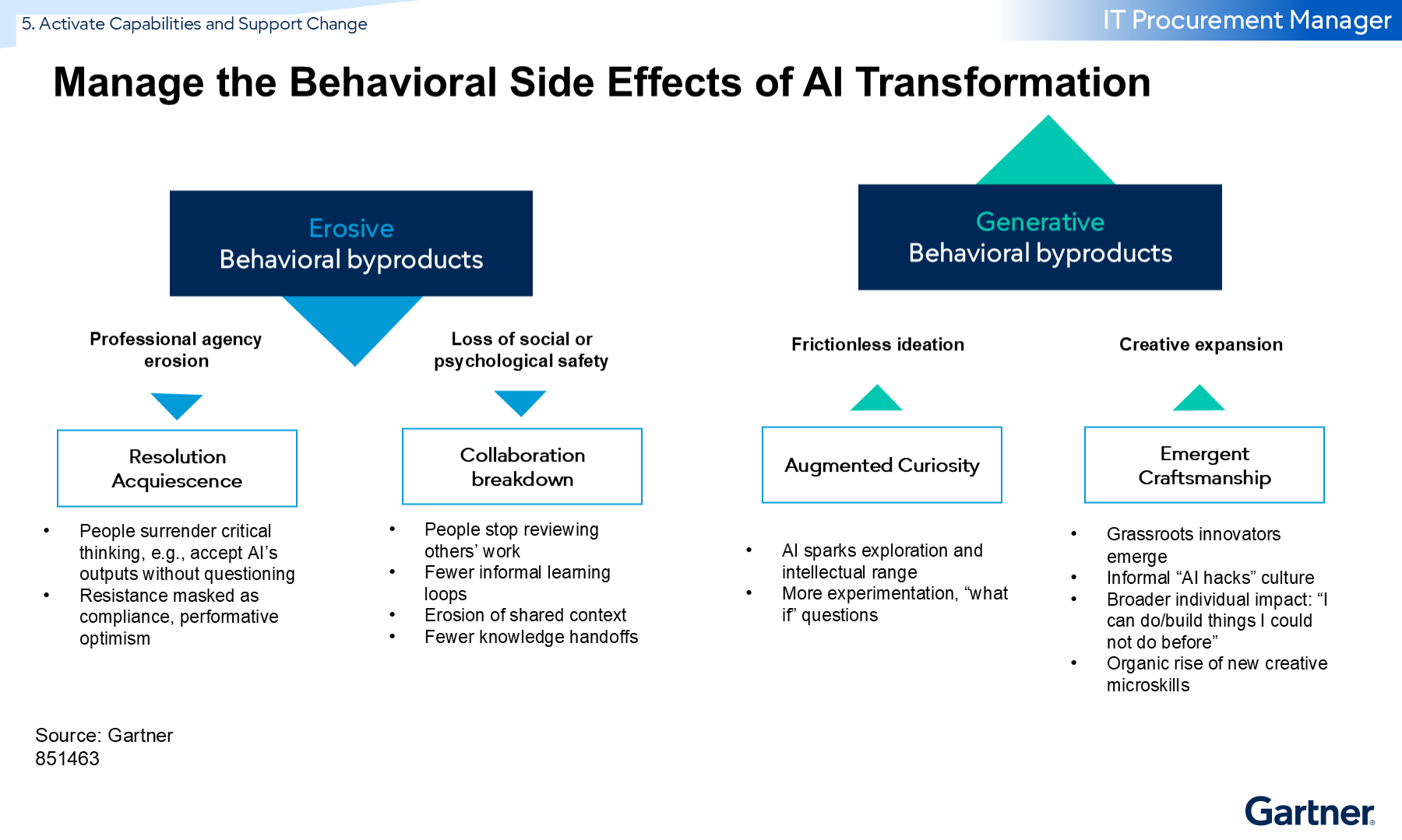
Those behavioral byproducts can be leveraged to train AI systems, inform process redesign and preserve the foundation in human capability areas where automation and AI capabilities lag or where there is a desire to maintain a human edge (see Prepare for AI’s Unexpected Workforce Behavioral Byproducts). Prepare the organization to address AI’s behavioral byproducts, while mitigating the erosive effects and nurturing the generative ones (see Figure 7).
Mitigate erosive behavioral byproducts:
- Threat response results from a perceived erosion of professional agency. For example, the IT procurement manager surrenders all critical thinking to AI, with resistance masking as compliance. This is known as resolution acquiescence. In the Gartner CIO Talent Planning for 2026 survey, 32% of CIOs and senior IT leaders reported overdependence on AI tools for decision making as a byproduct of AI usage at work.1
- One example of a mitigation tactic is to rotate employees through tasks that require skills like regulatory compliance checks, even if AI automates them, to keep human capabilities sharp.
- Collaboration breakdown is a result of eroding social safety. For example, people stop reviewing others’ work and there are fewer informal learning loops.
- One example of a mitigation tactic is to pair senior IT procurement managers with junior IT procurement managers to provide coaching and hands-on commercial risk assessment and cost-optimization analysis to strengthen key skills in these areas.
Nurture the generative behavioral byproducts:
- Augmented curiosity is ignited by frictionless ideation. At this stage, AI frees up capacity for the IT procurement manager to explore new ideas and opportunities.
- As an example, IT procurement managers are freed up to shift their focus from document generation to optimizing procurement strategies.
- Emerging craftsmanship is a result of creative expansion. New grassroots innovators emerge and the culture nurtures informal AI hackathons.
- For example, IT procurement managers learn new microskills, enabling them to focus on driving process innovation and anticipate competitive opportunities they couldn’t do before.
Success Measures
Success in redesigning the IT procurement manager’s job for AI extends beyond operational efficiency. It includes expanding the IT procurement manager’s job for new work, cultivating an experimentation culture with autonomous and innovative teams, as well as supporting long-term retention, mobility and performance. Here are some metrics you can use to track and measure the effectiveness of job redesign and outcome-driven metrics:
Operational efficiency/effectiveness of job redesign: These measures show whether redesign processes and changes are working. Use them for:
- Throughput per IT procurement manager (events completed per period)
- Percentage of rework (e.g., redrafting requirements, reconducting vendor checks)
- Better dashboards, reports and category/sourcing strategy plans
- Number of escalations caused by unclear roles or missing processes
Outcome-driven metrics: Essential for executive decision making on where to invest in improving IT procurement function for business impact:
- Average sourcing cycle time/contracting cycle time (time from request to signed contract)
- Realized cost reduction as a percent of baseline (savings delivered vs. target) — an ODM that reflects direct investment-to-outcome linkage
- Percentage of procure-to-pay activities automated / % of sourcing actions executed by AI agents (measures productivity and AI-enabled process automation)
- Vendor viability indicators — e.g., percentage of vendors with validated financial/roadmap evidence or acceptable risk score (used to manage vendor risk)
- Service availability/vendor delivery SLAs for critical IT stacks (unscheduled outage impact translated to business outcomes) — a technology ODM that procurement influences via contracts and supplier selection
- Time to deploy new capability (from contract signature to production) for transform initiatives — tracks procurement’s contribution to business innovation velocity
- Productivity uplift per procurement FTE (e.g., sourcing outcomes per FTE, or reduction in manual tasks post-automation) — aligns AI/productivity investments to measurable outcomes
AI agent effectiveness metrics (see Tool: How to Measure AI Agents):
- Performance: Focuses on the core business indicators, assessing how effectively the AI agent addresses critical business needs and drives value.
- Capability: Measures the technical prowess of the agent, directly influencing solution costs, system efficiency and engineering priorities.
- Reliability: Gauges the consistency and trustworthiness of the agent’s output, ensuring stable performance without unexpected variations.
Contributors
Kabeh Vaziri, Yanni Karalis, Lily Mok
Gartner has analyzed how automation and augmentation impact workflows in 20+ jobs, including the impact, depth and speed of automation/augmentation across over 300 workforce capability areas. These insights are informed by conversations with CIOs and CHROs on the future of the workforce.
1 Gartner CIO Talent Planning for 2026 Survey. This survey was conducted to understand how CIOs are designing their talent strategy in the AI-driven environment with respect to skills strategies, including training programs and skills evolution, IT organizational design, work design, and different aspects of using AI in work. The research was conducted online from November through December 2025 among 533 respondents across various industries and regions, including Asia/Pacific (n = 133), Europe (n = 150), and North America (n = 250). Qualifying organizations reported enterprisewide annual revenue of at least $50 million or equivalent. Respondents were screened for CIO or senior IT leadership roles with decision-making responsibilities in talent planning strategies and at least awareness of their enterprise’s AI vision and strategy. Disclaimer: The results of this survey do not represent global findings or the market as a whole, but reflect the sentiments of the respondents and companies surveyed.