The Future of Pen Testing Is Continuous Offensive Security Testing
6 March 2026 - ID G00845606 - 10 min read
By Dhivya Poole, Carlos De Sola Caraballo, and 1 more
Traditional penetration testing cannot keep pace with the speed and complexity of today’s IT and threat landscape, risking impactful exposures unvalidated between tests. Cybersecurity leaders must shift to a continuous testing discipline to reduce the risk of falling behind adversaries.
Insights at a Glance
Modern environments now change faster than traditional penetration testing (pen testing) can validate. Rapid cloud deployment, identity changes, API evolution, and AI‑enabled threats are producing exposure windows that periodic, point‑in‑time tests can no longer cover. As a result, cybersecurity leaders must shift to continuous offensive security testing (COST), a trigger‑driven, intelligence-led model that activates validation when material risk changes, not when the calendar dictates.
COST unifies penetration testing, red teaming, bug bounty, and control validation into a continuously operating capability. It blends automation, AI, and human adversarial reasoning to ensure validation is fast, relevant, and aligned to the actual conditions attackers would exploit.
COST mitigates delays associated with multiweek scoping and scheduling by utilizing predefined triggers and risk tiers to commence testing within minutes and achieve completion within strictly governed execution windows. It also aligns directly with CTEM, enabling organizations to validate high‑priority exposures as they emerge, feed evidence into remediation/mitigation workflows, and reduce exposure windows across cloud, identity, applications, and AI/ML systems.
What Cybersecurity Leaders Must Do Now
- Shift to trigger‑driven scoping: Define events that must autoinitiate validation (e.g., new deployments, identity changes, exposed assets, threat‑intel spikes).
- Adopt a risk‑tier model: Classify triggers into high/medium/low to determine urgency and testing depth.
- Modernize method selection: Map triggers to pen testing, red teaming, bug bounty, or control validation.
- Measure outcomes, not activity: Track exposure‑window reduction, trigger‑to‑start time, SLA completion rates, and detection‑coverage lift.
Strategic Planning Assumption
By 2028, over 60% of enterprise pen test programs will operate as continuous validation executed within DevSecOps pipelines and governed by CTEM, replacing annual assessments as the primary proof of resilience.
Issue Context
Point-in-time penetration testing is often inadequate in dynamic operational environments characterized by frequent shifts in release velocity, modifications to identity and privilege configurations, multicloud architectural complexity, and the rapid evolution of AI-enabled attacker methodologies, which can occur on a weekly or even hourly basis. This conventional approach results in extended exposure windows between assessments, necessitates reliance on unverified assumptions regarding the efficacy of controls, and delays the confirmation of exploitable pathways pertinent to critical assets such as customer-facing services, payment processing systems, or regulated data workloads.
COST addresses these inherent limitations by initiating validation in response to change events rather than adhering to a predetermined calendar schedule. Triggers derived from deployment events, configuration divergence, identity updates, and correlation with threat intelligence data determine the immediate testing priorities, while risk tiering governs the urgency and selection of the appropriate validation methodology. By integrating with continuous threat exposure management (CTEM), DevOps, and SecOps frameworks, this model translates validation outcomes into prioritized and accountable remediation and mitigation actions, thereby enhancing service uptime, fortifying fraud prevention capabilities, strengthening data-loss resilience, and ensuring compliance assurance.
The future of pen testing is continuous, business-risk-driven, and guided by threat intelligence. Embedding continuous validation into operational workflows ensures that organizations proactively prioritize and address the real-world attacks that target the most critical and impactful assets.
Impact Brief
Continuous validation of threat exposures is a strategic imperative for organizations operating in dynamic, change-driven environments. It enables organizations to:
- Reduce business risk: Breaches cost millions in direct losses, regulatory fines, and reputational damage. Continuous testing closes exposure gaps and validates defenses in real time.
- Accelerate remediation: Continuous testing shortens identification and mitigation cycles, reducing dwell time and limiting adversarial impact.
- Enhanced operations: COST drives ongoing assurance by embedding iterative validation, supporting automated response mechanisms, and enabling streamlined remediation into existing workflows, thereby ensuring security remains adaptive and proactive.
- Support business priorities and prove resilience: Provides actionable insights tied to critical assets and revenue-impacting processes, enabling informed security investment decisions.
- Champion proactive security: Refocus investment efforts and strategy on proactive security rather than reactive security (see From Defense to Offense: How to Champion Proactive Cybersecurity).
More Detail
Introducing COST
COST is an operating model that redefines penetration testing for environments where risk changes continuously. COST shifts offensive security from periodic, calendar‑driven assessments to an ongoing, trigger‑driven validation, enabling organizations to assess exposure, defensive effectiveness, and response readiness as material changes and new threats emerge. It provides timely, evidence‑based assurance that defenses work against current conditions and not just at a point in time.
For cybersecurity leaders, COST is not a new tool or technique, but the necessary evolution of penetration testing that reorganizes existing practices into an ongoing, operational validation model.
COST combines automation, AI and human expertise to simulate adversarial tactics to validate exposures before attackers exploit them. Using methods such as penetration testing, red teaming, and attack simulations, it validates weaknesses proactively and strengthens defensive and response capabilities against evolving threats.
COST is an operating model for offensive security that validates an organization’s security defenses through trigger‑driven, adversary‑based testing as environments and threats change.
Journey Toward COST
Figure 1 shows the key drivers that are fueling the shift toward COST. These drivers demand timely validation of exposure, defensive effectiveness, and response readiness. They compress exposure windows and invalidate calendar‑based testing, making intelligence‑led validation a strategic requirement for security operations.
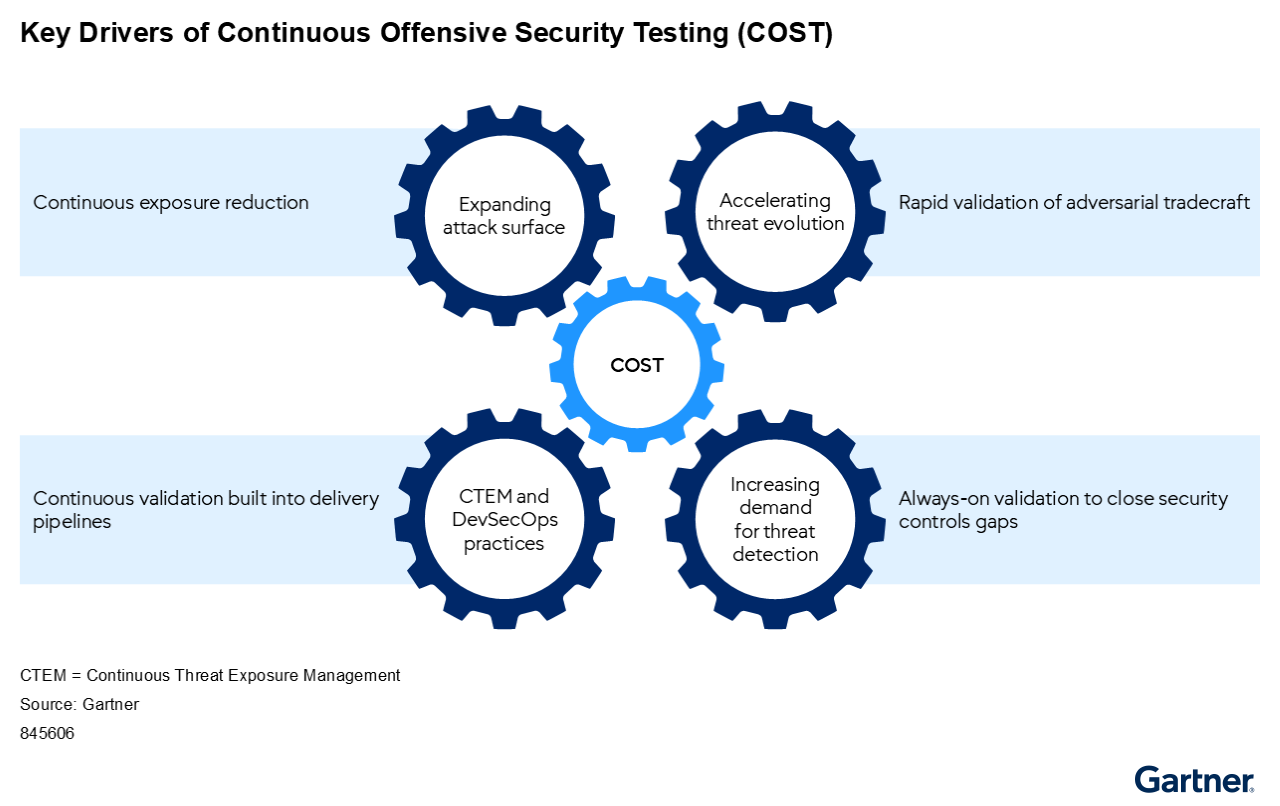
Expanding Attack Surface
The rapid growth of cloud, AI/ML, identities, and hybrid environments creates more entry points for attackers. COST provides real-time visibility and validation across this complex landscape without having to wait for the next test.
Accelerating Threat Evolution
Adversaries constantly innovate to bypass conventional defenses (e.g., VPNs and WAFs). Continuous testing enables verification of new tactics, enabling frequent validation and faster remediation/mitigation.
Increasing Adoption of Continuous Threat Exposure Management (CTEM) & DevSecOps Practices
COST aligns with CTEM (see Use Continuous Threat Exposure Management to Reduce Cyberattacks) and DevSecOps principles by enabling iterative testing, continuous feedback loops, and integrated validation-to-remediation processes (such as automatically creating and routing fix tickets from failed validation tests into CI/CD pipelines), ensuring an up-to-date secure posture.
Increasing Demand for Threat Detection Due Diligence
Organizations recognize the significant risks of relying on ad hoc practices in threat detection. The COST model implements proactive testing that validates detection capabilities in real time, ensuring security controls are effective and resilient against evolving threats.
Four Phases of COST
The COST operating model comprises four phases (see Figure 2):
- Target Definition (Scope) — Identify critical attack paths, and change triggers
- Plan — Select appropriate adversary techniques and validation objectives
- Execute — Conduct automated and human‑led offensive testing in response to change
- Report — Deliver actionable, evidence‑based insights to drive remediation and mitigation
These phases operate iteratively, enabling validation to occur at the speed of change rather than on an annual or quarterly cycle.
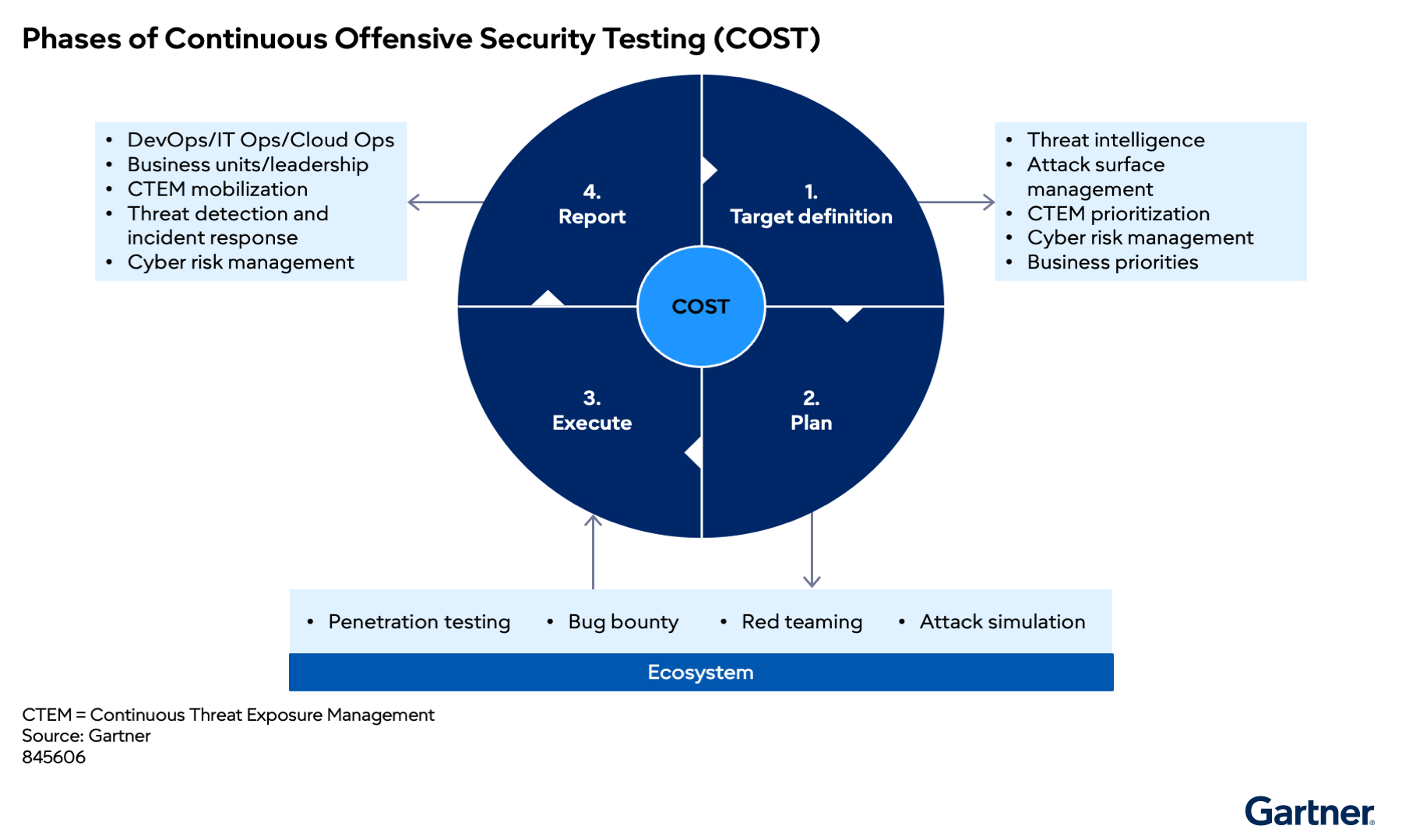
COST is not a linear, start‑and‑stop activity, instead, it operates as an iterative cycle that adjusts scope, depth, and focus in response to material change and emerging risk. Validation is initiated when environments, controls, or threat conditions change; refined as new evidence is uncovered; and used to inform remediation/mitigation and risk decisions on an ongoing basis. This cyclical model ensures testing remains relevant and aligned to real‑world conditions, rather than fixed to predefined schedules.
1. Target Definition: Ensuring the Right Things Are Tested
Defining the right scope is often the most critical challenge in offensive security. COST makes target definition (selecting and defining assets, environments, threats and exposures) continuous and risk‑driven, ensuring each cycle begins with meaningful, high‑impact targets by using multiple external and internal signals including:
- Threat intelligence (campaigns, indicators, active targeting)
- Attack surface management (ASM) discoveries
- DevOps/CI/CD pipelines
- CTEM prioritization (critical, medium, low exposures)
- Control posture changes (SIEM/EDR/IAM updates)
- Cyber risk management inputs (service importance, data sensitivity)
- Observed adversary behaviors
These inputs identify where material risk is emerging and act as a trigger to initiate focused testing. Common triggers include:
- New application or infrastructure deployments,
- Significant configuration or architectural changes,
- Relevant and up-to-date threat alerts
- CTEM “critical exposure” classification
- Zero‑day announcements affecting in‑scope technologies
Combination of external and internal signals such as threats, assets and exposures should be correlated and leveraged to activate offensive testing activities to ensure that validation aligns with meaningful changes in risk (see The Evolution of Threat Intelligence Is Unified Cyber Risk Intelligence).
Every trigger is classified into three risk tiers to ensure that every COST cycle starts with the right focus, urgency and depth:
- High Risk: externally reachable, privilege‑path‑changing, threat‑aligned or CTEM critical priority
- Medium Risk: internal posture changes not expanding exposure
- Low Risk: routine updates with minimal exposure impact
2. Plan: Selecting the Right Validation Approach
Once a trigger initiates a testing cycle, COST shifts from identifying what to test to defining how the validation should be carried out. The plan phase converts the trigger into a structured validation plan that is aligned to specific risk tier, system criticality and required depth to:
- Determine what must be validated (exposure, misconfiguration, privilege path, detection logic, external asset, etc.).
- Identify expected attacker objectives relevant to this trigger (e.g., lateral movement, credential abuse, data exfiltration).
- Define the depth of testing required based on risk tier (rapid validation vs deeper emulation).
Choose the most appropriate validation modality based on the trigger type and execution policy:
- Adversarial exposure validation (AEV) for high‑risk, time‑sensitive confirmation
- PTaaS/Penetration testing for exploitability verification
- Control validation when SIEM/EDR/IAM logic changes
- Bug bounty for new public exposure points
- Threat‑driven red teaming when deeper adversarial tradecraft must be simulated
Clear objectives, rules of engagement (ROE) are defined in response to triggers along with operational timelines and success criteria.
To support speed and agility, integrate with AEV platforms (see Market Guide for Adversarial Exposure Validation), cyber ranges or PTaaS (see Innovation Insight: Penetration Testing as a Service) solutions. These integrations orchestrate the selection, execution, tracking testing activities and support timely mobilization of findings.
3. Execute: Validation at the Speed of Change
The execute phase activates offensive security operations in line with the plan by launching tests when triggers are met, ensuring resources are focused on current and material risk. Deploy chosen methods:
- High Risk (autoinitiate ≤1-2h): AEV/bug bounty/PTaaS or red teaming
- Medium Risk (same‑day): Control validation/PTaaS
- Low Risk: Automated checks: PTaaS
Use hybrid intelligence for depth and scale:
- Automation — repeatable tests, retests
- AI — prioritization, chain prediction, adaptive sequencing
- Humans — chaining, logic flaws, creative adversary reasoning
4. Report: Driving Measurable Outcome
The emphasis of this phase is to act as a decision-support function rather than a documentation exercise. Findings are translated into prioritized remediation and mitigation actions aligned to business impact. Reports are customized to specific stakeholders, such as:
- DevOps (code & guardrails)
- Cloud/IT (config/architecture)
- SecOps (detection & response gaps)
- Executives (exposure‑window trend, reduction in dwell time)
Integrating COST findings directly back into the mobilize phase of CTEM enables rapid response to critical issues, tracking of progress, informing security decisions and to measure risk reduction centrally (see Mobilize Threat Exposure Management to Accelerate Remediation).
Implications for Cybersecurity leaders
For cybersecurity leaders, the implications are clear: assurance can no longer be achieved through periodic testing. In environments defined by continuous change, static testing models leave critical exposure gaps between assessment cycles, precisely when adversaries are operating most effectively.
Cybersecurity leaders must shift from asking “When was this last tested?” to prioritizing “What has changed, and has it been validated?” This requires rethinking offensive security not as a series of discrete engagements, but as a continuous operating capability tightly aligned to risk signals, threat intelligence, and business change.
Without this shift, organizations risk making security decisions based on outdated assumptions, misallocating resources to low‑impact testing, and discovering material weaknesses only after adversaries do. Adopting an ongoing, trigger‑driven model such as COST enables cybersecurity leaders to maintain confidence in security control effectiveness, prioritize validation where it matters most, and directly link offensive testing to measurable risk reduction and resilience capabilities.
The accompanying note, How to Implement a Continuous Offensive Security Testing Program, addresses the practical implementation of COST, turning this necessity into a structured, repeatable operating model.
Contributors
Luis Castillo, Steve Santos, Alex Tytarenko