Sales AI Vendor Race: Comparing Stand-Alone RAO vs. CRM Giants
20 March 2026 - ID G00846847 - 13 min read
By Dan Gottlieb, Adnan Zijadic, and 3 more
As AI transforms the sales tech market, CSOs face a pivotal choice: bring on stand-alone RAO vendors, or invest more in their CRMs. This research reveals the strategic trade-offs between the two options, guiding smarter evaluations and investment decisions.
Insights at a Glance
RAO and the AI vendor strategy conundrum. The revenue action orchestration (RAO) market offers core selling AI capabilities aimed to drive customer acquisition and account expansion, making AI adoption essential for measurable productivity gains. Chief sales officers (CSOs) need guidance on whether to buy RAO from their CRM providers or add a new RAO vendor to their stack. The capabilities associated with the options are not identical, yet they’re competing for budget, resources and attention.
You cannot replace CRM with RAO; you must decide whether to buy RAO from your CRM provider or a stand-alone RAO vendor. Determining the best-fit option depends on factors like corporate AI strategy, available expert resources for deployment and upkeep, and trade-offs between deep configuration and speed-to-value.
Stand-alone RAO vendors are attractive to sales buyers. Sales teams value the look and feel of specialized sales AI, the shorter time to value, and the opportunity to manage RAO within their function because it requires less configuration. Deployment of stand-alone AI tools is linked to bottom-line revenue and profitability outcomes. However, stand-alone RAO also requires licensing costs and CRM interoperability to implement; it will not replace CRM.
Adding RAO within CRM platforms is attractive to IT buyers. CRM teams deliver RAO on top of centrally governed data, configuring AI capabilities within the enterprise ecosystem with consolidated licensing costs. However, CSOs must accept trade-offs; implementing RAO in CRM requires architecting experiences across multiple CRM SKUs, requiring builder resources, increasing time to value, and possibly taking on hidden costs. Verify “feature-parity” claims to ensure true orchestration and context-aware AI.
Strategic Planning Assumption
By 2027, 95% of sellers’ research workflows will begin with AI (whether they choose to or not), up from less than 20% in 2024.
By 2030, 80% of sales leaders will consider AI integration in sales workflows to be a critical factor for competitive advantage.
By 2030, 80% of sales leaders will consider AI integration in sales workflows to be a critical factor for competitive advantage.
Issue Context
The AI vendor race is blurring category lines between CRM and RAO: AI capabilities like advanced activity intelligence, account/buyer intelligence, AI sales assistants and AI-guided actions are causing rapid capability overlap across the market, creating confusion for sales leaders trying to modernize their tech stacks. This problem is especially acute as CRM vendors caught up and are offering similar RAO capabilities.
High stakes for AI vendor decisions: CSOs must ensure RAO investments coexist with CRM effectively by managing critical trade-offs impacting AI maturity. 77% of sales leaders cite improving the integration of new technology with their current tech stack as a top change needed to meet revenue goals in 2027.1
Conflicting stakeholder priorities: IT, finance teams and CRM renewal cycles put pressure on CSOs to consolidate spend within existing CRM contracts, requiring sales leaders to clearly justify spend for stand-alone RAO tools. Four out of ten CSOs and sales execs believe their IT leaders are disconnected from sales’ business goals for revtech purchases,2 creating internal friction in the pursuit of AI vendor partners.
Distinct architectural roles: Despite surface AI similarities, CRM platforms are the essential sales data infrastructure. They serve as the indispensable systems for managing data models, enabling governance, and connecting sales data to the wider enterprise, whereas RAO vendors provide the specialized context and action layers necessary for specific sales execution and orchestrations.
Conflicting stakeholder priorities: IT, finance teams and CRM renewal cycles put pressure on CSOs to consolidate spend within existing CRM contracts, requiring sales leaders to clearly justify spend for stand-alone RAO tools. Four out of ten CSOs and sales execs believe their IT leaders are disconnected from sales’ business goals for revtech purchases,2 creating internal friction in the pursuit of AI vendor partners.
Distinct architectural roles: Despite surface AI similarities, CRM platforms are the essential sales data infrastructure. They serve as the indispensable systems for managing data models, enabling governance, and connecting sales data to the wider enterprise, whereas RAO vendors provide the specialized context and action layers necessary for specific sales execution and orchestrations.
Impact Brief
Over 90% of sales leaders say their current sales tools are not fully aligned with seller workflows1; when investing in AI, they must address this issue to help them sell more. Yet their CRM vendors and potential RAO vendors are all rolling out similar capabilities, forcing tough vendor choices. These choices cause friction and alignment challenges with IT and finance when deciding who to buy AI tooling from.
While CRM platforms are necessary for storing and tracking data, keeping them updated with the actual details of every deal takes more time than sales teams have. RAO fixes this by automatically capturing those details and organizing the work in a way that standard CRMs can’t do without significant configuration.
While CRM platforms are necessary for storing and tracking data, keeping them updated with the actual details of every deal takes more time than sales teams have. RAO fixes this by automatically capturing those details and organizing the work in a way that standard CRMs can’t do without significant configuration.
CSOs and their technology teams must articulate these distinct value propositions to IT and finance stakeholders. Choosing the right mix of foundational CRM stability and specialized RAO agility is essential to accelerate AI adoption, optimize seller workflows, and drive immediate revenue impact.
More Detail
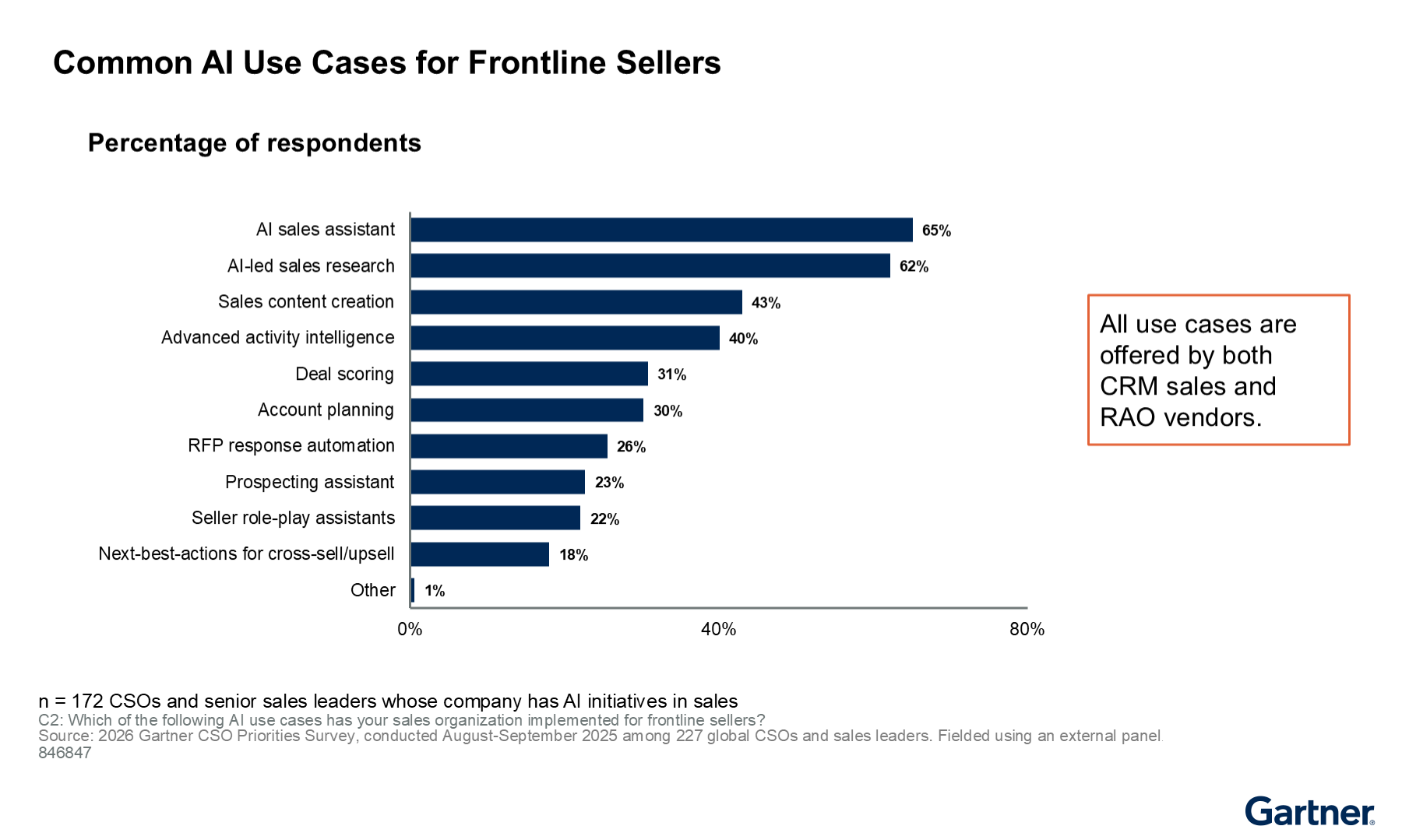
Most AI use cases supporting frontline sales fundamentals3 (see Figure 1) are supported by RAO vendors (see Critical Capabilities for Revenue Action Orchestration). However, since these capabilities are offered by both CRM and stand-alone RAO vendors, CSOs often find it difficult to align with their sales operations and IT partners on the feasibility and value of potential AI sales vendors.
Why RAO Is Needed To Improve Sales Productivity
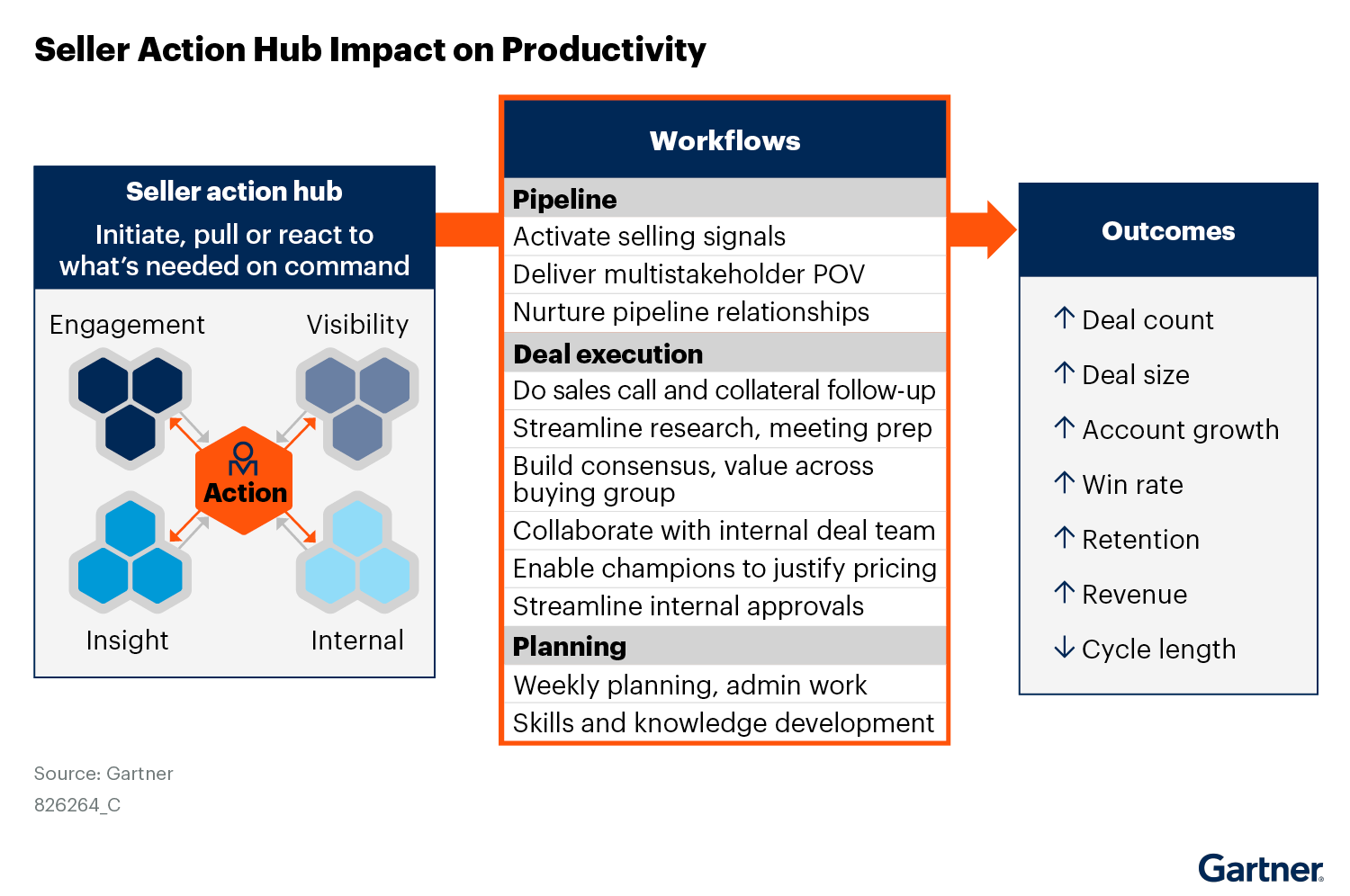
RAO presents a paradigm shift in how sales teams work, depicted as a system of action in the “Seller Action Hub” in Figure 2 (see Increase Sales Productivity With an AI-Powered Seller Action Hub). This paradigm enables frontline sales teams to manage customer engagement, AI-powered decision making and records management workflows within the same user experience. RAO tools free up time and effort to focus on higher-value pipeline prospects, deal execution and planning workflows.
Why RAO Cannot Completely Replace CRM
One cannot simply replace a CRM platform with an RAO tool. The CRM platform provides the necessary data architecture and governance that RAO tools inherit and build upon.
While CRM platforms have added RAO capabilities, the core function of a CRM platform remains distinct: it provides the essential infrastructure for sales data models, acting as the backbone where sales strategy is digitally governed. They handle mission-critical capabilities that RAO vendors do not support, such as:
- Essential sales data model foundations, governance and hierarchy: This includes managing territory structures, access rights, and account/deal ownership rules. Sales teams take meaningful action inside of CRM sales, primarily focused on managing records (i.e., lead, activity, account and opportunity management). The primary value of these actions is in capturing data from the frontline for management decision making and accountability.
- Enterprise interoperability: This entails connecting sales data to the “back of the house” (finance and delivery), as well as adjacent “front of the house” systems like marketing and customer service.
- Agentic AI platform extensibility: CRM platforms serve as a foundation for agentic AI platform development, custom application development, prebuilt applications in a marketplace, and industry-specific data models.
Where RAO Can Supercharge CRM
Where RAO capabilities from CRM platforms offer broad utility, stand-alone RAO vendors compete on frontline-specific depth and context.
Stand-alone RAO vendors are best known for the AI capabilities specifically designed for distinct jobs-to-be-done (JTBD) within sales, such as the workflows of an account executive, account manager, frontline sales manager, and sales leader. Examples include:
- Action layer: RAO requires less configuration to implement sales planning, intelligence gathering, administrative tasks, and customer messaging in a single interface. This enables sellers and colleagues to collaborate on deals, augmented by AI assistants and agentic AI capabilities.
- Context layer: AI capabilities that require customer context to be valuable, such as the AI sales assistant, advanced activity intelligence and deal scoring, offer value out-of-the-box. They use graph technology to map relationships, delivering value quickly with less setup. However, this context layer is highly dependent upon CRM sales data models.
- Revenue-specific agent orchestration: Sales-focused AI agents (deal-risk alerts, team-selling briefs, prospecting assistants) link insights directly to action, with less configuration than CRM.
- Community and expertise: Bundled thought leadership, professional services, and specialized user communities offer deeper, sales-centric support than many CRM sales platforms.
Comparing the AI Sales Assistant Capability
Analysis of the capability reveals the trade-offs required to implement RAO in a CRM platform versus using a stand-alone vendor, depicted in the table below. Where CRM integration offers customization, stand-alone RAO offers the pareto principle, where 80% of the capability’s value comes from 20% of the workflows it supports.
The AI sales assistant capability provides an easy-to-use interface that allows sellers to ask questions, receive guidance or nudges, access collateral, and compose customer communications.
The AI sales assistant capability provides an easy-to-use interface that allows sellers to ask questions, receive guidance or nudges, access collateral, and compose customer communications.
Simplified Example of Configuring AI Sales Assistant Between CRM and Stand-Alone RAO Vendors
AI sales assistant | Stand-alone RAO | CRM |
Design philosophy | Chat UX where users can ask questions and compose messaging using activity intelligence, queryable across accounts, deals, contacts, or meetings. | Chat UX customizable to support a wide range of query workflows, such as proactive nudges to update records or help answering questions about specific products. |
Setup | No capability-specific setup required; AI sales assistant is presented within specific RAO modules. | Admins configure AI assistant capabilities using agentic AI building tools, such as no-code logic builder, skill designer, data-repository, or prompt builder. |
Data readiness | No capability-specific data readiness requirements. | Admins associate relevant data to AI sales assistant workflows. Relies heavily on quality of CRM metadata framework to ensure AI understands relationships between data sources informing AI responses. |
(Based on customer inquiries and Critical Capabilities analysis) | ||
Source: Gartner (March 2026)
Framing RAO evaluations
When evaluating whether to partner with CRM or stand-alone vendors to deliver RAO, consider the following:
- Strategic alignment with corporate AI strategy. This choice should balance the CSO’s vision for sales technology to improve sales productivity with corporate AI strategy. If the CIO’s vision is to incorporate data across sales, marketing, service, finance (ERP), and the organization is willing to build highly customized, industry-specific workflows, lean toward the CRM provider to deliver RAO. If the organization needs to rapidly accelerate frontline sales productivity, deploy out-of-the-box AI plays and capabilities, and wants to rely on AI with less IT dependencies, lean toward stand-alone RAO vendors.
- The choice should be defensible internally based on ROI, not just costs. This requires detailed analysis of trade-offs between configuration and resource costs. A major source of friction arises when IT and finance pressure CSOs to consolidate spend with their existing CRM sales vendor to save money. AI capabilities like the AI sales assistant require significant configuration and grounding in CRM sales platforms. However, configuration can enable the AI assistant to handle a wider range of situations compared to out-of-the-box AI sales assistants common in RAO solutions.
- Speed-to-value. RAO solutions usually deliver value faster because they come preconfigured for B2B sales motions and are easier to use. If your IT organization lacks a robust sales focus, including CRM developers, investing in RAO from CRM may result in lower adoption and stalled AI maturity within frontline AI teams.
When Evaluating RAO Capabilities of CRM vs. Stand-Alone RAO
Actions
- Frame RAO and CRM sales as complementary: The question isn’t whether or not you need RAO capabilities; the answer to that is yes. The question is whether you need to do it via your current CRM provider or a specialized RAO vendor. Clearly articulate to stakeholders that RAO capabilities are the context layer for execution, while CRM is the governance infrastructure. Frame them as complementary, not competitive.
- Customize Critical Capabilities for Revenue Action Orchestration. Use the report’s custom-weighting feature to tailor your RAO Critical Capabilities assessment; assign higher weight to specific capabilities based on resource efficiency, cost, or configurability given your organization’s constraints and priorities.
- Audit internal sales IT resources: Before succumbing to pressure to consolidate on your CRM, assess your internal support. If you have limited CRM developers and sales architect resources available, prioritize investing in specialized RAO solutions to ensure immediate productivity gains.
- Leverage the ecosystem: Use your CRM’s application marketplace to find RAO vendors that integrate natively, ensuring you get the execution speed of RAO without breaking the data foundation of your CRM, or needing clunky integration workarounds that cancel out the benefits of RAO.
Cautions
- Don’t expect RAO to fully replace the CRM platform: RAO tools rely on the data structures and hierarchies defined in your CRM. Attempting to run a complex sales organization solely on an RAO platform often leads to governance failures.
- Beware of “feature parity” claims: Your team will need to build the muscle required to verify if vendor claims meet the specific orchestration and context-aware AI workflows your team needs. Vendors will keep adding overlapping AI capabilities they claim are competitive. For example, a CRM vendor may claim to have an inbound lead management agent, or a stand-alone RAO platform may offer an AI avatar for lead management, but it may not meet organizational requirements for humans-in-the-loop and routing requirements needed for reliable performance.
- Keep an eye on costs: Some CRM vendors push their customers to purchase the premium edition of their product and access to a cross-functional data architecture in order to gain all capabilities of an RAO solution. Be sure to include total cost, such as the all-in maintenance, trade-offs of technical resources required to build and test, credit costs for the AI capabilities to perform work, opportunity cost of other projects and additional SKU access required in your vendor evaluation criteria.
1 2025 Gartner CSO Priorities Survey. This survey was conducted to understand the top priorities, challenges and opportunities for chief sales officers in 2025. The survey was completed from October 2024 through December 2024 with an online sample of 246 heads of sales and senior sales leaders across North America (n = 165), Western Europe (n = 46) and Asia/Pacific (n = 35). Qualifying respondents belonged to a sales function of an organization with enterprisewide annual revenue in 2024 of at least $100 million or equivalent. Industry segments included manufacturing, information technology and high tech, banking and financial services, and pharmaceuticals. Disclaimer: The results of this survey do not represent global findings or the market as a whole, but reflect the sentiments of the respondents and companies surveyed.
2 2025 Gartner RevTech Survey. This survey was conducted to help sales leaders understand how to build a sales tech stack that drives revenue growth and seller performance, and how to structure sales tech leadership to ensure effective decision making about sales technology. The survey was completed from August through September 2025 with an online sample of 202 CSOs and senior sales executives across North America (n = 156), Western Europe (n = 38), and Asia/Pacific (n = 8). Qualifying respondents belonged to a sales function of an organization with enterprisewide annual revenue in 2024 of at least $100 million or the equivalent. Industry segments included manufacturing, information technology and high tech, banking and financial services, and healthcare. Disclaimer: The results of this survey do not represent global findings or the market as a whole, but reflect the sentiments of the respondents and companies surveyed.
3 2026 Gartner CSO Priorities Survey: This survey was conducted to understand how sales leaders are preparing their organization for future uncertainties, defining their sales culture and prioritizing seller skills to drive sales outcomes. The survey was completed from August through September 2025 with an online sample of 227 CSOs and senior sales executives across North America (n = 152), Western Europe (n = 38) and Asia/Pacific (n = 37). Qualifying respondents belonged to a sales function of an organization with enterprisewide annual revenue in 2024 of at least $100 million or equivalent. Industry segments included manufacturing, information technology and high tech, banking and financial services, and healthcare. Disclaimer: The results of this survey do not represent global findings or the market as a whole, but reflect the sentiments of the respondents and companies surveyed.