Use Immutable Endpoints to Defeat Ransomware, Stop Configuration Drift, and Guarantee Rapid Recovery
27 February 2026 - ID G00845723 - 9 min read
By Franz Hinner, Eric Grenier, and 2 more
Endpoints are an organization’s most fragmented, porous surface. CISOs should use this research to transition to the Workspace Immutable Secure Endpoint (WISE) model — a strategy that centralizes security to reduce attack vectors by aiming to eliminate persistent mutable endpoints.
Insights at a Glance
Mutable, agent-heavy endpoints create technical debt and remain a primary beachhead for attack. CISOs seeking to test immutable endpoints, or if ready to fully move to an immutable endpoint setup should use the WISE model transition plan. The phases are designed for controlled deployment; resulting in a more secure environment by reducing mutable endpoints, reducing configuration drift, and recovery times without relying on hardware logistics.
Key Insights:
- Break ransomware kill chains by using immutable endpoints that revert to pristine on reboot, removing persistence for low-and-slow attacks.13
- Slash hybrid worker downtime by 98% by replacing slow physical device swaps with automated firmware-level rehydration.1-3
- Protect DEX rigorously to avoid friction that drives users into unmanaged shadow IT.
Take Action:
Segment users by mission-criticality, risk, and SaaS-only needs to target Cloud DaaS, stateless OS, or secure BYOD.
- Mandate Ephemeral OS disks for cloud workloads and stateless OSs, like IGEL, ChromeOS, on edge devices so every reboot wipes persistence and enables minute-level recovery.
- Shift the control plane to identity by enforcing continuous conditional access at the primary IdP and governing data paths through secure enterprise browsers.
- Validate success with continuous DEX telemetry mapped to outcome-driven metrics, proving cloud execution sustains or improves productivity versus premigration baselines.
Strategic Planning Assumption
By 2030, immutable workspaces will become the primary interface for 30% of the workforce, necessitated by the need to neutralize AI-driven ransomware and cut support costs by 30%.4-12
Impact Brief
- Reduce attack surface by eliminating the configuration drift that causes 22% of enterprise endpoint controls to silently fail or drop out of compliance by transitioning to immutable, stateless workspaces. This architectural shift mechanically denies ransomware the local persistence it needs to dwell and spread across the network.11
- Ensure business continuity by protecting revenue and reputation by shifting disaster recovery timelines from an industry average of over seven months down to minutes. Mandating automated, stateless workspace refreshes completely bypasses the catastrophic downtime associated with manual reimaging after a malware event.13
- Unlock security budget by retiring complex on-device agents and patch tools, reclaiming up to 30% of endpoint OpEx for threat hunting.
- Satisfy insurability by using verifiable immutability to meet carriers’ hardened posture expectations.
Actions
- Segment users by business impact and vulnerability to prioritize mission-critical and high-risk roles for immediate immutable resilience.
- Enforce a no-local-persistence rule by redirecting local folders to secure cloud storage with encrypted offline caching, eliminating data liability.
- Isolate legacy Win32/64 apps using application publishing, like Cameyo, Amazon Workspaces Applications, Citrix Virtual Apps. Delivering just the app eliminates OS vulnerabilities and guarantees stateless recovery.
- Shift security trust from the physical device to user identity by mandating context-aware access and MFA exclusively at the cloud workspace entry.
Cautions
- Anticipate executive pushback regarding lost local data and customizations. Refuse appeasement via mutable cloud PCs, which merely shift ransomware targets to the data center.
- Mitigate network outage paralysis by mandating 5G failovers, and explicitly disqualify extreme-latency environments from cloud-exclusive deployments.
- Prevent ransomware persistence by swapping traditional workspaces for virtual workspaces and strictly managed enterprise browsers based on usage needs.14,15
How to Execute
Agent-heavy endpoints allow ransomware persistence and configuration drift. Use this research to transition to the WISE model, utilizing this four-phase roadmap to enforce stateless workspaces that wipe threats automatically and guarantee operational continuity.
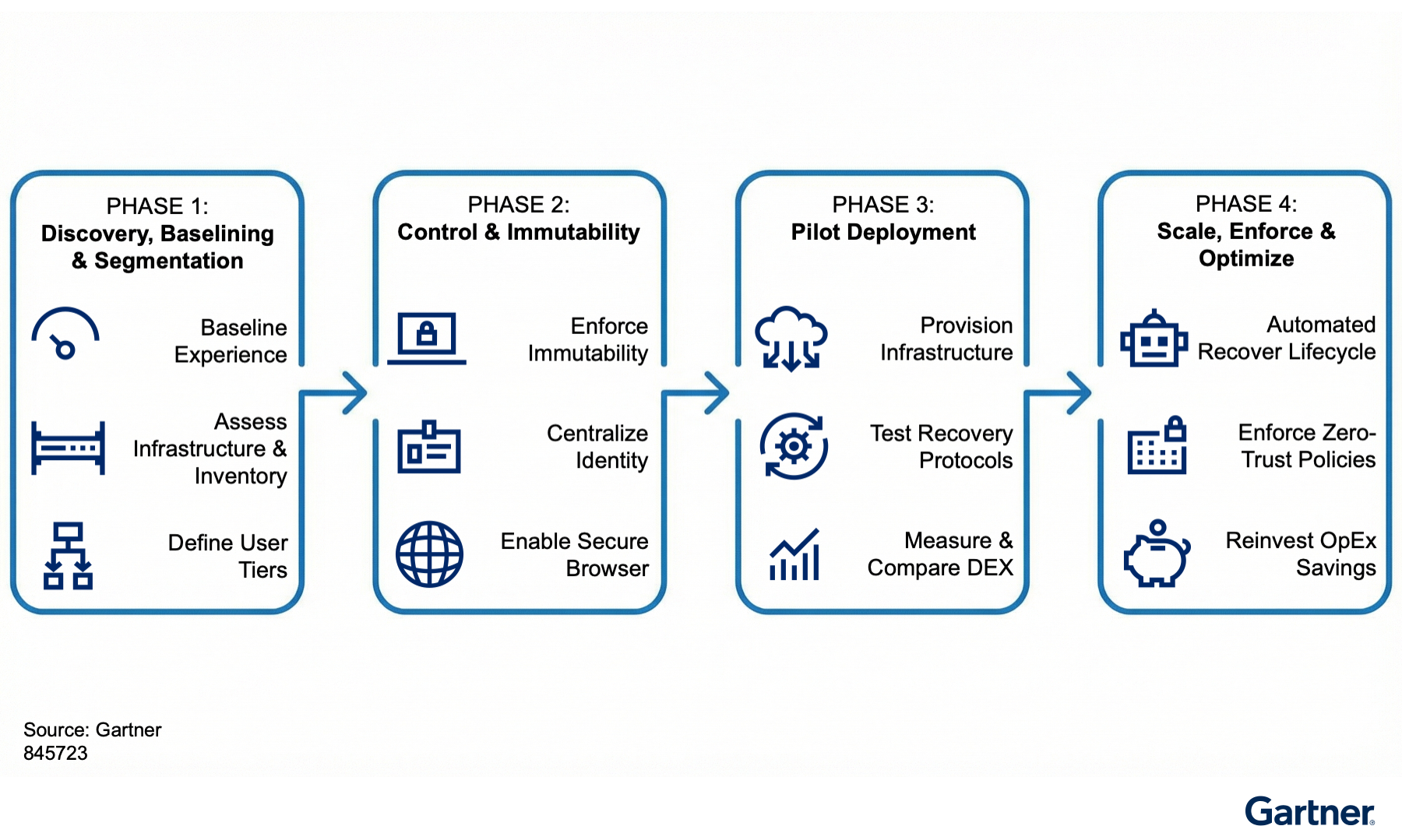
Phase 1: Discovery, Baselining, and Segmentation
Begin by mapping user workflows, establish experience baselines and define access tiers rather than device specs.
- Baseline experience by deploying digital employee experience (DEX) tools to measure latency, application performance, and digital friction before architectural changes.
- Assess infrastructure to evaluate cloud storage, network bandwidth, and redundancy to support continuous cloud traffic.
- Inventory application and peripheral assets to contrast SaaS-native versus legacy Win32/64 apps, documenting Excel macro web-versus-install differences, for immutable compatibility. Establish engineering workarounds for critical peripherals, like signature pads, card/CAC readers, medical/legal dictation devices, payment pinpads, bar code scanners, label printers.
- Define user tiers: Segment by risk, business impact, and vulnerability rather than device personas. Mandate immutable operating systems and workspaces. Abstracting the OS onto self-healing hardware eliminates expensive, pre-configured specialist loaner laptops (see Table 1).
- Plan for friction: Acknowledge desktop removal causes cultural shock. Build targeted change management and training strategies detailing cloud workspace selection and daily tool access.
The Wise Segmentation Decision Matrix
Axis 1: User Profile (Criticality & Risk) | Axis 2: Infrastructure & Hardware Recovery (Scale, Storage, Network) | Axis 3: Security, Governance & Friction Management |
Tier 1: Mission-Critical (Zero downtime tolerance) | Scale & Compute: High-performance DaaS/VDI or on-premises virtual desktops. Hardware Recovery Protocol: Implement firmware-based self-healing or hidden recovery partitions to eliminate loaner laptops. | Friction (Low Visual Change): Deliver a familiar Windows desktop by mandating non-persistent cloud VMs with Ephemeral OS disks and FSLogix profiles that persist user state while the OS regenerates. |
Tier 2: High Risk / Vulnerable (High likelihood of compromise) | Scale & Compute: Ephemeral, stateless OS on standard hardware. Hardware Recovery Protocol: Use the Microsoft Unified Write Filter (UWF) or equivalents for local sessions that write to RAM and are wiped on reboot. | Friction (High Visual Change): Embrace users to move stateless workspaces as a security safety net using SEBs so any local malware disappears on reboot. |
Tier 3: Operational (SaaS-only task workers) | Scale & Compute: Browser-execution only. Standard broadband. Hardware Recovery Protocol: Disclaim hardware responsibility for all BYOD devices. | Friction (Low): Users are already accustomed to web apps. Unified Security: Control access and data entirely via SEBs and Identity Provider (IdP) continuous conditional access, ignoring the local hardware state. |
Source: Gartner (February 2026)
Phase 2: Establish Control and Enforce Immutability
Move security logic off the endpoint, establish hard network boundaries, and physically restrict the operating system from retaining unauthorized state changes. Instruct your technical administrators to execute the following architectural shifts:
- Enforce endpoint immutability and do not rely on policy alone; mechanically prevent local persistence.
- Deploy stateless operating systems for Tiers 2 and 3 to prioritize purpose-built thin clients (for example, Dell Wyse, Microsoft Windows 365 Link) or stateless OSs, for example, IGEL OS, ChromeOS on Chromebooks, that write nothing to local disk and reset to a pristine, read-only state on every reboot.
- Make Windows immutable; when local Windows is unavoidable, use Microsoft Unified Write Filter (UWF) to redirect all writes into a temporary RAM overlay; for Cloud VDI (Tier 1), mandate Ephemeral OS Disks that destroy the session cache when the VM is deallocated.
- Embed hardware recovery protocols by adding firmware-level resilience or a hidden recovery partition so compromised endpoints can self-restore a golden image without shipping loaner laptops.
- Centralize identity as the perimeter to enforce device posture and conditional access at the primary IdP, avoiding overlapping rules and sync drift in downstream federation tools.
- Enable secure enterprise browser (SEB) capabilities for SaaS- or browser-only workflows, shift data control into the SEB; block exfiltration to unmanaged local devices while allowing secure, encrypted data movement between approved cloud apps, and avoid blanket copy/paste blocks.
- Adapt legacy agents for immutability to retain security capabilities by moving DLP to cloud-native CASB and SEB controls, shifting patching to golden-image updates, and continuously using DEX monitoring to verify immutable designs do not harm performance.
Phase 3: The Pilot Deployment
Start with a receptive department to prove back-end scaling, validate the model against your baselines, and test real-world recovery protocols.
- Provision infrastructure and select hardware by mapping pilot users directly to the Phase 1 Segmentation Matrix, scaling back-end web applications and cloud DaaS hosts before deploying any endpoints, then rolling out a pilot fleet using Ephemeral Disks for cloud workspaces or stateless operating systems for edge devices.
- Engineer applications and abstract profiles by using profile management (for example, FSLogix on persistent Windows) to load user context into generic immutable shells, explicitly cataloging local software dependencies, treating app packaging with shared dependencies as complex engineering, and using physical workstations protected by Unified Write Filters for heavy 3D or compute workloads when virtualization is brittle or cost-prohibitive.
- Execute persona-based training that drills stateless workflows and makes clear that bypassing cloud storage to save files locally guarantees permanent data loss on reboot.
- Test dual recovery protocols by running fire drills for OS corruption (proving rapid self-rehydration without IT) and for total hardware failure (measuring real downtime and shipping SLAs).
- Measure and compare DEX by continuously benchmarking pilot telemetry against pre-migration baselines to demonstrate stable latency and unchanged or reduced digital friction.
Phase 4: Scale, Enforce, and Optimize
Expand the program enterprisewide by enforcing strict data policies, automating the hardware life cycle, and actively reinvesting the saved operational expenditure.
- Automate recovery via zero-touch enrollment tied to firmware/hidden partitions and IdP. Shift help desks from manual reimaging to remote resets, requiring only Wi-Fi and IdP credentials for instant productivity.
- Enforce zero trust by mechanically forbidding local data storage. Redirect local folders to cloud storage to guarantee zero data loss during stateless daily wipes.
- Measure performance gains using DEX tools. Prove that eliminating OS bloat and legacy agents accelerates application load times, leveraging comparative data to justify enterprise expansion.
- Capture OpEx saved from eliminating manual patching, physical loaners, and malware tickets. Reinvest these resources into threat hunting, identity security, and refining secure enterprise browser (SEB) policies.
Success Measures
Track these outcome-driven metrics (ODM) against Phase 1 baselines to prove the WISE model’s value:
- Slash recovery times by decouple productivity from hardware health, and track mean user time impact (MUTI). Success will slash recovery from days (by shipping physical loaners) to minutes, using firmware rehydration and stateless hidden boot partitions.
- Compare continuous DEX scores (latency, crash rates, digital friction) against premigration baselines. Validate success by achieving lower downtime and higher productivity scores post-lockdown compared to mutable workspace.
- Drive endpoint help desk volume down, specifically malware remediation, patch failures, OS corruption, and device imaging tickets — to near zero.
- Reduce attack surface by eliminating local configuration drift, while monitoring malware-remediation tickets. Driving legacy operations burdens down or to near zero.
Contributors
Tom Cipolla, Sunil Kumar, Stuart Downes, Paul Furtado, Max Taggett, Khushbu Pratap
1 Stopping Breaches and Downtime: Building Resilience That Never Fails, Absolute Security
3 New Absolute Security Research Shows Top Endpoint Security Controls Fail 22% of the Time, Absolute Security
7 6 Help Desk Hacks to Reduce Your Ticket Volume, ManageEngine
8 What Is Patch Management? Process, Policy, and Cybersecurity Benefits, Palo Alto Networks
10 What Is VDI Security?, VMware
11 Log’S Cuts Recovery Times by 98% and Ensures Ransomware Resilience, Object First
12 Make Your Endpoints and Mission-Critical Applications Cyber Resilient, Absolute Security
15 Windows 365 Link Documentation, Microsoft