Market Guide for Emergency and Mass Notification Systems (EMNS)
16 December 2025 - ID G00831780 - 17 min read
By Manoj Bhatia
EMNS providers are adopting new communication platforms, and technologies such as AI, to modernize their emergency and crisis management toolsets and solutions. This guide provides insights into the EMNS capabilities for enhancing organizational crisis management and communication strategies.
Overview
Key Findings
- Emergency and mass notification systems (EMNS) automate emergency communications and support multiple channels (SMS, voice, email, push notifications, sirens, signage, and social media) for fast, targeted alerts.
- EMNS providers combine preventive measures to reduce risk and prepare with reactive capabilities to manage and respond to incidents as they happen. Modern EMNS platforms leverage real-time analytics and AI for incident detection, predictive insights, and improved decision-making.
- Cloud-based architectures, load balancing, and failover systems ensure EMNS can handle large-scale emergencies and remain operational. EMNS further implements strong cybersecurity (encryption, authentication, vulnerability assessment) measures to protect data and operations.
- EMNS now focus beyond managing singular threats and interfaces with business continuity solutions, supporting basic incident response plans, and visualizing data through intelligent hub dashboards. This collaborative approach positions EMNS providers as the operating system (OS) for emergency management.
Recommendations
- Choose EMNS platforms that deliver automated, multichannel messaging to ensure rapid, reliable, and inclusive emergency alerts for all stakeholders, regardless of location or device.
- Check that EMNS platforms provide integrated AI, real-time analytics, and IoT sensor capabilities to enable early incident detection, predictive risk assessment, and data-driven emergency decision-making.
- Ensure that EMNS platform prioritizes robust cybersecurity and regulatory compliance. This includes requiring comprehensive data encryption, strong user authentication, and regular vulnerability assessments. Platforms must demonstrate adherence to relevant industry standards and regulatory requirements to maintain operational integrity and protect organizational assets.
- Check for cross-emergency management ecosystem collaboration. EMNS solutions must foster strong partnerships with communications service providers (CSPs), public safety organizations, and first responder service providers to ensure collaboration and continuous improvements.
Market Definition
Gartner defines emergency and mass notification systems (EMNS) as unified crisis management solutions that monitor, orchestrate and manage emergencies across all phases, ensuring compliance with regulatory standards. EMNS enables businesses, schools, governments, healthcare and utilities to quickly alert people, enhancing safety, minimizing disruption and supporting fast, coordinated response. Organizations collaborate with CSPs and rely on EMNS to protect lives and operations.
EMNS are specialized solutions designed to rapidly communicate critical information to large groups of people during emergencies, disruptions or essential (mission-critical) events. These systems alert employees, residents, customers, partners, vendors, students or other stakeholders about situations such as natural disasters, security threats, IT outages or operational incidents.
EMNS addresses the business problem of timely and effective communication during crises, which is essential for safeguarding lives, minimizing operational downtime and ensuring organizational resilience. By automating and streamlining the notification process, EMNS enables organizations to achieve faster response times, enhanced safety, improved regulatory compliance and better coordination during emergencies.
Mandatory Features
The following eight mandatory features are essential capabilities that distinguish enterprise-grade EMNS from basic alerting tools. These features represent the minimum requirements organizations should expect when evaluating EMNS solutions for enterprise deployment:
- Multichannel communication with built-in redundancy: EMNS platforms must deliver notifications across multiple communication channels (e.g., voice, text, video, social media) simultaneously from a single interface. Leading solutions support more than eight distinct channels to ensure message delivery, even if primary channels fail.
- Response tracking: Bidirectional communication transforms EMNS from broadcast-only systems into interactive platforms, enabling organizations to collect feedback, confirm message delivery and ensure recipient safety.
- Prebuilt message templates: Comprehensive template libraries covering common emergency scenarios (such as natural disasters, workplace violence, etc.) must be provided by leading EMNS platforms for rapid and consistent communication. Preconfigured message templates eliminate composition time, reduce human error and ensure compliance with established processes.
- Role-based access control: EMNS systems must segment users into defined roles with specific permissions aligned to organizational responsibilities. Typical hierarchies include system administrators, alert operators and read-only users, as these prevent unauthorized access to sensitive contact data checks that are essential for HIPAA and GDPR compliance.
- Real-time analytics and dashboard reporting: Visibility into message delivery, recipient responses and post-incident reporting is critical. EMNS providers must offer comprehensive analytics and dashboard reporting capabilities to provide a unified view for tracking all audit trails, including alerts, user-level delivery and response records.
- Location-based targeting: Geotargeting enables organizations to send targeted messages to recipients based on specific geographic parameters, such as cities, zip codes, regions or countries. Furthermore, geofencing creates boundaries around particular locations using GPS, RFID, Wi-Fi or cellular networks, which can trigger alerts when devices are within these monitored areas.
- Third-party integration and API connectivity: EMNS platforms must offer basic integration capabilities with other IT systems, including single sign-on (SSO), identity management, business continuity planning (BCP), facility management and first responder services.
- High availability, scalability and 24/7 support: These are key capabilities that enable EMNS to remain operational during disasters. Massive scalability and cloud redundancies allow these platforms to handle exceptionally high message volumes during large-scale emergencies.
Common Features
The common features of EMNS products in this market include:
- Unified coordination and smart emergency hubs: Advanced platforms offer centralized management for emergency preparedness, featuring AI-powered conversational interfaces for rapid information gathering and video collaboration tools. Integration with digital security cameras and real-time visual communication enhances situational awareness and proactive incident prevention.
- Multimodal, branded communications: EMNS solutions support multimodal messaging (enabled via CSPs and CPaaS providers), including SMS, voice, email and new app notifications, such as those from WhatsApp, with customizable branding and crisis management templates. Features like branded calling, deep linking and custom landing pages ensure a consistent organizational security and a seamless user experience during critical events.
- Reliable out-of-band and IoT-enabled communication: Hardware SMS gateways enable high-availability, out-of-band communications via cellular networks, ensuring message delivery even when internet connectivity is disrupted. Integration with IoT sensors and devices further enhances real-time monitoring and response capabilities.
- AI-driven analytics, reporting, automation and travel risk management: Intelligent analytics and reporting leverage AI for automated escalation of unresolved incidents, comprehensive travel risk management,and geotargeted alerts based on employee locations and itineraries. These capabilities empower organizations to respond swiftly to evolving threats.
- Robust integrations, compliance and accessibility: EMNS platforms integrate with first responder services, business continuity tools and other agency software, supporting coordinated response efforts. Adherence to mission-critical standards (such as FedRAMP), accessibility guidelines (WCAG 2.1 Level AA, ADA) ensures secure, reliable and inclusive emergency communications for all users. EMNS may include API integrations with other agencies/IT software services. First responder services, BCP and crisis management planning in IT organizations are adjacent services in security and risk management, and are crucial for an inclusive EMNS solution development.
Market Description
EMNS solutions are designed to facilitate rapid, reliable, and multichannel communication with a wide range of stakeholders, including employees, residents, customers, partners, vendors, and students. By leveraging technologies such as SMS, voice calls, email, mobile apps, social media, and digital signage, EMNS ensures that vital information reaches recipients regardless of their location or device preferences.
The market demand for rapid, transparent, and insightful emergency communications is intensifying. Customers, citizens, employees, government agencies, industry associations, and the media are all pressuring enterprises to provide timely and accurate updates during emergencies and disasters.
EMNS have become essential crisis management platforms, enabling organizations to detect threats, send critical alerts, and coordinate emergency responses across various scenarios — natural disasters, security breaches, IT outages, and more. These systems use advanced monitoring and multichannel communication (SMS, voice, email, apps, social media, digital signage) to ensure timely information reaches everyone, everywhere.
The EMNS Market is growing. The need for fast, transparent emergency communication is growing. Stakeholders — including customers, employees, and government agencies — expect accurate updates during crises. EMNS help organizations safeguard lives, reduce downtime, and protect reputations.
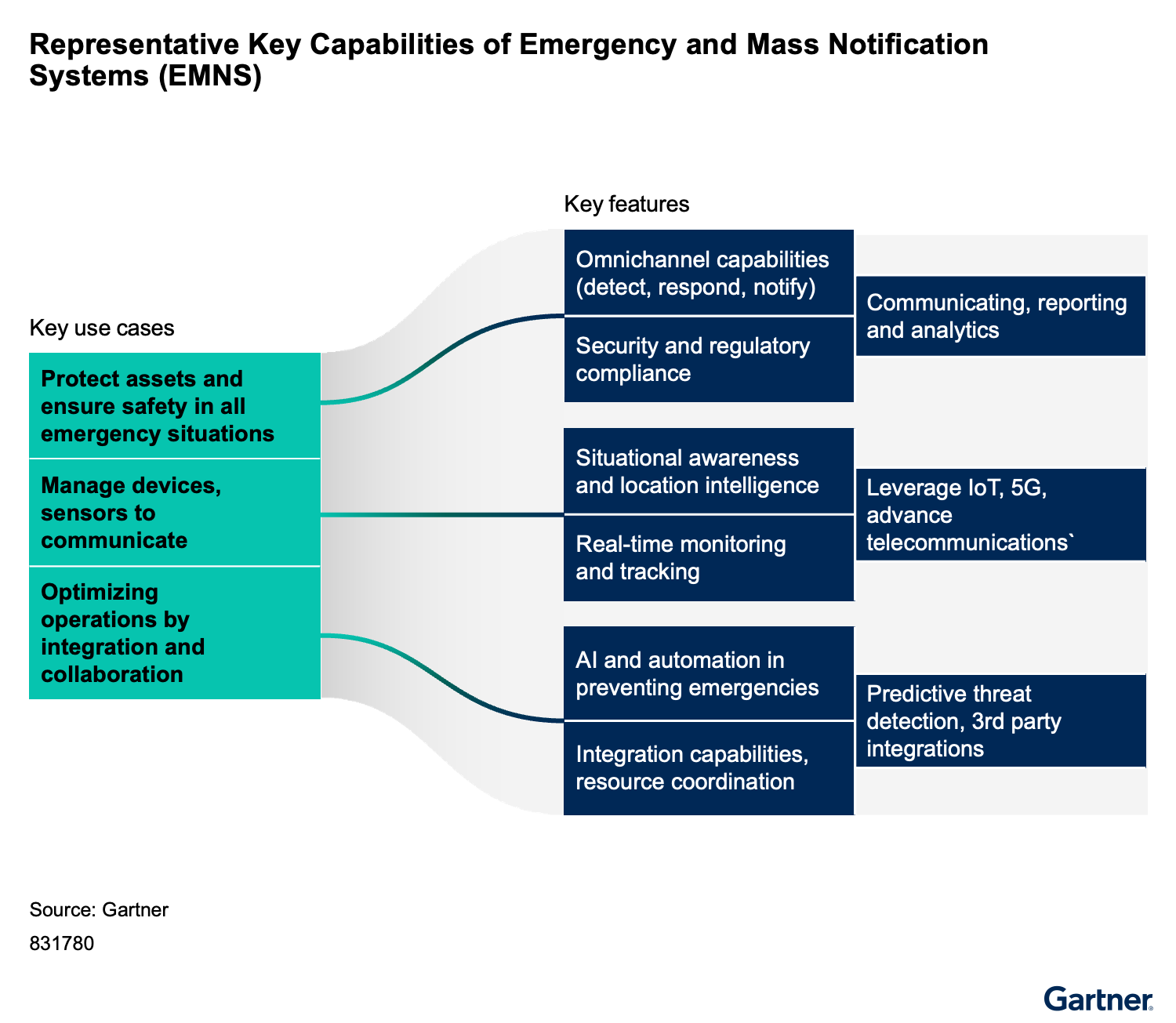
Key Pillars of Effective Crisis Communication:
- Precision and timeliness: Delivering the right message to the right people at the right time via the most appropriate channel is essential for safety and operational continuity.
- Technology integration: Managing devices, sensors, and leveraging advanced telecommunications technologies ensures robust message delivery and situational awareness.
- Innovation and synthesis: Harnessing cutting-edge technology and synthesizing data from diverse sources enhances the maturity and effectiveness of business continuity management (BCM) and Crisis/Emergency (C/E) plans, including seamless integration with other software solutions.
What Buyers Should Consider
- Multichannel communication and reporting
- Ensure the system supports SMS, voice, email, apps, desktop, and social media alerts.
- Look for real-time monitoring, analytics, and the ability to target specific groups or locations.
- Check for multilanguage support and international reach.
- Security and compliance
- Robust security and regulatory compliance (GDPR, HIPAA) are essential.
- Role-based access control (RBAC) protects sensitive data and enforces access policies.
- Mobile accessibility and advanced technologies to manage devices, sensors
- Both admins and users should access EMNS via mobile devices.
- Location-based targeting and 5G enable precise, real-time alerts for distributed teams or specific areas. Advanced call recording, transcription, dashboards and incident response planning via AI toolsets.
- Ease of use and integration
- Choose intuitive platforms that integrate with HR, IT, security, and facility management systems.
- Seamless API integration with telecom and IT infrastructure is crucial for automation and reliability.
- Vendor reliability
- Assess vendor reputation, support, and partnerships with telecom providers and public safety agencies.
EMNS are mission-critical for business continuity and crisis management. Choose solutions that are secure, scalable, easy to use, and fully integrated with your existing systems to ensure your organization is ready to respond — no matter the emergency.
Market Direction
The emergency and mass notification systems (EMNS) market is undergoing a profound transformation, propelled by the urgent need for resilient, intelligent management platforms that seamlessly integrate across diverse technologies and environments. As organizations face increasingly complex threats and operational challenges, several pivotal trends are shaping the future landscape of EMNS to offer unified coordination.
- Simplicity and customization:
There is a growing demand for intuitive, highly customizable, cloud-native platforms that empower organizations to manage emergencies with agility and precision. Emerging vendors are redefining the Emergency Operations Center (EOC) experience, making it accessible and adaptable for a broader range of users and devices. - AI-enabled preventive and predictive analytics:
Artificial intelligence (AI) and advanced analytics are becoming foundational to modern EMNS platforms. By harnessing real-time data from multiple sources, AI-driven insights enable organizations to anticipate incidents, automate responses, and make informed decisions with greater speed and accuracy. - Integration with IoT devices:
The proliferation of Internet of Things (IoT) devices is further amplifying the capabilities of EMNS. From environmental sensors and video surveillance to drones, IoT integration enables continuous monitoring and rapid data relay for comprehensive situation assessment. - Advanced telecom technologies: LEO (low Earth orbit) satellites, satellite communications, and drones are transforming emergency and mass notification systems. LEO satellite comms provide reliable connectivity in remote or disaster-affected areas where traditional networks may fail, ensuring critical alerts reach all stakeholders. Drones enhance situational awareness by delivering real-time aerial imagery and can relay emergency messages in hard-to-reach locations. For sectors like energy, utilities, and oil & gas, these advancements are enabling unprecedented levels of operational resilience.
Earth intelligence could further enhance EMNS by providing real-time geospatial data, satellite imagery, and environmental monitoring for improved situational awareness. This integration can enable EMNS platforms to deliver accurate, location-specific alerts, support risk assessment, and facilitate timely warnings during emergencies.
- Supporting federal government and public safety agencies: A few EMNS providers excel in IT systems in building resilience management and disaster recovery plans as they can integrate with federal agencies, first responder services, and mission-critical systems, adhering to strict security standards.
The pressure on organizational leadership to provide rapid, transparent, and authentic communication during emergencies is intensifying. This demand comes from a broad spectrum of employees, stakeholders, including partners and customers, government agencies, and the outside media. As a result, organizations are moving away from legacy manual communication methods in favor of purpose-built EMNS solutions.
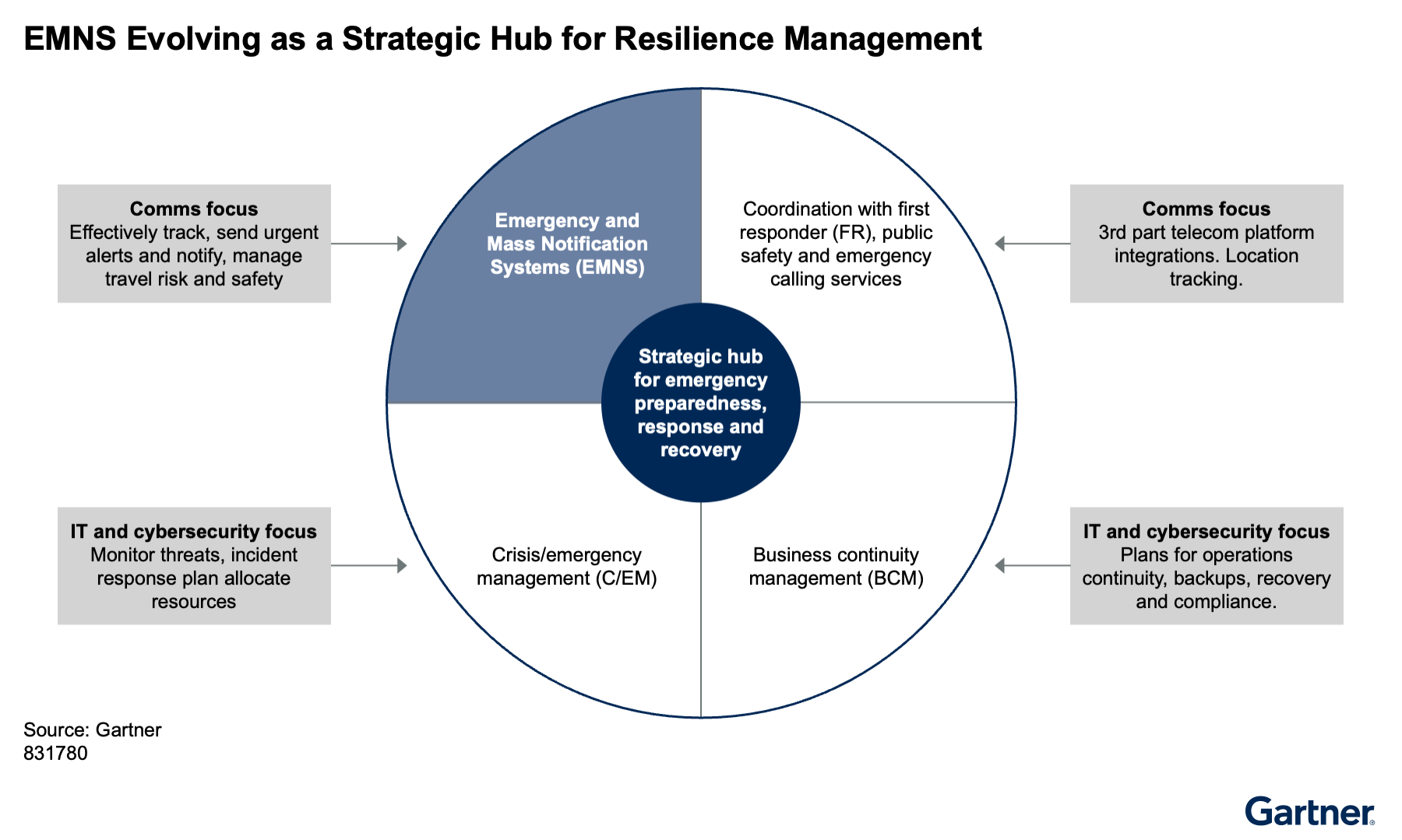
The EMNS market is clearly moving toward platforms that are not only robust and resilient but also intelligent, highly integrated, and user-centric. The convergence of advanced telecom capabilities, which enable centralized situational awareness, AI-driven analytics, and IoT integration, is setting a new standard for emergency management. This standard prioritizes speed, accuracy, and adaptability in response to emerging risks. These EMNS platforms are expected to serve as central hubs for emergency preparedness, response, and resilience management.
Organizations that embrace these innovations and specialize in targeted markets will better protect their people, assets, and operations in an increasingly unpredictable environment.
Market Analysis
The EMNS market is undergoing rapid transformation, driven by the escalating need for advanced, resilient, and multimodal communication systems tailored to the unique demands of emergencies arising from natural disasters, cybersecurity threats, active shooter incidents, and global public health crises. As organizations face increasingly complex risk environments, the ability to deliver timely, targeted, and reliable communications has become a mission-critical capability for both public and private sector entities.
Market Drivers and Trends
Several key factors are fueling the growth and evolution of the EMNS market:
- Rising frequency and severity of emergencies: The increase in natural disasters, cyberattacks, and other critical incidents has heightened the demand for robust notification and crisis management platforms.
- Regulatory and compliance requirements: Governments and industry bodies are mandating more stringent business continuity, safety, and security protocols, driving organizations to adopt advanced EMNS solutions.
- Digital transformation and integration: Organizations are seeking solutions that integrate seamlessly with other IT, security, and operational technologies, enabling end-to-end visibility and faster response times.
- Shift toward cloud-based and mobile-first solutions: The adoption of cloud architectures and mobile communication tools is enabling greater scalability, flexibility, and accessibility for organizations of all sizes.
Vendor Landscape and Strategic Focus
This section analyzes the current market landscape, highlighting key focus areas of vendors in EMNS and adjacent markets. Leading solution providers are not only enhancing core notification capabilities but are also investing in:
- Artificial intelligence and automation: Leveraging AI for threat detection, automated workflows, and predictive analytics to improve situational awareness and response efficiency.
- Resilience and continuity management: Expanding from simple notification to comprehensive crisis management, business continuity, and resilience platforms.
- Interoperability and ecosystem partnerships: Building open APIs and strategic alliances to ensure interoperability with physical security systems, IoT devices, and other enterprise platforms.
CIOs, security, and risk management leaders are increasingly expected to align their leadership vision with contemporary trends in cybersecurity and mission-critical system management. These include:
- Enabling digital transformation: Modern EMNS solutions are central to digital transformation initiatives, supporting agile operations and remote workforces.
- Embedding organizational resilience: Solutions are evolving to provide not just incident alerting, but also tools for preparedness, response, recovery, and post-incident analysis.
Evolution Toward Resilience Management
A select group of EMNS solution providers are evolving from this transformation journey and moving to become resilience management companies. These vendors are positioning themselves as strategic hubs for emergency preparedness, response, and recovery by driving technological innovation, operational priorities, and new vendor partnering strategies to stay differentiated in a crowded marketplace.
By integrating advanced analytics, workflow automation, and cross-functional collaboration tools, these companies are redefining the value proposition of EMNS, transforming from reactive alerting tools to proactive, enterprisewide resilience management platforms.
Future Outlook
Looking ahead, the EMNS market is expected to see continued consolidation, with leading vendors expanding their capabilities through acquisitions and partnerships. The focus will increasingly shift toward holistic risk management, user experience, and measurable outcomes, as organizations seek to build more adaptive and resilient operations in the face of an unpredictable threat landscape.
Representative Vendors
The vendors listed in this Market Guide do not imply an exhaustive list. This section is intended to provide more understanding of the market and its offerings.
Vendor Selection
Gartner identifies over 100 global vendors in this market. For this assessment, only a select group was chosen specializing in emergency management and mass notification systems.
Representative Vendors in EMNS
Vendor | Product | HQ |
Alertfind | AlertFind Mass Notification System | USA |
AlertMedia | AlertMedia Emergency Communication Platform | USA |
AlertCascade | AlertCascade Mass Notification Platform | UK |
Alertus Technologies | Alertus Emergency Notification System (ENS) | USA |
CORNERS | CORNERS Crisis Management Platform | South Korea |
CYGNVS | CYGNVS Cyber Crisis Management Platform | USA |
D4H | D4H Incident Management Suite | Ireland |
Dirad Technologies | DiRAD Mass Notification Solutions | USA |
Everbridge | Everbridge Critical Event Management (CEM) Suite | USA |
Everon | Everon Emergency Notification & Monitoring | Finland |
F24 | FACT24 Crisis Management & Emergency Notification | Germany |
FusionRM | Fusion Framework System — Risk & Resilience Management Platform | USA |
Hyper-Reach | Hyper-Reach Emergency Notification System | USA |
Incident | incident.io Incident Management Platform | UK |
Intrado | Intrado Emergency Notification Services | USA |
Juvare | WebEOC Nexus (Emergency Operations Center Software) UCP Federal Government | USA |
Lynx Systems (Micro Technology Services) | Lynx Emergency Notification & Duress Systems | USA |
N-ovate Solutions | N-ovate Emergency Notification Solutions | USA |
OnPage | OnPage Incident Alert Management | USA |
OnSolve | OnSolve Critical Communications Platform | USA |
Orisent (Vanguard Wireless) | Vanguard Wireless Emergency Alert System | Australia |
PagerDuty | PagerDuty Digital Operations Management | USA |
Peasi | Peasi Emergency Notification Platform | Canada |
RapidReach | RapidReach Notification System | Sweden |
Raptor Technologies | Raptor Emergency Management & Notification System | USA |
Rave Mobile Safety | Rave Alert Mass Notification | USA |
Regroup | Regroup Mass Notification | USA |
Rootly | Rootly Incident Management Platform | USA |
SafeReach | SafeReach Emergency Communication App | Netherlands |
Sentinel | Sentinel Resilience Platform | UK |
Singlewire | InformaCast Mass Notification | USA |
SnapComms | SnapComms Employee Communication Platform | New Zealand |
Veoci | Veoci Emergency Management Software | USA |
Voyent Alert (ICEsoft) | Voyent Alert Mass Notification | Canada |
ZeroEyes | ZeroEyes AI Gun Detection & Emergency Notification | USA |
Zinc Systems | Zinc Incident Management Platform | UK |
Source: Gartner (December 2025)
Market Recommendations
- Automation and real-time response: Select vendors that deliver advanced automation features and can provide automated, multichannel messaging, such as SMS, email, voice, app notifications, and social media. This ensures rapid, reliable, and inclusive emergency alerts for all stakeholders, regardless of their location, device, or accessibility needs. Look for capabilities such as:
- Support for WhatsApp, WeChat, or other non-conventional channels of communication.
- Frequent testing and updating of communication workflows to maintain preparedness and minimize delays in emergency notifications.
- Ability to support real-time delivery, message customization, and escalation paths to maximize reach and effectiveness during critical incidents.
- Leverage published survey results, peer review insights, and user feedback to evaluate the vendor’s real-world performance, reliability, and ability to deliver intuitive visualization.
- AI and advanced analytics: Integrate EMNS platforms with artificial intelligence, real-time analytics, and IoT sensor capabilities to drive proactive incident detection, predictive risk assessment, and smarter emergency management decisions.
- Check how AI-powered systems can analyze vast data streams to identify emerging threats, automate response recommendations, and optimize resource allocation.
- Ensure real-time analytics enable continuous monitoring of incidents and stakeholder responses.
- Look for how far EMNS providers have advanced in integrating with Conversational AI and IoT, while IoT sensors provide critical situational data from physical environments.
- Ensure platforms offer customizable dashboards and actionable insights to support informed decision-making across diverse operational scenarios.
- Security and compliance: Strengthen cybersecurity within EMNS platforms by implementing comprehensive data encryption, robust user authentication, and regular vulnerability assessments.
- Ensure that the platform adheres to relevant industry standards and regulatory requirements, such as GDPR, HIPAA, or FedRAMP, to protect sensitive information and maintain operational integrity.
- Require vendors to provide evidence of compliance, ongoing security training, and incident response protocols.
- Regularly review and update security policies to address evolving threats and maintain trust among stakeholders and regulatory bodies.
- IT integration abilities: Assess whether the vendor’s platform can seamlessly integrate with your existing BCM processes, IT systems, specialized industry vendors, and market segments, including those offering out-of-band (OOB) communication solutions for enhanced emergency response capabilities.
- Cross-ecosystem collaboration: Seek EMNS solutions that integrate seamlessly with communications service providers (CSPs), public safety organizations, and first responder service providers. Foster strong partnerships to enable coordinated emergency responses, data sharing, and continuous improvements in crisis management practices. This collaborative approach enhances organizational resilience, accelerates innovation, and ensures preparedness for evolving emergency risks.
As disruptions from cyber and physical threats increase, the demand for robust, integrated crisis management solutions is rising. The vendors reviewed in this report reflect a dynamic market driven by customer focus, technology, and operational resilience. To maximize value, organizations should choose EMNS vendors that align with their risk management goals and support both immediate crisis response and long-term resilience. Prioritize solutions that foster organizational learning, continuous improvement, and workforce agility, ensuring your organization stays ahead of evolving emergency risks.
Acronym Key and Glossary Terms
| BCM | Business Continuity Management |
| CEM | Critical Event Management |
| IRP | Incident Response Plan |
| EOC | Emergency Operations Center |
| GDPR | General Data Protection Regulation |
FedRAMP and Implications : UCP | Federal Government Management Software