The State of the IBM Mainframe in 2026
16 April 2026 - ID G00841778 - 18 min read
By Alessandro Galimberti, Tobi Bet, and 1 more
After two decades of stagnation, the IBM mainframe is demonstrating solid growth. Mainframe exit initiatives are declining, and rapidly addressing underinvestment in the platform has become a top priority despite ongoing challenges related to the skills gap and aggressive ISV pricing.
Insights at a Glance
Over the past three years, many organizations have shifted the IBM mainframe from a retirement candidate to a strategic pillar within hybrid IT estates. Mainframes continue to deliver unmatched resiliency, security, transactional integrity and backward compatibility compared with alternative platforms. Organizations are now prioritizing remediation of platform underinvestment to make their mainframe estate future-proof for the next decade.
Key Insight:
- IBM invests but skills gap is an issue: IBM’s strategy to continue investing in the platform has paid off: 2025 sales reached a record $5.8 billion and a 52% increase in inquiries from Gartner clients in 2025 compared to the previous year. The primary threat to IBM mainframe growth is the lack of broad system access for students and hobbyists to develop systems engineering skills, unlike comparable offerings from cloud hyperscalers or OS vendors; a frustration frequently voiced by Gartner clients.
- ISVs innovate, but aggressive pricing is still common: Large ISVs continue to invest in the platform, and new, innovative ISVs are emerging, bringing fresh capabilities to a market concentrated in a few players. Software remains customers’ largest cost element, so swapping ISVs is often the only way to realize savings. Also, as customers fear excessive vendor lock‑in within a single ISV, they often miss opportunities to fully leverage software capabilities they own.
- Large MSPs continue to invest, but new players are emerging: Large mainframe MSPs have consistently invested in mainframe expertise, and pioneering MFaaS — a cloud‑like model that enables customers to host their workloads in shared mainframes. New competitors are emerging: boutique MSPs that are committed to the platform, and large GSIs attempting to reposition themselves from mainframe‑exit vendors to full‑service mainframe MSPs.
Strategic Planning Assumptions
By 2030, 75% of vendors operating in the “mainframe exit” market will either pivot their business models or cease to exist.
By 2030, fewer than 10% of organizations that own a mainframe will consider a mainframe exit.
Issue Context
The last three years have seen a pivotal switch in the approach organizations have to their mainframe: from a legacy of the past, waiting for the right technology to enable a full mainframe exit toward public cloud or, at least, distributed systems, customers have instead realized that the benefits of a mainframe exit are outpaced by the risks and long-term TCO increase.
Gartner has observed a 52% year-over-year increase in mainframe-related client inquiries in 2025 compared to 2024. Concurrently, as per Market Share: Servers, Worldwide, 4Q25, IBM’s mainframe revenue has reached record high, with sales projected to hit a record $5.8 billion in 2025 (see Figure 1). Clients are increasingly focused on integrating emerging technologies into their mainframe environments and future-proofing these platforms for the next decade.
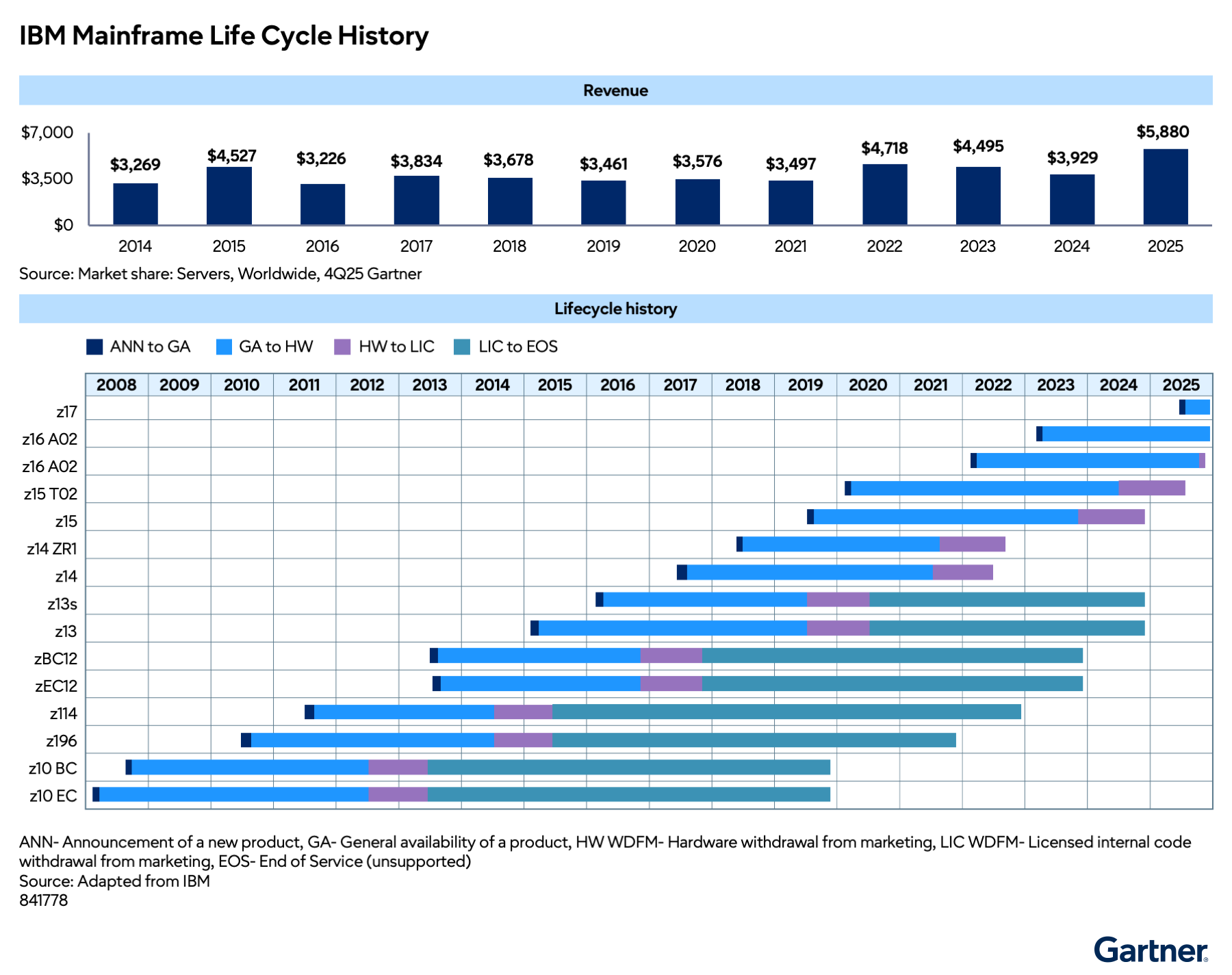
IBM continues to show its commitment to mainframe innovation, launching the z17 in April 2025 as part of its established 2.5-year innovation cycle. A few months later, IBM introduced the Spyre Accelerator, a technology designed to enable large-scale inference capabilities within the platform. The recent announcement of a partnership with Arm to develop dual-architecture hardware further underscores this innovative direction. These developments highlight IBM’s willingness to make significant investments to ensure the mainframe modernizes to remain a vital and thriving component of enterprise IT.
Despite these advancements, the shortage of mainframe skills — more than the perceived cost — remains the primary challenge for both customers and vendors. Managed service providers (MSPs) and independent software vendors (ISVs) have responded by establishing and funding their own academies to train new talent. Meanwhile, many end-user organizations are awaiting IBM’s next steps to modernize its education programs and align them with what other large vendors offer. IBM’s willingness and ability to address the mainframe talent gap will be a critical factor in determining whether the platform experiences renewed growth in the coming decade or faces a gradual decline.
Impact Brief
Contrary to the narrative promoted by mainframe exit vendors — who emphasize lower costs and greater agility — real-life experiences from Gartner clients indicate that full migration away from IBM mainframes frequently leads to suboptimal transformation outcomes and significant business disruption, often resulting in financial losses.1 Most mainframe customers are now prioritizing the reduction of technical debt and adopting platform innovations to future-proof their mainframe environments for the coming decade. Reduce IBM Mainframe Technical Debt Without Risky Exit Strategies provides more details on this topic.
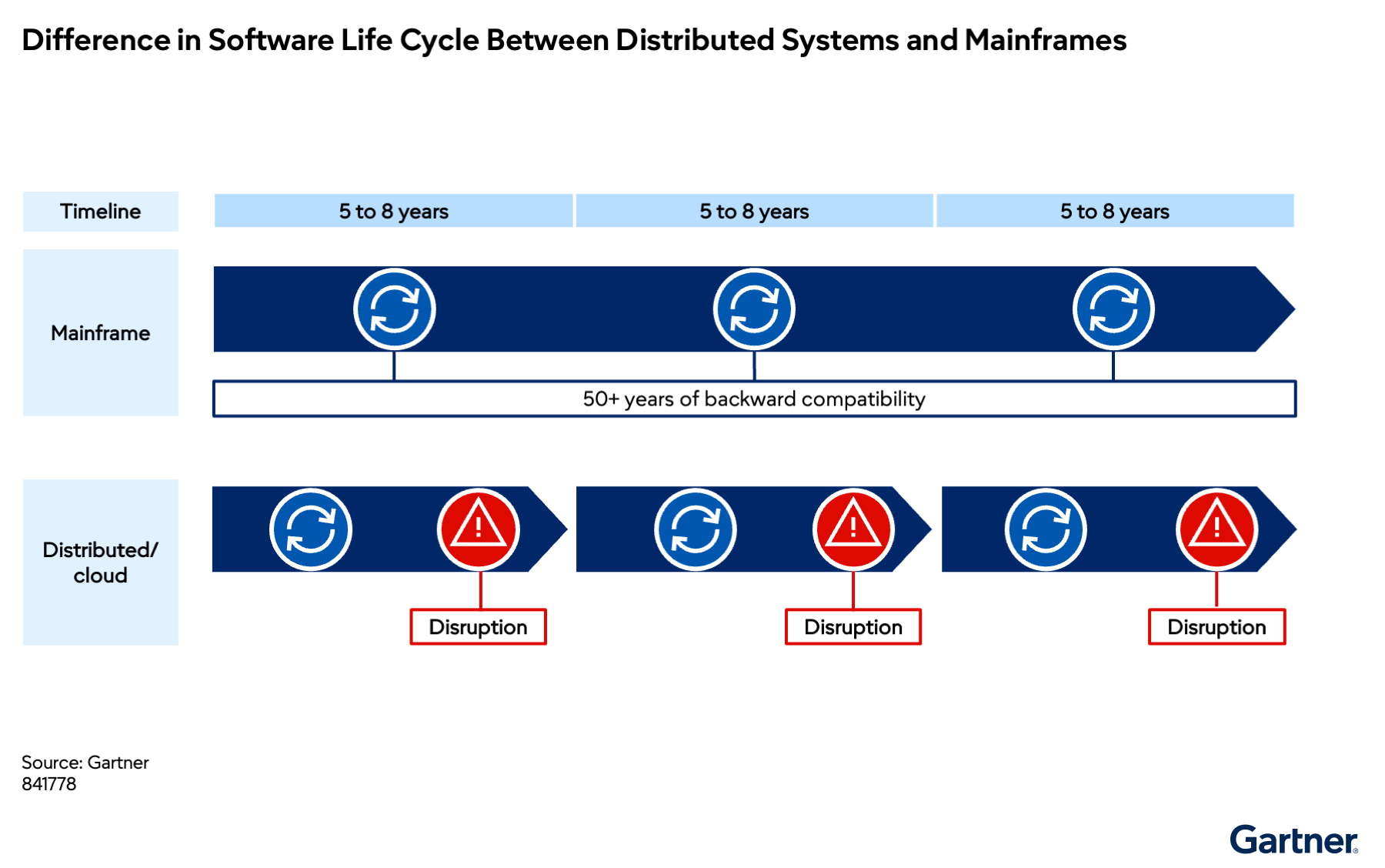
Mainframe backward compatibility is still unmatched in the industry. This means that while platforms such as cloud and distributed computing typically require upgrades and related costly testing every five to eight years to maintain vendor support for the entire stack, mainframes can reliably run code written more than 50 years ago.
Figure 2 shows the difference in software life cycle between distributed systems and mainframes.
The mainframe is still one of the best platforms for applications that map stable business processes, have a long expected life span and demand high security and transactional integrity. Conversely, the cloud and distributed environments are more appropriate for applications that change rapidly, require significant burst-in scalability and are geographically dispersed.
More Detail
IBM Continues to Invest, but Skills Remain the Top Issue
Mainframe Is Thriving, but Not for Everyone
In April 2025, IBM introduced the z17 mainframe, continuing its established 2.5-year release cycle. The z17 features up to 208 Telum II processors with integrated on-chip AI acceleration,2 and supports up to 64TB of main memory. To complement its IBM AI on Z portfolio, IBM launched the Spyre Accelerator for generative AI inference and expanded its watsonx Assistant suite to streamline mainframe operations.
Despite most mainframe customers also leveraging public cloud services, the IBM Z mainframe is not yet available as an embedded cloud platform within major hyperscalers such as Amazon Web Services, Google Cloud, Microsoft Azure and Oracle Cloud Infrastructure. This absence contributes to the perception that mainframes are outdated, costly, and overly complex. Customers seeking to integrate their mainframe and cloud environments must manage the cost, complexity, and latency associated with on-premises-to-cloud interconnects.
Mainframe Community Growth Amid Persistent Skills Gaps
IBM has made progress to address mainframe skill challenges through several initiatives. These include guided learning programs for both students and employers to nurture new talent, adoption of open source and common tooling to decrease the need for highly specialized skills, and investing in AI assistants to enhance client operational efficiency.
Online mainframe communities are expanding, with increasing engagement from both seasoned professionals and a growing cohort of younger enthusiasts.3 Notably, the System Z Enthusiasts Discord,4 server has emerged as a prominent forum, fostering collaboration across experience levels. The Open Mainframe Project.5 under the Linux Foundation, recently marked its 10th anniversary and has introduced key open-source tools such as ZOWE6 to the platform. Initiatives like the EMMA Apprenticeship Program,7 have also been established to cultivate new talent and address evolving skills requirements.
Although technology to emulate IBM mainframes on x86 has been available for over two decades — including both open-source and IBM proprietary solutions — IBM does not offer hobbyist licenses for core operating systems such as z/OS, z/VM, or z/TPF. The absence of broader system access for students and hobbyists to experiment and deepen systems engineering skills, comparable to those offered by other major vendors such as cloud hyperscalers or OS vendors, is the greatest threat to the current IBM mainframe growth trajectory, with many Gartner clients expressing frustration because of this. Heads of I&O Must Embrace Modern IBM Mainframe Skills and Technologies provide actionable advice to mitigate this important issue.
IBM Mainframe AI Advances Amid Adoption Challenges
In October 2025, IBM announced the general availability of the Spyre Accelerator and a new release of watsonx Assistant for Z. IBM Spyre is a set of accelerator cards optimized to handle generative and agentic AI workloads on the mainframe. These developments reinforce IBM’s commitment to continue bringing innovation even if it requires substantial investments, positioning the mainframe as a foundational AI platform for enterprise clients. Is the IBM Mainframe Ready for AI? provides a deep dive into this topic.
Despite significant vendor emphasis on AI ubiquity and investor interest, industry-specific AI use cases for the IBM mainframe remain limited. Early adopters of the IBM z17 have reported to Gartner that, while they have purchased the Spyre Accelerator, many are still evaluating practical applications. This requires IBM to act fast in supporting their clients to design and deploy AI use cases, ensuring the long-term success of future Spyre generations.
New Mainframe ISVs Are Emerging, but ISV Swap Remains Popular to Optimize TCO
ISV Swaps to Optimize TCO, Rather Than Mainframe Exit
Many CIOs and heads of I&O who have opted to abandon mainframe exit strategies in favor of increasing mainframe investments still face the challenge of securing board approval for this strategic shift. This is largely due to the persistent perception among nontechnical stakeholders that the mainframe is outdated and should be phased out. ISV-swap projects are often their first step to gain such buy-in, as they demonstrate that operating a cost-optimized mainframe environment is achievable, building stakeholder confidence at a reasonable ROI. These projects are often executed in collaboration with experienced SIs such as DXC, Eccox, GTSG, Kyndryl, and RES IT and often in conjunction with some effort to optimize MIPS consumption.
Nevertheless, ISV swaps reflect the main challenge within the mainframe ISV market, dominated by a small number of large ISVs that might apply aggressive pricing to a customer at any next renewal. Customers are compelled to spend time negotiating price and renewal protections, rather than prioritizing the business value these solutions can deliver. Also, often organizations are not willing to increase their investment in customizing a given product, fearing excessive vendor lock-in, missing opportunities to fully leverage the capabilities of their software and achieve operational benefits.
Emerging Mainframe ISVs Drive Innovation Amid Obstacles in Development
Alongside large ISVs — such as BMC, Broadcom, IBM, and Rocket Software — continue to invest on emerging mainframe technologies,8 allowing a new set of mainframe software providers to emerge. For example, 21CS, known in the market for taking over the development of VSEn from IBM — an alternative operating system suitable for smaller deployments — now provides a modern suite of products. These offerings include data migration, security, and connectivity for cloud object storage. AI-focused startups like Phase Change Software are delivering AI assistants designed to interpret and enhance COBOL code, while Zcrafter provides natural language interfaces for mainframe interaction directly from the terminal. Geniez AI utilizes their IP to enhance industry-leading LLMs, enabling them to deliver accurate and relevant information about the customer’s z/OS environment while leveraging mainframe’s security standards.
Recently, IBM announced the end of sale for zPDT,9— the de facto standard for small ISVs to develop, maintain, and support mainframe products without the financial burden of acquiring a real mainframe, often a purchase beyond the possibility of many small ISVs — expanding its cloud-hosted offering as an alternative.10 Members of the mainframe community have expressed their concerns that this move may increase the risk of smaller ISVs exiting the mainframe market by selling their business lines to larger ISVs.11 This will reduce the market diversity and competition that the mainframe ISV market needs. Moreover, some ISVs have raised concerns with Gartner regarding the resiliency of the new solution and the risks associated with hosting their intellectual property on an IBM-managed platform — especially when IBM may compete with similar software offerings.
One of the Most Securable Platform in IT
Security has been a foundational element of the IBM mainframe, with IBM consistently investing in advanced security features over time. Integrated security managers such as IBM RACF, Broadcom Top Secret, and Broadcom CA ACF2, along with logical partitioning and recent innovations — including pervasive encryption, integrated cryptographic hardware, secure boot for z/OS, and secure service containers — continue to reinforce platform’s security posture. These capabilities have contributed to the perception of IBM mainframe as the industry’s most secure platform.
Nowadays, the IBM mainframe is no longer the isolated “black box” of 30 years ago, when security by obscurity and network isolation were enough. Gartner observes that many customers continue to adopt a reactive approach to mainframe security. Like all modern platforms, mainframes now require proactive, real-time threat detection and enforcement of least-privilege access controls to mitigate risks in hybrid IT environments. Contrary to common assumptions, IBM mainframes are susceptible to ransomware attacks, prompting IBM to introduce offerings such as IBM Z Cyber Vault and spurring new vendors, such as MainTegrity, to address these emerging security requirements.
Mainframe MSPs Continue to Evolve Their Game, With New Competitors Emerging
MSP-Led Mainframe Academies to Future-Proof Skills Shortages
MSPs such as DXC, GTSG, Ensono, and Kyndryl have consistently invested in mainframe expertise, offering their customers decades of practical experience. These MSPs offer comprehensive project and managed services for IBM mainframes, supporting clients in a broad range of mainframe innovation activities such as modern developer experience, DevOps implementation, API enablement, inclusion of the mainframe in the hybrid estate, automation, AI incorporation and much more. See How to Modernize the Mainframe Environment for further details.
Despite MSPs being usually more appealing to IT practitioners than end-user customers, such providers also suffer from difficulties in finding mainframe skills in the market. In response, MSPs have established mainframe academies in collaboration with local educational institutions and IBM skills programs to address talent shortages. While these initiatives are effective, they underscore once again the criticality of mainframe skills. IBM’s willingness to broaden access to mainframe technologies — through hobbyist programs and emulation — will be pivotal in determining the platform’s growth or decline over the next five to 10 years.
MFaaS to Optimize Cost Efficiency
Mainframe-as-a-Service (MFaaS) is a type of cloud-like offering that enables customers to host mainframe workloads in logical partitions on a shared IBM mainframe, increasingly appealing to smaller organizations that often lack the scale for dedicated hardware. Gartner recommends MFaaS solutions, wherein providers deliver bundled hardware, IBM software and managed services for clients with workloads below 5,000 MIPS.12
Even in shared hosting models such as MFaaS, the IBM mainframe is not designed for smaller workloads. Gartner estimates that the economic threshold for mainframe viability typically falls between 500 and 1,000 MIPS. For organizations operating below this range, the cost per transaction is often uncompetitive. These customers tend to remain on the platform primarily due to organizational inertia and the risks and financial implications of migration, rather than a sustained strategic commitment to the IBM mainframe.
New MSPs Are Entering the Market Amid Opportunity and Some Uncertainty
New SIs and MSPs are entering the mainframe market, showing renewed interest and investment also from this type of vendor. For example, Vertali, a recently established U.K.-based mainframe SI, focuses on mainframe security, a domain frequently overlooked by CIOs until it is too late. IT Service Alliance is pursuing a strategy of acquiring smaller mainframe and enterprise systems vendors, subsequently offering equity to acquired employees to retain their specialized expertise. Blue Hill Data Services provides a productized MFaaS for customers up to 2,000 MIPS. Their flexible contracting and solutions aim to make continued use of the mainframe platform both more affordable and practical for a wider range of organizations. Additionally, some large GSI are expanding their mainframe capabilities from ad hoc or transitional support during a mainframe exit to comprehensive service offerings, aiming to be attractive to mainframe customers.
The long-term success of these new market entrants remains uncertain. While smaller, mainframe-focused ventures have the potential to become recognized market players, GSIs face substantial challenges. These include the willingness and commitment to invest in and sustain robust management platforms comparable to Kyndryl Bridge or DXC Oasis, and to realign their sales strategies to proactively engage in mainframe opportunities. GSIs that have historically advocated for mainframe exit must now demonstrate a renewed commitment to the platform: they do so without jeopardizing existing client relationships, particularly with clients who previously relied on them and subsequently faced significant challenges during their mainframe exit initiatives.
1 Mainframe exit failures remain one of the IT industry’s best kept secrets. Even when “successful,” mainframe migrations inevitably take longer than expected and costs increase through the extended transition period. Organizations that experience such failures rarely publicize them, as these incidents are often costly and may adversely affect investor or board perceptions. CIOs, heads of I&O, and other IT leaders often downplay the complexities associated with mainframe migration projects to mitigate potential impacts on their careers. Still, many organizations undertaking similar initiatives have sought Gartner’s guidance over the years. Below are anonymized excerpts from typical client inquiries on this topic:
- Inquiry 1: Our mainframe exit project is delayed due to unresolved technical/performance/functional issues. Each additional month of mainframe hosting incurs significant costs. Also, the client organization faces an expensive ISV contract renewal in a few months if these issues are not resolved. Although the client is exploring legal options, they have not yet pressured the vendor for concessions. The client is reliant on the vendor to resolve the remaining technical challenges but is concerned that ongoing work could become a revenue stream for the vendor. The client seeks advice on the most effective course of action and what expectations or demands can reasonably be made to the vendor.
- Inquiry 2: The client is currently negotiating a renewal for a major mainframe replatforming tool following their mainframe exit to cloud. The ISV is employing an aggressive commercial strategy, both in terms of pricing and by pushing to transition from perpetual licenses to subscription-based models. What feedback has Gartner received from other clients negotiating with this ISV? Have other organizations successfully migrated to another solution or reverted to a mainframe?
- Inquiry 3: The client is seeking a third-party consultancy with expertise in a specific distributed database, ideally with deeper knowledge than the ISV that developed the product. Having recently migrated their database from Db2 on z/OS to this database as part of a mainframe exit, they are now experiencing significant performance issues — daily batch processing has increased from 6 hours on the mainframe to 18 hours on the distributed system. Does Gartner have recommendations for vendors who can assist with database tuning and optimization.
2 The z17 supports a total of 234 Telum II processors: 208 are assignable to logical partitions and customer workloads, 24 are System Assist processors, and two are designated spares. Unlike distributed systems, most mainframe I/O is handled by processors dedicated to I/O tasks rather than by the central processors assigned (and licensed) to each operating‑system instance; this allows central processors to focus on application and database workloads. Processor assignment is dynamic and managed by the Type‑0 hypervisor PR/SM. If a processor fault occurs, PR/SM assigns a spare processor to avoid costly downtime.
3 Analyst’s observations on this topic are substantiated by BMC’s 20th annual mainframe survey: “A combined 66% of survey respondents identify as Gen Z or Millennial, an increase of 37% from 2018, the first year the generation question was asked. And not only do these groups now make up a majority of the mainframe’s workforce, they champion its staying power, with 99% of GenZ and 98% of Millennial respondents viewing it as a long-term platform or platform for new workloads.”
4 See the link to the Discord server at System Z Enthusiasts
6 ZOWE
8 A deep dive on emerging mainframe technologies to watch is part of the Heads of I&O Must Embrace Modern IBM Mainframe Skills and Technologies research note.
11 The Register IBM killing mainframe coding kit for PCs this year, Planet Mainframe IBM’s decision to discontinue support for the zPDT standalone offering threatens the mid-tier ISV market
12 Consider the 5,000 MIPS threshold as a general guideline rather than a hard threshold to follow in your negotiations. It should be adjusted based on the unique requirements and characteristics of your specific environment. Below few sample scenarios:
- If you require more than 5,000 MIPS on a single Central Electronics Complex (CEC) — either in a single or multiple LPARs — a dedicated environment is typically more cost-effective and operationally efficient as it allows you to decide any planned downtime.
- For workloads distributed across multiple CECs — for example, 3,000 MIPS on each of three CECs — typically a scenario where a Parallel Sysplex is involved - conduct a cost comparison between dedicated and shared models to determine the optimal approach.
- If your Parallel Sysplex strategy requires Coupling Facilities (CF) are hosted on separate CECs from your production LPARs, you might consider dedicated CECs for z/OS and a MFaaS model for hosting your CFs.
- An “hybrid model” can also be used to leverage some shared devices, such as FICON directors or network switches.
- For environments with 4,000 MIPS in production and 2,000 MIPS for disaster recovery, so still more than 5,000 MIPS, but spread across two CECs, MFaaS can be a viable and cost-effective solution.