When Website Traffic Drops, Modernize Your Retargeting Strategy
9 April 2026 - ID G00838696 - 12 min read
By Serena Philip
As websites evolve into dynamic engagement hubs and LLM-based search platforms deliver zero-click search results, buyers arriving through these channels show higher purchase intent. Demand generation leaders must update their retargeting strategies to better convert these visitors into leads.
Insights at a Glance
Intent and Purpose:
This research examines the impact of fragmented B2B buying journeys, where buyers use diverse sources (including AI tools) for vendor research. This fragmentation has reduced direct website traffic and made traditional retargeting less effective, impacting engagement and conversion. The guidance focuses on modernizing retargeting to sustain brand visibility, generate quality leads, and maximize ROI.
Key Insights:
- Traditional retargeting is less effective. Most visitors remain anonymous, and buying decisions involve large teams. As such, cookie-based targeting is limited.
- Advanced martech is essential. Deanonymization and intent data platforms are critical for identifying and segmenting anonymous visitors and buying groups.
- Personalization must occur across channels. Sequential, personalized messaging must be tailored to the buyer journey stage and intent across display, social, video, and connected TV.
- Unify the audience view. Integrating diverse data sources is necessary to understand buying groups and deliver relevant content.
Recommendations:
- Develop an advanced retargeting strategy to solve for fragmentation.
- Integrate multiple data sources for a unified audience view and accurate targeting.
- Upgrade the martech stack with deanonymization and intent data tools to address anonymous visitor challenges.
- Develop sequential, personalized messaging for each channel, aligned with buyer intent and journey stage.
Impact Brief
B2B buyers are using more sources — including generative AI (GenAI) — to evaluate vendors, making the buying journey more fragmented. Gartner found that 92%1 of respondents used AI in their buying process, showing how quickly GenAI has become mainstream for B2B research.
This fragmentation is reducing website traffic. Gartner predicts human website visits will drop by 80% by 2028 versus early 2025, while AI crawlers will rise. Over 60%2 of Google searches now end in zero clicks, further fragmenting buyer research.
Retargeting is more important than ever as buyers verify LLM-provided information. Your website can confirm and expand on the insights GenAI provides, while retargeting helps re-engage prospects and deliver relevant messaging. In 2025, 64%3 of technology marketers plan to use retargeting. However, traditional retargeting methods rely on cookies and form fills, and as a result most visitors remain anonymous.
Even when forms are filled, it’s often just one member of a buying team. Gartner data shows B2B buying teams can range from five to over 12 people,4 each seeking information across different channels.
To address these challenges, demand generation leaders must improve data quality and integrate tools for better targeting. Modernizing retargeting is essential as buyers now reach vendor websites later in their decision process.
In a fragmented, AI-driven landscape, evolving retargeting is key to maintaining visibility and maximizing ROI.
Actions
Retargeting in B2B: Evolving Beyond Website Visitors
Retargeting must evolve beyond simply re-engaging website visitors. Today, it’s an opportunity to reach and influence members of the buying team — even those who haven’t yet visited your site, but are involved in the decision-making process.
To effectively engage these teams, marketers must deliver personalized content and messaging across multiple channels. This approach is critical, as B2B buyers rarely act alone. By expanding retargeting strategies, vendors can maintain visibility and drive conversions in an increasingly saturated and fragmented digital landscape.
Step 1: Develop an Advanced Retargeting Strategy
While B2B marketers have long leveraged retargeting, thriving in today’s market requires moving beyond basic tactics like cookie-based targeting and gated content. Demand generation leaders should consider the following strategic shifts:
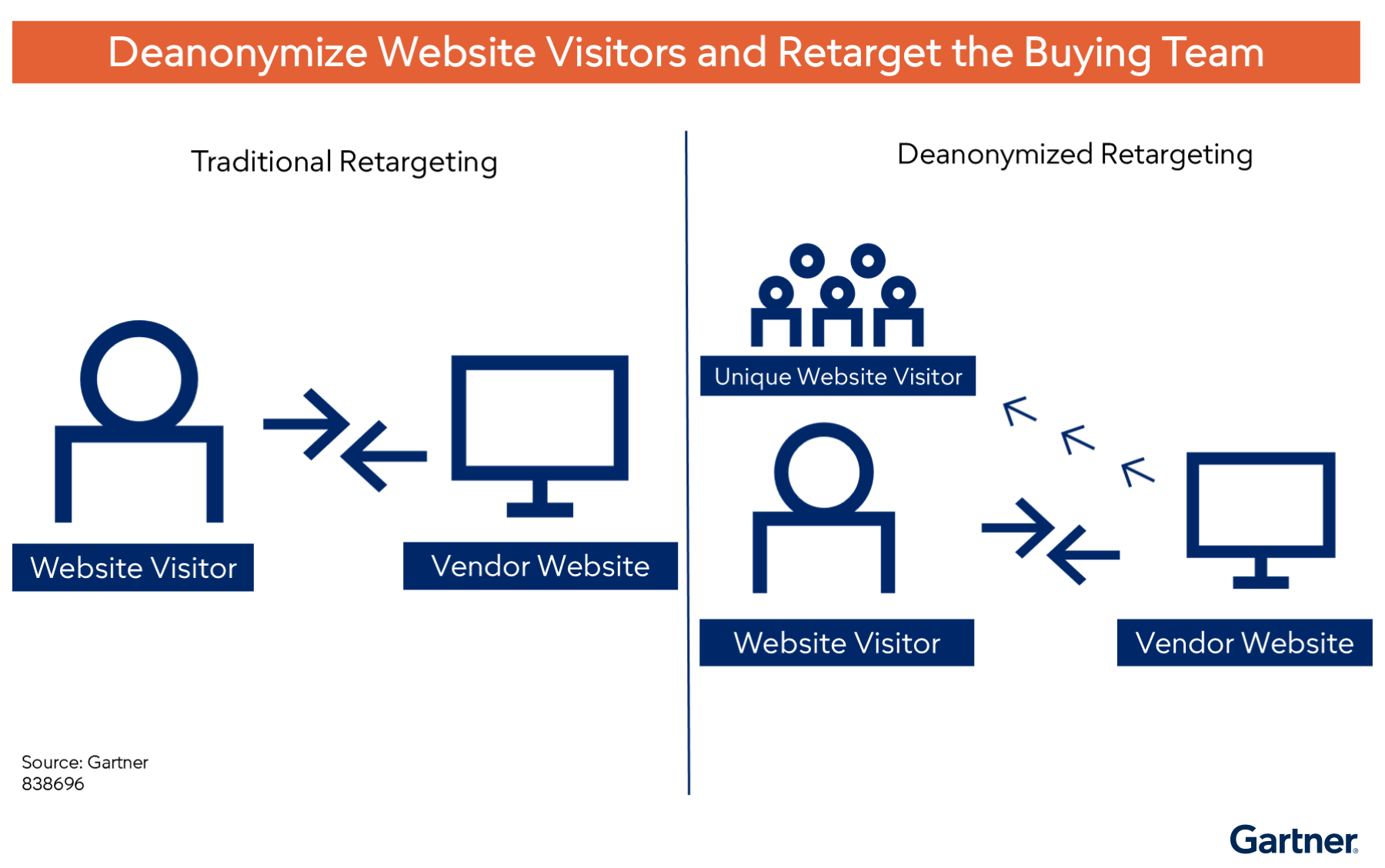
- Deanonymized retargeting: Use advanced tools to identify previously anonymous website visitors, and retarget not only them but also other members of their buying team who haven’t yet engaged.
- Preemptive retargeting (“Pretargeting”): Leverage intent signals to identify and influence potential buyers before they’ve engaged with your brand, positioning your solutions early in their research process.
- Personalized ads: Move away from the “spray and pray” approach. Instead, serve follow-up content tailored to each buyer’s journey and leverage thought leadership to nurture and convert prospects.
- Omnichannel retargeting: B2B buyers interact with an average of seven channels (including at least four digital channels) before making a decision. Retarget across multiple platforms — such as display, social, and connected TV — to create sequential ad experiences that align with where buyers are in their journey. Retarget prospects on industry-specific websites
- Video retargeting: Buyers consume a wide range of media. Video ads, especially on platforms like LinkedIn, can help your brand stand out in crowded channels.
By adopting these approaches, demand-generation leaders can dramatically improve retargeting effectiveness, reaching both direct website visitors and their broader buying teams with personalized messaging across diverse formats and channels. This surpasses the previously fragmented ways of retargeting as seen in Figure 1.
Step 2: Review Current Retargeting Tools and Data
To achieve advanced retargeting goals, it’s essential to have the right tools and data infrastructure. Rather than discarding existing solutions, evolve your martech stack so that traditional analytics, modern identity resolution, and intent data platforms work together seamlessly.
- Assess your current technology and data capabilities based on your strategic objectives.
- Identify gaps and determine which additional tools or integrations are necessary.
- Ensure all systems connect efficiently to enable a unified view of your audience and campaign performance.
Step 3: Build a Martech Stack for Retargeting
Once gaps have been identified, demand-generation leaders should begin selection of the tools based on the strategy and the gaps in the data. The selection of the tool should also be aligned with business resources such as budget, skills, and time to overcome the learning curve.
Demand generation leaders who are assembling their retargeting technology stack can use the table below to decide among the different categories.
Tools to Build Your Martech Stack for Retargeting
Tool | Description | Representative Examples |
Data and tracking tools | Platforms, tools, and technologies that track website visitors’ behavior | Pixel tracking, customer data platforms (CDP) |
Retargeting channels | Platforms that host the ad that will be used to retarget | LinkedIn, display advertising, programmatic ads, connected TV |
Third-party intent data tools | Tools that collect, analyze and purchase consumer information from external sources — as opposed to owned interactions | 6sense; Bombora; Demandbase; ZoomInfo |
Identification platforms | Tools that deanonymize website visitors and allow you to retarget buyers and others on their team | Bombora; LeadPost |
Integration and automations | Platforms that store customer behavior data to create highly targeted segments | HubSpot; Klaviyo; Salesforce |
Personalization tools | Tools that can be used for on-site personalization, pop-up tools, and personalized landing pages for specific ad campaign | Criteo; Drip (Sleeknote); Publicis Groupe (Yieldify); Unbounce |
Analytics | Tools that measure the performance of ads | Adobe Analytics; Google Analytics |
Source: Gartner (April 2026)
Demand generation leaders should note that as we continuously move toward a cookieless web experience, compliance with data laws and regulations must be met.
Step 4: Create Sequential Messaging for Retargeting
A key part of any successful campaign is customer-centric messaging. It is how your campaign resonates with buyers and ensures it is relevant. However, for messaging to truly be effective and efficient, it must be targeted to a specific persona and address their challenges and desired outcomes. This needs to be aligned with where they are in the buying journey.
Messaging for retargeting must be adapted to the data gathered to better understand intent. With that, messaging should evolve to match where buyers are in the buying journey. Continuously showing the same retargeting ad with the same messaging is ineffective; the messaging should match the customers’ stage in the buying journey and answer their pertinent questions at that particular stage to help them progress. To remain relevant, demand generation teams must map this for different personas based on the campaign, and create a messaging sequence.
How to Execute
To launch an advanced retargeting strategy, demand generation leaders should leverage their upgraded martech stack and adopt sequential messaging to overcome fragmented buying journeys and reach the entire buying team.
Start by using a deanonymization tool to turn anonymous website traffic into actionable business intelligence. These tools reveal attributes like the visitors’ companies, industries, and sometimes job roles, giving marketers deeper insight into who is engaging with their site and enabling more targeted retargeting.
With this data, build detailed audience segments based on content engagement, intent topics, and firmographics such as industry, company size, and location. Segment further by role or department for greater precision.
Next, create personalized messaging that aligns with each segment’s interests and stage in the buying journey. Instead of repeating generic messages, evolve your communications based on content consumed and intent signals, using both first- and third-party data. Adapt messaging and calls to action as prospects move through the buying journey..
Extend this approach to the entire buying team by leveraging deanonymization and third-party data to understand what others within the company and buying team are researching. This enables retargeting with relevant, intent-driven messaging for all stakeholders.
Activate your messaging across multiple advertising platforms such as programmatic display, Google Ads, connected TV, and LinkedIn, and expand content formats and channels to address where buyers seek information.
Finally, optimize your retargeting strategy by monitoring campaign performance (e.g., impressions, clicks, conversions, engagement rates) and refining segments and messaging accordingly. Regularly test creative elements and personalization tactics to maximize results. By following these steps, marketers can deliver the right content to the right buyers, driving more conversions both on and off the website.
Case Example: SAP Behavioral Personalization Retargeting

Challenge:
SAP’s initial retargeting efforts were limited to sap.com visitor data managed through Adobe Audience Manager (AAM), which restricted both reach and personalization. Adobe Analytics (AA) was integral to this process, as data was transferred from AA to AAM for segment creation and activation. For a time, segments were built directly within Adobe Analytics; however, this method was eventually abandoned due to a 24-hour delay in visitor qualification, which impeded real-time personalization. With the introduction of Marketo, SAP expanded its approach by integrating additional data sources — including paid social, account lists, and email nurture contacts — resulting in a broader and more effective retargeting strategy.
Solution:
SAP tailored campaigns using return-visitor behaviors, abandoned forms, and solution-based intent signals, allowing for messaging that addressed the needs of individual decision makers. The company used tactics like abandoned form reminders and personalized messaging for return visitors to guide prospects through the buying journey and drive actions such as event registration. SAP increased engagement by retargeting across email, social media (LinkedIn, Facebook), and display ads (Google Display & Video 360) to reach prospects on their preferred platforms.
Tools and Technology:
Instead of focusing on a single lead, SAP used account lists and Bombora’s device matching to reach multiple stakeholders within target organizations. SAP leveraged frequency capping, 6sense keywords, Bombora demographic data, and visitor segmentation via AAM and Adobe Target to enable advanced personalization and sequential messaging.
Results and Lessons Learned:
Abandoned form reminders for events drove the most engagement and registrations. High click-through rates were observed, though some were inflated by low activity volume. These tactics revealed that personalization journeys with multiple tactics performed best. They also were able to understand that scaling return visitor activities revealed the need for prioritization and frequency capping. SAP also tested AI-driven personalization for banners and found that combining tactics improved performance.
Success Measures
To measure success, demand generation leaders should track the following metrics:
- Click-through rate (CTR): Tracking CTR helps determine if your ads are relevant and engaging to your audience. A higher CTR indicates effective creative, messaging, and targeting.
- Conversion rate: Monitoring conversion rate shows how well your retargeting ads drive users to take meaningful actions, making it a primary measure of campaign effectiveness.
- Return on ad spend (ROAS): ROAS indicates the profitability of your campaign. Tracking this metric ensures your advertising investment is yielding positive returns.
- Cost per acquisition (CPA): Measuring CPA helps optimize your budget by identifying how efficiently you’re spending to gain new customers. Lower CPA suggests more cost-effective campaigns.
- Engagement metrics: Tracking engagement metrics helps you understand the quality of traffic driven by retargeting ads. High engagement indicates that returning users are more interested and likely to convert, allowing you to refine your audience and messaging for better results.
Tracking these metrics is crucial for understanding campaign performance, optimizing spending, and maximizing the impact of retargeting efforts.
2 2025 Gartner Technology Marketing Benchmarks Survey. This survey was conducted online from January through March 2025 among 332 respondents. Respondents came from technology-focused organizations located in the U.S., Canada and the U.K. with more than $10 million in annual revenue. Respondents were required to have knowledge of the marketing budget and spend (for the company or business unit) and the marketing campaign/program tactics. Quotas were established to guarantee a good distribution in terms of countries, product offering (software, technology services and hardware), customer type (B2B and B2B2C) and company size (annual revenue). Disclaimer: The results of this survey do not represent global findings or the market as a whole, but reflect the sentiments of the respondents and companies surveyed.
3 2024 Gartner B2B Buyer Survey: This survey was conducted to explore how B2B buyers learned about potential suppliers, what factors influenced their decision to purchase from a specific supplier and their perceptions of personalization. The survey was administered online from August through September 2024 and includes data from 632 B2B buyers from North America (n = 502) and Europe (n = 130). Respondents who qualified for this survey were required to be employed full time at an organization with a total revenue of at least $250 million (or equivalent) and have participated in a significant B2B purchase decision. A “significant B2B purchase decision” was defined as a decision that required deliberation with at least one other person and the evaluation of more than one potential supplier or vendor. Purchases included in this survey were made in a variety of categories, including manufacturing (n = 144), IT and high tech (n = 140), healthcare (n = 138), financial services (n = 115), non-IT business services (n = 57), and other (n = 35). Disclaimer: The results of this survey do not represent global findings or the market as a whole, but reflect the sentiments of the respondents and companies surveyed.
Disclaimer: The organization (or organizations) profiled in this research is (or are) provided for illustrative purposes only, and does (or do) not constitute an exhaustive list of examples in this field nor an endorsement by Gartner of the organization or its offerings.