Magic Quadrant for Document Management
28 April 2026 - ID G00828488 - 47 min read
By Tim Nelms, Jed Cawthorne, and 3 more
Document management platforms help create, capture, store, process, and deliver content for enterprise applications, business processes, AI assistants, and agents. Enterprise application leaders should evaluate AI-enabled document management for diverse collaborative and operational content purposes.
Market Definition/Description
Gartner defines document management as the tools and practices used to capture, store, process and deliver documents and information in support of personal, team and enterprise needs. Gartner estimates that 70% to 90% of enterprise data is unstructured, posing a significant challenge for organizations that need to unlock its potential using AI and also mitigate the risks of poor information governance. Document management platforms are critical to enterprise application strategies that require AI-ready, unstructured data (aka enterprise content).
Document management platforms serve a wide range of collaborative and operational use cases that enable the digital workplace, content collaboration, knowledge management, content-centric processes, content services for enterprise applications and information governance. These general-purpose platforms manage content that helps users in a variety of ways:
- Digital workplace suites include document management platforms, which help employees to collaborate on shared content while working remotely from each other.
- External collaboration is critical to employees working with external contractors, business partners and customers who require document management to collaborate on shared content.
- Knowledge management depends on document management for the capture, curation and circulation of information, and is critical for grounding AI assistants and agents.
- Content-centric business processes are enabled by document management platforms that automate workflows and tasks for document-heavy processes.
- Enterprise applications like CRM, ERP, human capital management (HCM) and supply chain management (SCM) integrate with document management platforms, sitting invisibly behind these enterprise applications.
- Information governance helps compliance leads and records managers responsible for ensuring that critical business information is handled, retained, classified and disposed of in accordance with regulatory, legal, and internal policy requirements. Information governance is critical to ensure data quality and accuracy for agentic AI.
Document management platforms are a packaged collection of component content services that have broad applications and can be configured to suit specific business needs and be found in digital workplace suites. They are often used as foundational platforms for building business solutions. They may compete with adjacent markets for content service applications like digital asset management and contract life cycle management, which are prepackaged components and configurations tuned to specific use cases that align with departmental and industry business needs. Deciding between a general-purpose document management tool and a packaged application is a key choice for buyers.
Vendors may offer content service components found in adjacent markets to support document management, including:
- Electronic signatures
- Intelligent document processing
- Artificial intelligence
- Process automation
- Enterprise search
- Customer communication management
Some vendors offer a complete suite of tools. However, best-of-breed approaches are common.
Mandatory Features
The mandatory features for this market include:
- Content storage capabilities facilitate the management of where and how content is stored, aligning with an overarching information life cycle management strategy. Essential services encompass on-premises or cloud-based storage, in addition to encryption.
- Metadata capabilities facilitate the indexing of content through summary data. Read-only system metadata constitutes a mandatory service.
- Library and repository capabilities enable the organization of document collections. Essential services required include document check-in and check-out, maintenance of version history and document identity.
- Information governance capabilities ensure that content is managed in adherence to operational and legal regulatory compliance requirements. Essential services include the formal declaration of records, their preservation, and the unrecoverable disposition of content.
- Security and protection capabilities prohibit unauthorized access to and modification of content and metadata. Essential services encompass role-based permissions, single-sign-on functionality and comprehensive access auditing.
- Search capabilities enable users to locate content based on metadata or the textual content of documents. Mandatory capabilities include the use of metadata search, full-text search, and the security trimming of search results.
- Digital workplace integration guarantees that documents can be used within digital workplace suites, which comprise collaborative work management tools, workstream collaboration platforms, online meeting applications, intranets and office document editing software.
- Administration capabilities provide advanced users and system administrators with the tools necessary to configure the system, evaluate its performance and manage its operations.
Common Features
The common features for this market include:
- User experience (UX) support facilitates user access to content irrespective of device or location. Document management solutions offer document browsing, searching and viewing capabilities across web and mobile platforms. Leading vendors provide support for diverse device types and operating systems.
- API and integration capabilities enable integration with other applications, accommodating a broad spectrum of content-centric use cases. Standard integration interfaces encompass command line interfaces, language framework software development kits (SDKs), web services (e.g., RESTful APIs) and batch interfaces. Some vendors use established integration standards such as secure file transfer protocol (SFTP), WebDAV and Content Management Interoperability Services (CMIS). Leading vendors support Agent2Agent (A2A) or MCP protocols for agentic AI interoperability.
- Collaboration capabilities assist employees and external parties in working together on content. Foundational services include team workspaces, integration with digital workplace suites and external collaboration. Leading vendors ensure synchronized content across all devices and facilitate real-time coauthoring and collaborative editing using desktop productivity tools.
- Workflow automation orchestrates and automates document-centric tasks between human users and system components. Basic services include structured document review and approval life cycles, management of case-centric processes, and reliable electronic signature capabilities. For more advanced requirements, solutions from adjacent markets such as business process automation (BPA), robotic process automation (RPA), enterprise low-code application platforms (LCAPs), intelligent document processing solutions (IDP), and business orchestration and automation tools (BOAT) are used. Leading vendors incorporate AI-augmented workflows and/or employ AI agents that use dynamic planning methodologies.
- Enterprise application integration facilitates user access to documents within the context of applications such as HCM systems (Workday, ADP, SAP SuccessFactors), CRM systems (Salesforce, Microsoft Dynamics 365), and ERP systems (SAP, Oracle, Microsoft Dynamics 365), in addition to industry-specific applications like patient administration systems in healthcare (Epic Systems) and policy administration systems in insurance (Duck Creek Technologies, Guidewire).
- Capture capabilities enable the ingestion and classification of content from diverse sources, including user devices, imaging services and other repositories. These capabilities encompass data extraction from images, optical character recognition for text-based images and image recognition.
- Artificial intelligence addresses significant knowledge management challenges by converting content designed for human consumption into machine-interpretable data and vice versa. AI-enabled capabilities are integrated across capture, storage, workflow automation and search functions. These include generative AI models, machine learning models, model operations (ModelOps), and multimodal AI processing.
- Deployment model flexibility provides organizations with options for commissioning and managing services, including SSaaS, vendor-managed services, and client-managed services. SaaS is the predominant deployment model for collaboration use cases and is becoming increasingly popular for operational use cases. Leading vendors support deployment options focused on government services (e.g., FedRAMP, StateRAMP) or sovereign hosting options that ensure the storage of content and metadata within specified geographical boundaries. Vendors offering self-service onboarding and adoption (SaaS) demonstrate greater success in new customer acquisition.
- Federation capabilities allow organizations to manage information spanning multiple document management systems from a unified tool. Federation services can support third-party document management systems, file systems and data from other enterprise applications.
- Advanced content storage capabilities include data residency, storage tiering, file system storage, content-addressable storage, and database storage.
- Advanced metadata capabilities comprise rule-based and event-based autoclassification, controlled vocabulary and taxonomy import, synonyms, metadata suggestions, manual override of automated metadata, external metadata management system integration, and permission-based views.
- Advanced search and AI assistant capabilities incorporate faceted search, which allows result filtering based on metadata, and AI assistants that support a conversational experience applicable to an entire corpus, a workspace or a specific document.
- Advanced security and protection capabilities include data loss prevention and security classification.
- Advanced library and repository capabilities encompass workspaces, knowledge graphs and export/import functionalities. These features are tightly integrated with content storage, metadata, search, governance and security services.
- Advanced information governance capabilities include support for specific records standards, AI-driven classification and automated disposition.
Magic Quadrant
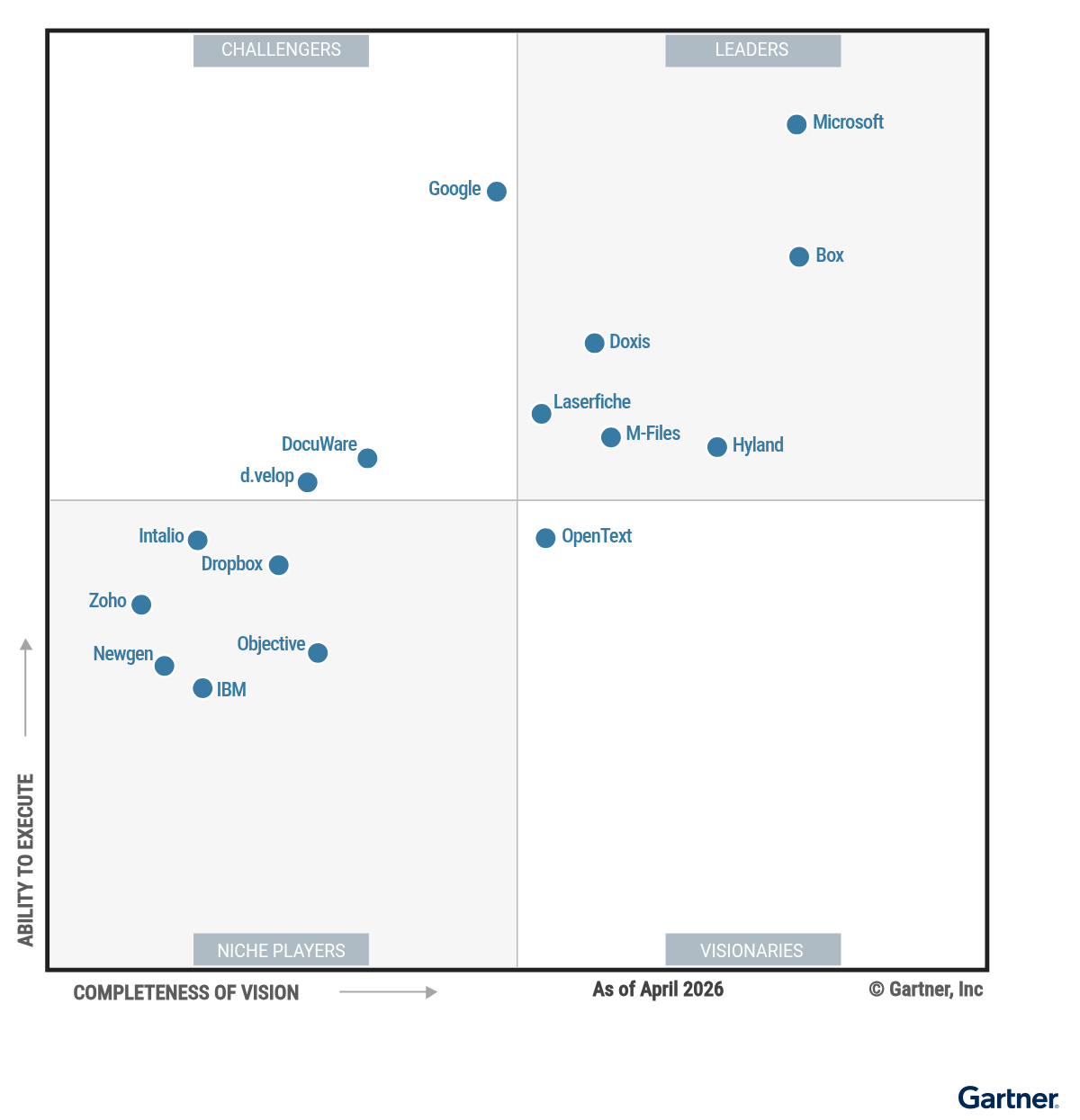
Vendor Strengths and Cautions
Box
Box is a Leader in this Magic Quadrant. Its platform is used for both collaborative and increasingly operational use cases, with operations focused in the U.S., Japan, Australia and New Zealand, and Europe. Box serves 116,000 customers across small, medium, and large enterprises, with a strong presence in the public sector, banking, insurance, life sciences, and legal industries. Its SaaS delivery and self-service models enable organizations to try, buy, and deploy products easily.
Recent investments include intelligent document processing (IDP) with Box Extract, improved security with Box Shield Pro, expanded automation, and enhancements to sovereign cloud services. Box Extract, Box Agent, and Box Automate are generally available in the first half of 2026.
- Customer experience: Transparent packaging, pricing, and bundling make it easy for customers to do business with Box. Client inquiry and peer insights data indicate that customers consistently report positive experiences.
- Self-service and scalability: The platform’s self-service SaaS model, including Federal Risk and Authorization Management Program (FedRAMP) support for U.S. government agencies, enables organizations to efficiently trial, purchase, and scale deployments with minimal vendor intervention.
- Marketing execution: Box maintains a strong web presence, providing consistent, clear, and accessible product, support, and developer communities. This in turn fosters user confidence and ease of engagement.
- Product and automation depth: Box’s capabilities in process automation and content governance may not fully address the needs of organizations with highly complex or specialized requirements. Enterprises with advanced operational document management needs should carefully assess the platform’s fit for these use cases.
- Data residency limitations: While Box Zones enables regional content storage, all metadata remains in North America, with sovereign metadata, search, and AI residency enhancements planned for 2026. Organizations with strict data sovereignty or regulatory requirements may need to consider alternative solutions until these capabilities are available.
- Vertical solutions: Box offers a horizontal platform with broad certifications. However, apart from compliance standards such as FedRAMP High, GxP (“good practice”), and the Health Insurance Portability and Accountability Act (HIPAA), it lacks first-party, industry-specific, content-centric applications. Customers seeking packaged solutions tailored to unique vertical requirements may find limited options.
DocuWare
DocuWare is a Challenger in this Magic Quadrant. Its platform is used primarily for operational use cases, with operations centered in Europe and North America. DocuWare serves 21,000 customers, primarily small-to-midsize enterprises (SMEs), with a strong presence in manufacturing, professional services, construction, wholesale, and real estate. Its partner-serviced SaaS delivery model supports efficient onboarding.
Recent enhancements include a browser-native user experience (UX), integration with e-invoicing providers, workflow analytics via third-party tools, and AI-driven document processing. DocuWare’s roadmap focuses on modernizing its web client, expanding compliance for European markets, and introducing AI assistants and a unified integration framework.
- Sales execution and value: DocuWare’s pricing and licensing structure is transparent and competitive, making it accessible for SMEs. Steady customer growth in the SME segment reflects its appeal for operational document management and value for money.
- Marketing execution: DocuWare’s clear and consistent messaging aligns with buyer needs and addresses key business function needs such as automated invoice processing, quality management, and contract management.
- Customer experience: DocuWare’s partner-led sales and onboarding model provides customers with local expertise and support, resulting in positive feedback from SMEs seeking tailored implementation and ongoing assistance.
- Product capabilities: DocuWare’s platform offers fewer advanced capabilities compared with other vendors, particularly in AI-driven document management and collaborative functionalities, which may limit its appeal for organizations seeking cutting-edge solutions.
- Innovation roadmap: DocuWare’s pace of innovation and future plans may not fully address evolving AI and automation needs. Prospective buyers should assess whether the provider’s roadmap aligns with their long-term requirements.
- Industry specialization: DocuWare demonstrates limited evidence of tailored solutions for specific industry verticals. Organizations with specialized needs may need to evaluate alternative platforms that offer deeper industry-specific functionality.
Doxis
Doxis (formerly SER Group) is a Leader in this Magic Quadrant. Its Doxis Intelligent Content Automation product is focused on operational use cases. Doxis’ operations are concentrated in Europe and North America, serving approximately 3,600 medium and large customers across banking, insurance, manufacturing, logistics, and healthcare.
Recent investments include intelligent document processing (IDP) with Doxis AI.dp; updatable application packages; cloud administration via Doxis OneCloud Studio and One Access; advanced semantic search and AI assistant features; and expanded integration with SAP SuccessFactors, Salesforce, and ServiceNow. Doxis also plans further enhancements in workflow orchestration and support for additional enterprise applications.
- Comprehensive capabilities: Doxis offers a broad set of operational document management features, including advanced content storage, robust enterprise application integration, and AI-powered back-end services, supporting complex enterprise use cases.
- Market momentum: Doxis is among the fastest-growing vendors in the document management market, driven by recent acquisitions such as Klippa for IDP, AFI Solutions for SAP services, and Metaforce.
- Vertical specialization: Doxis’ industry-specific solutions are adopted by nearly half of its customer base, with strong uptake in banking, insurance, manufacturing, logistics, and healthcare, reflecting its success in addressing vertical requirements.
- Limited market visibility: Despite its recent rebranding in January 2026, Doxis continues to have limited brand recognition outside its core market in Germany, with fewer mentions among customers and prospects.
- SaaS delivery limitations: Doxis’ client- and vendor-managed service models are not fully aligned with prevailing trends toward self-service SaaS deployment, which may not meet the needs of organizations seeking streamlined cloud adoption.
- Geographic reach: Doxis’ presence remains concentrated in Europe and North America. Customers in other regions should carefully evaluate its ability to provide adequate support and service for their requirements.
Dropbox
Dropbox is a Niche Player in this Magic Quadrant. Its platform is used mainly for collaborative and external sharing use cases, with operations centered in North America. Dropbox serves an estimated 500,000 small and midsize enterprise customers across marketing; technology; professional services; manufacturing; and architecture, engineering, and construction (AEC). Its SaaS delivery model supports simple deployment.
Recent enhancements include an in-app AI assistant called Dash, improved media performance, synchronization stability, and a modernized UX. Dropbox’s roadmap focuses on expanded AI capabilities, AI-supported video editing with Replay, AI-enabled automation, interoperability with AI platforms, enhanced reporting with Dropbox Protect, and improved role-based controls for external collaboration.
- Value proposition: Dropbox offers one of the most competitively priced document management platforms in the market, with list and market prices consistently below the industry median. This affordability makes Dropbox an attractive option for customers seeking cost-effective file-sharing solutions.
- Brand visibility: Dropbox maintains strong recognition across both consumer and enterprise segments, outperforming peers in search metrics and social media presence. Its well-established brand ensures high visibility among potential buyers.
- Scale and delivery: Dropbox serves a large and diverse customer base through direct channels and automated customer service, enabling efficient self-service at scale. This approach is highly valued by customers for its simplicity and accessibility.
- Feature depth: Dropbox’s limited capabilities in advanced document management — including workflow automation, governance, and content federation — may restrict its suitability for organizations with complex requirements.
- Competitive pressure: Dropbox faces increasing competition from integrated digital workplace suites, as customers consolidate collaboration tools and favor platforms that provide broader functionality within a single ecosystem, rather than focusing solely on external file sharing.
- Innovation pace: Dropbox’s product roadmap and innovation efforts lag behind market leaders, with its AI initiatives yet to demonstrate clear alignment with emerging trends, such as IDP and agentic automation.
d.velop
d.velop is a Challenger in this Magic Quadrant. Its d.velop documents platform is used mainly for operational use cases, with a geographic focus on Europe. The company serves 15,500 customers, primarily SMEs and some large enterprises across multiple industries.
d.velop’s recent enhancements include AI assistants for d.velop process studio, a retrieval-augmented generation (RAG)-based search pipeline, Kubernetes-based cross-cloud deployment, shared project spaces for external collaboration, and expanded SAP support across all S/4HANA deployment models. Its roadmap focuses on a control plane for human- and AI-driven work, centralized security and compliance management, eIDAS-aligned trust services, AI-based contract risk assessment, and Wiki-style workspaces.
- Product and integrations: d.velop offers a well-designed product with robust API and application integrations, including SAP, Microsoft Dynamics 365, Infor, Salesforce, and Sage. Its packaged application integrations demonstrate above-average market penetration, making it a strong option for customers seeking seamless connectivity.
- Marketing strategy: The company maintains a clear and consistent marketing message targeted at SMEs in Europe. Its focused approach resonates with this segment, positioning d.velop as a suitable document management platform for these organizations.
- Vertical industry solutions: d.velop invests heavily in industry-specific solutions and organizes its business into vertically focused units. Public sector, healthcare, health insurance, social care, and banking customers in Europe benefit from tailored offerings that address their unique requirements.
- Geographic strategy and global operations: The company’s focus on Europe means organizations with requirements for local support outside this region may find d.velop’s presence insufficient in North America and other global markets.
- Market visibility: d.velop is not a well-known vendor in this market and is rarely seen on shortlists or mentioned during client inquiry, except inside its home market. This limits its market potential and ability to acquire customers compared with competitors.
- Innovation alignment: While customers can provision and configure a cloud tenant via self-service, and citizen developers can independently create processes, enterprise deployments often involve more complex requirements and rely on d.velop’s expertise for configuration and customization. As a result, the company’s vendor management services are not yet fully aligned with self-service trends.
Google is a Challenger in this Magic Quadrant. Google Drive, available as part of the Google Workspace suite, is primarily focused on collaborative use cases. Google’s operations are geographically diversified, serving over 11 million customers that include SMEs as well as large enterprises across a wide range of industries. Google’s SaaS delivery model aligns with current cloud deployment trends.
Recent investments emphasize larger context windows for AI, enhanced security, and AI overviews. The company’s roadmap focuses on a new workspace concept called “projects,” improved workflow automation, and deeper interoperability with Microsoft Office, including macro conversion for all Microsoft Office apps and stand-alone VBA files.
- Customer experience: Google performs well across customer experience metrics, with customers citing high product quality, transparent pricing, and a self-service delivery model that supports strong retention.
- Cloud infrastructure and scale: Google’s global cloud infrastructure enables effective scaling, serving over 11 million Workspace and Drive customers with strong growth in EMEA. Its global cloud infrastructure makes Workspace a viable alternative to Microsoft 365, even where digital sovereignty is a concern.
- Overall viability: Google maintains a strong market position and ongoing investment in the digital workspace and collaborative document management markets, giving customers confidence in its long-term commitment.
- Product limitations: Google Drive provides limited capabilities for advanced content storage, metadata and search, and prebuilt enterprise application integration, which reduces its suitability for operational use cases. Organizations with these requirements should carefully assess whether Google can fulfill their needs.
- Innovation focus: Despite Google’s strong reputation in AI, innovation within Drive for the document management market is narrowly focused on core document management and collaborative workplace features, rather than broader operational capabilities such as records management.
- Market alignment: Google pursues a distinct strategy in this market, emphasizing collaborative document management focused on the digital workplace. Customers aiming for broader operational use cases must rely heavily on customization through Google Drive APIs.
Hyland
Hyland is a Leader in this Magic Quadrant. Its products, Alfresco and OnBase, are available independently and as part of the Content Innovation Cloud suite, with a primary focus on operational use cases. Hyland’s operations are geographically diversified across North America, Asia/Pacific, and Europe, serving approximately 15,000 customers — mainly large enterprises in healthcare, insurance, banking, and the public sector.
Recent updates include a new content repository; cloud federation for OnBase, Alfresco, Nuxeo, and Microsoft SharePoint; and AI-driven knowledge discovery, automation, and document classification. Hyland’s roadmap features knowledge graphs, AI agents for workflow automation, and expanded Content Innovation Cloud federation services.
- Broad capabilities: Hyland Alfresco demonstrates robust functionality across advanced content storage, information governance, AI-powered services, federation, and automation, making it suitable for organizations with complex document management requirements. It is the only vendor in this research to offer an open-source document management platform.
- Vision alignment: Hyland’s strategic focus on the semantic layer and agentic automation in the Content Innovation Cloud is well-aligned with emerging market trends and buyer demand for integrated platforms supporting AI assistants and agents.
- Industry expertise: Hyland demonstrates strong vertical expertise in healthcare, insurance, lending, and the public sector, delivering domain-specific applications that address industry-specific requirements for large enterprise customers.
- Customer acquisition and deployment: Hyland’s rate of acquiring and deploying new customers is below that of many of its competitors, due to a primary focus on large enterprises. Small and midsize organizations seeking streamlined, self-service onboarding may find better alignment with vendors emphasizing SaaS delivery models.
- Sales execution and pricing complexity: Customers report that the SKU structure and pricing for Alfresco and OnBase are complex, which can complicate procurement and long-term planning. Prospective customers should conduct thorough needs assessments and negotiate to secure predictable commercial terms for the duration of their contracts.
- Geographic coverage: Hyland’s revenue is predominantly concentrated in North America, with less presence in Europe and Asia/Pacific. Buyers in these regions should carefully assess Hyland’s local delivery and support capabilities relative to regional requirements.
IBM
IBM is a Niche Player in this Magic Quadrant. Its IBM Cloud Pak for Business Automation suite, which includes its document management product FileNet Content Manager, is focused on operational use cases. IBM’s operations are geographically diversified, serving approximately 1,500 mainly large enterprises with significant IBM technology investments.
Recent investments by the company emphasize AI-powered automation, agentic automation with IBM watsonx.ai, and a semantic layer with IBM watsonx.data Premium. Planned enhancements include Content Cortex, no-code and natural language agent creation, modernized document processing, and federated records management.
- Broad platform: IBM Cloud Pak for Business Automation, alongside the broader IBM product suite, offers an integrated platform for document management and process automation, making it well-suited for organizations with advanced automation and information governance requirements.
- AI capabilities: A range of AI capabilities, including those of IBM watsonx.ai, delivers a robust suite of AI features that enhance the document management platform, reinforcing IBM’s strength in content-centric process automation.
- Unified product strategy: IBM’s vision to consolidate its multiple content management solutions into Content Cortex addresses customer demand for a unified, end-to-end platform, simplifying deployment and management across diverse use cases.
- Market responsiveness: Gartner analysis indicates a lack of responsiveness by IBM to market demands in its document management portfolio, which puts prospective clients at risk of investing in a platform that may struggle to keep pace with their future collaborative needs.
- Pricing and sales execution: IBM’s document management offerings are priced at a premium relative to competitors, and customers report that pricing complexity leads to challenging negotiations and contributes to customer attrition.
- Sales focus and customer acquisition: IBM’s direct sales approach and limited resources dedicated to document management have resulted in few new customer acquisitions, with little emphasis on expanding the customer base for these products.
Intalio
Intalio is a Niche Player in this Magic Quadrant. Its core product is primarily focused on operational use cases. Intalio’s operations are concentrated in EMEA, serving 716 mainly SMEs, with a strong presence in government, public sector, energy, and utilities.
Recent investments include a new multitenant architecture, enhanced IDP, web-based document collaboration via ONLYOFFICE, and AI-enabled enrichment and knowledge discovery. Intalio’s roadmap promises agent-based automation, preconfigured solution templates, contextual understanding, expanded application integration, and AI-assisted administration.
- Product capabilities: Intalio demonstrates advanced capabilities in information governance, metadata management and search, AI-powered assistants and agents, and workflow automation, making it well-suited for buyers with these requirements.
- Competitive pricing: Intalio offers some of the most competitive pricing for operational document management, providing significant value and setting a challenging price point for other vendors in the market.
- Industry focus: Intalio delivers tailored industry solutions, particularly for government and public sector customers in the Middle East, with specialized offerings such as correspondence management designed to address unique regional needs.
- Scalability: Intalio’s limited customer acquisition and small installed base suggest that its operations are not yet optimized for scale. The current customer and vendor management services delivery model diverges from prevailing deployment preferences for self-service SaaS solutions, posing a barrier to broader adoption.
- Business viability: Intalio’s productivity, profitability, and annual revenue remain at the lower end among vendors evaluated in this research. The company has yet to capitalize on industry shifts toward SaaS and self-service delivery models, limiting customer access to emerging technologies.
- Geographic reach: Intalio’s concentration in the Middle East and Africa, with minimal presence in other regions, constrains its global competitiveness and growth potential. Organizations outside these core markets should closely evaluate whether Intalio’s geographic presence aligns with their support requirements.
Laserfiche
Laserfiche is a Leader in this Magic Quadrant. Its product is focused on operational use cases for organizations seeking to improve efficiency and compliance. Laserfiche’s operations are mainly in North America, serving approximately 9,500 customers, primarily midsize enterprises in government, financial services, healthcare, and education.
Recent enhancements include AI-enabled data extraction with Smart Fields, a Smart Chat AI assistant, improved metadata experiences, enhanced data lookups and integration, and a modernized multitenant architecture. Laserfiche’s roadmap features AI agents, agentic tasks in workflows, UX upgrades, GovRAMP Core verification, Criminal Justice Information Services compliance, and improved deployment.
- Customer experience: Laserfiche receives consistently high praise for customer experience in Gartner Peer Insights, with customers highlighting product quality, successful implementations, and positive vendor engagement.
- Product capabilities: Laserfiche demonstrates strong performance in critical capabilities assessments, excelling in advanced information governance, metadata and search, federation, and workflow automation.
- Market insight: Laserfiche shows a deep understanding of the operational document management market, supported by a clear roadmap for increasing AI automation. Its pragmatic approach to complex document management challenges resonates with buyers.
- Financial transparency: As a privately held company, there is limited public visibility into Laserfiche’s overall viability and financial performance. As a result, clients should conduct additional financial due diligence compared with other vendors evaluated in this Magic Quadrant.
- Global presence: Laserfiche shows limited evidence of business outside its core North American market, suggesting that buyers in other regions should carefully evaluate the capabilities of local system integrators and reselling partners.
- Industry focus: Laserfiche’s vertical solutions are primarily tailored to state and local government and education sectors. Customers outside these industries should request detailed implementation proposals to ensure alignment with their specific requirements.
M-Files
M-Files is a Leader in this Magic Quadrant. Its platform supports collaborative and operational use cases. M-Files’ operations are primarily focused in Northern Europe and North America, serving approximately 6,500 customers across small to large enterprises in professional services, manufacturing, tax, audit, consulting, and financial services.
Recent updates include M-Files for Tax Advisory, an enhanced UX with Workspaces, desktop co-authoring with M365, improved AI metadata extraction via the M-Files Aino Metadata Agent, and greater scalability through dedicated cloud infrastructure. The company’s roadmap emphasizes AI-enabled search, agentic workflow and records management, deeper enterprise integration, and expanded analytics.
- Strategic partnerships: M-Files’ recently announced strategic relationship with Microsoft marks a significant evolution in its approach, with Microsoft recommending M-Files for operational use cases beyond SharePoint’s scope. M-Files leverages Microsoft Purview and SharePoint Embedded to deliver document management closely aligned with the Microsoft ecosystem.
- Market understanding: A clear focus on operational use cases with a strategy for partnering on collaborative use cases is unique in this market. M-Files’ nuanced understanding of the dynamics of the document management market means that it can capitalize on the trend toward increased use of collaborative solutions, while focusing on its core strengths.
- Product capabilities: M-Files shows robust performance across advanced information governance, metadata and search, digital workplace, and federation capabilities. The company stands out as one of the few vendors excelling in both collaborative and operational use cases.
- SME segment fit: Customer churn is primarily concentrated among smaller, self-hosted customers and reflects M-Files’ strategic shift toward cloud-first, midmarket, and enterprise deployments. Prospective SME customers should evaluate whether this direction aligns with their needs.
- Delivery model: M-Files’ delivery model does not adequately support self-service procurement, nor does it align with evolving deployment trends for SaaS.
- Industry solutions maturity: M-Files’ vertical industry solutions are in early development, with most offerings still positioned as horizontal solutions within target industries. Customers in consulting and manufacturing should monitor the rollout of new capabilities to determine their suitability for specific business requirements.
Microsoft
Microsoft is a Leader in this Magic Quadrant. Its SharePoint and OneDrive products, available as part of the M365 suite, are widely used for both collaborative and operational document management solutions. Microsoft’s operations are geographically diversified, serving an estimated two million customers that span small, medium, and large enterprises across diverse industries.
Recent investments include unified AI entry with the Microsoft Copilot app, semantic search across M365, agentic workflow automation, enhanced SharePoint experiences, and data access and governance reports for SharePoint. Microsoft’s roadmap features advanced AI agents, agent orchestration, and a refreshed SharePoint UX focused on employee communications and governance.
- Market responsiveness: Microsoft has led the adoption of AI in document management, deploying AI assistants, agents, advanced search, and document processing capabilities at scale.
- Operational model: Microsoft’s SaaS platform aligns with customer preferences for self-service acquisition, onboarding, and deployment. Its global operations and rapid AI rollout make adoption straightforward compared with vendors with other models.
- Product capabilities: SharePoint and OneDrive deliver strong performance in metadata management, search, AI-powered features, and collaboration, reinforcing Microsoft’s leadership in collaborative document management.
- Limited product visibility: Microsoft’s marketing and positioning of SharePoint and OneDrive are often subsumed within the broader M365 digital workplace narrative, making it difficult for customers to locate specific information. As a result, organizations may not fully understand the essential role SharePoint and OneDrive play in grounding Copilot agents and assistants.
- Operational suitability: The increasing application of M365 to operational workloads places greater demands on SharePoint and OneDrive. Clients should carefully evaluate whether a general-purpose suite can adequately support complex operational requirements, such as integration with enterprise applications.
- Industry-specific solutions: Microsoft’s approach to document management is primarily horizontal, focusing on collaborative use cases. The company does not provide industry- or function-specific solutions for SharePoint and OneDrive, instead relying on its partner ecosystem for these.
Newgen
Newgen Software Technologies is a Niche Player in this Magic Quadrant. Its NewgenONE Contextual Content Services platform is primarily focused on operational use cases. Newgen’s operations are concentrated in the Asia/Pacific region and the Middle East, serving 503 mainly medium and large enterprises in banking, insurance, and the public sector.
Recent enhancements include updates to NewgenONE Marvin’s AI capabilities, agentic automation capabilities through NewgenONE AI Studio, reusable data objects, and improved UX. The roadmap features an AI agent designer with Agent Studio, enhanced connectivity via Model Context Protocol (MCP), dedicated workspaces for AI assistants and agents, and expanded agentic workflows.
- AI capabilities: Newgen has incorporated a wide range of AI features across document processing, classification, semantic search, and workflow automation, reflecting an ongoing commitment to AI-driven enhancements.
- Product breadth: Newgen provides a comprehensive suite that includes document processing, process automation, and customer communications management, closely matching the requirements of its core banking and public sector customers. Planned investments continue to target these key areas.
- Industry solutions: Newgen’s specialized offerings for customer onboarding, loan origination, and claims management are designed to accelerate time to value for clients in banking and insurance.
- Marketing visibility: Newgen has limited market presence, as Gartner rarely sees it referenced by clients during vendor selection or proposal reviews. Organizations should consider whether this lack of visibility may impact service availability in their region.
- Business model: Newgen’s business model relies on a large workforce to support a relatively small customer base, resulting in low customer acquisition rates and static client numbers. Productivity is lower compared with peers, and implementations often require substantial vendor support, making it less suitable for buyers seeking self-service solutions.
- Geographic reach: Newgen’s presence in North America and Europe is minimal. Prospective customers should carefully evaluate its geographic focus and market coverage.
Objective
Objective is a Niche Player in this Magic Quadrant. Its Objective Information Intelligence suite is primarily focused on supporting operational use cases across government departments. Objective’s operations are centered in Australia, serving a client base of 1,155 organizations, primarily medium and large central and local government agencies.
Recent enhancements include retrieval-augmented generation (RAG), multimodal AI, expanded governance controls for defense and regulatory sectors, and new records management experiences. The company’s roadmap emphasizes integration of platform components, self-service SaaS, RAG for active content, improvements in curating knowledge sets, federated data quality, and the introduction of an AI workflow assistant.
- Market focus and strategy: Objective is well-recognized within its specialized market segments and demonstrates a deliberate, consistent approach to its go-to-market strategy.
- Product capabilities and differentiation: The Objective 3Sixty product excels in federation, migration, and RAG-enabled search. Clients should ensure these features are included in the core Nexus document management offering, as they represent some of the vendor’s most advanced technology.
- Industry-specific solutions: Objective’s targeted focus on central and local government delivers robust solutions for specialized use cases, such as ministerial correspondence management and export controls.
- Customer acquisition and market presence: Objective’s rate of customer acquisition in this market remains modest, with fewer than 200 new customers in 2025. Clients in central and local government should assess overall market trends in document and records management to determine Objective’s suitability.
- Service delivery model: Objective’s approach to client and vendor management services does not fully align with current deployment trends or the growing client preference for self-service SaaS solutions.
- Geographic reach and localization: Objective’s execution capabilities are limited outside its core, predominantly English-speaking markets. Moreover, it falls behind competitors in meeting localization opportunities for clients beyond this region.
OpenText
OpenText is a Visionary in this Magic Quadrant. Its Core Content Management and Content Management products support operational use cases. Gartner estimates over 12,000 customers, which are mainly large enterprises in engineering, government, insurance, manufacturing, and life sciences. OpenText’s operations are geographically diversified, with a strong presence across North America, Europe, and the Asia/Pacific region.
Recent improvements include simplified self-service onboarding; expanded AI capabilities across multiple deployment models; enhanced integrations with M365, SAP, and Workday; and improved UX with JATO. The company’s roadmap emphasizes cloud migration, workflow automation with agentic AI, deeper application integrations, and ongoing investments in security and compliance for regulated industries.
- Global presence: OpenText maintains robust global operations, offering a well-balanced distribution of customers, revenue, and employees across North America, Europe, and Asia/Pacific. This provides assurance to clients seeking consistent support across multiple regions.
- Portfolio clarity: OpenText’s recent restructuring and rebranding efforts have enhanced the coherence and accessibility of its portfolio. The streamlined product suite enables clients to more easily identify and select solutions aligned with their needs.
- Vertical market focus: OpenText delivers comprehensive, platform-centered solutions for key verticals, such as engineering, life sciences, insurance, and banking. Clients benefit from these industry-specific offerings in addition to a range of specialized niche applications.
- Deployment alignment: The newer Core Content Management SaaS product aligns with modern preferences for self-service SaaS, but remains less widely adopted than established SaaS competitors. OpenText’s Content Management product relies on vendor-managed service delivery models that diverge from current deployment trends.
- Product differentiation: Gartner’s first independent evaluation of Core Content Management, OpenText’s emerging SaaS solution, found it to be less functional than the Content Management offering. Clients should carefully assess the differences in capabilities before assuming both products can address similar business needs.
- Product packaging and upgrades: OpenText’s introduction of X-Plans has simplified product packaging and pricing, but the new licensing model does not always extend legacy rights from previous product versions to new product versions, which may require relicensing.
Zoho
Zoho is a Niche Player in this Magic Quadrant. Its WorkDrive product, which includes the Zoho Office Suite, is mainly focused on collaborative use cases. Zoho’s operations are geographically diversified, serving 244,000 customers of primarily SMEs across IT services, consultancy, manufacturing, real estate, and financial services.
Recent updates include workflow automation, an AI assistant, improved governance with data loss prevention policies, integration with Zoho MCP, and new content hubs for WorkDrive. Planned enhancements include natural-language workflow creation; low-code/no-code process design; advanced media and governance features; as well as industry content services for building information modeling (BIM), digital imaging and communications in medicine (DICOM), and computer-aided design (CAD).
- Product transparency and accessibility: Zoho’s website and product documentation are well-organized, making it straightforward for prospective customers to evaluate its document management capabilities.
- Commercial appeal: Zoho’s strong sales execution and competitive list pricing contributed to the acquisition of 16,000 new customers in 2025, positioning it as an appealing option for SMEs.
- Global presence: Zoho demonstrates robust geographic reach, with operations spanning the Asia/Pacific, Europe, North America, South America, and the Middle East. Clients requiring language localization and sovereign deployment options can benefit from its diversified strategy.
- Core capabilities: Zoho demonstrates limited strength across the most critical document management capability areas, aside from AI assistants. Clients should carefully assess its suitability for tasks beyond collaborative digital workplace functions within the Zoho Suite.
- Market visibility: Zoho’s visibility in the document management market remains low, with minimal recognition among customers actively seeking solutions. Organizations should consider Zoho alongside M365 and Google Workspace when evaluating digital workplace suites, despite its lower profile.
- Industry customization: Zoho WorkDrive lacks industry-specific applications or configurations, and despite stated vertical market focus, offers no dedicated bundles or solutions tailored to individual industry segments.
Vendors Added and Dropped
We review and adjust our inclusion criteria for Magic Quadrants as markets change. As a result of these adjustments, the mix of vendors in any Magic Quadrant may change over time. A vendor's appearance in a Magic Quadrant one year and not the next does not necessarily indicate that we have changed our opinion of that vendor. It may be a reflection of a change in the market and, therefore, changed evaluation criteria, or of a change of focus by that vendor.
Added
- Docuware
- D.velop
- Intalio
- Zoho
Dropped
- Adobe was dropped from this year’s report because the 2024 Magic Quadrant for Document Management concluded that “Adobe’s offering is not a document management tool but rather a PDF document viewing and editing tool that integrates with other document management tools of choice. As such, Adobe Document Cloud does not offer document management capabilities in many areas and relies on third-party tools to support information governance use cases.”
- ShareFile (now Progress ShareFile) is focussed on business applications for accounting, finance, real estate, construction and other areas, targeting SMEs. ShareFile was dropped because it is not focussed on being a platform that can be configured for a wide variety of enterprise document management needs.
- Ricoh is now represented directly by its wholly-owned Docuware subsidiary.
Inclusion and Exclusion Criteria
To qualify for inclusion, providers were required to demonstrate that they met the following criteria:
- Market definition: The provider’s product must fit the Gartner definition of document management.
- Product: The provider must nominate up to two document management products that are licensed primarily on a per-user basis.
- General availability: The product must have been generally available as of 31 December 2025.
- Performance:
- The provider must have acquired 50 new enterprise customer logos for each nominated document management product/service during calendar year 2025.
- The provider must have software license revenue of over $70 million in constant currency in the document management market alone for each nominated product in 2025.
- Product or service capability: Each provider must provide the following functionality in its document management solution according to Gartner’s market definition:
- Mandatory: Content storage, metadata, search, library and repository services, security and protection, digital workplace integration, and information governance and administration.
- Common: Advanced forms of mandatory features, user experience, API and integration, collaboration, workflow automation, enterprise application integration, capture, AI, deployment options, and federation.
- Customers: The provider should have at least 500 enterprise customers for each document management product/service. At least 100 customers must deploy over 500 user licenses.
- User licenses: The provider should have at least 200,000 user licenses of the document management product being actively used by customers.
- Geography: The provider must have an active presence in at least three regions. “Active presence” is defined as having at least 10% of the document management revenue billable in a single region outside of the primary territory and a further 5% of revenue billable in a third territory. A region is defined as:
- North America
- Europe
- Middle East and Africa
- Asia/Pacific
- Latin America
- Deployment model: The provider’s offering must be available as either SaaS or as a vendor-managed service.
- Product language: The product must offer at least three localized language choices for the user experience and support processing and storage of multilingual content.
Honorable Mentions
AODocs: AODocs is a document management vendor with operations primarily in North America and Europe. Its product is available as multitenant or single-tenant vendor-managed services primarily hosted and integrated with Google Cloud Platform infrastructure. Its customers typically include enterprises within key verticals, including manufacturing, engineering/construction, and healthcare. AODocs did not qualify for this research because it did not meet the qualifying criteria for business performance.
Lenovo: Lenovo Filez is a document management vendor with operations primarily focused on the Chinese market. Its product is focused on digital workplace use cases and includes a suite of office applications. Its clients include enterprises in high-tech, manufacturing, finance, engineering, and utilities verticals. Lenovo Filez did not qualify for this research because it did not meet the qualifying criteria for business performance.
Papyrus Software: Papyrus is a document management vendor with operations primarily focused in Europe and North America. Its Papyrus Enterprise Content Manager and WebArchive Platform is focused on customer and operational experiences. Papyrus did not qualify for this research because it did not meet the qualifying criteria for business performance.
Evaluation Criteria
Ability to Execute
Product: Is measured by critical capabilities scores, AI capability scores, overall product and service, and delivery and implementation of product.
Overall Viability: Measures market-specific annual revenue, market-specific revenue growth, productivity, revenue mix, and profitability.
Sales Execution/Pricing: Measures new customer acquisition, revenue growth, user pricing, and contract flexibility.
Market Responsiveness and Track Record: Measures product release cadence, product roadmap execution, and time to market.
Marketing Execution: Is measured by external search metrics, external social media relevance, Gartner inquiry presence, vendor website, and innovation in marketing methods.
Customer Experience: Is measured by customer experience in terms of product and solution quality, selection and implementation, overall customer experience of the vendor, and customer retention.
Operations: Measures overall operational health, ability to deliver, employee engagement, and effective resource management.
Ability to Execute Evaluation Criteria
| Evaluation Criteria | Weighting |
|---|---|
Product or Service | High |
Overall Viability | High |
Sales Execution/Pricing | Medium |
Market Responsiveness/Record | High |
Marketing Execution | Medium |
Customer Experience | High |
Operations | Medium |
Source: Gartner (April 2026)
Completeness of Vision
Market Understanding: Measures vision and strategic focus, awareness of competitors, the vendors’ ability to listen to and act upon customer feedback, market knowledge, and competitive differentiators.
Marketing Strategy: Measures go-to-market approach, messaging and narrative clarity and consistency, product service bundling, and market visibility.
Sales Strategy: Measures channel strategy, sales partner network, and effectiveness of customer acquisition strategy.
Product Strategy: Measures the breadth and depth of the product portfolio, product roadmap quality, deployment models, and strategic ecosystem partnerships.
Business Model: Measures market alignment with overall business, efficiency of the business model, success of new delivery models, and overall outcomes from the business model.
Vertical Industry Strategy: Measures the vendor’s vertical/industry portfolio and the clarity and consistency of its vertical focus.
Innovation: Measures the vendor’s innovations broadly and more specifically in terms of AI trends, deployment trends, experience trends, and overall innovation.
Geographic Strategy: Measures region-specific investment, regional revenue, size and geographic spread of the customer base, and geographic presence.
Completeness of Vision Evaluation Criteria
| Evaluation Criteria | Weighting |
|---|---|
Market Understanding | High |
Marketing Strategy | Low |
Sales Strategy | Low |
Offering (Product) Strategy | High |
Business Model | Medium |
Vertical/Industry Strategy | Low |
Innovation | High |
Geographic Strategy | Low |
Source: Gartner (April 2026)
Quadrant Descriptions
Leaders
Leaders in this market have a well-defined strategy for addressing the need for document management and its six use cases. Leaders are well-aligned with industry trends for AI, deployment, and/or experiences. Their innovation pace surpasses other vendors. They are often more frequently mentioned in Gartner client inquiries than their peers. However, Leaders are not always the best choice. A smaller, more focused vendor might offer superior support and commitment for specific needs.
Challengers
Challengers in this market have the operational capability to service document management needs and functional capabilities broadly aligned with those of Leaders. However, there may be gaps evident in the critical capabilities required of their products. Challengers’ innovation in AI, deployment, or experience may progress more slowly than that of Leaders and their vision may not align with mainstream market needs.
Visionaries
Visionaries in this market demonstrate a strong understanding and strategic approach to delivering their solutions to customers. Their vision includes an appreciation for how document management must be tailored to the needs of individuals, teams, and enterprises. However, Visionaries’ execution may be weaker due to lower customer satisfaction, slower growth, or other operational uncertainties.
Niche Players
Niche Players in this market focus on either their current customer base or on relatively niche use cases. They tend to lack a broader understanding of market trends and do not adapt or respond to these trends as swiftly as others. Gartner tracks over 100 document management platforms, and most of these are niche. A Niche Player may offer superior capabilities for a given use case than a more general vendor categorized as a Leader.
Context
Organizations are moving away from the outdated assumption that a single document management platform can serve all business needs (see A Decentralized Strategy for Document Management). The emerging best practice is to deliver purpose-built content experiences embedded directly within the enterprise applications where work occurs (see Content Services Strategy: Through the Lens of Total Experience). By integrating unstructured data into these workflows, organizations reduce context switching, lower friction, and materially improve employee productivity. As a result, most enterprises now operate multiple document management platforms, selecting each based on its ability to optimize specific operational domains or enable broad collaboration (see Market Finder: Document Management).
At the same time, AI is redefining how content is consumed, connected, and transformed into insight (see Evaluating AI for Document Management). AI agents and assistants can now enable the seamless flow of enterprise information between people and applications, converting previously siloed information into a strategic enterprise asset — a concept Gartner calls “fluid knowledge” (see Innovation Insight: Fluid Knowledge). This shift elevates document management from a back-office utility to a foundational capability for digital and AI-driven work.
Yet the value of AI is only as strong as the quality, accessibility, and governance of the data it relies on. Robust information governance controls, managed and enforced through document management platforms, remain critical (see The Information Governance Maturity Model). To realize the promise of AI, organizations must modernize their information governance and management frameworks so that they are explicitly designed for the AI era (see 3 Principles for Effective Information Governance).
Market Overview
The document management platform market is substantial, valued at $18.9 billion in 2025, and projected to expand to $26 billion by 2028, reflecting a compound annual growth rate (CAGR) of 7.5% (see Forecast: Enterprise Application Software, Worldwide, 2024-2030, 1Q26).
Document management platforms are used for creating, capturing, storing, processing, and delivering enterprise content and unstructured data. They serve a wide range of collaborative and operational use cases, with vendors traditionally performing well at one, but not both, experience categories:
- Collaborative experiences support the digital workplace, external collaboration, and knowledge management (KM). These enable employees to share content and collaborate, keeping information synchronized across various devices.
- Operational experiences facilitate content-centric business processes, enterprise applications, and information governance. These are critical for operational teams across finance, legal, HR, sales, marketing, and R&D.
Document management platforms are also a strategic enabler of AI, ensuring AI assistants and agents are grounded in AI-ready content that is structured, accessible, and ready for AI consumption across modalities.
A key challenge for organizations is harnessing the potential of unstructured data (content) using AI, while simultaneously mitigating risks through robust control and governance. This content and data, delivered through a semantic layer, increasingly drives insights and decision making within enterprise applications through:
- Knowledge enrichment, which classifies, extracts, and summarizes information to ensure it is well-governed and AI-ready, overlapping with the market for IDP (see Magic Quadrant for Intelligent Document Processing Solutions).
- Knowledge discovery, which helps users gain insights via conversational AI assistants and agents. These tools also allow interaction with wider enterprise AI assistants and agents through MCP/A2A integration (see Market Guide for Enterprise AI Search).
As a mature market, with many vendors active for over two decades, change is often gradual rather than revolutionary. Across the last 18 months, all document management platform vendors have evolved in response to three key market trends in deployment, AI and experience.
Deployment
Clients want simpler acquisition, deployment, and access to innovation like AI. As a result, two deployment models account for the majority of new purchases. Self-service SaaS is common for collaborative use cases such as the digital workplace and external collaboration. Vendor-managed services are common for operational use cases. However, there is also a growing trend toward SaaS for operational experiences.
SaaS solutions traditionally struggle to offer the same depth of features as vendor-managed services. But this is changing, as Microsoft, Box, and Google are all widely deployed for these needs. Vendors like Hyland, OpenText, M-Files, and Doxis (formerly SER Group) have been slow to provide a viable, self-service SaaS solution. SaaS solutions exceeded 50% market share in 2025 and continue to grow at a higher rate than other deployment models.
AI
Clients deploying AI are investing in AI technology with a focus on democratizing access to AI assistants and agents, such as Microsoft 365 Copilot, Google Gemini, OpenAI ChatGPT, and Anthropic Claude. Clients that pursue this strategy quickly start to encounter challenges with broad adoption, governance, and ROI.
Consequently, there is increasing interest in applying AI to operational scenarios and experiences, a role to which document management platforms are well suited. These scenarios demand that the content is accurate, pertinent and trusted (APT) rather than redundant, obsolete and trivial (ROT). A platform’s ability to govern well-curated knowledgebases of content is the most significant factor in future adoption of document management.
The value of content is realised more quickly when curated and exposed by AI, which justifies investments in document management.
Experience
The number of content experiences is expanding, becoming increasingly nuanced and tuned to operational business needs. Some document management vendors offer prepackaged applications or templates that solve common departmental or industry needs. These solutions may compete with more specific content service applications in markets like engineering document management, contract life cycle management, legal document management, and digital asset management.
Choosing a document management tool has never been more challenging as platforms and applications increasingly vie for attention.
The evaluation of providers’ capabilities for this Magic Quadrant research and related Critical Capabilities research came from both primary and secondary research carried out by Gartner. The primary research for this Magic Quadrant includes:
- A detailed provider survey conducted between January and February 2026.
- Recorded demos, presentations, and documentation from each provider describing the product.
- Provider briefings to Gartner outside of the Magic Quadrant and Critical Capabilities processes focusing on aspects of the providers’ capabilities.
- Client inquiries received by Gartner concerning a provider’s document management offerings.
- Insights from other Gartner analysts who have spoken with the providers, or have spoken to clients of the providers, about their offerings.
Secondary research used for this research includes the following, all gathered from the last 12 months:
- Press releases and publicly available information, including company websites, financial reports, and product documentation.
- Views and comments provided by other Gartner analysts as part of the Gartner internal review process.
- Client satisfaction ratings and verbatim comments on the performance of individual providers taken from client reviews on Gartner Peer Insights.
Ability to Execute
Product/Service: Core goods and services offered by the vendor for the defined market. This includes current product/service capabilities, quality, feature sets, skills and so on, whether offered natively or through OEM agreements/partnerships as defined in the market definition and detailed in the subcriteria.
Overall Viability: Viability includes an assessment of the overall organization's financial health, the financial and practical success of the business unit, and the likelihood that the individual business unit will continue investing in the product, will continue offering the product and will advance the state of the art within the organization's portfolio of products.
Sales Execution/Pricing: The vendor's capabilities in all presales activities and the structure that supports them. This includes deal management, pricing and negotiation, presales support, and the overall effectiveness of the sales channel.
Market Responsiveness/Record: Ability to respond, change direction, be flexible and achieve competitive success as opportunities develop, competitors act, customer needs evolve and market dynamics change. This criterion also considers the vendor's history of responsiveness.
Marketing Execution: The clarity, quality, creativity and efficacy of programs designed to deliver the organization's message to influence the market, promote the brand and business, increase awareness of the products, and establish a positive identification with the product/brand and organization in the minds of buyers. This "mind share" can be driven by a combination of publicity, promotional initiatives, thought leadership, word of mouth and sales activities.
Customer Experience: Relationships, products and services/programs that enable clients to be successful with the products evaluated. Specifically, this includes the ways customers receive technical support or account support. This can also include ancillary tools, customer support programs (and the quality thereof), availability of user groups, service-level agreements and so on.
Operations: The ability of the organization to meet its goals and commitments. Factors include the quality of the organizational structure, including skills, experiences, programs, systems and other vehicles that enable the organization to operate effectively and efficiently on an ongoing basis.
Completeness of Vision
Market Understanding: Ability of the vendor to understand buyers' wants and needs and to translate those into products and services. Vendors that show the highest degree of vision listen to and understand buyers' wants and needs, and can shape or enhance those with their added vision.
Marketing Strategy: A clear, differentiated set of messages consistently communicated throughout the organization and externalized through the website, advertising, customer programs and positioning statements.
Sales Strategy: The strategy for selling products that uses the appropriate network of direct and indirect sales, marketing, service, and communication affiliates that extend the scope and depth of market reach, skills, expertise, technologies, services and the customer base.
Offering (Product) Strategy: The vendor's approach to product development and delivery that emphasizes differentiation, functionality, methodology and feature sets as they map to current and future requirements.
Business Model: The soundness and logic of the vendor's underlying business proposition.
Vertical/Industry Strategy: The vendor's strategy to direct resources, skills and offerings to meet the specific needs of individual market segments, including vertical markets.
Innovation: Direct, related, complementary and synergistic layouts of resources, expertise or capital for investment, consolidation, defensive or pre-emptive purposes.
Geographic Strategy: The vendor's strategy to direct resources, skills and offerings to meet the specific needs of geographies outside the "home" or native geography, either directly or through partners, channels and subsidiaries as appropriate for that geography and market.