Market Guide for Secure Enterprise Browsers
11 February 2026 - ID G00840552 - 15 min read
By Evgeny Mirolyubov, John Watts, and 1 more
Secure enterprise browsers enhance web browsing security, data loss prevention, and third-party access, available as extensions to existing browsers or full-stack solutions. Cybersecurity leaders must balance security and end-user experience when evaluating vendors in this rapidly evolving market.
Overview
Key Findings
- Secure enterprise browsers (SEBs) inspect web content within the browser, rather than in network traffic, to apply security controls such as threat prevention, data loss prevention (DLP), acceptable use policy enforcement, browser-specific hardening, telemetry collection, and the ability to manage third-party browser extensions.
- Cybersecurity teams in large complex organizations struggle to enforce organizationwide mandates for a single, full-stack SEB for security purposes, as employees rely on multiple browsers. Deploying a full-stack SEB alone does not enforce the use of only the chosen browser without fine-tuned endpoint application control and authentication provider integrations.
- Increasing end-user demand for safe adoption of AI services is prompting some SEB vendors to pivot toward AI usage control (AIUC) marketing. Despite introducing some AI-specific security features, SEB providers mainly focus on end-user interactions with web components of AI, missing the broader scope of AI usage (e.g., embedded AI applications, device AI assistants, local AI models on endpoints, use of additional modalities).
Recommendations
- Establish a browser management strategy that spans device types and includes regular assessments of browser security risks and controls. As part of this strategy, use SEBs as a complementary tool to address specific gaps in controls, rather than as a replacement.
- Choose to deploy a SEB extension for greater flexibility in multibrowser environments across all managed end-user endpoints. Choose the full-stack SEB form factor for third-party devices or when end-user flexibility in browser selection is not a priority.
- Use SEBs to provide lightweight, tactical implementation of controls for some web-based AI usage by the workforce. However, do not assume SEB providers offer comprehensive risk coverage for all types of AI usage within the organization.
Strategic Planning Assumption(s)
By 2028, 25% of organizations will augment existing secure remote access tools by deploying at least one secure enterprise browser technology, up from approximately 10% today.
By 2029, 30% of enterprises will use secure enterprise browser technologies to enhance browser extension audit, risk profiling, and control.
Market Definition
Gartner defines a secure enterprise browser (SEB) as a solution that delivers enterprise security policies and controls through a centrally managed browser extension, and optionally, a full-stack custom web browser. SEBs provide security and policy enforcement for web, SaaS and private applications, as well as browser hardening delivered through the browser rather than at the endpoint OS or network level. SEBs also enable visibility, control, and auditability of web application data accessed by end users from managed, lightly managed or unmanaged devices without the need for in-line decryption of web traffic.
SEBs can augment or replace existing browsers and add a new security visibility and control point. Security capabilities include:
- Adaptive access to SaaS and other browser-delivered apps based on digital worker identity and device posture assessment
- Browser extension audit, risk profiling, and control
- Web content filtering and threat defense
- Browser data loss prevention
- Browser hardening
- Identity protection
- Antiphishing
- Centralized visibility and reporting
- Centralized policy management
- Collection of browser security telemetry and behavioral analytics
SEBs support employee and third-party access wherever they can be installed. SEBs can be deployed as stand-alone solutions or as part of a broader endpoint and network security solution set.
Mandatory Features
- Browser extension compatible with common browsers
- Browser extension audit, risk profiling, and control
- Web content security, including malware protection and URL filtering
- Secure access to private and SaaS-based web applications
- Integration with authentication infrastructure providers for identity context and authentication
- Centralized web session logging, including user, device, destination, and activity
- Centralized management of browser-based security policies
Common Features
- Antiphishing and credential theft protection capabilities, including protection against the reuse of enterprise credentials on external web applications
- Conditional access policies based on device posture information available through a browser, including various OS settings and controls, as well as installed endpoint protection software
- Data security features, including data obfuscation and watermarking, as well as controls for copy and paste, webpage printing, screenshots, and downloads
- Browser hardening controls, including restricting unauthorized JavaScript execution, disabling risky functionality (such as developer tools), and protecting session tokens and cookies
- Browser-based discovery, risk scoring, and policy enforcement for workforce use of AI browsing agents, full AI browsers, and AI-enhanced traditional browsers
- Built-in productivity tools, including browser and homepage customization, usability clipboard, screen capture, AI assistant, and others
- Integration with key enterprise security technologies, such as security information and event management (SIEM), secure access service edge (SASE), and other adjacent technologies
Market Description
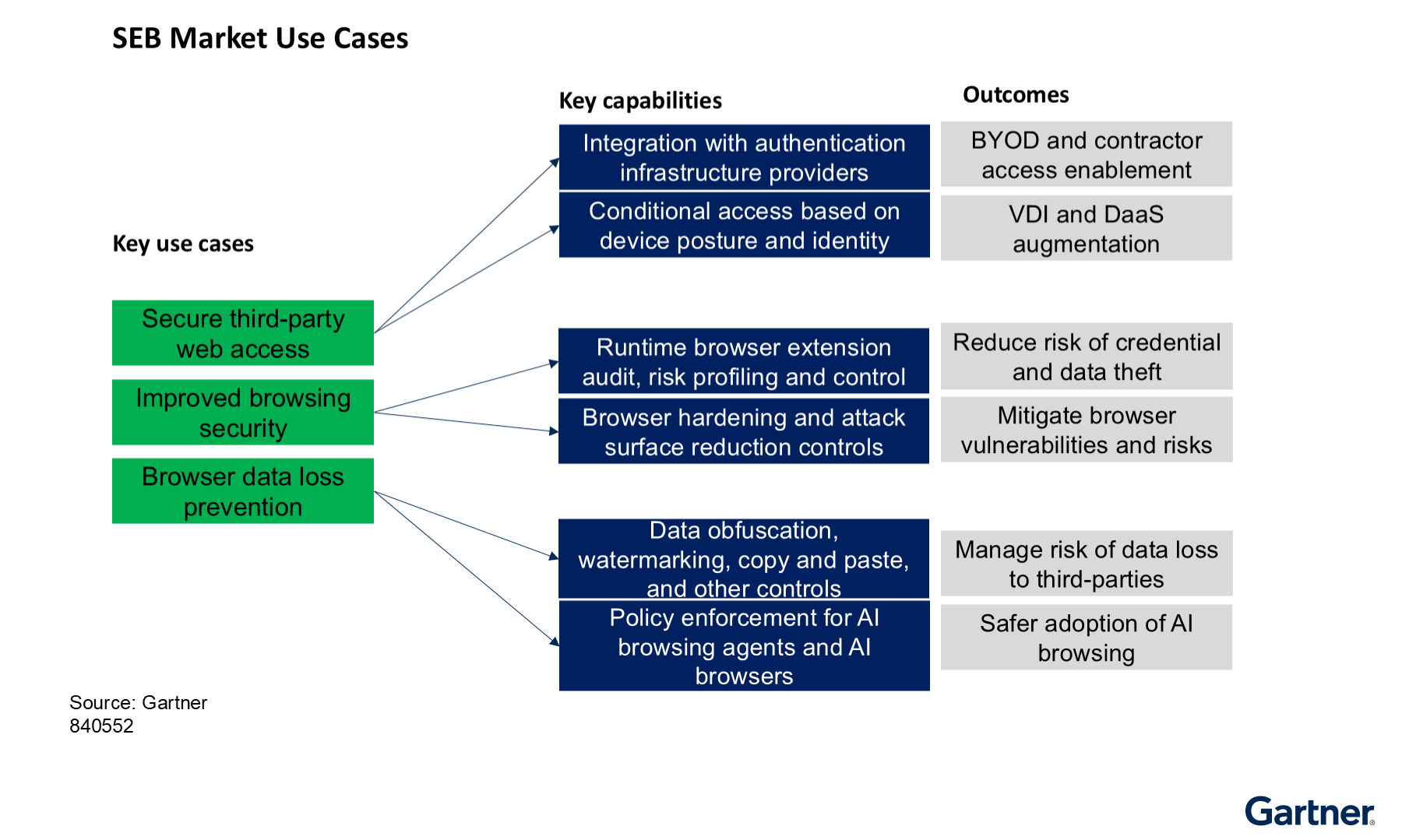
Solutions in the SEB market consist of technology that helps:
- Secure third-party web access
- Improve browsing security
- Enable browser data loss prevention
Figure 1 shows the three common use cases that SEB tools support, the key capabilities that enable those use cases and the outcomes most notable for each.
Market Direction
Organizations rely on web browsers as the primary interface for accessing most modern applications and cloud services, making them the main gateway to sensitive corporate data. SEB solutions provide cybersecurity leaders with an endpoint-agnostic security control point integrated directly into the browser. Concerns about malicious, compromised, and overprivileged browser extensions capable of exfiltrating organizational data and credentials are increasing. Consequently, cybersecurity leaders are prioritizing extension inventory, auditing, risk profiling, and control capabilities. While vendors outside the SEB market offer capabilities in this area, SEB providers are distinct in balancing ease of use, depth of functionality, and threat intelligence for effective, risk-based browser extension management.
Gartner expects competition in the SEB market to intensify as more vendors within SEB and in adjacent categories target similar use cases. Additionally, the barrier to entry is low, as cybersecurity vendors can leverage the open-source Chromium codebase to gain a head start in building their own full-stack SEB. Several secure access service edge (SASE) providers now offer SEB extensions or full-stack browsers, sometimes with aggressive bundling and discounting to gain or protect market share. Google is expanding SEB features in Chrome Enterprise and collaborating with third parties on complementary solutions. Microsoft announced new security controls for Edge for Business in November 2025. CrowdStrike has announced an intent to acquire Seraphic, one of the SEB providers. Several cybersecurity vendors are pursuing original equipment manufacturer (OEM) agreements to license third-party SEB software as part of their broader offering. Most SEBs are also extending capabilities to support the safe adoption of AI services by the workforce, introducing some overlap and competition with AIUC solutions. In the longer term, Gartner expects SEB solutions to become integrated features within broader workspace security platforms (WSP) and SASE solutions, rather than remaining a distinct market category.
Gartner end-user client interest in SEBs has increased significantly from 2023 to 2025, as reflected by an approximately 100% year-over-year inquiry volume growth rate. For most cybersecurity teams, SEB extensions are becoming the preferred form factor for protecting managed endpoints over full-stack SEBs due to easier deployment, minimal end-user training requirements, and compatibility with multibrowser environments. Deploying a full-stack SEB organizationwide requires greater IT buy-in, introduces more employee friction, and requires controls to restrict browser usage. Beyond improved browsing security and extension management, SEB solutions are often used to provide secure third-party access for contractors, business process outsources, personal employee devices, enabling segregation of web-based access to sensitive organizational data.
Market Analysis
SEB Market is Fragmented and Evolving Rapidly
A variety of SEB providers, each with distinct approaches, are targeting a range of buyers. These providers include pure-play SEBs, SASE providers, EPP vendors and large megavendors like Google and Microsoft. Some focus primarily on improving browsing security across multi-browser environments, while others position full-stack SEBs as replacements to traditional consumer or organization-managed browsers by integrating security and productivity features. Major browser providers like Google and Microsoft are adding security and productivity features to their enterprise offerings. The emergence of AI browsers — such as OpenAI’s ChatGPT Atlas, Opera’s Neon, and Perplexity’s Comet — introducing agentic capabilities that aim to automate workflows and boost productivity, has attracted considerable attention in SEB providers’ marketing. Some are addressing the cybersecurity risks posed by AI browsers, while others are incorporating AI features into their own full-stack SEBs.
Based on Gartner end-user client inquiries, SEB buyers include:
- Mature cybersecurity, but browser-specific gaps: Organizations with mature endpoint and network security from existing providers, but that need to address specific gaps in securing multibrowser environments. Examples include risk-based browser extension management, browser hardening, telemetry collection, mitigating poor user experience from decryption latency, and implementing data loss prevention for third-party access.
- Discrete use cases (third parties and kiosks): Organizations addressing discrete use cases, such as secure web and SaaS application access for third parties (e.g., contractors, BYOPC users), shared kiosks requiring web-only access, or hardened OS. These buyers often pair SEB investments with application modernization initiatives and aim to reduce reliance on issuing managed devices or paying for costly virtual desktop infrastructure (VDI).
- Standardizing on a single enterprise browser: Organizations with a long-term strategy to standardize on a single organization-managed enterprise browser to enhance security and productivity. These buyers typically have broad organizational and IT support for this approach and plan to enforce restrictions on approved browser usage over time.
- Cloud-first and remote workforce: Organizations with limited network security investments that primarily use cloud-based services and applications. This includes remote-first companies with few physical locations, seeking web security controls for their workforce without the complexity of a full SASE deployment.
- Adopting AI browsing agents: Organizations seeking to enable safer adoption of AI browsing agents and experimentation with emerging AI browsers through a lightweight tactical implementation for discovery and control of some AI usage.
— Source: Gartner (February 2026)Most buyers start with a single use case and rarely pursue organizationwide full-stack SEB deployment.
Regardless of the SEB implementation use case, cybersecurity leaders evaluating vendors in this rapidly evolving market must balance security improvements with end-user experience. Avoid solutions that lack seamless integration with the existing cybersecurity stack, fail to address existing security gaps, negatively impact employee productivity, introduce significant operational overhead, or require high licensing costs.
Choose Appropriate SEB Form Factors for Your Use Cases
To effectively evaluate vendors and products in this market, cybersecurity leaders must select SEB form factors and features best suited to their use cases. Several representative SEB providers offer both form factors: a full-stack SEB and an SEB extension.
SEB extensions are suitable for securing multibrowser environments. They support deployment across various Chromium-based browsers (such as Chrome, Edge, Brave, Atlas, Comet, Dia, and others), as well as Firefox and Safari. This compatibility enables greater flexibility during organizationwide deployments.
Full-stack SEBs are designed to replace existing browsers. That requires overcoming several organizational roadblocks, the primary one being resistance from end users. Other challenges include:
- Third-party requirements to use particular browsers (e.g., industry-vertical-specific software requiring designated browsers at exact patch levels for technical support).
- The need for more than one browser to mitigate operational resilience risks.
- Legacy application support (such as IE6 mode, which some SEB products support).
- Desire for privacy-enhanced browsers when using company resources for personal needs.
- Compatibility issues with legacy or uncommon operating systems.
— Source: Gartner (February 2026)Most organizations simply cannot restrict everyone to using a single full-stack SEB for all purposes.
The key issue is that, to fully realize the value of a full-stack SEB as the control point for all end-user and application interactions and to achieve cost savings by displacing other controls, a full-stack SEB must become the sole method for accessing apps and the web.
Below is a mapping of the three common SEB market use cases, most suitable form factors and cautions:
- Secure third-party access: Choosing to deploy a full-stack SEB form factor on third-party contractor and employee personal devices (BYOPC) enables deeper endpoint posture assessment as part of conditional access to some SaaS and other browser-delivered applications. It also reduces the potential for conflicts with third-party browser extensions and lowers the risk associated with browser vulnerabilities through native hardening and anti-tampering measures.
- Cautions: SEB installation on third-party devices may require approval for use on tightly controlled endpoints and raises privacy concerns on personal devices. As with other secure access methods, compromised third-party devices could enable unauthorized web access to corporate applications and data.
- Improved browsing security: Choosing to implement an SEB extension form factor on organization-managed end-user devices offers greater flexibility in browser choice and minimizes overlap with existing controls. For frontline worker devices, kiosks, and minimal (hardened) operating systems, choosing a full-stack SEB form factor reduces the attack surface, particularly where flexibility in browser choice is not a priority.
- Cautions: SEBs may cause conflicts or compatibility issues with existing web content security, data loss prevention, and AI usage control solutions that provide similar real-time web protection. Limitations in native response actions, such as removing malicious third-party extensions, as well as a risk of bypass by threat actors or end-users.
- Browser data loss prevention: Choosing a full-stack SEB form factor for browser-specific data security controls, such as obfuscation, watermarking, file download, and printing restrictions, helps reduce the risk of sensitive data loss to third-party devices and malicious third-party extensions. Selecting an SEB extension form factor for organization-managed devices, where endpoint DLP controls are limited, ensures consistent coverage across all IT-approved browsers while minimizing overlap with existing controls.
- Cautions: Similar to the previous use cases, SEB installation may require approval, raise end-user privacy concerns, cause conflicts with existing solutions, and be susceptible to bypass by threat actors if the device is compromised.
SEB Products Augment Rather Than Replace Security Tools
SEB products are complementary tools designed to address gaps in existing network and endpoint security controls. Unless your organization is a cloud-only, remote-work-oriented company that relies primarily on BYOPC, has few physical locations to secure, and has a low risk appetite, do not replace incumbent cybersecurity controls with SEBs.
See Table 1 for key SEB market differentiators and notable gaps relative to adjacent market categories.
Key SEB Market Differentiators and Gaps
| SEB differentiators | SEB gaps | |
|---|---|---|
Stand-alone SSE |
|
|
Stand-alone EPP |
|
|
ITDR |
|
|
AI UC |
|
|
VDI and DaaS |
|
|
Source: Gartner (February 2026)
Representative Vendors
The vendors listed in this Market Guide do not imply an exhaustive list. This section is intended to provide more understanding of the market and its offerings.
Vendor Selection
The vendors listed in this Market Guide do not imply an exhaustive list. This section is intended to provide more understanding of the market and its offerings.
Vendor Selection
Table 2 provides a list of representative SEB vendors. It is neither an exhaustive list nor a competitive analysis of the providers.
Representative Secure Enterprise Browser Vendors
| Provider | Product name | Form factor | Headquarters |
|---|---|---|---|
Acium | Acium | Extension | Miami, Florida, U.S. |
Cato Networks | Cato Browser Extension | Extension | Tel Aviv, Israel |
Conceal | ConcealBrowser | Extension | Augusta, Georgia, U.S. |
Check Point Software Technologies | Check Point Harmony Browse | Extension | Tel Aviv, Israel |
Ermes Cyber Security | Ermes Browser Security Platform | Extension | Torino, Italy |
Google | Google Chrome for Enterprise | Full-stack | Mountain View, California, U.S. |
Island | Island Enterprise Browser | Full-stack, extension | Dallas, Texas, U.S. |
Keep Aware | Keep Aware Browser Security | Extension | Austin, Texas, U.S |
LayerX | LayerX Browser Security Platform | Extension | Tel Aviv, Israel |
Mammoth Cyber | Enterprise Browser | Full-stack | Palo Alto, California, U.S. |
Menlo Security | Secure Enterprise Browser | Extension | Mountain View, California, U.S. |
Microsoft | Microsoft Edge for Business | Full-stack | Redmond, Washington, U.S. |
Netskope | Enterprise Browser | Full-stack | Santa Clara, California, U.S. |
Palo Alto Networks | Prisma Browser | Full-stack, extension | Santa Clara, California, U.S. |
Primary | Zero Trust Browser | Full-stack | New York, New York, U.S. |
Push Security | Push | Extension | Boston, Massachusetts, U.S. |
Seraphic | Browser Security Platform | Extension | Herzliya, Israel |
Sophos | Sophos Protected Browser | Full-stack | Abingdon, England, U.K. |
SURF Security | SURF Security Enterprise & Extension | Full-stack, extension | London, UK |
Zscaler (SquareX) | Zero Trust Browser | Extension | San Jose, California, U.S. |
Source: Gartner (February 2026)
Market Recommendations
- Establish a browser management strategy that spans device types and includes regular assessments of browser security risks and controls.
- Before investing in dedicated SEB solutions, scrutinize the utility of capabilities of your existing browser management, endpoint management, application control, exposure assessment, and network security providers. Use SEBs as a complementary tool to address specific gaps in controls, rather than as their replacement.
- Invest in pureplay SEB providers with a three-year horizon. Expect pureplay vendors to expand beyond browser security, incumbent browser providers to introduce additional SEB capabilities, and end users to increasingly delegate web and SaaS transactions to autonomous AI agents in the future.
- Choose to deploy an SEB extension form factor for greater flexibility in multibrowser environments across all managed end-user endpoints. Choose the full-stack SEB form factor for third-party devices or when end-user flexibility in browser selection is not a priority.
- Unless your organization is a cloud-only, remote-work-oriented company that relies heavily on BYOPC and has few physical locations to secure, do not replace incumbent cybersecurity technologies and controls with SEB.
- Use SEBs to provide lightweight, tactical implementation of controls for some web-based AI usage by the workforce. However, do not assume SEB providers offer comprehensive risk coverage for all types of AI usage within the organization.
This document draws on an analysis of conversations between Gartner analysts and end-user organizations from January 2024 through February 2026. This analysis of SEB capabilities is not tied to one particular vendor’s offering. We researched multiple vendors using both private and public resources, such as vendor documentation, data sheets, briefings to Gartner analysts and end-user inquiries.
Note 1: Gartner’s Initial Market Coverage
This Market Guide provides Gartner’s initial coverage of the market and focuses on the market definition, rationale for the market and market dynamics.