AI Use-Case Assessment for Marketing
6 March 2026 - ID G00844598 - 16 min read
By Nicole Greene, Andrew Frank, and 1 more
This assessment plots 20 of the most prominent use cases for AI, GenAI, and AI agents in marketing against value and feasibility. CMOs can use this evaluation for strategic conversations with their teams, cross-functional stakeholders, and IT peers to help guide prioritization and investment decisions.
Overview
AI is transforming marketing, enabling CMOs to drive tangible business outcomes, accelerate innovation, and improve operational efficiency.
According to the 2025 Gartner CMO Spend Survey, 88% of CMOs expected GenAI to have a positive impact on their marketing investment and strategy.1 Furthermore, market-shaper CMOs, who are known for their success across innovation and positioning capabilities, report automating a greater share of marketing tasks in key areas — including data analysis and insight generation, content development, and customer journey orchestration — using GenAI and AI agents.2 As organizations tailor AI to specific marketing use cases, CMOs must determine which use cases best support business and employee needs, while balancing innovation with organizational readiness.
Figure 1 visualizes 20 marketing-specific use cases across AI, GenAI and AI agents that were selected based on common marketing objectives and their potential to deliver measurable outcomes, plotted against business value and implementation feasibility axes. CMOs can use this assessment to guide strategic conversations and invest in use cases with the greatest impact.
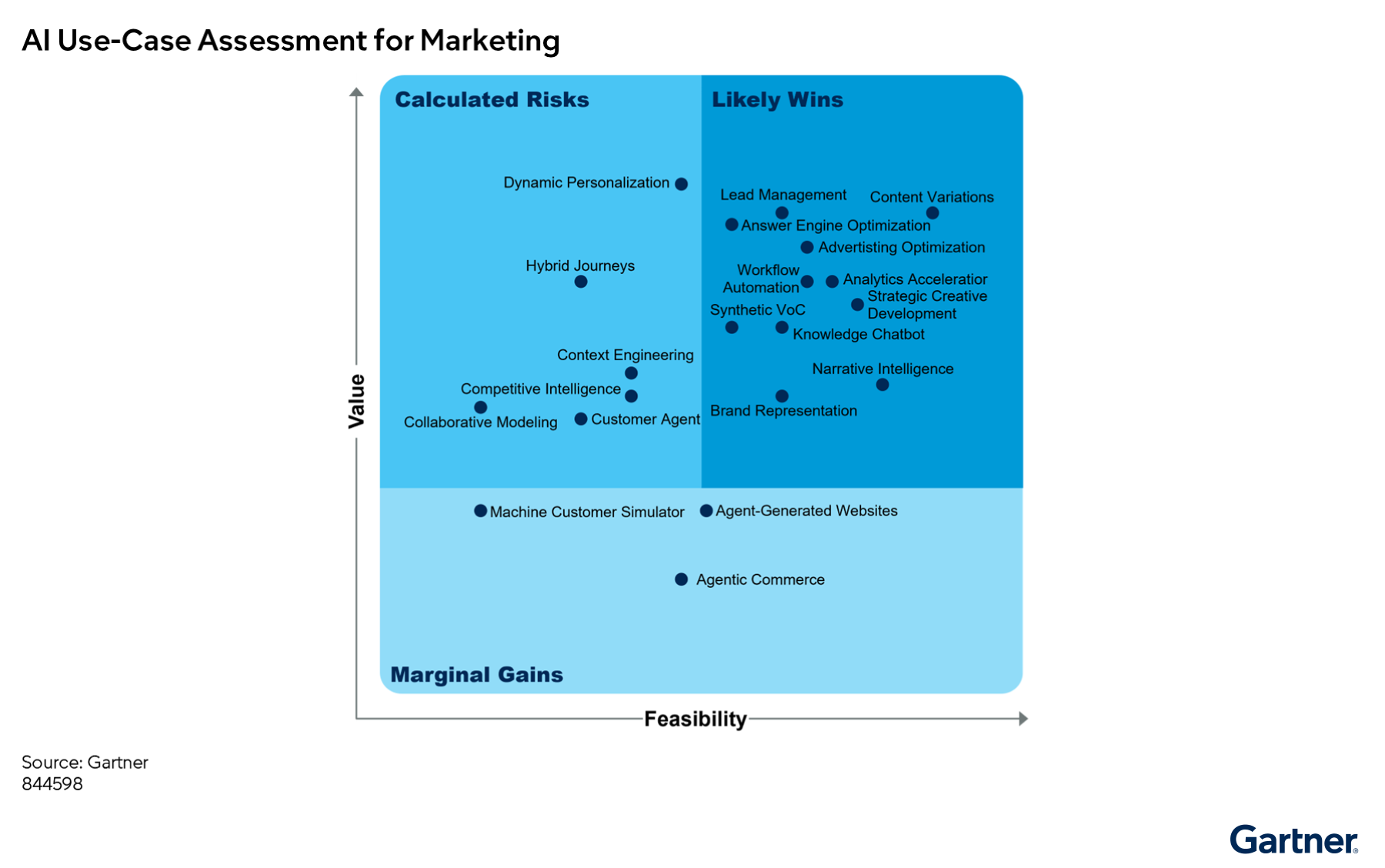
The use cases are grouped into the following categories, each supporting broader marketing and business objectives:
- Creative tools: Advertising optimization, agent-generated website, content variations, brand representation, dynamic personalization, and strategic creative development.
- Conversational interface: Agentic commerce, knowledge management chatbots, context engineering, customer agent, and narrative intelligence.
- Advanced analytics: Analytics accelerator, answer engine optimization, hybrid journey creation, competitive intelligence, collaborative modeling, and synthetic voice of the customer (VoC).
- Operational support: Lead management, machine customer simulator, and workflow automation.
Use cases were scored based on what is currently feasible and what value a typical organization could expect to realize over an 18-month period. This generalized assessment should be viewed through the lens of your organization’s specific circumstances.
How to Use
Review the AI use cases plotted on Figure 1, comparing them with the maturity and requirements of your marketing function and organization. CMOs can then use these findings to prioritize AI investments that improve customer experience, increase operational efficiency, drive revenue growth, and strengthen risk management. To assist with this task, download the presentation summary below.
Presentation
Download a summary presentation of this research here to drive strategic conversations:
Tool
A companion tool allows you to customize this assessment for your organization’s needs. Add or remove use cases, change value and feasibility dimensions, and adjust relative weightings as needed, then input your use-case scores.
View assessments of more use cases across different functions and industries in the AI Use Cases to Drive Business Impact. Save use cases to a dashboard and customize the assessments to your needs.
Use-Case Scoring Breakdown
Figure 2 shows how each use case was scored against each value and feasibility dimension (see Note 1 for explanations of the scoring labels).
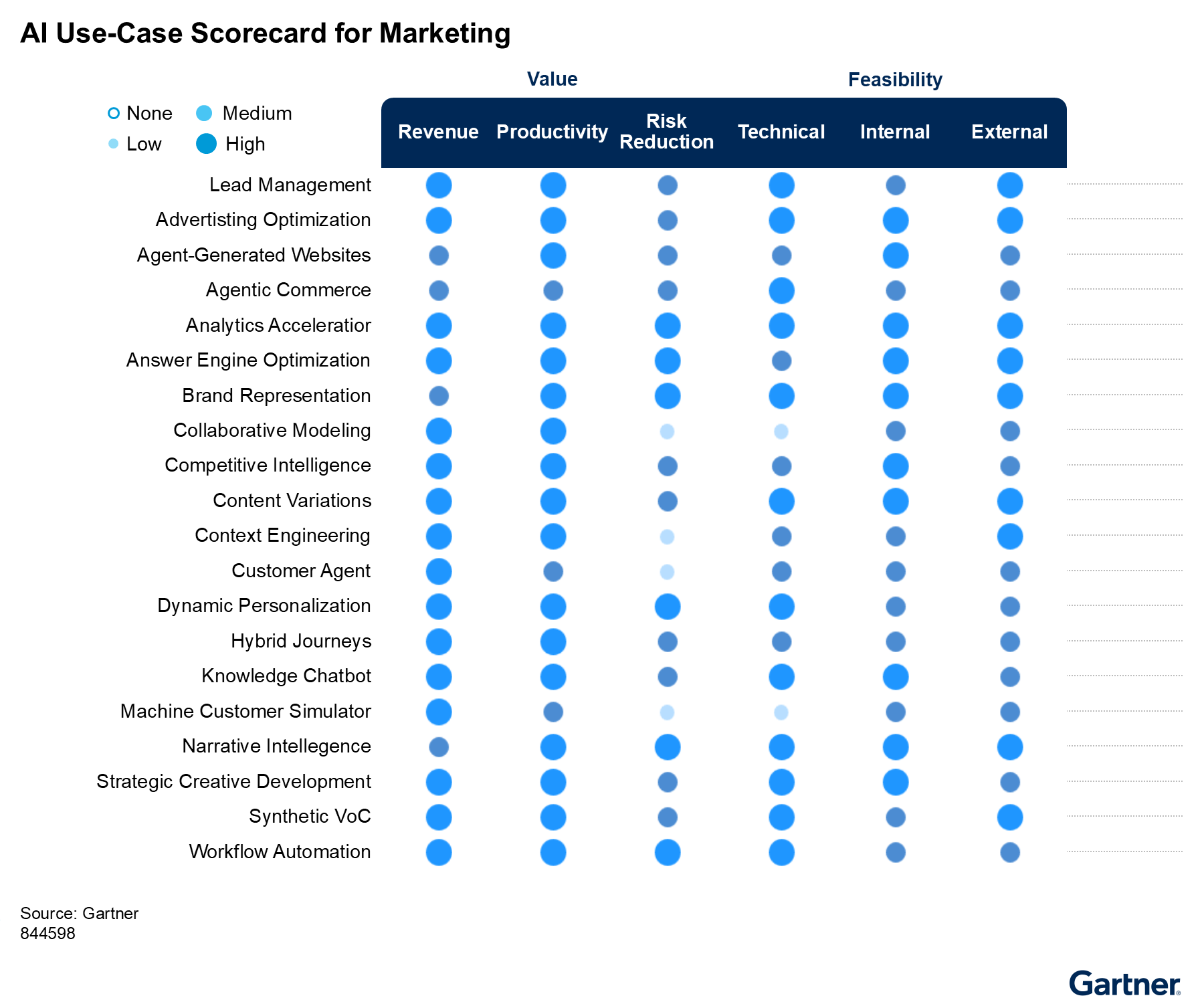
Table 1 shows the explanations of each dimension.
Use-Case Dimension Explanations
Dimension | Explanation |
Value | |
Revenue | Includes customer experience improvements that enable top-line revenue growth, such as improvements in advertising, personalization, sales enablement, and customer loyalty. |
Productivity | The ability to meet or exceed performance goals with equal or fewer resources, resulting in increased productivity, reallocation of work, faster execution, or reduced costs. |
Risk reduction | The ability to reduce potential reputational, security or operational risks, or to create agility to respond to future market disruptions. |
Feasibility | |
Technical | The ability to meet the technical requirements of a use case. Considerations include the core capabilities of the AI technology, the availability of vendor support, and the current state of the organization’s technology infrastructure. |
Internal | The organization’s ability and openness to use and incorporate the use case. This includes the willingness of internal stakeholders to make the necessary policy, the talent required by the use case, and procedural and change management activities to adopt the solution. |
External | The extent to which the environment outside the organization is conducive to successful execution, including consideration of the legal and regulatory environment, privacy, and public opinion. |
Source: Gartner (March 2026)
Scoring Breakdown by Category
The sections that follow summarize the rationale for each use-case score.
Use-Case Categories
Each use case is plotted in one of three categories. Click on the category name to jump to a section summarizing the rationale for each use-case score in that category:
- Likely Wins: Use cases combining medium-to-high feasibility with medium-to-high value, making them wins in most circumstances.
- Calculated Risks: Use cases offering medium-to-high value but low-to-medium feasibility, meaning they represent riskier options.
- Marginal Gains: Use cases offering low value and variable feasibility, making them more selective options.
Likely Wins
Back to Scoring Breakdown by Category
Use cases combining medium-to-high feasibility with medium-to-high value, making them wins in most circumstances (see Table 2).
Scoring Breakdown: Likely Wins
Use case | Value | Feasibility |
Advertising optimization Paid media planning, execution and operations, creative, spend and analysis, aimed at improving ad effectiveness and efficiency, often relying on first-party, platform or walled-garden data. | Improving the outcomes or reducing the costs associated with working and non-working media (e.g., to leverage ad platform buying algorithms, or accelerate campaign cycles) across creation, distribution and buying. | The privacy challenges to ad targeting and measurement are substantial and require widespread adoption of new market-level architecture. Platform feasibility varies from capabilities embedded in ad platforms and readily commercially available (e.g., automated audience targeting) to nascent independent systems (e.g., turnkey media planning). |
Analytics accelerator Multimodal conversational access to metrics and customer data to improve speed, communication, and accessibility of insights and consolidation of datasets. Complex results can be summarized, and narratives can be generated with relative ease compared to manual methods. | Analytics are more accessible, enabling faster synthesis of large datasets, better decisions; democratizes data for quicker, more reliable actions. | High feasibility due to embedded features, but markets may resist incremental costs for enhancements. |
Answer engine optimization AEO aims to help marketers harness answer engine disruption by helping to make and measure content readily found and featured by answer engines and AI chatbots. | Maintain and gain traffic and brand visibility lost to search engine design changes. | Commercial impact variable, requiring marketers to maintain SEM and SEO operations, while developing new AEO approaches (see Integrating AEO and SEO: Tactics for Improving Online Search Visibility). |
Knowledge chatbot Internal chatbot that enables marketing, sales, affiliates, and service personnel to quickly locate and summarize the information and documents they need for customer conversations. | Enables faster access to relevant content, data and information, improving employee engagement. Supports intermediated delivery of content to end users, potentially increasing sales. | Widely available products support simple interactions, while complex solutions require preparation, implementation, and ongoing management. Rushed implementations can harm employee experience when forced upon a reluctant organization. |
Content variations Tools and agents that help create text, image, video, and audio content variations for multichannel, localized, and segment-based marketing — either internal, such as briefs, pitch-decks, surveys, etc., or external, such as emails, website landing pages, social posts, display media, and video. | Increases productivity, variety, quality and velocity of content creation, improving customer engagement and response. | Embedded and stand-alone tools widely available; marketers must communicate about AI-generated content (see Use Generative AI to Enhance Content and Customer Experience). |
Lead management Use predictive intelligence to rank and qualify leads based on their likelihood to convert. AI-powered predictive models analyze historical conversions, fit-criteria match, and buying intent through first-, second-, and third-party sources to score leads. AI agents can act as lead admins and automate routing tasks. | Rank and qualify leads based on their likelihood to convert; AI agents can act as lead admins and automate routing tasks. | AI-powered predictive models analyze historical conversions, fit-criteria match, and buying intent (see CMOs: Use Generative AI for Personalization in B2B Demand Generation). |
Narrative intelligence Preemptively detect and monitor narratives using a broad range of data from various public sources (such as social media, news media, the dark web, internal communications channels, and other digital content). | Preemptively detect and monitor brand conversation using a broad range of data from various sources including social platforms, mitigate harmful narratives and associations. | Available in point solutions and embedded into some social media management tools (see What CCOs Need to Know About Narrative Intelligence). |
Strategic creative development Shape strategic creative briefs, translating brand strategy into concepts and initiating creative campaign workflows. | Shape creative briefs, identify inconsistent approaches using templates to identify areas of opportunity, translate brand strategy into concepts, and initiate creative campaigns. | Existing technology capabilities can support this use case, often in point solutions or content marketing platforms. Requires quality brand, competitive and customer insights to be effective. |
Workflow automation The coordinated use of AI across defined processes to automate and orchestrate marketing tasks and handoffs across people, systems and functions so that marketing work moves predictably from initiation to business outcomes with reduced manual effort and clearer decision rights, including proprietary brand, legal and regulatory compliance rules and guidelines. | Complex workflows and regulatory approval cycles represent a significant cost, risk and impediment to timely, effective communication. Flattened workflows accelerate efficiency and productivity. | Tasks will need to be automated, along with decisions around when an AI agent can do the work on its own and when human oversight or intervention is required. Specialized B2B and regulatory workflows are difficult to modify due to high operational risk and complexity of compliance rules. |
Source: Gartner (March 2026)
Calculated Risks
Back to Scoring Breakdown by Category
Use cases offering medium-to-high value but low-to-medium feasibility, meaning they represent riskier options (see Table 3).
Scoring Breakdown: Calculated Risks
Use case | Value | Feasibility |
Brand representation Customize content generation models with proprietary assets to encode and apply brand style, personality, look-and-feel, and signature assets to generated and suggested content. Can also include mandatory rules and explicit guidelines. | Accelerates and scales content creation with brand attributes, empowering global brand powerhouses and differentiation. | Complex and resource-intensive modeling efforts; dependence on quality and conformance of samples (see How to Teach AI About Your Brand). |
Collaborative modeling Use data clean rooms to train models on multiparty affiliate data without exchanging data samples, enabling more personalized experiences without compromising privacy. | Connection of data across geographies, business units, and affiliates for global and regional market growth, as well as entry into new markets. Protection of local data due to privacy and legislative regulations. | Time required to build trust among organizations for collaborative learning models takes time. Need for complete end-to-end infrastructure stack and high implementation maturity. |
Context engineering Dynamically provide AI systems with the information needed for the task at hand, including instructions, examples, data, tools, and memory-resident information. An evolution of prompt engineering to support early AI agents. | Dynamically provide AI systems with instructions, examples, data, tools and memory-resident information. The AI system’s performance is significantly enhanced, allowing for more accurate, relevant, and useful outputs tailored to the specific user request and operational environment. | Critical to give the model clear, specific guidance on desired outputs. This includes feeding relevant, up-to-date, or proprietary information into the immediate context window so the model can generate a response based on specific, nonpublic, or timely facts’ data security and IP risk. |
Competitive intelligence Evaluate the competitive market, illustrate the landscape with visualizations, and surface potential opportunities and improvements for competitive positioning. Agents perform more analysis, develop assessments and take internal actions to alert and highlight issues. | Lower overhead costs and faster competitive brand assessments. Yields increased market intelligence, share of voice, and supports faster recognition of new entrants and upstarts. | Hallucinations and bias risk strategic initiatives (e.g., competitive assessment, brand recommendations). |
Dynamic personalization Dynamically optimize and assemble content modules (text, images, audio, video) into personalized webpages and emails, generally without human intervention or oversight, to provide individual and segment messaging and experiences. | Shortens sales cycles and increases conversion rates while raising customer satisfaction and advocacy; reduces churn. | Limited success with existing personalization techniques; challenges with obtaining and consolidating customer data Inconsistent regulations and legislation across data security and privacy (see Cool Vendors in AI for Marketing). |
Hybrid journeys Use contact intelligence to influence and optimize behavioral objectives for humans and machines (opt-ins, conversions, shares, etc.) by varying messaging to enable journeys and drive desired response, including accelerating journey progression. Agents enable automated two-way interactions. | Improved understanding and influence of human and machine customer journeys for omnichannel marketing strategies and buying decisions. | Rapidly growing market for large language model-based solutions; requires effective planning, governance, and grounding to mitigate hallucinations. AI agents completing buying tasks requires new governance and a deep understanding of customer needs that control agent decisions. |
Synthetic VoC Create customer profiles to emulate advertising and content response and attitudinal surveys based on digital twins that mirror customer composition and segmentation. Simulate focus group dialogs and content assessment evaluations and drive “what if” analysis for improved business outcomes. | Overcoming customer data access limitations for personalized engagement; faster and potentially more accurate customer insights with expanded sources. Cost savings and faster insights compared to traditional market research customer panels. | Requires advanced governance to build confidence in the accuracy of prompted synthetic customer responses and to avoid unnecessary “AI training AI” loops. Production deployment by VoC and content vendors (see Build an Enterprise VoC Program for Customer-Centric Growth). |
Source: Gartner (March 2026)
Marginal Gains
Back to Scoring Breakdown by Category
Use cases offering low value and variable feasibility, making them more selective options (see Table 4).
Scoring Breakdown: Marginal Gains
Use case | Value | Feasibility |
Agentic commerce Agentic commerce encompasses both consumer-facing and B2B scenarios where agents can act as buyer agents (discovering and purchasing) and seller agents (assisting or transacting for sellers) and includes agent-to-agent interactions and protocols (for example, MCP, UCP and emerging interagent protocols) that enable discovery, evaluation and order placement. | AI agents act as buyer and seller agents to enable discovery, evaluation and order placement. | Includes agent-to-agent interactions and protocols (e.g., MCP, UCP); brands and commerce platforms need to determine who is accountable if AI agents do not follow protocols; increased data and privacy risks. |
Agent-generated websites AI-powered website generation automates the creation, design, and deployment of digital commerce sites. Leveraging user inputs and product data, AI generates visually appealing, responsive layouts, optimizes content for better product discovery, and personalizes user experiences, significantly reducing development time, increasing scalability, and ensuring alignment with brand and business objectives. | Optimizes content for better product discovery and personalizes user experiences to align with brand objectives. Significantly reducing development time and increasing scalability. Ensuring alignment with brand and business objectives. | Automates the creation, design, and deployment of digital sites, capabilities emerging in DXP, commerce and personalization engines. |
Customer agent Design and create AI personas and chatbots to engage with and assist customers pre- and postsale, automating processes, and serving as a scalable and always-accessible personality or customer service agent of the brand that can learn and adapt. | Curation and presentation of next best actions; delivery of personalized experiences; 24/7 support; enablement of native language engagement; support for sales enablement and nudging buying decisions Automation of customer-facing processes; scalable brand personality without increased resources. | Availability of humanlike interaction solutions with LLMs; need for quality data and careful governance; requirement of extensive constraints and testing to prevent jailbreaking and ensure accuracy. Need for organizational readiness, talent acquisition, and substantial governance beyond experimentation (see The Impact of AI Agents on Marketing). |
Machine customer simulator Machine customer simulators are intelligent simulation environments that emulate nonhuman economic actors (machine customers) to train, test, and evaluate their decision making, behaviors, and interactions in realistic, controllable scenarios. | Acceleration of pilots into implementation; manages risk by testing assumptions; refinement of actions for better business results. | Data issues, confounding factors increase hallucinations and bias risk; need for continual output validation to avoid long-term risk; new governance structures to establish decisions and escalations (see Research Highlights: Machine Customers). |
Source: Gartner (March 2026)
Back to Scoring Breakdown by Category
These use cases have been selected, positioned, and averaged out based on an assessment by Gartner analysts and client feedback. Their applicability may vary across organizations and industries. For detailed customization, use the Toolkit: Discover and Prioritize Your Best AI Use Cases With a Gartner Prism.
1 2025 Gartner CMO Spend Survey. This survey explored top-line marketing budgets with the goal of understanding how changing customer journeys, pressures from the C-suite, and cost challenges affect marketing’s spending priorities and channel effectiveness. Conducted online from January through March 2025, the research included 402 respondents from North America (n = 202), the United Kingdom (n = 97) and Europe (n = 103) France, Germany, Belgium, Denmark, Finland, Netherlands, Norway, and Sweden. Participants were required to be involved in decisions related to setting or influencing marketing strategies/planning, aligning marketing budgets/resources, or leading cross-functional programs and strategies with marketing. Seventy-seven percent of the respondents represented organizations with annual revenue of $1 billion or more. The respondents came from a diverse range of industries: manufacturing (n = 52), financial services (n = 50), insurance (n = 43), consumer products (n = 43), healthcare (n = 42), travel and hospitality (n = 37), IT and business services (n = 36), retail (n = 36), pharma (n = 32), and media (n = 31). Disclaimer: Results of this survey do not represent global findings or the market as a whole but reflect the sentiments of the respondents and companies surveyed.
2 2025 Gartner Marketing Transformation Survey. This survey was conducted to explore what CMOs are thinking about the near future (i.e., the next one to two years) of the marketing organization amid the disruption of AI and how they are approaching organizational structure changes and marketing operations management in 2025. The survey was administered online from August through October 2025 and includes data from 402 senior marketing leaders. These results represent marketers from North America (n = 189) and Europe (n = 213). Respondents were required to have decision-making authority over marketing budgets and strategy at an organization with at least $100 million in annual revenue. Fifty-eight percent of respondents came from organizations with at least $2 billion in annual revenue. Respondents came from a wide variety of industries, including technology products (n = 59); banking and financial services (n = 55); consumer products (n = 47); retail (n = 47); manufacturing and natural resources (n = 43); healthcare (n = 41); insurance (n = 33); pharmaceuticals, biotechnology, and life sciences (n = 23); media (n = 22); IT and business services (n = 20); and travel and hospitality (n = 12). Disclaimer: The results of this survey do not represent global findings or the market as a whole but reflect the sentiments of the respondents and companies surveyed.
2024 Gartner Consumer Community Survey. While the Gartner Consumer Community (n ≈ 500) resembles the U.S. general population, the data cited is based on the responses of community members who chose to take each activity. These samples may not be representative of the general population and the data should only be used for directional insights.
Note 1: Scoring Breakdown Explanations
Value
- High: Enables new ways of performing horizontal/vertical applications or even doing business, resulting in significant benefits in the form of increased review, cost savings and/or shifting industry dynamics.
- Medium: Offers incremental process improvements that translate into increased revenue and/or cost savings.
- Low: Offers limited process improvement that may not or aren’t intended to translate into increased revenue or cost savings.
- None: Not applicable or relevant to value creation.
Feasibility
- High: Within the capabilities of most organizations to implement with either minor or zero obstacles.
- Medium: Can be implemented by most organizations while facing moderate obstacles.
- Low: Challenging to implement and would involve overcoming significant obstacles.
- None: No chance of being able to implement.