Magic Quadrant for Digital Employee Experience Management Tools
8 June 2026 - ID G00836700 - 53 min read
By Dan Wilson, Stuart Downes, and 1 more
Poor digital employee experience directly impacts workforce productivity, operational resilience and technology returns. This research helps IT leaders responsible for DEX evaluate a DEX tool that delivers measurable improvements across technology performance, employee sentiment and operational outcomes.
Strategic Planning Assumptions
Through 2030, 80% of DEX tool deployments limited to IT-only use cases will fail to deliver sustainable ROI.
Through 2030, 75% of organizations without a defined DEX strategy and supporting tool will fail to materially reduce digital friction for employees.
By 2028, digital workplace teams that fully operationalize a DEX platform will carry 50% less incident- and experience-driven backlog than teams that do not.
Through 2030, digital friction caused by poor DEX will inhibit enterprise AI adoption and intended productivity gains.
By 2028, more than 60% of DEX initiatives owned solely by IT will stall due to lack of HR and organizational alignment.
Through 2030, organizations that rely primarily on surveys to assess DEX will misdiagnose at least half of their top experience issues.
Market Definition/Description
Digital employee experience management tools measure and help IT continuously improve employee sentiment toward and the performance of company-provided technology. They continuously surface actionable insights, drive self-healing automations, and optimize support and employee engagement via the near-real-time processing of aggregated data from endpoints, applications, employee sentiment and organizational context. These insights enable self-healing and can enhance employee interactions with self-service portals and chatbots. They also help IT support, asset management, procurement and other teams whose work depends on reliable information.
DEX tools help IT improve the digital employee experience by quickly identifying and remediating technology issues. Benefits for IT teams include greater visibility of device and application performance, reliability and usage; reduced overhead through automation; and improved endpoint configuration and patch compliance. Benefits for the workforce include reduced digital friction that impedes productivity, the ability to offer feedback, faster issue resolution, and rightsized virtual and physical endpoints with optimized life spans.
Common use cases include:
- Discovering and remediating configuration drift from company, vertical industry or regulatory standards
- Measuring and improving application adoption and reliability
- Improving sustainability and reducing spend by transitioning from scheduled to performance-based refresh cycles
- Reducing security risk and improving patching compliance by identifying and remediating the cause of missing patches, which endpoint management or patching tools often cannot identify or self-heal
- Ensuring readiness for OS upgrades inclusive of reliability, capacity, performance, configuration and requirements checks
- Establishing digital personas based on technology usage data to create technology bundles, simplifying and accelerating employee onboarding
Mandatory Features
Tools in this market must offer:
- Native data collection through a Windows and macOS agent, and APIs to import data from other IT management tools and data sources.
- Imported organizational context data from IT directory services or HR systems.
- Turnkey integration with IT service management (ITSM) platforms for service desk and ITSM process enhancements.
- Bidirectional employee engagement, which includes the ability to collect employee sentiment and feedback, and the ability to communicate with employees through agent-based pop-up or toast notifications, email, mobile device apps, or integration with collaboration tools.
- Analysis to derive actionable insights, which includes device and application usage and performance, anomaly detection, root cause analysis, and a DEX or health score.
- Ability to act on insights by executing scripts or self-healing automations, or by communicating with employees. The vendor also must provide a library of predefined scripts or automations and a workflow orchestration engine to enable customers to build their own automations.
Optional Features
Tools in this market may include:
- Data collection for mobile, Linux or Google ChromeOS devices, and support for additional workloads, such as:
- Virtual experience management through turnkey integrations with virtual desktop infrastructure (VDI) and desktop as a service (DaaS) environments. This includes session details from the virtual desktop, endpoint device, remote connection protocol and connection path.
- Application experience management for locally installed applications via a software agent and web/SaaS applications through a browser extension, turnkey or API integration.
- Unified communications (UC) experience management via turnkey or API integration and includes ingest session, meeting, call and/or interaction metrics.
- Mobile experience management via native capabilities, as well as turnkey or API integration with endpoint management or mobile monitoring tools.
- Enhanced employee engagement with advanced surveys that can be triggered by the employee, events or time. This includes question branching; AI-based sentiment analysis of written text; and advanced outbound communications to mobile devices, with native digital adoption platforms (DAP) capabilities or turnkey integration with third-party DAP.
- Advanced analysis to derive actionable insights that may include persona-based DEX scores or the ability to calculate an employee’s DEX score across multiple devices, virtual desktops and applications. AI/ML-based correlation and causation analysis helps with issue prioritization. Endpoint device life cycles can be managed based on performance, usage and predictive failure analytics, instead of age and warranty status. Digital personas can be defined to help align technology needs to employee segments and can be monitored as needs change. Unused, obsolete or rogue software can be identified and removed. OS upgrade compatibility and readiness can be assessed and managed. Configuration drift can be identified and remediated. Organizational sustainability goals can be supported by monitoring power consumption, configuring power savings features and engaging employees to promote better habits.
- Advanced integrations with IT service portals and chatbots for improved self-service. Single sign-on (SSO) integration and role-based access control (RBAC) optimizes access for various groups that use DEX tools. Reporting data can be exported to business intelligence (BI) or other reporting and data analytics platforms. Unified observability can be achieved through integration with other monitoring and observability tools. Improvements to asset tracking and desired state can be accomplished through asset and configuration management tool integrations. DEX tools can support organizational environmental, social and governance (ESG) strategies by estimating power consumption and enabling device life span extension initiatives, and offer integration with ESG management and reporting software.
Magic Quadrant
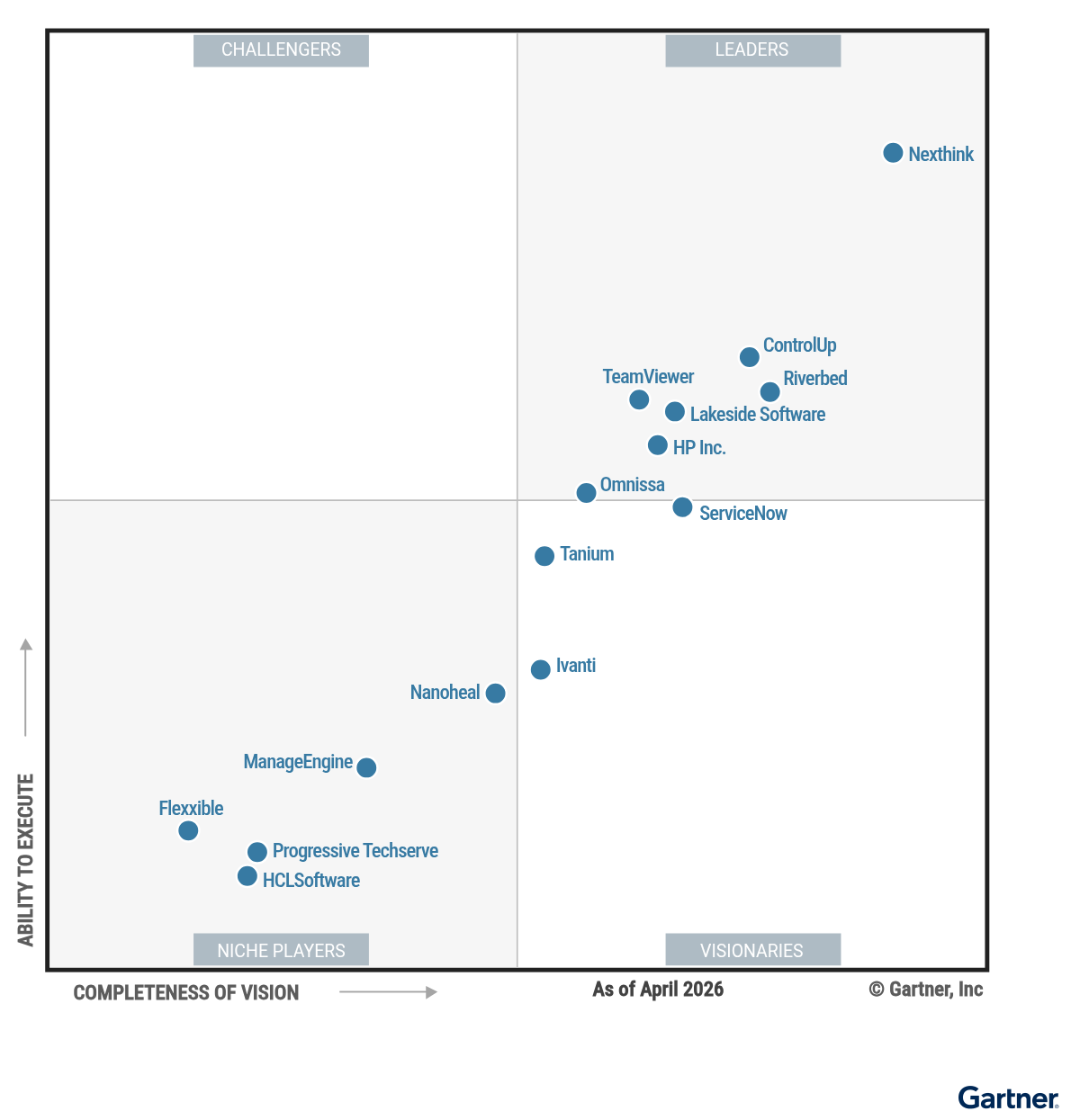
Vendor Strengths and Cautions
ControlUp
ControlUp is a Leader in this Magic Quadrant. ControlUp ONE is sold as a SaaS offering, hosted in Microsoft Azure and Amazon Web Services. ControlUp’s operations are based in the U.S., Europe and Israel. The company sells to customers of all sizes. ControlUp is a venture-backed, privately held company.
OS support includes Windows, macOS, Linux, ChromeOS, Android and most thin clients. ControlUp provides DEX capabilities across all major virtualization platforms and key application workloads, as well as Microsoft Teams and Zoom for UC. It integrates with ServiceNow and Freshworks for ITSM, and a growing number of endpoint management and security tools. ControlUp includes stand-alone remediations, with additional automation enabled through low-code workflow orchestration.
- Product strategy: ControlUp continues to add new capabilities and integrations, including improved UC experience with partner Telchemy, and Android support with partner B2M Solutions. It has also added new Freshworks and Jamf integrations. Several AI enhancements for IT administrators include Pulse AI, AI Assistant for IT Operations and MCP support. The company has also released employee-facing Connect for self-service and agentic issue identification and remediation.
- Overall viability: ControlUp maintains a strong financial position, consistent investment in product development, and organizational scale. The vendor also demonstrates stability and leadership continuity. DEX is a strategic priority. Its operating model, partner ecosystem and go-to-market approach indicate an ability to adapt to market changes while continuing to invest in innovation and customer success.
- Market understanding: ControlUp clearly articulates its value proposition within the DEX tools market and demonstrates a realistic view of competitive dynamics and market evolution. The company also shows consistent alignment with customer objectives and priority use cases. Its roadmap reflects a grounded understanding of current customer needs while anticipating near-term shifts and anticipated disruptions.
- Geographic strategy: ControlUp’s geographic strategy remains uneven, with strength concentrated in core regions while coverage, delivery capacity and market penetration are limited outside primary geographies. The vendor’s go-to-market approach and partner depth vary by region, which may constrain its ability to consistently support large, multinational customers.
- Marketing: Marketing execution lacks consistency and impact, particularly in clearly communicating differentiated value across buyer personas and maturity levels. Messaging is often product- or feature-centric, with limited emphasis on outcomes or business value, which may reduce resonance with executive stakeholders.
- Sales: Gartner clients cite challenges with aligning offerings to use cases and understanding total cost at scale. This may be caused by channel-driven variability in sales motions, discounting practices and pricing. ControlUp’s sales effectiveness also appears inconsistent across segments, which may hinder competitive displacement and expansion within larger enterprises.
Flexxible
Flexxible is a Niche Player in this Magic Quadrant. Its FlexxClient is available as a SaaS offering, hosted in Microsoft Azure. Flexxible’s operations span Europe, the U.S., Brazil and India. The company sells to midmarket and enterprise customers in the Americas and Europe. Flexxible is privately owned and led.
OS support includes Windows, macOS, Android, Linux and ChromeOS. DEX is offered for all major virtualization environments; local, web and SaaS applications; and Microsoft Teams UC. ITSM integration is available for ServiceNow. Integration with CrowdStrike for endpoint security is also available. Flexxible includes prebuilt remediations, with additional automation enabled through low-code workflow orchestration.
- Customer experience: Strong customer experience is supported by market-leading ratings on Gartner Peer Insights and positive feedback from similar sources. Customers cite ease of adoption within Flexxible’s intended scope and responsiveness to operational needs, contributing to solid satisfaction and retention.
- Overall viability: Flexxible maintains a sustainable operating model, stable ownership and continued investment aligned to its core market focus. Its financial position and organizational scale are sufficient to support existing customers and maintain ongoing product development.
- Sales: Sales strategy, execution and pricing are aligned to target customers’ expectations, with a straightforward go-to-market approach and pricing that resonates with midmarket and cost-conscious buyers. The vendor demonstrates consistency in closing and retaining customers within its primary segments.
- Business model: Flexxible’s smaller size and narrow focus may limit its ability to scale into adjacent use cases or broader enterprise deployments. Dependence on a relatively constrained customer profile and use-case set may restrict long-term growth compared with more diversified competitors.
- Market understanding: Flexxible’s approach is best aligned to technical and operational buyers, with less clarity around broader DEX outcomes and evolving buyer expectations. Positioning tends to lag market leaders in anticipating shifts toward experience-led, cross-functional use cases.
- Innovation: Innovation remains incremental, with progress focused on extending existing capabilities rather than introducing differentiated or market-shaping functionality. As a result, the vendor risks falling behind competitors that are investing more aggressively in advanced AI-driven analytics, automation and use cases.
HCLSoftware
HCLSoftware is a Niche Player in this Magic Quadrant. HCL BigFix Workspace+ includes on-premises and self-hosted offerings. HCLSoftware’s operations and enterprise customers are globally distributed. It is the software division of publicly traded HCLTech.
The HCL BigFix client supports most operating systems, but its DEX capabilities are limited to Windows and macOS in BigFix 11 or higher environments. ITSM integration with ServiceNow is available, as are endpoint management and security tool integrations. Turnkey DEX is not available for virtualization, applications and UC solutions, but can be built using APIs. HCL BigFix provides an extensive library of Fixlet remediations and allows customers to build their own.
HCLSoftware declined requests for supplemental information. Gartner’s analysis is therefore based on other credible sources.
- Geographic strategy: HCLSoftware maintains staff presence across most global regions except China, and a large network of resellers and managed service providers. Its globally distributed, centrally managed support model enables consistent service delivery for multinational customers. For organizations already standardized on HCL BigFix, DEX capabilities can be extended globally across endpoints.
- Operations: HCLSoftware demonstrates consistent, long-term product leadership continuity. The platform’s on-premises and hosted deployment options can scale to support deployments of over 500,000 endpoints. It has a large network of certified partners and BigFix professionals.
- Overall viability: The financial stability of HCLSoftware’s parent company, HCLTech, provides long-term investment capacity and global reach. BigFix remains part of HCLSoftware’s broader endpoint management portfolio and autonomous endpoint management vision.
- Product: HCLSoftware has made limited, incremental improvements to its DEX capabilities over the past year. Its offering remains less mature than most competitors’, with differentiation limited to automating the platform’s endpoint management capabilities. This positioning aligns to operations-focused organizations but is less compelling for those pursuing more advanced DEX strategies.
- Customer experience: Evidence of DEX-specific customer traction is limited, with few customer case studies and minimal representation in Gartner Peer Insights and similar sources. Gartner client awareness of HCL BigFix as a DEX tool is low, suggesting challenges in adoption visibility and market validation beyond its established customer base.
- Market understanding: HCLSoftware’s market understanding emphasizes endpoint-centric use cases while placing less emphasis on broader DEX outcomes. Messaging and roadmap signals lag market leaders in addressing evolving buyer expectations around human-centric DEX, advanced analytics and cross-functional use cases. The company’s lack of a turnkey SaaS offering may limit adoption as Gartner clients prefer SaaS for reduced complexity and overhead.
HP Inc.
HP Inc. is a Leader in this Magic Quadrant. Its Workforce Experience Platform (WXP) is sold as SaaS, hosted in Amazon Web Services. The publicly traded company’s operations and enterprise customers are globally distributed.
OS support includes Windows, macOS, SUSE Linux and Android. WXP imports iOS/iPadOS, ChromeOS and printer data from turnkey integrations. WXP integrates with ServiceNow for ITSM, but not native self-service portals or a chatbot. DEX for virtualization is limited to HP Anyware and agents on persistent desktops. DEX is available for web/SaaS applications and UC solutions, including room-based conference equipment. WXP includes prebuilt remediations, with additional automation enabled through a new low-code workflow orchestration.
- Geographic strategy: HP has staff presence across all major global regions and a broad partner ecosystem that augments delivery and support where needed. The company has a long-standing track record operating at global scale and shows awareness of regional differences by tailoring product capabilities, sales motions, customer engagement and marketing strategies to local market needs.
- Operations: HP benefits from significant operational scale, supported by mature global processes and an extensive partner network that includes technology providers, hardware manufacturers, resellers and system integrators. This operating model enables HP to support large, complex enterprise environments and extend WXP adoption alongside existing HP hardware and services relationships.
- Overall viability: HP demonstrates profitability, financial stability and long-term investment capacity. The company continues to allocate substantial resources to product development and has closed some feature gaps. Stable product leadership has established a clear roadmap, a consistent release cadence and a growing ecosystem of partners, reinforcing HP’s commitment to the DEX market.
- Marketing: Despite increased event participation and use of its dedicated website and social media as communication channels, WXP’s competitive mind share remains limited. HP is rarely cited as a top competitive threat, and WXP ranks lower in competitor mentions across analyst interactions, Gartner Peer Insights and similar sources.
- Market responsiveness: WXP has been generally available for less than two years and, while rapidly improving, remains less mature than leading competitors, particularly for higher-maturity use cases focused on employee enablement.
- Customer experience: Although WXP attracted a high volume of reviews and good Gartner Peer Insights ratings, DEX-specific customer case studies and partner-led success stories remain limited. Published references appear to be more general to HP than WXP-specific outcomes. Market awareness still lags HP’s broader enterprise reputation, with Gartner client interest tied to managed device life cycle services (MDLS) and warranty packages rather than stand-alone DEX.
Ivanti
Ivanti is a Visionary in this Magic Quadrant. Ivanti Neurons for Digital Experience is sold as a SaaS offering, hosted in Microsoft Azure. Ivanti’s operations and customers are globally distributed. The company is private-equity-owned.
OS support includes Windows, macOS and Linux. Apple and Android mobile support is provided by Ivanti Neurons’ mobile device management capabilities. ITSM integration is offered for Ivanti Neurons and ServiceNow. DEX support is available for applications and Microsoft Teams UC. Virtualization is limited to agents installed on virtual desktops. Ivanti also provides remediation bots, and customers can create their own remediations using low-code workflow orchestration.
- Market understanding: Ivanti brings a unique perspective to the market by embedding DEX into ITSM and combining it with autonomous endpoint management, discovery and security. The vendor’s self-healing and automation bot framework is distinctive. Ivanti’s go-to-market approach includes a focus on SMBs and midmarket companies that other competitors lack. The company also has a solid understanding of DEX tools’ market positioning for IT-focused organizations.
- Geographic strategy: Ivanti has staff in all geographic regions, in addition to hundreds of partners that support its globally distributed customers. The company offers global campaigns in six languages, covering 80% of its customer base. The Neurons platform is hosted in Microsoft Azure with in-region cloud partnerships for sovereign deployment requirements.
- Marketing: Ivanti demonstrates effective use of marketing channels, including hosting its own conferences, attending third-party conferences, and utilizing webinars, social media, blogs, newsletters, video content, user groups and thought leadership. Marketing differentiation focuses on integrated DEX observability with automated remediation, zero-impact IT support troubleshooting, and patented discovery and patch management capabilities.
- Customer experience: Evidence of DEX-related customer case studies was lacking during evaluation, as were customer reviews on Gartner Peer Insights and similar sources. Most Gartner clients, unless they’re already Neurons customers, are not aware of Ivanti’s DEX tool offering. Customer feedback is varied, and customer success services require an additional fee rather than being included in base pricing.
- Overall viability: DEX contributes a minority of Ivanti’s overall revenue, and annual recurring revenue has grown below market average. The company is profitable and has refinanced its debts, enabling future investments. Its installed base has grown significantly but still lags leading competition and leaves scalability unproven. Security vulnerabilities in other Ivanti products continue to concern Gartner clients. Analysis of public sources shows low employee satisfaction ratings.
- Business model: Ivanti’s value proposition is compelling but skewed toward lower-maturity IT operations use cases rather than employee experience/enablement, limiting its appeal for higher-maturity organizations. Ivanti has demonstrated limited success expanding DEX adoption to new customers. Analysis surfaced some misalignment between top customer requests and roadmap priorities.
Lakeside Software
Lakeside Software is a Leader in this Magic Quadrant. SysTrack is sold primarily as a SaaS offering, hosted in Microsoft Azure. Lakeside’s operations span the U.S., Europe and APAC, and the vendor sells to global enterprise customers. Lakeside is private-equity-owned, with the founder rejoining as CEO in 2025.
OS support includes all major operating systems, devices and thin clients. SysTrack integrates with several chatbots and ITSM platforms, Qualtrics for experience management and Splunk for observability. Lakeside offers DEX for all major virtualization environments, applications and UC solutions. The vendor provides a library of remediations, and customers can create their own using low-code workflow orchestration.
- Market responsiveness: SysTrack’s value proposition of an “AI-driven DEX engineering platform” is well-aligned to IT operations and support use cases. The vendor’s patented edge-first architecture and volume of data collection (10,000+ data points every 15 seconds with three-year retention) enhance its development of AI-native capabilities, including closed-loop learning that detects, diagnoses and remediates at the edge.
- Customer experience: Lakeside customers offer positive ratings on Gartner Peer Insights and similar sources, appreciating SysTrack’s deep data collection and retention capabilities, and how that contributes to root-cause analysis. Customer success services are included in base license costs, with each account receiving dedicated resources.
- Operations: Lakeside has rebuilt critical partnerships with global system integrators, OEMs and technology partners. The vendor’s channel strategy provides scalability despite its smaller organizational size. Its program with Lenovo has generated dozens of new accounts in territories without direct sales coverage. Azure and Amazon Web Services marketplace programs allow customers to acquire SysTrack using related cloud commitment funds.
- Marketing: Lakeside’s marketing cadence was noticeably lower as the vendor rebuilt its team and narrative. The vendor’s messaging around data depth and AI-native capabilities is still technically focused, emphasizing product features and IT outcomes, value and use cases. Human value and human-centricity are less evident, which may not resonate with experience-focused buyers seeking new ways of working.
- Sales: Lakeside grew in 2025, but still has a smaller installed base than some competitors in this Magic Quadrant. SysTrack has several packages and licensing options on a per-user and per-device basis. Prospective customers should carefully evaluate which licensing model best fits their needs.
- Overall viability: Lakeside is not currently profitable, but reports being on a path to profitability this year. Lakeside experienced an executive leadership overhaul in 2025, with its founder returning as CEO along with many prior leaders. The company’s smaller size and historically mixed employee satisfaction may constrain its ability to scale against vendors on stronger growth trajectories.
ManageEngine
ManageEngine is a Niche Player in this Magic Quadrant. DEX Manager Plus is primarily sold as a SaaS offering, hosted in its own cloud. DEX features are also available as an Endpoint Central add-on. ManageEngine’s staff are globally distributed to support customers of all sizes. It is a division of privately owned Zoho Corporation.
OS support includes Windows and macOS. DEX Manager Plus integrates with other ManageEngine products, including Endpoint Central to extend DEX to mobile devices. It can also integrate with third-party products via APIs. DEX for applications and UC solutions is limited to locally installed applications. Virtualization is limited to agents installed on virtual desktops. The vendor provides a library of remediations, and customers can create their own using low-code workflow orchestration.
- Overall viability: ManageEngine benefits from stable ownership as a division of Zoho Corporation, which is profitable, privately held and does not depend on external funding. The company invests heavily in R&D and product engineering. Leadership stability is strong, with the 2025 promotion of ManageEngine’s long-term leader to Group CEO reflecting a culture of internal promotion.
- Sales: ManageEngine’s DEX offerings follow the company’s familiar, long-term pricing strategy, to which customers are accustomed. Its approach enables customers to add new capabilities without requiring separate procurement cycles. The segmented go-to-market is well-differentiated, with an SMB and midmarket focus on reducing tickets and workload, and enterprise messaging focused on fleet visibility and workforce productivity.
- Geographic strategy: ManageEngine has staff in all geographic regions and hosts its SaaS offering in 20 different regions to address data residency and other related requirements. Regional support teams provide localized assistance, and marketing is tailored for different regions.
- Marketing: ManageEngine has not established a marketing presence for its DEX offerings. The vendor has not produced DEX-related thought leadership, reports or videos beyond the initial product announcement. Its ability to address the needs of DEX-focused organizations through marketing remains unproven.
- Customer experience: DEX-specific customer feedback is limited across Gartner Peer Insights and similar sources. No public-related customer case studies or joint partner customer success stories focused on DEX were found.
- Product: ManageEngine’s DEX offerings lack the depth and breadth demonstrated by established competitors. Support for UC, VDI/DaaS and most web/SaaS application workloads is limited. The vendor’s track record of delivering on roadmap commitments is untested, though historically it has been measured while expanding other products.
Nanoheal
Nanoheal is a Niche Player in this Magic Quadrant. Nanoheal is sold as an on-premises or SaaS offering hosted in Amazon Web Services, Microsoft Azure or Google Cloud. Its operations are India- and U.S.-based. The vendor sells to managed service providers (MSPs), global system integrators (GSIs) and resellers. Nanoheal is founder-owned and led.
OS support includes Windows, macOS, Linux, iOS, iPadOS, Android and ChromeOS. Nanoheal offers ServiceNow ITSM integration. DEX is available for all major UC solutions, virtualization environments and application types. Nanoheal provides remediations and enables customers to create their own using low-code workflow orchestration.
- Innovation: Nanoheal continues to advance its AI capabilities while maintaining data privacy and predictable AI costs. Recent key innovations include multidimensional anomaly intelligence with time-series modeling and cross-metric correlation; AI-assisted root cause analysis across device, network, application and configuration layers; and natural language workflow creation. Nanoheal has also launched an MCP Integration Layer (currently in beta), enabling AI agent orchestration with governance-aligned execution. The platform automatically identifies repetitive tasks and recommends automation opportunities.
- Sales: Nanoheal’s packaging for MSPs and IT organizations is simple to understand, with one SKU and a few add-ons. Its pricing is not publicly disclosed, but is among the lowest of vendors in this research. Training, standard deployment and customer success are included in enterprise agreements. The company demonstrated well-above-average annual recurring revenue and active DEX agent growth rates.
- Market responsiveness: Nanoheal remains focused on autonomous endpoint operations through governed automation, aligning with the needs of MSPs and GSIs that are seeking to improve the scale of their service offerings. The company’s roadmap aligns well with top customer requests. The acquisition of Actual Experience adds perceptual experience scoring that measures performance as workers perceive it.
- Customer experience: Analysis revealed no evidence of DEX-related customer case studies, limited customer reviews on Gartner Peer Insights and similar sources, and little awareness of Nanoheal outside of its partners and current customers.
- Marketing: Nanoheal’s marketing strategy is limited to attending other companies’ conferences, occasionally hosting webinars and user groups, and distributing newsletters to customers and partners. Nanoheal has little content on its website, and all video channels and social media accounts remain inactive.
- Geographic strategy: Nanoheal’s geographic presence is limited, with staff primarily in North America and APAC. Revenue distribution shows high dependence on the North American region. Evidence of execution through larger GSI partners is limited. The company does not tailor its go-to-market strategy for regional differences.
Nexthink
Nexthink is a Leader in this Magic Quadrant. Nexthink Infinity is sold as a SaaS offering, hosted in Amazon Web Services. Nexthink’s operations and enterprise customers are globally distributed. The company is founder-led and private-equity-owned.
OS support includes Windows, macOS, mobile and select thin clients. Nexthink provides DEX for all major virtualization environments, applications, and Microsoft Teams and Zoom UC. Its Amplify module integrates with ITSM and ITAM tools. Nexthink also integrates with several chatbots, Qualtrics for experience management and several observability tools. The vendor provides remediations and enables self-created remediations using Nexthink Flow.
- Market responsiveness: Nexthink Infinity continues to expand, with improved virtualization support, new Android support in beta and a fully integrated digital adoption platform (DAP) module called Adopt. Nexthink’s new employee-facing AI agent, Spark, is generally available in English and Japanese. Infinity Agentic Workspace features expert agents executing tasks end to end via MCP. A new AI Drive tool helps IT leaders see and scale AI adoption.
- Marketing: Nexthink attracts the most mentions from Gartner clients and competitors. The company leverages many marketing channels to reach customers, prospects and partners. It demonstrates thought leadership with its DEX Show podcast, DEX Hub website, Experience conferences and survey-based reports.
- Product: The mature Infinity platform is extensible and scalable, supporting over 1 million endpoints per customer and data residency wherever Amazon has data centers. Nexthink continues to deliver new modules and partner integrations alongside regular updates to the capabilities and content of both the Nexthink Library and Nexthink Flow.
- Sales: Nexthink recently adjusted its pricing and packaging, but its list prices are higher than many other DEX tools. The new packaging introduces consumption-based licensing alongside predictable subscriptions, with new list pricing and new discounting structures. Existing and prospective clients should analyze total cost of ownership inclusive of consumption and subscription license costs. Nexthink sells primarily to enterprise organizations, so customers with fewer than 5,000 endpoints usually have to go through resellers or partners.
- Geographic strategy: Nexthink’s revenue is driven primarily by North America and Europe, while the company is increasing its presence to drive growth in APAC, the Middle East and Africa. In 2025, it officially expanded into Japan with local staff, services and product translation.
- Ownership change: While Nexthink remains profitable and growing at or above market rates, the Vista Equity Partners acquisition introduces uncertainty. Customers should monitor and communicate any loss of key contacts and unfavorable changes to pricing, licensing, roadmaps, engagement or support levels.
Omnissa
Omnissa is a Leader in this Magic Quadrant. Its Workspace ONE Experience Management is sold as a SaaS offering hosted in Amazon Web Services. Omnissa’s operations and customers are globally distributed. Omnissa is private-equity-owned.
Workspace ONE’s OS support includes all major operating systems, devices and thin clients. Omnissa offers DEX for all major virtualization environments, applications and UC solutions. ITSM integrations are available for several ITSM platforms, and a browser extension covers others. Chatbot integrations are available for Moveworks and Slack. Omnissa provides remediations and enables customers to create their own using Freestyle Orchestrator.
- Innovation: Omnissa demonstrated effective use of its Omni AI Assistant for natural language script and sensor generation, anomaly detection and guided root cause analysis. The platform enables autonomous workspaces through convergence of management, security and experience capabilities. New features include Omni for End Users (conversational AI in Intelligent Hub, Teams and Slack), Omni for ServiceDesk with AI-driven playbooks, and a vulnerability agent with AI-generated remediation plans.
- Operations: Omnissa is profitable and continues to grow annual revenue and installed base. It launched a new partner program last year to 1,000 partners, and continues to hire for product innovation, customer support and partner enablement.
- Product: The vendor’s DEX tool integrates seamlessly with Workspace ONE Unified Endpoint Management (UEM) and Assist, as well as Omnissa Access, Freestyle Orchestrator and Horizon. It is highly extensible, with prebuilt integrations for products from ServiceNow, TOPdesk, CrowdStrike, Apple, Google, Microsoft and Zebra. The solution supports all primary enterprise workloads, including PCs, mobile devices, virtual desktops, and now servers and printers.
- Business model: Omnissa undersells its DEX capabilities by limiting the value proposition to IT-focused use cases rather than employee experience outcomes. There is little evidence of Omnissa actively competing against other DEX market leaders.
- Sales: Omnissa’s installed base and annual recurring revenue growth rates were below market average. Gartner has not heard of clients leaving other DEX tools for Omnissa. The company attracted few competitive mentions and ranked below average in competitor mentions on Gartner Peer Insights.
- Customer experience: Analysis identified a limited set of DEX-related customer case studies. Gartner Peer Insights review volume for Omnissa DEX is limited; however, there are mentions in reviews for Workspace ONE or Horizon in other categories, reducing DEX-specific signal clarity. Customer success services are included for larger accounts, not for all customers.
Progressive Techserve
Progressive Techserve is a Niche Player in this Magic Quadrant. Its Workelevate platform is primarily hosted in Microsoft Azure with optional Google Cloud and self-hosting. Its operations are based in India. The company sells to midmarket and enterprise customers. Workelevate is a subsidiary of Progressive Techserve and is founder-owned and led.
OS support includes Windows, macOS and Linux. Workelevate can build DEX integrations per customer for on-premises Citrix and Microsoft virtual environments. It offers UC support for Microsoft Teams, Slack, Google Meet, Zoom and Webex. Application experience is also provided. Workelevate integrates with many ITSM, UEM and observability tools. It provides remediations and enables customers to build their own.
- Product: Workelevate’s recent improvements include enhanced dashboards, agentic AI, self-healing and a Green IT dashboard. The platform offers an AI assistant for employee self-service, and another for IT administrators to support various aspects of experience, endpoint, asset and patch management.
- Innovation: Workelevate is positioned as an Agentic AI Fabric for the Digital Workplace powered by proprietary private small language models (SLMs) trained on digital workplace data. The SLMs are optimized for IT operations, automation workflows and enterprise knowledge retrieval. Agentic cross-system orchestration through MCP and A2A is available. The Agentic DEX Admin Chatbot provides conversational diagnosis, guided execution and governed automation.
- Overall viability: Workelevate demonstrated annual recurring revenue and installed base growth well above market average rates. The company maintains a strong commitment to DEX, with a quarterly release cadence. Its roadmap is well aligned to customer needs.
- Operations: Workelevate has added staff, but still has one of the smallest teams working on DEX among vendors in this market. It operates as a separate business unit and did not provide profitability data this year, after being unprofitable last year. Hosting still skews toward on-premises, which increases support and life cycle management efforts. All staff are based in India, which limits regional expansion and partner scalability.
- Geographic strategy: The vendor targets APAC, the Middle East, North America and Europe, but its lack of in-region staff presence limits its go-to-market effectiveness. The vendor has some MSP, technology alliance and solution provider partners, but does not appear to contend with larger competitors as they try to expand into North America and Europe.
- Customer experience: Analysis found few DEX-related case studies, limited share of voice and no evidence of customers leaving other DEX tools to adopt Workelevate. The vendor received positive reviews on Gartner Peer Insights and similar sources, but reviewer profiles skew toward small-to-midmarket, services-led environments. Customer success services require additional fees.
Riverbed
Riverbed is a Leader in this Magic Quadrant. Riverbed Aternity is sold primarily as a SaaS offering, hosted in Amazon Web Services or Microsoft Azure. Its operations and customers are globally distributed. Riverbed is private-equity-owned.
OS support includes all major endpoints. DEX is available for all virtualization environments, applications and UC solutions. Aternity integrates with ServiceNow for ITSM, Intel for deeper visibility and out-of-band management, Tableau for reporting, as well as endpoint management and observability tools. Further extensibility is available via Riverbed’s Smart OTel, MCP and A2A. Riverbed provides a library of remediations, and customers can create no-code remediations and runbooks using Intelligent Service Desk.
- Market responsiveness: Riverbed has significant tenure in the DEX tools market and continues to add new features. The company’s roadmap adapts to customer feedback and clearly addresses the top three customer requests for 2026. The vendor has tripled its DEX-focused workforce and expanded its partner ecosystem.
- Market understanding: Riverbed’s platform observability approach combines digital experience, application and network performance monitoring with a single agent, which differentiates it in the market. Its Smart OTel capability is the company’s approach to ensuring extensibility for non-DEX buyers in diverse environments.
- Product strategy: Riverbed’s agentic AI capabilities provides persona-aware insight, investigation and governed action as the primary interface for DEX. Additional innovations include Pulse (a social-media-style feed for observability with reinforcement learning) and Aternity Replay (privacy-first session recreation with on-device obfuscation). AI skills are publishable to Microsoft Copilot Studio for Teams chatbot self-service. Riverbed IQ Assist provides AI assistance to ServiceNow customers without requiring Now Assist.
- Customer experience: Customer success services are available at no additional cost, but advanced services may vary based on account size. While most customer reviews indicate strong daily operational reliance by IT teams and rich visibility, some customers report concerns about the platform’s ease of use and complexity, and integration breadth can require governance discipline.
- Sales: Riverbed’s annual recurring revenue growth rate lagged market average. Gartner receives few proposal reviews for Aternity. Gartner client engagement data shows limited evidence of Aternity replacing other DEX tools.
- Marketing: Gartner clients seeking a DEX tool may overlook Riverbed because the vendor’s messaging promotes its broader capabilities more than DEX-specific ones. Gartner clients in digital workplace and DEX roles cite limited awareness of Aternity’s capabilities.
ServiceNow
ServiceNow is a Visionary in this Magic Quadrant. ServiceNow Digital End-User Experience (DEX) is sold as a SaaS offering, hosted on its own AI Platform. ServiceNow’s operations and enterprise customers are globally distributed. ServiceNow is a public company.
OS support includes Windows and macOS. ServiceNow DEX fully integrates with the company’s own ITSM, ITAM, ESG and other offerings. DEX for UC supports Microsoft Teams and Zoom. Virtualization support is limited to agents installed on persistent desktops. Application experience includes locally installed PC apps and web/SaaS via a browser extension. ServiceNow provides a focused library of remediations and enables customers to create their own.
- Geographic strategy: ServiceNow tailors its go-to-market strategy to geographic regions, combining centralized planning with localized execution. The company runs its global Knowledge conference and then hosts smaller regional World Forums with localized content. Marketing campaigns are regionally adapted to local preferences. The company has staff and local language support in France, Germany, Italy, Japan, Spain and South Korea.
- Innovation: ServiceNow released its first agentic AI solution in December 2025 and has expanded since. AI capabilities include AI Worker Personas, DEX Diagnosis/Resolution Agents for automated root cause analysis, natural language query capability for IT operators, and Zoom diagnosis AI skills with confidence levels. The AI platform leverages over 2,000 patents, with hundreds more pending. The DEX tool benefits from training AI on its vast dataset spanning ITSM, ITOM, ITAM and SecOps.
- Overall viability: ServiceNow is profitable and growing, with companywide annual recurring revenue growth above market averages. DEX product leadership has been consistent. The company has extensive partner scalability via a large group of system integrator, consultant, technology and channel partners.
- Customer experience: ServiceNow customer story pages do not include DEX as a filter and searching for DEX surfaces no direct results. ServiceNow offers customer success services via Impact with tiered support, but dedicated success and architecture roles require additional cost. Analysis of Gartner Peer Insights and similar sources reveals good ratings from a smaller sample size, with feedback noting that the product requires a partner to implement and fine-tune with skilled resources, and offers limited customization.
- Market responsiveness: ServiceNow DEX has less tenure in the market and follows an intentionally incremental release cycle. DEX has few major releases per year and limited data on DEX-specific growth or revenue. Gartner has not heard of customers leaving other DEX tools for ServiceNow, though customer interest in ServiceNow DEX is increasing.
- Marketing: ServiceNow has made progress with product capabilities in its short tenure, but DEX thought leadership remains limited. Analysis found little DEX-specific content beyond conferences, webinars, blogs and videos showing product features.
Tanium
Tanium is a Visionary in this Magic Quadrant. Tanium DEX is sold as an on-premises or SaaS offering, hosted in Amazon Web Services, Microsoft Azure or Oracle Cloud. Tanium’s operations and enterprise customers are globally distributed. Tanium is a private company.
OS support includes Windows and macOS. Turnkey integrations for various ServiceNow and Microsoft products continue to improve. DEX for virtualization environments, UC solutions, web/SaaS applications and mobile devices is not available. Tanium provides remediations and enables customers to create their own using Tanium Automate.
- Operations: Tanium DEX’s linear chain architecture provides exceptional scalability, supporting very large and complex environments with mesh capabilities requiring minimal infrastructure. The platform handles millions of daily calls through its unified API Gateway. Tanium is profitable, growing and demonstrates organizational stability and scalability.
- Marketing: Tanium effectively leverages all marketing channels, led by its annual Converge conference and Converge World Tour events in London, Paris, Tokyo, Sydney, Singapore and Seoul. It has an active blog, podcasts, videos, newsletters and user groups, and participates in third-party conferences. Updated messaging centers on Autonomous IT, positioning the platform as enabling proactive detection, autonomous remediation and intelligent orchestration with human-in-the-loop governance.
- Geographic strategy: Tanium maintains a global-to-regional marketing model with consistent messaging. EMEA operations align with market maturity across the U.K., France and Germany. In APAC, the company adapts by market: regulated industries in Japan, enterprise expansion in Australia and New Zealand, public sector and financial services for Southeast Asia, and account-based marketing for financial services in Korea. Tanium has a strong and growing network of system integrator, channel, technology, implementation and services partners.
- Customer experience: Tanium ranked below average in Gartner Peer Insights competitor mentions. Analysis found limited DEX-related customer success stories. Tanium has transitioned away from its historically popular, high-touch Technical Account Manager (TAM) roles to a more-scalable, role-based engagement model that focuses on adoption and value realization.
- Product: Tanium DEX lacks turnkey support for virtualization environments, web/SaaS applications and UC solutions. Device power consumption monitoring is not supported for buyers with sustainability reporting requirements. DEX-specific updates over the past year were minimal, with most major releases focused on broader platform features.
- Market responsiveness/record: Tanium’s DEX-specific release cadence is average. Gaps in applications, VDI and UC workload coverage remain opportunities for further expansion. Tanium rarely competes with DEX market leaders but recognizes DEX’s importance in delivering its broader Autonomous IT vision. This may affect growth relative to market competitors that are advancing more quickly.
TeamViewer
TeamViewer is a Leader in this Magic Quadrant. TeamViewer DEX (formerly the 1E Platform) is sold primarily as a SaaS offering, hosted in Microsoft Azure. TeamViewer’s operations are segmented into European, North American and APAC regions, supporting enterprise customers based primarily in North America and Europe. TeamViewer is a public company.
OS support includes Windows, macOS, Linux and Android. DEX is available for applications, UC and virtualization environments. TeamViewer offers ServiceNow and Atlassian Jira ITSM integration, and a large library of remediations. Customers can create their own remediations using low-code workflow orchestration and the new AI Simple Cross-platform Agent Language for Extensibility (SCALE) Code Builder for NLQ remediation generation.
- Operations: TeamViewer operates a scalable, elastic SaaS platform on Microsoft Azure that supports deployments exceeding 1 million endpoints. The company has more than 20 years’ experience in DEX-related markets, with proven ability to sustain and evolve its platform. Its scalability is demonstrated by its largest customer having over 600,000 active DEX agents.
- Geographic strategy: TeamViewer maintains regional coverage with operations and staff in North America, Europe and APAC. A growing number of partners service other regions. The company has demonstrated significant progress with its APAC expansion, particularly in Japan and Korea. Services and support are provided globally, with no variation in service quality or SLAs.
- Marketing: TeamViewer has increased account-based marketing investment and added dedicated DEX marketing leadership in the last year. The company has expanded its thought leadership efforts through the hiring of a former industry analyst, the launch of a Global Benchmark Survey supporting the Digital Workplace Growth Index, and the publication of the Digital Workplace for Dummies book. TeamViewer continues to benefit from global brand visibility supported by longstanding sponsorships such as F1.
- Business model: DEX represents a minority of TeamViewer’s overall revenue. It experienced a single-digit decline in annual recurring revenue (ARR) in 2025, impacted by acquisition‑related turnover and U.S. government spending variability. DEX‑dedicated staffing mix changed following the acquisition of 1E, with some turnover in former 1E roles. Employee sentiment on public employer review platforms is mixed and varies by sample size and recency.
- Sales: TeamViewer has underperformed year over year in its DEX business. Installed base growth has been modest and well below market average. ARR has decreased and its competitive positioning appears to have weakened due to acquisition‑related turnover and U.S. government spending variability.
- Innovation: Product innovation balanced the integration of the TeamViewer, 1E and Exoprise platforms and agents with a more methodical delivery of new capabilities. The user experience unification is still in progress, with multiple interfaces visible within the single‑console setup. In 2025, TeamViewer adjusted select partnership approaches (e.g., B2M Solutions and Goliath Technologies) as in‑house capabilities expanded through acquisition and platform integration.
Vendors Added and Dropped
We review and adjust our inclusion criteria for Magic Quadrants as markets change. As a result of these adjustments, the mix of vendors in any Magic Quadrant may change over time. A vendor's appearance in a Magic Quadrant one year and not the next does not necessarily indicate that we have changed our opinion of that vendor. It may be a reflection of a change in the market and, therefore, changed evaluation criteria, or of a change of focus by that vendor.
Added
- ManageEngine
Dropped
- Almaden
- Liquidware
Inclusion and Exclusion Criteria
In addition to Gartner client relevance, as determined by analyst expertise and opinion, providers needed to meet the following criteria to qualify for inclusion:
- Have generally available, single-license SKU as of 31 August 2025 that includes all mandatory features defined in the Market Definition section and the following before the research cut-off date on 31 January 2026:
- Collect data via an agent for Windows and macOS (browser extension or server-based agent does not meet the requirement).
- Collect employee sentiment via surveys .
- Calculate, report and trend a DEX or health score per endpoint or employee that includes endpoint, application and employee sentiment data.
- Analyze data and generate actionable insights on ways to improve DEX.
- Act on insights by executing vendor-provided or customer-developed scripts, self-healing automations, runbooks, and workflows.
- Provide a low-/no-code workflow builder for automated actions.
- Send outbound employee engagement messages, nudges or campaigns.
- Ingest organizational context data from directory services, SSO and/or an HR system.
- Integrate with or provide web-browser overlay for ITSM platforms to improve service desk support and self-service.
- Provide additional extensibility via webhooks, APIs, OTel or other ways to integrate with other services/tools, and MCP, A2A and other AI-focused protocols.
- Core DEX tool capabilities (see the first six sub-bullets above) must be the vendor’s own intellectual property and not dependent on third-party functionality, partnerships or a white-labeled product.
Honorable Mentions
The providers that are most relevant to Gartner clients were selected for evaluation in this Magic Quadrant. However, the decision not to evaluate a provider does not mean that the provider lacks viability. The following are noteworthy providers not included in the formal analysis. These providers could be appropriate for clients, contingent on their requirements:
Almaden: Almaden Collective IQ (CIQ) combines DEX and IT asset management capabilities in a single platform. CIQ supports Windows, macOS, Linux, Android, iOS/iPadOS and thin clients. It collects technology performance, usage, inventory and employee sentiment to generate experience scores and AI-assisted insights. The platform emphasizes proactive detection of experience degradation and can recommend or execute remediation actions using built-in automation and integrations with third-party ITSM tools via APIs and webhooks. Almaden positions CIQ for organizations seeking to correlate experience data with asset life cycle and cost optimization initiatives.
Bumblebot Technologies: Bumblebot Tasky derives DEX scores and uses insights from continuous system telemetry insights to trigger endpoint automation and remediation. It integrates with existing ITSM platforms to streamline support operations and reduce ticket volumes. Analytics and reporting offers insights that help IT understand and improve DEX. Bumblebot positions Tasky for organizations seeking data-driven insights, reduced overhead and improved experience.
eG Innovations: eG Innovations End-User Experience Monitoring (EUEM) supports Windows, macOS, ChromeOS, Linux and thin-client endpoints. The platform provides DEX monitoring across physical and virtual desktops, enterprise applications and popular UC solutions. eG offers turnkey integrations with more than 15 ITSM platforms, with additional integrations enabled via webhooks. Insights can be acted on through scheduled and event-driven automations, including optimization scripts. Multitenancy support enables use by MSPs and GSIs.
Liquidware: Liquidware Stratusphere UX provides DEX monitoring, diagnostics and optimization for Windows and macOS endpoints, with longstanding strengths in VDI/DaaS PC environments. Stratusphere UX offers deep telemetry, login and logoff analysis, experience scoring, reporting and employee sentiment surveys, and integrates with Liquidware CommandCTRL for real-time remediation.
Microsoft: Microsoft Intune Endpoint Analytics is included with all Intune licenses, with Advanced Analytics available in M365 E3 and E5 bundles or as an add-on. Together, these capabilities provide enhanced reporting, anomaly detection, insights and limited automation focused on endpoint performance and reliability. DEX support for virtualization includes Windows 365, Azure Virtual Desktop and persistent virtual desktops enrolled in Intune. DEX support for application-level and UC experience monitoring is not provided. Microsoft offers turnkey ITSM integration with ServiceNow.
Zscaler: Zscaler Digital Experience (ZDX) is available as an add-on to Zscaler’s zero-trust access platform, offered in Standard, Advanced and Advanced Plus tiers. ZDX provides performance monitoring and usage metrics for endpoints, web and SaaS applications, network connectivity and selected UC solutions. ZDX integrates with ServiceNow, Jira and others for ITSM workflows, calculates and trends a ZDX score, and supports outbound communications to employees. In 2025, Zscaler added the ability to execute customer-developed remediation scripts and push communication to employees.
Evaluation Criteria
Gartner evaluates vendors on their Ability to Execute and their Completeness of Vision, as per the definitions below. When the two sets of criteria are evaluated together, the resulting analysis provides a view of how well a provider performs compared with its peers and how well it is positioned for the future.
For more information on Gartner’s Magic Quadrant research methodology, refer to our Research Methodologies on the Gartner website.
Ability to Execute
Gartner analysts evaluate vendors on the quality and efficacy of their DEX tool; their ability to be competitive, efficient and effective; and their ability to positively impact revenue, retention and reputation. Ultimately, vendors are judged on their ability to deliver on their vision.
General evaluation criteria are available at the bottom of this research. For this market, assessments were primarily based on:
- Product: Tool extensibility; support for standard, must-have and optional capabilities; and the vendor’s track record of delivering on its roadmap. The overall breadth of capabilities and the depth of product functionality are other important factors.
- Overall viability: Sustainability of investment/ownership structure, profitability, leadership stability, organizational and partner scalability, and year-over-year product revenue growth.
- Sales: Sustained growth, competition take-out. Bundling, pricing and discounting evolution. Effective use of sales channels (direct, channel, partner, marketplace) and partnerships.
- Market responsiveness: Tenure in the market, product vision, value proposition and quality of the vendor’s roadmap.
- Marketing: Creation of thought-leading content and effective use of various marketing channels. The ability to communicate a unique value proposition and address needs of target buyer personas.
- Customer experience: General customer feedback, availability of customer success services and related case studies.
- Operations: Size and scalability of the organization, partners and platform.
Ability to Execute Evaluation Criteria
| Evaluation Criteria | Weighting |
|---|---|
Product or Service | High |
Overall Viability | High |
Sales Execution/Pricing | High |
Market Responsiveness/Record | Medium |
Marketing Execution | High |
Customer Experience | High |
Operations | Medium |
Source: Gartner (June 2026)
Completeness of Vision
Gartner analysts evaluate vendors on their ability to understand current market opportunities and create and articulate their vision for future market direction, innovation, customer requirements and competitive forces. Ultimately, vendors are rated on their vision for the future, and how well that maps to Gartner’s position.
General evaluation criteria are available at the bottom of this research. For this market, assessments were primarily based on:
- Market understanding: Unique value to the market, understanding of external market forces and alignment with customer objectives and use cases.
- Product strategy: Vision to deliver expanded capabilities and a consistent product release cadence, as well as the ability to ensure that its roadmap addresses common customer needs and use cases.
- Business model: Business, value proposition and unique capabilities (for example, patents, people, technology and data).
- Innovation: Level of investment in product development in new areas related or adjacent to DEX, third-party and partner relationships and integrations, and use of AI/ML and other novel capabilities.
- Geographic strategy: The number of employees allocated to different regions, tailoring of go-to-market or product strategy to address regional differences, and the depth and scope of partners available in countries with existing and new customers.
Marketing strategy was assessed under marketing in the Ability to Execute sections.
Sales strategy was assessed under sales in the Ability to Execute sections.
Vertical/industry strategy was not assessed due to limited market impact and differentiation.
Completeness of Vision Evaluation Criteria
| Evaluation Criteria | Weighting |
|---|---|
Market Understanding | High |
Marketing Strategy | NotRated |
Sales Strategy | NotRated |
Offering (Product) Strategy | High |
Business Model | High |
Vertical/Industry Strategy | NotRated |
Innovation | Medium |
Geographic Strategy | Low |
Source: Gartner (June 2026)
Quadrant Descriptions
Leaders
Leaders exhibit strong execution and vision scores and exemplify the functionality required for IT organizations to continuously evaluate and improve DEX. Leaders have the broadest set of capabilities, strongest roadmaps, a larger installed base, and cover the most geographic regions and industries.
Challengers
Challengers exhibit a strong set of technologies, marketing and sales execution, and intellectual property — as also exhibited by Leaders — but do not have the requisite strategic support, vision, innovation or roadmap to compete in the Leaders quadrant. Many Challengers tailor solutions to specific market segments or use cases.
Visionaries
Visionaries exhibit strong strategic support, vision, innovation and a robust roadmap, but have not yet amassed the requisite size, installed base, platform breadth or integration points to compete in the Leaders quadrant.
Niche Players
Niche Players exhibit consistent ability to address specific use cases, geographic regions, market segments or verticals. Their offerings, however, fail to provide a breadth of features and cannot scale to be relevant to all buyers.
Context
The goal of any Magic Quadrant is to provide a level view of comparable vendors (size, capability and corporate structure) and their products’ or services’ ability to address the demands of a wide variety of buyers. Not every company’s requirements are identical. We encourage clients to review the accompanying Critical Capabilities research to review use-case and functionality requirements, and this Magic Quadrant research to align industry expertise, vision, technology and cost requirements with the right vendor, regardless of the vendor’s quadrant.
Market Overview
Demand for objective measurement and continuous improvement of the digital employee experience (DEX) continues to accelerate, driven by its direct impact on workforce productivity, employee retention and technology (including AI) adoption. DEX is no longer a proxy for EX or an IT support metric. It is a management discipline for how effectively technology enables work. Delivering a positive digital employee experience is the new baseline, the minimum expected from the business.
Employees are not seeking less interaction with IT. They want fewer transactional failures and more meaningful engagement that removes friction, supports business outcomes and improves how work gets done. Strategies focused solely on shift-left or ticket deflection and elimination misread the problem. The issue is not engagement volume. It is engagement value.
CIOs and their leadership teams now face a clear strategic inflection point. Those who remain focused on supporting the business risk commoditization, rising cost pressures and declining influence. Those who pivot toward improving employee experience, delivering value and enabling technology can elevate themselves from service providers to business enablers. This pivot requires more than new tools. It also requires operational maturity. Core IT management processes must be consistent, reliable and sufficiently resilient to run without constant oversight. Only then can capacity shift from reactive support to proactive enablement.
DEX tools are the control layer that makes this transition possible. They provide continuous visibility into technology performance and adoption, and employee sentiment. They find and eliminate digital friction hot spots with automated remediation. When fully operationalized, they reduce avoidable work, stabilize the environment and free IT capacity to focus on workforce enablement and digital dexterity. DEX and related tools are not optional infrastructure. Together, they are a strategic lever for workforce productivity and digital worker enablement, especially around AI adoption.
To better understand DEX tool adoption rates, polling conducted during eight Gartner conferences in the U.S, U.K. and Australia asked, “What is the current stage of your organization’s digital employee experience (DEX) management tool implementation?” A total of 605 attendees responded. Results were as follows:
- Fully implemented: 10.2%
- Partially implemented: 25.3%
- Piloting, procurement underway: 8.9%
- Planning to implement within the next 12 months: 20.0%
- Planning to implement beyond the next 12 months: 12.4%
- No plans to implement at all: 23.1%
Geographically, the percentage who reported being fully or partially implemented in the U.S. was 39.7% (n = 375), 28.6% U.K. (n = 192) and 28.9% Australia (n = 38).
Over the next year, Gartner predicts the DEX market will be shaped by:
- AI-driven DEX. AI-powered anomaly detection, correlation and causation, remediation recommendations, employee guidance, natural-language administration, early agentic capabilities for scoped tasks, and DEX emerging as a core layer for measuring and optimizing workforce AI adoption.
- Market consolidation. Continued M&A, platform absorption and ecosystem-led expansion.
- Use-case expansion. Frontline, mobile and non-IT-centric scenarios.
- More autonomous actions. Increased automation with human and policy controls.
- Trust and governance. Rising emphasis on privacy, transparency and employee trust.
Gartner Peer Insights: We considered reviews for Gartner Peer Insights posted from January 2025 through January 2026 for representative vendors in the DEX tools market.
2025 Gartner Top Ways to Improve the Digital Employee Experience in 2025 Session Poll. The question “What is the current stage of your organization’s digital employee experience (DEX) management tool implementation?” was asked to attendees in the breakout session “Top Ways to Improve the Digital Employee Experience in 2025” at the 2025 Gartner Digital Workplace Summit (Europe) on 19-20 May 2025. In all, 73 attendees responded. Disclaimer: The results of this survey do not represent global findings or the market as a whole but reflect the sentiment of the respondents surveyed.
2025 Gartner Top Ways to Improve the Digital Employee Experience in 2025 Session poll. The poll “What is the current stage of your organization’s DEX management tool implementation?” was conducted among attendees of the breakout session “Top Ways to Improve the Digital Employee Experience in 2025” at the 2025 Gartner Digital Workplace Summit (NA) on 12-13 March 2025. The same poll was conducted among attendees of the 2025 Gartner IT Infrastructure, Operations and Cloud Strategies Conference (APAC) on 13-14 May 2025. In all, 178 attendees participated in this poll across these sessions. Disclaimer: Results of this survey do not represent global findings or the market as a whole but reflect the sentiment of the respondents surveyed.
2025 Gartner Top Ways to Improve the Digital Employee Experience in 2025 Session poll. The poll “What is the current stage of your organization’s DEX management tool implementation?” was conducted among attendees of the breakout session “Top Ways to Improve the Digital Employee Experience in 2025” at the 2025 Gartner Digital Workplace Summit (NA) on 12-13 March 2025. In all, 140 participated in this poll. Disclaimer: Results of this survey do not represent global findings or the market as a whole but reflect the sentiment of the respondents surveyed.
2024 Gartner Top 10 Ways to Improve the Digital Employee Experience in 2025 Session poll. The poll “What is the current stage of your organization’s digital employee experience (DEX) management tool implementation?” was conducted among attendees of the breakout session “Top 10 Ways to Improve the Digital Employee Experience in 2025” at the IT Infrastructure, Operations and Cloud Strategies Conference (NA) on 10-12 December 2024. In all, 145 participated in this poll. Disclaimer: Results of this survey do not represent global findings or the market as a whole but reflect the sentiment of the respondents surveyed.
2024 Gartner Top 10 Ways to Improve the Digital Employee Experience in 2025 Session poll. The poll “What is the current stage of your organization’s digital employee experience (DEX) management tool implementation?” was conducted among attendees of the breakout session “Top 10 Ways to Improve the Digital Employee Experience in 2025” at the IT Infrastructure, Operations and Cloud Strategies Conference (EMEA) on 18-19 November 2024. In all, 117 participated in this poll. Disclaimer: Results of this survey do not represent global findings or the market as a whole but reflect the sentiment of the respondents surveyed.
Ability to Execute
Product/Service: Core goods and services offered by the vendor for the defined market. This includes current product/service capabilities, quality, feature sets, skills and so on, whether offered natively or through OEM agreements/partnerships as defined in the market definition and detailed in the subcriteria.
Overall Viability: Viability includes an assessment of the overall organization's financial health, the financial and practical success of the business unit, and the likelihood that the individual business unit will continue investing in the product, will continue offering the product and will advance the state of the art within the organization's portfolio of products.
Sales Execution/Pricing: The vendor's capabilities in all presales activities and the structure that supports them. This includes deal management, pricing and negotiation, presales support, and the overall effectiveness of the sales channel.
Market Responsiveness/Record: Ability to respond, change direction, be flexible and achieve competitive success as opportunities develop, competitors act, customer needs evolve and market dynamics change. This criterion also considers the vendor's history of responsiveness.
Marketing Execution: The clarity, quality, creativity and efficacy of programs designed to deliver the organization's message to influence the market, promote the brand and business, increase awareness of the products, and establish a positive identification with the product/brand and organization in the minds of buyers. This "mind share" can be driven by a combination of publicity, promotional initiatives, thought leadership, word of mouth and sales activities.
Customer Experience: Relationships, products and services/programs that enable clients to be successful with the products evaluated. Specifically, this includes the ways customers receive technical support or account support. This can also include ancillary tools, customer support programs (and the quality thereof), availability of user groups, service-level agreements and so on.
Operations: The ability of the organization to meet its goals and commitments. Factors include the quality of the organizational structure, including skills, experiences, programs, systems and other vehicles that enable the organization to operate effectively and efficiently on an ongoing basis.
Completeness of Vision
Market Understanding: Ability of the vendor to understand buyers' wants and needs and to translate those into products and services. Vendors that show the highest degree of vision listen to and understand buyers' wants and needs, and can shape or enhance those with their added vision.
Marketing Strategy: A clear, differentiated set of messages consistently communicated throughout the organization and externalized through the website, advertising, customer programs and positioning statements.
Sales Strategy: The strategy for selling products that uses the appropriate network of direct and indirect sales, marketing, service, and communication affiliates that extend the scope and depth of market reach, skills, expertise, technologies, services and the customer base.
Offering (Product) Strategy: The vendor's approach to product development and delivery that emphasizes differentiation, functionality, methodology and feature sets as they map to current and future requirements.
Business Model: The soundness and logic of the vendor's underlying business proposition.
Vertical/Industry Strategy: The vendor's strategy to direct resources, skills and offerings to meet the specific needs of individual market segments, including vertical markets.
Innovation: Direct, related, complementary and synergistic layouts of resources, expertise or capital for investment, consolidation, defensive or pre-emptive purposes.
Geographic Strategy: The vendor's strategy to direct resources, skills and offerings to meet the specific needs of geographies outside the "home" or native geography, either directly or through partners, channels and subsidiaries as appropriate for that geography and market.