Market Guide for Event Intelligence Solutions
5 May 2026 - ID G00830621 - 19 min read
By Martin Caren, Andre Bridges, and 1 more
Event intelligence solutions use AI to enhance and automate responses to events from digital services. Heads of I&O should use this research to see how EIS optimizes operations, reduces toil, and improves service performance and reliability.
Overview
Key Findings
- Despite proven benefits, EIS have struggled to establish a secure place in IT operations, with many IT operations teams failing to realize the full potential of EIS beyond event correlation and noise reduction. This leads to a perceived lack of value, an inability to justify cost, and a reevaluation of vendors and the market at large.
- I&O leaders and their teams find IT operations tool strategy, portfolio management and vendor selection challenging due to overlapping platform and solution capabilities and the partial convergence of adjacent markets of observability platforms, ITSM and EIS.
- GenAI capabilities are common among EIS and agentic AI functionality is rapidly being developed. The rapid evolution of this technology is driving a resurgence in expectations for AI in EIS.
- While EIS continues to evolve for service operations teams that focus on incident response and ticket-driven workflows, a separate market for agentic augmented SRE tooling is emerging. Unlike traditional EIS, agentic SRE tools are SRE-centric and focus on “toil” reduction via autonomous software agents that navigate complex distributed systems.
Recommendations
Heads of I&O should:
- Deliver value with EIS by focusing on well-defined use cases to augment, accelerate and automate IT operations.
- Optimize an IT operations management (ITOM) tools portfolio by evaluating EIS in the broader context of monitoring and observability. Market convergence provides an opportunity for potential tool rationalization.
- Utilize EIS as a high-fidelity “sensory layer” that feeds structured, context-enriched signals into LLMs and agentic-AI-enhanced reasoning loops, enabling a shift from manual to more autonomous remediation.
- Establish a dual-track strategy for AI adoption that distinguishes between centralized service operations and decentralized SRE functions. This ensures that tools are selected based on the specific persona’s workflow rather than a “one-size-fits-all” approach to automation.
Market Definition
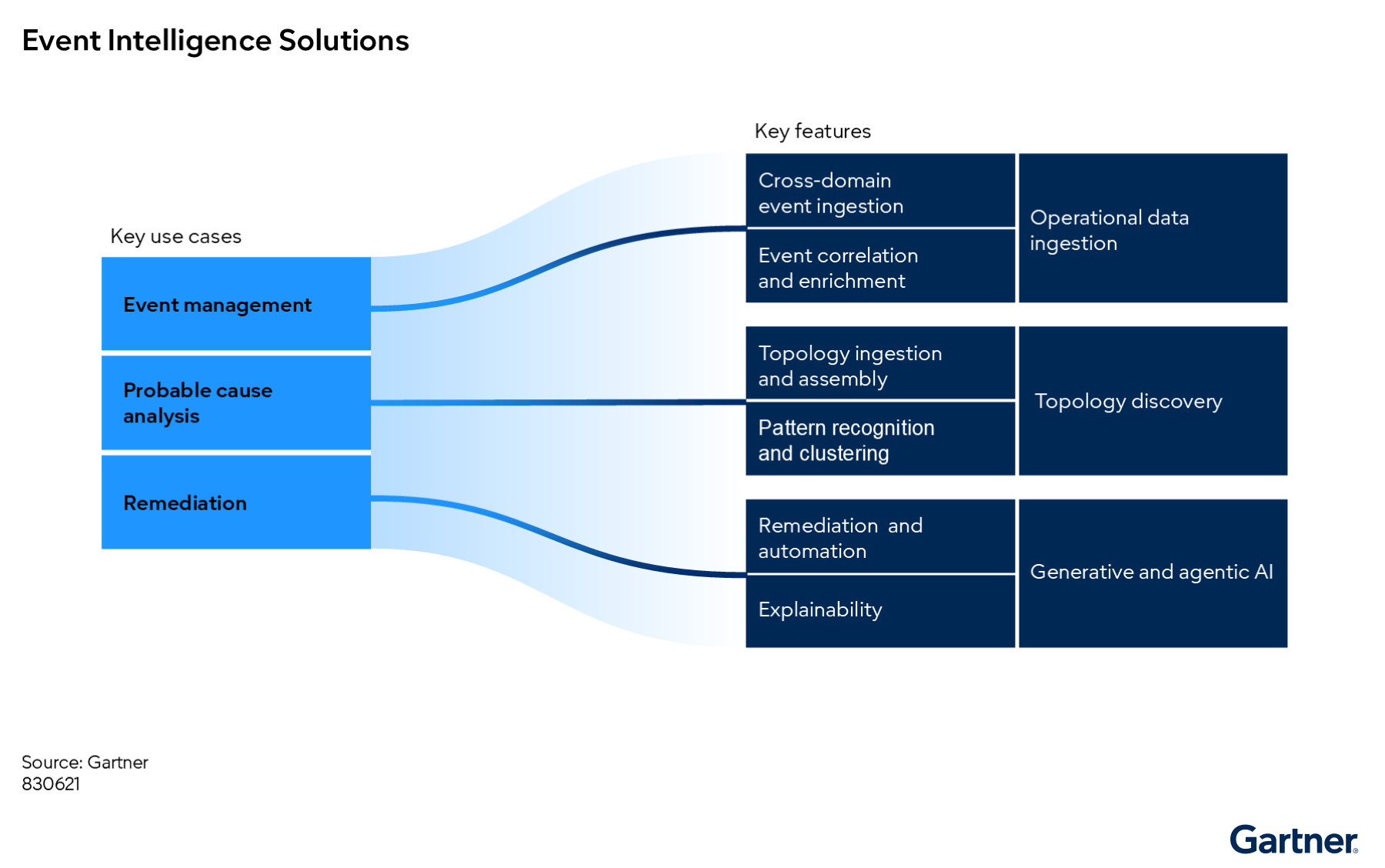
Gartner defines event intelligence solutions (EIS) as tools that apply artificial intelligence (AI) and data analytics to augment, accelerate and automate responses to signals or events detected from digital services. The key characteristics of event intelligence solutions include cross-domain event ingestion, topology assembly, event correlation and enrichment, pattern recognition, and accelerated remediation. These solutions are designed to process event streams into actionable insights and enable proactive responses that reduce toil and improve performance and availability. They are delivered as software as a service or self-managed software.
Event intelligence solutions consolidate signals or events from a portfolio of monitoring tools in order to accelerate and automate response and resolution. They allow IT operations teams to suppress event noise through correlation and deduplication and filter out false positives. Cross-domain events are often enriched with additional context, including device or service dependencies, relationships with historic and ongoing incidents and changes, and unstructured data such as knowledge-base articles.
Real-time correlation and analysis using multimodal AI delivers insights that augment, accelerate and automate the human effort involved in the event management process in response to events.
Typical use cases for event intelligence solutions include:
- Event correlation and enrichment
- Enhanced diagnostic and probable cause association
- Identification of potential remediation
- Execution of automated remediation natively or via integration
- Anomaly detection
- Predictive insights
- Centralized dashboarding
- Impact assessment
Mandatory Features
At a minimum, an event intelligence solution must provide the following capabilities:
- Cross-domain event ingestion: EIS ingest alerts and events from multiple monitoring tools or sources, including infrastructure, network, application, and cloud-native monitoring and observability tools for cross-domain analysis. The solution must perform analyses leveraging machine learning (ML) or other techniques that address real-time analysis at the point of ingestion (streaming analytics) and the historical analysis of stored data.
- Topology ingestion and/or assembly: EIS ingest and assemble unified topology of IT services, including applications, across domains. Topologies can include physical proximity, logical dependence or dimensions that capture the relationship among IT assets, applications and services.
- Event correlation and enrichment: EIS correlate, group and reduce superfluous notifications from monitoring tools, reducing unnecessary human intervention. In addition, events are enriched with additional contextual information relating to, for example, topology, services, owner or priority.
- Pattern recognition and clustering: EIS use AI/ML to process events to detect or predict critical events or incidents. Historical data is baselined, and models continuously learn and refine patterns of events. Operator feedback is used as a reinforcement mechanism to improve accuracy.
- Remediation and automation: EIS continuously learn and improve associations between an event or a pattern of events and the appropriate response either by explicit operator action or observation. The event intelligence solution offers a recommendation, automates a response or triggers an external automation action.
Common Features
Event intelligence solutions also provide common capabilities, such as:
- Operational data ingestion: The EIS may have the ability to ingest data from IT operations tools. This can include changes and incidents from an IT service management (ITSM) platform in addition to knowledge-base articles to aid with root cause analysis and suggested remediation.
- Confidence and inference quality: Building confidence in EIS is critical to their success, particularly concerning higher-risk use cases, such as unattended automated remediation. Therefore, inferences and suggestions made by event intelligence solutions may be accompanied by a quantified statement of confidence.
- Topology discovery: The EIS can include the ability to discover entities to be monitored across the application and infrastructure stack and build a topology map that establishes relationships and dependencies among them. This is distinct from topology assembly, as the event intelligence solution does the discovery versus collecting catalogs of assets from other sources.
- Explainability: AI algorithms are often opaque, black boxes that make their decisions beyond the reach of human understanding. Explainable AI refers to the extent to which AI models can be understood and the degree to which they are traceable and auditable. Explainability plays a vital role in building trust in an event intelligence solution.
- Generative AI: EIS can also leverage generative AI and natural language processing in order to include unstructured sources of knowledge to determine actionable next steps, including remediation actions. They can provide natural language summaries of issue, impact, root cause and possible remediation, and potentially replace traditional UI-based workflows with interaction via collaboration tools.
Market Description
EIS are primarily targeted at IT operations teams and network operations centers (NOCs), as they attempt to optimize their response to events from a portfolio of monitoring tools and observability platforms.
Cross-Domain Event Ingestion
Although there is some degree of market convergence (see Market Analysis section), EIS are distinct from observability platforms. Observability platforms focus on infrastructure, network, application performance, digital experience monitoring and the ingestion or analysis of telemetry data such as logs, metrics and traces. The primary feature of EIS, on the other hand, is their ability to ingest events generated from monitoring tools, observability platforms, and adjacent solutions such as ITSM platforms and developer tools.
It is not unusual for larger enterprises to have portfolios of anywhere between five and up to 40 or 50 tools for monitoring, each creating events that must be correlated, triaged and responded to by IT operations teams. This is one of the key drivers for implementing EIS.
Topology Ingestion and/or Assembly and Knowledge Graphs
Observability platforms perform discovery and dependency mapping of systems and their component parts. While some EIS include this capability natively, they have historically relied heavily on integration with third-party sources of truth, such as a configuration management database (CMDB), to collate this information. However, strict reliance on CMDBs has frequently hindered legacy EIS solutions, as routing and correlation break when CMDB data is incomplete or stale, which is the default state for many enterprises.
To overcome the reality that static topologies are rarely completely up to date, modern EIS architectures are evolving beyond basic topology assembly toward the creation of topologies based on knowledge graphs, seen as the foundation layer of many AI-powered systems. Instead of requiring data perfection first, these platforms ingest and synthesize fragmented operational knowledge from a wide variety of sources. In addition to CMDBs, EIS dynamically pull context from cloud provider APIs, observability platforms, service desks, change logs, and institutional knowledge bases such as run books and even chat history. This enables real-time, service-map-driven updates that are critical for environments that change frequently.
These broad integrations allow an EIS to compile a unified reasoning layer that captures not just logical and proximity dependencies, but comprehensive service and business context. This contextual topology is a critical component for mapping the relationship between, and impact of, events across multiple domains to facilitate a faster, AI-driven triage and automated response. Data normalization and reconciliation processes are essential to resolve discrepancies, handle duplicate or stale data, and ensure accuracy when ingesting from multiple sources. Security and access controls are also important, as this enriched topology data may contain highly sensitive institutional information, requiring EIS to enforce permissions and comply with privacy requirements.
Event Correlation and Enrichment
A primary use case for EIS is the ability to correlate events across domains from installed observability platforms and monitoring tools, reducing the manual toil and fatigue associated with event “noise.” In extreme cases this can result in a 95%+ reduction in events that require human intervention.
In addition, events are enriched with contextual information like associated impacted business services, prior incidents, change records, owner and even suggested resolver group and remediation action. This correlation and enrichment dramatically reduces the time taken to triage, prioritize, assign and ultimately resolve an event.
Pattern Recognition and Clustering
Beyond traditional rule-based correlation, modern event intelligence solutions (EIS) leverage agentic AI and generative AI to transform raw telemetry into actionable intelligence. By building a dynamic knowledge graph, EIS identify complex, multivariate patterns across events that signal impending service degradation.
Unlike legacy tools that operate as ‘black boxes,’ modern platforms provide probable cause analysis, explaining why a cluster formed and suggesting remediation steps based on historical and other data. This evolution shifts IT teams from reactive triage to supervised automation and learning, and where AI agents act as first responders to mitigate and fix issues before they become business-impacting events.
Remediation and Automation
Modern EIS platforms expedite remediation by acting as a comprehensive decision layer that provides operators with suggested next steps based on AI-driven causal analysis and agentic AI rather than static rules. Instead of forwarding raw alerts, these systems generate context-rich incidents that embed probable root causes, service impact visibility, and targeted remediation actions using agentic AI that responders can execute immediately with less manual investigation. Enterprise demand is shifting from merely gathering insights to driving autonomous action. This evolution is fueled by an architectural shift toward agentic AI and agentic SRE (see Market Guide for AI Site Reliability Engineering Tooling), that leverage rich operational knowledge graphs to automate complex response processes that traditionally required human judgment and cross-system synthesis.
Furthermore, while EIS historically integrated with external automation platforms, modern solutions increasingly offer embedded incident management and closed-loop workflow automation directly within the platform. By applying appropriate governance frameworks and guardrails, AI-based agents can navigate trusted toolchains to autonomously initiate policy-defined remediation. This level of automation reduces mean time to resolution (MTTR), eliminates manual toil, and drives measurable operational and financial efficiency.
Market Direction
The EIS market is in a period of continued convergence. Over the next year, several trends will reshape vendor offerings and buyer expectations:
- Convergence with adjacent markets: Some EIS capabilities are blending with observability and ITSM platforms. ITSM vendors and some observability vendors are expanding their portfolios to deliver EIS capabilities that cover event ingestion, correlation, and automated remediation. This convergence is expected to accelerate, driving portfolio rationalization and intensifying competition.
- Rise of agentic and generative AI: Vendors are rapidly integrating large language models (LLMs), generative AI, and agentic AI into EIS platforms. The current wave of innovation is focusing on context-aware automation, natural language interfaces, and agentic collaboration features that extend beyond IT operations to support business-centric outcomes.
- Shift toward autonomous operations: The market is moving from reactive event management toward proactive, autonomous remediation. Advances in knowledge graphs and AI reasoning will enable EIS solutions to not only identify and correlate events but also initiate and execute remediation actions with minimal human intervention.
- Emphasis on explainability and governance: As AI-driven automation becomes more prevalent, organizations will demand greater transparency, explainability, and auditable decision making from EIS platforms. Vendors will need to address regulatory requirements and build trust in AI-enabled operations.
- Expansion of use cases and personas: EIS adoption will broaden to include cross-functional teams and new operational personas, requiring solutions to support a wider range of workflows and integration scenarios.
- Emergence of agentic-augmented SRE tooling: While EIS continues to evolve for service operations teams, focusing on incident response and ticket-driven workflows, a separate market for agentic-augmented SRE tooling is emerging. Unlike traditional EIS, agentic SRE tools are developer-centric and focus on “toil” reduction through autonomous software agents that navigate complex distributed systems.
- Evolution of access and collaboration: Accessing EIS insights is evolving from relying solely on the solution’s own user interface to agentic integration with tools such as Microsoft Teams or Slack. This shift facilitates real-time collaboration on ongoing incidents across teams from within IT operations and beyond, enabling faster, more coordinated responses.
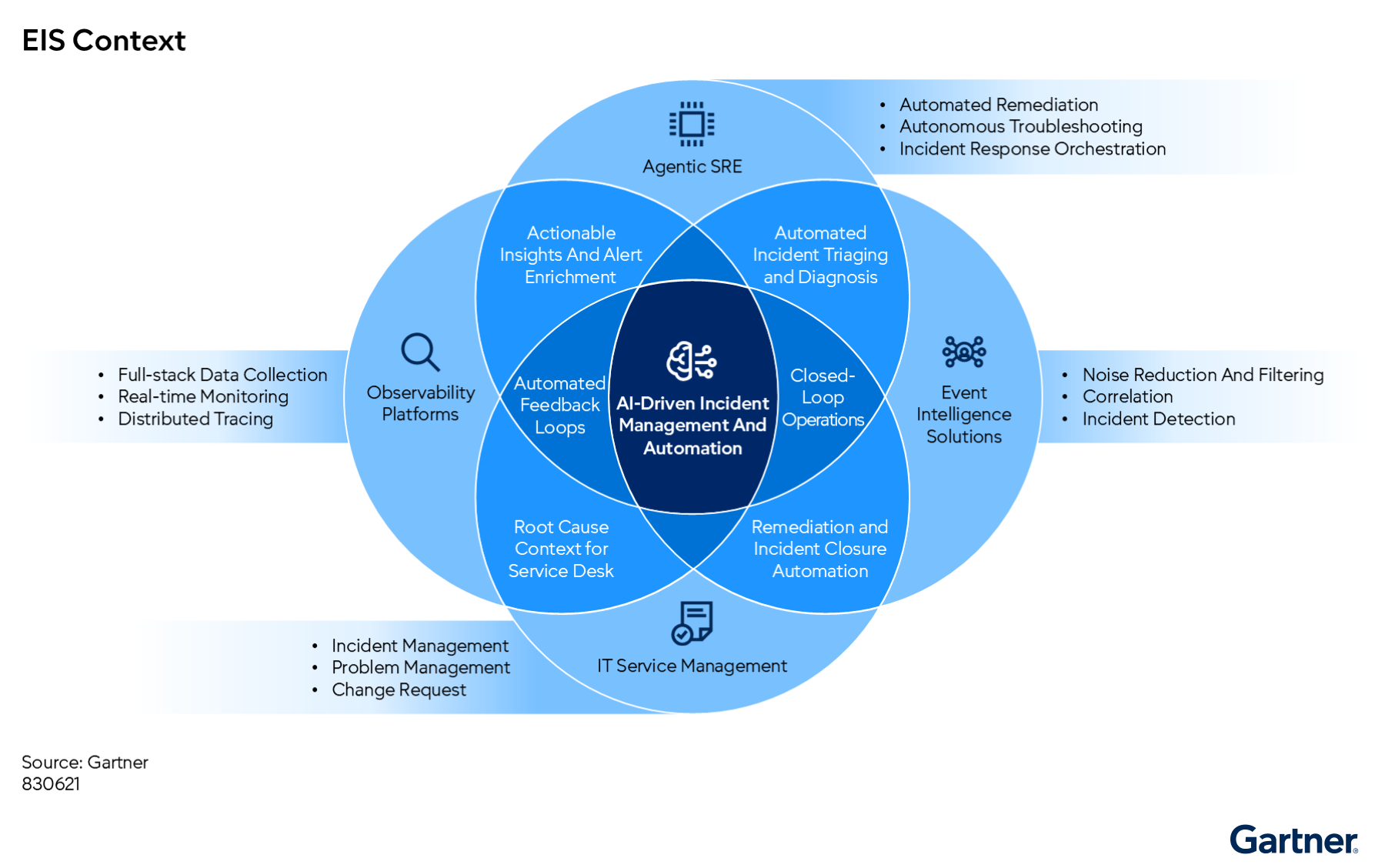
Convergence in these markets will continue as the respective vendors seek to deliver additional value and target new audiences with their products. Across these market sectors, adopting these capabilities is not expected to stop with observability/monitoring and ITSM products, which is additional competition against pure EIS solutions aiming not only to increase their portfolio offerings, but also bring their customers into an ‘all-encompassing’ ecosystem. I&O leaders should prepare for a market where the boundaries between observability, service operations teams, SRE, ITSM, and EIS blur, and where value is delivered through integrated, AI-powered platforms that optimize reliability, efficiency, and service outcomes.
Figure 2 illustrates how EIS sits alongside the broader portfolio of ITOM and SRE tools and how these adjacent markets are on a path of convergence, particularly in respect to EIS capabilities.
Market Analysis
Typical EIS Use Cases
EIS solve a number of challenges faced by IT operations teams by reducing human toil and decision making, accelerating the response process and automating tasks leading to remediation:
- Alert correlation and noise reduction: EIS uses pattern recognition to group related alerts into a single “incident” or “situation.” This can reduce noise by between 30% and 95%, allowing teams to focus on one actionable issue, rather than hundreds or thousands of individual alerts.
- Automated root cause analysis (RCA): By integrating with topology maps, CMDBs, ITSMs, developer tools, as well as their own internal knowledge graph, an EIS can pinpoint the “probable origin” of a failure. It identifies a specific change, such as a recent code deployment or configuration update, that correlates with the start of the issue.
- Anomaly detection and early warning: The platform learns a “baseline” of normal behavior. It flags statistical outliers — like a slow increase in latency or a memory leak — long before a service actually crashes, giving teams a head start on remediation.
- Automated incident remediation (self-healing): When a specific event pattern is recognized, the EIS triggers an automated run book. This can execute scripts to resolve the issue without human intervention, effectively “self-healing” the system and lowering the mean time to resolution (MTTR).
- Capacity planning and predictive insights: By analyzing historical trends and seasonality, the EIS can forecast when resources (like storage or bandwidth) will hit their limit. This allows teams to scale infrastructure exactly when needed, optimizing cloud costs and performance.
The EIS market is characterized by continued innovation, increasing convergence with adjacent markets, and continued buyer interest in AI-driven automation. However, adoption remains uneven, and organizations face a range of challenges as they seek to realize the full value of these solutions.
The market includes pure-play EIS vendors and observability platforms and ITSM platforms who integrate EIS modules with observability, ITSM, and SRE capabilities. While precise sizing is challenging, continued growth is fueled by the proliferation of hybrid architectures and the demand for end-to-end automation.
Market Dynamics
- Organizational drivers: The EIS market is primarily driven by organizations with large, disparate toolsets and operational maturity characterized by silos or a strong service operations/NOC model. These organizations often face challenges in correlating events across multiple monitoring, observability, and ITSM platforms, making EIS solutions attractive for reducing noise, accelerating triage, and automating incident response.
- Limited appeal in cloud-native SRE environments: In contrast, highly developed SRE-driven organizations, especially those operating in cloud-native environments with minimal legacy infrastructure, may find EIS less appealing. These organizations typically prioritize developer-centric, autonomous tooling focused on “toil” reduction and proactive reliability, and may rely more on integrated observability and SRE platforms rather than traditional event intelligence solutions.
- Convergence and competition: The lines between EIS, observability, ITSM, and SRE are blurring. Buyers increasingly expect platforms that deliver actionable insights, alert enrichment, automated triaging, RCA, and incident closure automation in a unified workflow.
- Innovation pace: AI-driven features such as correlation, anomaly detection, self-healing, and contextual alerting are now standard. Vendors are advancing toward full incident autopilot, leveraging cross-domain data and automation.
- Adoption barriers: Success depends on data integration, process maturity, and cross-functional collaboration. Organizations with fragmented data sources or siloed processes may struggle to realize full value.
Market Trends
- AI-driven automation: Actionable AI, agentic automation, and contextual alerts are transforming incident response and remediation.
- Integrated workflows: Platforms are connecting observability, ITSM, and SRE data, enabling automated feedback loops and unified incident management.
- Expansion of use cases: EIS solutions are used for noise reduction, correlation, RCA, alert fatigue mitigation, and anomaly detection, supporting both IT operations and SRE teams.
- Collaboration and explainability: Integration with collaboration tools and explainable AI features are becoming essential for cross-team engagement and trust.
Market Challenges
- Process maturity: Achieving automation and proactive reliability requires mature incident, change, and knowledge management processes.
- ROI and change management: Demonstrating business value and managing organizational change remain key hurdles.
- Vendor differentiation: Overlapping capabilities can create confusion; buyers must assess integration, AI maturity, and workflow support.
Market Analysis Summary
The EIS market is defined by convergence, innovation, and the shift toward unified, AI-powered incident management. Adoption is strongest among organizations with complex, legacy environments and siloed operations, while highly developed SRE-driven, cloud-native organizations may prefer developer-centric, autonomous tooling. Success depends on integration across observability, ITSM, and SRE, as well as investment in data quality and process maturity.
Representative Vendors
The vendors listed in this Market Guide do not imply an exhaustive list. This section is intended to provide more understanding of the market and its offerings.
Vendor Selection
EIS vendors come from various backgrounds, some expanding from adjacent markets complementing their broader tool portfolio, others with a specific focus on this market alone. All ingest cross-domain events, but they differ in their use-case focus and approach to advanced analytics and AI. The majority of vendors deliver their solutions as SaaS, although self-managed options do exist.
Modern observability platforms often include significant AI capabilities but are not listed here unless they also function as an EIS (see Table 1).
Representative Vendors in Event Intelligence Solutions
| Vendor | Solution Name |
|---|---|
BigPanda | |
BMC Helix AIOps | |
Splunk IT Service Intelligence (ITSI) | |
Datadog Events | |
APEX AIOps | |
ignio | |
xMatters | |
Alert Noise Reduction | |
GreySkies AIOps Platform | |
Grok | |
OpsRamp | |
IBM Cloud Pak for AIOps | |
Hybrid IT Infrastructure Monitoring | |
Event Intelligence | |
Operations Cloud | |
Scout | |
ScienceLogic SL1 | |
Selector AI | |
IT Operations Management (ITOM) | |
Event Intelligence | |
VIA AIOps | |
vuSmartMaps | |
Source: Gartner (May 2026)
Market Recommendations
To maximize the value of event intelligence solutions (EIS) investments and drive successful adoption, I&O leaders should:
Elevate the Business Case to the C-Suite
Avoid justifying EIS procurement based solely on operator-centric metrics like reducing noisy events. Instead, anchor investments directly to executive-level priorities such as revenue loss prevention, manual labor cost avoidance (OPEX reduction), and tool consolidation. Isolated tools with unclear ROI are often the first to be cut during budget constraints, whereas platforms that prove measurable operational efficiency and act as a strategic consolidation layer are protected.
Align EIS Investments With Business Outcomes
Ensure that EIS initiatives are directly linked to business-centric objectives, such as service reliability, customer experience, operational efficiency, and risk mitigation. Demonstrate ROI through measurable improvements in incident resolution times, reduced alert fatigue, and enhanced service continuity. Engage business stakeholders early and often to validate that EIS investments support broader organizational goals.
Understand Data Requirements and Process Maturity
The messaging from EIS vendors typically focuses on the benefits of successful implementation, with little regard for the prerequisites required to achieve these results. For example, the degree to which a solution relies on a mature CMDB or integration to third-party orchestration solutions varies across vendors.
When evaluating EIS, I&O teams should probe vendors for a clear understanding of both the data quality and process maturity requirements necessary to achieve the various use cases. I&O leaders should then plan their ROI and implementation based on a maturity path.
Evaluate Tools in Context
Your EIS exists within a portfolio of broader IT operations management tooling that extends from monitoring and observability to CMDB, ITSM, and automation. Integration between these components is essential for successful implementation.
Given the dependency on tools from adjacent markets, and the active convergence across these markets, I&O teams evaluating EIS should do so within this much broader context. I&O teams must create an IT operations tools portfolio architecture, which should include integrations across the components.
The implementation of EIS should be part of an IT operations management strategy that includes a roadmap for optimization and consolidation. Further, the convergence across adjacent markets presents an opportunity for I&O teams to assess incumbent vendors who may already offer the desired EIS capabilities.
Mandate Change
By nature, an EIS demands changes to existing processes, procedures, roles, responsibilities, and ultimately an organization’s culture. When evaluating use cases and value drivers for EIS, be aware of the changes to existing practices that these demand.
Conservative organizations or those operating within regulated industries should take a pragmatic view of their ability to drive rapid or radical change within their organizations. Expectations should be set accordingly with a strategy that supports incremental optimization as trust is developed and organizational change as management allows. Conversely, the rapid development of GenAI and agentic AI does afford organizations with a more aggressive risk appetite the opportunity to challenge existing processes, organization, and culture. With appropriate due diligence, there are opportunities to adopt emerging technologies that offer a radical evolution of IT operations that may drive a competitive advantage.
By following these recommendations, organizations can harness the full value of EIS in a converged IT operations environment, achieving greater reliability, efficiency, and agility, while positioning themselves for future advancements in AI-driven automation and service management.