— Internal Use Only —
Hype Cycle for Agentic AI, 2026
2 April 2026 - ID G00842058 - 120 min read
By Rajesh Kandaswamy, Leinar Ramos, and 4 more
Agentic AI promises powerful automation capabilities in varied domains, driving extreme interest and substantial investments. Yet, rapid progress in agentic AI is exceeded by hype and confusion. Grasping the core innovations and their progress is crucial to realize business value and avoid missteps.
Analysis
What You Need to Know
Agents represent a fundamentally new software paradigm — one that holds the promise of automation in ways not always possible earlier. However, the supporting infrastructure and processes are still maturing.
Hype and interest in AI agents have reached extraordinary levels, making it vital for CIOs and AI leaders to gain clarity on what’s real, what’s emerging, and what’s simply noise. The agentic AI space is shaped by a complex mix of innovations and components, each critical to understanding the true state and potential of the technology. Hence, we are introducing the “Hype Cycle for Agentic AI” to help you navigate the landscape, check progress against expectations, and make more informed decisions in a fast-moving environment.
- Interest in AI agents is significant and accelerating. According to Gartner’s 2026 CIO and Technology Executive Survey, only 17% of organizations have deployed AI agents so far, but 42% expect to do so in the next 12 months, and another 22% within the following year. This is the most aggressive adoption curve among all emerging technologies in the survey. Most enterprises are still in the early stages, using agents primarily to automate existing workflows rather than reengineering processes for agentic AI. Software engineering is an exception and has experienced significant growth in agentic coding. The focus remains on incremental automation, not yet on transformative change.
- Innovation in AI agents is moving quickly, but the hype is advancing even faster, fueling confusion about what agents can actually deliver. Current LLM-based agents are incredibly varied. The most common are capable of perceiving large volumes of information and using tools to take actions, with some basic planning, self-reflection, and correction. However, they remain limited in adaptability and often struggle with context-specific decision making in enterprise environments. This gap between promise and reality has led to unrealistic expectations that agents can operate autonomously and deliver high-value outcomes for complex tasks consistently. In practice, fully autonomous agents are not ready for most enterprise use cases, and human oversight remains essential. Semiautonomous deployments, where there is some human supervision of the work of AI agents, are what enterprises must plan for.
- The confusion is compounded by “agent-washing,” where legacy automation tools and RPA solutions have been rebranded as AI agent building platforms. This shift muddies the market, making it harder for buyers to distinguish between genuine agentic AI capabilities and traditional automation technologies dressed up with new terminology.
- The AI agent technology ecosystem is expanding rapidly. We are seeing the emergence of domain-specific agents tailored to particular industries or functions, as well as a proliferation of low-code and no-code platforms that lower the barrier to agent development. New frameworks and platform tools for agent training and evaluation are appearing, and SaaS vendors are aggressively embedding AI agents into their enterprise offerings to defend and extend their market positions. The result is an increasingly crowded and dynamic landscape, with innovation and speed to market outpacing standardization and sufficient guardrails.
- Agents represent a fundamentally new software paradigm — one that holds the promise of automation in ways not always possible earlier. However, the supporting infrastructure and processes are still maturing. Integration, reliability, security, governance, and financial management for agents are all evolving, and organizations should be prepared for gaps and growing pains. The processes for agent development, management, and cost control are, in many cases, being defined in real time.
- AI agents and generative AI (typically LLMs and LRMs) are distinct technologies in AI. AI agents can use a range of AI techniques, not just LLMs. For enterprise adoption, reliability and transparency are often best achieved with accurate, deterministic models, not only generative AI.
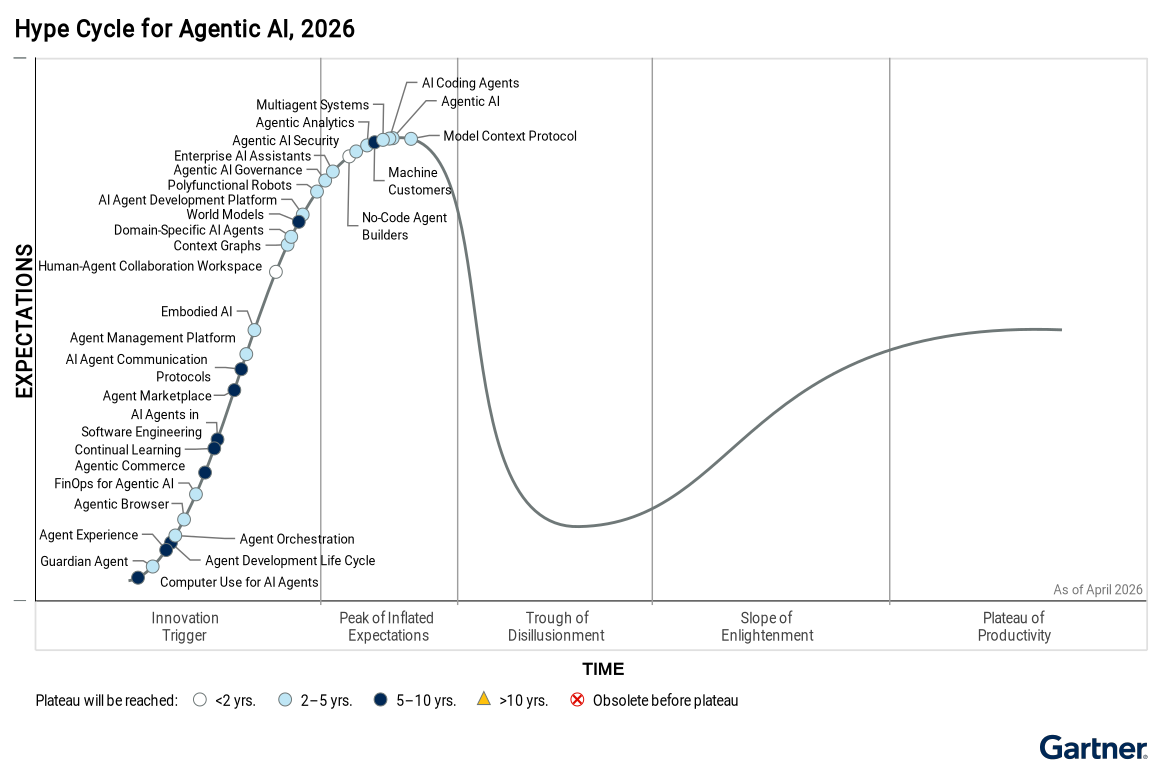
The Hype Cycle
The innovations shaping AI agents can be grouped into five key areas. Each area reflects a distinct set of capabilities and challenges that are unique to AI agents — autonomous or semiautonomous software entities that use AI techniques to perceive, make decisions, take actions and achieve goals in their digital or physical environments.
Agent Development
Agent development is fundamentally different from traditional application development. Building agents requires a mindset that accounts for autonomy, learning, and adaptability from the start. The agent development life cycle (ADLC) introduces structure and repeatability to a process that must allow for adaptability. AI agent development platforms are evolving to support the assembly, testing, and scaling of agents and multiagent systems, while computer use for AI agents is now maturing, enabling agents to interact with human user interfaces, bypassing the need for APIs but at potentially higher cost and slower performance. Context graphs connect data, actions, and goals in a dynamic graph that captures operational context, decision traces, and reasoning paths for agentic AI. Emerging world models allow agents to simulate and anticipate possible futures, raising the bar for context awareness and decision quality. The emergence of no-code agent builders is democratizing access, allowing business users and citizen developers to create and deploy agents without deep technical skills. The agent marketplace allows organizations to source and consume agentic capabilities, making it possible to discover, evaluate, and operationalize agents from a growing ecosystem. Collectively, these innovations are shifting the focus from code to capability, and from deterministic logic to adaptive behavior.
Agent Integration & Deployment
Integration and deployment are where agentic value is realized and scaled. Agents rarely operate in isolation; their impact depends on how well they can connect, collaborate, and build on existing digital investments. Agent communication protocols (such as the Model Context Protocol) are setting new standards for integrations, allowing agents to seamlessly exchange context and capabilities or access resources from other systems. Multiagent systems and agent orchestration are tackling the complexity of coordinating distributed, semiautonomous actors — each with their own goals, constraints, and methods. Integration is no longer just about APIs; it’s about ensuring agents can work together, adapt, and drive outcomes in dynamic environments.
Agent Human Interaction
The way we interact with agents is fundamentally changing the digital experience. Agents are not just tools; they are collaborators, able to interpret intent, negotiate outcomes, and act on behalf of users. Agent experience is emerging as a discipline focused on designing environments and workflows that agents can navigate and act within and move beyond user interfaces built solely for humans. Human-agent collaboration workspaces are enabling structured delegation, oversight, and accountability, blending automation with human judgment in persistent digital environments. Agentic browsers (or AI browsers) can reshape how we access and filter information, with agents curating and acting as intermediaries. Machine customers represent a new class of economic actors — agents that transact, purchase, and make decisions autonomously, raising new questions about trust, transparency, and the boundaries of digital commerce.
Agent Management
Managing agents is a strategic and operational necessity as organizations scale their use. It’s not enough to deploy agents — they must be monitored, governed, and optimized to ensure reliable, secure, and cost-effective performance. Agent management platforms provide a unified interface to secure, monitor and govern agents. Agentic AI governance and agentic AI security are critical as agents make decisions with real-world consequences, demanding new approaches to risk, policy enforcement, and runtime controls. Guardian agents are emerging as agentic overseers, ensuring that agent actions remain aligned with policy, intent, and organizational values. Agentic analytics offers visibility into agent behavior and outcomes, supporting both operational tuning and strategic insight. Continual learning ensures agents remain effective as environments and objectives shift, while FinOps for agentic AI brings financial discipline to the unpredictable costs of agent operation. Effective management is what turns agent deployment from pilot to enterprise-scale value.
Agent Use Cases
The range of agent applications reveals the breadth and ambition of agentic AI. Agentic AI, agentic coding, and AI agents in software engineering are redefining how software is built, maintained, and evolved, with agents able to design, test, and optimize code autonomously. Agentic commerce can transform digital commerce, with agents enabling or negotiating and executing deals on behalf of buyers and sellers. Domain-specific agents show the impact of tailoring intelligence to complex, high-stakes environments where accuracy and compliance are vital. Agentic analytics uses AI agents to orchestrate and automate the data-to-insight workflow, enabling faster and more adaptive analysis. Embodied AI and polyfunctional robots extend agent capabilities into the physical world, delivering automation that adapts to changing tasks and environments. The diversity of applications underscores that agents are not a single technology but are a new foundation for digital transformation, with implications for every sector.
The Priority Matrix
The Priority Matrix provides CIOs with a strategic lens to assess and compare the potential impact of agentic AI innovations featured in this year’s Hype Cycle. By mapping innovations according to their benefit rating and expected time to mainstream adoption, the matrix enables organizations to identify which technologies align best with their business objectives, industry applicability, and digital transformation agendas. However, it’s critical to recognize that impact alone should not drive investment decisions. Factors such as applicability to your unique context, budget constraints, time to implement, and expected ROI must also be weighed to ensure that investments are both ambitious and operationally sound.
Agentic AI is a rapidly evolving domain, with new innovations emerging and maturing at an unprecedented pace. The Priority Matrix reflects this dynamism, highlighting a diverse set of technologies that are poised to drive value across industries. Most innovations in this space are expected to reach mainstream adoption within two to five years, offering significant value and laying the groundwork for future advancements. CIOs should use the Priority Matrix not only to prioritize near-term opportunities, but also to build a resilient roadmap that balances exploration with disciplined execution as the agentic AI landscape continues to evolve.
Priority Matrix for Hype Cycle for Agentic AI
| Benefit | Years to Mainstream Adoption | |||
|---|---|---|---|---|
| Less Than 2 Years | 2 to 5 Years | 5 to 10 Years | More Than 10 Years | |
Transformational | ||||
High | ||||
Moderate | ||||
Low | ||||
Source: Gartner (April 2026)
On the Rise
Computer Use for AI Agents
Analysis By: Arthur Villa
Benefit Rating: High
Market Penetration: Less than 1% of target audience
Maturity: Embryonic
Definition:
Computer use for AI agents enables autonomous interaction with user interfaces, such as operating systems, desktop apps and web browsers, like human users. It involves perceiving interface elements, understanding context and making navigation decisions using inputs like a mouse and keyboard. AI agents execute tasks to achieve goals automating tasks within software and web environments without direct API access.
Why This Is Important
Enabling AI agents to use computers unlocks automation potential in business processes requiring manual software and web interaction. AI agents could surpass robotic process automation (RPA) technology by integrating reasoning and decision making for complex tasks. Computer use lets AI access data and function in legacy systems and web platforms without model context protocol servers or APIs. AI’s ability to navigate digital environments marks a significant advance toward autonomous systems.
Business Impact
- Automate tasks, access customer data and resolve issues across applications, like user enrollment.
- Improve data entry accuracy and speed in legacy systems and web forms.
- Browse the web autonomously, extract information and synthesize research findings.
- Automate web application testing by interacting with interfaces and identifying issues.
- Automate basic IT support tasks across operating systems and applications.
- Improve UI resilience in the face of application screen changes.
Drivers
- Advancements in AI perception and reasoning: Improved capabilities in computer vision, natural language understanding and decision making enable AI agents to better interpret and interact with GUIs. Models are becoming more adept at understanding web elements and responding to instructions.
- Demand for enhanced automation: Businesses are continuously seeking ways to automate more complex, end-to-end processes that go beyond the limitations of traditional automation tools. Computer use may overcome limitations such as the need to rigidly define UI interactions and adaptability to major UI changes.
- Development of specialized AI agent platforms and tools: Companies and open-source initiatives are actively developing platforms and tools that specifically focus on enabling AI agents to interact with user interfaces. Examples include tools for browser control and capturing UI actions.
- Increased availability of powerful AI models: The development of more capable AI models, including large language models (LLMs) with multimodal capabilities, provides the foundational intelligence required for agents to understand and navigate complex interfaces effectively.
- Growing recognition of the “digital employee” concept: The idea of AI agents acting as digital counterparts to human workers, capable of performing a wide range of tasks at the UI level, is gaining traction. This drives the development of technologies that enable such interactions.
- Need to integrate disparate systems: Many enterprises struggle with integrating various software systems. Computer use offers a potential solution by allowing AI agents to bridge these gaps through UI interaction.
- Rapidly decreasing costs of LLM usage: Recent evaluations indicate that token-based computer use capabilities currently surpass annual subscription-based RPA software in cost for high-frequency tasks. However, as the costs associated with computer use continue to decline, it is expected to drive increased adoption of this technology.
Obstacles
- Scope: Most computer use development is focused on browser environments, which can gather metadata like underlying HTML code. This focus presents an obstacle to broader adoption, as it limits interaction with application UIs such as Windows-based applications.
- Costs: For high-volume tasks, computer use is currently much more expensive than traditional deterministic automation. There is a high degree of variability due to token-based costs, which makes budgeting challenging.
- Speed: Many computer use providers rely on screenshots and analysis of those screenshots to determine UI interactions. As a result, computer use technologies often execute at much lower speeds than traditional automation technologies.
- Accuracy: Navigating complex workflows and decision making autonomously is difficult for AI. Improving success rates in these tasks is a development focus.
- Need for human oversight: Human intervention is often required due to potential errors and security risks, limiting full autonomy.
User Recommendations
- Prioritize use cases: Focus on specific, well-defined tasks where computer use can provide substantial value and ROI, starting with less complex, less critical processes with infrequent execution, but UI variability is high.
- Implement robust security: Use dedicated virtual machines or containers with minimal privileges for AI agents, implement identity access, restrict access to sensitive data and domains, and include safety checks and confirmation prompts for critical actions.
- Focus on secure platforms: Choose AI agent platforms or tools with features for monitoring, controlling and auditing actions, and mechanisms to address prompt injections and other security threats.
- Maintain human oversight: Create protocols for human review and intervention in AI workflows, particularly for tasks with real-world impacts or requiring affirmative consent.
Sample Vendors
Amazon Web Services; Anthropic; Browser Use; Google; Manus AI; Microsoft; OpenAI
Gartner Recommended Reading
Guardian Agent
Analysis By: Avivah Litan, Daryl Plummer, Tarun Rohilla
Benefit Rating: High
Market Penetration: Less than 1% of target audience
Maturity: Emerging
Definition:
Guardian agents supervise AI agents and help ensure their actions align with goals and boundaries. They monitor and block risky actions and are evolving from a collection of services to autonomous agents that enforce policies across platforms. Guardian agents are transitioning from human-directed automated oversight services into semiautonomous or fully autonomous agents that formulate and execute action plans, and redirect or block actions to align with intended agent goals.
Why This Is Important
- AI agents make deliberate choices — introducing new risks beyond traditional AI, such as complex event chains and interactions within and beyond organisational boundaries.
- These new risks are often invisible and hard for humans or systems to stop, especially as agents scale and gain complexity.
- Automation is critical to monitor, align, and control AI agents, especially as they interact with each other, since human intervention alone cannot scale.
Business Impact
- Safety and compliance: Vital for high-stakes and regulated sectors (e.g., finance, healthcare, legal, government) needing trustworthy, transparent and compliant AI at scale.
- Automated oversight: Human oversight can’t keep pace; automated risk detection/blocking, policy enforcement and auditability required for safe autonomous scalable AI.
- Competitive edge: Early tech-savvy adopters are driven to manage rising risks amid rapid agent growth, to avoid failures and gain competitive edge via reliable AI.
Drivers
- Lack of trust: Organizations hesitate to deploy AI/ML and GenAI for critical processes due to concerns about safety, ethics, and reliability. Guardian agents build trust by providing oversight and assurance.
- AI agency: As LLM-based AI agents gain autonomy to act with or without human involvement, the risk of unintended or unsafe actions rises, driving the need for robust, automated controls.
- Rapid acceleration: The proliferation of AI agents outpaces what human oversight alone can manage. Guardian agents automate governance, ensuring scalable, consistent monitoring and intervention.
- Guardian agents blend AI governance with runtime inspection and enforcement, leveraging AI techniques to monitor, control, and secure AI applications and agents as part of the AI TRiSM framework.
- Vendor lock-In potential: To ensure flexibility, support cross-cloud and hybrid compute and data environments, and support for enterprise-specific policy enforcement, guardian agents must remain independent of specific AI platforms or tools, complementing rather than duplicating built-in governance features.
- Need for versatility: Effective oversight requires a combination of agentic and non-agentic mechanisms to govern both agentic and traditional AI outputs and actions, supporting comprehensive risk mitigation and compliance.
Obstacles
- Trust in guardian agents themselves: As enterprises deploy guardian agents, it becomes essential to implement robust controls to prevent misalignment, security breaches, and operational risks from the guardian agents themselves.
- Skills shortage: Limited expertise in developing agentic and guardian AI systems delays progress.
- Implementation: Few APIs and integration tools hinder effective deployment.
- SaaS integration: Guardian agents are still immature, and can generally not yet support in-line and real-time blocking controls.
- Complexity: High intricacy increases risk of errors and inefficiency.
- Evasion: Advanced agents may bypass detection, requiring ongoing mitigation.
- Fairness/ethics: Defining these controls is subjective and challenging.
- Overconstraint: Excess caution can limit usefulness.
- Overreliance: Users may become complacent, needing education on limitations.
- Vendor hype: Overstated claims can create unrealistic expectations.
User Recommendations
- Launch a cross-functional initiative to systematically discover, inventory, map and manage all AI agents — sanctioned and unsanctioned — across the organization.
- Trial emerging guardian agents now to gain early expertise in safely overseeing increasingly autonomous AI systems, securing a lasting competitive advantage as these tools evolve into mature, full-scale automated AI overseers.
- Invest in emerging guardian agents that aid in continuous AI agent discovery, access management, assurance, monitoring, and improvement.
- Prioritize GA solutions independent of AI agent platforms to; ensure cross-cloud governance, full enterprise information governance and avoid vendor lock-in. Independent solutions should integrate with and complement GA solutions embedded in AI agent platforms for optimal coverage and results.
- Implement meta-governance controls for guardian agents themselves to mitigate their own risks of deviant or destructive actions and behavior.
Sample Vendors
Amazon; Google; Lumia Security; Microsoft; Noma Security; Virtue AI; Wayfound; Zenity
Gartner Recommended Reading
Agent Development Life Cycle
Analysis By: Manjunath Bhat, Gary Olliffe, Tigran Egiazarov
Benefit Rating: High
Market Penetration: 1% to 5% of target audience
Maturity: Embryonic
Definition:
An ADLC defines a structured and repeatable methodology to ensure AI agents are built with safety, security and alignment by design. Establishing an ADLC helps organizations define and enforce consistent agent development practices (e.g., eval-driven development) and adopt the right tools and technologies to deliver reliable, secure, and trustworthy AI agents. An ADLC adapts or extends the SDLC and helps navigate the challenges that arise with building nondeterministic and autonomous AI agents.
Why This Is Important
AI agents developed without reliability, security, or trust fail to garner user adoption. An ADLC enables both agility and quality for agent development teams. It provides a systematic way to select agent development platforms, frameworks and design patterns, and enforce quality gates using automated evaluations, observability, and guardrails. An ADLC mitigates nondeterminism risks and aligns AI agents with the organization’s governance, legal, security and architecture policies.
Business Impact
Organizations build custom agents to realize greater business value by tailoring them to fit their internal business workflows. These custom-built agents therefore become high-value deliverables, supporting an organization’s business-critical objectives. An agent development life cycle (ADLC) serves as an essential framework to consistently align the business-critical agent’s engineering process with the organization’s governance, reliability, ethical and security standards.
Drivers
- Addressing risks of nondeterminism: The need for a structured and rigorous ADLC is primarily driven by the challenges that arise in building AI agents which reason and act autonomously using model responses, which are inherently nondeterministic and unpredictable. The ADLC defines the adoption of both preventative measures (e.g., automated evaluation pipelines) and compensating controls (e.g., runtime guardrails, defined workflows and observability) to help mitigate the risks of nondeterministic behavior.
- Building in responsible AI practices to earn user trust: An ADLC can be used to implement responsible AI practices, turning abstract trust measures such as fairness, explainability and toxicity into measurable fitness functions that can be audited and integrated as part of software delivery pipelines. An ADLC helps the organization treat trust as a competitive differentiator by building agentic solutions that are trustworthy by design and continually evaluated against appropriate trust measures.
- Implementing AI governance consistently across engineering teams: The ADLC provides software engineering teams with a repeatable, auditable and scalable approach to safely build agents. Organizations can therefore scale AI governance initiatives by encouraging multiple agent development teams to adopt the ADLC.
Obstacles
- Low software engineering maturity: The ease of building a prototype agent belies the difficulty of building a production-ready, agent-based solution. When agent development teams fail to implement proven software engineering practices such as DevSecOps, “definition of done,” test automation and observability, they find it harder to implement an ADLC.
- Low AI engineering maturity: An ADLC assumes a sufficiently mature AI engineering competency. Implementing an ADLC requires organizational competency in evaluations, LLM understanding, agent observability, guardrails, context engineering, agentic design patterns and agent-specific security threats.
- A rapidly evolving technology stack: The tools, protocols and frameworks across the technology stack for agentic workloads are still emerging and may have no real-world reference implementations. ADLC tool providers may go out of business or get acquired. Therefore, teams will face high friction when trying to assemble ADLC toolchains.
User Recommendations
- Establish an ADLC to guide, codify and institutionalize practices that address the new challenges in agent development. The steps in the ADLC should include integrating security guardrails, evaluations for trust and alignment, engineering relevant context systems and implementing cost observability.
- Implement the ADLC as an evolution of your SDLC, incorporating emerging practices such as context engineering and eval-driven development while applying proven DevSecOps and SRE practices.
- Identify opportunities for toolchain rationalization, address interoperability challenges and fix gaps in agent security and agent developer experience by mapping out the complete ADLC and inventorying current and planned acquisitions of platforms, frameworks and tools.
- Engage platform engineering teams to consistently manage, scale and govern the tools, platforms, context artifacts and frameworks supporting the ADLC for your organization’s most common types of agents.
Gartner Recommended Reading
Agent Experience
Analysis By: Brent Stewart, Paige Kirk, Sarah Baumunk
Benefit Rating: High
Market Penetration: 1% to 5% of target audience
Maturity: Emerging
Definition:
Agent experience (AX) is a design and engineering discipline focused on preparing back-end systems to attract and serve AI agents. AX ensures APIs, data, documentation, workflows and interoperability standards are machine-readable, discoverable and reliable. Like UX for humans, AX makes software understandable, portable and actionable for agents through standardized interfaces, efficient execution patterns and governable contracts across systems.
Why This Is Important
Poor AX degrades human UX: when agents can’t reliably complete tasks, people get inconsistent outcomes and switch providers by redirecting their agents elsewhere. Also, as agent autonomy increases, agents will “shop” for systems that maximize task success (and avoid operational surprises), making AX a competitive differentiator in what agents choose to use.
Business Impact
Better AX makes your system easier for agents to choose, trust, and use. Clear interfaces based on AI-focused standards such as MCP, machine-readable intent, and predictable workflows reduce retries, failures, and compute waste so agents complete more tasks per dollar. The result is more agent-initiated calls, higher conversion and throughput, and new revenue via API consumption, marketplace distribution, and partner integrations.
Drivers
- Protocols are defining the agentic web. Open standards like MCP are making systems easily pluggable into agents via consistent tool/data connections, which raises the premium on agent-friendly interfaces, schemas, and workflows.
- Interoperability is becoming a competitive imperative. The Linux Foundation-hosted Agentic AI Foundation and backing from OpenAI, Anthropic, and Block signal a market push toward shared agent standards — making “agent choice” and experience a first-order concern.
- Cost, reliability, and governance constraints are forcing structure. As agents scale, organizations must optimize for goal achievement with robust recovery from internal/external failures, while keeping humans central to enforce normative, financial, and agency guardrails. Governance must cover not just observable workflows, but agent security/access controls and drift detection. FinOps pressure from wide per-run cost variance further drives demand for predictable, measurable, and auditable execution.
- Platform vendors are shipping agent-native runtimes and interoperability layers, accelerating the shift from chat UIs to tool-driven execution with durable state (memory). In this model, AX becomes a deciding factor in whether agents can discover capabilities, execute tasks efficiently, and recover predictably when conditions change.
- Agent usage diverges from human usage. As agents expand in scope and capability, they stop behaving like “fast users” of human UIs and instead execute goal-driven, multistep workflows with emergent behaviors (tool chaining, retries, workarounds). This requires teams to optimize systems for agent-native interaction patterns and guardrails, not just human-inspired workflows.
Obstacles
- Fragmented standards and semantics: MCP/tool calling is converging, but schemas, permissions, error models vary, so agents can’t generalize reliably across vendors.
- Reliability and observability are immature: Few teams have SLOs, traces, evals, etc., making failures hard to debug, expensive to harden, and risky to automate.
- Governance and safety overhead: Least-privileged access, auditability, data boundaries, and human override are non-negotiable in enterprises, but they add significant effort.
- Legacy UX/API coupling: Systems optimized for humans require refactoring into explicit, machine-readable contracts, Often across many teams and years of tech debt.
- Cost and value uncertainty: Agent runs can be materially more expensive than traditional automation due to model inference, tool retries, and orchestration overhead.
- Cultural trust and privacy: Many users already defend against perceived surveillance (e.g., ad blockers) and may try to block agents from acting on their behalf.
User Recommendations
- Treat agents as top users: Map agent personas and journeys alongside human users. Build an AX backlog and track success, retries, and cost-per-success.
- Make intent + workflows reliable: Use schema-first tool contracts, normalize goals into an intent model, and design API-first, replayable state transitions with traces from intent to tool calls to outcome for auditability.
- Design for human agent experience (HAX) now, autonomy later: Ship mixed-initiative patterns that enable human-AI partnership and progressively “thin” GUIs (for most systems) into supervision consoles and exception queues.
- Operationalize governance: Pilot an agent integration layer, run controlled A2A pilots, and harden quarterly with policy-as-code, circuit breakers, and rollback paths based on observed failures, drift, and compute waste.
- Instrument AX like APM/RUM: Implement real and synthetic agent run monitoring with end-to-end traces, replayable state, and outcome/cost metrics.
Gartner Recommended Reading
Agent Orchestration
Analysis By: Anushree Verma, Alastair Woolcock
Benefit Rating: High
Market Penetration: Less than 1% of target audience
Maturity: Emerging
Definition:
Agent orchestration represents the next stage of agentic AI evolution as networks of diverse, specialized agents interact dynamically to solve multifaceted problems, adapt to environmental changes and continuously optimize their collective performance. These can be agents interacting with multiple applications to achieve a particular goal for the user.
Why This Is Important
The current AI agent implementations are mostly built with individual, task-specific agents built for specific tasks, which are very focused and provide incremental benefits. Therefore, this creates a value gap for enterprise-scale AI adoption. This is leading to a technical debt and a rise in security and risk issues due to agent sprawl. Therefore, without orchestration, AI agents will sprawl across the enterprise and become chaotic and unmanageable, limiting business impact.
Business Impact
Agentic orchestration represents the rise of a new control plane from record keeping to delivering business outcomes. It enables transparent economics of AI agents — tracking automation mix, SLA attainment, and cost per decision — and aligning monetization to proven outcomes. Furthermore, it can bridge gaps between disparate systems, such as ERP, CRM, HCM and more, allowing agents to access, analyze, and act on data across the enterprise securely and work on complex tasks at scale.
Drivers
- Technological advancement: Agentic orchestration represents the next stage of agentic AI evolution as networks of diverse, specialized agents interact dynamically to solve multifaceted problems, adapt to environmental changes and continuously optimize their collective performance. As these AI agents evolve, they will need a control plane to generate workflows, an execution plane and a governance engine to enforce SLAs and policies.
- Vendor investment: Many vendors have accelerated capabilities for developing agentic orchestration in the last three to six months, contributing to the acceleration of the trend.
- Standards and protocols: Development will accelerate agentic orchestration adoption and enable the evolution of AI agents to collaborate between multiple agentic systems. Currently, agentic AI platforms have enabled large language model (LLM)-based applications to access APIs and data sources, but integrations are often unique or proprietary. This fragmentation increases complexity of orchestrating agents and highlights the lack of industry standards, adding to user confusion. Standards and protocol development is still in its early days. Certain standards may evolve or become obsolete over time as well.
- The unification promise: Agent sprawl is creating unmanaged security and risk issues for the enterprise. Moreover, there is a value gap created by the current deployments due to the misalignment with the business outcomes. Agentic orchestration holds the promise of unifying these task-specific agents and provides a mechanism to align them to the business outcomes.
Obstacles
- Most products in the market are AI assistants, not AI agents. AI assistants do not typically engage in self-directed actions like AI agents do. Therefore, in such cases agentic orchestration would not be needed which limits market demand, unless there has been agent washing where an assistive implementation has been packaged as an AI agent.
- The core proposition of agentic orchestration should ideally go beyond one vendor’s environment to maximize the transformative potential of such an offering. However, most of the offerings in the market limit it to a single development environment or limited to one’s own development platform.
- There are fragmented pieces of agentic orchestration in the name of management plane, agentic fabric, control tower, trust center and governance, which needs to be brought together in a unified manner.
User Recommendations
- Do not overinvest in AI agents deployment for every small task. Start evaluating agentic orchestration platforms by your AI agent vendors to unify your implementation which will be more beneficial from a long term capability of your company.
- Look at ways to shift to agentic orchestration platforms that can verify outcomes end-to-end, with transparent evidence of performance, compliance, and cost control.
- Assess the capabilities of your vendors to determine whether they have orchestration offerings or their products can be integrated with other agentic orchestration — and to what extent — to determine their long term viability with these products.
Sample Vendors
Capgemini; GlobalLogic; IBM, Kore.ai; OneReach.ai, Pipefy; Ravical; SME UP; XMPro
Gartner Recommended Reading
Agentic Browser
Analysis By: Haritha Khandabattu, John Watts
Benefit Rating: Low
Market Penetration: 1% to 5% of target audience
Maturity: Embryonic
Definition:
Agentic browsers — commonly referred to as AI browsers — integrate agentic features directly into the web browsing experience, using local or remote AI inference to process web content and user instructions. Unlike traditional browsers that rely on user-driven, search-and-click navigation, they autonomously execute tasks from natural language goals, with conversational assistance and dynamic summarization, designed to support human oversight where feasible.
Why This Is Important
Agentic browsers mark a shift from search-and-click interaction to goal-driven execution, where AI agents autonomously navigate websites and applications to complete tasks. This changes how work is performed, how users engage with digital channels, and how enterprises manage security, governance and risk, as browsers become an active execution layer rather than a passive interface.
Business Impact
Agentic browsers unlock new business value by enabling agentic commerce, richer self-service experiences, and economically viable digital offerings. They reduce employee, customer and stakeholder effort by automating multistep tasks across web applications. While they disrupt traditional engagement models, analytics visibility and security controls, they create opportunities to redesign digital experiences, enhance stakeholder engagement and develop new AI-native service models.
Drivers
- Limits of API-only automation (near-term): Many enterprise and consumer workflows are not fully exposed through APIs, making browser-based agents a practical path to automate real-world digital work that spans legacy systems and web interfaces.
- Shift from navigation to execution: Advances in LLMs and multimodal AI enable browsers to interpret intent and autonomously navigate, interact with, and complete tasks across websites and applications, moving beyond search and summarization to action-oriented workflows.
- Productivity pressure on knowledge workers: Organizations seek to reduce time and effort spent on repetitive, multistep web tasks (e.g., research, form filling and scheduling), driving interest in agentic automation embedded directly in the browser.
- AI vendors competing for the interface layer: Major AI providers are positioning browsers as a strategic control point for user traffic acquisition, accelerating investment and experimentation as part of a broader “browser war” focused on owning user interaction and attention, and generating revenue.
- Demand for context-aware assistance: Agentic browsers leverage live page context, open tabs, and recent interactions to deliver more relevant assistance and task execution than stand-alone AI tools, increasing perceived utility despite governance risks.
- Growing acceptance of human-in-the-loop AI: Early designs emphasize supervised autonomy and confirmation for high-impact actions, encouraging cautious enterprise exploration even as reliability and security remain immature.
Obstacles
- Practical limits of human supervision: Agentic speed and verbosity make HITL real-time oversight impractical across multistep actions.
- LLM reasoning accuracy: Inconsistent planning and partial task success make reliability improvements key for enterprise deployment.
- Security and data leakage: Browsers may expose credentials and sensitive data to cloud AI back-ends, creating compliance risk.
- Prompt injection: Hidden web content can manipulate agent behavior — an unresolved, categorywide vulnerability.
- Erroneous autonomous actions: Reasoning gaps risk incorrect transactions and unintended system changes.
- Governance blind spots: Agentic actions can bypass audit logging and AI TRiSM controls in opaque environments.
- Immature enterprise controls: Enforcement, auditability and admin visibility remain limited.
- Interface obsolescence: Direct API access may make browser investments redundant.
- B2C disintermediation: Agents reduce direct engagement, data capture and brand influence.
User Recommendations
- Start by understanding the potential: Identify two to three high-friction workflows (e.g., expense filing and scheduling) where agentic browsing drives measurable gains. Define a clear, testable value hypothesis.
- Default posture — AI browsers: Treat as high-risk. Reassess only when vendors demonstrate enterprise-grade security, governance, auditability and prompt injection resilience.
- Gate back-end AI access: Require security, privacy, compliance, and IP reviews of underlying AI services. Block browsers relying on unapproved back-ends.
- Pilot under strict controls: Use sandbox environments, AI-literate users, low-risk use cases and rollback mechanisms.
- Require vendor-side controls: Make adoption contingent on audit logs, policy enforcement, HITL mechanisms, and governance capabilities. Factor vendor maturity into decisions.
Sample Vendors
The Browser Company; Fellou; OpenAI; Opera; Perplexity
Gartner Recommended Reading
FinOps for Agentic AI
Analysis By: Ashish Banerjee, Andrei Razvan Sachelarescu
Benefit Rating: Moderate
Market Penetration: 1% to 5% of target audience
Maturity: Emerging
Definition:
FinOps for agentic AI is the financial discipline of managing the volatile costs inherent to agentic AI. Unlike clear and predictable costs of traditional software, agentic AI triggers unpredictable variable expenses through many LLM calls, longer reasoning traces, larger contexts, tool retries and multiagent loops. Without rigorous financial guardrails, attribution and observability, these systems can spiral into unpredictable token spend and API charges with little insight into actual ROI.
Why This Is Important
FinOps for agentic AI is important as the costs of widespread AI agent use becomes highly variable due to context size, tool calls, retried prompts and agent swarms, not just traffic. It can help enforce budgets, model routing, caching, loop/timeout breakers and step attribution to forecast unit economics, cap tail risk and enable showback/chargeback with governance. It connects the cost of operations of AI agents to the business outcomes, such as worker productivity or developer efficiency.
Business Impact
Agentic AI changes the spend pattern from a predictable “per user per session” to an unpredictable “per decision path” that can branch, retry, call tools, expand context or involve multiple agents. FinOps for agentic AI provides cost-related policies, governance and correlations to business outcomes for AI agents. Providing outcome-connected cost intelligence enables AI leaders to make more informed decisions around AI and agent investments, such as prioritizing the highest ROI use cases.
Drivers
- Explosive enterprise rollout of task-specific agents (forecast to jump to about 40% of enterprise apps by 2026 YE) increases autonomous LLM/tool calls and makes spending harder to predict (see Gartner Predicts 40% of Enterprise Apps Will Feature Task-Specific AI Agents by 2026, Up from Less Than 5% in 2025).
- The agent-to-agent economy: By 2028, 60% of agents will autonomously interact with external systems, creating a complex web of cross-vendor costs (see AI Vendor Race: Multiagent Systems Will Force an Evolution in Hybrid and Multicloud FinOps Practices).
- Proliferation of multiagent orchestration in platforms (agents delegating to other agents) multiplies steps, context, retries — creating “tail-risk” bills.
- Reasoning-model adoption for complex planning or decision making (models trained to “think longer and harder”) raises token/compute intensity per task.
- GPU and AI infrastructure supply dynamics drive high acquisition and operating costs, pushing FinOps teams to apply tighter governance and forecasting.
- Democratized decision making: AI spend is shifting from IT to business units, who now fund nearly 30% of AI initiatives (see AI Portfolio: How to Vet, Prioritize and Fund AI Use Cases), requiring clear showback/chargeback models to maintain accountability.
- Scale overload: Past “everyday AI,” agent and tool sprawl makes spend and entitlements opaque; a unified FinOps and ITAM practice creates a single inventory of agents/models/tools/licenses, assigns owners, enables showback/chargeback, and governs renewals/compliance, so complexity does not outpace value.
- Maturing cost-control primitives (capacity reservations/PTUs, model routing and integrated observability) let FinOps actively balance quality, latency and cost at runtime — turning FinOps from reporting into a closed-loop control plane for agent workloads.
- The availability of AI agent governance tools (gateways, catalogs, policy controls) emboldens businesses to scale quickly despite concerns around cost governance.
Obstacles
- Rapid model/pricing churn: Frequently changing model tiers, token accounting and multivendor discount structures make forecasting and unit economics unstable.
- Immature tooling: Limited routers, caching, budget enforcement and automated policy tests in many runtimes.
- Sparse, inconsistent telemetry: Token/reasoning/tool costs often lack unified tags and per-step attribution across stacks.
- Optimization trade-offs: Cost controls can degrade accuracy/latency, slowing adoption until patterns mature.
- Data/privacy constraints: Logging prompts/tool outputs for cost/quality auditing can conflict with compliance.
- Cross-team ownership gaps: App teams, platform, FinOps and security lack shared KPIs and operating model.
- Talent/time scarcity: The people best positioned to add cost guardrails (agent builders) are also the scarcest; their time is prioritized for new capabilities, not cost instrumentation and optimization.
User Recommendations
- Stand up agent cost telemetry: Log tokens, tool calls, latency, $ per step; enforce tagging by agent/workflow/environment.
- Define unit KPIs: Cost per resolved task, success rate, agent value multiple (total value generated/agent cost), effective context utilization.
- Implement guardrails: Max steps/tokens/$, timeouts, loop detection, fallback paths, human-in-the-loop for high risk.
- Route smartly: Default to small models; invoke reasoning models only for hard decisions; cache, reuse results.
- Control context: Summarize, externalize state, cap retrieved docs.
- Build governance: Policy for tools/data access, approvals, audit trails; run automated evals before release.
- Co-create cost-benefit models with IT finance that match real-time consumption with business results.
- Operationalize agentic FinOps as a shared capability: Embed FinOps practitioners into the AI agent engineering team to run monitoring, cost-anomaly detection and guardrails — tied into accounting/showback, and not built in isolation.
Sample Vendors
Airia; Exostellar; Finout; Flexera; IBM
Gartner Recommended Reading
Agentic Commerce
Analysis By: Rajesh Kandaswamy, Akif Khan, Sandy Shen, Pieter den Hamer, Jason Daigler
Benefit Rating: Transformational
Market Penetration: Less than 1% of target audience
Maturity: Embryonic
Definition:
Agentic commerce is a form of digital commerce that significantly leverages AI solutions or agents. Buyers use AI to discover products, negotiate, decide, and transact, while sellers use AI for marketing, negotiating, selling, or fulfilling customer needs. In agentic commerce, AI actively assists each party, enabling smarter, automated, and adaptive commercial transactions. Agentic commerce also includes AI agents acting on behalf of buyers and sellers.
Why This Is Important
Agentic commerce reduces friction in buying by using AI to match preferences, enabling easier translation of intent into purchases while balancing complex and competing priorities. For sellers, it enables more personalized marketing, deeper engagement, and increased conversion, unlocking growth opportunities. With rapid adoption among key demographics and strong investment fueling growth, agentic commerce is an emerging channel that enterprises cannot afford to ignore.
Business Impact
Agentic commerce will see early adopters uncovering new AI-driven buying patterns, influencing both consumers and enterprises. Companies must find ways to participate and stand out, meeting the advanced requirements of AI agents and competing with agentic-first startups. Expect innovation in customer acquisition, product bundling, pricing, and postpurchase service. This channel will disrupt digital and ad markets, while exposing new risks around fraud and security.
Drivers
- The rapid rise of AI platforms such as ChatGPT and Google Gemini is creating a powerful new channel for commerce. While widely used for information and productivity, these platforms have a vast reach conducive for agentic commerce and they have launched check-out programs for commerce. Agentic commerce offerings have been launched by a few companies including OpenAI, Gemini, Walmart, and Shopify.
- Younger generations and affluent consumers are already using AI tools to inform and execute purchase decisions. Their adoption is drawing enterprise attention, as businesses seek to engage these valuable segments and avoid losing ground to competitors who move faster.
- Agentic commerce can help convert consumer intent into actual purchases better than digital channels such as search engines, especially for complex or high-value transactions that often stall in traditional channels. This unlocks new commercial opportunities and increases transaction volume.
- Major investments in agentic technologies and solutions from digital commerce leaders — including technology giants, retailers, payment providers, and online marketplaces — are accelerating the development and adoption of agentic commerce, driving ecosystem maturity.
- The emergence of standards and protocols for agentic commerce (Agentic Commerce Protocol and Universal Commerce Protocol) and agent communication (such as MCP and A2A) will lower integration barriers, speed up innovation, and foster interoperability across platforms.
Obstacles
- Customer hesitation and trust: Customers worry about the safety, reliability, and consistency of agentic transactions. Unclear accountability, insufficient benefits, hallucination, ethics, and brand trust, can slow adoption.
- Merchant hesitation: Merchants fear financial risk, brand dilution, and loss of direct customer relationships. Further, lack of clarity about changes needed, costs, regulatory requirements, and liability can inhibit merchants and other business stakeholders.
- Fragmentation: Too many competing channels, providers, protocols, and platforms can create confusion and inconsistency, making it harder for both buyers and sellers to navigate and trust the ecosystem.
- Visibility: Merchants lack the tools today to give them visibility into human versus agent activity in their digital channels.
- Fraud and cybersecurity risks: Lack of standard methods today to reliably link human users to their agents makes it harder to prevent fraud, especially during check-out and payment.
User Recommendations
- Assess how customers use AI to discover products, compare competitors, or complete purchases. Use these insights to identify technology gaps and improve the research, acquisition, and experience for your audience.
- Prioritize agentic commerce initiatives with select offerings for various channels. This includes popular AI chat platforms such as ChatGPT and Gemini, your digital commerce sites, partner platforms, or agent-enabled buying services.
- Establish guardrails to manage financial, reputational, operational, and AI-specific risks and prevent malicious agents causing damage.
- Optimize product data to be AI- and agent-ready with structured and outcome-driven catalog enrichments, contextual information, and enriched with schema markups and sitemaps.
- Use bot management solutions to gain visibility of agentic traffic in terms of volume and behavior.
- Monitor the emerging agentic commerce protocols to see which offer sufficient assurance about the identity of the human behind the agent.
Sample Vendors
Anthropic; Constructor.io; Google; Mastercard; Netcore; OpenAI; Perplexity AI; Salesforce; Shopify; Stripe; Visa
Gartner Recommended Reading
AI Agents in Software Engineering
Analysis By: Shiva Varma, Steve Deng
Benefit Rating: Transformational
Market Penetration: 1% to 5% of target audience
Maturity: Emerging
Definition:
AI agents in software engineering (SWE) are autonomous or semiautonomous software entities designed specifically to streamline and enhance different aspects of the software development life cycle, from requirements definition through deployment. This umbrella category includes coding, review, testing agents and more. They use AI techniques to perceive, make decisions, take action and achieve goals in the development environment.
Why This Is Important
Demand for software delivery continues to outpace engineering capacity. AI agents significantly enhance SWE by automating developer tasks and optimizing workflows across the software development life cycle (SDLC), including project planning, testing, deployment and maintenance. This enables leaders to increase throughput and deliver more features with the same people, skills, capacity and cost (factoring in AI costs).
Business Impact
AI agents in SWE can reduce effort and delivery time, improving developer experience by automating and coordinating work across the SDLC. However, they introduce risks including knowledge loss, inconsistent code quality and new security exposures. Early adoption will focus on lower-risk tasks, exposing the next constraint. This drives workflow changes as developers shift toward supervising and coordinating multiple agents. Overoptimism about autonomy creates bottlenecks, defects and skills gaps.
Drivers
- Pressure to increase software delivery throughput: Demand for new digital capabilities continues to outpace engineering capacity, pushing teams to automate more of the SDLC and reduce cycle time without proportional headcount growth. Large-scale modernization and technical debt remediation initiatives further strain capacity, increasing interest in agent-driven refactoring and code transformation.
- Shift from assistance to execution: As AI code assistants become standard, organizations increasingly expect AI to deliver measurable productivity gains across the SDLC, not just generate code. This is accelerating interest in agents that can take actions across repositories, CI/CD and developer tooling to complete multistep tasks.
- Agentic capability enabled by tool integration: Agents combine AI techniques with access to repositories, issue trackers, CI/CD pipelines and developer tooling, allowing them to operate across systems rather than within a single IDE instance.
- Need to reduce friction in testing and validation: AI-augmented testing and evaluation techniques increase automation in test creation, execution and analysis, helping teams improve coverage and accelerate feedback loops while reducing manual effort.
- Growing complexity of modern software environments: Cloud-native architectures, frequent releases and dependency sprawl increase coordination overheard across build, security and deployment workflows, making end-to-end automation more valuable.
- Improved model performance on agentic coding tasks: Rapid gains in frontier model performance on complex, multistep coding tasks have significantly improved reliability in agentic workflows, expanding the range of tasks agents can execute with acceptable accuracy.
- Improved robustness from multimodal understanding: Multimodal AI enables agents to interpret diverse inputs (e.g., UI states, logs and documentation) and adapt to changing interfaces and APIs, expanding applicability beyond code-only workflows.
Obstacles
- Lack of trust and predictability: Engineers remain uncertain whether agents can reliably plan and execute tasks. Human oversight and validation are required to prevent failures and downstream defects. Impact depends on the maturity of delivery practices and automation.
- Process industrialization gaps: Sustainable value requires standardized workflows, deeper automation and clear ownership. Without process redesign localized gains plateau as new bottlenecks emerge in the SDLC.
- Evaluation and quality assurance gaps: Many organizations lack consistent metrics, guardrails and feedback loops to assess agent-driven changes and detect regressions across environments.
- Security and access control: Agents require access to repositories and CI/CD systems, creating credential, authorization and supply chain risks, including prompt and tool injection attacks.
- Rapidly evolving landscape: Rapid shifts in models, architectures and products complicate vendor selection, integration and long-term stability.
User Recommendations
- Target the right problems. Map human-led workflows, decision points, objectives and tools to identify where agents can safely automate or augment workflows.
- Adopt a phased rollout. Begin with software engineering agents applied to discrete, well-bounded activities before expanding to broader, cross-SDLC workflows as trust, controls and experience mature.
- Build in controls: Use approvals, automated evaluation and human validation to manage non-deterministic outputs and prevent regressions.
- Design for portability: Keep workflows, prompts, policies and evaluations non-specific to any single coding agent. This allows agents to be replaced or coordinated with other agents over time as capabilities, standards and vendors evolve.
- Measure outcomes consistently: Establish an internal evaluation playbook to track impact on cycle time, throughput, quality and risk.
Sample Vendors
Amazon; Anthropic; Cognition; Cline; GitHub; Google; OpenAI; Qodo
Gartner Recommended Reading
Continual Learning
Analysis By: Mike Fang, Ashish Banerjee, Mark O'Neill, Steve Deng
Benefit Rating: High
Market Penetration: 1% to 5% of target audience
Maturity: Emerging
Definition:
Continual learning is an artificial intelligence (AI) learning approach that involves sequentially training a model for new tasks while preserving previously learned tasks. Models incrementally learn from a continuous stream of nonstationary data, and the total number of tasks to be learned is not known in advance.
Why This Is Important
Continual learning is a rapidly evolving field that seeks to bridge the gap between current AI and humanlike lifelong learning. It enhanced the agency of the AI agents, adapting to new patterns and changing environments without losing previous knowledge. It is critical for real-world applications where data is dynamic, computational resources are limited, and retraining models from scratch is infeasible.
Business Impact
Continual learning empowers AI to evolve over time, enabling use cases such as personalized healthcare and adaptive fraud or threat detection in finance and cybersecurity. It also has the potential to unlock significant advancements in areas like reliable robotics that learn from new environments, as well as a broad spectrum of applications including prediction, planning, perception, content generation, and recommendations for enhanced adaptability.
Drivers
- Agentic AI: Agentic AI applications must maintain a long-term, episodic memory of interactions to avoid repeating errors and to accumulate experience like a human employee.
- Dynamic environments: The need to reduce massive scheduled retrains drives the demand for frequent fine-tuning and real-time updates to avoid model drift in a continuously changing environment.
- Personalization at scale: Growing requirements for AI to adapt to individual user behaviors and evolving language patterns in virtual assistants necessitate ongoing updates.
- Edge computing and data gravity: Resource-constrained devices require models that can learn locally from new experiences without requiring a full system overhaul.
Obstacles
- Technical architecture: Neural networks lead to catastrophic forgetting, which happens when updating a model with new tasks causes it to lose knowledge it had previously learned.
- Context window limitation: Retaining prior knowledge through architectures like LLMs while acquiring new skills via in-context learning is constrained by context window.
- Computational and memory complexity: Learning new knowledge increases storage requirements, which makes deploying models on edge devices hard.
- Stability-plasticity trade-off: Models must balance the ability to learn new knowledge (plasticity) with the need to keep old information intact (stability).
- Lack of standardized benchmarks: The absence of datasets and evaluation frameworks hinders the development and comparison of new methods.
- Academic focus: Continual learning has been a topic of academic research for years, including more specific approaches for adaptive ML. Despite this interest, practical, real-world use is lagging.
User Recommendations
- Pilot high-dynamic use cases: Implement continual learning for use cases where rapid adaptation to new environments and threats is a priority. Examples include cybersecurity, fraud detection, and robotics.
- Maintain human-in-the-loop (HITL) oversight: Use HITL for systems in regulated or high-stakes environments to ensure safety and accuracy as the model evolves.
- Develop observability infrastructure: Build internal evaluation benchmarks to ensure that data quality and performance requirements continue to be met as the system learns sequentially.
- Build data pipeline: Build reusable data pipelines not only for data ingestion, but also for implementing validation processes that test both new and historical data.
- Monitor the compliance requirements: Ensure compliance with data privacy regulations when storing past data for replay.
Sample Vendors
Advanced Machine Intelligence (AMI) Labs, Beam AI, ContinualAI, Corti.ai, Google, Stanhope AI, Verses.AI
Gartner Recommended Reading
Agent Marketplace
Analysis By: Rajesh Kandaswamy, Haritha Khandabattu, Aakanksha Bansal
Benefit Rating: High
Market Penetration: Less than 1% of target audience
Maturity: Emerging
Definition:
An agent marketplace enables enterprises to discover, evaluate, purchase, consume, govern, and manage prebuilt AI agents and supporting tools from providers. Such marketplaces leverage AI to simplify the work in acquiring and consuming AI agents. A marketplace may offer agents that span all domains or focus on a targeted subset. Marketplaces can include capabilities such as managing costs, budgets, handling payments, and managing credentials.
Why This Is Important
AI agent marketplaces make it easy for enterprises to discover, evaluate, and integrate AI agents (and supporting tools and technologies) from diverse providers, addressing needs efficiently. By centralizing access to AI agents, marketplaces accelerate innovation and improve quality through competition. They help organizations save time and resources, focus on strategic differentiation, and provide a platform for both established and emerging vendors to showcase and improve their solutions.
Business Impact
The proliferation of AI agent marketplaces, combined with citizen development and specialized vendors, creates new opportunities, and many organizations will deploy AI agents across functions and business lines. This shift, driven by need for efficiency or speed, will lead to more everyday tasks being outsourced to AI agents. As a result, organizations will develop new roles, processes, and controls to effectively manage, oversee, and mitigate risks associated with this agent-driven work.
Drivers
Rapid advances, and accompanying hype, in AI agent technology are fueling broad enterprise interest, as organizations recognize the potential for agentic automation across industries and functions. Several key developments are driving this momentum:
- Hyperscalers and major enterprise software vendors are launching agent marketplaces to keep clients within their platforms and simplify agent acquisition and deployment. Agentic AI marketplaces or networks embedded in enterprise clouds: Most major clouds (e.g., AWS, Azure, Google Cloud, Salesforce’s AgentExchange) are integrating agent marketplaces for vertical and enterprise-specific needs. AI Agents List, AI Agent Store and Agent Directory are three growing AI agent marketplaces. Agent AI, Olas, Enso, Fetch.ai’s Agentverse and Lyzr are all examples of startups that have raised millions in venture capital investment to build out AI agent marketplaces or marketplace-like features.
- The emergence of Model Context Protocol (MCP) and other AI agent communication protocols are enabling agent integration with existing technology investments and agent-to-agent collaboration.
- The increasing codification and standardization of work processes across industries and functions create fertile ground for agent-driven automation, especially in routine and repeatable roles.
- Organizations are shifting toward a “buy over build” approach, driven by limited internal AI expertise, resource constraints and the realization that many processes are nondifferentiating and can be addressed efficiently with off-the-shelf agents.
- Early agent marketplaces are broad or cover a few domains. The rich possibilities of agents in any domain, industry subsegment, function, technology or vendor software will lead to many niche agent marketplaces to suit those unique needs.
Obstacles
Growth of agent marketplaces depends heavily on the broader adoption of AI agents. Key obstacles are:
- Unproven reliability and accountability: AI agents have yet to demonstrate consistent, predictable performance at scale, leading to concerns on financial, reputational or operational risks. These concerns are amplified when using external agents, as liability for agent errors or misbehavior remains unclear and lacks legal precedent.
- Unclear value proposition and evolving cost models: Skepticism persists regarding the tangible benefits of AI agents. Excessive “agent washing,” where legacy technologies are rebranded as agents, has blurred distinctions and undermined trust. Additionally, cost-benefit analyses and total cost of ownership (TCO) are challenging due to uncertain vendor costs and the resources required.
- Immaturity in technology and integration protocols: The technologies and protocols needed for agent interaction are still evolving. Progress is needed for safety, integrity and seamless operation.
User Recommendations
- Start with agent marketplaces in standardized or greenfield domains to ease deployment and avoid integration headaches.
- Prioritize simple, well-bounded pilots and favor semiautonomous agents for reliability and always weigh operational, financial, and reputational risks before scaling.
- Rigorously plan and monitor costs, use scenario analysis and outcome-based pricing, and involve risk teams early to address liability and compliance.
- Demand AI agents that handle real-world data, integrate smoothly, support protocols like MCP, and meet enterprise security, credential, and monitoring standards.
- Commit resources to onboarding, readiness testing, user training and continuous monitoring to ensure performance and compliance.
- Use marketplaces not just for procurement, but to scout new use cases and benchmark against industry best practices.
Sample Vendors
AI Agent Store; AWS; Google; OpenAI; Microsoft; Salesforce; ServiceNow; TinyAI.Tools
Gartner Recommended Reading
Agent Management Platform
Analysis By: Tom Coshow
Benefit Rating: High
Market Penetration: 1% to 5% of target audience
Maturity: Emerging
Definition:
AI agent management platforms (AMPs) provide a unified interface to secure, monitor, and govern agents independent of where they are deployed. An AMP should also include the management of agent acquisition from marketplaces, libraries, and analytics regarding cost and performance.
Why This Is Important
As enterprises accelerate their adoption of AI agents and automation tools, the complexity of managing these resources is intensifying. AI agent management platforms are important because they bring structure, visibility, and control. The proliferation of AI agent development platforms drives organizations to deploy AI agents across multiple platforms and environments. This diversification brings innovation, but it introduces new challenges regarding integration, oversight, and risk management.
Business Impact
Enterprises deploying AMPs will have a significant advantage in preventing agent sprawl and instituting best practices in agentic AI. AMPs can:
- Provide accountability to ensure alignment of investments to business outcomes.
- Control the security relationship between agents, humans, and data.
- Manage context and data inputs that affect the reliability of agent decision making.
- Observe and alert on agent behavior changes due to changes in the LLM.
Drivers
- Controlling AI agent sprawl: Controlling AI agent sprawl is essential to prevent redundant deployments, reduce operational costs, and mitigate security risks by maintaining centralized visibility over all AI agents.
- Managing agent marketplaces and libraries: Managing agent marketplaces and libraries ensures that only vetted, compliant, and secure agents are procured and deployed, reducing the risk of shadow IT and maintaining quality standards.
- Tooling catalogues: Tooling catalogues provide a comprehensive inventory of approved tools and integrations, enabling organizations to standardize solutions and manage dependencies effectively.
- Securing agent behavior: Securing agent behavior is critical to protecting sensitive data and business processes with robust controls and monitoring, ensuring agents act within defined policies.
- Observing and governing AI agent behavior across platforms: Observing and governing AI agent behavior across multiple platforms allows organizations to enforce policies consistently, detect anomalies, and maintain compliance in hybrid and multicloud environments.
- Financial reporting: Financial reporting delivers transparency into AI agent and tooling costs, supporting budgeting, cost optimization, and ROI analysis for informed decision making.
Obstacles
- Building or buying an AMP that manages enterprise AI agent development and deployment is a nontrivial exercise. This task requires leveraging other AI observability, security, and governance tools.
- The diversity of the agent platform ecosystem will challenge the effectiveness of integrations and communications.
- Budgets for governance technologies lag the desire for a solution.
- The market currently provides many different levels of AMP capabilities. Many of these solutions only manage agents on their platform.
- The level of governance and observability across AI agent runtime platforms is handled differently by different providers and goes to different levels of detail and control.
- Scalability and cost instability. Cost control, rate limiting, and workload optimization mechanisms are not yet fully mature.
- Weak governance and guardrails. Enterprise-grade agent compliance and risk management are still evolving.
User Recommendations
- Prioritize unified monitoring solutions as a key component and the starting point of AMP deployment.
- Look for observability and governance tools with deep integrations across platforms that enable stopping an agent from taking a bad action and provide the ability to enforce guardrails.
- Focus on business-critical agents and those that are exposed outside the governance controls of their host platform.
- Project the needs of your organization three years out. How will you manage 500 AI agents spread across different departments, built on different platforms, and acquired from different marketplaces?
- Use AMPs to provide enterprisewide financial reporting on AI agents, regardless of which platform they operate on. Provide cost and ROI dashboards at the agent detail and summary levels.
- Define agent governance from Day 1. Define ownership, approval workflows, and monitoring standards upfront. Implement logging, audit trails, and fallback mechanisms.
Gartner Recommended Reading
AI Agent Communication Protocols
Analysis By: Keith Guttridge, Gary Olliffe
Benefit Rating: High
Market Penetration: 1% to 5% of target audience
Maturity: Emerging
Definition:
An AI agent communication protocol is a specification that defines the rules, formats and procedures to enable an AI agent to interact with its environment or with other agents. Unlike conventional APIs or GUIs, which were designed for human understanding, these protocols are designed for AI system use. The two most popular examples are Model Context Protocol (MCP) and agent-to-agent protocol (A2A).
Why This Is Important
AI agent protocols are essential for connecting AI agents and the environment in which they operate. By standardizing communication, these protocols allow AI agents to collaborate with agents running on other platforms, access data from multiple sources and execute tasks from any provider. This interoperability is critical for scaling enterprise AI agent implementation and adoption. MCP’s rapid adoption is driving much of this hype, with A2A trailing a distant second.
Business Impact
AI agent communication protocols help unlock the AI agent potential. By providing AI-focused protocols to enable agent-to-environment and agent-to-agent communication, enterprises will enable greater interoperability between their AI agent technologies and their existing enterprise information technology investments.
Drivers
- Agent-to-environment communication: Standards such as MCP and the more recent Universal Tool Calling Protocol (UTCP) look to establish a common language and structured formats for AI agents to connect to a wide range of applications and data sources. More specialized protocols such as Agents Payment Protocol (A2P), Trusted Agent Protocol (TAP), Agentic Commerce Protocol (ACP) and x402 are emerging for commerce use cases.
- Agent-to-agent communication: Standards such as A2A and increasingly MCP, allow AI agents built on different platforms to collaborate across diverse systems and organizational boundaries. AI agents can advertise their functions and capabilities through standardized descriptions, making it easier for other agents to find and use their services and promoting the creation of modular AI components that can be easily integrated.
- Agent-to-human communication: MCP Apps and Agent User Interaction Protocol (AG-UI) are nascent standards to enable AI agents to influence how user experiences may be rendered for AI agent interaction.
- Improve operational oversight: Standards such as OWASP Agent Observability Standard (AOS) are emerging to help with AI agent observability and enable insight into agentic processes
- Enhance security and trust: Protocols define robust mechanisms for secure interactions, such as authentication, encryption and privacy-preserving techniques, ensuring that sensitive data is protected even when agents operate across different entities or security domains.
- Reduce development complexity and costs: Protocols offer standardized interfaces and methods for agent interactions, which minimizes the need for developers to build custom integrations for every tool or agent, thereby simplifying development and lowering maintenance expenses.
Obstacles
- New standards are emerging: As new standards emerge to solve AI agent pain points, existing standards may fail due to lack of adoption. The best technical solution does not always win.
- Rapid standard evolution: Each new version evolves to address capabilities weaknesses that early adopters had to work around. Managing change across a single protocol is complex. Managing change across multiple protocols may be too challenging for some organizations.
- Poor quality implementations: Ultimately, it is the quality implementation of the standard that determines success, not the specification. Poorly implemented protocols can cause a lack of trust in the specification as a whole.
- Lack of supporting tools: Many of the protocols focus on the AI agent interaction pattern in a point-to-point fashion and forget about management features such as registration, discovery and access policies. This is often left to the vendor community to fill the gaps.
User Recommendations
- Adopt MCP for connecting AI agents to their environment in the short term. While UTCP might seem more logical for existing APIs, adoption of the standard is yet to take off.
- Treat A2A with caution. While this might seem the most popular protocol for interagent communication among the vendor community, the ubiquity of MCP places future iterations of MCP at an advantage for interagent use cases within enterprises.
- Insist on using OpenTelemetry (OTel) for observability at a minimum, and investigate emerging standards for AI agent and large language model (LLM) observability.
- Review AI agent protocol for security risks and build mitigations around known threat patterns. Check each implementation for adherence to the standards.
- Focus on AI gateways to govern your chosen protocols. Agent registries, API registries, MCP registries and model registries will help manage your AI agent environment.
Sample Vendors
Anthropic; Coinbase; Google; Microsoft; OpenAI; Salesforce; Stripe; The Linux Foundation
Gartner Recommended Reading
Embodied AI
Analysis By: Pieter den Hamer
Benefit Rating: Transformational
Market Penetration: Less than 1% of target audience
Maturity: Embryonic
Definition:
Embodied AI is based on the view that intelligence and embodiment in a certain context are inextricably linked — one shapes the other. It is an approach where a physical or virtual AI agent’s models are trained and co-engineered with its embodiment: the user interface, sensors, appearance, actuators or other capabilities required to perceive and interact with a specific, real or simulated environment. This enables more robust, resilient and adaptive execution of intelligent tasks.
Why This Is Important
This innovation aims to create AI agents, including their embodiment, that can act safely, reliably and (semi)autonomously in complex and dynamic real-world conditions more so than current AI approaches, which do not take practical factors effectively into account. This is achieved through active perception and adaptive behavior, orchestrated by an AI agent’s intelligence in symbiosis with the capabilities and constraints of the AI agent’s host or body in a certain environment.
Business Impact
Embodied AI paves the way toward more robust, trustworthy, adaptive and actionable AI for the real and physical world, vastly expanding AI’s domain. This is particularly the case where there is a need for more practical know-how, common sense, social and emotional intelligence, and a greater resilience to deal with dynamics and unexpected events in real-world environments. Example use cases include not only autonomous vehicles and smart robots but also virtual assistants or gaming characters.
Drivers
- Recent advances in GenAI and agentic AI are impressive; yet, AI still has significant limitations, particularly its reliability in dealing with the dynamics and complexity of reality.
- Advances in realistic 3D/4D simulations, virtual/augmented/mixed reality and gaming. Combined with reinforcement learning for adaptive behavior training, this allows the baseline versions of both embodiment and intelligence of AI agents to co-evolve, before further deploying and improving them in a real environment, be it physical or virtual.
- Emerging approaches include world models, physics-informed or first principles AI (representing, among others, the laws of physics or engineering heuristics), adaptive AI (learning during operations), emotion AI (understanding and expressing feelings in a social context), composite AI (e.g., using neurosymbolic AI for spatiotemporal reasoning) and causal AI (representing cause-and-effect relations).
- Innovation is ongoing in sensor technology, robotics engineering and, for example, new materials for more natural mechanics and haptic interfaces (relevant for embodied AI in physical contexts).
- Scientific insights about intelligence are evolving; intelligence is no longer seen as a centralized brain-only concept. Cognitive traits like perception, emotion, reasoning and behavior are often distributed and co-evolved in multiple parts of the body.
- Investments are being made in research to develop future artificial general intelligence, for which embodied AI is increasingly seen as a critical step, based on the view that intelligence is inseparable from its operational entity that interacts with the environment. This means it is not abstracted from but grounded in reality by design, holding the promise of providing intrinsic meaning or semantics to its knowledge representations and “native” common sense.
Obstacles
- The world is a very complex, unpredictable and even chaotic place. That is why the development of realistic simulations, effective robotics and — for example — truly autonomous cars has proven to be elusive.
- Real-world interaction requires real-time, highly responsive AI, even with limited energy and compute resources (e.g., on mobile or edge devices). However, more lightweight and energy-efficient AI are not easily achievable.
- Embodied AI holds the promise of more autonomous AI. Unfortunately, this may not only facilitate benevolent but also malevolent use. Effective regulation and risk management for responsible AI are, however, not a given.
- AI embodiments can be — depending on the use case — unnecessarily humanoid in their design, bringing in additional complexity and challenges.
- Embodied AI requires multidisciplinary collaboration between experts in areas as diverse as machine learning, GUI design and mechanical engineering.
User Recommendations
- Identify use cases that may benefit from applying embodied AI, in more virtual domains, such as online customer interaction or knowledge worker augmentation, and in more physical domains, such as manufacturing, logistics, healthcare or facility management.
- Explore the value that embodied AI can add by reducing the limitations of current AI in terms of better interpretation of, for example, physical constraints in a warehouse or cultural norms in client interaction. This may result in increased safety or decreased bias in the use of AI, respectively.
- Extend the mindset of how AI agents should be developed or trained. Move from a modeling-only approach toward one that considers how intelligence can be a synergy between AI models and the design of the agent’s embodiment. This could, for example, relate to the facial expression of virtual agents or the coordination of movement in physical agents.
Sample Vendors
DEEP Robotics; Figure AI; Guerrilla Games; Intrinsic; KUKA; Qualcomm; Sereact; Toshiba; Unitree; Wayve
Gartner Recommended Reading
Human-Agent Collaboration Workspace
Analysis By: Alastair Woolcock, Tom Coshow
Benefit Rating: High
Market Penetration: Less than 1% of target audience
Maturity: Emerging
Definition:
Human-agent collaboration workspaces are shared digital work environments that enable people to define outcomes, delegate work to multiple AI agents, supervise execution, and approve results through structured handoffs, guardrails, and performance dashboards. They provide persistent workspaces for human oversight, agent stewardship, feasibility checks, and outcome accountability across teams of agents, applications and people.
Why This Is Important
Enterprises are shifting from single AI assistants to coordinated teams of agents across workflows and systems. Copilots assist tasks and orchestration manages execution, but neither provides a system of work for supervising autonomy, approvals, risk, and outcomes. Human-agent collaboration workspaces sit above them, embedding stewardship, feasibility gates, and accountability into agent-enabled operations.
Business Impact
Human-agent collaboration workspaces allow organizations to combine human judgment with agent autonomy, including:
- Digital workplace, HR, and workforce transformation leaders redefining roles and skills
- Line-of-business operations teams supervising AI-driven execution
- IT, security and risk teams governing agent behavior at scale
- Revenue, service, and support teams coordinating multiagent workflows with human approvals
A layered model centralizes agent governance while federating outcome supervision.
Drivers
- Enterprises are deploying multiple agents across workflows, creating demand for a shared workspace that coordinates human and agent roles, rather than relying on isolated copilots or chat-based interfaces.
- Vendors are productizing agentic control planes, exposing services for identity, policy, risk, and observability that enable explicit delegation, autonomy levels, and supervision of agent teams.
- Growing concerns around cost, compliance, and unintended agent behavior are driving adoption of feasibility checks, guardrails, and approval gates prior to execution, not just post-run monitoring.
- The emergence of composable digital workers — including router, worker, and supervisor agents — requires new interaction models where humans remain in the loop to oversee quality, escalation, and goal alignment.
- Increased standardization of agent-to-tool connectivity — including tool registries and reusable integrations — is enabling “one integration, many agent use cases,” accelerating the need for human-centric orchestration layers above technical execution.
- Organizations are seeking a governed “agent layer above systems” that spans operational and analytical data, usage signals, and intent data to support outcome-based work and continuous optimization.
Obstacles
- Many enterprises still frame AI interaction through chat-based assistants, limiting readiness for outcome-centric, multiagent workspaces.
- Governance, security, and identity models for supervising agent teams across systems and data estates remain immature and fragmented, and largely focus on agent management and not agent-human outcomes.
- Designing effective human-in-the-loop patterns requires organizational change and understanding of new agentic-led workflows, not just technology adoption.
- Cost visibility, metering, and outcome attribution for agent-driven work are still evolving.
User Recommendations
- Treat human-agent collaboration workspaces as a new system of work, distinct from agent orchestration or copilots, and align ownership across digital workplace, IT and business leaders.
- Start with supervised autonomy by defining agent steward roles, feasibility checks, approval flows, and escalation rules before expanding agent independence.
- Design for outcome-centric execution by embedding KPIs, budget caps, evidence capture, and cost metering into the workspace, rather than relying on session-based interactions.
- Invest early in observability and flight recording to enable auditability, trust, and continuous tuning of agent behavior and human-in-the-loop patterns.
Sample Vendors
Microsoft, ServiceNow, Google, OpenAI, Salesforce, Agentflow, IBM
Gartner Recommended Reading
Context Graphs
Analysis By: Jim Hare, Radu Miclaus, Tom Coshow
Benefit Rating: High
Market Penetration: Less than 1% of target audience
Maturity: Emerging
Definition:
Context graphs are evolving structures that connect data, states, actions, and goals into a single graph used for agentic AI. They extend knowledge graphs by capturing operational context, decision traces, governance metadata, and semantic meaning while preserving temporal and causal links to show why decisions were made and how reasoning unfolded.
Why This Is Important
Context graphs give AI agents the structured memory enterprises actually need. Instead of treating data as isolated records, they connect people, systems, documents, policies, and events into a living map of relationships. This lets agents reason across workflows, enforce governance, surface hidden dependencies, and act with business awareness. The result is smarter automation, fewer errors, stronger compliance, and AI that scales with organizational complexity.
Business Impact
Context graphs give enterprises a backbone for scaling agentic AI by unifying scattered data, tools, and rules into shared memory for agent utilization. They let agents understand relationships across people, systems, and policies, improving reasoning, coordination, and trust. This shared layer enables collaboration, smooth handoffs, and adaptation without brittle prompts, making broad AI rollout easier while preserving compliance.
Drivers
Growing adoption of agentic AI, stricter demands for transparency and traceability, and the push for real-time decision making across complex workflows involving multiple agents are driving the need for graph-based context modeling. Some of the key drivers include:
- Long-horizon memory. Agentic AI needs to operate across long timelines, not single prompts. Context graphs preserve decisions, goals, and dependencies so agents don’t “forget” or restart their reasoning with every interaction.
- Multiagent coordination. Enterprises deploy systems of agents that must share understanding to effectively collaborate. A context graph acts as a shared source of truth and know-how, preventing duplicated work and conflicting actions.
- Contextual reasoning over enterprise data. Most enterprise data is, by nature, either unstructured (e.g., documents) or structured (e.g., relational tables). Context graphs turn documents and tables into business entities and domain-specific relationships, enabling more effective discovery, impact analysis, dependency tracing, and causal reasoning.
- Tracking agent actions and states. Agents take actions that change the state of real systems. Context graphs track what was done, why it was done, and what it affects next, which is critical for safe and reversible autonomous actions.
- Governance, auditability, evaluation and trust. Enterprises need to explain and audit AI agents’ decisions and actions. Context graphs provide traceable reasoning paths and data lineage that embeddings alone can’t capture.
- Cost and performance efficiency. Passing massive context windows is expensive and slow. Graph queries retrieve only relevant subgraphs, reducing token usage and improving latency at scale.
- Debuggability and observability. When agents fail, teams need visibility into the agent’s knowledge and reasoning. Context graphs make agents’ internal states inspectable, turning failures into diagnosable engineering problems.
Obstacles
- Fragile models. Graphs are often incomplete, stale, or biased, causing agents to plan on imperfect state presentations and make confident but wrong decisions.
- Social decision understanding. Understanding why decisions happen is a social activity that depends on human input and knowledge engineering to interpret reasoning, assumptions, and context.
- Complex decision tracing. Reasoning spans workflows, policies, communication channels, and agent logic, requiring extensive, error-prone tagging, labeling, and linking.
- Unreliable contexts. Incomplete, noisy, or temporally outdated relationships between nodes can cause the graph to propagate misleading dependencies.
- Sparsity vs. density trade‑off. Richer graphs improve decisions but increase noise, cost, and inconsistency.
- Dynamic environments. Rapidly changing nodes/edges break long‑horizon plans and force continual replanning.
User Recommendations
- Adopt context graphs when agentic AI must reason across complex, interconnected entities (people, docs, systems, events) and maintain evolving relationships of time.
- Prioritize vendors that already support decision‑trace data capture instead of building it yourself.
- Start with one high‑impact workflow and focus the graph on the key entities, states, and relationships that drive agent actions. Model events occurring in existing systems and establish annotations that quantify the success or failure of the outcome.
- Design the graph as part of a comprehensive context layer capturing goals, entities, relationships, state, and decision artifacts. Pull trace data from workflows, policies, communications, and outputs of existing agents.
- Architect for multiagent coordination from the start with identity, roles, permissions, and shared vs. private memory.
Sample Vendors
Atlan; Franz; Kognitos; Microsoft; Neo4j; Palantir; Redis; Siemens; TrustGraph
Gartner Recommended Reading
Domain-Specific AI Agents
Analysis By: Arnold Gao
Benefit Rating: High
Market Penetration: 5% to 20% of target audience
Maturity: Emerging
Definition:
Domain-specific AI agents are AI agent systems purpose-built for a single domain, pretrained and “workflow coded” with that domain’s vocabulary, data schemas and regulatory constraints. Unlike general-purpose agents, they operate within a strictly narrowed domain to eliminate the vast majority of logic errors and hallucinations. These agents deliver reliable, compliant automation for complex tasks with superior efficiency.
Why This Is Important
Domain-specific agents evolve general AI agents into reliable expert task workers. By embedding domain rules and knowledge, these agents safely automate complex, high-stakes tasks that general agents can’t accomplish. Meanwhile, they codify agentic behavior that is common in domains, which offers cost, efficiency and accuracy benefits.
Business Impact
Domain-specific agents transform high-stakes sectors by automating complex, regulated workflows. Key areas include healthcare, legal and finance.
Unlike general AI agents, they are trained on industry data and constrained by SOPs, schemas and rules. They operate within strict constraints to eliminate hallucinations and logic errors. This ensures regulatory adherence and expert-level accuracy, significantly reducing operational risk and manual oversight.
Drivers
- The industry focus has pivoted from “answer questions” to “take actions.” Agents are no longer just retrieving information but are now expected to autonomously execute end-to-end tasks, such as processing an insurance claim from intake to payout without human intervention.
- Enterprises discovered that general-purpose AI agents hit a reliability ceiling in specialized fields, while domain-specific agents fine-tuned on proprietary data can offer higher accuracy and lower inference costs than massive generalist models.
- Vendors’ value proposition has moved from selling productivity tools (SaaS) to selling work outcomes. Domain-specific agents are now capturing labor market budgets by replacing entire roles rather than just augmenting them, leading to outcome-based pricing models.
- Investors and founders are pivoting to domain-specific agents because they offer better defensibility. By training agents on valuable, nonpublic industry data, companies build moats that generalist model providers cannot easily cross.
- Startup and investor momentum is accelerating the rise of domain-specific agents. A growing number of startups are attracting capital to purpose-build agents for specific domains, offering clearer ROI and faster paths to monetization than general-purpose agents.
Obstacles
- Domain-specific agents require deep access to private, industry-specific data, which is often siloed in legacy systems, unstructured, or protected by privacy laws. The data engineering required to train these agents is harder and slower than building generic models.
- Because these agents operate in sectors that require high reliability, the threshold for deployment is high. Eliminating hallucinations to compliant standards requires expensive domain experts rather than generalists, which creates a major resource bottleneck.
- Domain-specific agents also inherit core agentic risks around reliability, trust, cost and security. Even with domain tuning, enterprises remain concerned about unpredictable behavior at scale, escalating inference costs, and secure access to sensitive systems. These concerns slow production deployment in the same ways seen with general-purpose agents.
User Recommendations
- Evaluate domain-specific agents first in workflows where reliability, compliance or financial risk is a hard requirement. Begin by identifying a small number of high-error-cost processes and assess whether domain-specific agents can materially reduce risk compared with general-purpose agents before scaling further.
- Prioritize data engineering to unify siloed, nonpublic data, as domain-specific agents require deep access to proprietary, unstructured history (e.g., claims data, legal files) to function.
- Ensure strict traceability for regulatory compliance by requiring vendors to demonstrate exactly how their domain-specific agents map to specific industry SOPs and schemas. Establish heavy human-in-the-loop validation protocols during early deployment to mitigate legal exposure in areas like clinical coding or financial trading.
Sample Vendors
Cascade AI; Cursor; Epic Systems; Harvey; LandingAI; Salesforce; ServiceNow; Sierra; Temenos
Gartner Recommended Reading
AI Agent Development Platform
Analysis By: Tigran Egiazarov, Gary Olliffe
Benefit Rating: High
Market Penetration: More than 50% of target audience
Maturity: Emerging
Definition:
AI agent development platforms provide developer-centric frameworks, SDKs and runtime environments for designing, building, testing, deploying and operating production-grade AI agents and multiagent systems. They abstract LLM orchestration, memory, tools and integrations while providing life cycle management, governance, observability and enterprise integration capabilities.
Why This Is Important
AI agent development platforms offer a runtime environment that abstracts the complexities of bridging raw large language model (LLM) capabilities and enterprise-grade autonomous systems, agent memory, and agent tool integration, agent monitoring and governance. They provide a cohesive set of integrated technologies and tools to create, deploy, run and monitor AI agents. This allows developers to focus on business logic rather than infrastructure, enabling rapid iteration and the automation of complex workflows with reduced engineering overhead.
Business Impact
AI agent development platforms allow organizations to have a shorter time to market entry for AI agent development. The AI agent development platforms market reflects the consolidation of technologies across AI agent development, deployment, scalability, security and AI agent observability within a platform to streamline AI agent delivery. They are essential for businesses aiming to achieve excellence in AI agent development, productivity and market responsiveness.
Drivers
- Advancements in agent capabilities: The rise of AI agents drives the need for platforms supporting running complex technology stacks, memory management, tools, AI agent monitoring and discovery.
- Open-source innovation: Active open-source communities (e.g., LangChain, CrewAI, Microsoft Agent Framework) are significantly contributing to the growth of AI agent development frameworks, resulting in more feature-rich and accessible solutions.
- Democratization of development: The spectrum of technology stacks — from supporting open-source AI agent development frameworks to private out-of-the-box agent development capabilities — enables a broader range of developers with different levels of AI engineering skills to create AI agents. This facilitates the rapid prototyping and deployment of straightforward agentic flows without requiring deep coding expertise. Some platforms provide marketplaces featuring tools, agent integrations, and prebuilt connectors for enterprise applications, making it easier to seamlessly incorporate agents into existing business ecosystems.
Obstacles
- Security and governance: Agents expand the threat surface (e.g., prompt injection, data exfiltration), and many organizations lack mature governance to manage autonomous actions and third-party integrations.
- Skills gaps: Developing production-ready agents requires a blend of software and AI engineering skills (e.g., eval-driven development) that is currently scarce. Creating customized stacks using pro-code frameworks and inference services can result in overly complex, risky development that is difficult to support long-term. Moreover, inadequate practices and a lack of knowledge regarding AI agent architecture will result in fast accumulation of technical debt in agentic AI systems.
- Lack of interoperability: Although new standards like the Model Context Protocol (MCP) and Agent2Agent (A2A) protocol are emerging to enable interoperability, current AI agent development platforms often lack commonly accepted standards, limiting the ability of agents from different platforms to interact. Moreover, it significantly limits cross-platform governance.
User Recommendations
- Prioritize agentic AI use cases based on business value and technical viability. Partner with business stakeholders to identify opportunities where AI can materially improve outcomes.
- Choose an AI agent development platform by taking into account the needs for AI agent security, observability, governance, monitoring and scalability. Note that interoperability across platforms is currently low, as many platforms offer a specialized set of tools for those capabilities.
- Prepare application architectures for AI agents, not just simple LLM integrations. Assess and modernize your application architecture for AI readiness, focusing on composable design with well-defined, metadata-rich APIs for exposing context and functions as agent tools.
- Invest in context engineering through AI-ready data by modernizing data pipelines, implementing strong metadata management, and investing in ModelOps and AI engineering through partnering with data and analytics leaders.
- Adopt eval-driven development principles for building AI agents. Enable consistent and repeatable evaluations using agent-eval tools to automate evaluation runs that measure application performance, safety and reliability against product-specific metrics designed for your unique requirements.
- Apply agent-layer optimizations for context and orchestration management to achieve meaningful cost reductions. For more details, see Cost Optimization Strategies for Delivering LLM-Based AI Agents.
Sample Vendors
Amazon Web Services; Anthropic; CrewAI; Google; IBM; LangChain; Microsoft; OpenAI; Salesforce; SAP; ServiceNow
World Models
Analysis By: Mike Fang, Nick Ingelbrecht, Sushovan Mukhopadhyay
Benefit Rating: Transformational
Market Penetration: Less than 1% of target audience
Maturity: Emerging
Definition:
World models are AI models that learned abstract representations of an environment. They enable AI systems to make predictions via simulating potential future states and helping to understand the consequences of the actions taken.
Why This Is Important
AI systems struggle to function effectively in physical environments due to challenges such as safety concerns, restricted data coverage, limited adaptivity to novel situations, and an absence of cause-and-effect reasoning capabilities. World models are fundamental for efficiently forming representations based on the environment, constructing plans, and simulating events and their outcomes. They offer insights into potential effects of actions in the environment, which are crucial for AI agents.
Business Impact
By capturing the underlying principles of the environment, world models enable the simulation and anticipation of future states and outcomes based on current conditions and actions. This allows AI agents to acquire knowledge, refine planning, and apply insights to new situations for informed decision making, even in unfamiliar contexts. World models give AI agents a controlled environment for experimentation, letting users explore strategies, algorithms and policies before real-world deployment.
Drivers
- World models have applicability across various sectors, from film production to autonomous vehicles and robotics. Their ability to enable simulation and anticipate complex interactions makes them invaluable tools for AI agents to achieve innovation and efficiency in diverse fields.
- World models empower AI to perform more sophisticated prediction and planning tasks, moving beyond mere pattern recognition in observed data. By simulating and understanding the dynamics of environments, AI can better handle uncertainty or missing information and therefore make informed decisions that account for future possibilities and contingencies.
- These models can be used to enhance the realism and credibility of generated video content by incorporating physical laws and constraints. This ensures that the produced visuals adhere to the principles of physics, resulting in more believable and immersive experiences.
- Trained on extensive multimodal datasets derived from robots functioning in real-world scenarios while combining first-principle AI capabilities, world models can guide robots in object manipulation and interaction with their environments.
- World models assist embodied AI in comprehending associations, counterfactuals, and interactions and modeling the dynamics of the world. They go beyond summarizing observed content by efficiently simulating potential scenarios to predict outcomes, thereby enabling the selection of optimal actions.
- Research from control theory and cognitive science, such as Joint-Embedding Predictive Architecture (JEPA), has highlighted alternative approaches to construct world models.
Obstacles
- Simulating real-world environments and inferring causal relationships are among the most challenging domains of AI and therefore of building world models. Counterfactual reasoning requires simulating hypothetical causes and predicting outcomes, but current models are limited.
- Simulating physical laws is challenging for world models, especially in capturing real-world physical rules. Existing synthetic video generation models like Sora simulate phenomena like object motion and light reflections but struggle with complex physical effects like fluid dynamics and aerodynamics, lacking accuracy and consistency.
- Techniques supporting world models mainly interpolate data, not extrapolate it. The real world has many uncertainties, making world models difficult to build.
- Unlike humans, world models need a large amount of situational and contextual combinations, leading to high computational costs. Additionally, acquiring real-world data faces challenges like public availability and privacy issues.
User Recommendations
- Avoid relying solely on GenAI techniques for world modeling as a solution for every use case; instead, leverage a broad array of methods from both physical AI and cognitive science to create a more comprehensive and effective model.
- Utilize extensive multimodal datasets, including sensory inputs like images and sounds, to train or customize world models for better contextual understanding and decision making of the AI agents across diverse scenarios.
- Implement strategies to mitigate bias and ethical issues in world models, ensuring fair and unbiased decision making for AI agents.
- Manage expectations around these techniques, as they are still surrounded by hype. Begin by piloting them in more focused or non-mission-critical use cases through mini world models limited to constrained environments (as in game situations).
Sample Vendors
Covariant; Decart; Google; Meta; NVIDIA; OpenAI; VERSES; World Labs; XPENG
Gartner Recommended Reading
At the Peak
Agentic AI Governance
Analysis By: Svetlana Sicular
Benefit Rating: High
Market Penetration: Less than 1% of target audience
Maturity: Embryonic
Definition:
Agentic AI governance is the framework of policies, decision rights, guardrails, and oversight mechanisms for agents and agentic workflows. It ensures agents operate within defined constraints regarding safety, accountability, interoperability, and behavior. Agentic AI governance extends AI governance to address specific ethics, security, and business risks in multiagent orchestration, autonomous decision making, and agent-human dynamics.
Why This Is Important
As agentic AI moves to the core of the business and scales, governance is necessary to ensure the following:
- Accountability and guardrails for autonomous insights, decisions and actions.
- Interoperability, reliability and evaluation in dynamic environments.
- Conduct, coordination and compliance of agentic systems in heterogeneous environments.
- Compounded risks due to complexity in orchestration and interaction among components.
Business Impact
Successful agentic AI governance builds the trust and reliability essential for scaling autonomous agents and complex workflows. It reduces regulatory compliance costs — potentially by 70% by 2028 — allowing investment to shift toward strategic growth. It mitigates high-stakes risks such as collusion, insider threat, hallucinations, unethical behavior, and privacy violations. It provides the necessary framework to manage liability and ensure interoperability across heterogeneous environments.
Drivers
- Human accountability for agentic actions. Accountability mechanisms require explicit definition of roles, responsibilities and objectives for all stakeholders involved in agentic AI. Ownership and accountability for agentic decisions, actions and components require a multifaceted approach that spans policy, technology, and full awareness of organizational accountability.
- Agentic AI guardrails to manage complex risks must be integrated into the very design and function of the agent. The drivers for guardrails include the following unique agentic characteristics: goal-orientation and orchestrated collaboration; autonomy; perception and environmental interaction; reasoning and planning; tool veering and use; learning and behavior adaptation; memory to store and recall past scenarios and actions.
- Interoperability, reliability and evaluation in dynamic agentic environments. AI agents pop up in various departments that use disparate, rapidly changing and evolving frameworks from different providers. Governance precepts for a common technical stack help to reuse agents and make them reliable and trustworthy.
- Compounded risks due to complexity in orchestration and interaction stem from the interactions between probabilistic components, where a single error, such as an incorrect decision or parameter extraction, can trigger a catastrophic chain reaction. Plan for governance to evolve when agentic systems move from fixed workflows to more dynamic coordination and planning.
- Conduct, coordination, compliance and collusion of agentic systems. In complex environments, agentic AI can exhibit emergent, hard-to-predict behaviors created by hallucinations, bugs or infinite loops. When interacting with tools and data, it is difficult to ensure that agentic actions consistently align with human preferences. Autonomous agents handling sensitive data and executing tasks across various systems need to be aware of regulations, privacy and ethics.
Obstacles
- Governance could be perceived as a barrier to agentic AI adoption that is currently accelerating in the enterprises: Governance must support the agentic AI progress and focus on the immediate tasks at hand, rather than building out for potential future roadmaps.
- Decision making in dynamic, open-ended environments is hard to scale, reproduce, observe and monitor. It is aggravated by “decision amnesia,” where an organization lacks systematic tracking of decision outcomes. Decision intelligence is often undertaken backward: based on agentic hype rather than business objectives.
- Divergent approaches between AI tool providers and the identity and access management (IAM) industry create control challenges. AI tools often rely on basic authentication and authorization methods that result in fragmented security policies and complexity, which hinder visibility, accountability and compliance. Organizations are also struggling with agents that have their own credentials and API keys.
User Recommendations
- Extend AI governance to agentic AI: establish a framework that spans all agentic artifacts for accountable decision making and visibility for agentic operations.
- Promulgate a code of conduct for AI agents to establish ground rules for consistency with existing policies and values.
- Address interoperability, reliability and evaluation early, so that the organization makes a concerted and safe progress with agentic AI. Issue standards to enable reusability and sharing. Make a rule to define goals and success criteria for each agent, and further reflect them in evaluations and monitoring from the outset.
- Adopt solutions to observe, monitor and manage AI agents to streamline the development and optimization of agents.
- Establish human-in-the-loop escalation triggers and decision-centric practices, such as decision modeling, decision monitoring and decision risk assessments.
- Define access policies for agentic access to resources, monitoring their activities and conducting regular audits.
Gartner Recommended Reading
Enterprise AI Assistants
Analysis By: Justin Tung, Max Goss
Benefit Rating: High
Market Penetration: More than 50% of target audience
Maturity: Adolescent
Definition:
Gartner defines an enterprise AI assistant as an AI-first application powered by one or more GenAI models and designed to augment human capabilities and support human-led actions, often powered by enterprise-specific data. Employees interact with an enterprise AI assistant market (EAIA) through a chat-based experience (text or voice) that they access across the web, desktop and mobile.
Why This Is Important
The EAIA is rapidly maturing as major vendors pivot from reactive AI assistants to more proactive and integrated agentic solutions that offer a broad range of AI services and can meet specific enterprise use cases. However, despite significant vendor hype and widespread industry interest, many organizations are still slow in scaling their deployments, citing concerns over ROI, security and governance, and adoption.
Business Impact
EAIAs can boost employee productivity, enhance engagement, and automate diverse workflows. They help staff with tasks like brainstorming, data analysis, and reporting, freeing time for higher-value work. When used appropriately, EAIAs also have the potential to improve the employee experience. Businesses can benefit from EAIAs automating personal and team-based workflows, offering clearer ROI through vendor and user-built solutions across business domains.
Drivers
- Widespread industry interest in AI: Across industries, organizations recognize AI’s potential to boost productivity and automate repetitive tasks. This broad interest is fueled by success stories, competitive pressures, and the promise of tangible benefits. As AI becomes a strategic priority, enterprises seek out AI assistants to stay ahead, streamline operations, and unlock new opportunities.
- Aggressive vendor investments in AI capabilities: Major technology vendors are rapidly advancing their AI offerings, pouring resources into research, development, and integration of AI features into their platforms. These vendors are continuously attempting to enhance their assistants with new functionality, integrations, and improved user experiences.
- Democratization of AI: AI is becoming more accessible to nontechnical users through intuitive interfaces and no- or low-code tools. This democratization allows employees across all roles, not just technical ones, to leverage AI assistants in their daily work.
Obstacles
- ROI is elusive: Many organizations struggle to see tangible returns despite significant investments, as adoption varies by role and licensing plus change management costs are high, with no guaranteed financial benefit.
- Security and governance concerns: AI can amplify existing risks and introduce new threats like prompt injections or data poisoning. Many organizations are unprepared, and security and governance are the top blocker to wider AI deployment.
- Employee mistrust or overreliance: Without proper training, employees may mistrust AI motives (e.g., job cuts) or overrely on AI outputs, risking poor decisions from AI errors.
- Agent sprawl: Too many agents shared too widely can cause data oversharing and compromise. Ease of no-code or low-code building increases this risk, if not managed.
- Cost concerns: Consumption-based pricing makes forecasting difficult, and overdependency could expose organizations to future price increases.
User Recommendations
- Evaluate the effectiveness of your existing EAIAs on their ability to support other AI-driven use cases within your organization beyond just productivity.
- Utilize the free EAIA capabilities that are provided with your office productivity suites to drive general AI literacy. However, avoid overreliance on a single vendor or tool, which could lead to lock-in.
- Ensure that the EAIA solutions you select include robust security and governance capabilities to guard against common challenges such as oversharing, agent sprawl and sensitive data loss.
- Scale EAIA investments selectively, rather than based on volume discounts, ensuring that you have alignment between executive leadership and business users over what problems they will solve and how you will measure success critically. Consider augmenting EAIAs with vertical AI agents that can more easily target specific business use cases.
Sample Vendors
Amazon; Anthropic; Google; OpenAI; Microsoft; Mistral; Writer
Gartner Recommended Reading
Polyfunctional Robots
Analysis By: Bill Ray
Benefit Rating: Transformational
Market Penetration: 1% to 5% of target audience
Maturity: Adolescent
Definition:
Polyfunctional robots are designed to perform multiple tasks, based on end-user needs. Unlike traditional robots, they can undertake tasks beyond their original design, allowing for quick adaptation to changing demands, enhancing their versatility and utility. Integrating physical AI capabilities with polyfunctional robots will bridge the gap between digital intelligence and the physical world, making automation more flexible, cost-effective, and deeply integrated into workflows and processes.
Why This Is Important
Polyfunctional robots will revolutionize industries by providing adaptable solutions that boost efficiency and flexibility. In manufacturing, logistics, healthcare, agriculture and defense, these robots streamline workflows by switching between tasks — such as assembly, order fulfillment, patient support, crop management and public safety operations — and drive economic efficiencies. Their versatility enables rapid adaptation to changing demands, reduces costs and enhances productivity.
Business Impact
The polyfunctional nature improves the return on investment by increasing utilization and the value of that utilization. A robot that performs a single task can only deliver value when that task is in demand, but a polyfunctional robot can quickly be repurposed. Enterprises will increasingly maintain fleets of polyfunctional robots for organizational use. Third-party companies will also emerge, offering fleets for short-term rent to help enterprises manage unexpected demand.
Drivers
- Shortages of labor and the drive to increase productivity per employee are pushing enterprises toward greater automation.
- Many countries are facing a demographic decline as the workforce ages and see robotic automation as a way to mitigate the impact of this shift.
- The cost of robot hardware has fallen markedly over the last five years, resulting in a wide spread of pricing and capabilities, which enables competitive differentiation.
- AI is enabling greater autonomy, allowing robots to operate in human-dominated environments without significant modification or additional safety infrastructure.
- The application of GenAI enables polyfunctional robots to take on new tasks and even put together plans requiring multiple steps toward completing an objective.
- Geopolitical pressure among large economic blocs, which see the adoption of robotics as a significant competitive advantage, is prompting governmental investment.
Obstacles
- Public perception of robot capabilities still exceeds practical reality, allowing innovative companies to raise large amounts of capital by overpromising on time scales and capabilities.
- Robots remain expensive, with the ideal price point (and corresponding capabilities) still not resolved.
- Safety standards (notably ISO 10218-1:2025), which are essential for robots that will coexist with humans, are still not widely adopted.
- Robot fleet orchestration lacks standards, resulting in vertically integrated solutions that struggle to cooperate with each other.
User Recommendations
- Identify tasks that could transition to a robot or robot-human sharing, even if such a transition seems economically unsupportable, as combining such tasks may tip the balance.
- Examine every robot acquisition to understand whether a polyfunctional robot would provide greater value now or in the future.
- Build local expertise in robotology (human-robot relations) with a view to drawing up essential company policies and ensuring polyfunctional robots can be repurposed in-house.
Sample Vendors
Agility Robotics; Apptronik; Boston Dynamics; ROBOTERA; Tesla; UBTECH; Unitree Robotics
Gartner Recommended Reading
No-Code Agent Builders
Analysis By: Kelli Smith
Benefit Rating: High
Market Penetration: 5% to 20% of target audience
Maturity: Emerging
Definition:
No-code agent builder (NCAB) tools offer an integrated design and runtime environment to build, publish and manage AI agents without exposing any code to the builder. These AI agents are autonomous or semiautonomous software entities that use AI techniques to perceive, make decisions, take actions and achieve goals in their digital or physical environments.
Why This Is Important
NCAB tools broaden the democratization of AI development, enabling enterprise customers to leverage more employees, including business users, to engage in the development of AI agents. NCAB tools simplify the process, reducing reliance on scarce and costly AI talent. Enterprises can quickly prototype, test and deploy AI agents to foster innovation and experimentation, adapt to market changes, enhance efficiency through automation, and gain a competitive edge.
Business Impact
NCAB platforms are poised to be catalysts to create agentic AI value for enterprises faster by removing cycles of due diligence for agentic AI frameworks and tools. This enables employees closest to the business to design impactful agentic solutions. These platforms help reduce dependency on specialist AI skills and software engineering, enabling faster innovation from those with business domain expertise. They also can federate solution delivery across the enterprise.
Drivers
- Ecosystem expansion: Vendors from diverse backgrounds — including LCAP, iPaaS, RPA, workflow automation, SaaS, and AI — are integrating no-code agent-building capabilities into their platforms. Meanwhile, AI-native NCAB startups are introducing agile, innovative solutions that challenge established approaches.
- Democratization of AI development: NCAB platforms are part of the broader no-code trend, empowering business users, citizen developers, and self-taught builders to create AI agents through visual (drag-and-drop) and conversational interfaces. SaaS providers are broadening their user base by enabling nontechnical users to build and deploy AI agents.
- Addressing talent and capacity constraints: Enterprises face shortages of AI and IT talent, with central teams unable to keep pace with business demand. NCAB platforms decentralize agent development, reducing backlogs and enabling rapid response to business needs.
- Consumerization of agent development: Self-taught users who experiment with automation and AI agents in their personal lives now seek to apply these skills at work. This trend drives demand for intuitive NCABs that enable seamless transfer of automation skills from personal to professional contexts.
- Overcoming limitations of traditional automation: Existing scripted or rule-based automation bots and virtual assistants are too rigid for many use cases. NCABs provide the flexibility needed for dynamic, AI-driven automation.
- Accelerating business innovation: NCAB platforms enable rapid prototyping, testing, and deployment of AI agents, fostering innovation, experimentation, and faster adaptation to market changes. They support more autonomous operations and standardize workflows, reducing unnecessary human intervention.
- Business technologist enthusiasm: Growing enthusiasm among business technologists for the impact of AI on IT systems is accelerating adoption and experimentation with NCAB platforms, sometimes outpacing traditional IT delivery models.
Obstacles
- Pricing: NCAB pricing can be complex, with some tools limited to premium tiers and extra charges for advanced features.
- Enterprise readiness: Success with NCABs requires AI-ready data and interfaces. However, many organizations struggle to deliver these foundational elements, significantly limiting the potential of NCABs.
- Securing AI agents: Integrating NCABs into existing applications and data sources, and an increased dependency on third-party LLMs introduces new enterprise risks and threats.
- Governance at scale: With the potential creation of hundreds or thousands of agents, robust monitoring and observability become critical. Many organizations lack the resources, policies, and AI governance structures necessary to manage agent deployment at scale.
- Vendor lock-in: Some NCAB vendors operate as walled gardens, restricting integration and expansion beyond their ecosystem. This makes it challenging to migrate AI agents to other platforms or leverage broader agent orchestration frameworks.
User Recommendations
- Debunk zealous vendor marketing by establishing a formal definition and spectrum of AI agents for your organization and an inventory of use cases. This will bring clarity to IT and business units seeking to build agents.
- Establish IT criteria for supporting NCAB tools in the business by assessing the technology based on use-case fit, pricing model, and operational and security requirements.
- Assess risks from LLM usage and data access. Question vendors on their TRISM capabilities for both vendor-supplied and BYO models.
- Integrate NCABs into your broader enterprise AI strategy to ensure consistent enablement and governance across the business and IT.
- Select vendors with transparent pricing, usage controls, and adherence to AI standards (e.g., MCP, A2A). Request their connectivity catalog (MCP, API, SaaS) to ensure compatibility with your specific enterprise environment.
Sample Vendors
Asana; Glean; Google; Microsoft; Relevance AI; Salesforce; Thunk.AI; Tray.ai; UiPath; Workato; Writer; Zapier
Gartner Recommended Reading
Agentic AI Security
Analysis By: Tarun Rohilla, Avivah Litan
Benefit Rating: High
Market Penetration: 5% to 20% of target audience
Maturity: Adolescent
Definition:
Agentic AI security protects autonomous or semiautonomous, goal-driven AI systems by implementing dynamic controls, continuous monitoring, and adaptive access and governance. It ensures real-time visibility, prevents misuse via unauthorized privileges, mitigates vulnerabilities, and enforces strict policies and risk boundaries. Challenges of long-lived stateful execution, nondeterministic workflows and multiagent coordination are addressed with a focus on securing, governing and monitoring.
Why This Is Important
Agentic AI security is critical as it provides dynamic, real-time safeguards for autonomous or semiautonomous, goal-driven AI systems. By addressing the risks associated with stateful execution, nondeterministic workflows and multiagent coordination, it prevents misuse and vulnerabilities that traditional application security measures cannot mitigate.
Business Impact
Organizations across industries must invest in agentic AI security to protect mission-critical system availability, sensitive data, ensure regulatory compliance, and build trust amid heightened regulatory and market pressures. This innovation minimizes risk exposure while providing continuous monitoring and dynamic controls that translate into improved operational efficiency and a stronger cybersecurity posture, while enabling businesses to leverage agentic AI without compromising safety.
Drivers
The evolution of autonomous AI capabilities and the integration of agentic AI into business-critical functions has been a catalyst for the demand for associated security measures. Several factors are driving this:
- Enterprise adoption and market growth: Integration of agentic capabilities into enterprise software is accelerating. This is driven by the demand for systems that can autonomously execute complex workflows rather than just generate text. There is an observed shift from passive assistants to active agents that are capable of tool usage and decision making, outpacing the existing incumbent security controls and creating an urgent demand for specialized defenses.
- Evolution of agentic-specific attack vectors: Attack techniques that exploit the unique architectural blocks of agents such as memory, planning and execution are emerging. Examples include credential hijacking or abuse, input manipulation or data poisoning, excessive agency, rogue and erroneous agent transactions, and agent deviation leading to unintended behavior. Additionally, MCP, A2A and AP2 protocols have expanded the attack surface and have introduced risks associated with tool poisoning and unauthorized cross-agent delegation.
- Regulatory and standard frameworks: Industry standards for agentic risks have catalyzed market activity. OWASP, NIST and CAISI are examples where emphasis has been laid on agentic AI security. These, in addition to the EU AI Act, which requires obligatory adherence for high-risk and general-purpose AI systems, are compelling organizations to adopt dedicated agentic security measures to ensure compliance and liability protection.
Obstacles
- The inherent nondeterministic nature of large language models makes formal verification of agent behavior a complex task. This is due to the fact that similar or identical inputs can provide varied outputs, questioning the reliability of baselines. This adds to the complexity of the nondeterministic nature of agentic AI security.
- Adaptive attacks put pressure on the success of current defense mechanisms as agents are manipulated into forcing permissions to bypass human oversight.
- Observability (and explainability) to detect bias and deception in reasoning poses a significant hurdle.
- Transition towards a multiagent ecosystem raises concerns as single compromised agents can inject failures through insecure protocols.
- Enterprise adoption is inhibited due to challenges related to the lack of liability frameworks attributed to autonomous actions.
User Recommendations
- Enforce zero trust and least privilege for agents — treating them as untrusted nonhuman (machine) identities.
- Critically monitor and introspect on deceptive reasoning in real time by utilizing observability tools and explainability techniques that analyze agent behavior.
- Limit the tool access to what is strictly required and necessary for specific tasks and enforce explicit authentication for every access call.
- Mandate human oversight for high-stakes transactional actions, requiring agents to gain human approvals prior to execution of sensitive operations. Couple this with techniques that provide controls for agent manipulations, such as permission prompts.
- Execute agent workflows in secure and ephemeral environments to contain damage due to agent compromises.
Sample Vendors
Astrix Security; CheckPoint; Microsoft; Noma Security; Onyx Security; Palo Alto Networks; Pillar Security; Straiker Security; Token Security; Vijil; Zenity
Gartner Recommended Reading
Agentic Analytics
Analysis By: David Pidsley, Anirudh Ganeshan, Souparna Palit
Benefit Rating: High
Market Penetration: 5% to 20% of target audience
Maturity: Emerging
Definition:
Agentic analytics is the process of data analysis that applies AI agents across the data-to-insight workflow, orchestrating tasks semiautonomously or autonomously toward stated goals that support, augment or automate insights. Agentic analytics represents the evolution of the augmented analytics market by incorporating agentic pipeline automation and generative AI (GenAI) that often uses large language models (LLMs). AI agents help to deliver a generative analytics experience for data consumers.
Why This Is Important
Agentic analytics evolves the GenAI-powered self-service experience. This augments the data-to-insight workflow. Machine execution of automated data analysis works without upfront deterministic planning or continuous human input in analytics operations. It disrupts the stagnant state of ABI platform adoption, which hovers at only about 30% of employees. It makes development and consumption of dashboards, reports and summaries more accessible as outputs become digestible and adaptive.
Business Impact
- Agentic analytics improves efficiency and productivity by automating analytical tasks, reducing reliance on large, centralized data teams.
- Banks use AI agents to analyze and update customer profiles and credit scores. Governments use guardian agents to enable continuous safety monitoring and threat responses that correlate live multimodal and social data in real time. Healthcare analyzes patients for real-time insights using AI agents.
Drivers
- The increasing variety of data types — structured, semistructured and unstructured — requires more sophisticated analysis approaches that can handle multimodal inputs and produce multistructured outputs.
- Currently, analytics and business intelligence (ABI) tool adoption is stubbornly low at 25% to 32% of employees, despite decades of tool improvements, creating demand for more accessible analytical approaches.
- GenAI accelerates the adoption of data-driven insight generation that simplifies the human orchestration of complex data tasks. It helps uncover hidden patterns through natural language processing of data sources and metadata, and generate actionable insights at scale. By automating the analysis task planning for vast and varied datasets, agentic AI enables organizations to contextualize analytics content for intelligent applications. This helps bridge the gap between raw data and analytical content outputs like dashboards, reports and data stories.
- Human-AI delegation preferences are evolving. Many decision makers are currently familiar with AI’s recommending decisions and, within two years, expect to be comfortable with AI making decisions with human approval.
- Agency is a spectrum. ABI platforms are evolving from the augmented era to the agentic era. The agentic approach shifts from tools that augment the data pipeline to systems that automate data analysis without continuous human input.
- Emergence of vendor-managed data ecosystems from cloud hyperscalers creates integrated environments that support resource-intensive agentic analytics use cases with AI agent and machine learning infrastructure.
- Model context protocol has become an emerging standard to enable two-way communication among AI models, applications and data sources. It provides a standardized way for applications to share contextual information with LLMs, and expose tools and capabilities to AI systems. Nascent standards facilitating communication and collaboration between AI agents are also a driver.
Obstacles
- Effectiveness of agentic analytics depends heavily on AI-ready data quality and consistency, requiring organizations to implement robust semantic layers that provide consistent business definitions, metrics, relationships and data lineage.
- Lack of transparency in how insights and recommendations are generated creates a black box that hinders trust and adoption, particularly prohibitive in regulated industries where compliance risks emerge.
- Challenges of pricing transparency and flexibility complicate organizations’ ability to predict and budget for agentic AI costs, especially when usage patterns can vary widely based on data queries processed or volume and variety of data analyzed.
- Individuals’ resistance to automation of analytical tasks within their jobs creates cultural obstacles, requiring significant change management and skills development to transition analytics professionals into new roles and responsibilities managing and governing the AI-powered analytics continuum.
User Recommendations
- Identify high-value, low-effort use cases where agentic analytics platforms deliver clear business value, and establish AI team protocols for human involvement; gain stakeholders’ trust. Plan and align D&A architecture choices to be vendor-agnostic with enterprisewide agentic AI platform adoption and broader business goals.
- Implement a robust D&A and decision governance framework, including a semantic layer, data quality and consistency: clear definitions, metrics, relationships and validation process.
- Prioritize trusted vendors offering strong explainability and transparency features, such as bias detection, data lineage tracing and detailed insight drill-downs. Assess for greater alignment with hyperscaler cloud data ecosystems.
- Invest in data and AI literacy programs to prepare users for semiautonomous systems, and adapt to agentic workflows by delegating tasks to AI agents, monitoring outputs and refining data analysis processes through ongoing human-agent collaboration.
Sample Vendors
Aible; Alibaba Group; Databricks; Google; Microsoft; Qlik; Salesforce (Tableau); Tellius; Sigma; ThoughtSpot
Gartner Recommended Reading
Agentic AI
Analysis By: Erick Brethenoux, Pieter den Hamer
Benefit Rating: Transformational
Market Penetration: 5% to 20% of target audience
Maturity: Emerging
Definition:
Agentic AI is an approach to building AI solutions that uses one or multiple software entities classified wholly or partly as AI agents. AI agents are autonomous or semiautonomous software entities that apply AI techniques to perceive, decide, act and pursue goals across digital or physical environments.
Why This Is Important
Agentic AI remains at the peak of the Hype Cycle, driven by rapid interest and ongoing confusion about its capabilities. It continues to ride both the generative AI and emerging multiagent hype waves. Yet, for the right use cases, agentic AI can deliver real value through deeper AI integration. AI agents are ushering in new software practices built on highly distributed decision‑making systems.
Business Impact
Decades of AI agent systems, often based on embedded systems, show that agentic AI can generate significant business value when applied appropriately. Agentic AI creates this value through goal-driven systems that offer more flexibility, adaptability and higher levels of automation and, more importantly, augmentation — further bridging the gap between humans and machines.
Drivers
- Multiagent systems: Beyond hype around AI agents, coordination across multiple agents is also overhyped. Agentic AI often inherits misconceptions from interest in multiagent systems, which combine several agents to work toward shared goals.
- Technological advancement: Agentic AI draws on rapid advances in composite (hybrid) AI, decision intelligence and large action models.
- Market momentum and hype: Agentic AI enjoys strong market interest, with many organizations experimenting and investing in early pilots.
- Vendor investment: Vendors are accelerating agentic capabilities, which amplifies demand and accelerates the trend.
- Advanced automation promise: Agentic AI enables less brittle, more resilient, and more contextual process flows than traditional workflow automation or RPA, opening flexible levels of automation.
- Complex use cases: As business environments, goals, and execution grow more complex and dynamic, organizations need more distributed, less deterministic approaches, a fit for multiagent systems.
Obstacles
- Market hype is diluting the meaning of AI agents, with vendors engaging in “agent washing” by rebranding AI assistants, RPA tools and chatbots to attract buyers without delivering true agentic capabilities. This fuels false expectations about the technology’s maturity.
- Predictability is a core limitation for AI agents. Many AI agents can perform specific tasks, but they lack the reliability needed for consistent execution, making them unsuitable for full automation.
- Greater autonomy introduces new risks, exceeding those associated with stand‑alone AI models or GenAI assistants. As agents take more independent actions, the potential impact of errors grows significantly.
- Most market offerings are still AI assistants, not true agents. Assistants rarely take self‑directed actions or manage multi‑step goals, yet users are becoming increasingly confident without understanding the technical and operational commitments required to build real agents.
User Recommendations
- Do not take vendor promises at face value. Assess whether their offerings truly qualify as AI agents or agentic AI, to what extent they do so, and whether they can deliver the expected benefits — not all use cases require these capabilities.
- Determine your actual need for agentic capabilities by evaluating each use case’s complexity, dynamics and other relevant characteristics.
- Evaluate alternative delivery approaches, such as conventional workflow automation or robotic process automation, to avoid deploying AI agents where simpler solutions are more effective.
- Prepare for the future of AI agents by building the foundations of application composability, governance, and data management. The agentic AI approach demands additional scrutiny and stronger security controls.
Sample Vendors
CrewAI; Dust; Epic Games; LangChain; Unity; XMPro
AI Coding Agents
Analysis By: Philip Walsh
Benefit Rating: High
Market Penetration: 5% to 20% of target audience
Maturity: Adolescent
Definition:
AI coding agents are autonomous software engineering solutions that use context and tools, translate human intent into multistep plans, and execute and verify those steps across code, tests, and related engineering artifacts. AI coding agents enable developers to prompt, steer, delegate, and supervise workflows through synchronous or asynchronous modes with varying human oversight, delivered via IDEs, CLIs, cloud environments, desktop apps and collaboration platforms.
Why This Is Important
AI coding agents are the evolution of AI code assistants, enabling systems to autonomously plan, execute and refine multistep development tasks across IDEs, CLIs, pipelines and collaboration tools. They accelerate software development and shift developers toward higher-value design, architecture, review, and supervision activities.
Business Impact
AI coding agents improve developer productivity by automating feature development, testing, code review, and modernization to varying degrees. They enable scalable remediation of technical debt and expand the viability of custom development. They also accelerate team workflows by supporting rapid prototyping and enabling faster feedback on business needs and new ideas. However, consumption‑based pricing and governance requirements introduce new cost and risk considerations.
Drivers
- Technology maturation: Vendors have evolved from code completion and chat‑based help toward autonomous or semiautonomous execution of multistep tasks, supported by orchestration layers that enable developers to delegate and supervise multiple agents.
- Workflow expansion: AI coding agent capabilities now span IDEs, terminals, browsers, cloud consoles, desktop apps and collaboration tools, making agents pervasive across the SDLC rather than isolated to individual tools.
- Enterprise priorities: Gartner’s Software Engineering Survey for 2026 shows leaders’ top priorities are creating and delivering on AI strategy for software engineering and improving developer productivity, with “using AI tools to improve software development and delivery” named as the most important action to deliver on those priorities.
- Proven early productivity gains: As per Gartner’s Software Engineering Survey for 2026, 90% of engineering leaders report AI has increased productivity, though most report gains under 25%, creating pressure to move beyond code assistants toward more agentic approaches.
- Talent and throughput constraints: Organizations must deliver more software without significant increases in staffing, increasing interest in workflow automation and offloading multistep tasks to AI coding agents.
- Rising in‑house development: Gartner’s Software Engineering Survey for 2026 shows that increased AI tooling is a top reason for enterprises to increase in-house development versus relying on external service providers.
Obstacles
- Cost volatility: Consumption‑based pricing models create risk of unplanned overages, increasing the need for structured cost oversight and optimization.
- Skill and governance gaps: Gartner’s Software Engineering Survey for 2026 indicates that skill gaps in areas such as AI is a top barrier to achieving software engineering priorities.
- Accuracy and security: Agents can introduce bugs or insecure code, requiring strong oversight and quality and security scanning tools.
- Lack of platform engineering maturity: Scaling adoption and maintaining control depends on platform engineering practices that integrate these tools into the ecosystem and define appropriate paved roads.
- Brownfield complexity: Legacy systems remain difficult targets for AI coding agents.
- Role disruption: Developers must adapt to new work patterns focused on delegation, orchestration and review, rather than direct coding. Some practitioners remain attached to the hands‑on problem‑solving aspects of traditional coding.
User Recommendations
- Start with low-risk use cases, such as tests and documentation, to learn and iterate.
- Rightsize human oversight to code risk: Establish differentiated levels of human review, based on code criticality, complexity and risk exposure, to ensure oversight where it matters most without negating the productivity gains of agentic development.
- Implement guardrails and sandboxing with least-privilege permissions and auditability.
- Integrate agents into CI/CD and DevSecOps pipelines for automated validation and compliance checks.
- Develop “AgentOps” practices through platform engineering for context engineering, monitoring, guardrails, backpressure, safety controls, and orchestration management at the workstation and CI/CD level.
- Plan for consumption-based cost oversight with dashboards, metering and predictable budgets.
- Implement continuous upskilling for developers focused on agentic workflow techniques (task decomposition, steering and supervision), context engineering, and product understanding.
Sample Vendors
Amazon; Anthropic; Cognition; Cursor; GitHub; Google; OpenAI; Tabnine
Gartner Recommended Reading
Machine Customers
Analysis By: Don Scheibenreif
Benefit Rating: High
Market Penetration: 1% to 5% of target audience
Maturity: Emerging
Definition:
Machine customers are nonhuman economic actors that obtain goods or services in exchange for payment. Examples of machine customers include AI agents, generative AI chatbots, smart appliances, connected cars and Internet of Things (IoT)-enabled factory equipment. Machine customers act on behalf of a human customer or an organization.
Why This Is Important
Gartner estimates 5 billion B2B and B2C internet-connected machines can act as customers today, growing to 12 billion by 2030. These machine customers will have varying degrees of autonomy. AI assistants (or chatbots) will also reach into the billions. Machines are increasingly capable of buying, selling and requesting services. Moreover, machine customers are evolving from simple informers to advisors and decision-makers.
Business Impact
Over time, trillions of dollars are expected to be in control of nonhuman customers. This will result in new opportunities for revenue, efficiencies and managing customer relationships. Leaders seeking new growth must reimagine their operating and business models to take advantage of this emerging market of tens of billions of machine customers. Organizations that miss this opportunity will be marginalized, just like those retailers who missed the digital commerce wave.
Drivers
- In the coming years, machine customers are set to become major players in industrial, retail, and consumer sectors. Billions of connected products, powered by advanced technologies, will soon act as autonomous customers, shopping for services and supplies for themselves and their owners. According to Gartner’s CEO and Senior Business Executive Surveys, 29% of CEOs are developing strategies to engage with machine customers and AI agents, with half expected to have a strategy by the end of 2026. By 2030, 19.5% of revenue is projected to come from machine customers.
- Currently, machines inform, recommend, and perform routine tasks but are evolving into sophisticated customers. Examples include Amazon’s Dash Replenishment Service, HP Instant Ink, Tesla’s self-ordering of spare parts, and Fastenal’s auto-replenishing vending machines. More advanced tasks are handled by Waymo’s autonomous taxis and Agility Robotics’ Digit.
- AI platforms and agents are accelerating this trend. Services like Amazon Alexa+, Google Gemini, and OpenAI’s Instant Checkout enable 24/7 inquiries, product recommendations, streamlined check-out, and support for human agents. In B2B, AI-based contract negotiation systems like Pactum AI, used by Walmart and Maersk, generate fair contracts, while supplier discovery and data platforms are shaping machine customer interactions.
- Payment solutions — such as Mastercard’s Agent Pay and Google’s Universal Commerce Protocol — will further empower AI agents to execute digital transactions. Overall, machine customers represent new revenue streams, increased productivity, enhanced health and security, and benefits for both sellers and buyers.
Obstacles
- Operating model changes: Serving machine customers will disrupt existing models. Companies must create separate experiences for machines and humans, scaling operations to meet real-time machine demands or risk losing them.
- Lack of trust: Humans may distrust machine customer technology over privacy and accuracy, while machines may distrust suppliers.
- Fear of machines: Some fear delegating purchasing to machines and AI. Customers and organizations must assess governance for ethical, legal, fraud, and risk standards.
- Security and governance: Increased AI use may lack security, leading to misinformation and reputational damage.
- Cost: Implementing and maintaining these systems is complex and costly. Adapting to changing needs requires significant investment in technology, software, and support.
User Recommendations
- Identify use cases where your products and services can be extended to machine customers. Collaborate with digital, data, strategy, sales, and customer officers to explore the potential.
- Assess B2B customers’ tech purchase intent data to spot machine customer capabilities and use cases.
- Pilot ideas to understand required technologies, processes, and skills. Build digital commerce and AI capabilities — starting with generative and agentic AI.
- Use APIs and bots for low-complexity transactions, then expand to complex purchases.
- Monitor competitor adoption of AI agents as machine customers. Follow examples from Amazon, Google, HP, iProd, NEC, OpenAI, and Tesla for evidence of capabilities and business-model impact.
Sample Vendors
Amazon; Anthropic; Google; HP Inc.; iProd; NEC; OpenAI; Pactum; Perplexity; Tesla
Gartner Recommended Reading
Multiagent Systems
Analysis By: Leinar Ramos, Anthony Mullen, Pieter den Hamer
Benefit Rating: Transformational
Market Penetration: 1% to 5% of target audience
Maturity: Emerging
Definition:
Multiagent systems (MAS) are collections of AI agents that interact to achieve individual or shared goals. These agents can operate within a single environment or be independently developed and deployed across distributed environments.
Why This Is Important
Multiagent systems are a powerful design architecture for managing complex workflows. By breaking workflows into modular components, these systems enable individual AI agents to specialize in specific decisions and tasks. Applying multiple AI agents together allows them to tackle complex tasks that individual agents cannot while creating more adaptable, scalable and robust solutions.
Business Impact
MAS can be used in:
- Software development for automating complex tasks across the software delivery life cycle.
- Complex business workflows such as customer service, marketing and sales.
- Robotics for warehouse optimization, search and rescue, and environmental monitoring.
- Supply chain operations for scheduling, planning, routing and supply chain optimization.
- Transportation for traffic flow optimization and autonomous vehicle coordination.
- Telecom for network optimization and fault detection.
Drivers
- Evolution of MAS: MAS can be built on a single platform, across platforms or across the internet, forming networks of AI agents. These emerging design patterns provide flexibility and access to diverse skills and tools as agents form dynamic collaborations to address complex challenges.
- Multiagent frameworks: The rise of multiagent frameworks is increasing the feasibility of experimenting with and deploying these systems, particularly those based on LLM‑powered agents. These frameworks simplify the creation, orchestration and management of multiple AI agents.
- Limitations of single AI agents: Current AI agents are not reliable enough to perform well across a broad set of tasks. As a result, it is often more effective to break a process into smaller tasks and assign each task to a narrow, specialized agent coordinated through MAS.
- Increased decision-making complexity: AI is increasingly used in real‑world engineering problems that involve complex systems, where large networks of interacting components exhibit emergent behavior that is difficult to predict. The decentralized nature of MAS makes them more resilient and adaptable to complex decision making.
- Agent communication protocols: The emergence of agent‑to‑agent communication standards and protocols is increasing potential interoperability among agents built on different platforms.
- Critic agents: Agents that apply standards and guardrails can evaluate workflow quality and determine whether to proceed to the next step or execute final actions, enhancing overall decision‑making quality and task execution.
Obstacles
- Training complexity: MAS are harder to train and build than individual AI agents. These systems can exhibit emergent behavior that is difficult to predict in advance, increasing the need for robust training and testing.
- Monitoring and governing multiple agents: Coordinating and collaborating across agents is challenging. Effective oversight requires careful monitoring, governance and a shared grounding to ensure the system behaves as intended.
- Reliability: Multiagent approaches without some form of centralized planning are often unreliable. Successful implementations typically enforce tighter workflow control across agents, which improves reliability but reduces system flexibility.
User Recommendations
- Use MAS for complex problems that single AI agents cannot solve, including tasks that require multiple perception steps, decisions and actions to achieve higher accuracy. Break each step of the workflow into modular tasks to produce accurate results across complex processes.
- Shift to a multiagent approach gradually since this is an emerging research area and its risks and benefits are not yet fully understood.
- Invest in technologies that support collaboration among AI agents to harness the full potential of MAS as cross‑platform agent capabilities evolve.
- Establish clear guardrails when implementing MAS, including legal and ethical guidelines on autonomy and liability, as well as robust security and data privacy measures.
- Educate AI teams on MAS: how they differ from single‑agent designs and the frameworks available to build and manage these systems.
Sample Vendors
Amazon Web Services; CrewAI; Google; LangChain; Maisa AI; Microsoft; OneReach; Openstream.ai; Salesforce; Thunk.AI
Gartner Recommended Reading
Model Context Protocol
Analysis By: Andrew Humphreys, David Pidsley
Benefit Rating: High
Market Penetration: 1% to 5% of target audience
Maturity: Emerging
Definition:
Model Context Protocol (MCP) is an open standard that enables two-way communication between AI models and other applications and data sources. It provides a standardized way for applications to share contextual information and expose tools and capabilities to AI systems that use LLMs.
Why This Is Important
MCP standardizes access to external data and tools, simplifying AI integration, improving interoperability, and reducing the need for custom code or non‑AI‑friendly APIs. published by Anthropic in November 2024 and donated to the Agentic AI Foundation in December 2025. It continues to evolve with new features and use cases. MCP has seen rapid adoption driven by widespread community adoption backed by AI providers including OpenAI, Google, and Microsoft adopting the standard.
Business Impact
MCP can lead to more context-aware AI systems and can reduce integration effort by standardizing how to give AI models access to contextually relevant and up-to-date data as well as enabling AI systems to take actions. However, poor implementation and ungoverned adoption have led to additional security concerns, as well as strategic questions about its usage. It also may be eclipsed by future standards that have greater openness and security.
Drivers
- Unlike traditional APIs, MCP enables AI agents and applications to discover available tools, data sources, and capabilities at runtime rather than just in the original design and implementation. This makes it easier to give access to new data sources or allow new actions without retraining the model or significantly altering the core system, increasing the flexibility and agility of the AI solutions.
- AI service providers and multiple application, analytics, decision intelligence platforms and middleware vendors have rapidly built and are offering prebuilt remote MCP servers in their applications and MCP support in tools. This further helps grow the MCP community adoption and ecosystem and simplifies adoption. This can lead to increased value and innovation as teams can reuse predefined MCP servers for new use cases without needing to build new MCP servers or custom integration points.
- A key claimed driver is that productivity and effectiveness for AI agent development are increased because connecting to data sources and tools is simplified as it removes the need for custom, point‑to‑point integrations to be built for each agent and strengthens governance, security, and auditability. However, if you already have a strong approach to using APIs or other approaches to standardize how data and tools are accessed this claim may be overstated.
Obstacles
- Poor design and implementation of MCP, especially for legacy systems or diverse technology stacks, can lead to suboptimal architectures and governance. Integrating MCP into existing infrastructure requires adherence to best practices and design principles.
- Security is a common risk from poor implementation, particularly related to authorization to data and tools and to risks with data privacy and security. Ensuring that classified information is protected and access is appropriately controlled is crucial.
- MCP is relatively new and has been evolving rapidly with many version updates in the last 15 months. Early adopters may face challenges with keeping implementations up to date with the latest version of the standard.
- Most MCP clients disproportionately emphasize tool listing and tool calling, often ignoring or minimally supporting the rest of the protocol. This narrows MCP’s use to “function calling at scale,” undercutting its intended role as a general context interchange protocol.
User Recommendations
- Establish a formal review process to assess MCP use‑case risk. Start with read‑only MCP tools for contextual data. Introduce tools that modify data or trigger actions only with strong identity, security, and governance controls.
- Implement an MCP gateway to ensure MCP access is governed, observable, and auditable, supporting trust, compliance, and centralized policy enforcement.
- Allocate budget to manage technical debt, giving teams time to track MCP’s rapid evolution, update implementations as standards change, and retain the option to exit if MCP loses its strategic value.
- Strengthen security using centralized SSO (e.g., Okta, Active Directory, AWS IAM, Auth0). Use per‑user authentication instead of shared API keys, enforce least‑privilege RBAC for AI agents, require continuous re‑authentication for long‑running sessions, and apply human‑in‑the‑loop approvals for high‑risk actions such as sensitive data access or critical transactions.
Sample Vendors
Anthropic; Axiom; Cloudflare; Composio; Google; Microsoft; OpenTools; Stripe; Zapier
Gartner Recommended Reading
Appendixes
Hype Cycle Phases, Benefit Ratings and Maturity Levels
Hype Cycle Phases
Phase | Definition |
Innovation Trigger | A breakthrough, public demonstration, product launch or other event generates significant media and industry interest. |
Peak of Inflated Expectations | During this phase of overenthusiasm and unrealistic projections, a flurry of well-publicized activity by technology leaders results in some successes, but more failures, as the innovation is pushed to its limits. The only enterprises making money are conference organizers and content publishers. |
Trough of Disillusionment | Because the innovation does not live up to its overinflated expectations, it rapidly becomes unfashionable. Media interest wanes, except for a few cautionary tales. |
Slope of Enlightenment | Focused experimentation and solid hard work by an increasingly diverse range of organizations lead to a true understanding of the innovation’s applicability, risks and benefits. Commercial off-the-shelf methodologies and tools ease the development process. |
Plateau of Productivity | The real-world benefits of the innovation are demonstrated and accepted. Tools and methodologies are increasingly stable as they enter their second and third generations. Growing numbers of organizations feel comfortable with the reduced level of risk; the rapid growth phase of adoption begins. Approximately 20% of the technology’s target audience has adopted or is adopting the technology as it enters this phase. |
Years to Mainstream Adoption | The time required for the innovation to reach the Plateau of Productivity. |
Source: Gartner (April 2026)
Benefit Ratings
Benefit Rating | Definition |
Transformational | Enables new ways of doing business across industries that will result in major shifts in industry dynamics |
High | Enables new ways of performing horizontal or vertical processes that will result in significantly increased revenue or cost savings for an enterprise |
Moderate | Provides incremental improvements to established processes that will result in increased revenue or cost savings for an enterprise |
Low | Slightly improves processes (for example, improved user experience) that will be difficult to translate into increased revenue or cost savings |
Source: Gartner (April 2026)
Maturity Levels
Maturity Levels | Status | Products/Vendors |
Embryonic | In labs | None |
Emerging | Commercialization by vendors Pilots and deployments by industry leaders | First generation High price Much customization |
Adolescent | Maturing technology capabilities and process understanding Uptake beyond early adopters | Second generation Less customization |
Early mainstream | Proven technology Vendors, technology and adoption rapidly evolving | Third generation More out-of-box methodologies |
Mature mainstream | Robust technology Not much evolution in vendors or technology | Several dominant vendors |
Legacy | Not appropriate for new developments Cost of migration constrains replacement | Maintenance revenue focus |
Obsolete | Rarely used | Used/resale market only |
Source: Gartner (April 2026)
2026 Gartner CIO and Technology Executive Survey. This survey was conducted online from 1 May through 30 June 2025 to help CIOs and technology executives benchmark their priorities and investment plans against those of peers worldwide. Qualified respondents led a digital/technology function and were accountable for running or improving/growing a specific area of their enterprise. In total, 2,501 CIOs and technology executives participated, with representation from all geographies, revenue bands and industry sectors (public and private).