The 3 Core Components of the Context Layer for AI Agents
11 March 2026 - ID G00848874 - 15 min read
By Andrés García-Rodeja, Michael Gonzales, and 2 more
A well-architected context layer is essential for ensuring the reliability and efficiency of custom-made AI agents. By integrating semantics, operational state, and provenance, D&A leaders can establish a robust foundation for agentic AI, enabling scalable, trustworthy, and business-aligned outcomes.
Insights at a Glance
Data and analytics (D&A) leaders struggle to systematically acquire and structure knowledge for AI. The absence of a dedicated context layer, an emerging component in agentic architectures, leads to unreliable agent behavior and higher costs, especially when LLMs process poorly prioritized or noisy data without effective context filtering.
Key Advice
A robust context layer is foundational to AI success. D&A leaders must prioritize its development to empower AI agents with the knowledge necessary for consistent, reliable, and cost-efficient decision automation.
Core Insights
- Despite rapid adoption1 and rising AI investment, 2 only one in five organizations report significant value from GenAI tools.3 Common barriers to value realization include limited impact and hallucinations, often stemming from weak data and governance foundations.
- The context layer for AI is not an off-the-shelf product; it must be engineered by combining services, capabilities, and custom modeling to convert organizational tacit knowledge into machine-readable, explicit knowledge.
Recommended Actions
D&A leaders must architect a robust context layer that enables AI agents to efficiently retrieve, organize, and select relevant knowledge for specific tasks. This context layer should incorporate the following components:
- Semantic understanding: Interpret and organize information based on meaning, not merely keywords or raw data.
- Operational state: Integrate right-time data to ensure AI agents operate with the most current information.
- Provenance: Implement mechanisms to track data sources to insights, decisions and outcomes, supporting continuous improvement and auditability.
Strategic Planning Assumption
By 2027, organizations that prioritize semantics in AI-ready data will increase their agentic AI accuracy by up to 80% and reduce costs by up to 60%.
Impact Brief
Adoption of AI agents is expected to grow rapidly over the next year. According to the 2026 Gartner CIO and Technology Executive Survey, 42% of respondents reported their enterprise would deploy AI agents by the end of 2026.1 Additionally, the 2025 Gartner Modern Data Value Realization Survey indicates that among surveyed organizations, AI agent spending is expected to rise from an average of 22% of annual AI spending in 2025 to 31% in 2026.2
Despite increased investment, value realization remains inconsistent. The 2025 Generative and Agentic AI in Enterprise Applications Survey found that only around one out of five respondents report that GenAI tools provide significant value to their organization, and one out of eight claim that GenAI tools aren’t likely to live up to promises. Limited or sporadic impact, and issues such as hallucinations, are cited as reasons for this negative assessment.3
A major contributor to this gap is the absence of a context layer in agentic AI architectures. Organizations adopting AI without robust data and governance foundations often face unpredictable, unreliable outcomes. As a result, developing a context layer has become a critical enabler for agentic AI. It provides essential semantics, governance, and unified data access, ensuring AI agents deliver trustworthy, scalable, and business-aligned outcomes. Without it, organizations risk falling behind in effective AI adoption.
Actions
- Create and maintain a comprehensive context layer by assembling semantics, operational state, and provenance, while ensuring live updates, continuous improvement, and auditability.
- Avoid attempting to build a comprehensive context layer all at once. Start with high-value use cases, then iterate and expand based on real business needs and demonstrated outcomes.
- Provide AI agents with right-time access to operational state and relevant context by leveraging emerging protocols such as the model context protocol (MCP) for efficient retrieval, organization, and selection of information.
- Ensure robust data modeling and governance practices are in place as prerequisites for building an effective context layer, and that AI-ready data is available to support it.
- Establish mechanisms to track agent decisions, outcomes and feedback, supporting continuous improvement and auditability.
Cautions
- No vendor currently offers a fully out-of-the-box solution for a robust context layer. Interoperability between commercial and custom-built components is essential, so plan for integration from the outset.
- Be wary of market hype and ambiguous terminology, such as “context graph.” Typically, a context graph refers to the provenance component, not the entire context layer solution.
How to Execute
D&A leaders struggle to systematically acquire and structure knowledge for AI. A robust context layer is essential in modern agentic architectures, as it addresses these challenges by enabling efficient retrieval of relevant knowledge, leveraging semantics to organize information, and prioritizing the most important context for agents.
The context layer acts as a dedicated architectural component that curates, integrates, and delivers the information required by AI agents. It provides dynamic and persistent background knowledge that enables AI agents to interpret inputs, make informed decisions, and act in alignment with business objectives. The context layer includes business entities and relationships, knowledge graph representations and decision traces.
— Gartner 2026The context layer is foundational for AI success. D&A leaders must prioritize the development of a robust context layer to empower AI agents with the knowledge required for consistently reliable, cost-efficient and contextually relevant decision making.
The following data points underscore why the context layer is a critical component for agentic AI architectures:
- Organizations that implement semantic modeling such as taxonomies and ontologies are up to 2.2 times more likely to achieve high effectiveness in data engineering practices supporting AI use cases compared to those that do not, yet only 44% have implemented these.4
- Only 30% of D&A solutions currently leverage real-time data streaming and event-driven analytics, although real-time analytics can drive up to 35% higher business value.5
- 74% of organizations in a small Gartner survey recognize that data governance tools help in operationalizing AI governance,6 underscoring the need for mechanisms to manage and trace AI actions.
- Client inquiries about context layers and semantics have surged, reflecting fast-growing market interest.
This context layer cannot be bought off the shelf; it must be engineered to fit your organization’s unique needs. It is not a single product, but rather a collection of services, capabilities, and custom modeling that work together to transform the tacit knowledge of the organization into machine-readable, explicit knowledge that AI agents can leverage.
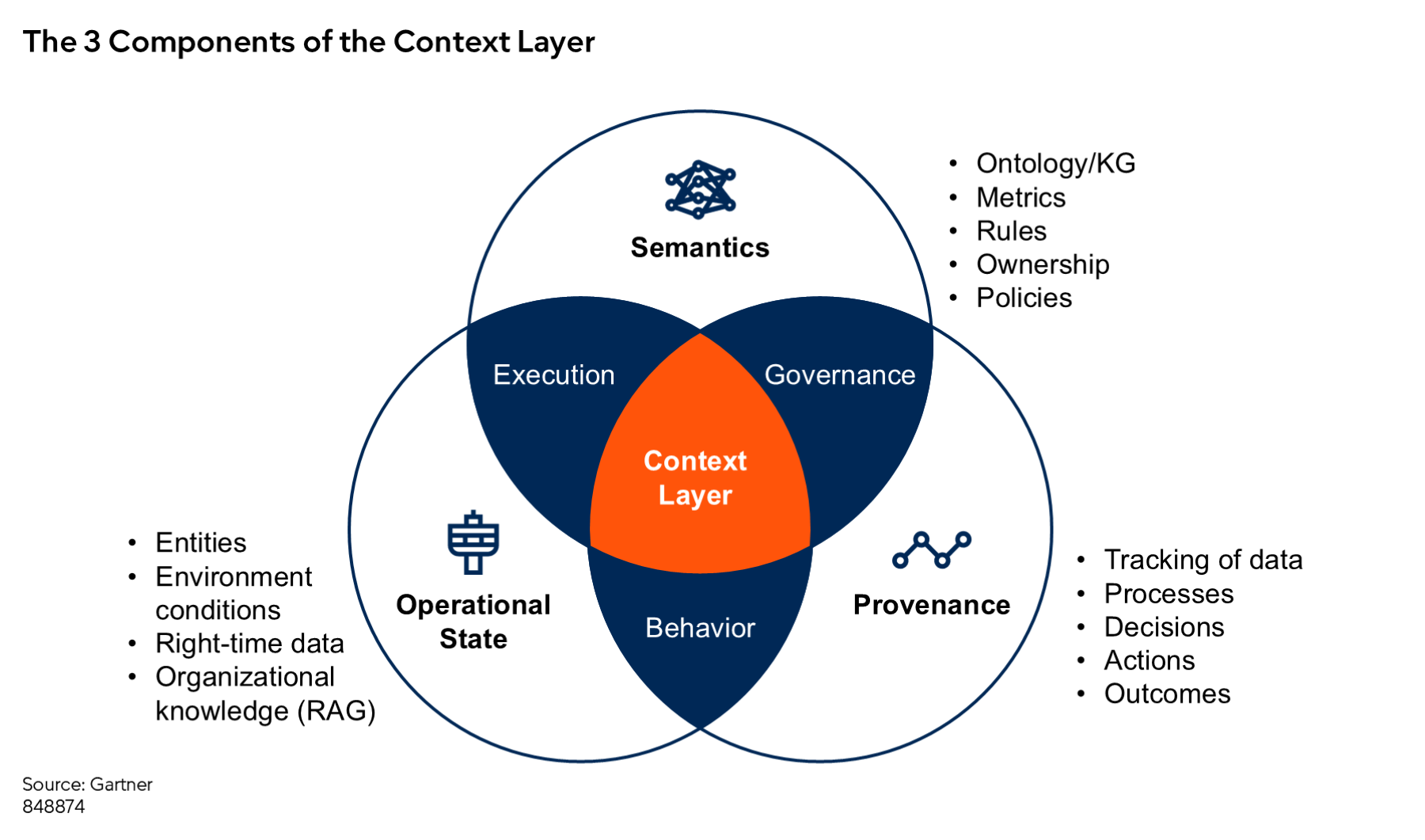
As illustrated in Figure 1, building a context layer requires thoughtful integration of semantic models, operational state sources, and provenance mechanisms.
The context layer is a foundational component that enables context engineering. As defined in Innovation Insight: Context Engineering, context engineering is the discipline of designing, managing, and optimizing the information provided to GenAI models to improve output accuracy, elevate relevance, ensure reliability, and optimize cost, ultimately enhancing overall performance. This is achieved by building comprehensive systems that dynamically supply AI models with the knowledge and operational constraints necessary for multistep task execution.
Effective context engineering requires a spectrum of information inputs as shown in Figure 2: short-term memory, governing policies, instructions and tools, curated examples, relevant and right-time data, and long-term memory. However, the increasing volume, fragmentation, and multimodality of relevant data and long-term memory are creating significant bottlenecks.
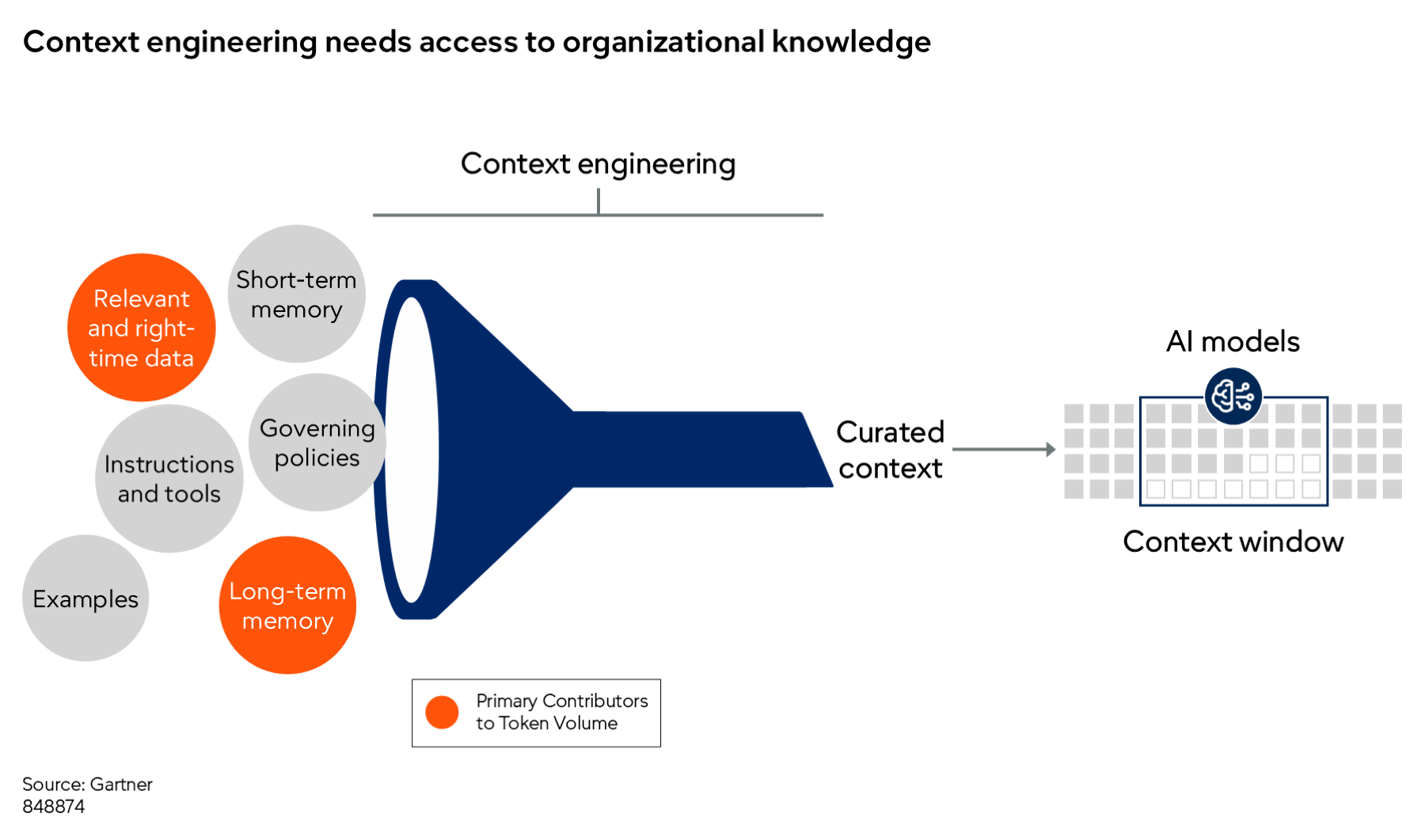
The core challenge is efficiently locating and retrieving the most relevant information, as well as filtering, summarizing, and updating context so that the layer remains current and actionable for each step in a multistep agentic process. The context layer provides the capabilities needed to minimize noise and prevent information overload in the context funnel.
While a context layer is designed to support any AI agent, its practical benefits are currently realized primarily by self-built or highly customizable agents. Off-the-shelf vendor agents are not architected to leverage an external context layer unless they allow for integration or behavioral customization. However, as the ecosystem evolves and vendors begin to recognize the value of context engineering, broader support and compatibility may emerge.
When building a context layer, organizations should avoid attempting to construct a comprehensive solution all at once. Instead, it is advisable to begin with high-value use cases, iterating and expanding the context layer based on real business needs and proven outcomes. The following sections dive deeper into each of the three components of the context layer.
Semantics
Semantics, in the context of agentic AI, refers to the explicit representation of meaning and relationships within business data. It includes the development and use of ontologies and knowledge graphs, which act as the connective tissue linking data, metrics, rules, security, ownership, and policies. This ensures that AI agents interpret and organize knowledge based on meaning and context, rather than relying solely on raw data or isolated attributes.
Follow these recommendations to effectively implement semantics:
- Avoid the pitfalls of large, monolithic projects by federating semantic modeling efforts across domains and business units. This approach enables incremental progress and broader organizational buy-in.
- Establish consistent metadata and terminology across data products to reduce ambiguity and enhance the contextual relevance of AI-driven decisions. Organize knowledge based on meaning, rather than just keywords or raw data.
- Ensure the organization’s business glossary is integrated within the ontology and knowledge graph for seamless semantic alignment and access.
- Create and maintain a unified set of business metrics, explicitly identifying definitions and mapping relationships between business processes and value streams. This clarity enables AI agents to understand how value is created, measured, and captured across the organization.
- Represent business rules, policies, and compliance requirements in machine-readable formats. This enables AI agents to consistently interpret and apply them, supporting automation, governance, and auditability.
Operational State
While semantics provide meaning and context, AI agents also require situational awareness to make informed decisions and take effective actions. Operational state refers to an agent’s ability to access right-time information about key business entities such as customers, products, or suppliers, as well as the current status of business processes and environmental conditions. This situational awareness is enabled by integrating both structured data (e.g., data products, data lakes, data APIs) and unstructured data, accessed through retrieval-augmented generation (RAG) or GraphRAG approaches, which capture the breadth of organizational knowledge.
Follow these recommendations to give agents seamless access to the organization’s operational state:
- Enhance AI agents’ situational awareness by connecting them to right-time data sources, such as event-driven analytics platforms. This ensures agents operate with the most contextually relevant and timely information for decision making.
- Utilize protocols such as the model context protocol (MCP) to provide AI agents with seamless and secure access to relevant data required for their tasks, reducing friction and latency in decision making.
- Ensure that underlying data models are designed for AI-readiness, supporting efficient data integration and retrieval.
- Extend operational awareness by incorporating unstructured data and organizational knowledge through retrieval-augmented generation and GraphRAG, enabling agents to access a broader and richer context.
Provenance
Provenance refers to the ability to systematically track data lineage, decisions, actions, outcomes, and feedback throughout the life cycle of AI agent operations. Robust provenance mechanisms allow AI agents to reference historical decisions and their results, supporting continuous improvement, adaptation, and auditability. This transparency not only enhances trust and accountability, but also empowers agents to learn from past actions and refine future decision making.
To establish effective provenance capabilities:
- Implement comprehensive tools to capture, audit, and analyze AI agent decisions and outcomes. This ensures traceability and supports regulatory compliance.
- Set up formal processes to regularly collect and review feedback on AI agent decisions and outcomes. Use these insights to update and improve the data, rules, and knowledge provided to agents, ensuring their performance continuously adapts to changing business needs and remains aligned with organizational objectives.
High-Level Conceptual Framework
With a robust context layer in place, AI agents can efficiently access the information needed to achieve their goals. While the operational state provides right-time business data, it can introduce noise if not properly filtered. Leveraging semantics enables agents to retrieve only the most relevant information, minimizing unnecessary data and streamlining the context engineering pipeline. Provenance adds traceability, ensuring data reliability.
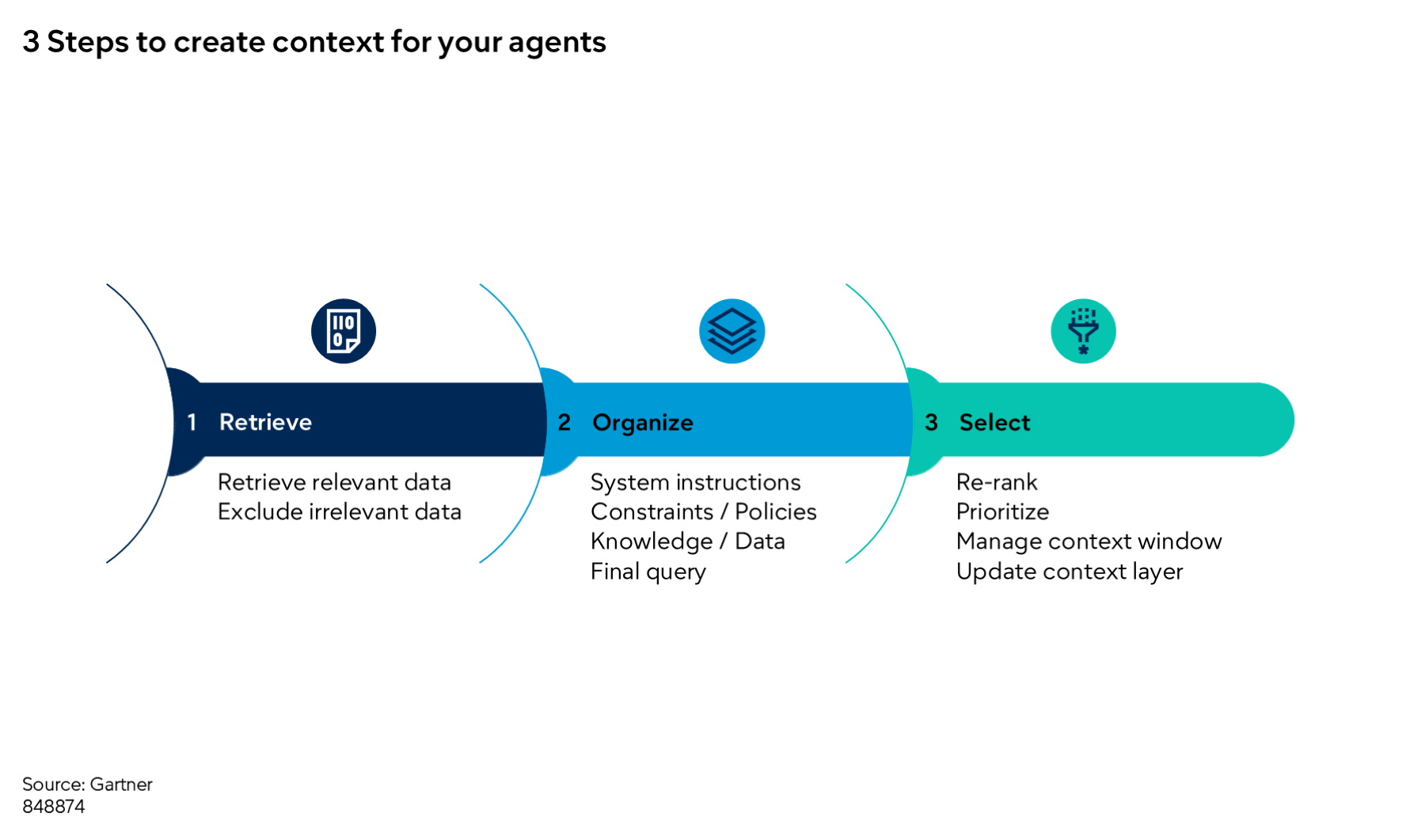
Semantics, operational state, and provenance form the architectural foundation of the context layer, powering a three-step context engineering pipeline as shown in Figure 3: retrieve, organize, and select:
- Retrieve only the information directly relevant to the current action or decision, guided by the context layer.
- Organize the retrieved data to build a coherent context.
- Select and prioritize only the most pertinent information in the agent’s context window, and update the context layer with new outputs or insights as needed to support ongoing, multistep processes.
Success Measures
Context Layer ROI
- The ROI of the context layer is the captured value after its establishment, divided by the total expense of creating and sustaining it (see How to Calculate the Value and Cost of AI Agents as a reference).
- LLM cost savings thanks to context size optimization.
AI Agent Reliability Metrics
- % of actions resulting in positive business outcomes (e.g., successful recommendations, accurate responses).
- % of actions compliant with rules and policies (measured via audit logs or automated validation).
Retrieval KPIs
- Precision: % of retrieved knowledge objects that are relevant.
- Recall: % of all relevant knowledge objects that are retrieved.
1 2026 Gartner CIO and Technology Executive Survey. This survey was conducted online from 1 May to 30 June 2025 to help CIOs and technology executives benchmark their priorities and investment plans against those of peers worldwide. Qualified respondents led a digital/technology function and were accountable for running or improving/growing a specific area of their enterprise. In total, 2,501 CIOs and technology executives participated, with representation from all geographies, revenue bands and industry sectors (public and private).
2 2025 Gartner Modern Data Value Realization Survey. This study explores how organizations realize value from AI investments, including ROI, key accelerators and inhibitors, spending patterns, and the areas where data and analytics (D&A) deliver impact on AI value creation. The research was conducted online from November through December 2025 among 353 respondents from North America (n = 140), EMEA (n = 89), Asia/Pacific (n = 89), and Latin America (n = 35). Quotas were established for company sizes and for industries to ensure a good representation across the sample. Organizations were required to have deployed at least one AI use case in production. Respondents were screened to include the highest-level D&A or AI leaders, their direct reports and selected corporate executives. All respondents were required to be responsible for organizationwide AI investment activities — such as managing AI investments, selecting and prioritizing AI use cases, and measuring AI value or ROI. Disclaimer: The results of this study do not represent global findings or the market as a whole, but reflect the sentiment of the respondents and companies surveyed.
3 2025 Gartner Generative and Agentic AI in Enterprise Applications Survey. This study was conducted to understand the key challenges and opportunities when deploying generative AI (GenAI) tools, and where organizations should focus their AI investments. This research also aims to understand what stage organizations are at on their AI agent journey and their thoughts on AI agents. The research was conducted online from May through June 2025 among 360 respondents from organizations with at least 250 full-time employees across all industries (except IT software) in North America (n = 149), Europe (n = 140) and Asia/Pacific (n = 71). Soft quotas were established for country, company size, and respondent’s function type and job level to ensure a good representation across the sample. Organizations were required to have deployed or plan to deploy in less than one year at least one generative AI tool in at least one core enterprise application domain: digital workplace applications, customer relationship management applications, or enterprise resource planning applications. Respondents were team leaders or above, excluding C level, and involved in the rollout of generative AI tools; they were required to have certain responsibilities regarding these generative AI tools. Disclaimer: The results of this survey do not represent global findings or the market as a whole, but reflect the sentiments of the respondents and companies surveyed.
4 2025 Gartner State of AI-Ready Data Survey. This study was conducted to understand how data management organizations evolve for AI and to glean insight into how organizations are developing capabilities, skills, techniques, tools, and technologies to support AI-ready data. The research was conducted online from June through August 2025 among 250 respondents from North America (n = 100), EMEA (n = 70), Asia/Pacific (n = 50), and LATAM (n = 30). Quotas were established for company sizes and for industries to ensure a good representation across the sample. Respondents were screened for involvement and knowledge of data and analytics, data science, and AI strategy and initiative. Disclaimer: The results of this study do not represent global findings or the market as a whole, but reflect the sentiment of the respondents and companies surveyed.
5 Gartner Chief Data and Analytics Officer Agenda Survey for 2026. This survey was conducted to determine the priorities and strategic challenges of the chief data and analytics officer (CDAO) role or the office of the CDAO for 2026. It also sought to inform agenda planning or potential research topics for the data and analytics practice, and track the progress of the CDAO role in organizations. The research was conducted online from September through November 2025 among 502 respondents from across the world. All respondents in the survey are data, analytics or AI leaders. The survey sample was gleaned from a variety of sources, including a Gartner-curated list of CDOs and other high-level data and analytics leaders. Disclaimer: The results of this survey do not represent global findings or the market as a whole, but reflect the sentiments of the respondents and companies surveyed.
6 2025 Gartner Evolution of D&A Governance for AI Survey. This survey was conducted online from 22 July through 4 August to understand how D&A governance has evolved in its mandate and scope in the age of AI. In total, 68 respondents participated, all of which were Research Circle members, a Gartner-managed panel. Respondents were qualified based on their involvement and participation in decision making for data and analytics governance at their organizations in North America (n = 39), EMEA (n = 15), Asia/Pacific (n = 5) and Latin America (n = 9) regions.
Disclaimer: The results of this survey do not represent global findings or the market as a whole, but reflect the sentiments of the respondents and companies surveyed.
Disclaimer: The results of this survey do not represent global findings or the market as a whole, but reflect the sentiments of the respondents and companies surveyed.
Client interaction data from inquiries with Gartner’s customers.