Comprehensive Guide to Identity and Access Management
31 March 2026 - ID G00845644 - 9 min read
By Michael Kelley, Nathan Harris
Identity and access management is both a business enabler and a cybersecurity imperative serving multiple constituencies: workforce, customers, partners and machines. Cybersecurity leaders can create an appropriate strategy for successful IAM practice by navigating this research to build knowledge across multiple technology domains.
Analysis
Identity and access management (IAM) is crucial for securing a world where traditional corporate network boundaries have vanished. It serves as both a security foundation and a business enabler in this interconnected environment. IAM focuses on identity as the ultimate control surface, integrating context, continuity and consistency to fully identify and understand the entitlements of users and devices.
In a zero-trust world, IAM ensures secure access by establishing explicit trust. The rise of generative and classic AI presents new opportunities and challenges, driving the evolution of IAM. Traditional IAM models, originally designed for perimeter-centric networks, struggle to manage identities across diverse applications in hybrid and multicloud environments. These outdated models necessitate a shift to a flexible, integrated identity fabric that is secure, interoperable and distributed.
Toward that goal, identity-first security places identity-based controls at the core of cybersecurity architecture, moving away from obsolete perimeter-based controls. This approach provides enhanced visibility and control. In addition, it elevates IAM to a business-first mechanism, enabling digital business at scale. Finally, this shift also requires new strategies for protecting the IAM infrastructure, which has become the latest battleground for bad actors.
Identity and access management research is a complicated area of Gartner research, with a management capability layered over multiple distinct and separate technologies (see Figure 1). In addition to this, the constituents served by IAM initiatives are very diverse, both in terms of their desires and their requirements for success.
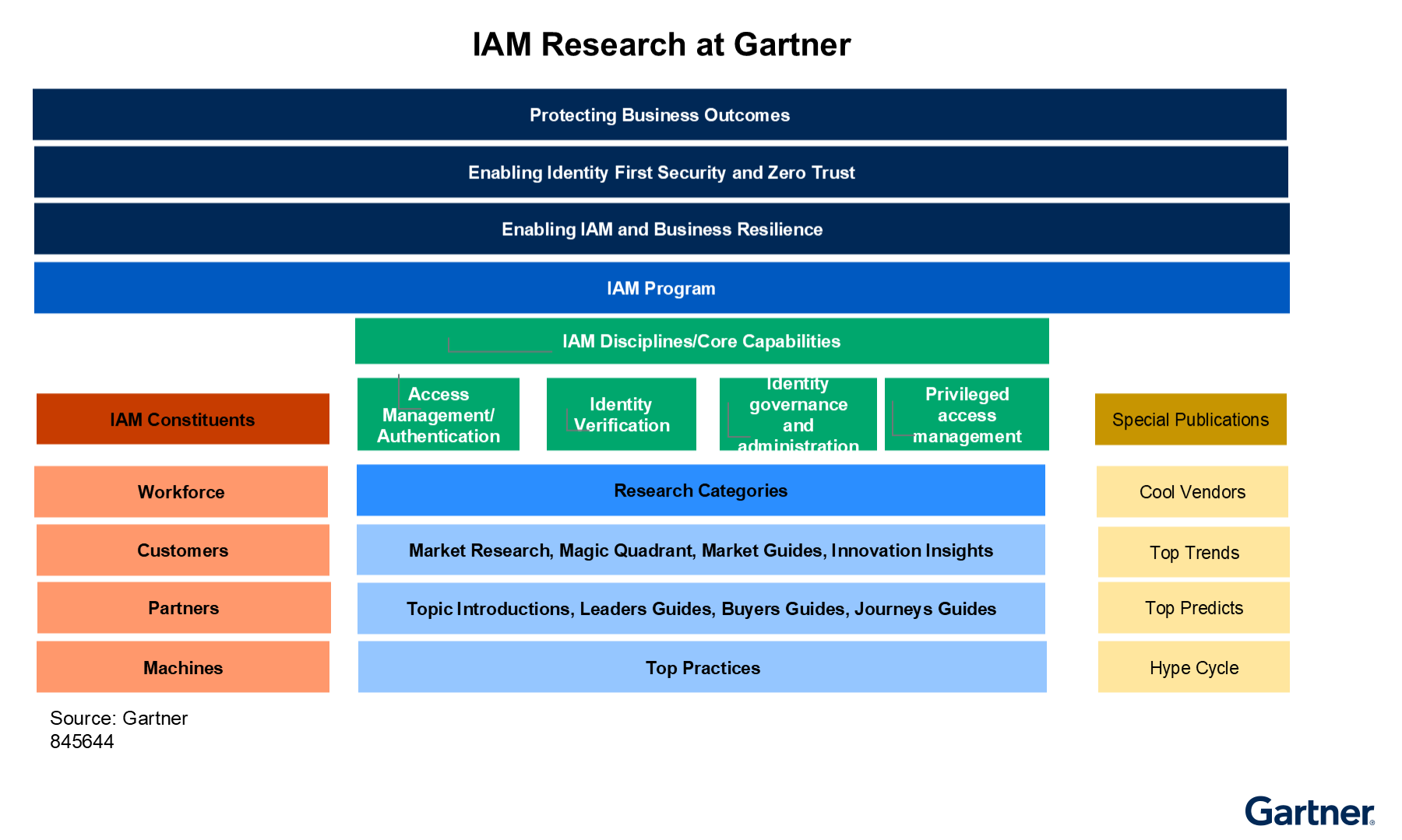
Start with these notes:
Gartner’s IAM initiative helps organizations align business needs with established and emerging IAM practices by:
- Evolving your IAM infrastructure into a more cohesive and composable identity fabric, combining IAM tools, data and other security technologies to enhance user experience (UX) and deliver better value.
- Emphasizing the fundamentals of identity-first security — continuity, context and consistency — to secure interactions between humans and machines through continuous adaptive trust (CAT).
- Providing guidance on IAM hygiene and identity threat detection and response (ITDR) to enhance resilience.
- Highlighting ways to maximize or extend the value of existing IAM technologies and investments in support of digital business using visibility and observability via identity visibility and intelligence platforms (IVIP).
- Focusing on identity verification to prevent account opening (AO) and account takeover (ATO) attacks by both human actors and malicious bots.
IAM Domains
Much like a four-legged stool, four discrete technology domains support the management capability (the people, processes and procedures) in order to deliver a capable IAM product.
Delivering IAM
An IAM program is crucial to forming a cohesive identity fabric and delivering required services effectively. Only a comprehensive, well-planned and well-governed IAM program can lay the foundation for cybersecurity and enable a business to achieve its strategic objectives, including resilient identity infrastructure, services, teams and processes. Organizations must define an IAM strategy promoting desired security, risk management and business outcomes, while planning technology and resource budgets.
Cybersecurity leaders responsible for IAM need to establish and run an effective long-term program for implementing IAM practices, processes and technologies that align with security and business objectives.
Gartner research supporting the development and implementation of an IAM program:
Start Here to Understand IAM and the Maturity of Your IAM Program
Best Practices for IAM Program Management
Toolkits for Planning and Building Strategies
Identity Verification and Digital Identity
Identity verification (IDV) is the combination of activities during a digital interaction that brings a real-world identity claim within organizational risk tolerances. IDV capabilities, delivered as SaaS or software, provide assurance that a real-world identity exists, that the individual claiming it is the true owner, and that the owner is genuinely present during the digital interaction. IDV’s purpose is to establish such confidence when curated credentials do not exist, are not available or do not provide sufficient assurance.
Decentralized identity (DCI) democratizes digital identity by decentralizing both the storage and the use of identity data. The primary benefits of DCI are privacy, anonymity and user autonomy. DCI tools include a trust fabric, typically a distributed ledger like a blockchain; a digital wallet, which is tied to an entity (user); verifiable credentials (VCs), which represent identity attributes used to prove identity claims; and decentralized identifiers (DIDs), which establish pseudonymous relationships for issuing and verifying claims. DCI systems are delivered via software and SaaS capabilities. Users are primarily humans, but machines and even business entities can be users of DCI.
Cybersecurity leaders who are responsible for IAM should implement identity verification processes in digital channels to validate user identities within workforce or customer contexts.
Gartner research supporting the acquisition and implementation of identity verification technology:
Research for Choosing and Acquiring IDV Technology
Best Practices for Identity Verification
Gartner Research on Digital and Decentralized identity
Identity Governance and Administration
Identity governance and administration (IGA) tools manage the identity life cycle and govern access across on-premises and cloud environments. They aggregate and correlate disparate identity and access rights data, and then layer controls over accounts and associated access. IGA enables organizations to effectively manage identities, accounts and associated entitlements across infrastructure and applications, regardless of hosting strategy, while meeting requirements for compliance, security risk management, and business process and IT service delivery enablement.
Cybersecurity leaders responsible for IAM should build processes and procedures and acquire technology to help them administer and provision accounts and entitlements, govern identity life cycles for entities such as people and machines, and use analytics to help automate and reduce manual processes.
Gartner research supporting the acquisition and implementation of IGA:
Getting Started With IGA
Research for Evaluating and Selecting IGA Technology
Best Practices for IGA
Access Management and Authentication
Access management (AM) tools include authentication and single sign-on (SSO) capabilities. They establish, manage and enforce runtime access controls for applications and APIs. These tools support access by human and machine identities across workforce, customer and partner constituencies. User authentication, by contrast, is the journey-time process that validates an identity’s right to access a digital asset. It executes through a combination of an authenticator, signal evaluation and an authentication decision point, which may be from different vendors.
Cybersecurity leaders who are responsible for IAM should work to establish capabilities that verify that humans and machines are who or what they claim to be, and ensure that they are entitled to securely access applications, data, or other resources in line with zero-trust principles (via authorization and adaptive access).
Gartner research for access management:
Getting Started With Access Management
Research for Evaluating and Selecting Access Management Technology
Best Practices for Access Management
Gartner research for user authentication:
Getting Started With User Authentication
Research for Evaluating and Selecting User Authentication Technology
Best Practices for User Authentication
Privileged Access Management and Machine IAM
Privileged access management (PAM) tools enable and protect elevated levels of technical access by managing and protecting accounts, credentials and commands that are used to administer or configure systems and applications. Available as software, SaaS or hardware appliances, these tools manage privileged access for both people (system administrators and others) and machines (systems or applications).
Gartner defines five PAM tool categories: privileged account and session management (PASM), privilege elevation and delegation management (PEDM), secrets management, remote PAM (RPAM) and cloud infrastructure entitlement management (CIEM).
Machine IAM is also covered in this domain primarily because the vast majority of machine access is privileged.
Cybersecurity leaders responsible for IAM should enable secure privileged (that is, administrative) access by humans and machines by discovering, managing, brokering and logging permissions, credentials and usage.
Gartner research supporting the acquisition and management of PAM:
Getting Started With PAM
Research for Evaluating and Selecting PAM Technology
Best Practices for Privileged Access Management
Gartner Research Supporting Identity and Access Management for Machines (Devices, Workloads, Applications, AI Agents)
Gartner Special Publications for IAM
Research Highlights
Some recommended content may not be available as part of your current Gartner subscription.