Magic Quadrant for Communications Platform as a Service
18 May 2026 - ID G00839923 - 48 min read
By Lisa Unden-Farboud, Pankil Sheth, and 1 more
CPaaS providers offer cloud-based platforms for enterprises, developers and other business roles to build communication workflows that digitally operationalize customer engagement and experiences via APIs, SDKs, visual builders and AI. CIOs can use this Magic Quadrant to evaluate providers.
Strategic Planning Assumptions
By 2029, 95% of global enterprises, including multinational corporations (MNCs), will leverage communications platform as a service (CPaaS) to operationalize customer experience (CX) and engagement, up from 60% in 2025.
By 2029, 85% of global enterprises, including MNCs, will require enhanced security based on AI in their CPaaS toolsets, focusing on preemptive cybersecurity to mitigate threats arising from use of AI, up from 40% in 2025.
By 2029, 90% of enterprise software applications will include agentic AI, up from less than 25% in 2026.
By 2029, standardized agent communication protocols will enable over 80% of multiagent systems (MAS) to incorporate agents from multiple vendors, fostering greater innovation and flexibility.
Market Definition/Description
Gartner defines communications platform as a service (CPaaS) as a cloud-based platform that enables businesses to embed a range of communications capabilities into applications over channels such as voice, SMS, email, messaging apps, and video. They also provide conversational capabilities, security, authentication, and automation. CPaaS delivers omnichannel, programmable experiences to enhance digital customer engagement. In 2026 and beyond, CPaaS aims to offer deeper capabilities, such as customer journey analytics, automation, personalization, and omnichannel engagement driven by AI and 5G.
The purpose of CPaaS is to enable enterprises to enhance their communication workflows by providing simplified access to multiple communication capabilities without requiring the complex architectures typically needed to leverage these channels.
CPaaS enables enterprises to shorten the time to market for new products and services, personalize communications, and orchestrate customer journeys across multiple channels. It delivers digital engagement and operationalizes customer experience, while also driving business efficiencies at scale with digital service delivery. It is modular/composable in design and can expand from initial single use cases to many others as additional business units learn of its value.
CPaaS enables a multitude of use cases, such as:
- Basic notifications
- Marketing communications
- Conversational customer experience
- Global enterprise support
- Customer support
- Vertical and horizontal use cases, such as campaign management, telemedicine, remote learning, e-commerce, and field services
CPaaS capabilities can also be consumed in a wholesale model, powering third-party cloud vendor offerings, such as contact center, CRM, multichannel marketing, and ERP. There are also wholesale use cases in which CPaaS providers wholesale communications to each other and to telecom service providers.
Mandatory Features
Mandatory features include:
- A standard set of core CPaaS communications APIs for:
- Voice calls (SIP)
- SMS
- Local and global direct inward dialing (DID)
- Identity confirmation, such as two-factor authentication (2FA)/multifactor authentication (MFA), and flash calling
- At least two other rich communications channels, such as Google Rich Communication Services (RCS), Apple Messages for Business, Multimedia Messaging Service (MMS), WhatsApp Business or WeChat
- AI-powered bots with conversational capabilities, at least for voice and/or chat
- The ability to integrate with GenAI models, including foundational models and large language models (LLMs)
- Customer service and support for CPaaS capabilities, including customer onboarding; technical support; and usage; and real-time dashboards, delivery insights, and engagement metrics.
Optional Features
Optional or more-advanced CPaaS capabilities (of which a vendor may not have all) include:
- Messaging channel APIs, such as in-app/in-website messages and push notifications; additional rich communications channels such as Microsoft Teams, LINE, Viber, Telegram, Instagram, Direct Messages on X, Discord, or Snapchat; or email, each of which can be provided with an omnichannel and orchestrated capability that may leverage AI (including generative AI)
- Conversational bots, based on traditional enterprise conversational AI or GenAI, which can be personalized and contextualized using customer data from a client CRM and/or customer data platform (CDP).
- Advanced voice APIs:
- Emergency/E911 communications
- Audioconferencing
- Call queuing
- Interactive voice response (IVR)
- AI workflow automation with smart routing, dynamic IVR and self-service flows
- Music on hold
- Speech to text (STT) and text to speech (TTS)
- Natural language processing (NLP)-based sentiment analysis
- Call recording
- Branded calling
- Click to call
- WebRTC
- Video channel:
- Programmable video APIs, such as video streaming
- In-app video service
- Video know your customer (KYC)
- Real-time transcription and language translation during live video sessions
- Facial recognition
- Advanced security and privacy:
- Voice-facial-finger biometrics
- Call risk scoring
- SIM verification
- Silent mobile verification
- Call/delivery analytics
- Call tracking
- Dynamic route capabilities
- Antiphishing and anti-spam
- Phone number anonymization/number masking
- Automated compliance audits
- API rate limiting and throttling
- AI-driven anomaly detection
- Fraud detection and authentication using voice biometrics
- Programmable wireless, including e-SIMs
- Internet of Things (IoT)-packaged solution APIs
- Device-to-cloud communication APIs
- SMS, WhatsApp notifications for IoT sensor events
- Voice-control APIs for smart devices
- Video streaming APIs for cameras
- Network APIs, including one or more from those defined by CAMARA or GSMA’s Open Gateway Initiative
- Other APIs for payments
- CDPs:
- Aggregate customer data from multiple sources
- Creating customer profiles for personalized engagement
- Audience segmentation based on behavior, demographics, and preferences, preferably AI-driven
- AI-powered messaging personalization, next best action, and recommendations using CDP data
- Customer journey analytics
- Agentic AI capabilities:
- Orchestration of GenAI models
- Intelligent call routing based on the intent and past interactions
- Autonomous customer journey orchestration, such as onboarding, troubleshooting across channels without human intervention
- Voice and visual AI agents that combine voice bots with visual elements like RCS carousels for richer interactions
- Support for third-party add-ons and integration through a vendor and partner marketplace
- Advanced support for visual builders, customer success programs, compliance (vertical/horizontal), and developer activities (such as events, certifications, and blogs)
- Support for horizontal (such as campaign management) or vertical use-case scenarios (such as banking, healthcare, logistics, and retail)
Magic Quadrant
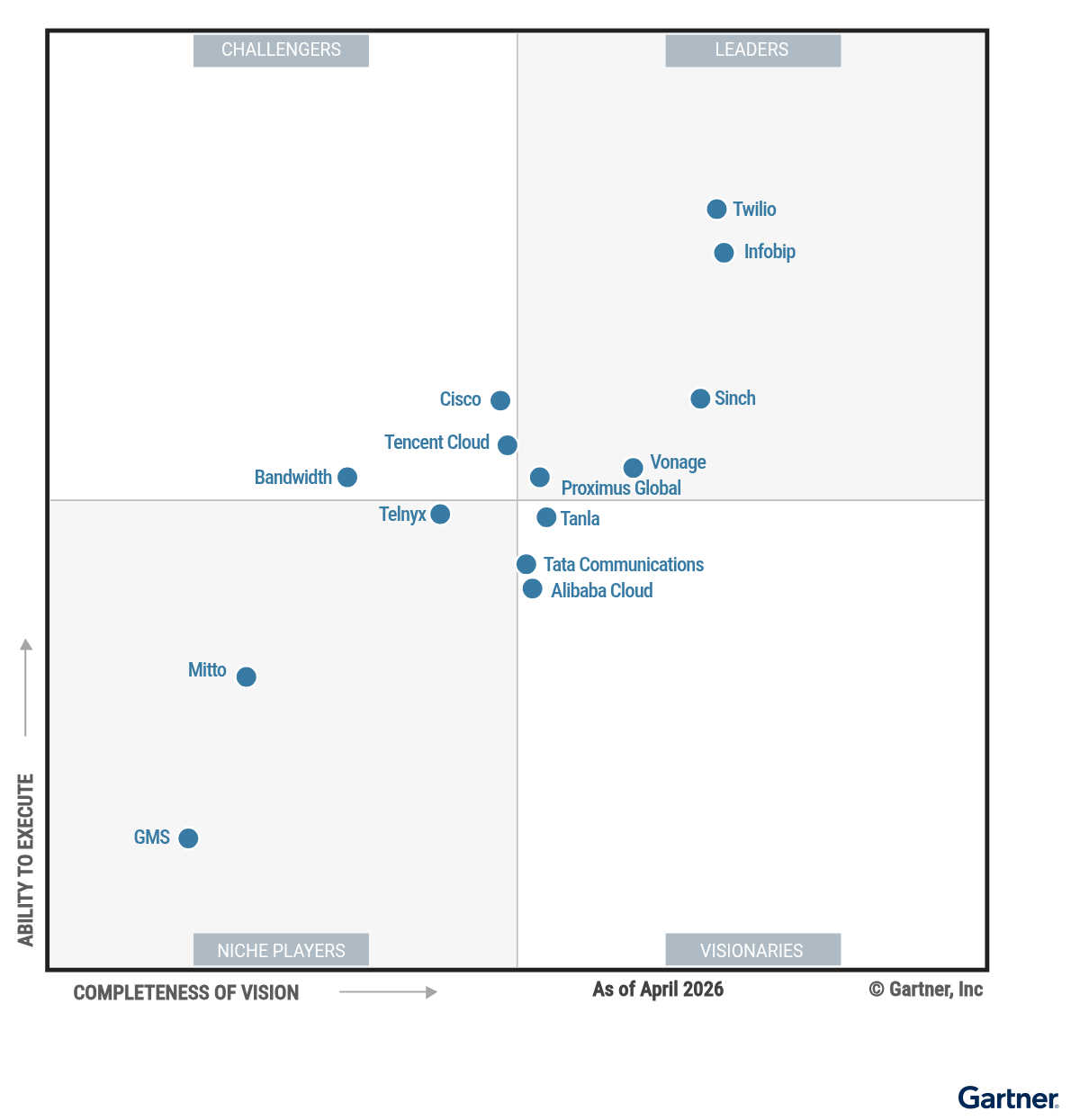
Vendor Strengths and Cautions
Alibaba Cloud
Alibaba Cloud is a publicly held, China-based hyperscaler and Visionary in this Magic Quadrant. It offers e-commerce, digital payments, entertainment, cloud infrastructure, AI models like Qwen series, DingTalk, and CPaaS. The CPaaS business focuses on China and APAC, expanding into LATAM and MEA, and lightly in Europe and North America. Alibaba Cloud provides a secure, AI-enhanced, API-first CPaaS platform for global voice, SMS, and omnichannel engagement for developers and enterprises across all verticals. Its key AI enhancements include AI Assisted Flow, Communications Intelligent Engine, Communication Agent, Intelligent Voice calling, AI-driven messaging, 5G-enhanced calling features and artificially inflated traffic (AIT) proactive monitoring and prevention.
- Alibaba Cloud has a strong brand and deep presence in APAC, where it conducts just over 60% of its business. It has significant coverage, compliance, and local sales and support capabilities in the region.
- Alibaba Cloud has a comprehensive, AI-enhanced API suite for developer and enterprise ecosystems with easy integration via SDK and cloud APIs, along with global scaling infrastructure and country-specific compliant architecture.
- Alibaba Cloud’s set of AI-driven CPaaS capabilities, including advanced capabilities in voice, video, ChatApp, WhatsApp and security, enable large customers to scale their customer communications.
- Although expanding, Alibaba Cloud’s presence in Europe and North America is light.
- A few customers cited difficulty in accessing support and app malfunctions when features don’t always load properly.
- Alibaba doesn’t have its own API marketplace for major CRM, contact center, and ERP systems in comparison to other major CPaaS vendors.
Bandwidth
Bandwidth, a Challenger in this Magic Quadrant, is U.S.-based and publicly held. In 2025, Bandwidth pivoted to become the orchestration layer for AI-driven conversations, prioritizing mission-critical, multimodal voice and messaging with expanded network trust. It advances bring your own AI (BYOAI) orchestration at the edge for regulated industries and global reach. Bandwidth voice enables Amazon, Microsoft (MS), Zoom, Genesys and others via wholesale or bring your own carrier (BYOC), and co-creates with hyperscalers and MNCs across hybrid and cloud environments. Its Maestro platform enables BYOC and BYOAI orchestration across its Universal Platform, with AI Receptionist and Synthi for automation and predictive support. Its vendor-agnostic strategy drives choice, savings and fast deployment. Its key investments include AI enablement, global scope, and partnering for go-to-market strategy in EMEA and LATAM.
- Bandwidth’s Maestro enables no-code orchestration and AI integration that supports enterprise digital transformation and cloud migration with an open, vendor-agnostic architecture and network ownership.
- Bandwidth partners with top unified communications as a service (UCaaS), contact center as a service (CCaaS) and conversational AI (CAI) vendors, providing prebuilt integrations, a trusted vendor track record, and opportunities for cross-selling. It serves large enterprises and regulated industries, while investing in voice AI, messaging (including a messaging registration center), Number Reputation Management, and Rich Communication Services (RCS) for conversational experiences.
- Bandwidth is recognized for its strong focus on network trust, security, and regulatory compliance, offering enterprise-grade capabilities and high-quality support. Customers praise Bandwidth’s high levels of support and professionalism, as well as its easy escalation process and 24/7 support.
- Bandwidth’s offerings remain focused heavily on voice and messaging. Bandwidth lacks advanced customer journey capabilities such as supporting a wide range of over-the-top (OTT) messaging channels (beyond Voice, WhatsApp, and RCS), video, payments, and e-commerce, which limits its suitability for some use cases.
- Bandwidth’s brand awareness is limited outside of the U.S., but it’s expanding in markets like EMEA and LATAM.
- A few customers cite mixed feedback on the ticketing system’s ease of use, and it can take time for the support team to understand the issue and find a solution.
Cisco
Cisco, a U.S.-based public company, is a Challenger in this Magic Quadrant. Its CPaaS product, Webex Connect, integrates with Cisco’s Webex AI Agent and Webex Contact Center to deliver personalized customer journeys, enable smart self-service-to-human handoffs, and support data-driven, omnichannel customer experiences. Cisco mainly serves large enterprises and global enterprises, often co-creating solutions with customers and partners. Ongoing investments include launching Webex AI Agent as an expansion to its Bot Builder, increasing RCS and OTT channel usage through features like branded text, and boosting compliance and observability capabilities that enterprises value. They also include continued deeper integrations with other Cisco and Webex products, leveraging Cisco’s wider security capabilities for agentic workloads.
- Webex Connect’s Flow Builder facilitates ease of use, allowing businesses to manage a range of use cases from proactive, intelligent one-way communications involving consent, channel preference, and presence checks to two-way automated journeys involving custom business logic and seamless integration with back-end systems.
- Cisco provides integrations with a range of CCaaS, CRM customer engagement center (CEC), ERP, and marketing solutions, allowing the rapid creation of customer journeys that require orchestrating workflows across these solutions.
- Cisco provides a 99.999% platform availability SLA as a standard offering and a 100% availability option for premium support tiers, a perk that its peers typically don’t offer.
- While Cisco offers a video API in Webex Connect, its breadth of features supported lags behind some of its peers. For instance, it doesn’t support delayed/recorded video broadcast, live translation, or interactive whiteboard.
- Webex Connect has recently expanded capabilities in Australia and Singapore, but adoption still skews toward North America, Europe, and India. Customers in other geographies should evaluate Cisco based on their ability to provide localized sales and support.
- Feedback from Gartner Peer Insights data indicates that some users report issues with slow customer support responses.
GMS
GMS, a privately held company based in Switzerland, is a Niche Player in this Magic Quadrant. GMS provides a CPaaS platform that integrates messaging, voice, security, AI, and network APIs. GMS serves clients like enterprises and mobile network operators (MNOs) across the globe and maintains direct connections with over 275 MNOs. Last year, GMS delivered a unified single sign-on (SSO) experience across its platform, enhanced core messaging channels through support for new Viber message types, launched an AI-based content builder, and launched a customer data platform (CDP). In 2026, GMS plans to onboard new over-the-top (OTT) channels, and introduce new WhatsApp capabilities.
- GMS’s global presence and relationships with MNOs give it strong regulatory expertise across Eastern Europe, South APAC, and Central APAC.
- GMS has strong expertise in the Viber channel. It offers Viber business calls, carousel messages, lists, and Viber Gems, which are interactive festive animations that trigger user chats. This is valuable for enterprise customers in regions with a high number of Viber users, such as Eastern Europe and Southeast Asia, as it enables richer customer engagement with users over the channel.
- GMS is responsive to customer and partner needs, incorporating their feedback into its product, pricing, and packaging. For instance, it incorporated customer enhancement requests into its UX redesign and its SSO portal to align with user requirements.
- GMS’s voice offering provides a smaller set of features than peers. For example, it currently lacks support for features like E911, WebRTC calling, and phone number anonymization.
- GMS currently doesn’t offer video APIs. Customers looking to embed video experiences into their customer journeys, like those in education or retail verticals, should address this gap by working with additional vendors.
- Currently, GMS offers a limited set of compliance and certifications. Customers in regulated industries, or those handling sensitive information, should ensure that GMS can adhere to their compliance requirements.
Infobip
Infobip is a Leader in this Magic Quadrant. Privately held and based in London, Infobip’s customers span midsize enterprises to large platform providers. It offers a wide range of CPaaS open-architectured and modular capabilities for use individually or combined with seamless integrations. The platform covers telco infrastructure (network APIs, number risk scoring), communication channels (voice, SMS, RCS, email, OTT) and agentic AI (AgentOS, CAI, CDP). Infobip has a developer portal, supports self-service, and has a marketplace and partner program for CSPs, VARs, SIs, ISVs and digital marketing agencies (DMAs). Infobip’s AI investment continues to place agentic AI at the core of interactions and orchestration, API tools, advanced security enhancements, and Model Context Protocol servers that allow AI agents and platforms to connect directly.
- Infobip’s adoption of MCP servers and involvement in MCP standards has given it an early advantage in AI agent development. Its AgentOS and MCP servers let enterprises easily set up conversational capabilities via multiple channels while preserving modularity and context.
- Infobip has more than 800 global carrier connections. Its ecosystem includes a wide range of partners, from SIs and VARs to tech partners. Its global footprint spans Europe, MEA, APAC, North America, and LATAM, enabling enterprises to scale with local delivery, sales, and support.
- According to Gartner Peer Insights reviews, customers find Infobip’s interface easy to use and indicate that the support team is timely, always available, and provides a good escalation structure right up to board level. Customers also cite that its APIs are easily adaptable and configurable, and provide elaborate and transparent responses.
- Local capabilities in a few emerging APAC and LATAM countries (such as Vietnam and Argentina) lack maturity. For example, within Argentina, platform interfaces are not yet adjusted to local language, and customers occasionally experience voice outages. Message delivery in these areas is also slow and poor at times.
- Some Infobip clients report that new customer training, guidance, and resources could improve, notably on how to maximize the solution’s potential.
- According to Gartner Peer Insights, Infobip occasionally takes longer than expected to negotiate master service agreements (MSAs), especially in complex and evolving environments.
Mitto
Mitto, a Niche Player in this Magic Quadrant, is a Swiss-based private company delivering omnichannel communications with AI-powered messaging for seamless integration via SMS, WhatsApp, Viber, RCS, voice, chat, email, and video (via partners). It offers 2FA, 10DLC, mobile intelligence, advanced AI-based global routing, and AIT detection. Mitto Conversations features a centralized no-code interface for two-way messaging across its channels in a single dashboard. The platform supports deep CRM, Martech, and ERP integrations for channels like SMS, RCS, WhatsApp and Viber, and scales across Europe, U.S., APAC, MEA, and LATAM. Mitto continues to invest in advanced AI-powered smart routing, omnichannel campaign enhancements and partner expansion.
- Mitto supports customers by ensuring regional regulatory compliance through direct connections with over 800 carriers worldwide. This allows businesses to send traffic locally and meet market requirements. Customers value Mitto’s reliable message delivery and regional performance.
- Mitto’s proactively monitored, AI-enabled intelligent routing offers dynamic and automated optimizations for critical, real-time communications use cases.
- According to Gartner’s Peer Insights reviews, customers praise Mitto’s ability to send SMS and Viber messages, as well as its clear API documentation.
- According to Gartner inquiry analytics, Mitto’s brand awareness remains limited among large enterprises seeking CPaaS capabilities, which could impact overall growth.
- Mitto lacks the wider AI integrations that some of its larger peers have. It’s also limited in terms of CCaaS and digital customer services (DCS) integrations compared to peers evaluated in this Magic Quadrant, and doesn’t have a CDP.
- Based on some customer feedback, Mitto’s dashboard design lacks deep analysis and filter options, and the user interface needs more organization.
Proximus Global
Proximus Global is a Leader in this Magic Quadrant. Based in Belgium, Proximus Global emerged as a strong global CPaaS player with strong acquisition growth over the past 24 months. Proximus Global provides a platform for omnichannel engagement using SMS, voice, email, WhatsApp, and RCS along with an orchestrated AI layer on top of it. It also offers global connectivity, network APIs, security, and compliance to meet the needs of multinational organizations. Its scalable infrastructure, telco-grade backbone with application layer orchestration delivery, and support appeal to businesses modernizing communication. It continues to focus its investments on programmable network APIs, security and AI-based use cases.
- Proximus Global provides a broad range of communication channels, including direct RCS connectivity and orchestrated fallback, with multiroute capabilities in key markets, coverage in 31 countries and partnerships with 85 operators worldwide.
- Proximus Global’s reliable, secure, and high-performance global network backbone ensures seamless communication for multinational customers. This direct control over network quality, reduced latency, and enhanced support benefits enterprises with complex, multilocation connectivity requirements.
- Proximus Global continues to expand its presence in APAC, the Middle East, LATAM and North America, which may be advantageous for multinational clients seeking regional coverage and support.
- Proximus Global’s platform currently lacks autonomous agentic AI capabilities and integration with MCP servers, which may impact enterprise clients seeking to invest in agentic use cases.
- Retention and lead conversion remain areas of concern, with some clients reporting challenges related to account management.
- Support for third-party AI platforms is limited, with the exception of Amazon Bedrock. Clients seeking flexibility in integrating external AI models or third-party DCS and CCaaS platforms may encounter difficulties, as marketplace and integration capabilities are still developing.
Sinch
Sinch, a publicly held company headquartered in Sweden, is a Leader in this Magic Quadrant. It provides unified products built on enterprise-grade infrastructure and has operations across NA, EMEA, LATAM, and APAC (including India). Sinch offers a full set of CPaaS features across messaging, voice, email, and verification, along with an AI-powered smart conversational capability and Agent Builder for a unified experience. Sinch also has APIs for voice, conversations (13 channels), verification, email, numbers for SMS, MMS, voice and RCS globally for two-way conversations, campaigns and support. Sinch serves enterprises of all sizes, including some of the world’s largest companies, offering no-code multichannel messaging and contact center offerings that integrate deeply with CCaaS, CRM, ERP and AI natives. Sinch is investing in enterprise trust and compliance (regional consent controls and personally identifiable information [PII] safeguards), rich messaging at scale across RCS and WhatsApp, low-latency enterprise-grade voice AI infrastructure, cross-channel intelligence from platform interactions, conversational orchestration, AIT and fraud controls, agentic workflows and AI discoverability, partnerships, geographic expansion, and deeper vertical focus.
- Sinch has a prominent partner ecosystem, with more than 1,000 active partners and over 500 integrations spanning enterprise systems of record (Salesforce, Microsoft, SAP, and Adobe), AI-native platforms, and carrier ecosystems.
- Sinch has a prominent focus on advanced security using AI- and machine learning (ML)-driven fraud controls. AI advanced security capabilities are also discoverable via MCP, enabling autonomous identity verification and fraud checks in agent workflows. Customers cite Sinch’s adherence to security standards as a positive.
- Sinch’s 600+ direct carrier connectivity provides a wide geographic footprint for enterprise-grade capabilities with regional and vertical-specific sales and support, notably in financial services, retail, healthcare, tech and telecom.
- According to Gartner Peer Insights reviews, some customers cite pricing as a consideration, with feedback varying by product line and contract structure.
- Some customers note a learning curve for nontechnical users within specific API consoles.
- Although Sinch has made progress over the past year consolidating support across its product lines, some customers with multiproduct deployments continue to note variability across service touchpoints.
Tanla
Tanla, a publicly listed company headquartered in India, is a Visionary in this Magic Quadrant. The vendor has a strong presence in the APAC region, particularly in India and Southeast Asia, and is growing in the Middle East and Europe. Tanla offers a range of enterprise communication solutions, including basic and advanced messaging, as well as support for OTT channels like WhatsApp and RCS. Its portfolio also includes digital platforms that leverage emerging technologies like generative AI and blockchain to complement enterprise communications. Tanla demonstrates particular strength in security use cases and compliance, especially for India and other emerging markets. The company’s investments continue to focus on intelligent routing, threat detection, and enhanced data security and privacy capabilities.
- Tanla enhances its service reliability and market reach by partnering with leading technology providers like Google and Meta (especially for RCS and WhatsApp channels) and collaborating with global telecom operators. Customers benefit from access to a robust ecosystem and greater support for international expansion.
- Tanla offers a comprehensive CPaaS suite, including messaging, voice, digital marketing, and AI engagement tools, making it ideal for organizations seeking omnichannel communications. Its portfolio is strengthened by advanced security features and AI capabilities that provide enhanced protection and intelligence for enterprises.
- Tanla differentiates itself by maintaining a strong focus on security and privacy, particularly through its Trubloq and Wisely Ai platforms. These offerings reinforce Tanla’s position in the market as a provider with robust solutions for compliance, threat detection, and data protection.
- Tanla’s vertical strategy remains a challenge for solution-led procurement, particularly in sectors like payments, telehealth, and remote learning where the vendor doesn’t currently offer tailored solutions.
- Tanla lacks a video offering and has limited network API support, which narrows its appeal for comprehensive multimedia solutions. Its restricted integration currently supports Anthropic and OpenAI only as a direct integration with third-party AI platforms and may hinder customers aiming to utilize out-of-the-box integration with platforms like Amazon, Deepseek, Google, IBM and Microsoft.
- Tanla’s recent growth is concentrated in APAC, the Middle East, and parts of Europe. North American and European clients, particularly in healthcare and government, may face issues due to limited support for regional compliance standards like HIPAA, E911, and FedRAMP.
Tata Communications
Tata Communications (Tata), a global, publicly held communications technology provider headquartered in India, is a Visionary in this Magic Quadrant. Tata delivers a broad suite of CPaaS offerings that encompasses basic and advanced messaging, voice, and video, complemented by Kaleyra CCaaS, its independent CCaaS platform. Tata maintains a well-distributed global business presence, and demonstrated strong growth in North America in the past year. The vendor’s recent acquisition of Commotion enhanced Tata’s capabilities in orchestrated AI layers, enabling advanced customer communication and agentic AI use cases. It continues to invest in AI-driven solutions, expanding autonomous customer journey capabilities across channels.
- Tata Communications demonstrates strong vertical focus and offers programmable APIs for advanced use cases like verification, identification, and rich messaging. Enterprises seeking industry-specific, solution-driven approaches may benefit from the vendor’s broad capabilities and tailored offerings.
- With extensive coverage across India, Asia/Pacific, the Middle East and Africa, and notable growth in North America, Tata Communications has established itself as a global provider for multinational enterprises. Its direct carrier relationships and infrastructure spans over 190 countries and supports global scalability and local compliance requirements.
- Tata’s marketplace partnerships with leading CCaaS, CRM, and DCS providers align well for enterprises with complex integration needs. The vendor also offers robust third-party AI platform integration, providing flexibility for large organizations seeking adaptable AI models.
- Despite its global infrastructure and a strong global telco brand, Tata has low brand awareness among Gartner clients seeking CPaaS solutions. This may impact enterprises already using any other services from Tata and its ability to secure enterprise deals.
- Tata’s CCaaS platform, Kaleyra CCaaS, is appropriate for small to midsize organizations; however, it lacks the advanced features and scalability required by large enterprises. Large enterprises may not prefer Tata’s combined CCaaS and CPaaS offering, as they frequently opt to maintain these functionalities as distinct entities.
- Tata’s CPaaS solutions have yet to expand and scale with a strong developer-led community and presence in other IT vendors’ marketplaces.
Telnyx
Telnyx, a Niche Player in this Magic Quadrant, is a U.S.-based, privately held provider of CPaaS services that operates its own global private IP network. Telnyx delivers a broad portfolio of communication services, including basic and advanced messaging, voice, and video, with a primary focus on messaging and voice traffic. The provider’s core business concentrates in North America, with a growing presence in Europe, but its business reach and support capabilities outside these regions remain limited. Telnyx operates owned infrastructure across APAC, and Middle East and North Africa (MENA), including licensed carrier status in 45+ countries and telephony points of presence (PoPs) in Dubai, Singapore and Sydney. Telynx’s ownership of its network infrastructure, Session Initiation Protocol (SIP) stack and edge PoPs enables it to offer enhanced control, reliability, and quality of service, particularly for organizations with demanding voice and messaging requirements.
- Telnyx operates its own private global IP network, and its infrastructure spans 60+ countries. This allows it to support reliable and scalable international communications by enabling lower latency, higher-quality voice and messaging, and enhanced redundancy.
- Telnyx’s self-serve signup and transparent pricing model enables developers and SMBs to easily adopt its services without sales engagement, supporting rapid onboarding and fostering broader market adoption.
- Telnyx demonstrates robust technical and commercial expertise in delivering core messaging and voice capabilities, consistently providing reliable and high-quality foundational communications services.
- Telnyx’s vertical and industry-specific offerings are limited, particularly in areas such as payments and customer data platforms (CDP). Organizations with specialized requirements in these domains should carefully evaluate Telnyx’s capabilities to ensure alignment with their industry needs.
- Telnyx currently lacks an independent comprehensive contact center offering; rather, it offers an API-first programmable approach, which may limit its suitability for organizations seeking an out-of-the-box integrated CCaaS solution. Prospective customers should assess whether Telnyx’s capabilities align with their customer service requirements.
- Telnyx faces challenges serving customers outside of North America and Europe, mainly due to lack of local support teams outside these regions and local currency billing options. Multinational organizations operating in other regions should carefully assess Telnyx’s geographic coverage, support capabilities, and billing flexibility to ensure they meet global business requirements.
Tencent Cloud
Tencent Cloud, a Challenger in this Magic Quadrant, is a publicly traded cloud provider headquartered in China. While its business remains APAC-focused, Tencent Cloud is expanding in the Middle East and North America. The company specializes in robust audio and video CPaaS capabilities tailored for gaming, digital content, media, e-commerce, and meetings. Tencent Cloud also offers a diverse mix of customer communication channels, including basic and advanced voice and messaging, conversation APIs, Internet of Things (IoT), and security APIs. The provider continues to innovate in real-time audio and video solutions for low-latency and AI-native multichannel CPaaS to facilitate hyperpersonalization.
- Tencent Cloud excels in delivering vertical-specific tailored solutions. It demonstrates strong capabilities in achieving regional compliance and industry-specific certifications that support customers’ regulatory and operational requirements across diverse sectors.
- Tencent Cloud demonstrates strong capabilities in partnering with third-party AI engine providers, enabling its customers to leverage a broad ecosystem of advanced AI solutions within its platform.
- Tencent Cloud offers advanced, low-latency, high-definition real-time audio and video capabilities via a robust global infrastructure. AI noise suppression and adaptive network optimization ensure reliable, interactive experiences for gaming, meetings, education, and social media, making it ideal for organizations needing these solutions.
- Tencent Cloud’s geographic presence remains heavily concentrated in the APAC region. Despite recent growth in North America and the Middle East, the provider still lags behind global peers in international market reach. Prospective customers outside APAC should assess Tencent Cloud’s regional capabilities and support before engagement.
- Tencent Cloud continues to face challenges with integration across third-party marketplaces, including leading CCaaS, CRM, and DCS vendors. In addition, enterprises with complex or multivendor environments should thoroughly assess Tencent Cloud’s integration capabilities and roadmap to ensure alignment with their technical and ecosystem needs.
- Network APIs aren’t currently positioned as a stand-alone strategic focus for Tencent Cloud, and it offers only basic capabilities in this area, which may limit options for organizations seeking advanced network programmability and integration. Leading vendors in the industry are increasingly prioritizing network APIs to enable greater flexibility and innovation, making this a potential gap for customers with evolving connectivity needs.
Twilio
Twilio, a U.S.-based, publicly traded company, is a Leader in this Magic Quadrant. Its CPaaS platform focuses on powering customer interactions by combining secure omnichannel communications, artificial intelligence, and unified data. Twilio operates globally and targets enterprises of all sizes across a broad range of verticals, ISVs, and VARs. In 2025, Twilio further strengthened its AI offerings, including enhancements to voice AI, conversation intelligence, observability, and support for BYOAI. These AI-focused infrastructure enhancements position Twilio as a developer-friendly platform for enterprises and ISVs to develop AI-enabled use cases. Twilio also supports zero-copy activation through its CDP to platforms such as Snowflake, Databricks, and AWS Redshift, enabling easy access to data in these data warehouses to drive communications and AI. Twilio also expanded RCS coverage on its platform, and continued its focus on trust, fraud prevention, customer and agent identity, and cross-channel conversations.
- Twilio’s platform unifies data, communications, and AI capabilities. It can help break down data siloes by combining knowledge with behavioral and conversational data from multiple sources to power personalized and contextual engagement.
- Twilio has further simplified the developer experience through initiatives like improving its low-code/no-code builders, enabling integration of third-party AI models, and expanding its offerings’ composability through resources like the Twilio Flex SDK.
- Twilio combines signals derived from its massive scale and global operations across 180+ countries with proprietary AI models to deliver benefits like optimized routes for customer traffic, real-time fraud detection and prevention, and enhanced deliverability of communications.
- Based on Gartner Peer Insights reviews and inquiry feedback, concerns about the high platform costs persist among some customers.
- Despite reversing its decision on sunsetting its video API, Twilio’s video API capabilities still lag behind some of its peers.
- Twilio operates globally and serves customers in all regions, but its physical presence and employees in the Middle East and Africa are limited. Twilio provides 24/7 follow-the-sun and phone support in this region largely through a remote workforce.
Vonage
Vonage, a U.S. subsidiary of Ericsson, is a publicly traded company and Leader in this Magic Quadrant. Vonage’s CPaaS platform offers a single, integrated developer experience for communications APIs and new network APIs across messaging, voice, video, email and security combined with AI development tools. Its compliant solutions target midsize to large enterprises globally. Vonage enhanced its branded calling, BYOAI capabilities, video API, and fraud protection suite. It leveraged its own capabilities, and its relationship with Ericsson and other partners to combine communication and network APIs, AI and data into network-powered solutions. It also expanded its RCS coverage to several countries with brand registration and compliance tools, along with expanded WhatsApp marketing features. Vonage also enhanced its AI capabilities, adding AI integrations like AWS Nova Sonic’s speech-to-speech framework and AI search tools for developers. Vonage is investing in its AI-coding support, its BYOAI connectors and brand experience support while protecting against fraud.
- Vonage moved early to make its APIs “AI-ready” through documentation and tooling like MCP servers. This makes Vonage APIs visible and usable within AI-based software development tools, and helps developers using these tools discover the Vonage platform’s features.
- Vonage’s video API capabilities are among the most extensive and scalable in the industry, making it a strong choice for embedding video-based experiences in applications.
- Based on Gartner Peer Insights reviews, Vonage continues to receive praise for customer support responsiveness and effectiveness.
- Based on Gartner Peer Insights reviews, some customers report Vonage’s pricing as expensive compared to peers.
- Vonage relies heavily on a developer-led go-to-market strategy, and lags behind some of its peers in targeting platforms and ISVs, and in co-creation.
- While Vonage is working to deliver network APIs that work in a consistent fashion across networks, some of them heavily depend on underlying network capabilities of partners. Enterprises looking to use network APIs must ensure that they operate consistently in their target markets.
Vendors Added and Dropped
We review and adjust our inclusion criteria for Magic Quadrants as markets change. As a result of these adjustments, the mix of vendors in any Magic Quadrant may change over time. A vendor's appearance in a Magic Quadrant one year and not the next does not necessarily indicate that we have changed our opinion of that vendor. It may be a reflection of a change in the market and, therefore, changed evaluation criteria, or of a change of focus by that vendor.
Added
- Alibaba Cloud
- GMS
- Telnyx
Dropped
No vendors were dropped in this Magic Quadrant.
Inclusion and Exclusion Criteria
To qualify for inclusion in this Magic Quadrant, providers need to fulfill all of the following requirements:
- Vendor CPaaS revenue of U.S. $375 million or more in 2025 (January through December 2025) with at least U.S. $10 million of revenue billed in at least three of the following five regions:
- North America
- Europe
- Asia/Pacific (including Japan)
- Latin America
- Middle East and Africa
- Or vendor CPaaS revenue of U.S. $200 million to U.S. $374.99 million with overall annual revenue growth of 10% or more January to December 2025 versus January to December 2024, and with revenue of at least U.S. $5 million billed in at least three of the five above-mentioned regions each.
- Vendor revenue figures must be reported in U.S. constant currency.
- Vendor revenue is for CPaaS services designed for developer consumption. This includes communications-related services delivered through APIs, SDKs, integrated development environments (IDEs) and documentation. CPaaS revenue excludes revenue from out-of-the-box SaaS-based solutions, which tend to be for nondeveloper roles and do not enable developer access.
- Revenue for a particular global region is allocated to where the CPaaS contract is signed. This is typically corporate headquarters or the regional business unit of a multinational organization.
- Vendors must have employee personnel (sales, marketing, customer support and R&D), along with proof of operations in the regions in which they claim revenue (e.g., North America, Europe, Asia/Pacific [including Japan], Latin America, and the Middle East and Africa). Proof of operations can include physical buildings cited on the website, local language support, support of local currencies and billing, or website references to customers in that particular market.
- CPaaS vendors must offer the core standard CPaaS capabilities of APIs for:
- SMS (to send and receive SMS messages).
- Voice calls (SIP, to place and receive voice calls).
- Local and global direct inward dialing (DID; to route voice calls via DID).
- Phone number registration for above-mentioned core capabilities.
- Identity confirmation via methods such as 2FA/multifactor authentication (MFA) or flash calling.
- CPaaS vendors must offer at least two other rich communication messaging media. Examples include Google RCS, Apple Messages for Business, MMS, WhatsApp for Business or WeChat, along with email.
- CPaaS vendors must have AI-powered bots with conversational capabilities, at least for voice and/or chat.
- CPaaS vendors must offer integration with GenAI models, including foundational models and large language models (LLMs).
- CPaaS vendors must also provide customer service and support for the above-mentioned core CPaaS capabilities, including customer onboarding, technical support, and usage and real-time dashboards, delivery insights and engagement metrics.
Gartner required a letter of attestation from the business leader responsible for the profit or loss of the provider’s CPaaS offering to certify that the minimum inclusion criteria thresholds were met.
A broader mix of CPaaS services, in addition to the core above-mentioned capabilities, are considered as “optional” capabilities. These include functionality such as:
- APIs for a wider array of messaging channels beyond those mentioned above. This can include messaging channel APIs, such as in-app/in-website messages and push notifications, Microsoft Teams, LINE, Viber, Telegram, Instagram, DM on X, Discord, or Snapchat, along with email, which can be provided with an omnichannel and orchestrated capability that may leverage AI (including generative/agentic AI). Note: Gartner is aware that vendors may not have all rich messaging channels listed here; but, as a core standard, they needed to provide at least two for inclusion.
- Conversational bots, based on traditional enterprise conversational AI or GenAI/agentic AI, which can be personalized and contextualized using customer data from a client CRM and/or CDP.
- Advanced voice APIs for services such as emergency/E911 communications, audio conferencing, call queuing, interactive voice response (IVR), AI workflow automation with smart routing, dynamic IVR and self-service flows, music on hold, speech to text and text to speech, natural language processing (NLP)-based sentiment analysis, call recording, and branded calling. Support also includes optional basic voice services, such as click to call, WebRTC and calls from within apps.
- Video, including programmable video APIs, such as video streaming, in-app video service, video know your customer (KYC), real-time transcription and language translation during live video sessions along with facial recognition.
- Advanced security and privacy, through voice-facial-finger biometrics, call risk scoring, SIM verification, silent mobile verification, call/delivery analytics, call tracking, dynamic route capabilities, anti-phishing and anti-spam, phone number anonymization/number masking, automated compliance audits, API rate limiting and throttling, AI-driven anomaly detection and fraud detection using voice biometrics.
- Programmable wireless, including e-SIMs, and Internet of Things (IoT)-packaged solution APIs, device-to-cloud communications API, SMS WhatsApp notification for IoT sensor events, voice control APIs for smart devices and video streaming APIs for cameras.
- Network APIs, including one or more from those defined by The CAMARA Project or GSMA’s Open Gateway Initiative.
- APIs for payments.
- CDP capabilities such as aggregation of customer data from multiple sources, customer profile creation for personalized engagement, audience segmentation based on behavior, demographics and preferences (preferably AI driven), AI-powered messaging personalization, next best action and recommendations using the CDP data, and customer journey analytics.
- Agentic AI capabilities, such as the orchestration of GenAI models, intelligent call routing based on the intent and past interactions, and autonomous customer journey orchestration, such as onboarding, troubleshooting across channels without human intervention. Agentic AI capabilities also include voice and visual AI agents that combine voice bots with visual elements like RCS carousels for richer interactions.
- Support for third-party add-ons and integrations through vendor and partner marketplaces. Advanced support for visual builders, customer success programs, compliance (vertical/horizontal) and developer activities (such as events, certifications and blogs), and support for horizontal (such as campaign management) or vertical (such as banking, healthcare, logistics and retail) use-case scenarios.
CPaaS vendors that have a wider base of services extending into the optional CPaaS categories will have a richer product portfolio. These related optional capabilities listed above will improve the value of the CPaaS solution to customers and are included in Gartner’s ratings.
Gartner did not consider vendors whose offerings are predominantly focused on a specific CPaaS service, such as video or IoT.
Inclusion in the CPaaS Magic Quadrant and our CPaaS definition does not extend to out-of-the-box software providers in such areas as UCaaS, CCaaS, and CRM, even if they provide APIs to manage those offerings.
Evaluation Criteria
Ability to Execute
Gartner evaluates providers on the quality and efficacy of the processes, systems, methods or procedures that enable IT provider performance to be competitive, efficient and effective, and to positively impact revenue, retention and reputation within Gartner’s view of the market. Gartner evaluates vendors in their ability to offer and support a variety of CPaaS capabilities to enterprises to enhance and operationalize their customer experience.
Product or Service: The capabilities, features and overall quality of the core goods and services that compete in and/or serve the defined market. We’re looking at areas like messaging services (including basic messaging like SMS and advanced messaging like WhatsApp or RCS), voice capabilities, video, omnichannel orchestration and personalization, integrations, AI capabilities, compliance and certifications, advanced capabilities (like payments), and security solutions (like contact center and campaign management).
Overall Viability: The organization’s overall financial health, as well as the financial and practical success of the relevant business unit. This includes the likelihood that the organization can continue to offer and invest in the product, as well as the product’s position in the organization’s portfolio. We’re looking at areas like revenue growth, healthy financials (including funding status), and client retention.
Sales Execution/Pricing: The organization’s capabilities in all presales activities and the structures that support these activities. This includes deal management, pricing and negotiation, presales support and the overall effectiveness of the sales channel. We’re looking at areas like sales momentum (direct, indirect, pro services), partner strength, and CPaaS growth (revenue, single enterprise logos, active developer accounts).
Market Responsiveness and Track Record: The ability to respond, change direction, be flexible and achieve competitive success as opportunities develop, competitors act, customer needs evolve and market dynamics change. This includes the provider’s history of responsiveness to changing market demands. We’re looking at areas like customer responsiveness, mechanisms for listening to customers, and roadmap enhancements that respond to customer inputs.
Marketing Execution: The ability to deliver clear, high-quality, creative and effective messaging via publicity, promotional activity, thought leadership, social media, referrals and sales activities. This includes the organization’s ability to influence the market, promote the brand, increase awareness of products and establish a positive reputation among customers. We’re looking at areas like marketing approaches to basic and advanced CPaaS, thought leadership with developers and buyers, and global influence.
Customer Experience: The degree to which a vendor’s products, services and programs enable customers to achieve their desired results. This includes the quality of supplier/buyer interactions, technical support or account support, as well as ancillary tools, customer support programs, availability of user groups and service-level agreements. We’re looking at areas like customer service and support, website clarity, and developer ecosystem.
Operations: The organization’s ability to meet its goals and commitments. This includes the quality of its organizational structure, skills, experiences, programs and systems that enable the organization to operate effectively and efficiently. We’re specifically evaluating the ability to deliver high-quality services and customer support, SLAs for operations, and performance KPIs, customer onboarding, and customer success programs and processes.
Ability to Execute Evaluation Criteria
| Evaluation Criteria | Weighting |
|---|---|
Product or Service | High |
Overall Viability | High |
Sales Execution/Pricing | Medium |
Market Responsiveness/Record | Low |
Marketing Execution | Medium |
Customer Experience | High |
Operations | Medium |
Source: Gartner (May 2026)
Completeness of Vision
Gartner evaluates service providers on their ability to articulate logical statements convincingly about the market’s current and future direction, innovations, customer needs, and competitive forces, and on how well these correspond to Gartner’s position. Ultimately, we rate providers on their understanding of how they can exploit market forces and how well they map to Gartner’s view of the market.
Market Understanding: This criterion looks for the vendor’s ability to understand customer needs and translate them into products and services by listening and understanding customer demands, being aware of changing dynamics in the market and how well this understanding has shaped the vendor’s positioning and strategy to address customer needs. It also looks at competitive differentiation.
Marketing Strategy: This criterion looks for clear, differentiated messaging that is communicated internally and externally through social media, advertising, customer programs and positioning statements. An effective marketing strategy is crucial to articulate differentiation from other CPaaS offerings and approaches and how messages are brought to market to broaden penetration and drive adoption.
Sales Strategy: This criterion looks for the vendor’s ability to create a sound go-to-market, pricing and developer/self-service ecosystem/partner strategy for selling that uses the appropriate networks including direct and indirect sales, marketing, service and communication. This includes partnerships that extend the scope and depth of a provider’s market reach, expertise, technologies, services and their customer base.
Offering (product) planning: This criterion looks at the vendor’s approach to product development and delivery in a way that meets current and future requirements, with an emphasis on market/product differentiation, functionality, methodology and features. It also looks at the vendor’s track record of delivering relevant new capabilities and its capability to change as the economy, new technology and customer demand changes.
Business Model: This criterion looks at the design, logic and execution of the vendor’s business proposition. It looks at how clear the business model is, the success application of the model, and the evolution and adaptability of the business model in response to changing business conditions.
Vertical Industry Strategy: The ability to strategically direct resources (sales, product, development), skills and products to meet the specific needs of verticals and market segments. We’re looking for how the vendor addresses and delivers to industry verticals via initiatives to serve different verticals, as well as GTM approach (presales, support, partner ecosystem strategies).
Completeness of Vision Evaluation Criteria
| Evaluation Criteria | Weighting |
|---|---|
Market Understanding | Medium |
Marketing Strategy | Medium |
Sales Strategy | Medium |
Offering (Product) Strategy | High |
Business Model | Low |
Vertical/Industry Strategy | Medium |
Innovation | High |
Geographic Strategy | High |
Source: Gartner (May 2026)
Quadrant Descriptions
Leaders
Leaders are in the strongest position to influence the market’s direction. They demonstrate a market-defining vision of how CPaaS can be deployed in various use cases. Leaders have the Ability to Execute against that vision through the capabilities of their organization, business model and platform. They have demonstrated business results in the form of customer feedback and growth. They excel in their combination of market understanding, innovation, platform features and overall viability.
Challengers
Challengers have established presence, credibility and viability, and have demonstrated the ability to meet customers’ expectations. Challengers often have good technology capabilities, but may lack coverage in selected technology areas, have limited geographic coverage, or not support a broad set of use cases.
Visionaries
Visionaries can deliver innovative capabilities and sophisticated CPaaS experiences, such as vertical-industry-specific use cases or e-commerce services. These vendors embody trends that are shaping the CPaaS market. They may have limitations in terms of brand awareness, ability to support large customers or market sizing compared to their counterparts. Visionaries have strong innovation and roadmaps.
Niche Players
Niche Players may offer selected CPaaS capabilities compelling to certain users, but their solution may have limitations in areas such as:
- Proven financial success
- Breadth of features and functions
- Brand awareness
- Presence to deliver across multiple geographies
- Strong business execution in the market
- Ability to support large enterprise requirements
Context
This Magic Quadrant evaluates vendors that meet Gartner’s inclusion criteria for CPaaS. CIOs seeking to improve customer relations digitally, enhance business outcomes, and drive operational efficiencies and digital transformation should use this research as part of their market evaluation. They should align their strategy with that of their application leaders and business unit teams to identify potential CPaaS use cases to drive operational efficiency across the organization, enhance digital outreach to customers for customer engagement and scale this efficiently. Although many vendors did not qualify for this research, they may be perfectly suited for specific use cases. In addition to vendors in this report, evaluate:
- Regionally dominant vendors: Gartner analysts see different shortlists in each country. A regionally strong vendor can be a good choice because it understands the local nuances, culture, language and regulatory compliances.
- Domain specialists: Some buyers may have specialized needs in a particular area, such as video, IoT, payment and event ticketing, or chat commerce capabilities.
- Industry-specific: Vendors may have a deep focus and expertise, and compliance support for a specific vertical industry, such as healthcare, finance or retail.
- Vendors delivering wholesale/premium CPaaS support: Select CPaaS vendors can assist other tech vendors in building, branding and promoting a CPaaS solution based on internal and white-labeled functionality.
- Megavendors of large software suites: Hyperscalers such as Microsoft and Amazon can provide selected CPaaS elements that fit the needs of a particular customer. Often the buyer leverages existing relationships with prenegotiated price points.
Selecting the best-fit CPaaS vendor for your organization should factor in a number of variables. The core three filters are:
- Product features, functionality and capabilities: The CPaaS market covers many different capabilities, spanning voice, messaging, security, solutions, and video, among others for both horizontal and verticalized use cases. Some vendors may specialize in particular areas such as voice or video. Others will offer a broader suite of capabilities. All are adding AI into the mix. Enterprises should therefore pursue CPaaS vendors fulfilling their requirements.
- Geography served: CPaaS providers are typically strong in their home region. However, they may or may not support other regions. Look for vendors that can support you through local operations and staffing, in addition to the strength of their partnerships (VARs, SIs and delivery partners). Preferably, they can bill in your preferred currency and have local language support in each region.
- Compliance, localization and regulatory support: Buyers increasingly require CPaaS providers to store their data locally, adhere to security regulations and fulfill regulatory requirements. This typically varies by region, vertical and use case.
The second set of filters tend to focus on:
- Price: This includes pricing based on API usage, traffic, setup and development costs, and pricing for any additional or customized support needs.
- Platform scalability and performance: Metrics such as platform availability, message latency and ability to handle projected traffic volumes are important.
- Developer environment: This includes APIs, SDKs, documentation, developer sandbox visual builders and certifications.
- Professional service support and service expertise: Some customers prefer assistance in building their CPaaS offerings, while others use their internal staff. In addition, strong service expertise is important to be able to assist with any complexities associated with integration and implementation, as well as responding to support requests efficiently.
Market Overview
In 2025, the communications platform as a service (CPaaS) market grew 9.3% in constant currency, reaching $14.88 billion, with projections to hit $17.03 billion by 2026 at a 13% growth rate (see Forecast: Enterprise Infrastructure Software, Worldwide, 2024-2030, 1Q26). Vendors are now embracing AI, addressing both simple and complex use cases, and enhancing industry-specific capabilities as part of their product portfolios. They are strengthening direct sales and broadening their partner ecosystems with a focus on AI and security capabilities.
CPaaS providers are prioritizing solution-based approaches that involve integrated, AI-driven solutions to enhance ROI (such as improving sales and conversions) and deliver value-based outcomes. Investments extend beyond traditional SMS and voice to include omnichannel engagement, conversational AI, and advanced messaging platforms like RCS and WhatsApp, with omnichannel orchestration. Security and compliance remain top enterprise customer priorities, with AI augmenting fraud detection, campaign management, chatbot functionalities, compliance and regulation guidance specific to markets and in real time.
Developer tools and partner ecosystems are being enhanced to support large-scale, complex deployments, with improvements in UI/UX and API efficiency. While M&A activity has been limited, deals include Tata Communications’ acquisition of Commotion, Twilio’s acquisition of Stytch, Cisco’s acquisition of EzDubs, and Tanla’s merger of Karix Mobile with Gamooga. Vendors are partnering with leading AI providers (Amazon, Google, Microsoft, etc.) to deliver advanced use cases such as conversational orchestration, and compliance automation. They are also investing heavily in developing MCP connectors for Claude and others to get access to external information and also working on edge processing rather than centralized cloud deployments to increase the efficacy of real-time AI and agentic use cases.
Enterprises are digitizing engagement with internal and external stakeholders, leveraging unified APIs to orchestrate personalized, contextual experiences across channels while retaining context. Adoption of platforms like WhatsApp and RCS is rising, and conversational bots are driving new applications and enhancing legacy systems. Low-code/no-code builders and templated solutions are enabling rapid deployment.
Pricing models are evolving, with several vendors seeking to simplify and enhance pricing transparency in addition to evaluating outcome-based pricing. Network APIs are enabling telcos to scale globally, with AI-powered security measures mitigating threats such as spam and fraud, but this has not transformed into large-scale adoption yet. Unified conversational capabilities, along with investments in MCP servers, are enabling autonomous agent capabilities and agent-to-human capabilities, enhancing CX.
For enterprises, CPaaS selection should focus on comprehensive features, integration capabilities, regional support, and partner strength — not just price. Gartner Peer Insights offers valuable vendor feedback.
AI is transforming CPaaS from simple communication conduits to intelligent engagement layers, orchestrating seamless, personalized interactions across channels. Security, trust, and compliance are now foundational, with embedded identity verification and automated compliance features addressing evolving regulatory demands. There will be a need for ongoing monitoring and adaptation as AI and regulations evolve. Enterprises seek unified, flexible platforms that consolidate communication tools, enable cross-channel orchestration, and support composable, outcome-driven solutions.
Ultimately, successful CPaaS deployments will harmonize AI-powered orchestration, robust security, and operational efficiency within scalable platforms. As AI lowers technical barriers, differentiation will depend on trusted engagement, seamless integration, and measurable business outcomes.
Surveys. For this year’s and last year’s Magic Quadrant reports on CPaaS, Gartner looked at over 50 vendors in the CPaaS space.
Client inquiries. Gartner analysts involved in this research conducted over 4,000 inquiries about the CPaaS market over the last five years.
Vendor demonstrations and due diligence. The final set of vendors completed the Magic Quadrant survey, supplied demonstrations of their platform and showed use cases that covered the major capabilities. In addition, Gartner collected feedback from vendor client references in Gartner Peer Insights reviews, and relied on secondary sources and inquiry to complete the data gathering.
Ability to Execute
Product/Service: Core goods and services offered by the vendor for the defined market. This includes current product/service capabilities, quality, feature sets, skills and so on, whether offered natively or through OEM agreements/partnerships as defined in the market definition and detailed in the subcriteria.
Overall Viability: Viability includes an assessment of the overall organization's financial health, the financial and practical success of the business unit, and the likelihood that the individual business unit will continue investing in the product, will continue offering the product and will advance the state of the art within the organization's portfolio of products.
Sales Execution/Pricing: The vendor's capabilities in all presales activities and the structure that supports them. This includes deal management, pricing and negotiation, presales support, and the overall effectiveness of the sales channel.
Market Responsiveness/Record: Ability to respond, change direction, be flexible and achieve competitive success as opportunities develop, competitors act, customer needs evolve and market dynamics change. This criterion also considers the vendor's history of responsiveness.
Marketing Execution: The clarity, quality, creativity and efficacy of programs designed to deliver the organization's message to influence the market, promote the brand and business, increase awareness of the products, and establish a positive identification with the product/brand and organization in the minds of buyers. This "mind share" can be driven by a combination of publicity, promotional initiatives, thought leadership, word of mouth and sales activities.
Customer Experience: Relationships, products and services/programs that enable clients to be successful with the products evaluated. Specifically, this includes the ways customers receive technical support or account support. This can also include ancillary tools, customer support programs (and the quality thereof), availability of user groups, service-level agreements and so on.
Operations: The ability of the organization to meet its goals and commitments. Factors include the quality of the organizational structure, including skills, experiences, programs, systems and other vehicles that enable the organization to operate effectively and efficiently on an ongoing basis.
Completeness of Vision
Market Understanding: Ability of the vendor to understand buyers' wants and needs and to translate those into products and services. Vendors that show the highest degree of vision listen to and understand buyers' wants and needs, and can shape or enhance those with their added vision.
Marketing Strategy: A clear, differentiated set of messages consistently communicated throughout the organization and externalized through the website, advertising, customer programs and positioning statements.
Sales Strategy: The strategy for selling products that uses the appropriate network of direct and indirect sales, marketing, service, and communication affiliates that extend the scope and depth of market reach, skills, expertise, technologies, services and the customer base.
Offering (Product) Strategy: The vendor's approach to product development and delivery that emphasizes differentiation, functionality, methodology and feature sets as they map to current and future requirements.
Business Model: The soundness and logic of the vendor's underlying business proposition.
Vertical/Industry Strategy: The vendor's strategy to direct resources, skills and offerings to meet the specific needs of individual market segments, including vertical markets.
Innovation: Direct, related, complementary and synergistic layouts of resources, expertise or capital for investment, consolidation, defensive or pre-emptive purposes.
Geographic Strategy: The vendor's strategy to direct resources, skills and offerings to meet the specific needs of geographies outside the "home" or native geography, either directly or through partners, channels and subsidiaries as appropriate for that geography and market.