Critical Capabilities for Communications Platform as a Service
20 May 2026 - ID G00839921 - 53 min read
By Ajit Patankar, Pankil Sheth, and 1 more
CPaaS is an established technology for enabling customer engagement that’s also evolving into a platform for omnichannel human-AI communications. CIOs and CTOs should use our evaluation of 14 vendors’ products across five use cases to compile a shortlist for consideration.
Overview
Key Findings
- Communications platform as a service (CPaaS) is now a key component of enterprise technology ecosystems to operationalize customer engagement and improve customer experience, complementing technologies such as contact center as a service (CCaaS), CRM, and marketing automation platforms.
- Voice is making a comeback as a critical communication channel for customer engagement, with the rapid adoption of generative AI (GenAI) and conversational AI use cases on voice, following the earlier adoption of such AI use cases on digital communication channels.
- CPaaS platforms now include AI development tools and frameworks, coupled with access to curated large language models (LLMs) and bring your own AI (BYO-AI) features, to facilitate technical developers and citizen builders’ efforts to build generative AI and agentic AI use cases for customer engagement and workflow orchestration.
- To prepare for rising agentic AI adoption in enterprise systems, CPaaS platforms are increasingly providing interfaces based on standard protocols to allow AI agents to access CPaaS capabilities.
- CPaaS vendors continue to invest in platform features that help enterprises deal with the rising amounts of fraud, spam, and phishing attacks, identity and trust management issues, and the ever-growing burden to comply with data sovereignty, privacy, and vertical-specific regulations.
Recommendations
CIOs seeking to drive digital transformation, improve customer experience, and position for an agentic AI world should:
- Improve operational efficiency, customer service and marketing outcomes by using CPaaS to complement the capabilities of platforms such as CCaaS, CRM, and marketing automation, especially in areas such as omnichannel communications, compliance, security, and customer journey orchestration.
- Incorporate the voice channel as a key component within an omnichannel customer engagement strategy supported by CPaaS capabilities such as programmable voice, omnichannel orchestration, AI, and trust and risk management.
- Enhance GenAI and agentic AI use cases such as virtual assistants and AI agents by utilizing development and orchestration tools and frameworks to create and manage customer profiles and conversational intelligence.
- Use standard protocols exposed by CPaaS to enable autonomous AI agents to discover and utilize communications and compliance capabilities within multistep agentic workflows.
- Use CPaaS as a core component of your strategy to secure communications and ensure compliance with relevant regional and industry-specific data sovereignty and customer data privacy regulations.
What You Need to Know
The purpose of this Critical Capabilities report is to provide insights into the product and service capabilities offered by vendors evaluated in the companion document, the Magic Quadrant for Communications Platform as a Service. To help clients select the right CPaaS platform for their use cases, Gartner has assessed 14 vendor products in this document based on 12 critical capabilities we view as key to differentiated offerings in the programmable communications market. Analysis is based on factors such as vendors’ answers to our product questionnaire, vendor video submissions, our insights into usage and adoption, client inquiries, and various other sources and interactions.
Analysis
Critical Capabilities Use-Case Graphics
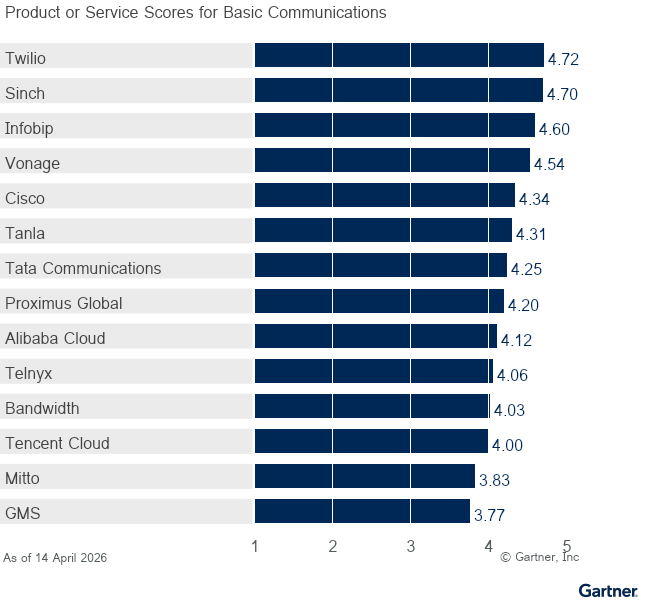
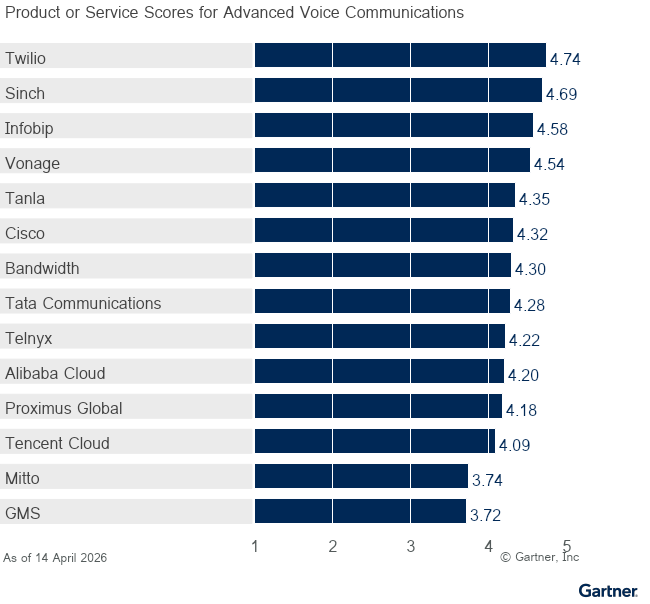
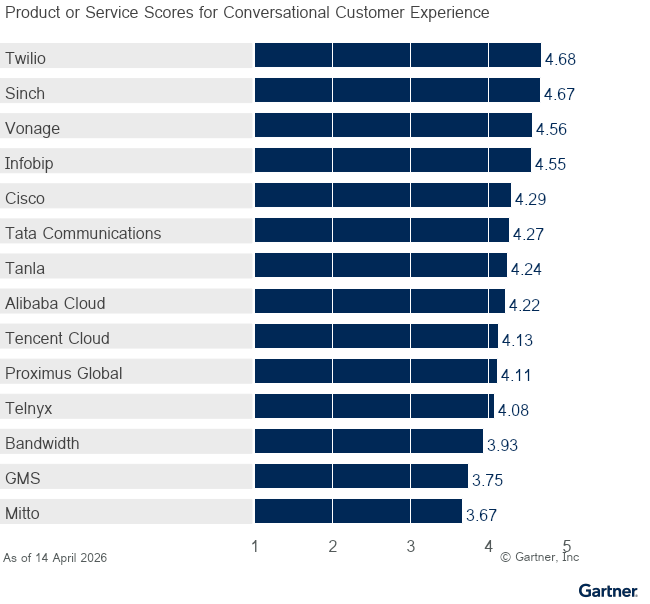
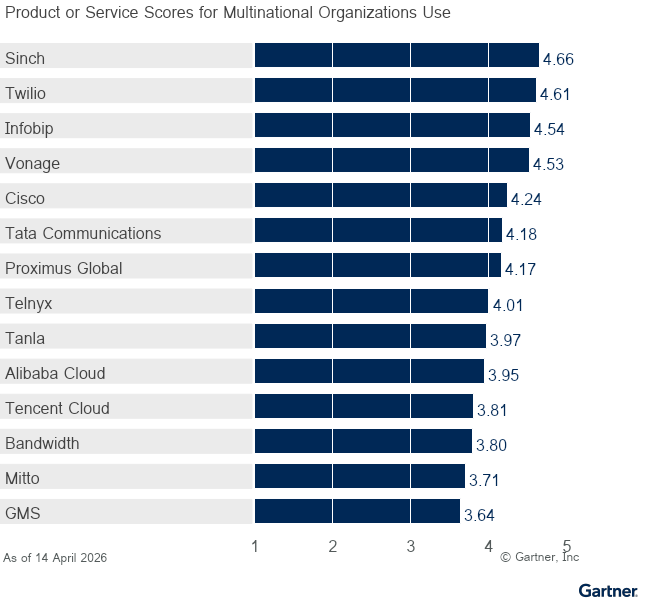
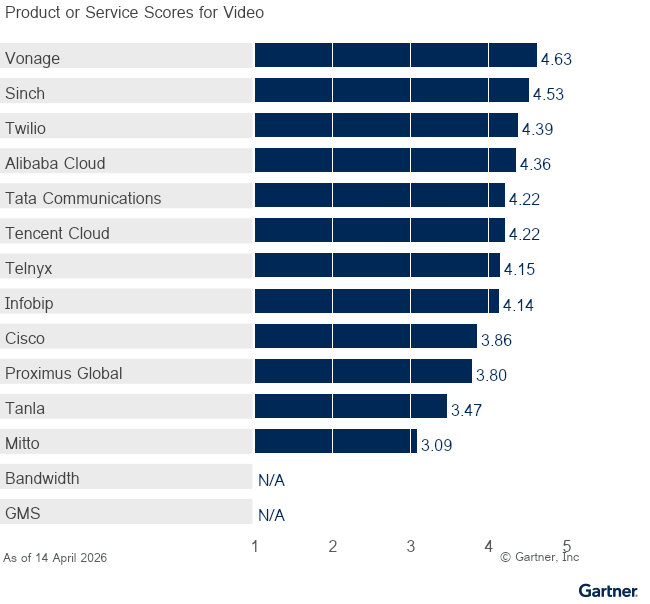
Vendors
Alibaba Cloud
Alibaba Cloud, part of the Alibaba Group, is a leading China-based cloud conglomerate with strong CPaaS capabilities in its home market, as well as across Asia and selected Middle East and Latin American countries. It delivers global service via its own infrastructure, offering data sovereignty, privacy compliance, and local sales and support. It’s expanding in high-growth regions like LATAM and EMEA, and has presence in Europe and North America. However, its current customer base remains APAC-centric. Alibaba’s world-leading LLM, Qwen, and its workplace app, DingTalk, enhance CPaaS by enabling AI-powered customer communications.
Alibaba Cloud’s CPaaS provides a comprehensive, AI-enhanced API suite (SMS, voice, video, rich messaging) with seamless integration via SDKs and APIs that bring together its conversational customer experience use cases for enterprises. Its global, autoscaling infrastructure delivers high reliability and industry-specific workflows for secure, compliant communications across verticals like e-commerce, healthcare, logistics, and finance.
As a hyperscaler, Alibaba Cloud handles large enterprise-scale volumes daily, offering advantages in reliability, global reach, and performance. Its CPaaS is AI-native, with capabilities listed on Qwen as an MCP, allowing it to power communication channels with natural language-driven customer engagement. The AI flow builder enables multichannel orchestration through standardized, no-code flows, enhancing customer experience. AI optimizes processes, orchestrates services and channels, and prevents artificially inflated traffic.
Alibaba Cloud’s most suitable use case is for applications requiring low-latency communications such as video, enabled by its 3,200 global edge nodes. The platform offers comprehensive API features, including live broadcast, recorded chat, live captions, transcriptions, virtual whiteboards, and 5G video capabilities.
Alibaba Cloud’s strongest capabilities are in video, AI features, and enterprise-grade capabilities. The company prioritizes infrastructure, security, real-time analytics, and regulatory compliance.
An area of improvement for Alibaba Cloud is to expand its geographic footprint. Although it has a presence in most regions, its revenue is mostly concentrated in APAC. Another area of improvement is integrations where it currently provides far fewer prebuilt integrations with CCaaS, CRM CEC, or ERP systems than its peers, which limits customer’s ability to build customer journeys that orchestrate across enterprise systems.
Bandwidth
See verified user reviews and ratings for Bandwidth on Peer Insights.
Bandwidth is a public company headquartered in the U.S. Its CPaaS platform provides capabilities in messaging, voice, emergency calling, branded calling and messaging, trust, identity, and fraud protection. Bandwidth positions its CPaaS platform as the orchestration layer for trusted, AI-driven conversations. It targets large enterprises and top UCaaS and CCaaS vendors. Bandwidth differentiates by offering its communications capabilities on its owned-and-operated global network with direct carrier interconnects. This provides deterministic routing control, low latency, PSTN replacement, emergency services integration, and regulatory compliance at the infrastructure layer.
Over the past year, Bandwidth added several product innovations to enhance its CPaaS platform, and added WhatsApp and RCS as messaging channels. Maestro, a key component of its CPaaS offering, is a cloud-based orchestration platform that allows enterprises to connect, create, and deploy communication workflows. To Maestro, Bandwidth added AI-native orchestration capabilities through BYO-AI integrations, OpenAI Realtime support, and MCP Server capabilities that enable agentic workflows. It also launched Number Reputation Management, a solution that gives enterprises visibility and control over outbound calling reputation.
Bandwidth’s most suitable use case is for advanced voice communications, where it offers a wide range of basic and advanced programmable voice capabilities, including branded calling. It complements voice features with authentication tools like Pindrop that it directly embeds into the carrier layer to mitigate fraud, spoofing, and deepfakes without slowing down the customer experience. It also provides 99.999% voice platform uptime, supporting mission-critical voice and messaging workloads.
Bandwidth’s strongest capabilities are in voice, advanced security, and enterprise-grade capabilities. It embeds identity authentication, number reputation management, and compliance automation directly into call routing and messaging flows. In addition to its excellent platform uptime, Bandwidth also provides service availability SLAs aligned to enterprise offerings and customer use cases, with defined service credits for qualifying outages.
Bandwidth’s biggest opportunities include expanding the breadth of its messaging channels and enhancing its video API capabilities. In messaging, Bandwidth does not offer several channels such as Apple Messages for Business, push notifications, and email. For video, it doesn’t currently offer a video API.
Cisco
See verified user reviews and ratings for Cisco on Peer Insights.
Cisco is a public company headquartered in the U.S. Its CPaaS offering, Webex Connect, is part of the Webex Customer Experience suite of applications that includes Cloud Contact Center, AI Agent, AI Assistant, and Workforce Optimization. As part of this suite, Webex Connect drives a three-pronged strategy: AI-driven omnichannel engagement, enterprise-grade controls for security and observability, and a comprehensive CX approach that extends across all customer touchpoints.
Webex Connect offers a broad set of capabilities including messaging, voice, security, low-code/no-code visual builders, AI development tools, and an extensive set of integrations with a range of CRM, CCaaS, and ERP solutions. The Webex AI Agent platform allows enterprises to use no-code tooling to create both scripted and autonomous agents deployable across various communication channels. Webex Connect and its flow builder provide APIs that enable external agentic AI agents to utilize communication services.
Cisco’s most suitable use case is basic communications, where it provides a mix of messaging, voice, security, and AI features backed by a secure and scalable platform that enables enterprises to create and deliver notifications and critical communications over multiple channels. Webex Connect’s close integration with Webex AI Agent, AI Assistant and Cloud Contact Center enables it to elevate any basic communications into extended omnichannel conversations as needed, enabling intelligent self-service-to-human handoffs and empowering data-driven, omnichannel experiences.
Cisco’s strongest capabilities are its enterprise-grade capabilities, integrations, and conversational experience. Cisco complements its enterprise-grade platform credentials through its regional platform deployments that it uses to meet customer demand for sovereign solutions in their local markets. In addition to prebuilt integrations, Cisco allows easy creation of custom integrations through its low-code visual builder and APIs. Cisco supports omnichannel conversational experiences through strong support for conversational features, including seamless orchestration across channels, handoffs between agents and humans, intelligent fallback between channels, and low-code/no-code builders for creating customer journeys. Webex Connect provides customers ease of use, extensive multichannel communications capabilities, and ease of integration with other systems.
Cisco’s biggest opportunities for improvement across its capabilities are its video API and its global footprint. Although Cisco offers a video API, its features are quite limited compared to several of its peers. While Cisco offers CPaaS in many regions across the globe, its customers are mostly concentrated in North America and the U.K.
GMS
GMS is a private company headquartered in Switzerland. GMS provides a CPaaS platform that integrates messaging, voice, security, AI, and network APIs. The vendor serves enterprises across the globe and maintains direct connections with over 275 MNOs.
GMS’ CPaaS platform provides a range of capabilities, including messaging, voice, security, AI tools, a campaign manager, and contact center. It supports a range of messaging channels, including SMS, WhatsApp, Viber, Telegram, RCS, and email. The platform also includes a low-code AI agent builder for voicebots, and supports GenAI-based content creation for campaigns. While it offers developers self-serve access to APIs, GMS also co-creates by working closely with customers to adapt solutions, integrations, commercial models, and even SLAs to each client’s specific industry, regulatory, and operational needs.
GMS’s most suitable use case is basic communications, which it facilitates through a mix of messaging, security, AI tools, and omnichannel orchestration. GMS offers a range of security features, which it augments by using network APIs like silent authentication, SIM swap detection, and device verification.
GMS’ strongest capabilities are in messaging, enterprise-grade features, and AI features. GMS has strong expertise in Viber and offers access to several Viber features like business calls, carousel messages, lists, and “Gems” — animated and interactive stickers and effects in chats.
GMS’ biggest opportunities for improvement in its capabilities are in voice, video, and advanced features. By offering more programmable voice features, GMS can better position its platform for voice-based customer journeys, including voice AI experiences. Offering a video API would enable its customers to use video as a channel in omnichannel customer journeys. Advanced features like a customer data platform (CDP) would allow GMS to provide customers a data layer to collect, analyze, and utilize information from customer journeys.
Infobip
See verified user reviews and ratings for Infobip on Peer Insights.
Infobip, headquartered in the U.K., offers a comprehensive, modular CPaaS platform that enables large platform providers, MNCs, enterprises, and midsize businesses to use components individually or in combination. The platform is AI-centric, spanning telco infrastructure (network APIs, number risk scoring), a broad array of communication channels, agentic AI, partner solutions, and advanced conversational capabilities.
Infobip’s AgentOS delivers a unified, low-code orchestration layer that combines omnichannel communications, AI automation, and customer data in a single visual environment. This empowers developers and business users to design and deploy journeys with drag-and-drop tools, supporting real-time, event-driven personalization, intelligent routing, and seamless handoff between AI agents and humans while maintaining context. MCP servers further enhance platform modularity, allowing enterprises and partners to scale conversational capabilities efficiently.
Infobip supports co-creation with enterprises as well as self-service for developers and nontechnical users, enhanced by its AgentOS offering’s ability to simplify complexity. The company serves digital-first and traditional enterprises, MNCs, platform providers, tech partners, SIs, ISVs, and telcos globally, with 800+ direct carrier connections, 40+ data centers, and regional teams providing localized and vertical expertise.
Infobip’s most suitable use case is conversational customer experience, which it facilitates through strengths in messaging, voice, conversational experience, and AI features.
Infobip’s strongest capabilities are in messaging, advanced features, security, and AI features. It supports a wide range of messaging channels at scale, omnichannel integration and CDP, and a broad range of GenAI and agentic AI features. In 2025, Infobip launched integrated fraud intelligence, combining real-time fraud scoring, number risk analysis, number intelligence, and risk scoring to combat SMS pumping, AIT onboarding, and fraud.
Infobip’s ongoing investments focus on agentic AI, with autonomous AI at the core of interactions and orchestration, API tools for end-to-end customer journeys, and MCP-driven innovation. Additional focus areas include network APIs, self-service, security, geographic expansion, and growing the Shift developer conference in APAC.
Infobip’s areas for improvement include enhanced training, guidance, and more granular reporting to maximize solution potential.
Mitto
See verified user reviews and ratings for Mitto on Peer Insights.
Switzerland-based Mitto delivers omnichannel communications via a broad range of channels. It serves small to large multinational enterprises across finance, insurance, retail, technology, telecom, services, and transportation and logistics. Mitto also supports a significant wholesale customer base, with direct connections to 800+ carriers globally.
Mitto’s mobile intelligence suite delivers network APIs compliant with GSMA Open Gateway/CAMARA standards for SIM swap, quality on demand (QoD), device status, number verification, OTP SMS, and KYC API. Mitto empowers tech partners, resellers, and solutions partners with comprehensive API access, self-service, co-marketing, dedicated training, and expert support through an enhanced Partner Portal. Its prebuilt, AI-assisted low-code/no-code functions simplify setup and scaling for both developers and nontechnical users via Mitto’s Conversations and Campaigns.
Mitto integrates with multiple digital payment types via APIs and offers advanced security features. Deep integrations with leading CRMs, marketing tech, ERP, and e-commerce platforms allow businesses to use SMS, RCS, WhatsApp, and Viber directly within their existing platforms. Mitto continues to expand its partner ecosystem for faster scaling.
Mitto’s most suitable use case is basic communications, where it enhances enterprises’ communications delivery through its wide range of messaging and voice services and direct carrier connections.
Mitto’s strongest capabilities are in messaging, voice, and advanced security. Mitto provides proprietary, AI-powered smart routing that optimizes message delivery across various channels for global coverage based on real-time quality, cost, criticality, and performance signals. Advanced traffic monitoring, anomaly detection, pattern recognition, and AI-driven fraud flagging protect network integrity. Mitto also provides RCS connectivity across 132 carriers in 64 countries.
Mitto’s opportunities for improvement lie in customization. While Mitto offers vertical-specific sales teams and solution architects for regional customization, it provides fewer horizontal services than peers (like CDP and contact center) and doesn’t integrate with as many AI models as peers.
Proximus Global
Proximus Global (an integration of Route Mobile, BICS, and Telesign) is headquartered in Belgium and has significantly expanded its global footprint and enhanced its capabilities as a comprehensive CPaaS provider. Proximus Global delivers a suite of messaging services, including RCS direct connectivity and orchestrated fallback, with coverage spanning 31 countries. The platform further supports a broad array of communication modalities like voice, video, advanced security, and foundational AI/GenAI features. Proximus Global also launched Konera, a suite of programmable network APIs that expose advanced capabilities in identity, quality, and device intelligence. Proximus Global maintains an equal focus across all major global geographies, positioning itself as an international CPaaS vendor.
In terms of AI capabilities, Proximus Global currently offers a set of features that address most enterprise clients’ immediate needs. However, the platform’s agentic capabilities — critical for advanced automation and agent-driven use cases — are still evolving.
Proximus Global continues to invest in greater pricing transparency and in strengthening its developer ecosystem. However, Proximus’ portfolio currently lags in verticalized solutions, which are increasingly important for enterprise customers seeking industry-specific capabilities.
Proximus Global’s most suitable use case is basic communications, which it supports through a wide and robust set of messaging and voice features. Its direct RCS connectivity differentiates Proximus by providing significant reach and flexibility for global enterprises.
Proximus Global’s strongest capabilities are in messaging, voice, global footprint, and advanced security. Its expansion strategy is based on localized sales enablement, partner ecosystems (SIs, resellers, hyperscalers), structured cross-sell execution, and harmonized APIs across entities.
While strong in messaging, Proximus Global doesn’t yet offer support for some advanced messaging and integration options, including WeChat, LINE, and browser-based push notifications. Furthermore, Proximus Global does not provide a CDP, which may constrain customers’ ability to unify and activate customer data across channels for more sophisticated use cases.
Sinch
See verified user reviews and ratings for Sinch on Peer Insights.
Sinch, a publicly traded Sweden-headquartered company, delivers a robust CPaaS portfolio. It unified its business into a single go-to-market organization, and embeds AI, smart conversations, and Agent Builder for a seamless customer experience. Sinch serves developers, AI agents, enterprises, ISVs, SIs, and AI platforms, offering low-code tools for omnichannel journeys and advanced orchestration for seamless app/API integration. With 600+ direct carrier connections, a global voice network, and deep ISP email inbox reach, Sinch maintains strong worldwide coverage. Self-serve capabilities support developers and AI agents, while customer success teams serve key verticals like financial services, retail, healthcare, tech, and telecom. Sinch’s partner ecosystem includes 500+ integrations and 1,000 active partners — from native integrations (Salesforce, Microsoft Dynamics 365, SAP) to AI-native ecosystems and channel providers. Sinch is a SAP Endorsed App, Adobe Digital Experience Tech Partner, and natively available in AI natives like Loveable Cloud.
Sinch’s enterprise-grade security is central, with embedded controls, reporting, and autonomous identity verification. AI/ML-driven fraud controls block AIT, phishing, and spam, while its network APIs cover SIM swap, device status, number verification, and OTP SMS. Smart Conversations delivers AI-powered content security with native PII masking. Contact Pro, Sinch’s omnichannel customer service platform, integrates with leading CRMs and ERPs, including SAP and Salesforce. The portfolio also includes video and payments.
Sinch’s most suitable use case is conversational customer experience. Its smart conversational capabilities unify 13 messaging channels (with RCS at enterprise scale), AI-powered voice on its carrier-grade, and high deliverability email for enterprise-grade omnichannel communications and orchestration.
Sinch’s strongest capabilities are in messaging, voice, conversational experience, and AI features. Sinch’s CPaaS strategy incorporates generative and agentic AI, enhancing orchestration and intelligence across messaging, voice, and email. Its MCP servers and agent-optimized coding improve developer and agent experiences. Sinch’s Agent Builder orchestrates AI agents across channels, integrating with major LLMs and providing guardrails.
Some customers have noted that initial setup can be time-consuming, and have flagged pricing as a consideration.
Tanla
Tanla, headquartered in India, is a CPaaS provider distinguished by its comprehensive feature set, with a particular emphasis on security, privacy, and innovation. The company maintains a strong market presence in the APAC (notably India and Indonesia) and the Middle East region by leveraging its regional expertise to address the unique needs of enterprises in these geographies. Tanla’s flagship platform, Wisely, anchors its portfolio. It delivers a wide spectrum of CPaaS capabilities, including basic and advanced messaging, voice, push notifications, email, security, payments, customer data platform (CDP), omnichannel orchestration, and AI-driven chatbots. Tanla introduced several notable innovations over the past year, such as AI-powered Subscriber Reputation Scoring Engines that enable reputation scoring for users and numbers, and a Cascaded Classification System, an intelligent route controller that prioritizes messages based on multiple criteria.
Beyond CPaaS, Tanla also offers platform-as-a-service (PaaS) solutions for telecommunications operators, which constitute a significant portion of its overall CPaaS revenue. This dual focus enhances Tanla’s value proposition for telco partners but may dilute emphasis on enterprise-specific feature enhancements.
Tanla’s most suitable use case is advanced voice communications, especially in APAC (and India, in particular). It supports the use case through a strong set of voice features and advanced security offerings.
Tanla’s strongest capabilities are messaging, voice, advanced security, and conversational experience. It offers advanced omnichannel orchestration and personalization, powered by AI/ML-driven intelligent channel, time, and route orchestration to optimize customer engagement across multiple channels, including voice.
Tanla’s biggest opportunities for improvement lie in AI and integrations. Tanla’s approach to AI and GenAI primarily focuses on enhancing communication channels rather than providing a unified, orchestrated AI layer across its offerings. The platform currently lacks flexibility for integration with third-party CDP solutions and external AI engines from major providers such as Amazon, DeepSeek, Google, and Microsoft, which may limit enterprises’ ability to leverage best-of-breed AI solutions or unify customer data across disparate systems. Video is still missing from Tanla’s portfolio as well.
Tata Communications
See verified user reviews and ratings for Tata Communications on Peer Insights.
Tata Communications, headquartered in India, is a global CommTech leader that offers a comprehensive suite of CPaaS capabilities. The company maintains a strong position in traditional conversational channels, including voice, SMS, and WhatsApp, and demonstrates the ability to handle significant service volumes across these modalities. Tata Communications expanded its portfolio to encompass advanced messaging channels (like RCS) and a broad range of digital and social media integrations, reflecting a strategic commitment to supporting modern omnichannel customer engagement. The company also provides an integrated contact center solution, making it particularly well-suited for the SMB market.
Tata Communications continues to position itself as a unified customer experience (CX) platform, bridging CPaaS, CCaaS, and AI capabilities. While this unified approach resonates strongly with the SMB segment, enterprise adoption remains limited with this value proposition, in part due to the evolving maturity of the platform’s enterprise-specific features for contact centers.
Tata Communications’ most suitable use case is advanced voice communications, which it supports through its strong, comprehensive voice capabilities and security features.
Tata Communications’ strongest capabilities are advanced security, voice, messaging, and AI features. Tata Communications acquired AI-native enterprise SaaS platform Commotion in the past year, enhancing its capabilities in AI and agentic use cases, and enabling the delivery of autonomous customer journeys powered by agentic AI. Commotion’s integration positions Tata Communications to address the growing demand for intelligent, automated customer experiences.
In terms of opportunities, Tata Communications has yet to fully capitalize on network APIs, despite its global telecom heritage. This represents a missed opportunity to leverage its network assets for enterprise innovation. The company’s business model also remains predominantly enterprise-focused, resulting in limited emphasis on developer enablement. Support for developer ecosystems, APIs, and integrated development environments (IDEs) is currently minimal, which may constrain adoption among organizations seeking greater flexibility and self-service capabilities.
Telnyx
Telnyx, headquartered in the United States, is a CPaaS provider with a strong foundation in core communications capabilities, notably SMS and voice. The company expanded its portfolio to include advanced messaging channels like WhatsApp, RCS, push notifications, and fax, offering a comprehensive suite for omnichannel engagement. Telnyx excels in foundational communication and messaging use cases, making it a strong choice for organizations seeking reliable, high-volume SMS, voice, and programmable communications. However, its lack of email support remains a notable gap, as email remains a critical channel for enterprise customer communications.
Over the past 12 months, Telnyx introduced several innovations in its platform, including Voice AI Agents with native PSTN integration and real-time text-to-speech and speech-to-text APIs that support over 80 languages and dialects. The company also invested in co-locating GPU infrastructure in regional markets using existing points of presence (PoPs) in Sydney and Paris to support compliance and deliver low-latency services as it expands into APAC and Europe.
Telnyx’s most suitable use case is advanced voice communications, supported by its voice and its AI feature capabilities.
Telnyx’s strongest capabilities are voice, AI features, and enterprise-grade capabilities. The company’s carrier-grade global IP backbone — owned and operated in-house — serves as the foundation for its CPaaS and AI offerings, ensuring high performance, scalability, and direct network control. While approximately 86% of Telnyx’s business is in North America, the vendor is steadily expanding its international reach to support enterprises with both domestic and emerging global communication needs.
Telnyx’s portfolio lacks verticalized solutions like payments and customer data platforms (CDP), which are increasingly important for enterprises seeking industry-specific capabilities and data-driven engagement. The company’s contact center offering takes a programmable, API-first approach rather than a traditional unified CX platform model, which may limit organizations seeking an out-of-the-box CCaaS solution. Telnyx offers network-level APIs including networks, private wireless gateway, SIM card life cycle management, and cloud storage, though these are positioned as infrastructure services rather than packaged network API products. Its marketplace integrations with third-party platforms (including CRM, CCaaS, and DCS) are delivered natively within its product rather than through third-party marketplace listings.
Tencent Cloud
Tencent Cloud, headquartered in China, is a prominent CPaaS provider with a strong regional focus on the APAC market (particularly China), and an expanding presence in the Middle East and Africa. Tencent Cloud leverages its ownership of WeChat and WeCom to deliver a robust portfolio of CPaaS capabilities, including basic and advanced messaging (with conversational features), programmable voice, and a comprehensive suite of security functions.
Tencent Cloud continued to innovate over the past 12 months, enhancing its multichannel CPaaS platform with embedded AI across real-time voice, messaging, audio, and video. The platform offers interoperability with enterprise applications like CRM and ERP, enabling context-aware connectivity for enhanced customer engagement. Additionally, Tencent Cloud introduced cloud edge device solutions designed for real-time interactions to further support use cases that require low latency and high-quality video communications.
Tencent Cloud’s most suitable use case is in video, supported by its core strengths in delivering seamless, high-quality video streaming, conferencing, and interactive experiences. Its robust infrastructure and low-latency capabilities make it an ideal choice for enterprises seeking reliable solutions for live broadcasting, virtual events, and real-time collaboration tools.
Tencent Cloud’s strongest capabilities are in video, AI features, and voice. The company’s native, full-stack AI engine deeply integrates into its communication platform, providing advanced AI and agentic capabilities. Tencent Cloud also offers strong flexibility for enterprises seeking to integrate third-party AI tools, supporting a “bring your own AI” approach. Its AI and agentic capabilities are among the most comprehensive in the market, and the vendor excels at delivering verticalized solutions tailored to a wide range of industry segments.
However, Tencent Cloud currently lacks support for certain advanced messaging channels like Instagram, X (formerly Twitter), and Snapchat. While these channels have limited adoption in Tencent Cloud’s core markets, their absence may be a consideration for multinational enterprises with broader channel requirements. Furthermore, Tencent Cloud’s offering around network APIs remains underdeveloped, with no current support for network API use cases. This is a notable gap for enterprises seeking to leverage network intelligence for advanced, context-driven solutions.
Twilio
See verified user reviews and ratings for Twilio on Peer Insights.
Twilio, headquartered in the U.S., is a dominant CPaaS provider with global operations. Twilio’s CPaaS serves as an engagement platform designed to power customer interactions by combining secure communications, artificial intelligence, and unified data.
Twilio provides a broad set of capabilities, including messaging, voice, video, email, omnichannel orchestration, security, fraud management, payments, low-code builders, compliance frameworks, integrations, CDP, and AI development tools, complemented by strong support and customer success programs and an extensive SI and VAR partner network. Twilio combines its massive scale (with over 4,800+ carrier connections) with its proprietary AI models to deliver trust and optimization at scale through capabilities like traffic route optimization, and proactively detecting and blocking artificially inflated traffic (AIT) and spam.
Twilio’s most suitable use case is advanced voice communications, where it offers a wide range of basic and advanced programmable voice features, and has evolved from providing voice connectivity to powering voice AI interactions. Twilio’s ConversationRelay, a BYO-AI solution that allows businesses to integrate their preferred AI models, enables developers to build low-latency voice AI interactions without dealing with underlying telecom networks’ complexity. Its Conversation Intelligence solution extracts real-time insights from unstructured audio, enabling organizations to act on real-time and contextual content.
Twilio’s strongest capabilities are in messaging, voice, integrations, and AI features. For messaging, it supports a wide range of basic and advanced messaging channels, including a highly scalable email offering (SendGrid). Twilio provides integrations with a large number of CCaaS, CRM CEC, CRM Marketing, and ERP solutions, allowing developers to easily build customer journeys that orchestrate across those solutions. Twilio integrates its communications infrastructure and channel data together with its Segment CDP and unified profiles. This enables clients to create unified customer profiles that collect and organize conversation history across channels, together with customer data from CRM, ERP, and data warehouses. These profiles are purpose-built to be searchable and usable by AI agents, enabling enterprises to enrich customer data with both historical behaviors and real-time insights. The result is a rich, actionable dataset that powers conversational and agentic AI use cases.
Twilio’s opportunities for improvement center on its video API, which does not provide as extensive a set of features as some of its peers. Also, while customer feedback about Twilio is generally positive, some customers continue to report speed of customer service responses as an issue. Others mention cost as a concern.
Vonage
See verified user reviews and ratings for Vonage on Peer Insights.
Vonage, based in the U.S., is a wholly owned subsidiary of Ericsson. With global operations, sales, partners, and customer support, Vonage serves enterprises, developers and ISVs/VARs across all regions.
Vonage’s CPaaS platform provides extensive capabilities, including messaging, voice, email, video, security, integrations, reporting, and analytics, AI development tools, network APIs, an extensive set of compliance frameworks, and enterprise-grade scale and SLAs. Vonage’s focus on scaling emerging network-powered solutions, which are a combination of communication and network APIs, AI, and data, by expanding access to network APIs based on the Open Gateway/CAMARA initiative differentiates it from its peers. The vendor also expanded its RCS coverage globally along with increasing its footprint in the U.S., including brand registration, compliance tools, and automatic fallback to SMS. It also expanded its WhatsApp marketing features, and expanded its fraud protection suite capabilities.
Vonage’s most suitable use case is video. Vonage offers one of the widest feature sets in the industry through its video API, along with a highly scalable video platform. It complements these API-accessible features with wide SDK coverage across web, iOS, Android, React-Native, Windows, and Linux, plus server-side support and AI integrations with popular frameworks like Python and Pipecat.
Vonage’s strongest capabilities are in video, security, and AI features. Its security offerings include Verify API for multichannel 2FA, Fraud Defender for real-time fraud alerting and blocking, defending against AIT, and Identity Insights for assessing a range of fraud signals. It augments its security offerings by using subscriber and network insights derived from network APIs. Through the Vonage AI Hub, it offers both developers and nondevelopers the tools to build AI-powered customer experiences. Vonage’s platform is AI-ready via MCP Documentation and Tooling servers that make Vonage APIs visible and usable for agents within AI-based software development tools. API integrations with platforms like Salesforce Agentforce, AWS Bedrock, and Google Vertex AI enable customer agentic solutions to use Vonage APIs.
Opportunities for Vonage to improve exist in making its pricing more transparent and easier to understand, and in improving its product documentation. Vonage also does not provide its own CDP, which is increasingly important for data-driven customer engagement, although it does support partner CDPs. Another area of improvement is to add support for payment APIs, which Vonage currently does not support.
Context
The core value proposition of CPaaS is that it simplifies access to communications so that developers can embed omnichannel, intelligent communications in software and business processes.
The early adopters of CPaaS tended to be developers in digital native enterprises, who used it for A2P and person-to-person (P2P) communications over channels such as SMS and voice for simple use cases, such as sending OTPs, delivery notifications, and appointment reminders. For such use cases, enterprises required CPaaS platforms to provide at a minimum, API-based access to these channels, support for regulatory compliance, and developer support.
Over time, developers and nontechnical users in all types of enterprises — from digital natives to ISVs and brick-and-mortar companies — have embraced CPaaS. Users rely on CPaaS not only for basic use cases, but also as an essential component of a suite of technologies to engage customers, improve customer experience, perform marketing and sales activities, and for digital transformation of business processes. This suite includes, in addition to CPaaS, adjacent technologies such as CCaaS, CRM CEC, digital customer service (DCS), and marketing automation.
To support such use cases, CPaaS platforms have evolved to provide more advanced features. These include API-based access to video and email, advanced messaging channels such as RCS and WhatsApp, and omnichannel orchestration. They also include AI use cases with conversational AI, generative AI, and agentic AI, and increased integrations with enterprise systems and SaaS applications.
Given the importance of CPaaS in enterprise operations, users expect CPaaS vendors to provide high levels of platform scalability, reliability, and availability, strong customer support, effective customer success programs, robust data security, and support for regulatory compliance. Multinational organizations also expect CPaaS platforms to support them across geographies by providing seamless connectivity to communications channels and local sales and support. With the growing incidence of fraud and security threats, users also place high value in CPaaS capabilities in fraud management, security, identity, trust, verification, and branded calling and messaging.
Users also expect CPaaS vendors to have strong partner networks that provide access to professional services and system integration services.
CPaaS vendors have invested in their AI capabilities by offering conversational AI and GenAI-based tools for a variety of use cases, such as creating and deploying virtual assistants, content creation for customer engagement and marketing, sentiment analysis, and natural language processing. CPaaS platforms offer low-code/no-code builders for facilitating these use cases. They also integrate with a number of AI tools from partners such as LLMs, testing tools, observability tools, and TTS and STT models.
Increasingly, CPaaS vendors are also adding agentic AI capabilities. They are doing this on two fronts. First, many CPaaS vendors are providing tools to build and deploy autonomous AI agents that can perform a number of tasks related to customer engagement and workflow orchestration. These vendors have expanded their low-code/no-code tools to now build agentic AI use cases in addition to GenAI ones. The second front for agentic AI innovation for CPaaS platforms is to provide tools such as MCP servers and support for standard protocols, such as MCP and agent-to-agent (A2A) to enable third-party AI agents to discover, request, and use CPaaS capabilities including communication channels.
Market Definition
Gartner defines communications platform as a service (CPaaS) as a cloud-based platform that enables businesses to embed a range of communications capabilities into applications over channels such as voice, SMS, email, messaging apps, and video. They also provide conversational capabilities, security, authentication, and automation. CPaaS delivers omnichannel, programmable experiences to enhance digital customer engagement. In 2026 and beyond, CPaaS aims to offer deeper capabilities, such as customer journey analytics, automation, personalization, and omnichannel engagement driven by AI and 5G.
The purpose of CPaaS is to enable enterprises to enhance their communication workflows by providing simplified access to multiple communication capabilities without requiring the complex architectures typically needed to leverage these channels.
CPaaS enables enterprises to shorten the time to market for new products and services, personalize communications, and orchestrate customer journeys across multiple channels. It delivers digital engagement and operationalizes customer experience, while also driving business efficiencies at scale with digital service delivery. It is modular/composable in design and can expand from initial single use cases to many others as additional business units learn of its value.
CPaaS enables a multitude of use cases, such as:
- Basic notifications
- Marketing communications
- Conversational customer experience
- Global enterprise support
- Customer support
- Vertical and horizontal use cases, such as campaign management, telemedicine, remote learning, e-commerce, and field services
CPaaS capabilities can also be consumed in a wholesale model, powering third-party cloud vendor offerings, such as contact center, CRM, multichannel marketing, and ERP. There are also wholesale use cases in which CPaaS providers wholesale communications to each other and to telecom service providers.
Mandatory Features
Mandatory features include:
- A standard set of core CPaaS communications APIs for:
- Voice calls (SIP)
- SMS
- Local and global direct inward dialing (DID)
- Identity confirmation, such as two-factor authentication (2FA)/multifactor authentication (MFA), and flash calling
- At least two other rich communications channels, such as Google Rich Communication Services (RCS), Apple Messages for Business, Multimedia Messaging Service (MMS), WhatsApp Business or WeChat
- AI-powered bots with conversational capabilities, at least for voice and/or chat
- The ability to integrate with GenAI models, including foundational models and large language models (LLMs)
- Customer service and support for CPaaS capabilities, including customer onboarding; technical support; and usage; and real-time dashboards, delivery insights, and engagement metrics.
Optional Features
Optional or more-advanced CPaaS capabilities (of which a vendor may not have all) include:
- Messaging channel APIs, such as in-app/in-website messages and push notifications; additional rich communications channels such as Microsoft Teams, LINE, Viber, Telegram, Instagram, Direct Messages on X, Discord, or Snapchat; or email, each of which can be provided with an omnichannel and orchestrated capability that may leverage AI (including generative AI)
- Conversational bots, based on traditional enterprise conversational AI or GenAI, which can be personalized and contextualized using customer data from a client CRM and/or customer data platform (CDP).
- Advanced voice APIs:
- Emergency/E911 communications
- Audioconferencing
- Call queuing
- Interactive voice response (IVR)
- AI workflow automation with smart routing, dynamic IVR and self-service flows
- Music on hold
- Speech to text (STT) and text to speech (TTS)
- Natural language processing (NLP)-based sentiment analysis
- Call recording
- Branded calling
- Click to call
- WebRTC
- Video channel:
- Programmable video APIs, such as video streaming
- In-app video service
- Video know your customer (KYC)
- Real-time transcription and language translation during live video sessions
- Facial recognition
- Advanced security and privacy:
- Voice-facial-finger biometrics
- Call risk scoring
- SIM verification
- Silent mobile verification
- Call/delivery analytics
- Call tracking
- Dynamic route capabilities
- Antiphishing and anti-spam
- Phone number anonymization/number masking
- Automated compliance audits
- API rate limiting and throttling
- AI-driven anomaly detection
- Fraud detection and authentication using voice biometrics
- Programmable wireless, including e-SIMs
- Internet of Things (IoT)-packaged solution APIs
- Device-to-cloud communication APIs
- SMS, WhatsApp notifications for IoT sensor events
- Voice-control APIs for smart devices
- Video streaming APIs for cameras
- Network APIs, including one or more from those defined by CAMARA or GSMA’s Open Gateway Initiative
- Other APIs for payments
- CDPs:
- Aggregate customer data from multiple sources
- Creating customer profiles for personalized engagement
- Audience segmentation based on behavior, demographics, and preferences, preferably AI-driven
- AI-powered messaging personalization, next best action, and recommendations using CDP data
- Customer journey analytics
- Agentic AI capabilities:
- Orchestration of GenAI models
- Intelligent call routing based on the intent and past interactions
- Autonomous customer journey orchestration, such as onboarding, troubleshooting across channels without human intervention
- Voice and visual AI agents that combine voice bots with visual elements like RCS carousels for richer interactions
- Support for third-party add-ons and integration through a vendor and partner marketplace
- Advanced support for visual builders, customer success programs, compliance (vertical/horizontal), and developer activities (such as events, certifications, and blogs)
- Support for horizontal (such as campaign management) or vertical use-case scenarios (such as banking, healthcare, logistics, and retail)
Product/Service Trends
Several product and service trends are evident in CPaaS, driven by customer expectations and technological advances. These are as follows:
- Increasing adoption of GenAI, conversational AI, and predictive AI: Vendors are utilizing AI for a broad range of functions, including automation of customer interactions, personalization, and contextualization, content creation and summarization, operational efficiency gains, fraud management, and traffic route optimization. Vendors continue to enhance features such as low-code/no-code bot builders and journey builders, and knowledge management tools by using AI within these tools.
- BYO-AI: While vendors integrate with a variety of curated LLMs, many also support a bring your own AI (BYO-AI) approach, providing development frameworks that enable customers to plug in their preferred AI technologies, such as LLMs.
- Enhanced tools for more effective AI: Vendors are increasingly providing support for capabilities such as retrieval-augmented generation (RAG), vector DBs, and zero-copy activation. Some vendors also provide their own customer data platform (CDP), or integrate with partner CDPs. The focus is on providing developers with easy access to data, including but not limited to customer preferences and behavior, to power AI use cases.
- Support for voice AI: Over the past year, vendors have invested heavily to support voice AI use cases via tools such as TTS, STT, ASR, and integration with speech LLMs, such as OpenAI’s Realtime API.
- Rise of agentic AI capabilities: Several vendors now support the creation and deployment of autonomous AI agents based on agentic AI. Vendors have also retooled their low-code/no-code builders to support the creation of such AI agents. Several vendors are making their platform capabilities, such as access to communication channels, discoverable and accessible to third-party AI agents. They are adding features such as MCP servers and supporting agent protocols such as MCP and A2A. Some vendors also provide observability and testing tools, and AI agent orchestration capabilities. The adoption of agentic AI in CPaaS is expected to continue increasing, and CPaaS is expected to evolve to support a range of human-AI and cross-agent interactions.
- Growth of RCS and WhatsApp: Adoption by enterprises of advanced messaging channels is rising. In response, CPaaS vendors have increased support for channels such as RCS and WhatsApp. They have steadily increased the number of countries in which they offer RCS. As RCS becomes more widely supported by carriers and available in more countries, CPaaS vendors will market RCS more aggressively to enterprises. Similarly, WhatsApp has seen significant adoption by enterprises, especially in emerging markets such as India and Brazil.
- Importance of security: To help enterprises deal with increasing security threats, CPaaS vendors have been enhancing features such as fraud detection and prevention, identity and risk management, branded calling and messaging, detecting and blocking AIT, number reputation management, and call verification.
- Rising interest in network APIs: Network APIs, based on the Open Gateway and CAMARA standards, are still a nascent but emerging area in which more CPaaS vendors are investing. While more carriers are supporting network APIs on their networks, adoption of such APIs by developers is still in its early stages.
Critical Capabilities Definition
Messaging
This includes the functionality to use APIs, SDKs, and IDEs to send and receive communications over SMS, MMS, email, and advanced messaging channels.
Advanced messaging channels include WhatsApp, WeChat, Facebook Messenger, LINE, Viber, Telegram, KakaoTalk, RCS, Google Business Messages, and Apple Messages for Business.
This capability also includes support for seamless customer communications across multiple channels to provide customers with a consistent and frictionless experience, as well as to personalize and contextualize communications.
Voice
This includes the functionality to use APIs, SDKs, and IDEs to send and receive communications over the voice channel, as well as advanced voice capabilities.
Advanced voice capabilities include IVR, intelligent IVR, emergency or E911, call scoring, audioconferencing, call queuing, music on hold, multimedia, speech-to-text, NLP, call recording, sentiment analysis, as well as branded calling.
Video
This includes the functionality to use APIs, SDKs and IDEs to incorporate video into applications for one- or two-way, one-to-one or many-to-many communications.
Advanced Security
This includes support for advanced communications security features, such as those for identity management, fraud detection and prevention, voice-facial-finger biometrics, call risk scoring, and SIM verification, along with call/delivery analytics, call tracking and dynamic route capabilities.
Integrations
This includes support for integrating with third-party systems, including CCaaS, CRM, ERP, EHR, ITSM, ticketing systems, and scheduling systems, as well as support for payments.
The support provided includes both out-of-the-box prebuilt integrations, and features developers can use to quickly build integrations.
Advanced Features
This includes support for advanced features such as CDP, omnichannel integration, support for GenAI and AI/NLP features, including chatbots and voicebots, and emerging features such as network APIs (Open Gateway/CAMARA), and support for communicating with IoT devices.
AI Features
This includes support for incorporating AI in communications through features such as access to AI development platforms, foundation/LLM models, NLP, sentiment analysis, and RAG.
It also includes low-code/no-code builders for building AI virtual assistants, and AI agents, support for agentic AI protocols, such as MCP or A2A, AI-driven personalization, and predictive analytics.
Conversational Experience
This includes templatized vertical- and horizontal-focused applications that customers can use out of the box by performing configuration activities, but without the need to perform development. Examples of such applications include telemedicine, remote learning, and campaign management.
Enterprise-Grade Capabilities
This measures the ability of the vendor to meet service-level standards and expectations pertaining to platform reliability, availability, scalability, business continuity, disaster recovery, and performance. It also covers customer support options and service-level agreements.
This capability includes support for storing and handling customer data securely, managing data privacy, and complying with applicable data security, privacy, and residency regulations. These include the General Data Protection Regulation (GDPR), the Federal Risk and Authorization Management Program (FedRAMP) and the U.S. Health Insurance Portability and Accountability Act (HIPAA).
Customer Success Orientation
This covers the ability of the vendor to help customers increase the value and usage of the CPaaS platform through various initiatives and resources. These include customer success programs, vendor/partner consulting, professional services, and SI partners to augment customers’ resources.
This capability also measures the extent to which the vendor supports an ecosystem of technology and professional services partners through marketplaces and partner programs.
Global Footprint
This covers the ability of the vendor to support basic and advanced communication channels in multiple geographies across the globe, provide developer support, and customer support, and comply with applicable regulations in those geographies.
Developer Orientation
This capability measures the support that the vendor provides to developers to facilitate use of the CPaaS platform for developing, testing, debugging, deploying and maintaining applications.
It covers developer-facing tools (APIs, SDKs, low-code/no-code visual builders), plus developer support and programs such as events, webinars, forums, and blogs.
Use Cases
Basic Communications
The use of messaging and communication channels to support A2P or P2P communications that are limited to simple one-way notifications or simple two-way communications.
Examples of channels include SMS, MMS, basic voice features, email and in-app messaging. Examples of business purposes for which such communications are used include appointment reminders, delivery notifications, OTPs for account sign-ups and logins, MFA, password resets, person-to-person chats, marketing messages, surveys, voting, and shared services (e.g., Uber).
Advanced Voice Communications
The use of advanced voice capabilities to build rich and engaging customer experiences that primarily use voice as a channel.
Along with enabling advanced voice-based experiences, this use case also consists of providing the required emergency calling services required by law, support for complying with local and national laws, and regulations governing the use of voice channels (e.g., Kari’s Law, RAY BAUM’S Act), and protection against fraud and spam.
Conversational Customer Experience
Combining basic communications, advanced messaging channels, and video to deliver richer customer experiences and engagement, not just notifications or information.
The purpose is to deliver enriched customer journeys. These journeys may also involve the use of chatbots and voicebots. Examples of business applications for which these conversational experiences may be used include customer acquisition, onboarding, upsell and cross-sell, e-commerce, and customer support. These experiences typically use the more sophisticated features and rich media capabilities provided by CDP, as well as advanced channels, advanced security, payments, and omnichannel orchestration.
Multinational Organizations Use
The ability to support large organizations or multinationals using the CPaaS platform.
This use case includes support of basic customer communications and/or complex customer interactions across multiple channels, and across a number of regions.
Video
This use case involves supporting integrated video capabilities that are tightly built into applications.
Examples include telemedicine, education, gaming, collaboration, video surveillance, and monitoring.
Vendors Added and Dropped
Added
- Alibaba Cloud
- GMS
- Telnyx
Dropped
- No vendors were dropped in this Critical Capabilities.
Inclusion Criteria
To qualify for inclusion in this Critical Capabilities, providers need to fulfill all of the following requirements:
- Vendor CPaaS revenue of U.S. $375 million or more in 2025 (January through December 2025) with at least U.S. $10 million of revenue billed in at least three of the following five regions:
- North America
- Europe
- Asia/Pacific (including Japan)
- Latin America
- Middle East and Africa
- Or vendor CPaaS revenue of U.S. $200 million to U.S. $374.99 million with overall annual revenue growth of 10% or more January to December 2025 versus January to December 2024, and with revenue of at least U.S. $5 million billed in at least three of the five above-mentioned regions each.
- Vendor revenue figures must be reported in U.S. constant currency.
- Vendor revenue is for CPaaS services designed for developer consumption. This includes communications-related services delivered through APIs, SDKs, integrated development environments (IDEs) and documentation. CPaaS revenue excludes revenue from out-of-the-box SaaS-based solutions, which tend to be for nondeveloper roles and do not enable developer access.
- Revenue for a particular global region is allocated to where the CPaaS contract is signed. This is typically corporate headquarters or the regional business unit of a multinational organization.
- Vendors must have employee personnel (sales, marketing, customer support and R&D), along with proof of operations in the regions in which they claim revenue (e.g., North America, Europe, Asia/Pacific [including Japan], Latin America, and the Middle East and Africa). Proof of operations can include physical buildings cited on the website, local language support, support of local currencies and billing, or website references to customers in that particular market.
- CPaaS vendors must offer the core standard CPaaS capabilities of APIs for:
- SMS (to send and receive SMS messages).
- Voice calls (SIP, to place and receive voice calls).
- Local and global direct inward dialing (DID; to route voice calls via DID).
- Phone number registration for above-mentioned core capabilities.
- Identity confirmation via methods such as 2FA/multifactor authentication (MFA) or flash calling.
- CPaaS vendors must offer at least two other rich communication messaging media. Examples include Google RCS, Apple Messages for Business, MMS, WhatsApp for Business or WeChat, along with email.
- CPaaS vendors must have AI-powered bots with conversational capabilities, at least for voice and/or chat.
- CPaaS vendors must offer integration with GenAI models, including foundational models and large language models (LLMs).
- CPaaS vendors must also provide customer service and support for the above-mentioned core CPaaS capabilities, including customer onboarding, technical support, and usage and real-time dashboards, delivery insights and engagement metrics.
Gartner required a letter of attestation from the business leader responsible for the profit or loss of the provider’s CPaaS offering to certify that the minimum inclusion criteria thresholds were met.
A broader mix of CPaaS services, in addition to the core above-mentioned capabilities, are considered as “optional” capabilities. These include functionality such as:
- APIs for a wider array of messaging channels beyond those mentioned above. This can include messaging channel APIs such as in-app/in-website messages and push notifications, Microsoft Teams, LINE, Viber, Telegram, Instagram, DM on X, Discord, or Snapchat, along with email, which can be provided with an omnichannel and orchestrated capability that may leverage AI (including generative/agentic AI). Note: Gartner is aware that vendors may not have all rich messaging channels listed here; but, as a core standard, they needed to provide at least two for inclusion.
- Conversational bots, based on traditional enterprise conversational AI or GenAI/agentic AI, which can be personalized and contextualized using customer data from a client CRM and/or CDP.
- Advanced voice APIs for services such as emergency/E911 communications, audio conferencing, call queuing, interactive voice response (IVR), AI workflow automation with smart routing, dynamic IVR and self-service flows, music on hold, speech to text and text to speech, natural language processing (NLP)-based sentiment analysis, call recording, and branded calling. Support also includes optional basic voice services such as click to call, WebRTC and calls from within apps.
- Video, including programmable video APIs, such as video streaming, in-app video service, video know your customer (KYC), real-time transcription and language translation during live video sessions along with facial recognition.
- Advanced security and privacy, through voice-facial-finger biometrics, call risk scoring, SIM verification, silent mobile verification, call/delivery analytics, call tracking, dynamic route capabilities, anti-phishing and anti-spam, phone number anonymization/number masking, automated compliance audits, API rate limiting and throttling, AI-driven anomaly detection and fraud detection using voice biometrics.
- Programmable wireless, including e-SIMs and Internet of Things (IoT)-packaged solution APIs, device-to-cloud communications API, SMS WhatsApp notification for IoT sensor events, voice control APIs for smart devices, and video streaming APIs for cameras.
- Network APIs, including one or more from those defined by The CAMARA Project or GSMA’s Open Gateway Initiative.
- APIs for payments.
- CDP capabilities such as aggregation of customer data from multiple sources, customer profile creation for personalized engagement, audience segmentation based on behavior, demographics and preferences (preferably AI driven), AI-powered messaging personalization, next best action and recommendations using the CDP data, and customer journey analytics.
- Agentic AI capabilities, such as the orchestration of GenAI models, intelligent call routing based on the intent and past interactions, and autonomous customer journey orchestration such as onboarding, troubleshooting across channels without human intervention. Agentic AI capabilities also include voice and visual AI agents that combine voice bots with visual elements like RCS carousels for richer interactions.
- Support for third-party add-ons and integrations through vendor and partner marketplaces. Advanced support for visual builders, customer success programs, compliance (vertical/horizontal) and developer activities (such as events, certifications and blogs), and support for horizontal (such as campaign management) or vertical (such as banking, healthcare, logistics, and retail) use-case scenarios.
CPaaS vendors that have a wider base of services extending into the optional CPaaS categories will have a richer product portfolio. These related optional capabilities listed above will improve the value of the CPaaS solution to customers and are included in Gartner’s ratings.
Gartner did not consider vendors whose offerings are predominantly focused on a specific CPaaS service, such as video or IoT.
Inclusion in the CPaaS Magic Quadrant and our CPaaS definition does not extend to out-of-the-box software providers in such areas as UCaaS, CCaaS, and CRM, even if they provide APIs to manage those offerings.
Weighting for Critical Capabilities in Use Cases
| Critical Capabilities | Basic Communications | Advanced Voice Communications | Conversational Customer Experience | Multinational Organizations Use | Video |
|---|---|---|---|---|---|
Messaging | 20% | 2% | 15% | 12% | 5% |
Voice | 15% | 30% | 10% | 8% | 5% |
Video | 0% | 0% | 5% | 5% | 35% |
Advanced Security | 13% | 13% | 10% | 11% | 10% |
Integrations | 5% | 5% | 5% | 5% | 5% |
Advanced Features | 5% | 5% | 8% | 5% | 5% |
AI Features | 7% | 15% | 15% | 8% | 7% |
Conversational Experience | 5% | 5% | 10% | 5% | 5% |
Enterprise-Grade Capabilities | 12% | 12% | 9% | 8% | 10% |
Customer Success Orientation | 5% | 5% | 5% | 5% | 5% |
Global Footprint | 10% | 5% | 5% | 25% | 5% |
Developer Orientation | 3% | 3% | 3% | 3% | 3% |
As of 14 April 2026 | |||||
Source: Gartner (May 2026)
This methodology requires analysts to identify the critical capabilities for a class of products/services. Each capability is then weighted in terms of its relative importance for specific product/service use cases.
Critical Capabilities Rating
Each of the products/services that meet our inclusion criteria has been evaluated on the critical capabilities on a scale from 1.0 to 5.0.
Product/Service Rating on Critical Capabilities
| Critical Capabilities | Alibaba Cloud | Bandwidth | Cisco | GMS | Infobip | Mitto | Proximus Global | Sinch | Tanla | Tata Communications | Telnyx | Tencent Cloud | Twilio | Vonage |
|---|---|---|---|---|---|---|---|---|---|---|---|---|---|---|
Messaging | 4.3 | 3.5 | 4.5 | 4.1 | 4.7 | 4.4 | 4.5 | 4.8 | 4.7 | 4.5 | 3.8 | 4.5 | 4.8 | 4.6 |
Voice | 4.2 | 4.8 | 4.3 | 3.5 | 4.5 | 4.0 | 4.5 | 4.8 | 4.6 | 4.5 | 4.5 | 4.5 | 4.8 | 4.5 |
Video | 4.8 | 2.0 | 3.0 | 2.0 | 3.3 | 2.0 | 3.3 | 4.3 | 2.0 | 4.3 | 4.3 | 4.8 | 3.8 | 4.8 |
Advanced Security | 4.4 | 4.5 | 4.0 | 3.4 | 4.6 | 4.1 | 4.2 | 4.6 | 4.6 | 4.6 | 3.8 | 3.5 | 4.8 | 4.7 |
Integrations | 3.8 | 3.3 | 4.5 | 4.0 | 4.5 | 3.4 | 3.8 | 4.6 | 4.3 | 4.2 | 4.3 | 3.4 | 4.8 | 4.3 |
Advanced Features | 3.5 | 3.5 | 4.3 | 3.8 | 4.7 | 3.0 | 3.8 | 4.7 | 4.3 | 4.2 | 3.5 | 4.2 | 4.5 | 4.5 |
AI Features | 4.7 | 4.3 | 4.5 | 4.3 | 4.7 | 3.7 | 4.2 | 4.7 | 4.4 | 4.5 | 4.5 | 4.7 | 4.8 | 4.7 |
Conversational Experience | 4.3 | 4.0 | 4.5 | 4.3 | 4.7 | 3.9 | 4.2 | 4.7 | 4.5 | 4.3 | 4.0 | 4.3 | 4.7 | 4.5 |
Enterprise-Grade Capabilities | 4.4 | 4.5 | 4.7 | 4.4 | 4.6 | 3.2 | 4.0 | 4.7 | 4.0 | 3.6 | 4.5 | 4.0 | 4.7 | 4.5 |
Customer Success Orientation | 4.0 | 4.0 | 4.1 | 2.0 | 4.4 | 3.4 | 3.6 | 4.4 | 4.0 | 3.9 | 3.8 | 4.0 | 4.6 | 4.6 |
Global Footprint | 3.0 | 3.4 | 4.2 | 3.6 | 4.6 | 3.9 | 4.5 | 4.7 | 3.1 | 3.9 | 3.8 | 2.9 | 4.4 | 4.4 |
Developer Orientation | 4.0 | 3.6 | 3.5 | 3.0 | 4.4 | 3.2 | 2.9 | 4.5 | 4.2 | 3.5 | 3.8 | 2.4 | 4.8 | 4.2 |
As of 14 April 2026 | ||||||||||||||
Source: Gartner (May 2026)
Table 3 shows the product/service scores for each use case. The scores, which are generated by multiplying the use-case weightings by the product/service ratings, summarize how well the critical capabilities are met for each use case.
Product Score in Use Cases
| Use Cases | Alibaba Cloud | Bandwidth | Cisco | GMS | Infobip | Mitto | Proximus Global | Sinch | Tanla | Tata Communications | Telnyx | Tencent Cloud | Twilio | Vonage |
|---|---|---|---|---|---|---|---|---|---|---|---|---|---|---|
Basic Communications | 4.12 | 4.03 | 4.34 | 3.77 | 4.60 | 3.83 | 4.20 | 4.70 | 4.31 | 4.25 | 4.06 | 4.00 | 4.72 | 4.54 |
Advanced Voice Communications | 4.20 | 4.30 | 4.32 | 3.72 | 4.58 | 3.74 | 4.18 | 4.69 | 4.35 | 4.28 | 4.22 | 4.09 | 4.74 | 4.54 |
Conversational Customer Experience | 4.22 | 3.93 | 4.29 | 3.75 | 4.55 | 3.67 | 4.11 | 4.67 | 4.24 | 4.27 | 4.08 | 4.13 | 4.68 | 4.56 |
Multinational Organizations Use | 3.95 | 3.80 | 4.24 | 3.64 | 4.54 | 3.71 | 4.17 | 4.66 | 3.97 | 4.18 | 4.01 | 3.81 | 4.61 | 4.53 |
Video | 4.36 | N/A | 3.86 | N/A | 4.14 | 3.09 | 3.80 | 4.53 | 3.47 | 4.22 | 4.15 | 4.22 | 4.39 | 4.63 |
As of 14 April 2026 | ||||||||||||||
Source: Gartner (May 2026)
To determine an overall score for each product/service in the use cases, multiply the ratings in Table 2 by the weightings shown in Table 1.
Acronym Key and Glossary Terms
| Acronym | Term/Definition |
| A2A | Agent-to-agent: Open-source protocol launched by Google that enables autonomous AI agents to discover, authenticate, and collaborate with each other. |
| AIT | Artificially inflated traffic: A type of SMS fraud where attackers generate massive volumes of fake traffic, often using bots, through a company’s website or app. |
| BYO-AI | Bring your own AI: An approach where vendors integrate with curated LLMs but also provide development frameworks that enable customers to plug in their preferred AI technologies. |
| CCaaS | Contact center as a service:Offers SaaS-based applications enabling customer service departments to manage multichannel customer interactions holistically from the perspectives of customers as well as employees. |
| CDP | Customer data platform:Software applications that support marketing and customer experience use cases by unifying a company’s customer data from marketing and other channels. |
| DCS | Digital customer service:A solution that supports customer service conversations by using digital engagement orchestration across multiple channels and modalities. |
| DID | Direct inward dialing: Local and global phone numbers used to route voice calls that are a core standard CPaaS capability. |
| E911 | Emergency 911: Advanced voice capability/emergency calling services required by law. |
| EHR | Electronic health record:Integrated clinical information systems that healthcare providers use to capture and store patient health status and care delivery data. |
| ERP | Enterprise resource planning:Application technology that supports the automation of operational activities for service-centric (nonproduct) industries, including financial management, order-to-cash, source-to-pay, human capital management, and other administrative capabilities. |
| FedRAMP | Federal Risk and Authorization Management Program:A U.S. government-wide program providing a standardized approach to security assessment, authorization, and continuous monitoring for cloud products. |
| GDPR | General Data Protection Regulation:A comprehensive EU law, effective 25 May 2018, that harmonizes data privacy laws, strengthening rights for individuals (data subjects) and placing strict obligations on organizations processing personal data. |
| HIPAA | U.S. Health Insurance Portability and Accountability Act: A data security and privacy regulation that enterprise-grade CPaaS platforms must support for compliance. |
| ITSM | IT service management:Software that offers cohesive workflow management and automation for organizations to plan, deliver, support, and improve integrated IT services. |
| IVR | Interactive voice response:An automated telephony technology that allows callers to interact with a company’s host system via keypad tones or voice recognition. |
| KYC | Know your customer: A process for identity verification, sometimes implemented via video. |
| MCP | Multichannel protocol:Provides a standardized way for applications to discover and access contextual information, tools, and capabilities that can be used with large language model “function-calling” features. |
| MFA | Multifactor authentication:A security process requiring two or more credentials — something you know (password), have (token), or are (biometrics) — to verify identity. |
| NLP | Natural language processing: A subfield of AI that allows computers to interpret, manipulate, and comprehend human language. |
| OTP | One-time password:A secure, temporary code — usually four to eight digits — sent to a user via SMS, email, or an app to authenticate a single login attempt or transaction. |
| PSTN | Public switched telephone network: The public network for voice communication. |
| RAG | Retrieval-augmented generation:An AI framework that improves large language model accuracy by retrieving external data — such as company documents or live databases — to ground responses. |
| STT | Speech-to-text:An AI technology that converts spoken language into written text using neural networks and machine learning. |
| TTS | Text-to-speech:An AI technology that converts written text into natural-sounding, human-like spoken audio using neural networks and machine learning. |
Critical Capabilities Methodology
This methodology requires analysts to identify the critical capabilities for a class of products or services. Each capability is then weighted in terms of its relative importance for specific product or service use cases. Next, products/services are rated in terms of how well they achieve each of the critical capabilities. A score that summarizes how well they meet the critical capabilities for each use case is then calculated for each product/service.
"Critical capabilities" are attributes that differentiate products/services in a class in terms of their quality and performance. Gartner recommends that users consider the set of critical capabilities as some of the most important criteria for acquisition decisions.
In defining the product/service category for evaluation, the analyst first identifies the leading uses for the products/services in this market. What needs are end-users looking to fulfill, when considering products/services in this market? Use cases should match common client deployment scenarios. These distinct client scenarios define the Use Cases.
The analyst then identifies the critical capabilities. These capabilities are generalized groups of features commonly required by this class of products/services. Each capability is assigned a level of importance in fulfilling that particular need; some sets of features are more important than others, depending on the use case being evaluated.
Each vendor’s product or service is evaluated in terms of how well it delivers each capability, on a five-point scale. These ratings are displayed side-by-side for all vendors, allowing easy comparisons between the different sets of features.
Ratings and summary scores range from 1.0 to 5.0:
1 = Poor or Absent: most or all defined requirements for a capability are not achieved
2 = Fair: some requirements are not achieved
3 = Good: meets requirements
4 = Excellent: meets or exceeds some requirements
5 = Outstanding: significantly exceeds requirements
To determine an overall score for each product in the use cases, the product ratings are multiplied by the weightings to come up with the product score in use cases.
The critical capabilities Gartner has selected do not represent all capabilities for any product; therefore, may not represent those most important for a specific use situation or business objective. Clients should use a critical capabilities analysis as one of several sources of input about a product before making a product/service decision.