Top Trends in Data and Analytics for 2026
17 February 2026 - ID G00843061 - 29 min read
By David Pidsley, Robert Thanaraj, and 3 more
In 2026, the leading trends are AI agents, advancements in semantics, and data and analytics platform convergence. For D&A leaders looking to identify key business and technology themes, these areas are essential to deliver cost-effective value and become an AI-first enterprise faster.
Overview
Opportunities and Challenges
- An AI-first enterprise can leapfrog its peers by using a strategic approach to maximize AI benefits through D&A, achieving better business outcomes than its peers. Blockers to scaling this vision include fragmentation within the organization, complex IT systems, a sprawl of disconnected data silos, and analytics technologies that hinder enterprisewide AI success.
- Agentic D&A uses AI agents to accelerate the real-time data‑to‑impact life cycle, creating more responsive operations, streamlined data management, higher-quality decision making, and faster business value. But there are risks that D&A leaders must overcome by implementing decision governance, which ensures transparent and ethical results as they use generative AI (GenAI) and broaden their AI engineering practices.
- Placing semantics at the core improves AI comprehension. Strategies such as composite semantic layers and graph retrieval-augmented generation (GraphRAG) provide essential context to improve AI agent response quality, consistency, and reliability. Context engineering is an emerging practice. The challenge is that many organizations struggle with fragmented architectures and scattered data across systems that don’t communicate with each other, preventing AI agents from realizing their full potential.
- D&A platformization replaces scattered, single-purpose solutions with converged data management and AI governance platforms, driving trust through consistent policy deployment. Previous technology consolidation involved tedious migrations that posed additional challenges in localizing controls to respond to global sovereign AI ambition and initiatives. These factors further increased the need for flexible and rationalized platform engineering to simplify D&A operations.
What You Need to Know
- AI-first enterprises outperform competitors by integrating agents, semantics and platforms into their D&A strategy. Successful organizations will leverage a unified platform to drive business success through AI-first initiatives.
- Agentic D&A accelerates the data-to-impact life cycle by integrating AI agents into operations with real-time data streaming. This enables more responsive, automated workflows, but requires strong decision governance to mitigate GenAI risks and ensure safe outcomes.
- Semantics at the core is critical for AI accuracy and reliability, achieved through composite semantic layers and GraphRAG to provide contextual meaning and eliminate fragmented architectures. Organizations that adopt these strategies improve AI agent response accuracy.
- Unified D&A platforms can create the clarity needed to drive trust by combining data management, analytics, governance, and agentic capabilities together into a single, simpler, converged environment. This consolidation reduces complexity and redundancy, and gives organizations the flexibility they need to become AI-first while responding to the often-conflicting sovereign AI strategies emerging from nation-states.
Strategic Planning Assumptions
By 2030, more than one in 10 enterprises will be AI-first, having outperformed competitors through the adoption of agents, semantics and converged D&A platforms.
By 2029, 20% of D&A leaders will have embraced agentic D&A, with AI agents automating data management and data streaming, as well as decision governance for safety.
By 2028, organizations that adopt composite semantic strategies with GraphRAG to reduce inference costs will have improved agentic AI response and reliability by 50%.
By 2030, over 50% of enterprises will have leveraged a single platform that converges data, analytics, governance and agentic features to advance their AI-first strategy.
Insight From the Experts
AI-First Enterprises Are Enabled By D&A Platforms, Agents and Semantics at the Core
More D&A leaders are now “AI-centric” than “technology-oriented,” as identified in the Gartner Chief Data and Analytics Officer Agenda Survey for 2026.1 Get commitment to a strategy that explicitly exploits and embeds AI to use this self-improving and adaptable technology to make better decisions, take actions and create new types of value at scale.
Cost pressures won’t stop AI, but cutting corners on semantics and tool silos will stop AI value realization.
The key lesson you should take away from these top trends is the need, in 2026, to focus on these themes while on your journey toward an AI-first enterprise. Pick your top trend now and use the presentation materials, graphics, predictions, proof points, real world examples, recommendations, and factual evidence to demonstrate foresight and thought leadership.
Kind regards, David Pidsley and the D&A Trends Team
Executive Overview
“AI-first” is a strategic approach guiding enterprises, and their units, to maximize the benefits of AI.
An AI-first enterprise is an organization that adopts an enterprisewide commitment to being AI-first, which is a strategic approach to maximize AI’s benefits by always considering AI alongside other options and using it when it makes the most sense for core decisions and investments.
The executive-level insight of this research is that D&A trends in 2026 are being driven by the three themes of: agentic D&A, semantics at the core and D&A platformization, as shown in Figure 1.
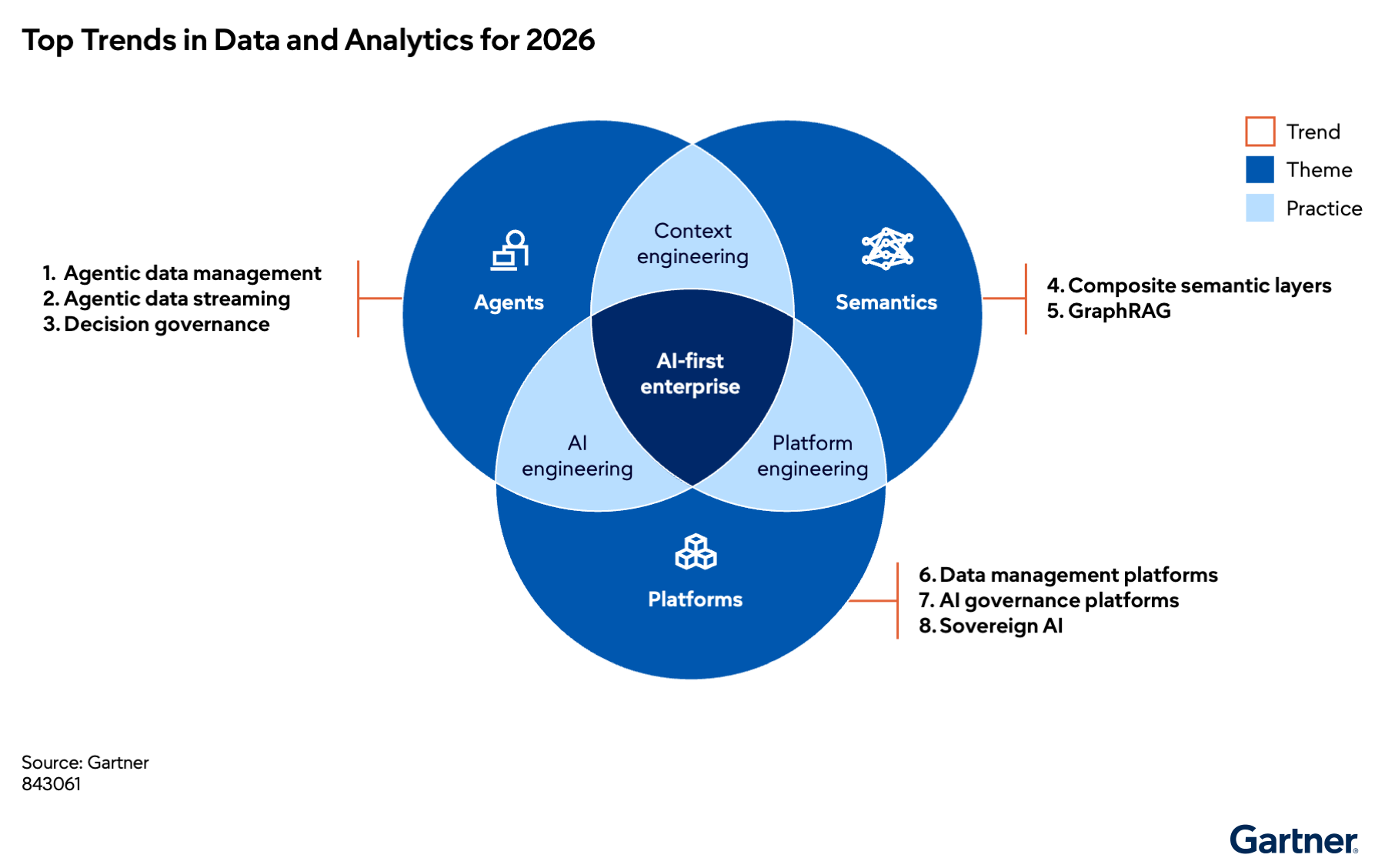
For more details on AI-first enterprises, see AI-First Unpacked: What It Means, Why It Matters, and When to Act and IT 2030: Reinvent IT With AI for Long-Term Success.
Research Highlights
Agentic D&A
Insights from: Ramke Ramakrishnan
Agentic D&A is an AI-first strategy and operating model that advances the effective deployment of AI agents within D&A operations and provides the foundations for trust in their performance.
Enterprises adopt agentic D&A so that organizational resources and AI interoperate seamlessly to adapt and optimize data-driven decisions and outcomes.
Agentic D&A is the foundation for building a truly AI-first enterprise. By deploying AI agents to manage the complete data-to-impact life cycle through agentic data management, enable real-time data flow with agentic data streaming, and enforce robust decision governance, organizations can achieve flexibility, scalability, and trust.
Agentic D&A involves automation of governed data and analytics end-to-end. It evolves the function of D&A to be more useful for AI agents than humans. It prioritizes machine consumption, where AI-enabled nonhuman actors access services and act on behalf of human teams, customers, or organizations. See AI Agent Adoption Transforms Data and Analytics Strategy and Operations.
Agentic D&A is the next wave in optimizing the data-to-impact life cycle. By integrating AI agents wherever resources are scarce, organizations maximize business value through responsive D&A operations.
Agentic D&A Enables the AI-First Enterprise
Agentic D&A lays the groundwork for an AI-first enterprise by using AI agents to drive agentic data management and agentic data streaming, all supported by robust decision governance. Integrating AI agents into data management workflows allows for autonomous and adaptive oversight of the entire data life cycle. It also facilitates real-time data flow and responsiveness through agentic data streaming, ensuring that high-velocity, near-real-time data gets to downstream analytics and AI systems seamlessly. Furthermore, since decision governance is applied, every decision remains interpretable, accountable, transparent and compliant.
Proof Points:
- Evaluation of AI agents is conducted using three primary measurements: the quality of task execution, the feedback provided by users, and the overall user experience, according to the 2025 Gartner AI in Software Engineering Survey. 2
- Organizations using shared data services to build AI agents utilize a more diverse mix of technologies, including event streaming (41%) and event stream processing (25%), than those organizations that do not use shared services to build AI agents, according to the 2024 Gartner Exploring the Intersection of Data, Analytics and Software Development Survey.3
- Where AI agents take on greater decision automation, the need for human oversight is clear. Seventy-six percent of IT and business leaders already rate decision monitoring and governance as “always important” for their organizations’ decision intelligence, based on the 2024 Gartner Decision Intelligence Survey, underscoring this trend as a required safeguard for safe and scalable agentic D&A operations. 4
Real-World Examples:
- Agentic data management automates and sharpens key functions, including resource scaling, real-time error correction, metadata management, data privacy, workflow tuning, and dataset curation across diverse industries like banking and financial services, healthcare, and manufacturing.
- Agentic data streaming is widely used in fraud detection and risk management, decision intelligence, digital twins, and automated factories and logistics.
- Organizations like Verizon rely on decision governance to increase transparency, ensure accountability for every data‑driven decision, and prioritize high‑value, lower‑risk AI initiatives through clear ownership, lineage tracking and quality scoring. 5
Emerging Practice: AI Engineering
AI engineering is the discipline for designing, developing, delivering, operating, and governing technology systems that use, deploy and apply AI to deliver business value. The discipline unifies DataOps, MLOps, ModelOps, and DevOps pipelines to create a coherent development, deployment (hybrid, multicloud, edge) and operationalization framework for AI-based systems. This emerging practice amplifies the trends that intersect the agentic D&A and D&A platformization themes. For more information, see Hype Cycle for Data, Analytics and AI Leaders and Programs, 2025.
Recommendations:
- Innovate with agentic D&A to realize your long-term vision by streamlining data operations through agentic data management, accelerating real-time insights with agentic data streaming, and reducing GenAI risk using decision governance.
- Integrate AI agents into existing data management workflows and empower data management teams to become adaptive, self-learning and to provide actionable recommendations.
- Begin with a business-driven latency assessment to clarify requirements. If near-real-time data movement is enough, use “micro-batching.” Reserve agentic data streaming for scenarios that genuinely require millisecond-level responsiveness, like fraud prevention or digital twins.
- Adopt decision governance to create a system of record for decisions. Make sure AI‑augmented choices are transparent, traceable and accountable. Strengthen decision quality and reduce GenAI risk by giving AI agents the governed logic and guardrails they need to support safe, outcome‑aligned automation as you move toward agentic D&A.
Research Highlights
Streamlining Operations With Agentic Data Management

Agentic data management refers to adaptive, self-learning systems that use AI-driven automation to optimize and streamline the entire data-to-impact life cycle, which requires safeguards, control and trust. It enables organizations to accelerate key data management processes, allowing data operations teams to focus on strategic priorities and drive better business outcomes, making it the leading trend in data management today.
Real-Time Acceleration With Agentic Data Streaming

Agentic data streaming is the real-time flow and processing of data designed for AI agents. This continuous flow allows AI systems to ingest, analyze, and respond to live data, supporting event-driven workflows, multiagent collaboration, and rapid context shifts. Since batch processing can’t keep up with accelerating real‑time agent needs, agentic data streaming delivers the speed and accuracy required for effective operation, multiagent systems, decision automation, and agentic AI use cases.
Reducing GenAI Risk With Decision Governance

Decision governance applies governance principles to decision intelligence, advancing decision making with an accountability framework for ethical, transparent, and repeatable decisions that align with objectives. Placing trust in AI agents that make automated but ungoverned decisions is not only a risk, but a fast track to failure. D&A leaders monitoring emerging drivers of change can reduce the risks associated with generative AI by adopting an accountability framework to ensure decision quality and compliance, nurturing trust in human and AI decision making.
Semantics at the Core
Insights from: Christopher Long
Semantics at the core is a strategic principle that requires the contextual meaning of data to be the foundational element of the D&A operating model, ensuring the establishment of standardized semantic definitions and business logic across platforms. This foundation ensures the success of analytical consumption by both human and AI agents.
Semantics at the core enables the AI-first enterprise by establishing the standardized, contextual foundation necessary to connect fragmented analytical silos. This creates the reliable structure required for AI agents to scale and drive the best business outcomes.
D&A leaders must optimize an AI-ready D&A architecture by strategically rethinking the semantic layer as a multitiered, composite architecture and further contextualizing data using GraphRAG.
Semantics at the core must be adopted as the strategic imperative of the modern D&A operating model, shifting semantics from an afterthought to the critical foundation required for building robust, interoperable, reliable and scalable AI systems.
Semantics at the Core Enables the AI-First Enterprise
Semantics at the core enables the AI-first enterprise by establishing the contextual meaning of data as the central element of the D&A operating model, guaranteeing that business logic and standardized definitions are consistent across all platforms. This principle is the strategic priority for AI-ready analytics because reliable, scalable AI systems — specifically, agentic AI and large language model (LLM)-powered applications — require governed, certified context to work reliably and consistently. By putting this semantic foundation first, organizations provide the necessary grounding for AI agents, which is likely to increase agentic AI accuracy and value by a large margin.
Moreover, the principle of “semantics at the core” seeks to combat the widespread semantic fragmentation and analytical silos that currently hinder the deployment of AI-first enterprise capabilities. By mandating that metrics be defined once and utilized consistently everywhere, semantics at the core drives the adoption of AI-ready architectural solutions like the composite semantic layer and semantic interoperability standards. This allows AI agents to programmatically access portable, trusted metrics across distributed environments, transforming fragmented data into the unified, trusted data that fuels a programmable, AI-first enterprise.
Proof Points:
- Many organizations duplicate their analytics across multiple platforms, often due to inadequate integration and lack of analytical delivery planning. They also struggle to achieve consistency in their metrics layer. Enterprises cannot fully leverage AI agents in these fragmented D&A architectures. Those organizations adopting semantic modeling practices are more likely to achieve high effectiveness in data engineering practices used to support AI use cases, according to the 2025 Gartner State of AI-Ready Data Survey.6
- Enterprise AI applications demand a high level of accuracy and reliability. Standard retrieval-augmented generation (RAG) approaches often struggle to deliver, according to a 2023 data.world Team Generative AI Benchmark.7 This evidences the need to explore emerging trends like GraphRAG, as it overcomes those limitations of standard RAG.
Real-World Examples:
- Toyota Motor Europe’s “freedom in a box” framework federates semantic development and ownership across domains, illustrating a practical, composite semantic layer. The “freedom in a box” program allows business domains to independently create their own specific data products and analytical models (“freedom”), rather than forcing a single, one-size-fits-all standard. By wrapping these distributed artifacts in strict governance and certification protocols (“the box”), Toyota effectively coordinates these diverse semantic objects to promote consistency and cohesion across the architecture.8
- Microchip Technology’s customer service team faced delays because they couldn’t directly access order or production data, relying on engineering and operations teams. To solve this, they built a GraphRAG-powered chatbot and a private LLM, which overcame traditional RAG limitations by retrieving structured, real-time operational insights for domain-specific questions. Customer service gained instant access to complex data, while technical teams were freed from routine queries.9
Emerging Practice: Context Engineering
Context engineering is the discipline of designing, managing, and optimizing the information provided to GenAI models at inference time to enhance performance, improve their accuracy, elevate their relevance and optimize their cost. It represents the art and science of precisely populating the LLM context window with enough relevant information at each step of an AI application’s workflow. This emerging practice amplifies the trends that intersect the agentic D&A and semantics at the core themes. For more information, see Hype Cycle for Software Engineering, 2025.
Recommendations:
- Establish an AI-first enterprise with a foundation of semantics at the core by adopting interoperable, composite semantic layers to unify business logic across all environments. Handle more complex use cases with GraphRAG to ground models in ontological context, thereby minimizing AI bias and hallucinations.
- Acknowledge that implementing a composite semantic layer is a complex integration and engineering challenge, not a plug-and-play solution. This is not a hands-off integration; it takes an active audit of where logic currently lives, whether that be in data management platforms, semantic layers, SQL, code, or analytics and business intelligence platforms.
- Begin with a minimal knowledge graph on internal data, then scale and benchmark GraphRAG rather than standard RAG for measurable gains and improvements.
Research Highlights
Making Composite Semantic Layers Interoperable

The composite semantic layer coordinates diverse semantic objects — such as data products, knowledge graphs, and BI models — across the D&A architecture. Since a “single universal layer” often feels difficult to define, this pattern is essential. It increases reusability and minimizes repetition by strategically aligning artifacts. This approach bridges context gaps, reduces data silos and enforces consistent business logic throughout the organization.
Handling Complex Use Cases With GraphRAG

GraphRAG improves the accuracy, reliability, and explainability of RAG systems by using knowledge graphs (KGs) to boost both recall and precision. It does this by either retrieving the right facts directly or enhancing other retrieval methods. This added context narrows search results and filters out irrelevant data. When high accuracy is needed, most RAG systems fall short, but leaders can overcome these limitations by combining KGs and context with GraphRAG.
D&A Platformization
Insights from: Robert Thanaraj
D&A platformization is a technology rationalization process that replaces disconnected, single-purpose data and analytics tools with converged platforms to simplify architectures, standardize operations, and reduce technical handoffs across teams and systems.
D&A platformization is a strategic step toward building an AI-first enterprise. It unifies fragmented systems and technologies for sustained advantage.
D&A leaders can streamline their architectures and standardize their delivery processes by replacing scattered, single-use tools with converged platforms.
Converged data, analytics and AI platforms simplify the complex operations that have traditionally slowed down D&A teams, making it easier for them to become AI-first faster.
D&A Platformization Enables the AI-First Enterprise
Becoming an AI-first enterprise is essential for getting ahead and winning the race. Achieving this vision at scale is challenging because of the sprawl of disconnected technologies, organizational fragmentation and overly complex systems.
In response, many D&A vendors are broadening their product offerings, leading to a major convergence of data, analytics, decisioning, governance and AI capabilities. Converged platforms eliminate silos, simplify AI-ready D&A architectures and give organizations the integrated foundation they need to scale AI capabilities organizationwide. This trend means most enterprises will have adopted converged platforms as a key component of their agentic D&A strategy and operating model. Some of these converged platforms are detailed in the following Gartner research:
By replacing scattered, single-use tools with unified platforms that bring together key capabilities and standardized processes, D&A leaders can streamline their architectures and reduce unnecessary technical handoffs across teams and systems. For example, a team may have built data pipelines using one technology, another team may manage data quality using a different system, and yet another team may be creating analytical reports using a third tool. Using multiple overlapping tools is inefficient, whereas a converged platform helps enterprises become AI-first, faster. See Predictions 2026: Agentic Data Management is Indispensable for Agentic AI Success.
Proof Points:
- On average, organizations have deployed a dozen data management solutions and struggle to realize their AI goals at scale, based on evidence from Gartner client interactions on the topic during 2024-25.
- Half of chief data and analytics officers consider optimizing the technology landscape to be their primary responsibility.1
- Organizations that use AI governance platforms are more than three times more likely to achieve high effectiveness in AI governance practices than those that do not. 6
- 60% of respondent organizations expect to increase reliance on regional solutions, according to the 2025 Gartner Cloud End-User Buying Behavior Survey. 10
Real-World Examples:
- Organizations like BDO,11 Toyota 8 and WPP 12 use data management platforms, making data accessible as products via marketplaces, easing data access through natural language queries, applying governance for quality and ROI, and supporting RAG services, GenAI applications, and LLM integration.
- AI governance platforms are used in mitigating shadow AI risks, enforcing runtime guardrails and ensuring audit readiness for global AI regulations, such as the European Union’s AI Act, AI risk frameworks and the NIST AI Risk Management Framework.
- Nation-states are accelerating sovereign AI through tariff and trade policy, investment in private entities, government funding, situation-specific regulation/deregulation, industry initiatives, and public/private transactions.
Emerging Practice: Platform Engineering
Platform engineering for D&A is the discipline of designing, building and scaling self‑service platforms that provide opinionated, secure and well‑governed ways to adopt D&A practices across an organization. It aims at improving D&A developer experience, accelerating D&A delivery, maximizing ROI and supporting a responsible AI life cycle. This emerging practice builds on the key trends that we’re seeing around platformization and semantics. For more information, see Five Principles to Achieve Platform Engineering Success.
Recommendations:
- Balance the pressures of D&A platformization by bringing together solutions via data management platforms and driving trust through AI governance platforms, while still granting D&A control to the teams that need it most. As sovereign AI continues to emerge, it can push organizations toward either more platformization or further divergence, depending upon the specific AI use case.
- Review and rationalize the current data management technology landscape by using data management platforms to eliminate redundant, underused technologies. Stop introducing further data management point solutions.
- Prioritize adoption of AI governance platforms to increase the effectiveness of AI governance. Rigorously assess the capabilities of vendors’ platforms to select those that meet current and foreseeable AI governance needs.
- Respond to the commercial opportunity and undisclosed threat presented by sovereign AI by modernizing D&A roadmapping and D&A platformization. This will also accelerate AI-first enterprise initiatives, advancing AI use cases from utilization to create a decisive advantage.
Research Highlights
Converging Solutions With Data Management Platforms

Data management platforms are integrated, dynamic data environments for managing enterprise data with operational simplicity. These platforms promise to consolidate and replace individual fragmented data management solutions. By adopting a suitable data management platform, D&A leaders can reduce silos, simplify operations and deliver AI-ready data, faster.
Driving Trust With AI Governance Platforms

AI governance platforms are tools designed to make sure that organizations abide by set policies, regulations and industry standards across common responsible AI principles. As AI usage ramps up, organizations require more robust ways to provide centralized oversight, apply risk management frameworks and enforce necessary controls. D&A leaders should use these platforms to enable more effective AI governance programs.
Global Sovereign AI Accelerates

Sovereign AI reflects a nation-state’s ambition to develop and use AI without foreign assistance for sovereign objectives, including global AI leadership and economic competition. As AI becomes key to economic strength, nation-states prioritize controlling their own AI, minimizing reliance on foreign countries for labor and talent, intellectual property, and AI techniques. D&A leaders must explore their sovereign AI landscape to uncover opportunity and respond to nonobvious threats.
2025 Trends: Revisited
You read the Top Trends in D&A for 2025, so how did those work out in hindsight? Our analysts look back at last year’s top trends and comment.
2025 Trends: Revisited
Analyst Reflections on 2025 Trends | Analyst |
“Metadata management solutions quietly became the backbone of D&A. Now they’re the indispensable plumbing of modern data management operations. Beyond governance, these underpin AI reliability in production. What was once dismissed as background noise is now the unifying force behind the semantics at the core theme this year.” For guidance, see Magic Quadrant for Metadata Management Solutions. |  |
“Synthetic data adoption held steady as a privacy-friendly supplement to real production-grade data for testing and training AI models, contributing to the acceleration of AI, AI agents and GenAI use cases. In 2026, it feeds agentic D&A by reducing data friction and GenAI risk, and increasing availability of fit-for-purpose and compliant data to fuel AI innovation and driving domain-specific solutions.” For guidance, see Executive Briefing on Emerging Technology: Synthetic Data. |  |
“Multimodal data fabrics: Everyone loved the vision; few enjoyed the integration work! This trend was conceptually inevitable; however, execution remained uneven as organizations lacked metadata maturity. We see that shift in 2026 toward data management platforms and semantics at the core.” For guidance, see 2025 Strategic Roadmap for the Data Fabric Architecture. |  |
“Highly consumable data products are now a best practice, although laggard organizations spent last year debating what a ‘product’ means. There’s still work remaining to iron out exactly how data products should be deployed, but mature organizations are successfully building them.” For guidance, see How to Build and Manage Data Products. |  |
“Composite AI challenged the idea that one single type of AI model could do it all. As architectures became more complex and specialized, we helped clients recognize that not every problem was a ‘nail’ requiring an LLM-shaped ‘hammer.’ The right AI toolkit was needed for the right job.” For guidance, see How to Build Reliable Agents Using Composite AI. |  |
“Small language models have turned GenAI into domain-specific engines. Enterprises recognized that the scale of LLMs created challenges in production environments. Organizations (that could) pivoted toward specialized small language models (SLMs), and 2026 brings the integration of knowledge graphs through GraphRAG as critical enablers.” For guidance, see Explore Small Language Models for Specific AI Scenarios. |  |
“AI agents: curiosity and vendor hype went mainstream before trust caught up. Lots of demos, fewer live systems. ROI pending. Everyone’s talking to agents; fewer of us are uncritically trusting their replies. The big theme of 2026 is agentic D&A.” For guidance, see AI Agent Adoption Transforms Data and Analytics Strategy. |  |
“Agentic analytics exploded. BI users stopped waiting for dashboards and started ‘talking to their data.’ Semantics, not tech, is now the constraint. This escalated from ‘interesting’ to ‘oh wow’ extremely fast. Agentic data management and streaming are the promise, but composite semantic layers must now catch up.” For guidance, see A Journey Guide to Activating Agentic Analytics Across the Enterprise. |  |
“Decision intelligence platforms (DIPs) are not loud or flashy, but are increasingly unavoidable, especially once decisions are prematurely automated and get audited. DI keeps showing up as the antidote wherever GenAI is misused. DIPs are still trending. Watch for decision governance within the agentic D&A theme.” For guidance, see Magic Quadrant for Decision Intelligence Platforms. |  |
Source: Gartner (February 2026)
Contributors
Sumit Agarwal, Yogesh Bhatt, Lydia Clougherty Jones, Thornton Craig, Diarmuid Curran, Alan Duncan, Mike Fang, Fay Fei, Andrés García-Rodeja, Michael Gonzales, Pieter den Hamer, Gareth Herschel, Afraz Jaffri, Sarah James, Stephen Kennedy, Lauren Kornutick, Nina Showell, Priya Sundararaman, Ehtisham Zaidi
1 Gartner Chief Data and Analytics Officer Agenda Survey for 2026. This survey was conducted to determine the priorities and strategic challenges of the chief data and analytics officer (CDAO) role or the office of the CDAO for 2026. It also sought to inform agenda planning or potential research topics for the data and analytics practice, and track the progress of the CDAO role in organizations. The research was conducted online from September through November 2025 among 502 respondents from across the world. All respondents in the survey are data, analytics or AI leaders. The survey sample was gleaned from a variety of sources, including a Gartner-curated list of CDOs and other high-level data and analytics leaders. Disclaimer: The results of this survey do not represent global findings or the market as a whole, but reflect the sentiments of the respondents and companies surveyed.
2 2025 Gartner AI in Software Engineering Survey. This study was conducted to explore the adoption of AI within software engineering functions, focusing on two key areas: the use of AI tools (e.g., AI code assistants, AI code agents) throughout the software engineering life cycle (SDLC); and the development of AI-powered solutions (or AI engineering) within software engineering functions, along with their contribution to business outcomes. The research was conducted online from 29 April through 25 June 2025 among 299 respondents from North America (n = 150), EMEA (n = 104) and Asia/Pacific (n = 45). Quotas were established for company sizes and for industries to ensure a good representation across the sample. Organizations were required to be either piloting or using AI tools in SDLC for less than four years, and either piloting or having built AI solutions in their software engineering functions. Respondents included both leaders and individual contributors from software engineering functions, each with at least one year of tenure at their current organization. All respondents were involved in decision making or directly engaged in using AI tools or building AI solutions within their software engineering functions. Disclaimer: The results of this survey do not represent global findings or the market as a whole, but reflect the sentiments of the respondents and companies surveyed.
3 2024 Gartner Exploring the Intersection of Data, Analytics and Software Development Survey. This survey was conducted to explore how the collaboration between data and software development teams — or D&A and software development teams — impacts successful deliverables. Specifically, it explored best practices for cooperation between data scientists and software developers, as well as between data engineers and software developers. The research was conducted online from May through July 2024. In total, 402 respondents were surveyed from organizations in North America (n = 160), EMEA (n = 159) and APAC (n = 83). Quotas were established for company sizes and for industries to ensure a good representation across the sample. Organizations were required to have $500 million or more in total annual revenue or operating budget for fiscal-year 2023. Respondents were required to hold a managerial role or higher (excluding C-level roles) and were primarily focused on data and analytics (D&A) or software development. They were also required to have a high level of personal familiarity in at least one of the following areas: creating shared data services (such as APIs and data products), creating applications using shared data services and knowing shared data service architecture, and creating analytic and AI models consuming shared data services. Disclaimer: The results of this survey do not represent global findings or the market as a whole, but reflect the sentiments of the respondents and companies surveyed.
4 2024 Gartner Decision Intelligence Survey. This survey was conducted online from 15 October through 4 November 2024 to understand the impact of data and analytics and the evolving role of AI and generative AI in organizational decision making. A total of 112 IT leaders, CIOs and business leaders participated; 100 were members of Gartner’s Research Circle, a Gartner-managed panel, and 12 were contacted through the dissemination of the survey link via LinkedIn posts and outreach to clients. Participants were in roles at the manager level or above and were from North America (n = 52), EMEA (n = 40), Asia/Pacific (n = 10) and Latin America (n = 10). Disclaimer: The results of this survey do not represent global findings or the market as a whole, but reflect the sentiments of the respondents and companies surveyed.
6 2025 Gartner State of AI-Ready Data Survey. This study was conducted to understand how data management organizations evolve for AI and to glean insight into how organizations are developing capabilities, skills, techniques, tools, and technologies to support AI-ready data. The research was conducted online from June through August 2025 among 250 respondents from North America (n = 100), EMEA (n = 70), Asia/Pacific (n = 50), and LATAM (n = 30). Quotas were established for company sizes and for industries to ensure a good representation across the sample. Respondents were screened for involvement and knowledge of data and analytics, data science, and AI strategy and initiative. Disclaimer: The results of this study do not represent global findings or the market as a whole, but reflect the sentiment of the respondents and companies surveyed.
7 Generative AI Benchmark: Increasing the Accuracy of LLMs in the Enterprise with a Knowledge Graph, data.world.