Innovation Insight: Agentic AI in CRM
26 February 2026 - ID G00845239 - 15 min read
By Ilona Hansen, Olive Huang
Agentic AI for multidomain CRM unifies, analyzes, and optimizes customer relationships across marketing, sales, customer service, digital commerce and cross-CRM functions. It provides customer-facing teams with intelligent tools for improving interactions and delivering better customer experiences.
Overview
Key Findings
- Agentic AI CRM introduces risks — such as data privacy, bias, and loss of oversight — because of the complexity of managing autonomous agents across all CRM domains.
- Integration and interoperability challenges seamless unification of customer data and workflows, limiting cross-domain CRM effectiveness.
- Rapid market shifts could be an early indicator for replacing domain-specific CRM tools with unified, multiagent platforms, creating uncertainty around future-proof solution choices.
Recommendations
- Build strong governance with clear policies for agent orchestration, privacy, and accountability. Maintain human oversight, like a boss managing the digital workers, through regular audits and intervention mechanisms to minimize operational and compliance risks as you scale.
- Select platforms with robust interoperability, open APIs, MCP support, forthcoming A2A protocols, and metadata-driven data fabrics. Start with pilot integrations, then scale gradually. Assign teams to monitor and resolve issues for consistent, reliable workflows.
- Prioritize advanced orchestration and governance, and adapt your CRM strategy as unified platforms mature to stay agile and competitive.
Introduction
The era of the passive AI is over, and organizations are quickly entering the age of the agentic AI. Unlike generative AI, which is triggered by a prompt, agentic AI proactively pursues goals, reasons, plans workflows, and executes actions across systems. Agentic AI while currently grounded in single agents moves to orchestrated multiagent systems. This shift will force organizations to move from managing software and humans to managing a digital workforce. The central challenge for enterprise application leaders is no longer just “AI adoption,” but avoiding uncontrolled “AI agent sprawl” while extracting value from these autonomous entities.
Agentic AI CRM claims to improve customer experience interactions and unify data across marketing, sales, service, digital commerce, and analytical or cross-CRM domains. It empowers teams to collaborate more effectively and respond to customer needs faster, and more personalized. It promises seamless data governance, compliance, and user enablement across all domains. Operational data required for decision making is provided with sourcing paths, indicating which information has influenced the requested analysis. This traceability ensures that performance optimization actions can be targeted and executed where they are most needed.
Already 54% of enterprise application leaders have piloted or deployed intelligent applications, of which agentic AI CRMs are part, across their application portfolio according to Gartner’s Enterprise Applications Signature Study for 2026.1 This trend will increase over the next few years, as customers demanding AI will be the No. 1 driver for organizations to invest in CRM (see Predicts 2026: Will AI in CRM Finally Prove Its Worth?). The investment is justified by highlighting how agentic AI for CRM drives efficiency, improves customer satisfaction, and enables the organization to stay agile and competitive in a rapidly changing digital landscape.
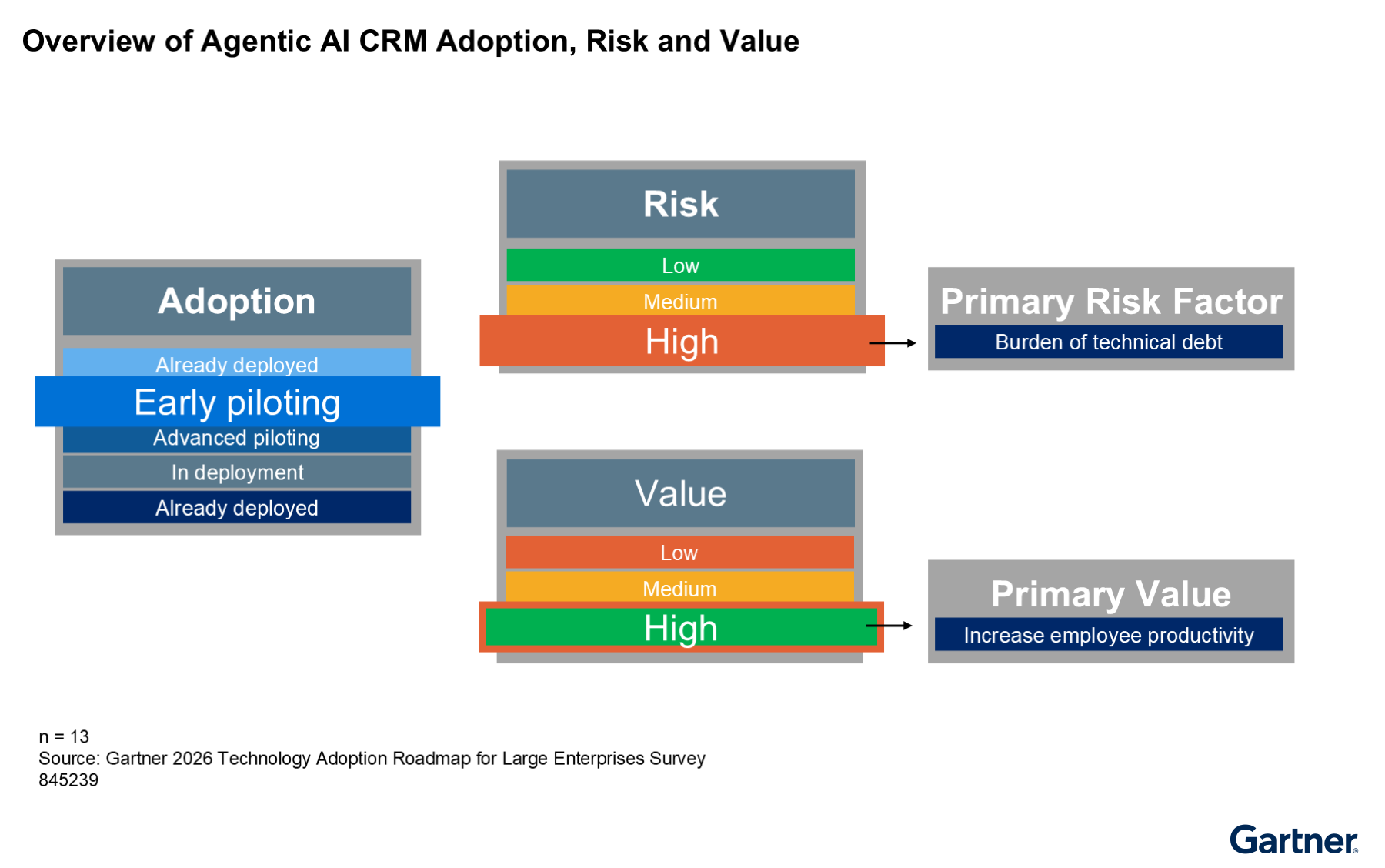
A 2025 Gartner survey2 found that the majority of respondents see multidomain agentic AI CRM as being in early pilot stages — high risk, but with significant potential value for organizations, see Figure 1.
Description
A multidomain CRM agentic AI framework must provide AIOps (operations), application life cycle management (ALM), and observability for automated deployment, monitoring, and governance of AI agents. It should also deliver multiagent orchestration, secure data management, flexible agent creation, open model support, and integrated compliance Unique characteristics include a foundational model-based reasoning engine, a metadata-driven data fabric, access to CRM functions, workflows and APIs, emerging multiagent orchestration capabilities, and configurations supporting security, privacy and trust.
However, placing trust in AI agents that make automated but ungoverned decisions is a fast route to failure. Unless the rollout is accompanied by sufficient testing and well-monitored operations. Agentic AI CRM has emerged as a challenge for application architects due to the accelerated pace of innovation and constant iterations. Gartner expects this space to continue evolving rapidly, particularly due to the early-stage challenges associated with its brief time on the market. Implementing agents is more complex in practice than it can appear.
Creating agents seems quick. Creating a secure, reliable, accurate agent or agents requires more consideration and far more time. Which in turn requires more monetary investments.
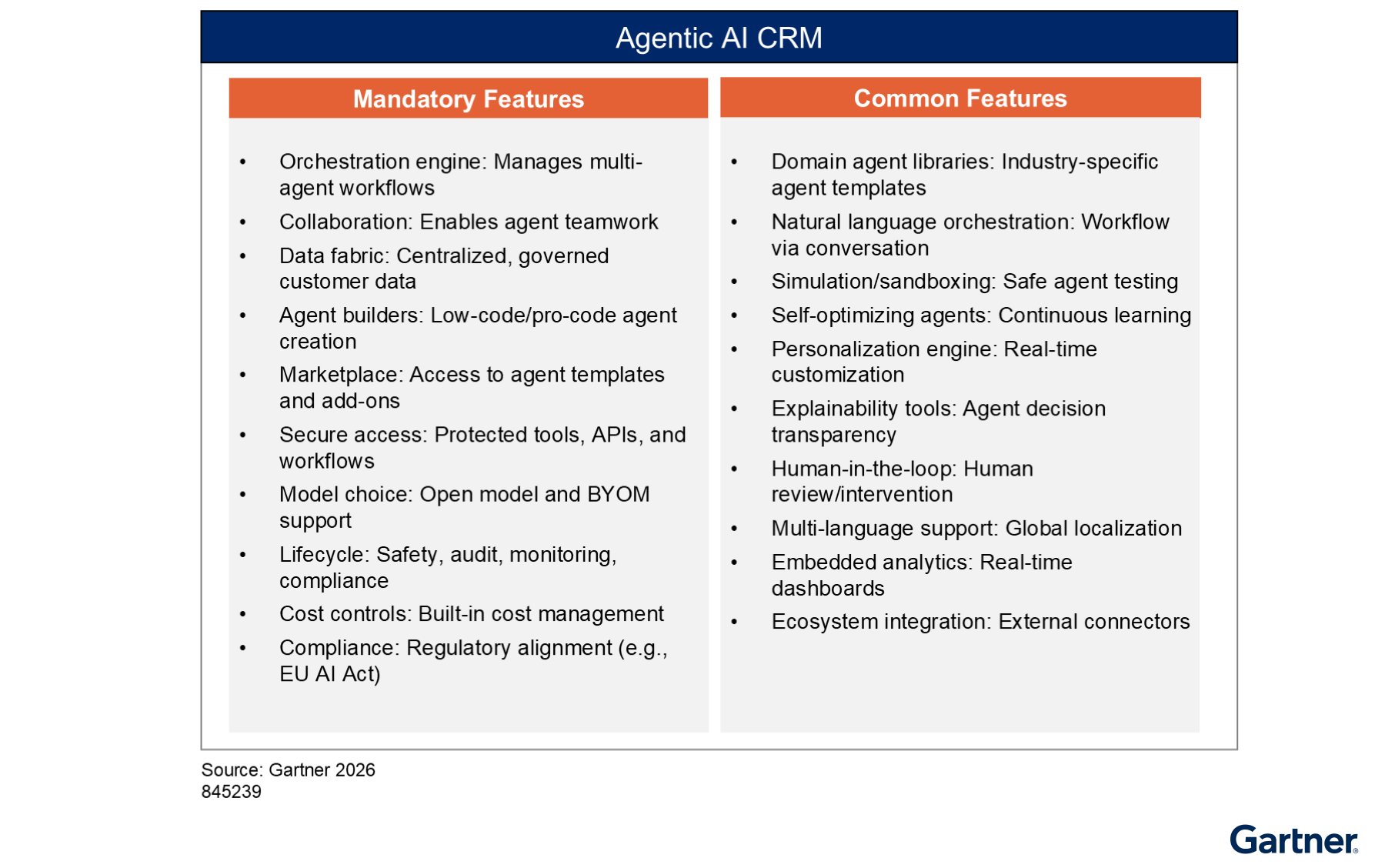
Agentic AI CRM is a governed environment to design, orchestrate, and operate multiagent AI systems that plan, act, and learn across sales, service, marketing, digital commerce, and adjacent CX/ERP workflows. Figure 2 lists out the mandatory, and the common capabilities provided by agentic AI CRM.
Mandatory Features
Orchestration engine: Manages and coordinates complex, event-driven workflows across multiple autonomous agents in sales, service, marketing, commerce and cross-CRM functions.
Collaboration: Facilitates real-time communication, context sharing, and task delegation among agents and human users to resolve cases and drive outcomes.
Data fabric: Aggregates, cleanses, and governs customer data from all CRM domains, providing agents with consistent, high-quality, real-time information.
Agent builders: Empowers business users and developers to design, test, and deploy specialized AI agents using flexible low-code and pro-code tools.
Marketplace: Delivers a catalog of prebuilt agent templates and extensions, enabling rapid adoption and innovation through easy customization and deployment.
Secure access: Implements role-based access, encrypted APIs, and workflow protections, and includes a dedicated security layer to defend against traditional agentic attack vectors, with continuous monitoring and threat detection to ensure only authorized agents and users access sensitive data and system functions.
Model choice: Allows organizations to select, integrate, and govern proprietary or third-party AI models, supporting open architectures and BYOM for tailored reasoning.
Life cycle: Ensures agent safety, identity, continuous monitoring, logging, and automated audits to maintain compliance and operational reliability.
Cost controls: Provides real-time analytics, usage quotas, and spend management tools to optimize agent deployment and prevent budget overruns.
Compliance: Anticipates regulatory frameworks and automated policy enforcement, adapting to evolving laws (e.g., EU AI Act, GDPR) for audit-ready operations.
This orchestration environment moves beyond earlier reactive and assistive CRM generative systems (e.g., “draft this email”) to agentic orchestration, enabling proactive and delegated actions like “manage my calendar and resolve this billing dispute.”
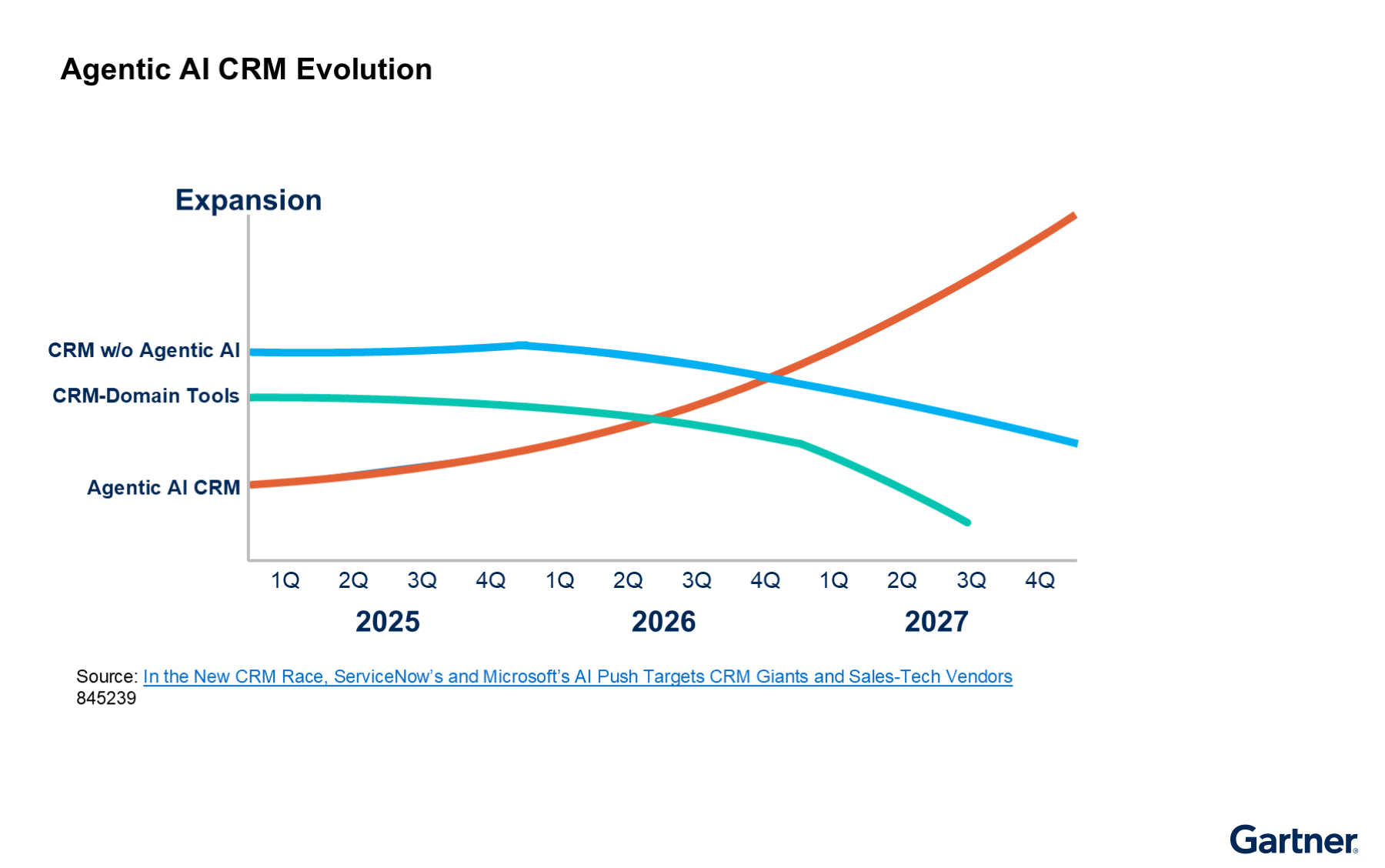
Gartner predicts a shift in the CRM market as agentic AI CRM takes off. Some vendors are already racing ahead with multidomain agentic AI solutions, forcing competitive CRM vendors to catch up or risk being left behind. As this wave hits, it is expected that CRM-domain single-purpose tools will fade away — making room for powerful, unified platforms that put multiagent management at the center of customer relationships (see Figure 3).
Benefits and Uses
Enterprise application leaders are expecting soon after implementation efficiency gains and improved customer experience from multidomain agentic AI in CRM, but Gartner has not yet seen proof of this promise. However, over the following six through 18 months, deeper integration and automation drive innovation, adaptability, and long-term value across all CRM domains including marketing, sales, customer service, digital commerce and cross-CRM.
Cross-CRM Functions (Analytics, Data Management, User Adoption, Compliance)
Benefit/Value:
Multidomain agentic AI CRM delivers unified data governance, continuous compliance, and enhanced user enablement across all CRM domains, such as marketing, sales, customer service, and digital commerce. By automating analytics, data quality, compliance monitoring, and user support, organizations gain reliable, actionable insights and maintain regulatory alignment. The system provides traceable sourcing paths for all operational data, ensuring that every decision is grounded in transparent, high-quality information. This traceability supports performance optimization, risk mitigation, and faster, more informed decision making at every level of the organization.
Examples for cross-CRM include, but are not limited to:
- A data quality agent automatically detects duplicate or inconsistent records across sales, marketing, and service, then initiates reconciliation workflows to maintain a single source of truth.
- A compliance agent continuously scans for changes in data privacy regulations (e.g., GDPR, CCPA) and updates workflows to ensure the organization remains audit-ready, automatically alerting stakeholders to required actions.
- An adoption agent monitors user engagement with new CRM features, identifies training gaps, and delivers in-app, contextual guidance or micro-learning modules to accelerate user proficiency.
- An analytics agent aggregates KPIs and operational metrics from all CRM modules — marketing, sales, service, and commerce — into a unified dashboard for executive leadership, allowing for real-time, cross-domain performance analysis.
- A reporting agent generates audit trails for all automated decisions, showing which data sources and agents influenced outcomes, supporting both compliance and internal reviews.
- A risk management agent flags anomalies in data access patterns or workflow execution, triggering automated investigations or escalation to security teams.
- A user feedback agent collects and analyzes user input on new features or processes, providing actionable insights to product and IT teams for continuous improvement.
These cross-CRM agentic AI functions not only reduce manual effort and data silos, but also empower organizations to adapt quickly to regulatory changes, optimize business processes, and drive higher user satisfaction and trust in the CRM ecosystem.
Risks
As organizations increasingly transition from traditional CRM systems to agentic AI CRM platforms, they encounter a new spectrum of risks that can significantly impact operational efficiency and strategic outcomes. The adoption of these advanced platforms often introduces additional costs and complexities, necessitating careful evaluation of potential challenges related to integration, data governance, and ongoing management.
Agentic Interaction Literacy and Usability Risks
Forcing agentic conversational interfaces onto users may hinder productivity, especially for those lacking digital literacy or whose roles require rapid, precise task execution.
Concern: Users may struggle to adapt, leading to inefficiency, frustration, and errors — particularly in high-volume, technical support environments where traditional UI elements (e.g., buttons) are essential for speed and accuracy.
Data Privacy and Security Risks
AI agents may inadvertently access or share sensitive customer data, increasing breach and compliance risks.
Concern: Automated cross-domain data flows complicate audit trails and detection of unauthorized access.
Concern: Automated cross-domain data flows complicate audit trails and detection of unauthorized access.
Algorithmic Bias and Ethical Risks
Agents can amplify biases in training data, leading to unfair outcomes and poor data quality.
Concern: Systemic bias loops and untraceable bad data may erode customer trust and brand reputation.
Concern: Systemic bias loops and untraceable bad data may erode customer trust and brand reputation.
Loss of Human Oversight
Autonomous agents require ongoing human oversight to prevent errors, legal issues, and uncontrolled repetitive workflows that may trigger excessive actions or data processing.
Concern: Lack of monitoring with actionable KPIs and metrics increases the risk of operational disruptions, resource exhaustion, and undetected performance issues.
Integration and Interoperability Challenges
Orchestration agents across diverse platforms risk integration failures and data mismatches.
Concern: Errors can quickly spread, causing operational disruptions.
Compliance and Regulatory Risks
Automated processes may not adapt quickly enough to changing regulations, risking noncompliance and potential legal penalties.
Concern: Agents introduce not only increased audit complexity and observability challenges, but also raise compliance concerns due to their ability to achieve outcomes through multiple, nonrepeatable paths. This lack of process repeatability makes it harder to demonstrate consistent compliance, trace decision logic, and satisfy regulatory scrutiny.
Overautomation and Customer Experience Risk
Excessive automation can feel impersonal, creepy and frustrating for customers.
Concern: Independent agents may cause conflicting actions, damaging relationships and employee satisfaction.
Alternatives
As organizations explore advanced CRM solutions, several alternative platforms and orchestration tools offer powerful automation and integration capabilities. While these competitors are evolving rapidly, they often lack the fully autonomous, collaborative agentic AI features that set agentic AI CRMs apart. Therefore, most of the identified alternatives are rather complementary to a CRM.
Traditional CRM Suites With Advanced Automation
These platforms are expanding beyond basic CRM by embedding AI-powered automation, predictive analytics, and workflow orchestration. They offer unified customer data, automated task management, and integrated experiences across sales, marketing, service, and commerce. However, their AI is often assistive or reactive, rather than fully agentic and autonomous.
Dedicated Workflow and Process Orchestration Platforms
These tools specialize in automating complex business processes, case management, and cross-functional workflows. They use AI and RPA to streamline operations, reduce manual effort, and connect disparate enterprise systems. Their orchestration capabilities are robust, but typically focus on process automation rather than autonomous agent collaboration (see Magic Quadrant for Business Orchestration and Automation Technologies). Which makes them complementary to a CRM.
Composable and Integration Platforms
Integration platforms enable seamless connectivity and data flow between multiple applications, including CRM, ERP, and custom solutions. They support API-led orchestration, low-code automation, and real-time data synchronization. While powerful for integration, their intelligence is usually limited to rule-based automation, not agentic AI. Which makes them complementary to a CRM.
Customer Data Platforms (CDPs) With Orchestration
CDPs unify customer data from multiple sources and are adding orchestration features to automate personalized engagement and trigger actions across CRM and marketing tools. Their orchestration is typically data-driven and focused on customer experience, but not yet fully agentic or cross-domain. Which makes them complementary to a CRM.
Recommendations
- Build a safe and accountable foundation: Set up strong governance, clear policies, and data privacy measures. Ensure ongoing human oversight and regularly audit AI agent actions to minimize risks and maintain accountability.
- Start small, scale smart: Begin with focused pilot projects to achieve early wins, then expand agentic AI CRM use step by step. Invest in platforms that offer robust integration, data quality, and bias monitoring as you grow.
- Empower people and stay informed: Provide thorough training and transparent communication to drive user adoption. Continuously evaluate new solutions and market trends, choosing platforms with proven multiagent orchestration and adapting your strategy as technology evolves.
Representative Providers
Vendors Offering CRM Multidomain Agentic AI Capabilities
Vendor | Product names |
Einstein Copilot, Einstein 1 Platform, Flow Orchestration | |
Copilot, Power Platform, Customer Insights | |
Customer Experience, Business AI, SAP Joule | |
CX Cloud, Fusion AI, Oracle Digital Assistant | |
Experience Cloud, Journey AI | |
Now Platform, ServiceNow AI | |
Attio CRM with Agentic AI | |
Creatio Studio, Creatio CRM, Creatio AI | |
Source: Gartner (February 2026)
Vendors Evolving Toward Multidomain CRM Agentic AI Capabilities
Vendor | Product names |
Freshsales, Freddy AI | |
Zoho CRM, Zia AI | |
HubSpot CRM, ChatSpot | |
SugarPredict | |
CXone, Enlighten AI | |
Source: Gartner (February 2026)
1 Gartner Enterprise Applications Signature Study for 2026. This survey was conducted to understand enterprise application leaders’ priorities, challenges, and approach to managing their organizations’ applications portfolios. 269 enterprise application leaders globally from various industries, geographies (North America — 57%, Europe — 26%, Asia/Pacific — 17%) and revenue bands starting at USD 500 million participated in this survey from November 2025 through December 2025. Gartner created a functional performance index and identified specific actions enterprise application leaders can take to improve functional performance. Disclaimer: The results of this study do not represent global findings or the market as a whole, but reflect the sentiments of the respondents and companies surveyed.
2 Gartner’s Technology Adoption Roadmap for Large Enterprises is an annual primary research survey. Here’s a brief overview:
- This survey was conducted to understand deployment plans, adoption timelines, value and risks associated with more than 200 technologies across infrastructure and operations; data and analytics; software engineering; cybersecurity; strategic portfolio management and enterprise applications.
- The survey was administered via an online panel from August through October 2025, with 731 respondents from North America, EMEA and Asia/Pacific across industries in enterprises with annual revenue of more than $1 billion.
- Qualified respondents were CxOs, senior IT leaders, their peers and their direct reports.
- The survey results allow leaders in enterprise applications to cut through vendor hype to determine which technologies to invest in and when, to remain competitive among peers.
- This data summarizes findings from 113 respondents identified as enterprise application leaders. Application leaders indicate their enterprise’s current adoption plan for each technology across the following stages: not monitoring, monitoring, planning, piloting, in deployment and already deployed.
- These results are aggregated to determine a final adoption stage for each technology (Column I). Calculation methodology for determining the final adoption stage, risk and value level is shared on the second sheet in the excel.
- Respondents who selected “piloting” for a specific IP were asked to indicate whether they are in the early or late piloting stage. Therefore, the data in columns K and L (early and advanced piloting) is a subset of the data in column F (piloting).
- Similarly, respondents who selected “in deployment” were asked to indicate the average deployment completion. Therefore, the data in column N is a subset of the data in column G (in deployment).
- Definitions of stages:
Stage | Definition |
Not monitoring | Neither evaluating nor considering this technology for investment at this time. |
Monitoring | Preliminary research, trend analysis and awareness of potential technologies of interest without committing to specific evaluation or funding requests. |
Planning | Prioritization of potential technologies and securing the necessary funding. This includes assessing risk, value and cost and defining the initial deployment strategy (where, when, and how) for limited-scale validation or piloting. |
Piloting | Early piloting: Hands-on experimentation at a limited, controlled scale typically in a nonproduction environment. The goal is to validate the technology’s capabilities or prove its value, with the intention of broader deployment if target outcomes are achieved. The decision for enterprisewide rollout has not yet been made. |
Advanced piloting: Developing a comprehensive strategy for the technology’s expansion across the entire organization after assessing its viability and alignment with business goals at scale. | |
In deployment | Early deployment: The initial phase of rolling out the technology to a partial target population or a limited set of key use cases within the enterprise. This is often iterative and agile with a focus on monitoring its performance, integration, and user adoption in a live environment. |
Late deployment: The expansion of the technology to the complete target population and all intended use cases across the enterprise, establishing full operationalization and integration into the core infrastructure. | |
Already deployed | Already deployed this technology to the complete target population or all intended use cases within our enterprise gathering feedback and identifying opportunities for further enhancement or retirement. |