CPO’s Guide to Integrating AI Into Procurement Workflows: Applying AI to Tasks
30 April 2026 - ID G00852091 - 10 min read
By Tanya Chatterjee, Thomas Pocock, and 1 more
Chief procurement officers struggle to unlock ROI from AI due to poor workflow integration and unclear oversight. This document helps CPOs integrate AI effectively at the task level by mapping workflows, defining AI collaboration models and setting guardrails for scalable adoption.
Insights at a Glance
Procurement’s early AI adoption has delivered uneven results. Task-level gains have failed to scale across teams and fragmented integration has diluted ROI. The outcome has been unpredictable business impact and low confidence among stakeholders. To move beyond isolated wins, CPOs must formalize AI integration by selecting the right tasks for AI deployment, defining clear collaboration boundaries and establishing guardrails that balance innovation and compliance.
Key Insights
- Effective AI adoption requires task-level workflow design. Breaking procurement workflows into discrete tasks allows leaders to define the right level of AI involvement in each task and select AI technologies accordingly.
- Clear human-AI collaboration models are required for scalable execution. Explicitly defining how AI supports, augments or automates each task ensures consistent use and predictable outcomes.
- Bottom-up microexperimentation should inform the final selection of AI solutions for pilots. Employee-led trials can help identify best-fit AI solutions for each task and improve adoption outcomes by building early ownership and confidence in the solutions selected.
- Not all microexperiments should advance to pilots, and fewer should scale. Defining clear guardrails (ownership, decision rights and success metrics) across employee experimentation, piloting and scaling minimizes risk and ensures that only AI use cases with demonstrated impact progress and scale within procurement workflows.
Recommended Actions
- Deconstruct workflows into discrete tasks to identify the specific points where AI can be integrated effectively.
- Define the human-AI collaboration model at the task level, and enable bottom-up microexperiments to identify best-fit AI solutions for formal pilots.
- Preset governance guardrails across microexperimentation, piloting and rollout stages, defining the scope, ownership and success metrics for each.
Impact
AI adoption in procurement has delivered clear benefits at the individual level, improving speed and output quality for specific tasks. However, these gains are diluted at the team level. While 71% of employees report improved individual output from generative AI, only 54% report improvement at the team level, with an even wider gap when assessing impact on quality.1 Clearly, value is lost as AI-enabled work aggregates across people and workflow handoffs.
This gap is caused not due to AI capability but by workflow designs. When AI use is left to individual discretion or bolted on piecemeal to legacy workflows, it delivers isolated task improvements but fails to generate consistent, end-to-end performance outcomes. The result is fragmented gains that do not meet business needs.
Closing this gap requires procurement leaders to deconstruct workflows into defined task components, assign explicit human-AI collaboration models and establish guardrails with success metrics tied to organizational objectives. Incorporating employee input to identify best-fit solutions is also critical, both to improve workflow design and to reduce resistance during scale-up.
Actions
To integrate AI into procurement workflows CPOs should take the following actions:
- Deconstruct priority workflows into discrete tasks using process mapping, process mining or task mining to identify where AI should be integrated at a task level.
- Define the human-AI participation model at the task level, choosing among hybrid human-AI modes based on task variability, decision-making needs and tolerance for error. Encourage bottom-up microexperiments to identify best-fit AI solutions, and use these insights to determine which ones should proceed to formal evaluation.
- Preset controls to govern AI and ensure that microexperimentation remains flexible, but standardize only validated practices by assigning end-to-end workflow owners, clarifying decision-making structures and establishing escalation paths to ensure alignment across procurement, IT and enabling functions.
Cautions
CPOs should anticipate the following risks and challenges when integrating AI into their workflows:
- Sustained commitment is essential. AI Integration is iterative and cross-functional. CPOs must budget for sustained investment and secure leadership and team alignment to keep momentum beyond initial pilots.
- Change management and training requirements are frequently underestimated. Effective adoption requires reskilling and tool maturity. Without aligned capabilities, operational and implementation risks increase.
How to Execute
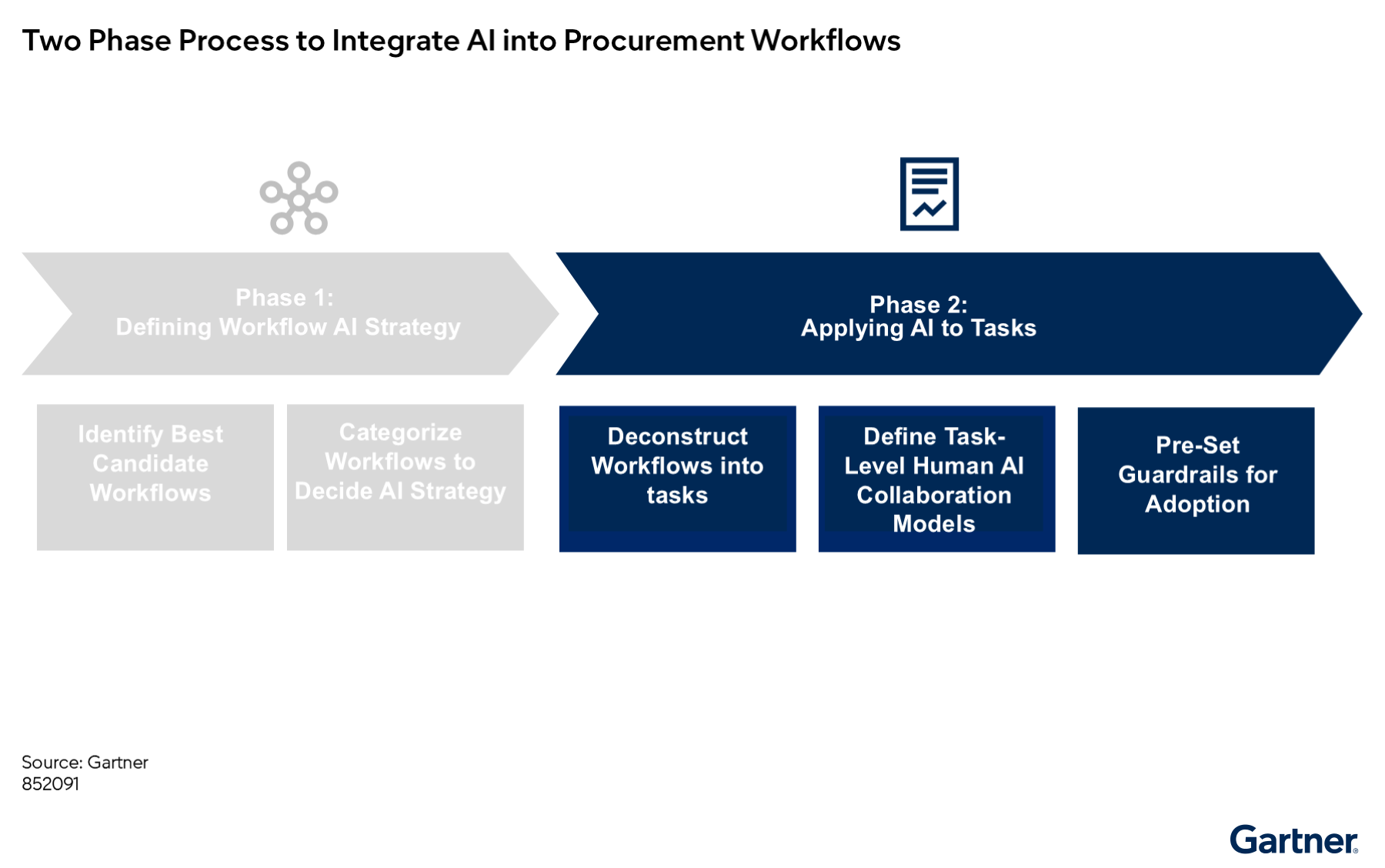
Integrating AI into procurement workflows spans two phases: First, defining workflow AI strategy and then adopting AI at the task level (see Figure 1). This document focuses on the second phase. See CPO’s Guide to Integrating AI Into Procurement Workflows: Defining Workflow AI Strategy for guidance on the first.
Step 1: Deconstruct Workflows Into Tasks
Instead of treating any workflow as a single block — for example, looking at the entire strategic sourcing process together — breaking it into smaller, discrete steps helps identify individual tasks, decision points and hand-offs between people/systems and checks and approvals. This allows you to:
- Surface the implicit rules of underlying workflows.
- Identify friction points.
- Identify AI opportunities for each task based on its complexity, variability and decision-making requirements.
Simplify Before You Automate
Slow and cumbersome workflows undermine AI transformation gains, reinforced by the false belief that technology alone will fix broken workflows. Before mapping AI solutions, ensure that you are working with the leanest version of your workflow which doesn’t compromise compliance or performance.
See Simplify Procurement Processes With Assumption-Busting Sprints to understand how Pharmavite leverages two-week-long assumption-busting sprints to eliminate its most cumbersome process requirements.
Figure 2 provides an example of workflow deconstruction for strategic sourcing. Here workflows are articulated at the broadest level and subsequently deconstructed into tasks.
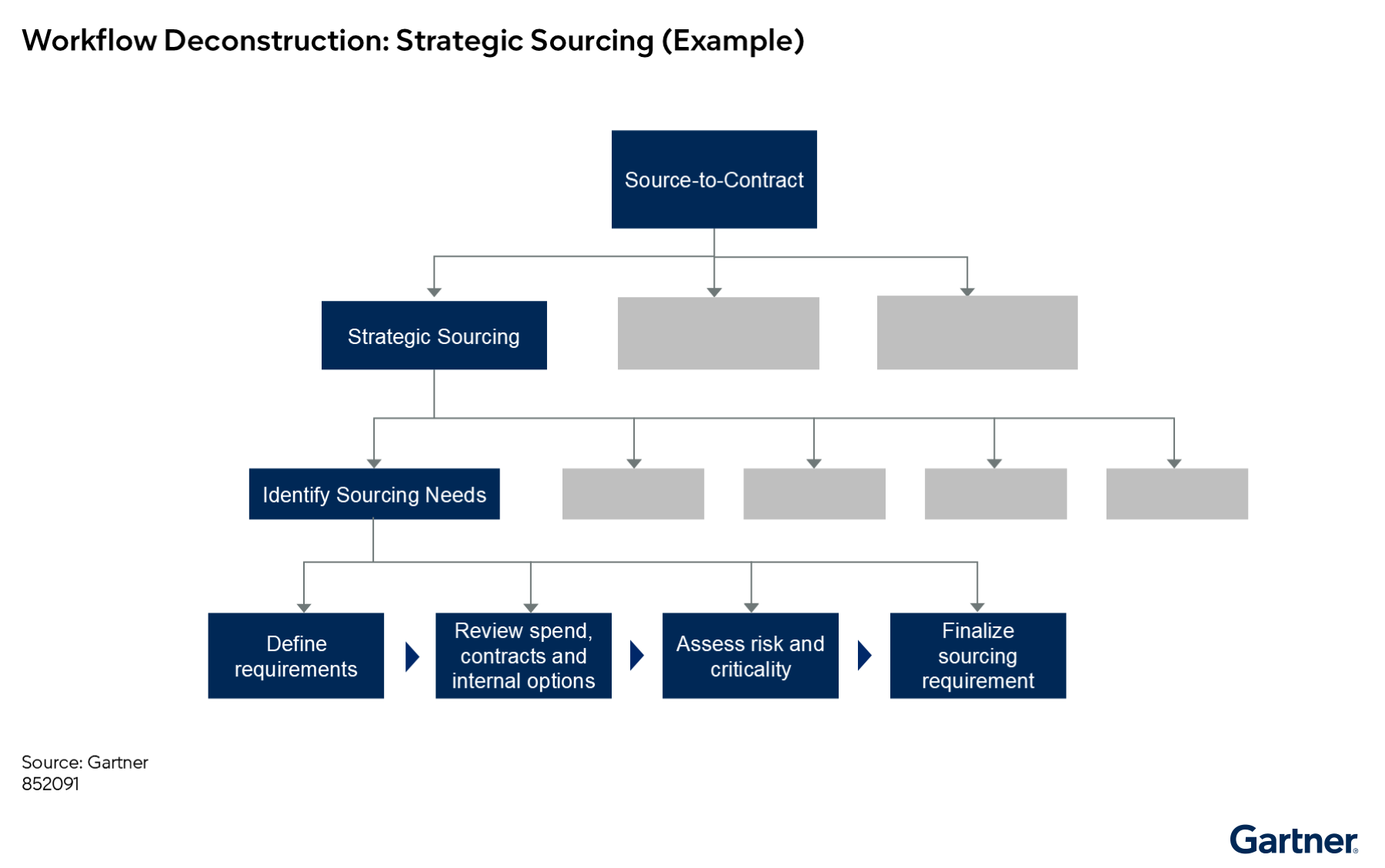
Work with your team to map the workflow manually using flowcharts (manual process mapping). If you need deeper insights, especially if considering agentic AI, you can use technology capabilities such as process mining and task mining (see Table 1).
Technology Capabilities Supporting Workflow Decomposition
Technology Capabilities | Technical Functionality | Technical Considerations |
Process mapping | Creates visual flowcharts of how work is done. Helps decompose business objectives into workflows and tasks. | Needs time from business stakeholders. Best when integrated with existing process tools. |
Process mining | Employs algorithms to extract process models from event logs. Good for systems with extensive digital activity logs. | Requires access to detailed system log data. Will need computing power and data preparation. |
Task mining | Uses desktop-level data capture to analyze user interactions with applications. To be used in high-frequency tasks performed on digital platforms. | Must comply with data-privacy regulations; may require installing software on employee devices. |
Source: Gartner (May 2026)
See Ignition Guide to Source-to-Pay Process Mapping for guidance on how to create manual process maps for the source-to-pay processes. The underlying process-mapping principles are adaptable and can be extended to all procurement workflows within the organization.
Step 2: Define Human-AI Collaboration Model for Each Task
At this stage, you would already have a high-level strategy for the end-to-end workflow and a set of tasks, which are the outcome of Step 1. The focus now shifts to making specific investment decisions and AI governance choices.
While the AI strategy acts as a guide for the entire workflow, its operationalization will vary at the task level.
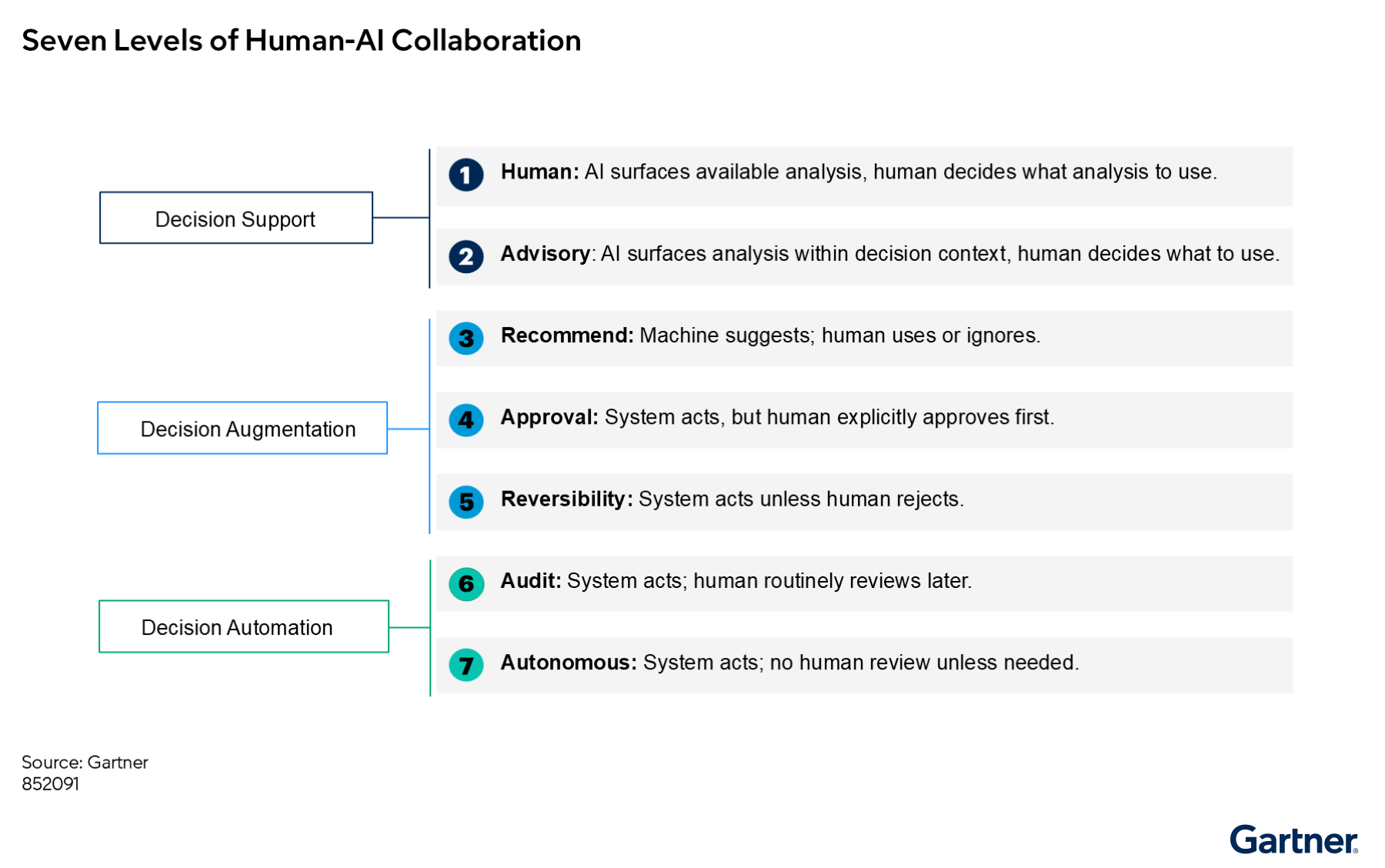
Choose between seven levels of human-AI collaboration for each task as shown in Figure 3. Your choice will depend on the nature of the task (task variability, dependencies on other tasks) and balance between risk of error and opportunity. Each collaboration level explicitly governs AI permissions for the task, from advisory support through fully autonomous execution. This will influence the final set of approved AI tools.
The initial configuration is a starting point. When scaling, empower the team to fine-tune the balance of formalization and autonomy within tasks, for example:
- Spot Buy Execution: Most spot buys follow a recommend-with-approval model, but in emergency cases, the collaboration level shifts to human-led execution so buyers can act immediately.
- Supplier Risk Monitoring: AI provides routine daily risk recommendations but escalates to an audit-level collaboration during material events (for example, bankruptcy), triggering automated requests for information to suppliers while humans review and decide next steps.
Use a Co-Creation Approach to Crowdsource Best-Fit AI Solutions
Map each task to an AI use case that aligns with the selected human-AI collaboration model. Avoid preselecting specific solutions through a top-down decision. Instead, use a co-creation approach to crowdsource best-fit ideas from the teams who will execute the tasks. This builds trust, reduces resistance and accelerates adoption because employees place greater value on solutions they help shape. Use the Presentation Slides: AI Case Study Library for Procurement to expose staff to real-world examples and help them Avoid These Misconceptions About AI to Drive Value.
Enable Specific Task Microexperiments to Inform AI Solution Choice
Before entering formal piloting, CPOs should encourage bottom-up microexperiments in which employees informally test AI solutions within procurement tasks for which the human-AI collaboration model has been defined. This will help surface which solutions perform best for specific tasks within workflows by identifying differences in output quality and usability.
For example, if RFP evaluation is an area for which you want to use AI augmentation as a “recommender” (see Figure 3), ask employees to run the same summarization and risk identification task across multiple LLM tools (such as Copilot, ChatGPT or Gemini) and report which performs best.
These insights can then be used to determine which technologies and use cases advance to formal pilots. This two-stage approach ensures that while ideation at the solution level is decentralized and inclusive, execution remains uniform and is driven by leadership priorities.
See Top 5 AI Adoption Tactics for Chief Procurement Officers for guidance on how to involve employees and managers in procurement’s AI transformation.
Step 3: Preset Guardrails for Purpose-Driven Adoption
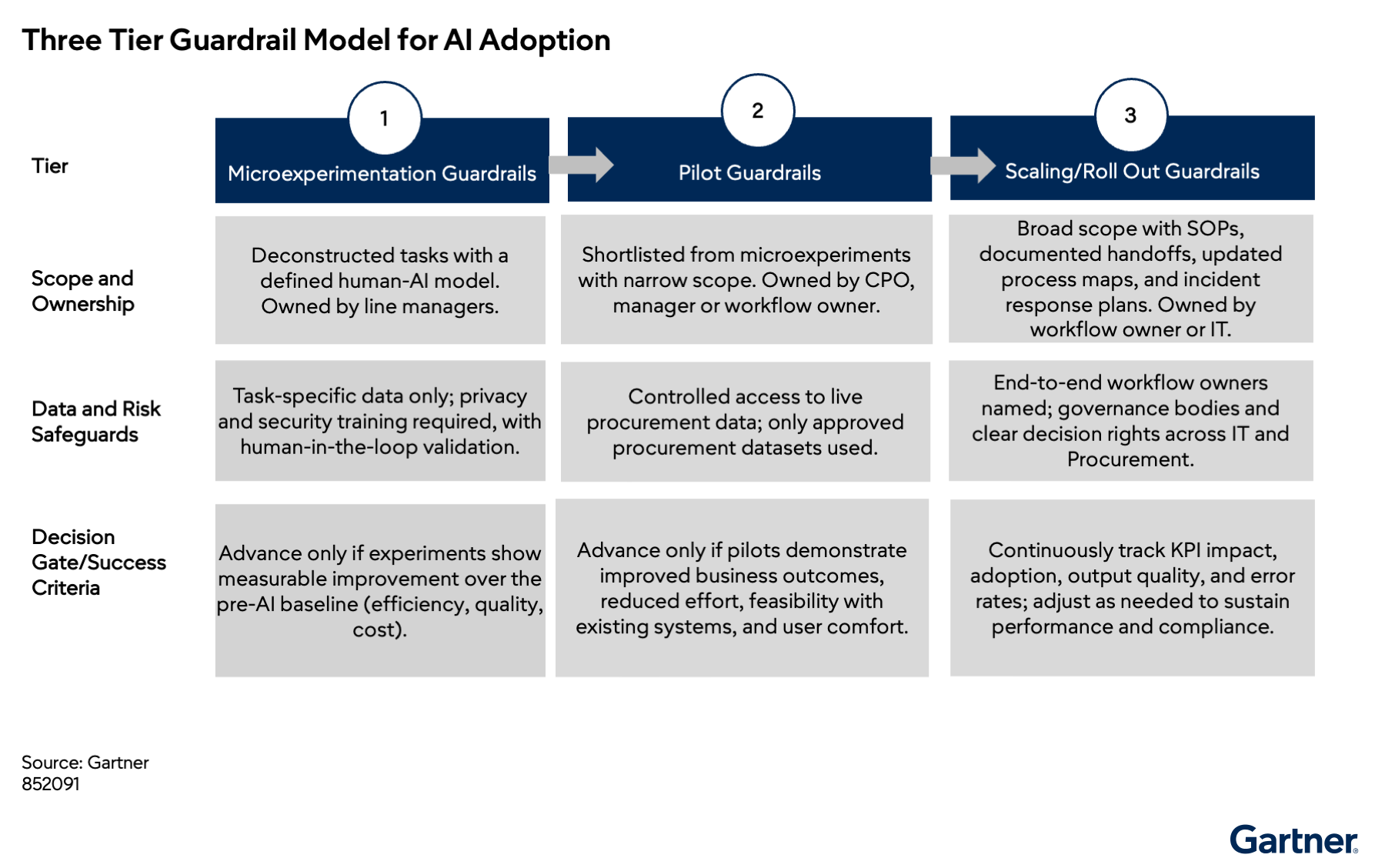
Before rollout, CPOs must preset three tiers of guardrails (see Figure 4) to ensure consistent execution for all parties working across the workflow. Formalize guardrails for responsible AI use, enabling microexperimentation within a defined safety boundary while enforcing continuous improvement and performance standards. Clarify the:
- Workflows in scope and their ownership: CPOs own the guardrail framework end to end, defining the scope and delegating responsibility to managers, workflow owners and governance bodies at each tier.
- Data and risk safeguards: CPOs ensure guardrails embed data privacy, access controls, acceptable error thresholds and adhere to organization policies. Managers enforce these standards locally, while end users are accountable for compliance in daily tasks.
- Success metrics and decision gates: CPOs evaluate baseline and postintervention outcomes, including efficiency (time saved per task, turnaround time), quality (decision accuracy, error rates, stakeholder satisfaction), and business impact (cost reduction, improved compliance, revenue lift). CPOs set evaluation criteria and managers or workflow owners monitor results.
With guardrails in place, CPOs can confidently move to piloting and iteration. Expand scope cautiously, begin with a single workflow, then a cluster, and only then progress to functionwide orchestration. This staged approach ensures innovation remains controlled, compliance is preserved and AI adoption scales reliably with measurable impact.
Success Measures
CPOs can evaluate progress in integrating AI into procurement workflows by measuring improvements in the following KPIs:
- Impact on Enterprise Objectives: Evaluate whether AI-enabled workflows are improving targeted procurement outcomes identified in CPO’s Guide to Integrating AI into Procurement Workflows: Defining Workflow AI Strategy.
- Workflow cycle time reduction = (Baseline workflow cycle time − Post-AI cycle time) / Baseline cycle time × 100.
- Error rate reduction = (Baseline number of workflow errors − Post-AI workflow errors) / Baseline workflow errors × 100
- AI pilot success rate = (Number of AI pilots meeting predefined success criteria / Total pilots run) × 100.
1 2024 Gartner GenAI and AI in Supply Chain Survey. This survey explored the use of generative AI (GenAI) and AI tools in supply chain organizations to boost productivity, reduce costs, and assess their impact on talent and employee experience. The data was collected online from 4 June through 12 August 2024. In total, 265 respondents were surveyed in English across North America (n = 121), Western Europe (n = 81) and Asia/Pacific (n = 63). Of the respondents, 102 were people managers (leaders), while 163 were staff (individual contributors). One hundred seventy-eight respondents reported their primary work location was in a corporate office location or desk-based remote work, while the other 87 reported their primary work location was either in a production/manufacturing facility or in a location that requires them to be physically present, including, but not limited to, warehousing facilities, supplier locations or transportation. Respondents were asked a series of questions regarding their organization’s current use of GenAI and AI as productivity-enhancing tools. Questions regarding changes in time savings, the amount of work output and work quality as a result of AI and GenAI implementation were asked to collect leaders’ team output and individual contributors’ own output. Employee experience feelings were measured by assessing the anxiety and career security induced by GenAI and AI tools. Additional questions were asked to provide insight into how supply chain KPIs, including, but not limited to, ROI, cost to serve and on-time in-full, changed in relation to AI and GenAI investment size. Disclaimer: The results of this survey do not represent global findings or the market as a whole, but reflect the sentiments of the respondents and companies surveyed.