Magic Quadrant for Accounts Payable Applications
18 June 2026 - ID G00835012 - 41 min read
By Miles Onafowora, David Condon
AP software now leverages AI for dynamic workflow approvals, real-time fraud detection and global e-invoicing compliance. Using these applications, CFOs can fast-track the time to process an invoice, unlock early payment discounts and drive strategic insights from AP data for working capital optimization.
Market Definition/Description
Gartner defines the accounts payable application market as cloud-based solutions that use intelligent automation to empower finance teams to independently manage end-to-end invoice processing, execute payments, and maintain master data across one or more ERP systems. These applications deliver configurable workflows, real-time analytics, and integration with procurement and treasury systems, creating a unified and scalable accounts payable operation.
Organizations rely on accounts payable (AP) applications to efficiently manage a broad spectrum of financial obligations, including invoices, recurring payments, and other payables supported by various forms of documentation. These solutions help ensure that outgoing payments are processed accurately and on time, supporting both operational continuity and financial control.
Modern AP platforms are designed for flexibility, scalability, and seamless integration. Their modular, cloud-based architecture allows organizations to configure workflows that align with business needs and industry standards. Integration with ERP systems and other core financial applications ensures data consistency and end-to-end visibility. These platforms also connect with procurement systems, banking partners, and payment service providers, enabling centralized management of payment operations. The ability to accept payment requests in multiple digital formats supports the diverse requirements of suppliers, vendors, employees, and other payees, enhancing operational agility. Additionally, AP solutions facilitate internal processes, such as employee expense reimbursements, providing a unified approach to managing all outgoing payments.
Intelligent automation is a defining feature of today’s leading AP applications. These platforms use technologies such as artificial intelligence, machine learning, natural language processing, robotic process automation, and advanced data capture to transform AP operations. Intelligent automation not only reduces manual intervention, it also improves data accuracy, accelerates processing times, and ensures compliance with internal policies and regulatory requirements. It provides real-time visibility into payment workflows and process performance, empowering teams to make informed decisions and respond proactively to exceptions.
The most common business problems addressed by accounts payable applications include:
- Improving efficiency by automating and simplifying AP processes
- Providing better visibility into payment activity and cash flow
- Supporting financial controls and compliance through built-in safeguards
Mandatory Features
The mandatory features for this market include:
- Invoice processing automation — The ability to provide automated workflow management of a wide range of expenses, including supplier and vendor invoices, recurring payments, and other financial obligations. This encompasses automated capture, matching, coding, validation, and approval workflows for invoices, statements, contracts, and other supporting documentation.
- Cloud-based — The product must be a cloud-based application.
Optional Features
The optional features for this market include:
- Payments — The ability to initiate payments for various financial obligations, including supplier and vendor invoices, recurring payments, and other payables, via electronic transfers, checks, virtual cards, or other remittance methods. This also includes the capability to transmit payment remittance information to external payees or to provide seamless integration with ERP applications to facilitate payment processing and reconciliation.
- Master data management — The ability to centrally create, maintain, and govern core data records, such as supplier, vendor, and payee information, ensuring data consistency, accuracy, and integrity across all accounts payable processes and integrated financial systems.
- Payment audit — The ability to validate against internal policies and general regulatory requirements through invoice and expense reviews, approval workflows, audit trails, and internal compliance reporting.
Magic Quadrant
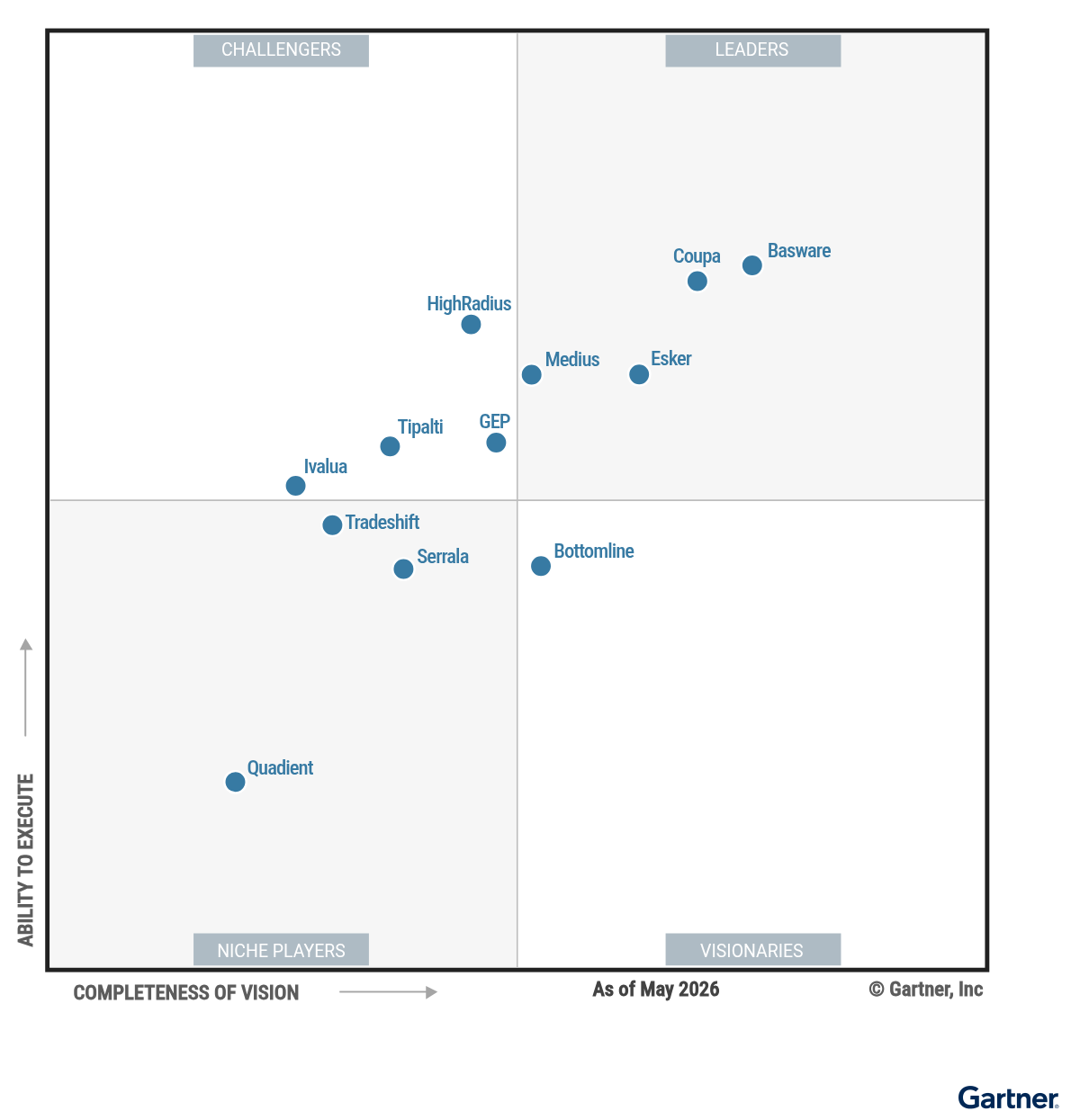
Vendor Strengths and Cautions
Basware
Basware is a Leader in this Magic Quadrant. Its product, Basware Invoice Lifecycle Management, delivers AI-powered invoice capture and touchless workflow automation. Basware’s open e-invoicing network solutions improve supplier collaboration, eliminate paper-based processes and enable continuous, global compliance.
A key innovation is its AP Protect AI engine, which proactively blocks fraud and anomalies in real time, helping to safeguard spend and reduce overhead required for manual reviews. Notably, its AI-powered SmartCoding automates general ledger (GL) coding and exception handling, accelerating invoice processing, minimizing errors and delivering higher straight-through processing rates.
Over the next 12 months, Basware plans to expand GenAI and AI-driven automation capabilities into its supplier management and predictive workflow management modules for improved invoice error detection.
- Workflow intelligence: Basware offers advanced invoice processing capabilities that combine business rules, user behavior and invoice data. The solution leverages governed autonomy for controlled AI to adapt to changing business needs, eliminating bottlenecks using automatic approval and exception routing.
- Network capabilities: Basware’s supplier network enables CFOs to monitor supplier reliability and compliance risks and compare AP metrics, such as payments, invoice approval rates and process costs, against aggregated, anonymized peer data. This visibility also enables better optimization of cash flow.
- Global compliance: Basware supports global e-invoicing requirements in more than 60 countries, automatically adapting to local tax laws and reporting mandates. Its compliance engine continuously updates to reflect global standards, minimizing regulatory risk and audit exposure.
- Pricing: Basware’s pricing structure includes multiple components such as transaction volumes and add-ons. This can reduce cost predictability and make it harder for CFOs to forecast total cost of ownership, particularly as usage scales.
- Third-party service: Key elements of Basware’s application, including hosting and payment execution, rely on third-party vendors. Organizations should evaluate vendor accountability, service-level alignment and operational governance across these external providers to ensure support resilience, incident management and compliance requirements.
- Customer support: Organizations with complex AP environments or global service requirements should evaluate Basware’s support coverage, escalation processes and service-level agreements to ensure alignment with requirements for response times, regional support and 24/7 availability.
Bottomline
Bottomline is a Visionary in this Magic Quadrant. Its product, Paymode, automates invoice capture, payment processing and compliance checks for accounts payable. Finance leaders can monitor payment activity, reduce manual tasks and ensure adherence to regulatory requirements throughout the AP process.
A key innovation is its Paymode network, which enables secure, automated payments and rebate generation, helping to optimize cash flow and reduce payment fraud. Notably, its AI-powered payment validation monitors digital behavior and payment patterns in real time, helping to identify and prevent suspicious transactions before funds are released.
Over the next 12 months, Bottomline plans to enhance its AI-driven invoice capture, ERP integrations and analytics for payment optimization.
- Integration flexibility: Bottomline’s Paymode platform supports file-based, API and webhook integrations with leading ERP and AP systems. Finance teams benefit from real-time data consistency, configurable workflows and secure authentication, enabling efficient payment processing and reconciliation across diverse environments.
- Messaging strategy: Bottomline communicates cost control, risk reduction and process-efficiency-focused product messages using real customer examples and process outcomes. This focus on practical results helps finance teams assess how the solution aligns with their operational needs and priorities.
- User feedback: Bottomline incorporates feedback from user groups, customer reviews and partners to identify AP trends and evolving priorities, such as simplifying invoice ingestion and improving process efficiency. This approach has led to expanded invoice submission options that reduce manual work, improve reconciliation and increase flexibility in AP processes.
- Analytics scope: Bottomline provides standard approval time metrics, but users must manually configure reports or extract data to gain deeper insights into AP processing trends. This can increase the effort required to identify process bottlenecks and opportunities for improvement.
- Performance metrics: Although Bottomline supports AI-powered invoice processing, there is limited visibility into advanced self-learning metrics or detailed audit trails of accuracy improvements. Buyers may need to further evaluate the platform’s visibility into continuous learning and performance tracking.
- Customer support: Support is limited to extended weekday hours, and access to health dashboards is not as mature compared to some competitors. Regional teams operating outside standard hours may experience delays in issue resolution or limited visibility into AP performance.
Coupa
Coupa is a Leader in this Magic Quadrant. Its AP application delivers AP automation, AI-driven invoice capture and integrated spend analytics. Coupa’s community intelligence for benchmarking and advanced supplier risk management improve compliance and AP performance for global enterprises.
A key innovation is Coupa’s community-driven AI, which leverages anonymized data from the Coupa community to provide predictive insights and optimize invoice processing outcomes. Notably, its InvoiceSmash automates invoices into standardized invoice formats and reduces manual data entry and errors.
Over the next 12 months Coupa plans to introduce Compose, a tool that lets users create and manage custom workflows in a low-code environment, linking its Intake & Orchestration to other systems through Navi Connect.
- Supplier Portal: Coupa offers a centralized supplier directory with onboarding workflows, compliance and risk checks, and performance analytics. Suppliers can query invoice status and share discounting options in real time through self-service portals, enabling finance teams to streamline segmentation, monitor risk and optimize working capital opportunities.
- Global compliance: Coupa manages e-invoicing regulations across more than 50 countries and integrates payment options within AP workflows. CFOs can address international regulatory requirements and streamline payment processes without separate compliance logic.
- Customer collaboration: Coupa incorporates customer input into its product roadmap strategy using advisory boards and user groups to prioritize new features. Customers can engage directly with the vendor on future product releases, allowing better product alignment to user requirements.
- Pricing: Coupa’s hybrid user- and transaction-based pricing, along with credit-based charges for advanced next-gen AI features, introduces variability beyond standard modular pricing. As organizations expand usage or adopt advanced AI, costs may fluctuate unexpectedly, making budgeting and forecasting more challenging for AP teams.
- Dashboard customization: Coupa’s interface lags behind other leading vendors; the ability for users to tailor dashboards to specific roles or workflows and visual reporting capabilities is limited, with less-intuitive views, and offers a more standardized approach.
- Coding rules: Coupa’s AP application uses a rule-based hierarchy and machine learning (ML) to assign GL codes, but resolving conflicts or adjusting rule priorities is less-intuitive than with some competitors. AP teams must manually review and configure settings, making complex coding scenarios more time-consuming to manage.
Esker
Esker is a Leader in this Magic Quadrant. Its product, Esker Accounts Payable, delivers template-free AI invoice capture and automated compliance. Esker’s Supplier Inquiry Management performs intelligent dispute handling and dynamic discounting, reduces approval cycles and improves working capital.
A key innovation is Esker’s AI-driven triage, which uses ML and user feedback to prioritize invoice exceptions. Notably, this capability reduces manual intervention by automatically flagging and routing exceptions, enabling AP staff to focus on more complex tasks and improving overall efficiency in invoice processing and exception resolution.
Over the next 12 months, Esker plans to launch AI-augmented AP agents and expanded ERP integrations for invoice prioritization and more visible AP compliance.
- Intelligent automation: Esker uses AI to automate exception handling, suggest coding for invoices using both historical and invoice line-item data, and identify anomalies in AP processes. This supports faster routing for approvals and strengthened internal controls, while reducing manual oversight.
- Workflow flexibility: Esker’s product supports configurable workflows and multilevel approvals, allowing organizations to customize the AP approval workflow to their organization’s structure. CFOs can adapt AP management to fit evolving business and compliance needs.
- Product strategy: Esker advances its AP application through a structured R&D pipeline and research-backed pilots that move new technologies from prototype to production. This approach gives finance teams early access to validated innovations, supporting informed technology adoption and reducing implementation risk.
- Native capabilities: Esker’s AP application is dependent on ERP integration for some regulatory invoice and tax reporting, in comparison to other vendors in the Leader quadrant that offer more-comprehensive native compliance features. This reliance could increase reconciliation steps or require additional IT resources.
- Market messaging: Esker’s recent marketing focuses on adding AI-driven features and enhanced benchmarking, but messaging around these shifts is not consistently differentiated or supported by clear outcome data. As a result, finance leaders may find it challenging to assess the unique value of these emerging AI updates compared to competitors.
- Withholding calculation: Esker relies on external systems to calculate withholding taxes, rather than handling these calculations natively within its AP application. This approach may require additional integration effort and limit automation for organizations that prefer centralized tax management within a single solution.
GEP
GEP is a Challenger in this Magic Quadrant. Its product, GEP SMART AP Automation, delivers native invoice processing, AI-powered invoice capture and automated compliance workflows. GEP’s dynamic discounting and supplier risk management unlocks cash flow improvements through early payment discounts while proactively managing supplier risks.
A key innovation is its AI-driven invoice anomaly detection, which proactively identifies fraud and exceptions to support secure AP operations. Notably, the application combines deterministic rules with probabilistic matching and machine learning to enhance detection accuracy across complex, high-volume-invoices environments.
Over the next 12 months, GEP plans to enhance its AP intelligence offering with autonomous invoice resolution, predictive exception handling and AI agents to support touchless processing.
- Global support: GEP offers multilingual, 24/7 support, and a dedicated customer success team, serving complex, multiregion requirements. This structure ensures faster issue resolution and better continuity benefits for finance teams managing global supplier networks and cross-border transactions.
- Invoice controls: GEP’s application integrates supplier management with invoice validation, payment status tracking and compliance checks, linking supplier data to financial workflows. CFOs benefit from improved accuracy in payments, reduced risk of duplicate invoices and strengthened audit trails for AP.
- Phased deployment: GEP uses a collaborative approach during the AP deployment across procurement, finance and IT that support improved adoption rates. CFOs can benefit from reduced transition risks with GEP’s supplier onboarding and workflow configuration services.
- CFO-facing roadmap: GEP has introduced AI-driven capabilities for invoice processing and exception handling; however, advanced autonomous processing capabilities remain limited to specific workflows or customer deployments. CFOs may require additional configuration, governance and human oversight before scaling touchless AP operations broadly.
- Ecosystem flexibility: GEP’s AP application is built on a unified platform with a focus on native capabilities, but support for third-party extensions, plug-ins and open developer frameworks is less-extensive than some open-architecture competitors. This may limit the ability of finance teams to rapidly adopt or build niche AP innovations outside GEP’s core roadmap.
- Analytics depth: GEP supports operational AP reporting and dashboarding; however, organizations seeking advanced predictive analysis, enterprisewide KPI modeling, or consolidated analytics across finance and procurement applications should assess GEP’s current out-of-the-box capabilities against their requirements.
HighRadius
HighRadius is a Challenger in this Magic Quadrant. Its product, HighRadius AP Automation Software, delivers native payment processing, AI agents for invoice capture, and intelligent exception management. HighRadius’ supplier onboarding automation and real-time fraud detection support enterprise-grade compliance and operational efficiency.
A key innovation is its autonomous AI agents, which handle invoice approvals and exception resolution, enabling faster cycle times and reducing AP workload. Notably, its AP application achieves over 98% header-level and 95% line-level accuracy on invoice processing while supporting 50+ languages, significantly reducing manual data entry.
Over the next 12 months, HighRadius plans to launch new AI-driven AP capabilities by expanding predictive models and exception-handling workflows, building on its ability to analyze historical invoice data and prioritizing workloads based on due dates and payment terms.
- Pricing: HighRadius uses an outcome-based pricing model, linking fees to metrics in AP performance such as reduced processing times or increased automation. This approach allows CFOs to better align technology costs with measurable business outcomes, ensuring investment is tied directly to AP process improvements and shared risk with the vendor.
- Intelligent workflow: HighRadius uses AI-driven workflow automation to route invoices, manage approvals and prioritize exceptions, based on predefined rules and historical transaction patterns. This helps AP teams accelerate invoice processing, reducing manual intervention and improving policy compliance across high-volume invoice environments.
- Exception routing: HighRadius automates both exception flagging and intelligent routing based on exception type, user role and business rules, reducing manual triage. This offers faster invoice resolution and lower risk of delayed payments due to human error.
- Integration: HighRadius provides 50+ ERP integrations and is listed on major marketplaces, but compared to some leading competitors, there is greater reliance on flat-file formats for legacy systems and fewer certified, out-of-the-box ERP adapters. The absence of webhook support means finance IT teams may need to use standard APIs for real-time data synchronization.
- Mobile access: HighRadius does not offer a dedicated mobile app for AP. Additionally, users rely on a responsive UI for approvals through email, Slack or Teams. This may not meet CFOs’ needs, especially for teams requiring robust on-the-go capabilities.
- Market presence: While HighRadius maintains a solid core customer base, it is still expanding its independent customer references in certain target regions compared with other established competitors, which may impact buyer confidence in those specific areas.
Ivalua
Ivalua is a Challenger in this Magic Quadrant. Its product, Ivalua AP Automation, delivers native invoice processing, uses AI to capture invoice data and offers configurable workflow automation. Ivalua’s supplier performance management supports unified data and workflows by integrating AP data across different ERPs.
A key innovation is its AI-driven supplier risk scoring, which provides proactive alerts and insights to mitigate compliance and fraud risks. Notably, its dynamic risk-scoring methodology allows AP and procurement teams to proactively identify high-risk suppliers.
Over the next 12 months, Ivalua plans to launch autonomous AP workflows for buyer-issued purchase orders in invoice processing, enabling more touchless AP operations with adaptable human oversight.
- Configurable modules: Ivalua provides configurable modules designed to support invoice compliance with sector-specific regulations, such as HIPAA and FDA-regulated industries. System administrators can adapt AP processes to meet regulatory requirements without extensive custom development.
- Supplier portal: Ivalua’s supplier self-service portal enables real-time invoice and payment status tracking, and dispute management, reducing queries back to the AP finance team. CFOs see improved supplier relationships and lower operational overhead in AP inquiries.
- Pricing: Ivalua’s pricing model offers a core AP automation subscription with built-in AI and ML tools for invoice validation and fraud detection, with modules like invoice data capture and supplier risk management licensed separately. Organizations can configure the application and avoid unnecessary spend on unused features.
- Payment initiation: Ivalua’s AP application does not support the initiation of domestic wire transfers directly from the application. This limitation could result in the need for manual intervention or reliance on external systems for completing these payments.
- User feedback: Ivalua’s process for incorporating user feature enhancements is primarily driven by procurement-focused customers, which can make AP- and finance-specific updates less visible. Finance buyers should carefully evaluate whether their requirements will be prioritized and clearly communicated within Ivalua’s roadmap.
- Analytics roadmap: Ivalua’s AP predictive analytics are limited to basic forecasting and anomaly detection, without advanced features such as real-time risk scoring, automated cash flow optimization or predictive exception management. CFOs are limited in their abilities to act early and take proactive measures to optimize working capital and prevent payment issues.
Medius
Medius is a Leader in this Magic Quadrant. Its product, Medius AP 360, combines AI-driven invoice processing, supplier inquiry automation and intelligent exception management to support AP efficiency, processing accuracy and operational visibility.
A key innovation is Medius’ AI-driven exception prediction and resolution, which is designed to streamline AP workflows and reduce manual intervention. Notably, Medius’ AP AI models are trained on over $400 billion of annual transaction data to support real-time supplier assistance, automate query handling, and help identify duplicate payments and potential fraud risks.
Over the next 12 months, Medius plans to extend its AI orchestration capabilities across its spend suite and further expand embedded analytics capabilities to improve workflow optimization, operational visibility and actionable operational insights for finance organizations.
- AI-enabled exception management: Medius leverages AI to proactively identify anomalies and process bottlenecks throughout the invoice life cycle, using LLMs to analyze data for issues such as discrepancies between invoices and POs or duplicate entries. CFOs benefit from real-time risk scoring and automated alerts, enabling AP teams to address workflow delays sooner.
- Auditability: Medius provides audit trail capabilities across AP workflows, capturing actions and changes at each stage of the invoice cycle with automated logging. This strengthens financial governance, as all activities can be tracked and reviewed to support control, compliance and external audit purposes, while providing the transparency and traceability required to support AI-driven autonomous financial operations.
- Product strategy: Medius uses structured pilot programs, phased feature rollouts and telemetry-driven feedback to refine new functionality before broad release. This will help AP organizations adopt new automation capabilities with lower operational disruption, improved usability and reduced deployment risk.
- Disaster recovery: Medius primarily operates customer environments in a single region with built-in redundancy, while cross-region recovery is reserved for exceptional scenarios. For organizations with large-scale or multiregion deployments, this model may introduce additional complexity and considerations for operational readiness and risk mitigation.
- Global e-invoicing: Medius relies on third-party partners to support portions of its global e-invoicing and compliance coverage across certain jurisdictions. CFOs should evaluate regional capability and integration requirements based on geographic and regulatory needs.
- Payment providers: Medius leverages a network of partners to enable payment execution and financing capabilities. While this expands functionality, organizations may require additional coordination across payment providers to maintain consistent workflow visibility and status tracking.
Quadient
Quadient is a Niche Player in this Magic Quadrant. Its product, Quadient Accounts Payable Automation, provides invoice processing and configurable workflow automation. Quadient’s two-way and three-way invoice matching helps organizations improve processing accuracy and reduce manual intervention across AP workflows.
A key innovation is Quadient’s use of AI-driven invoice capture and intelligent document processing to support automated extraction, validation and workflow routing across multiple invoice sources. Notably, Quadient’s workflow automation and analytics support fraud alerts, approval optimization and improved visibility into AP processing.
Over the next 12 months, Quadient plans to expand workflow automation, reporting capabilities and approval management functionality, while enhancing support for vendor onboarding coordination processes.
- Invoice capture: Quadient’s AI-driven document processing layer refines extraction accuracy by learning from historical transactions and user feedback. Combined with ERP-based validation and reporting on accuracy metrics, this provides finance teams with improved automation and clear visibility.
- System integration: Quadient provides strong integration support across a range of midmarket ERP systems. Its connector-based model allows integration with existing finance systems with minimal disruption.
- Approval flow: Quadient’s approval framework allows for defining complex routing rules based on multiple business criteria, with support for delegation, escalation and real-time monitoring of approval status. This enhances governance while improving processing efficiency and reducing the risk of delayed approvals.
- Supplier self-service portal: Quadient primarily relies on email-driven invoice submission workflows, while broader supplier self-service portal capabilities remain limited. This increases reliance on manual interaction for invoice submission for AP teams, compared to vendors with more mature supplier portal functionality.
- Fraud controls: Quadient’s fraud control focuses on rule-based validations like IBAN checks and duplicate detection, rather than predictive or AI-driven scoring. This lack of visibility limits the ability to proactively manage and optimize fraud risk, compared to more advanced applications.
- Split ownership: Quadient relies on the ERP as the system of record for supplier data, while payment onboarding and validation are handled by external partners. This separation creates dependencies across multiple systems, reducing CFO visibility and increasing coordination effort for finance teams managing supplier and payment processes.
Serrala
Serrala is a Niche Player in this Magic Quadrant. Its product, Alevate AP, combines invoice processing, AI-driven capture and compliance-focused workflow automation to support global AP operations. Serrala differentiates through its integration of AP automation with payment controls, multicurrency support and centralized bank connectivity capabilities.
A key innovation is Serrala’s AI-driven fraud detection and payment risk monitoring capabilities, which analyze invoice, supplier and payment activity to identify anomalies and potentially fraudulent transactions. Notably, Serrala provides explainability features that help users understand why transactions are flagged as higher risk, supporting finance teams in fraud investigation and decision-making capabilities.
Over the next 12 months, Serrala plans to enhance e-invoicing and ERP integration, and introduce explainable AI agents to support regulatory compliance and evolving global invoicing requirements.
- AI-driven risk management: Serrala incorporates explainability features into its AI-driven fraud and anomaly detection capabilities, which provide greater transparency into transaction risk identification. This provides more confidence to the finance teams in AI-supported decision making and strengthens fraud investigation processes.
- Global compliance: Serrala supports global compliance requirements, including e-invoicing mandates and tax regulations, for adapting to regional updates and evolving standards. This reduces regulatory exposure and supports CFO confidence in compliance across jurisdictions.
- Application support: Serrala provides application stability supported by incident management and recovery capabilities. This reduces operational risk and supports continuity of finance operations, even in complex or distributed environments.
- Supplier portal: Serrala’s supplier onboarding process requires finance teams to manually support activities such as data validation, document collection and compliance verification. Limited supplier self-service functionality increases administrative effort and reduces scalability for organizations managing high supplier volumes.
- AP analytics: Serrala provides dashboards with predefined metrics and allows users to set custom KPIs, thresholds and alerts. Organizations may need to invest in initial setup and ongoing tuning to achieve optimal insights, compared to vendors with more automated or turnkey analytics capabilities.
- Payment optimization: Serrala relies primarily on predefined payment rules and workflows, rather than dynamic AI-driven payment decision making. This reduces flexibility for organizations seeking more autonomous optimization of payment timing and execution activities.
Tipalti
Tipalti is a Challenger in this Magic Quadrant. Its product, Tipalti accounts payable, combines AI-driven invoice processing, workflow automation and global payment capabilities to support AP operations across multinational environments. Tipalti’s multicurrency payment and supplier management capabilities help organizations centralize payment operations, improve visibility into international payables and reduce reliance on regional banking relationships.
A key innovation is Tipalti’s conversational AI assistant, enabling finance teams to surface instant insights and quickly generate custom reports via natural language queries. Notably, Tipalti’s AI-driven matching capabilities analyze invoice and purchasing data contextually to improve invoice processing accuracy while maintaining user oversight and validation controls.
Over the next 12 months, Tipalti plans to introduce AI-driven tools that automate AP workflows and highlight exceptions for human review. This will help finance teams streamline manual tasks and focus on higher-value activities.
- Invoice automation: Tipalti uses real-time performance monitoring and automated workflows to identify and resolve supplier and transaction issues before payment execution. Customers benefit from improved data quality, reduced payment failures and enhanced AP process integrity at scale.
- Operational continuity: Tipalti delivers continuous system monitoring, automated incident detection and response, and structured recovery protocols across its application offering. CFOs can benefit from uptime guarantees and reduce operational risk and improved confidence in service continuity.
- Fraud detection: Tipalti uses a global payments network to identify and block suspicious activity, using shared data and behavioral patterns across its customer base. This enables the CFO to benefit from network intelligence that enhances fraud detection and strengthens payment beyond internal AP controls.
- Product roadmap: Enhancement requests are prioritized based on midmarket organizations’ demand and platform strategy, which may delay support for features required by large, highly complex global enterprises. CFOs should assess alignment between their future needs and Tipalti’s roadmap to ensure critical capabilities are addressed.
- Customizations and extensions: Extensibility of core functionality is limited beyond standard integrations and its prebuilt connectors. This can constrain CFO flexibility to fully tailor AP processes to unique or changing business requirements.
- E-invoicing: Tipalti’s e-invoicing compliance capabilities are currently focused on a limited set of countries, which requires integration with additional tools to support global mandates. This can increase complexity for organizations seeking a unified approach to compliance across multiple jurisdictions.
Tradeshift
Tradeshift is a Niche Player in this Magic Quadrant. Its product, Tradeshift Accounts Payable Automation, delivers invoice capture, multiway matching and supplier onboarding with native e-invoicing compliance. Tradeshift’s supplier portal is a centralized application for suppliers to submit invoices and track status, and to support personalized outreach.
A key innovation is Ada 2.0 coding with ML, which improves GL coding accuracy with advanced decision-tree logic to reduce manual review in AP workflows. Notably, its coding engine is designed to handle complex and diverse invoice scenarios, improving efficiency and compliance in AP operations.
Over the next 12 months, Tradeshift plans to enhance document processing automation by combining OCR, ML and LLM to improve coding precision, expand anomaly detection, and support higher-volume AP operations with reduced exception-handling effort.
- Embedded analytics: Tradeshift uses anomaly detection, workflow bottleneck identification, and supplier risk insights with statistical models and AI-driven dashboards. These features give CFOs visibility into processes, fraud indicators and invoice cycle performance.
- Enterprise connectivity: Tradeshift supports a wide range of document formats and integration methods, including electronic data interchange, API, and AI-based optical character recognition. This enables finance teams to connect to ERP systems and supplier networks globally.
- Global compliance: Tradeshift combines e-invoicing and tax compliance capabilities with configurable workflow and rules orchestration to support multinational compliance requirements. This enables organizations to manage diverse regional mandates through a more centralized operating model while reducing regulatory complexity.
- Payment orchestration: Tradeshift’s functionality focuses on early payment programs, such as dynamic discounting and supply chain finance, with limited native payment execution. This means CFOs requiring end-to-end payment orchestration will need additional solutions.
- Partnership ecosystem: Tradeshift’s payments and tax support rely on external partners. This creates dependency risks and reduces control for CFOs who are reliant on the performance and stability of third-party providers.
- Governance: Tradeshift’s rule engine and configurable workflows introduce complexity in implementation and ongoing governance. Full realization of automation benefits and maintenance of consistency may necessitate additional process discipline and oversight from CFOs.
Vendors Added and Dropped
We review and adjust our inclusion criteria for Magic Quadrants as markets change. As a result of these adjustments, the mix of vendors in any Magic Quadrant may change over time. A vendor's appearance in a Magic Quadrant one year and not the next does not necessarily indicate that we have changed our opinion of that vendor. It may be a reflection of a change in the market and, therefore, changed evaluation criteria, or of a change of focus by that vendor.
Added
The following vendors were added to this year’s evaluation:
- Bottomline
- HighRadius
- Tipalti
- Tradeshift
Dropped
The following vendors were dropped from this year’s evaluation:
- Airbase (now acquired by Paylocity)
- AvidXchange
- JAGGAER
- Pagero (now acquired by Thomson Reuters)
- SoftCo
- Zycus
Inclusion and Exclusion Criteria
Product Capabilities
Each vendor must deliver a cloud-based accounts payable (AP) application that includes the following product capabilities:
- Supports the mandatory and optional AP application features as defined in the Market Definition section of this research.
- Is deployed as a cloud-based solution via SaaS on a provider-managed public or private cloud.
- Was released for general availability before 1 January 2025 and is actively sold on a stand-alone basis, independent of other offerings or services.
- Provides integration with one or more ERP applications.
- Offers clients a supplier portal for management of invoices, payments, and dynamic discounting.
Market Presence
Each vendor must meet at least one of the following two market criteria:
- Have at least 180 active customers within the live system.
- Have at least 100 active customers within the live system, with a minimum 10% year-over-year customer count growth.
Each vendor must meet all of the following criteria for its AP application:
- Actively market and sell products to 10% of clients that have annual revenue above $1 billion over the last year. The definition of a customer is a single legal entity paying for a stand-alone AP application.
- Support customers with legal entities in at least two of the following regions: North America, Latin America, EMEA, or Asia/Pacific.
- Must service clients in at least five of the following major industries and must also have at least a 2% client portfolio representation in at least five of those industries, ensuring a diverse industry mix:
- Banking, finance, and insurance
- Communications and telecom
- Education, energy and utilities
- Government
- Healthcare
- Life sciences
- Manufacturing
- Media and entertainment
- Professional services
- Retail
- Technology
- Transportation and logistics
Evaluation Criteria
Ability to Execute
Gartner evaluates each vendor’s Ability to Execute by evaluating how specific criteria enable the vendors to be competitive and effective in the market, support their ability to retain and satisfy customers, assist in creating positive perception and help them adequately respond to market changes.
In this Magic Quadrant, the product or service and customer experience criteria are particularly important:
Product or service encompasses the vendors’ ability to deliver current capabilities, a high-quality product, comprehensive feature sets and expertise, with a strong emphasis on functionality that enhances accounts payable application capabilities beyond what customers find in their ERP solutions.
Customer experience evaluates the degree to which a vendor’s products, services, and programs enable customers to achieve their desired results. This includes the quality of supplier/buyer interactions, technical support or account support, as well as ancillary tools, customer support programs, availability of user groups, and service-level agreements.
Sales execution/pricing, market responsiveness/record, and operations are of secondary importance. Overall viability and marketing execution are not rated; by assigning a zero weight to these criteria, the assessment focuses the analysis more heavily on items that are truly differentiating for current AP application customers.
Ability to Execute Evaluation Criteria
| Evaluation Criteria | Weighting |
|---|---|
Product or Service | High |
Overall Viability | NotRated |
Sales Execution/Pricing | Medium |
Market Responsiveness/Record | Medium |
Marketing Execution | NotRated |
Customer Experience | High |
Operations | Medium |
Source: Gartner (June 2026)
Completeness of Vision
Gartner assesses vendors’ Completeness of Vision by evaluating how specific criteria enable the vendors to articulate their perspectives on the market’s current and future direction, anticipate customers’ future needs and technology trends, address competitive forces, and exploit market forces to create new opportunities for themselves and their customers.
In this Magic Quadrant, market understanding, product strategy, and innovation are particularly important:
Market understanding evaluates a vendor’s ability to anticipate and respond to future buyer requirements and industry trends. Strong alignment between product development and the evolving needs of CFOs is an important factor in positioning vendors as Leaders in the Magic Quadrant for accounts payable applications.
Offering (product) strategy involves using insights about buyer needs to shape products and services, emphasizing market differentiation, functionality, methodology and features. This includes focusing on product development and delivery, while integrating strategies to support customers within a broader ecosystem.
Innovation focuses on the marshaling of resources, expertise or capital for competitive advantage, investment, consolidation, or defense against acquisition. This ensures vendors can continuously offer CFOs AP applications that adapt to their evolving requirements.
Vertical/industry strategy assesses a vendor’s approach to allocating resources, expertise, and product features to address the distinct requirements of specific market segments and industries.
Marketing strategy is of secondary importance, while vertical/industry strategy is considered to a lesser extent.
Sales strategy, business model and geographic strategy are not rated, as by assigning a zero weight to these criteria, the assessment focuses the analysis more heavily on items that are truly differentiating for current AP application customers.
Completeness of Vision Evaluation Criteria
| Evaluation Criteria | Weighting |
|---|---|
Market Understanding | High |
Marketing Strategy | Medium |
Sales Strategy | NotRated |
Offering (Product) Strategy | High |
Business Model | NotRated |
Vertical/Industry Strategy | Low |
Innovation | High |
Geographic Strategy | NotRated |
Source: Gartner (June 2026)
Quadrant Descriptions
Leaders
Leaders demonstrate a market-defining vision for how AP applications enable CFOs to move beyond processes efficiency toward intelligent, autonomous finance operations. Their AI, ML, GenAI and AI agent capabilities are natively built into their AP offering, enabling real-time decision making and proactive cashflow management in a continuously monitored environment. These vendors are shaping the future of AP by integrating advanced analytics, predictive insights and orchestration capabilities into a unified application.
Leaders have developed AP applications that extend beyond task automation for invoice ingestion, matching and on-time payment cycles to sustainable intelligent workflow orchestrations across the entire invoice life cycle. These orchestrations require little to no human intervention, pivoting buyer engagement to smart analytics that enable better decisions on how AP operations can inform working capital optimization goals.
Their applications embed AI and agent capabilities that support use cases such as autonomous invoice capture and coding, dynamic exception handling, fraud and anomaly detection, and predictive cash and working capital optimization. By integrating intelligence and AI agents directly into AP processes, they reduce manual intervention while improving accuracy, compliance and operational speed. Leaders demonstrate continued investment in AI and innovation of agent capabilities, setting them apart in a competitive market.
Leaders consistently demonstrate strong market momentum, winning new business across geographies and industries and deepening relationships with their current customer base. They deliver scalable, configurable solutions supported by a robust partner ecosystem, including system integrators, ERP providers and industry-specific solution partners. Their ability to combine product innovation with effective go-to-market execution positions them to influence market direction and deliver measurable business outcomes for CFOs.
Challengers
Challengers demonstrate strong execution capabilities and deliver dependable AP applications that address a broad range of customer needs. Their applications support core AP processes, including invoice capture, processing, payments and compliance, while increasingly incorporating AI-enabled features to improve efficiency, accuracy and control. These vendors have established credibility in the market, supported by a solid customer base, consistent delivery and proven implementation success.
Challengers are enhancing their solutions with AI, ML and GenAI, but these advancements are typically applied to specific use cases, rather than embedded throughout the end-to-end process. Their offerings often optimize discrete activities such as invoice coding, exception handling or fraud detection, rather than enabling fully orchestrated AP operations. As a result, their ability to deliver real-time decision making and predictive insights is more limited, compared to Leaders.
While Challengers excel in execution and provide reliable customer experiences through structured implementation and strong support, their product strategies tend to focus on incremental improvements. Roadmaps are often shaped by immediate customer needs, rather than a forward-looking vision that anticipates broader market trends or evolving CFO requirements. This focus can limit their ability to rapidly respond to shifts in buyer expectations.
A Challenger can advance toward the Leaders quadrant by evolving its product strategies to support more AI-native applications, deeper integration across finance systems, and advanced orchestration capabilities. Embedding intelligence across the invoice life cycle and enabling predictive decision making will help deliver measurable outcomes in areas such as working capital optimization and operational scalability. Developing a more visionary approach and investing in innovation will be important for Challengers seeking to influence the direction of the AP applications market.
Visionaries
Visionaries demonstrate a clear and forward-looking vision for the future of AP, aligning product strategies with emerging trends, such as AI natively built into their core offering, and with a focus on delivering near-autonomous AP processing. Their solutions often challenge traditional AP operating models by embedding intelligent orchestration across workflows and enabling more adaptive, insight-driven processes.
Visionaries are redefining how AP functions operate, introducing capabilities such as autonomous invoice-to-pay processing, dynamic exception resolution and AI-driven decision support. Their application emphasizes flexibility, configurability and rapid innovation, enabling organizations to experiment with new use cases and accelerate digital finance transformation.
Visionaries may face challenges in execution, scalability, or consistency of delivery. While their innovation is compelling, their solutions may not yet be as mature, fully integrated or widely adopted as those of Leaders. Customers may experience variability in implementation outcomes, global coverage or ecosystem depth, and they may need to rely more heavily on partners to support deployment and scaling.
A Visionary can become a Leader by strengthening go-to-market execution, expanding ecosystem partnerships and demonstrating consistent delivery of measurable business outcomes. Conversely, a Visionary may remain highly specialized if it prioritizes innovation over scalability, or focuses on specific segments rather than broader market expansion.
Niche Players
Niche Players focus on delivering specialized AP solutions tailored to specific use cases, industries, geographies or ERP systems. Their offerings are often designed to address targeted requirements, such as e-invoicing compliance, regional invoicing regulations or specific application integrations. While they may incorporate AI and automation, these capabilities are typically focused on discrete functionalities, rather than integrated across the end-to-end accounts payable process.
Niche Players differentiate with deep functionality in specific AP process areas, rather than comprehensively offering it across the full invoice life cycle. Their solutions can provide strong value for organizations with well-defined requirements or niche operating models, particularly where industry-specific functionality or regulatory compliance are priorities. However, their product strategies are generally not oriented toward delivering fully integrated AI-native applications.
These vendors typically have a more limited market presence and customer base, often concentrated within specific regions, industries or existing customer segments. Niche Players can represent a viable option for organizations seeking focused functionality or rapid deployment within a defined scope that will not impact longer-term requirements for end-to-end AP transformation.
Niche Players may evolve into Visionaries by strengthening their product vision and expanding into adjacent capabilities, or they may evolve into Challengers by improving execution, scalability and market reach. Conversely, those that remain niche may continue to serve targeted segments effectively, without expanding beyond their niche.
Context
The following are key considerations and recommendations when assessing vendors in this market:
- Implementation strategies and support: Evaluate each vendor’s existing prebuilt connectors to ERPs, banks and other applications, along with their integration technology capabilities. Assess your existing technology portfolio and how those technologies would best integrate with the AP application you select. You should also know typical implementation time frames and costs.
- AI features: Product features and roadmaps vary among vendors. Assess each vendor’s product roadmap for future automation and AI developments, including anomaly detection and use of GenAI and AI agents to support collaboration. Consider your need for the most advanced and differentiating capabilities, versus products with more limited AI capabilities that might also meet your automation needs.
- Regulatory compliance: Tax regulations and e-invoicing compliance requirements are subject to frequent changes, emphasizing the need to compare these requirements against a vendor’s capabilities. Industries like manufacturing, healthcare, hospitality, public sector and education have unique AP processes that require customized vendor configurations. These tailored setups address the specific needs and operational requirements of each industry, ensuring efficient and effective financial processes.
- Pricing models: Vendors typically provide services through subscription-based pricing, enterprise user plans, tiered pricing or usage-based pricing, often with additional costs for support. Subscription-based pricing is most common because it offers predictable revenue for vendors and manageable costs for customers, with fees calculated on a recurring monthly or annual basis, based on factors like the number of users, modules or transactions. Extra fees may apply for system connectors, such as ERPs or additional modules for procurement integration.
- Ongoing support: Consider the vendor’s escalation process for urgent issues and check if it provides dedicated account managers or technical support contacts. Additionally, ask to preview its self-serve learning and development resources, and inquire about forums for engaging with other companies in the user community.
For further guidance, a more detailed analysis of the service providers’ capabilities with scoring based on different use cases is available in Critical Capabilities for Accounts Payable Applications.
Market Overview
Current Market Landscape
The accounts payable (AP) application market is in a phase of dynamic change as organizations prioritize automation, AI-driven efficiency, compliance and integration to address manual process inefficiencies and regulatory demands. At the same time, CFOs now expect seamless ERP integration, advanced analytics and real-time insights. In response, vendors are investing in AI innovation and enhanced user experience, particularly in global compliance and fraud prevention.
Market Trends
The AP application market is undergoing rapid transformation as organizations prioritize automation, compliance, and integration to streamline financial operations. Vendors are investing heavily in AI-driven features such as intelligent invoice capture, autonomous exception management and predictive analytics, enabling finance teams to reduce manual workloads and improve accuracy. The push for real-time invoice life cycle visibility and seamless integration with ERP, procurement and treasury systems reflect a growing demand for holistic, end-to-end automation that supports business agility and regulatory readiness.
Concurrently, the market is seeing increased adoption of user-centric design, dynamic workflows and advanced supplier collaboration tools, making AP applications more accessible and adaptable for distributed workforces. The emergence of AI agents is accelerating the shift toward applications that can proactively manage exceptions, detect anomalies and optimize processes with minimal human intervention. As global e-invoicing and tax mandates evolve, embedded compliance automation has become a key differentiator, prompting vendors to deliver jurisdiction-specific features and robust audit trails.
As AP applications evolve, the market is seeing a surge in features that enable greater transparency, control and agility across the invoice life cycle. Recent innovations include real-time invoice life cycle visibility, embedded supplier collaboration tools and advanced analytics that surface actionable insights for spend optimization and risk mitigation. There is also a growing emphasis on adaptive approval workflows and automated compliance checks that can dynamically adjust to changing business rules or regulatory requirements. These advancements are helping finance teams move from transactional processing to a more strategic and proactive role within the organization.
These trends are collectively moving AP applications beyond basic automation, positioning them as strategic applications for enhanced financial control, risk management and data-driven decision making across the enterprise.
Overall, the AP application market is shifting from basic task automation to intelligent, integrated and compliant AP offerings, with both customers and vendors emphasizing AI innovation, adaptability for approval workflows and strategic outcomes for cash flow optimization.
Market Outlook
ERP systems, including those delivered in the cloud, offer basic accounts payable capabilities, but often do not address the advanced automation and compliance needs of modern finance teams. As regulatory requirements become more complex and efficiency expectations rise, organizations are adopting dedicated AP applications to fill these gaps. These solutions provide features, such as intelligent invoice capture, automated three-way matching, and workflow routing, that surpass the functionality of standard ERP modules. They also integrate smoothly with existing financial systems, allowing companies to enhance their processes without overhauling core ERP investments.
Recent advances in AI are accelerating this shift. Many AP applications now include generative AI (GenAI) tools for invoice summarization, user guidance and predictive analytics for cash flow. AI agents are also emerging, supporting autonomous exception resolution, real-time anomaly detection and adaptive process improvements with limited human input. With these innovations, AP teams can achieve greater automation, compliance and insight than ERP-native tools can deliver. As a result, more organizations are deploying stand-alone AP applications to complement their ERP environments and address evolving business needs.
Ability to Execute
Product/Service: Core goods and services offered by the vendor for the defined market. This includes current product/service capabilities, quality, feature sets, skills and so on, whether offered natively or through OEM agreements/partnerships as defined in the market definition and detailed in the subcriteria.
Overall Viability: Viability includes an assessment of the overall organization's financial health, the financial and practical success of the business unit, and the likelihood that the individual business unit will continue investing in the product, will continue offering the product and will advance the state of the art within the organization's portfolio of products.
Sales Execution/Pricing: The vendor's capabilities in all presales activities and the structure that supports them. This includes deal management, pricing and negotiation, presales support, and the overall effectiveness of the sales channel.
Market Responsiveness/Record: Ability to respond, change direction, be flexible and achieve competitive success as opportunities develop, competitors act, customer needs evolve and market dynamics change. This criterion also considers the vendor's history of responsiveness.
Marketing Execution: The clarity, quality, creativity and efficacy of programs designed to deliver the organization's message to influence the market, promote the brand and business, increase awareness of the products, and establish a positive identification with the product/brand and organization in the minds of buyers. This "mind share" can be driven by a combination of publicity, promotional initiatives, thought leadership, word of mouth and sales activities.
Customer Experience: Relationships, products and services/programs that enable clients to be successful with the products evaluated. Specifically, this includes the ways customers receive technical support or account support. This can also include ancillary tools, customer support programs (and the quality thereof), availability of user groups, service-level agreements and so on.
Operations: The ability of the organization to meet its goals and commitments. Factors include the quality of the organizational structure, including skills, experiences, programs, systems and other vehicles that enable the organization to operate effectively and efficiently on an ongoing basis.
Completeness of Vision
Market Understanding: Ability of the vendor to understand buyers' wants and needs and to translate those into products and services. Vendors that show the highest degree of vision listen to and understand buyers' wants and needs, and can shape or enhance those with their added vision.
Marketing Strategy: A clear, differentiated set of messages consistently communicated throughout the organization and externalized through the website, advertising, customer programs and positioning statements.
Sales Strategy: The strategy for selling products that uses the appropriate network of direct and indirect sales, marketing, service, and communication affiliates that extend the scope and depth of market reach, skills, expertise, technologies, services and the customer base.
Offering (Product) Strategy: The vendor's approach to product development and delivery that emphasizes differentiation, functionality, methodology and feature sets as they map to current and future requirements.
Business Model: The soundness and logic of the vendor's underlying business proposition.
Vertical/Industry Strategy: The vendor's strategy to direct resources, skills and offerings to meet the specific needs of individual market segments, including vertical markets.
Innovation: Direct, related, complementary and synergistic layouts of resources, expertise or capital for investment, consolidation, defensive or pre-emptive purposes.
Geographic Strategy: The vendor's strategy to direct resources, skills and offerings to meet the specific needs of geographies outside the "home" or native geography, either directly or through partners, channels and subsidiaries as appropriate for that geography and market.