Predicts 2026: Smart Tech, Smarter Retail — Navigating the AI Inflection Point
15 January 2026 - ID G00841559 - 21 min read
By Tom Nolan, Kelsie Marian, and 5 more
Retailers face an AI inflection point. To compete, they must deliver valuable outcomes by adopting inventory agents, shopping agents and smart carts — while addressing talent gaps and governance risks. Retail CIOs can gain competitive advantage through robust data, ecosystem partnerships and ethical AI frameworks.
Overview
Key Findings
- Retailers are replacing costly, inefficient legacy inventory systems with AI-powered agents to boost agility and resilience.
- Leading retailers are turning to ecosystem partnerships with universities and industry organizations to secure critical AI talent, build future talent pipelines and accelerate innovation.
- AI shopping will transform the retail customer journey, with AI agents initiating a growing share of online purchases.
- AI strategy and governance failures now cause greater brand damage for retailers than cybersecurity breaches, quickly eroding customer trust, employee satisfaction and brand equity.
- Adoption of AI-powered smart cart technology is accelerating among Tier 1 grocery retailers (see Note 1), streamlining operations and enhancing the in-store customer experience.
Recommendations
- Prioritize AI-ready, real-time in-store data infrastructure, including item-level RFID and smart shelf technologies, to enable accurate inventory visibility.
- Accelerate creation of AI innovation hubs that integrate student talent for real-world projects, fostering agile experimentation and building future pipelines.
- Prepare core retail capabilities (inventory, pricing, fulfillment) for agentic integration by making product data discoverable and actionable for generative AI (GenAI) platforms.
- Invest in AI literacy programs for technical and nontechnical staff to ensure responsible deployment aligned with trust, risk and security management (TRiSM) policies.
- Launch targeted smart cart pilots to validate vendor capabilities and operational impact before scaling deployments.
Strategic Planning Assumptions
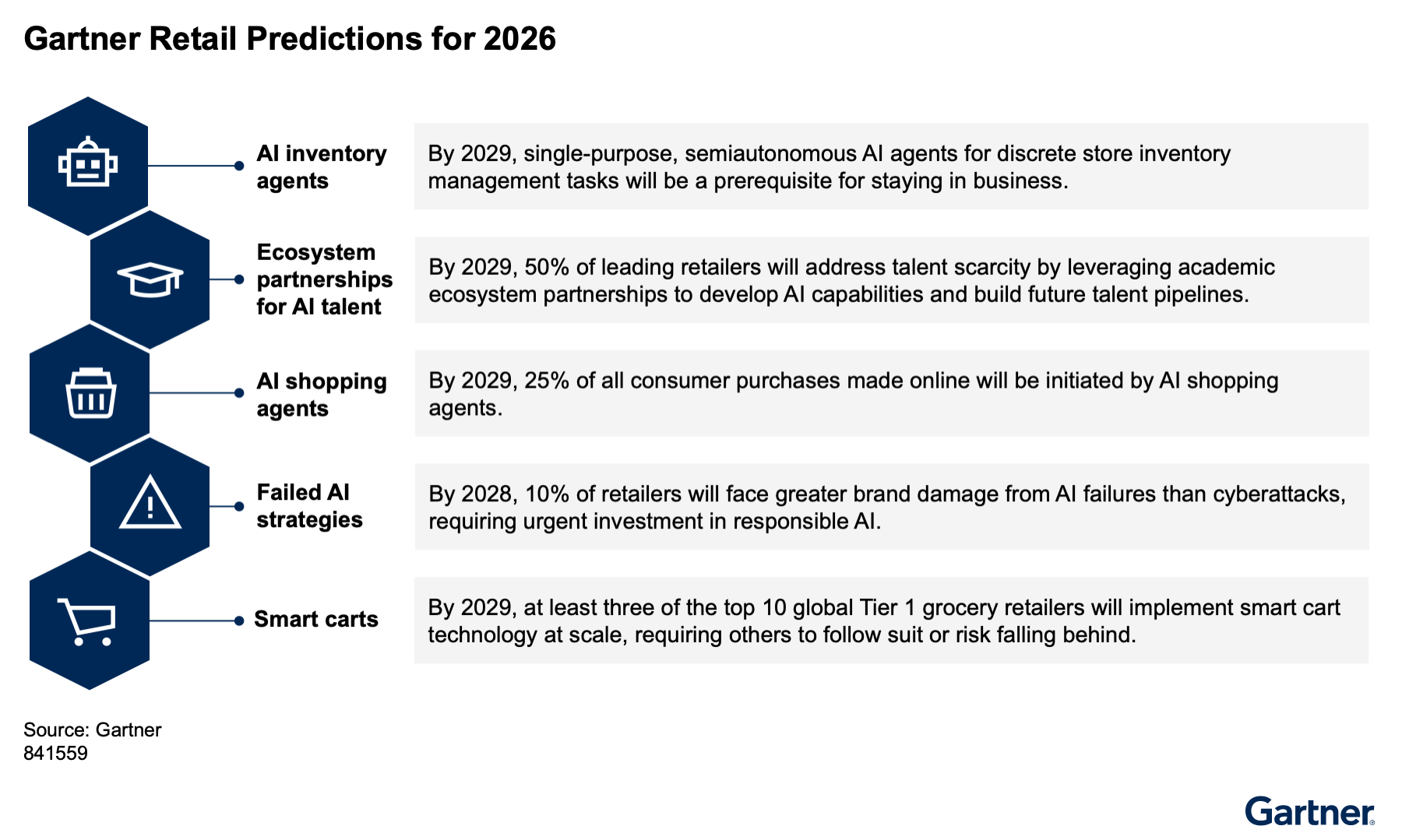
- By 2029, single, semiautonomous AI agents for discrete store inventory management tasks will be a prerequisite for staying in business.
- By 2029, 50% of leading retailers will address talent scarcity by leveraging academic ecosystem partnerships to develop AI capabilities and build future talent pipelines.
- By 2029, 25% of all consumer purchases made online will be initiated by AI shopping agents.
- By 2028, 10% of retailers will face greater brand damage from AI failures than cyberattacks, requiring urgent investment in responsible AI.
- By 2029, at least three of the top 10 global Tier 1 grocery retailers will implement smart cart technology at scale, requiring others to follow suit or risk falling behind.
Analysis
What You Need to Know
Retail is entering a critical phase of AI-driven transformation. Retailers are shifting from outdated inventory systems to intelligent agents that deliver agility, resilience and competitive advantage. Success will depend on advances in adoption, high-quality data, robust governance and strategic talent partnerships. At the same time, AI shopping agents are fundamentally transforming unified commerce shopping processes across physical and digital channels, driving a growing share of purchases and reshaping the retail landscape. For example, the 2025 Gartner Consumer Omnibus Survey reported that overall, 44% of U.S. consumers expressed willingness to let AI tools assist with shopping tasks.1
However, the stakes are high.
Failures in AI strategy and governance now pose a greater risk to brand reputation than cybersecurity breaches, with missteps quickly eroding customer trust and employee satisfaction.
In response, Tier 1 grocery retailers are rapidly adopting a range of AI-powered solutions, including smart carts, to streamline operations and enhance the in-store experience. Smart carts are set to become a strategic asset in grocery retail, powering AI-enabled store transformation while unlocking new high-margin revenue streams.
As major retailers accelerate adoption, vendors are rapidly reorganizing around AI‑native platforms — especially agentic commerce and in‑store automation.
To help the business remain competitive, retail CIOs must make a compelling case for boards and CEOs to prioritize technology investments in real-time data infrastructure, pilot innovation hubs that integrate emerging talent and prepare core retail applications and systems for AI integration. Building AI literacy in both technical and nontechnical staff is essential, as is testing smart cart solutions on a small scale before broader rollout. These steps will help retailers navigate the evolving landscape and harness the full potential of AI.
Strategic Planning Assumptions
Strategic Planning Assumption: By 2029, single-purpose, semiautonomous AI agents for discrete store inventory management tasks will be a prerequisite for staying in business.
Analysis by: Kelsie Marian, Robert Hetu and Sandeep Unni
Key Findings:
- Legacy store inventory systems are costly to run due to technical debt, which places a financial burden on retailers.
- Inaccurate forecasting, shrinkage and shifting consumer behavior all contribute to chronic stockouts or excess inventory, both of which leave customers disappointed and retailers suffering significant margin erosion and lost sales.
- Disconnected legacy systems with infrequent counts — which are prone to human error — and siloed low-quality data hinder real-time inventory visibility, further complicating fulfillment and store operations.
- Single-purpose, adaptive semiautonomous AI agent systems, performing discrete store inventory management tasks such as replenishment and forecasting, offer retailers a way to improve the real-time granularity and accuracy of inventory.
- Retailer investments for enabling store-based agents are rising. The 2026 Gartner CIO and Technology Executive Survey reveals only 16% of retailers have operationalized AI agents, but 48% plan deployment during 2026 — a clear inflection point.2
Market Implications:
- Retailers that do not implement store-based AI agent systems will face significant deficiencies in inventory accuracy and fulfillment speed, ultimately jeopardizing their ability to compete and remain viable in the market.
- Some routine tasks, such as gap scans, will be automated by AI agents to help free associates for more customer-facing interactions.
- Although SIM vendors have begun to incorporate AI agents into offerings, most retailers currently lack the rich, real-time data foundation required to leverage AI agents.
- AI benefits span finance and operations, demanding new attribution models to justify IT investment.
- The rise of AI agents will require governance frameworks for ethical AI, privacy and compliance.
Recommendations:
- Invest in edge computing to ensure SIM AI agents will perform effectively, as they depend on event capture and local processing in real or near real time.
- Establish a cross-functional AI governance framework — co-owned by IT, legal, compliance and operations — to define ethical standards, ensure data privacy and oversee autonomous agent behavior across all retail decision-making processes.
- Experiment with single-purpose store inventory AI agents to address root causes of stock disruptions and simplify inventory adjustments.
- Adopt standardized protocols and interoperable APIs to enable seamless integration and real-time orchestration between various single-purpose AI agents and core retail systems, ensuring consistent and accurate inventory actions.
Related Research:
Strategic Planning Assumption: By 2029, 50% of leading retailers will address talent scarcity by leveraging academic ecosystem partnerships to develop AI capabilities and build future talent pipelines.
Analysis by: Tom Nolan
Key Findings:
- Retail CIOs face mounting pressure to scale AI capabilities, but existing internal AI talent is insufficient to meet demand. Current talent pipelines are also further constrained with overall IT headcount stagnation or reduction. The 2026 Gartner CIO and Technology Executive Survey reported that 29% of retail respondents expect a decrease in IT headcount, and 34% expect no change.2
- Retailers remain committed to spending on AI. On average, spending on AI and GenAI in 2026 is set to increase by 36% and 38%, respectively, while 48% of retail respondents will deploy agentic AI in 2026.2
- Ecosystem partnerships between retailers and academic institutions facilitate the integration of real-world retail challenges into practical AI training in context and deep learning engineering as well as AI ethics, helping students gain experience with industry-relevant applications.
- Several retailers and trade associations have announced significant investment into AI talent and literacy. Examples include:
- Amazon has partnered with 11 Mississippi higher education institutions to advance AI and machine learning capabilities, supporting the growth of Amazon Web Services.
- Dyson’s need for unique skill sets led to the creation of the Dyson Institute, where it awards Dyson-designed degrees — combining academic studies with real-life projects alongside practicing engineers.
- Walmart will provide free, customized AI training and certification to its 3.5 million associates and frontline workers through Walmart Academy, transforming its team into an AI-powered workforce.
- The National Retail Federation and Georgetown University have launched the NRF Business of Retail Initiative to address industry challenges such as personalization, logistics, frictionless commerce, AI applications and agentic shopping.
Market Implications:
- Competitive advantage will increasingly hinge on the ability to embed AI-ready talent into IT operations faster than competitors. The challenge is particularly acute in critical retail-specific applications. While areas such as inventory and demand forecasting technology are prime candidates for AI involvement, many retailers lack the specialized talent to implement these systems effectively.
- Retailers that do not invest in academic ecosystems to grow and secure AI talent pipelines risk slower AI adoption, higher costs and increased reliance on external consultants.
- Technology vendors such as Microsoft are also turning to educational institutions to co-create AI innovation labs to accelerate AI capabilities and talent.
- IT organizations will shift from reactive hiring to proactive talent cultivation through long-term academic partnerships.
- Retailers who do not pursue academic partnerships could supplement training with the creation of in-house materials and curated AI assets from vendors and massive open online course (MOOC) providers, which target more generic AI upskilling.
- Co-innovation with universities will accelerate AI solution development, especially in areas such as predictive analytics, computer vision and intelligent automation.
- CIOs will need to manage new governance models that ensure control over intellectual property, facilitate data sharing and promote the development of ethical AI with academic partners.
Recommendations:
- Form strategic alliances with universities to co-create AI-focused IT programs, including internships, labs, hackathons and joint research aligned with retail tech stacks.
- Pilot AI innovation hubs within IT departments that integrate student talent with real-world projects, fostering agile experimentation to secure a long-term talent pipeline and facilitate early recruitment.
- Track talent conversion metrics (e.g., internship-to-hire ratios, project ROI) to optimize partnership value and inform future IT workforce planning.
Related Research:
Strategic Planning Assumption: By 2029, 25% of all consumer purchases made online will be initiated by AI shopping agents.
Analysis by: Kelsie Marian and Sandeep Unni
Key Findings:
- AI shopping agents are gaining traction as a promising path to revenue-generating customer engagement.
- AI shopping agents will initially handle routine, lower-value purchases with less consumer control while shoppers will retain more control over higher-value transactions. Over time, more adoption is generally expected as consumers’ trust in technology advancements increases.
- Human oversight will be necessary during early adoption for sensitive transactions to ensure accountability and build trust.
- The effectiveness of AI shopping agents depends on access to real-time, high-quality data. Retailers must upgrade legacy inventory, pricing and CRM systems to address consumers’ demands for personalization, increasing retail complexity and market volatility.
- Deploying AI shopping agents requires sharing proprietary product data with third-party AI providers, reducing control over valuable insights. Major platforms and retailers are partnering to deliver conversational AI interfaces to consumers. For example:
- OpenAI launched Instant Checkout via its Agentic Commerce Protocol (ACP) with initial partners including Etsy and Shopify.
- Walmart partnered with OpenAI to enable shopping directly through ChatGPT’s Instant Checkout, leveraging AI for product recommendations and purchase fulfillment.
- PayPal introduced its Agent Toolkit and partnered with Perplexity to facilitate AI-powered shopping directly from search results. PayPal also teamed up with OpenAI to adopt the Agentic Commerce Protocol (ACP) to expand payments and commerce in ChatGPT.
Market Implications:
- By 2030, the U.S. B2C retail market alone could see up to $1 trillion in orchestrated revenue from agentic commerce.
- Retailers that delay AI readiness risk ceding market share to early adopters, as first movers are rapidly building agent-compatible capabilities and positioned to capture outsize value.
- Retailers will expand core commerce systems from traditional storefronts to agent-readable interfaces, driving adoption of various protocols to enable secure, structured transactions and allow AI agents to interact directly with commerce platforms.
- Market dynamics will push retailers to provide access to product catalogs and back-end systems with enriched, highly structured product data.
- These one-click shopping experiences will likely improve conversion rates by bundling products and services in real time based on consumer priorities, raising transaction value.
- Retailers will need to ensure and grow consumer trust of AI shopping agents via transparency in data use, agent control, purchase approvals and access to human support.
- The shift toward models where human associates and AI agents co-execute channelless experiences will drive competitive differentiation among vendors. It will favor those with advanced conversational AI capabilities, seamless integration flexibility and robust support for unified commerce orchestration that reinforces trust and customer satisfaction.
- The deployment of AI shopping agents is elevating concerns over exposure of proprietary customer data to third-party AI providers, risking loss of control over valuable insights.
Recommendations:
- Establish an initiative to build customer behavior priority models, unify customer data and restructure product information, ensuring real-time consistency across all channels.
- Define a proactive agent partnership strategy by convening a cross-functional task force (e.g., IT, digital commerce, legal) to evaluate and select which platforms your enterprise wishes to be present on.
- Allocate dedicated resources to making core retail data (inventory, pricing, fulfillment) available for leading GenAI platforms to discover and act on.
- Partner with digital commerce stakeholders to understand data preparation requirements for leveraging agent-readable commerce protocols (e.g., ACP, AP2, MCP) across all core storefront, order management and check-out APIs.
- Experiment with AI shopping agents, then analyze results to determine which products drive engagement and should be prioritized for AI-enabled purchase.
Related Research:
Strategic Planning Assumption: By 2028, 10% of retailers will face greater brand damage from AI failures than cyberattacks, requiring urgent investment in responsible AI.
Analysis by: Tom Nolan
Key Findings:
- Retailers are rapidly adopting AI to enhance customer experience, optimize operations and drive innovation, yet many lack robust governance frameworks to manage AI risks.
- Gartner forecasts estimate that AI services within the retail industry are expected to grow at a CAGR of 14.5% through 2029, highlighting AI’s continued importance in core retail operations.
- While cybersecurity remains a critical concern, AI missteps — such as biased algorithms, poor personalization or failed automation — can erode consumer trust and brand equity even more rapidly, leading to customer distrust, employee dissatisfaction and compromised safety. Examples include:
- Anthropic’s pilot with its Claudius agent managing a vending machine store resulted in financial losses, employee threats and payment account hallucinations.
- Target’s Help AI chatbot has received negative feedback from employees, stating parameters are too restrictive and instances of compromised employee and customer safety.
- Fashion retailer Mango was criticized by customers for using AI-generated images of models and clothing with models not representing real humans.
- While some retailers are proactively engaging in cybersecurity education and partnerships, few have equivalent programs for AI literacy and ethical deployment, creating risk across the organization.
Market Implications:
- Retailers that treat AI as a plug-and-play solution without strategic oversight risk reputational harm, especially as consumers become increasingly aware of AI-driven decisions and can more easily recognize AI-created content.
- The ongoing AI training and change management implications on a retailer’s workforce is an important factor. Gartner’s position is that for every 100 days of AI implementation, you can expect to spend 25 more days training staff and an additional 100 to 200 days for change management.
- The shift in brand risk from cybersecurity to AI failure will prompt retailers to reassess their risk management priorities, with a heightened focus on transparency, explainability and the ethical use of AI, resulting in elevated AI responsibility.
- Competitive advantage will increasingly hinge on retailers’ ability to align AI initiatives with customer values, regulatory expectations and operational resilience.
- Technology vendors such as IBM are demonstrating capabilities of responsible and ethical AI through transparency, governance and risk compliance. OpenAI also is focused on ethical AI with their Head of Preparedness role, who oversees mitigation of frontier capabilities that create new risks of severe harm.
- Retailers that fail to integrate AI governance into their digital transformation strategies may face regulatory scrutiny, customer backlash and internal disruption.
- Initiatives such as Lowe’s annual AI Day demonstrate how retailers are embedding AI into core business functions. However, other challenges such as technical debt and legacy infrastructure had to be addressed first in order to scale AI.
Recommendations:
- Collaborate with your C-suite colleagues to establish cross-functional AI governance teams to oversee ethical use, risk mitigation and performance monitoring of AI systems.
- Invest in AI literacy and training programs for both technical and nontechnical staff to ensure responsible deployment and alignment with TRiSM policies for AI.
- Conduct regular AI audits and scenario testing to identify potential failure points and assess brand impact before public rollout.
- Benchmark AI initiatives against cybersecurity protocols, applying similar rigor in risk assessment, incident response and stakeholder communication.
- Engage organizational communities in AI transparency efforts, such as publishing AI usage policies or offering opt-outs for automated decision making.
Related Research:
Strategic Planning Assumption: By 2029, at least three of the top 10 global Tier 1 grocery retailers will implement smart cart technology at scale, requiring others to follow suit or risk falling behind.
Analysis by: Max Panther Hammond and Sandeep Unni
Key Findings:
- Smart carts are set to become a strategic asset in grocery retail, powering AI-enabled store transformation while unlocking new high-margin revenue streams. They can enable deeper personalization and more immersive shopper engagement, while advancing data-driven intelligence and in-store retail media activations.
- According to the 2026 Gartner CIO and Technology Executive Survey, 53% of retail respondents plan to increase investment in smart check-out technologies, highlighting growing momentum behind innovation for in-store customer experience and operational efficiency.2
- The growth of retail media in stores will make smart carts increasingly attractive to grocery retailers due to their ability to deliver personalized content based on customer profiles, order history and in-store behavior. This positions them as a powerful tool for targeted engagement and monetization through a high-margin revenue stream.
- Although smart carts cannot completely eliminate inventory shrink due to theft, they can enable decreased levels of shrink particularly through scenarios such as ticket switching, substitution and basket-based loss, thus contributing to overall store-level profitability.
- Gartner expects Amazon’s decision to phase out the “entire store” smart check-out model in larger Amazon Fresh formats, combined with a broader market slowdown of similar implementations, to contribute to accelerated smart cart momentum among grocery retailers.
- The “entire store” smart check-out model has been largely limited to smaller retail footprints, making scalability a challenge for traditional, larger formats. In contrast, computer vision AI-based smart carts offer a more flexible solution, enabling implementation across a broader range of store sizes, including traditional supermarkets.
Market Implications:
- Smart carts provide grocery retailers with a rich dataset of real-time, granular customer data, as well as their in-store movement, product interactions, purchase paths and dwell times. This enables data-driven decisions for optimized layouts, personalized promotions and better inventory management in store.
- Several grocery retailers who have already deployed smart cart solutions are seeing the results of customer adoption and acceptance. For example, in July 2025, Wegmans partnered with Instacart to deploy hundreds of AI-powered Caper smart carts in Syracuse, New York. Early results show strong shopper adoption, with Net Promoter Scores exceeding 70, signaling high satisfaction and readiness for broader rollout.
- Smart cart adoption will require retailers to upgrade in-store architecture, with edge computing becoming critical for enabling real-time data processing, reducing latency, and improving security and data protection.
- Several vendors are offering the ability to retrofit existing shopping carts with smart technology, which will make adoption more accessible for retailers by lowering upfront costs. It will also preserve consumer choice for the use of smart carts as an addition to traditional carts and not as their replacement in a store setting.
- Grocers will need to carefully consider the implementation and maintenance costs, combined with the number of carts required in large formats, against the benefits yielded, to overcome barriers to scaling this technology innovation.
- Retailers must actively market the benefits and support customers and associates through reducing the learning curve, overcome resistance to change, enable trust and encourage uptake.
- Privacy concerns related to in-store surveillance and data collection will have an impact on adoption, particularly in markets with heightened sensitivity to personal data.
Recommendations:
- Initiate small-scale, targeted pilots to validate vendor capabilities and operational impact before committing to broader smart cart deployments.
- Evaluate vendor scalability, integration readiness, support infrastructure and long-term viability to prepare for large-scale implementations.
- Conduct thorough cost-benefit analyses covering hardware, software, maintenance and cart volume, with a focus on scalability for large-format supermarkets, hypermarkets or similar store environments.
- Modernize physical store infrastructure to support edge computing, enabling uninterrupted customer experiences, real-time data processing, reduced latency and enhanced security.
- Partner with store operations and training teams to mitigate customer adoption barriers by investing in targeted communication, accessible in-store support and structured training programs to accelerate learning and foster trust.
Related Research:
A Look Back
In response to your requests, we are taking a look back at some key predictions from previous years. We have intentionally selected predictions from opposite ends of the scale — one where we were wholly or largely on target, as well as one we missed.
On Target: 2023 Prediction — Through 2025, fashion and apparel gross margins for multichannel retailers will drop by as much as 10 percentage points from 2022 levels.
Persistent inflation and tariffs have driven up costs for raw materials, manufacturing and logistics, while ongoing supply chain disruptions have forced retailers to rely on higher-cost expedited shipping. Retailers are also trying to protect against additional costs from tariffs and overall market volatility.
At the same time, competition from online and direct-to-consumer brands has led to more frequent promotional activity, thus eroding pricing power and compressing margins. As consumers’ spending power has become guarded and diminished through inflation, the balancing point of price absorption by the retailer versus passing costs to consumers has eroded retailer margins further, both in increased costs and reduced sales volume.
Several fashion and apparel retailers have experienced margin decline in recent years:
- Nike’s gross margin for full-year results declined from 46.0% in 2022 to 42.7% in 2025.
- TJX’s gross margin declined from 35.3% in 2022 to 30.6% in 2025.
- Capri Holdings, the parent company of Michael Kors, Versace and Jimmy Choo, reported that gross profit decreased 15.4%, to $2.826 billion during Fiscal 2025, compared to $3.339 billion for Fiscal 2024
Missed: 2019 Prediction — By 2025, 20% of the top 10 global grocers by revenue will be using blockchain for food safety and traceability to create visibility to production, quality and freshness.
Despite significant industry interest and a surge of pilot initiatives, blockchain adoption for food traceability among the world’s largest grocers remains limited. IBM Food Trust, the most prominent blockchain network in this sector, lists Walmart, Carrefour, Albertsons and Costco as participants. However, even among these leaders, implementations are narrowly scoped — typically restricted to select categories such as leafy greens or private-label products rather than broad, enterprisewide deployments. Other top-tier grocers have not announced comparable initiatives, and recent industry reports confirm that blockchain remains an emerging technology rather than a mainstream solution for food safety.
While a handful of leading retailers have experimented with blockchain, the market has not achieved the maturity or scale originally predicted. Broader adoption continues to be hindered by integration complexity, unclear return on investment and competing technologies such as computer vision, which have seen use cases for detecting freshness of produce within the store environment.
At present, blockchain for food traceability remains a niche capability rather than a standard practice among global grocery leaders, highlighting the need for ecosystem alignment before widespread adoption can occur.
1 2025 Gartner Consumer Omnibus Survey. The purpose of this survey was to understand consumer behaviors and sentiment across a wide range of topics and industries that included shopping behaviors, brand communications, loyalty, pharmacy and banking. The research was conducted online from 11 through 31 March 2025 among 2,000 respondents in the United States. Respondents were required to be at least 18 years old. Quotas were set for geographic areas, age, gender, ethnicity and employment status to approximate the U.S. adult population as a whole.
2 2026 Gartner CIO and Technology Executive Survey. This survey was conducted online from 1 May to 30 June 2025 to help CIOs and technology executives benchmark their priorities and investment plans against those of peers worldwide. Qualified respondents led a digital/technology function and were accountable for running or improving/growing a specific area of their enterprise. In total, 2,501 CIOs and technology executives participated, with representation from all geographies, revenue bands and industry sectors (public and private), including 116 from retail.
Note 1: Tier 1 Retailers
Gartner defines the Tier 1 market as large, global retailers that conduct business in multiple geographic locations. Tier 1 global retailers operate extensive store real estate as one of many channels and touchpoints and generate annual retail revenue of at least $3 billion per year.