Emerging Market Quadrant for Deepfake Detection — Startup Vendors
25 June 2026 - ID G00850109 - 17 min read
By Apeksha Kaushik, Alfredo Ramirez IV, and 2 more
Hyper-realistic deepfakes threaten digital trust, necessitating an urgent shift in cybersecurity strategies. C-level executives must prioritize deepfakes as a major cybersecurity risk and should use this research to evaluate startups offering continuous, cryptographic, forensic-grade deepfake detection.
Summary Market Definition
Gartner defines deepfake detection as an emerging cybersecurity discipline with capabilities to detect, analyze and perform forensics on fabricated, manipulated, AI-generated or AI-manipulated multimedia — including images, audio, video and live interactions — when the primary purpose is to deceive or disinform. The offerings in this market assess media authenticity and tampering using digital media analysis and risk scoring, with applications across episodic and industrial disinformation use cases. For more, see the Detailed Market Definition section below.
Key Emerging Market Trends
This emerging market is still fairly immature and evolving with startups dominating its evolution. Due to increasing market complexity, deepfake detection is evolving into an operating discipline rather than solely a discrete technology sector. Providers in the market are taking many different approaches to deepfake detection. As enterprises prioritize resilience, safety and predictability, leadership will increasingly favor providers that combine forensic credibility, ecosystem fluency and sustained operational ownership.
This Emerging Market Quadrant highlights how startup vendors are positioning themselves along this trajectory based on technical disruption, deep industry use cases and ecosystem execution. There are other established vendors in this market such as Fujitsu, Intel FakeCatcher, iProov, Pindrop, Recorded Future and others, but for the purpose of this research, we are focused on the startups.
Divergent Commercialization Strategies
As of this publication, startup vendors in the emerging market for deepfake detection are translating their proprietary research into commercial execution through distinct architectural and integration strategies:
- Some vendors are pursuing an ecosystem-embedded strategy, weaving multimodal forensic capabilities directly into the client’s established infrastructure of global system integrators (GSIs) and enterprise communications via “free” API enablement. This inherently exposes these vendors to platform commoditization as larger cybersecurity suites absorb baseline detection capabilities.
- Other vendors are moving toward deploying a hardware-anchored strategy that guarantees absolute cryptographic provenance at the physical sensor level to provide undeniable, verifiable truth.
- Some of the vendors are executing a domain-specific interception approach, deploying highly targeted defense optimized for distinct channels — such as securing remote hiring pipelines or intercepting live synthetic audio natively at the endpoint.
Emergence of Disinformation Security Standards and Frameworks
Looking toward the future, standards and frameworks will emerge for disinformation security (such as DISARM) in the way that MITRE ATT&CK acts as a standard for cyber attack/defense. Approaches to adopting these will also evolve from reactive analysis of digital media toward autonomous and proactive detection and prevention of injection attacks in real time at the edge. Vendors will need to fit into those standards if they gain momentum.
Establishment of DTAPs and TrustOps Teams
Over the next one to three years, organizations will transition toward establishing comprehensive digital trust and authenticity platforms (DTAPs) governed by dedicated trust operations (TrustOps) teams. However, this rapid mainstreaming will trigger intense market consolidation. Deepfake detection is widely expected to transition from a highly specialized, discrete market into a standard, non-negotiable feature integrated within broader enterprise architectures. Identity verification (IDV) and cybersecurity megavendors are already moving to acquire or build detection layers directly into their existing trust and risk management stacks. The core deepfake detection capabilities will be rapidly absorbed and commoditized by larger DTAPs or adjacent IDV and cybersecurity platforms.
Emerging Market Quadrant Analysis
Gartner’s Emerging Market Quadrant is designed to help clients understand the dynamics of relatively new and fast-moving market capabilities and form shortlists of technology providers to explore when making tech buying, partnering, acquisition and investment decisions. For more information on the underlying methodology, see How Markets and Vendors Are Evaluated in Gartner Emerging Market Quadrants.
An Emerging Market Quadrant is not an exhaustive analysis of every tech provider in an emerging market. It is a focused analysis of the providers Gartner analysts believe are most indicative of the market and most relevant for Gartner’s technology buyer clients who are exploring engaging in the emerging market.
Market Shapers: Characterized by Scale, Ecosystem Readiness and Disruption
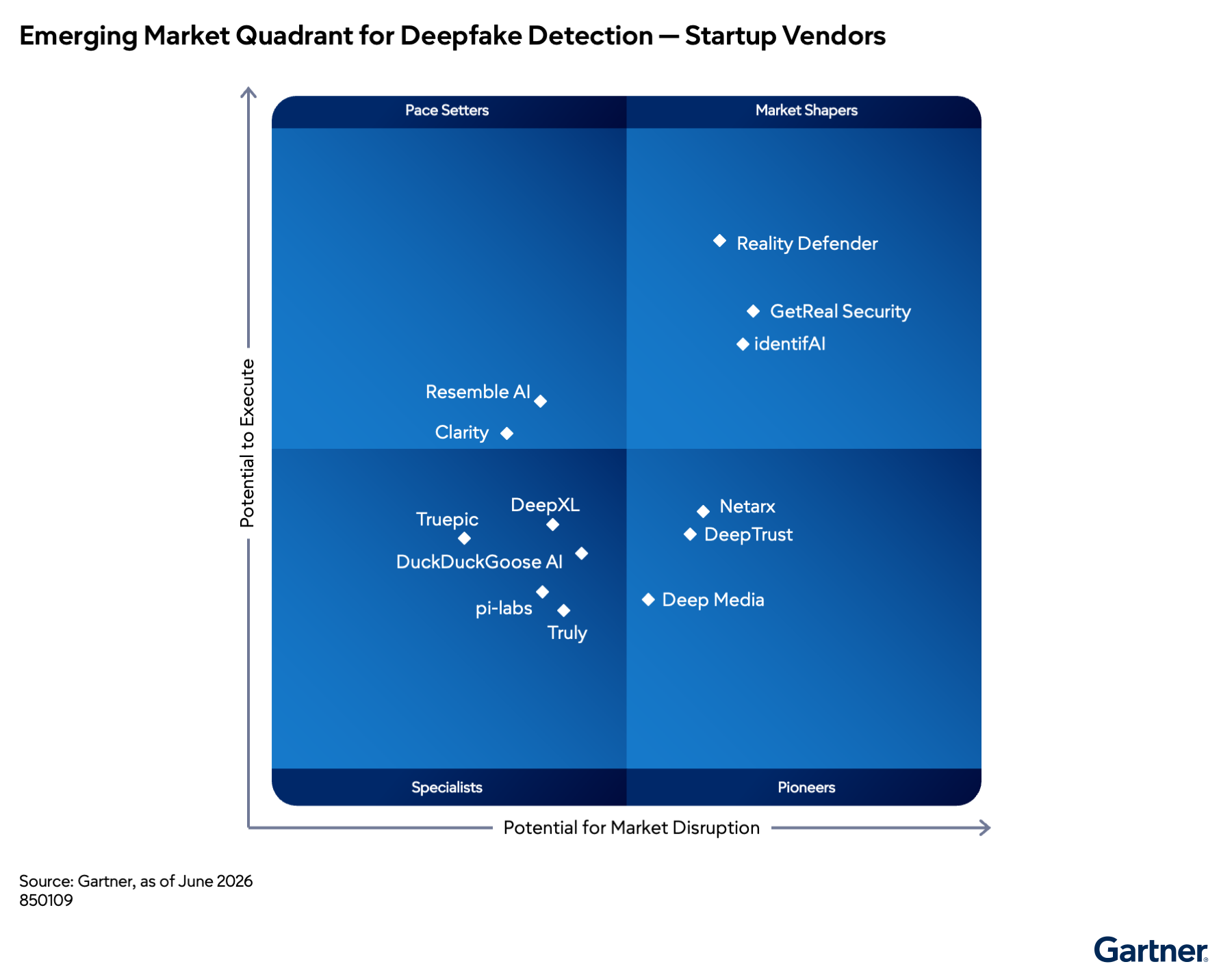
The assessment of this quadrant is based on Gartner’s opinion of the collective characteristics of its featured vendors: Reality Defender, GetReal Security and IdentifAI.
Analysis of Disruptive Potential
Market Shapers’ offerings are characterized by multimodal ensemble models capable of scrutinizing audio, video, image and text concurrently, combined with deep forensic signals intelligence and threat propagation/proliferation graphs. By embedding these capabilities into continuous operational workflows, these offerings disrupt traditional detection tactics and procedures.
Vendors in this quadrant deploy continuous intelligence operations that analyze environmental, pixel-level, voice/sound-wave-based and physical artifacts across omnichannel communications.
Buyers seeking to improve digital trust should evaluate these solutions based on their ability to integrate directly into existing GSIs and enterprise platforms. Furthermore, buyers may consider:
- Market Shapers have a diversity of approaches to collection and storage of sensitive data, where some vendors prefer workflow integration to draw on identity and other data for context, while others have zero storage and contact with corporate data policy. Moreover, deployment options range from on-premises and air-gapped to cloud-hosted and managed.
- Deepfake detection solutions are built on custom pretrained foundation models for the best detection capabilities, but they are not universal across vendors as there are also options for forensic-based authenticity models.
- Market Shapers excel at ecosystem integrations with native OEM integrations with videoconferencing solutions, integration with security operations tools and ingesting other telemetry.
- Explainability of results for EU legislation requirements is a feature of some leading offerings as well.
- The cost of tokens is increasingly a big factor to consider in deepfake analysis and also as a use case for Market Shapers to minimize AI costs from external AI bots when detected as not human, for example.
- Vendors also offer continuous monitoring and detection options with verification of authenticity across multiple interactions, workflows and even across time.
Case Example: Neutralizing Coordinated Multimodal Executive Impersonation
Goal: Guarantee the authenticity of high-stakes corporate interactions and neutralize synchronized synthetic media attacks designed to bypass standard verification protocols.
Situation: A multinational enterprise is targeted by a sophisticated threat group utilizing real-time, hyper-realistic video and audio deepfakes during a live, multiparty executive videoconference to authorize a massive, fraudulent financial transfer.
Implication: Typical cybersecurity practices today fail to prevent the use of the synthetic avatars or detect them. Without a systemic authenticity layer, the organization is exposed to catastrophic financial theft and a complete collapse of confidence in its internal communications.
Resolution: By natively embedding multimodal solutions into its global conferencing network, the enterprise establishes continuous, real-time intelligence. The platform simultaneously scrutinizes video pixel inconsistencies and audio artifacts as they occur, autonomously flagging the synthetic C-suite personas and intercepting the transaction before execution.
Analysis of Potential to Execute
Vendors in the Market Shapers quadrant are building the most disruptive technology solutions that are starting to be deployed and used at scale, demonstrating the ability to not only build technical capabilities but also go to market and partner in ways that make their enterprise value more tangible to enterprises. With maturing go-to-market capabilities, these vendors are learning the needs of enterprise buyers and iteratively improving their products and platforms to meet those needs. Market Shapers are also well-positioned to gain market share due to their strongest execution capability, fueled by notable strategic capital backing and superior staff expertise and experience.
Market Shapers are moving beyond an academic or overly technical focus and investing in go-to-market capabilities and expertise around business development, partnerships, sales and marketing. Vendors in this quadrant maintain the financial runway to sustain rapid R&D cycles against emerging generative AI threats, supported by embedded global distribution networks forged with critical technology partners, cybersecurity services providers, identity security providers and hyperscalers. This execution maturity allows them to transition deepfake detection from a discrete technical feature into a systemic one and making platformwide trust primitive.
It is important to recognize that the quality and accuracy of deepfake detection are not the sole arbiter of success in this market. The vendors demonstrate how deepfake detection can evolve from being a discrete technical capability into a product or platform that can bring value to enterprises by delivering value within the context of business workflows. Execution is further strengthened by their ability to deploy reliably at massive enterprise scale.
Recommended Actions, Risks and Cautions
- Implement multimodal solutions to establish an enterprisewide media zero trust architecture across your core communication channels.
- Beware of platform commoditization risks; ensure the vendor provides deep proprietary forensic intelligence rather than basic, easily bypassed pattern recognition.
- Exercise caution against overreliance on a generalized horizontal platform if your organization possesses highly specialized vulnerabilities to deepfakes that necessitate domain-specific vertical protections offered by vendors in other quadrants in this research.
Pace Setters: Delivering Technical Sophistication With Impact in Specific Domains
The assessment of this quadrant is based on Gartner’s opinion of the collective characteristics of its featured vendors: Resemble AI and Clarity.
Analysis of Disruptive Potential
The Pace Setters quadrant includes vendors that are advancing digital trust by delivering highly specialized, production-ready authenticity validation within specific communication modalities or high-stakes business functions. Rather than attempting to secure the entire enterprise horizontally, these offerings disrupt the market through deep technical and forensic expertise tailored to specific domains, such as intercepting audio anomalies or protecting the remote employee life cycle. This means that they can potentially have greater impact in the narrower domains in which they focus.
Innovation in this quadrant is driven by neutralizing the high false-positive rates and operational friction produced by overgeneralized detection models. By employing native capabilities for active semantic, physical and physiobehavioral artifact analysis localized within specific data streams, these solutions create highly reliable benchmarks for authenticity in targeted interactions. Buyers should evaluate these vendors when seeking precision instruments to defend against highly localized narrative and impersonation schemes where failure tolerance is exceptionally low.
Case Example: Human Resources and Remote Hiring Protection
Goal: Prevent the infiltration of fake candidates using synthetic identities during the remote corporate hiring and onboarding process.
Situation: Threat actors are leveraging hyper-realistic voice clones and “deepfake employee” schemes to bypass standard HR filters and secure remote employment.
Implication: Fraudulent hires bypass standard identity verifications, leading to internal security breaches, financial loss and compromised corporate networks.
Resolution: Continuous forensic-grade verification is integrated natively into the HR platform, actively analyzing semantic and physical artifacts to proactively defend the employee life cycle and filter out synthetic identities before granting network access.
Analysis of Potential to Execute
Providers in the Pace Setters quadrant demonstrate strong execution capability rooted in high engineering rigor, credible production benchmarks and sufficient venture funding to dominate their chosen niches. Execution strength is defined by disciplined delivery models that guarantee trust in targeted workflows, translating complex forensic science into seamless, process-specific authenticity safeguards. They possess strong domain-specific market visibility and specialized technical depth.
However, their potential to disrupt the market remains constrained by their narrower focus, which inherently limits their breadth of impact across the wider enterprise landscape.
Buyers are cautioned to mitigate the risk of architectural fragmentation by planning how these domain-specific tools will eventually integrate into a broader centralized TrustOps approach. Furthermore, while highly effective within their core modality, attempting to scale these single-domain solutions into generalized defense may expose organizations to multimodal bypass attacks.
Recommended Actions, Risks and Cautions
- Deploy these solutions for targeted, mission-critical workflows, such as HR remote hiring pipelines or dedicated executive synthetic voice protection, where domain-specific precision is paramount.
- Heavy reliance on single-modality defense leaves organizations highly vulnerable to sophisticated, multimodal bypass attacks that combine synthetic elements across different media types.
- Carefully plan integration roadmaps; applying these highly specialized tools across broader, unoptimized enterprise networks can lead to architectural fragmentation and security silos.
Pioneers: Focused on Differentiated Multilayered Approaches for Localized Disruption
The assessment of this quadrant is based on Gartner’s opinion of the collective characteristics of its featured vendors: Netarx, DeepTrust and Deep Media.
Analysis of Disruptive Potential
Pioneers are approaching the challenges of deepfake detection in differentiated ways, creating products that address deepfake threats by doing more than just detection. For example, some focus on endpoint integrity and semantic context, not just deepfake detection.
The Pioneers quadrant vendors challenge conventional detection paradigms by introducing entirely different architectural approaches to secure digital trust. Solutions in this quadrant are disruptive in concept, moving aggressively away from reactive, postevent file scanning. Instead, they introduce useful approaches such as semantic context, ContextRAG filtering for proactive web-scale scanning, managed endpoint agents delivering real-time “in-call nudges” and frameworks linking digital identity directly to device hardware via blockchain.
Disruption stems from pushing defense mechanisms to the absolute edge of the interaction inception. These platforms utilize agentic web-scale scanning, real-time metadata evaluation and semantic radar mapping to detect the “synthetic DNA” of campaigns at their inception. Buyers looking to shift toward proactive narrative resilience or secure live, previously unmonitored communication channels should evaluate these highly differentiated architectures.
If they gain traction, the potential for disruption is high given their differentiated approaches, compared to those vendors who only focus on deepfake detection.
Case Example: Live Call Endpoint Protection
Goal: Secure live communication channels without requiring complex third-party platform plug-ins or API integrations.
Situation: Enterprise workers utilize diverse, fragmented communication platforms that lack native synthetic media defense, exposing them to real-time spoofing and social engineering.
Implication: Organizations are critically vulnerable to real-time impersonation that traditional network security tools cannot detect, leading to unauthorized data access.
Resolution: A managed endpoint agent is deployed that operates independently of the communication platform, autonomously evaluating metadata to provide automated “in-call nudges” or interventions upon detecting synthetic artifacts in live conversations.
Analysis of Potential to Execute
These vendors are now just starting to execute on more mature go-to-market motions and also hiring more people with the requisite skills in these areas, moving beyond founder-led activities across the business. The focus thus far has been more on building product capabilities than it has on go-to-market motion. They should now place emphasis on moving beyond working with design partners and conducting POCs so as to execute better and scale up; more funding is now needed to drive go-to-market execution.
The Pioneers quadrant demonstrates emerging execution capability, characterized by exceptional technical agility and strong, specialized channel partnerships. Vendors here should utilize robust MSP/MSSP-first strategies to balance market delivery, demonstrating how deepfake detection can evolve into an autonomous, proactive TrustOps function managed directly at the endpoint.
Execution constraints exist primarily in human capital and financial resources. Because these vendors often rely on leaner teams and earlier-stage funding, their ability to execute massive, direct global sales motions is limited without heavy reliance on partners.
Recommended Actions, Risks and Cautions
- Pilot these forward-looking, agentic solutions to secure edge environments and live communication channels natively, bypassing the limitations of traditional API integrations.
- The long-term execution of these vendors carries significant risk due to currently limited financial backing and leaner teams, which could impede their ability to provide sustained, global enterprise support.
- Exercise caution when embedding highly novel architectures deep into operational workflows; mandate strict data portability and maintain robust fallback mechanisms in the event the vendor pivots or is acquired.
Specialists: Offer Deep Expertise in Narrowly Defined Areas
The assessment of this quadrant is based on Gartner’s opinion of the collective characteristics of its featured vendors: pi-labs, Truepic, DuckDuckGoose AI, DeepXL and Truly.
Analysis of Disruptive Potential
Vendors in the Specialists quadrant are mostly focused on narrow use cases such as on the integrity of image capture for industry-specific use cases. Some others are still taking an overly technical and academic approach to deepfake detection without clear alignment to enterprise use cases and needs. As such, their current ability to disrupt is somewhat constrained.
Focusing on highly specialized forensic niches, they include generating native pixel-level detection capabilities along with heatmaps, deploying massive adversarial data engines, extracting unique physical imperfections from mobile camera sensors or specializing purely in financial document forensics. By anchoring cryptography directly to the physical capture device or specific document workflows, some of these vendors can provide heavily regulated sectors with court-admissible, regulatory-compliant verifiable chains of custody that generative AI cannot circumvent.
Case Example: Cryptographic Provenance at the Edge
Goal: Guarantee the absolute origin, integrity and provenance of media files from the moment of capture.
Situation: Fully synthetic or maliciously manipulated images and financial documents are submitted as part of critical evidence or remote insurance claims.
Implication: Without a verifiable, immutable chain of custody, organizations cannot separate authentic digital evidence from generative deepfakes, paralyzing legal and financial workflows.
Resolution: A hardware-anchored trust solution is integrated to extract the unique, microscopic imperfections of a smartphone’s camera sensor, digitally signing the media at the point of capture to generate an unclonable, tamper-proof record of truth.
Analysis of Potential to Execute
Execution trends for Specialists are confined to dominating narrowly defined forensic workflows. These vendors need to demonstrate that they have the funding and staffing to successfully execute a go-to-market and product development motion that will take them to broad traction. With a highly technical niche, they are relying on specialized engineering talent and robust, continuous algorithmic training loops rather than massive sales forces. Because their operational models intentionally avoid horizontal expansion, their ecosystem affinity and breadth of disruption are deliberately narrow. They can execute well as critical building blocks for targeted initiatives but generally lack the overarching integration capability required to act as an enterprisewide trust platform.
Recommended Actions, Risks and Cautions
- Utilize these vendors for high-stakes edge cases where cryptographic provenance, physical sensor authentication or air-gapped sovereign defense are strict regulatory requirements.
- Deploying discrete specialist tools creates the risk of operational silos. Strictly verify that these point solutions can export their verifiable data via APIs into your centralized enterprise SOC or TrustOps architecture.
- Hardware-anchored trust solutions often introduce significant deployment friction (e.g., mandating specific profiles or specific capture devices); ensure the forensic necessity justifies the heavy organizational change management required.
Detailed Market Definition
Gartner defines deepfake detection as an emerging area with capabilities to detect, analyze and perform forensics on fabricated, manipulated, AI‑generated or AI-manipulated multimedia — including images, audio, video and live interactions — when the primary purpose is to deceive or disinform. The offerings in this market assess media authenticity and tampering using digital media analysis and risk scoring, with applications across episodic and industrial disinformation use cases.
The rapid proliferation of hyper-realistic deepfakes poses an existential threat to digital trust. It necessitates technologies to detect when a piece of media is synthetic, digitally manipulated, fully generated by AI or manipulated by AI. In many cases, the technologies can determine which specific parts of media are synthetic or have been AI-generated or manipulated.
This market includes both episodic (internal attack surface, low attack count, shorter duration) and industrial (external attack surface, high attack count, longer duration) disinformation deepfake use cases. Episodic examples include identity impersonation in real-time communication channels such as Microsoft Teams or Zoom using audio and video deepfakes to target employees, or submission of digital media as part of a process such as an insurance claim or evidence gathering by journalists. Industrial examples include deepfake digital media posted on social media, blogs or websites as part of a broader narrative attack.
This market does not include deepfake detection that is an integral feature (rather than a stand-alone product) of biometric processes such as those used in voice biometric authentication solutions, face biometric authentication solutions or identity verification solutions.
Mandatory Features
- Digital media analysis:
- Confirmation of digital signatures attesting to authenticity, including a confirmation of signature chain
- Assessment of whether media has been organically captured or synthetically generated (wholly or partially) by AI tools
- Tamper detection:
- Assessment of whether digital media has been modified, fully or partially, after initial capture or creation
- Explainability:
- Clear risk assessment of digital media, typically providing a decision or probability that the content is AI-generated or has been manipulated
- Explanation as to why a decision or probability has been assigned
Optional Features
- Human behavior analysis:
- Analysis of behavioral features such as lip sync, eye gaze, speech cadence and patterns, and facial cues
- Analysis of biomarkers such as blood flow, heart rate, breathing
- Risk assessment of contextual signals in real-time interactions:
- Collection and analysis of a user’s IP address, location, device or other contextual signals
- Data output:
- Comprehensive output (decision, risk score, explainability attributes) in a variety of formats (API, webhooks, batch reports, etc.) for consumption by other enterprise applications
- Out-of-the-box integrations:
- Prebuilt integrations with enterprise applications such as cybersecurity tools (e.g., ITDR, SIEM, SOAR), HR tools (e.g., application tracking systems) or contact center applications.
- Extended digital media analysis:
- Metadata analysis and watermark checking
- Generative AI fingerprinting
- Where appropriate for the media type, support for content provenance protocols such as C2PA
- Extended tamper detection:
- Where appropriate for the media type, indication of which parts have been modified
- Granular data control:
- Flexibility for clients to configure data retention periods, segmented data handling policies, single vs. multitenant processing and regional processing
Note
These are representative startup vendors and do not imply an exhaustive list. Please note for the purpose of this research, we have included the startup vendors only. Beyond the scope of this research, there are established players too in this market such as Fujitsu, Intel FakeCatcher, iProov, Pindrop, Recorded Future and others.