Magic Quadrant for Robotic Process Automation
24 June 2026 - ID G00839318 - 39 min read
By Arthur Villa, Melanie Alexander, and 3 more
Robotic process automation remains the most cost-effective, reliable technology for automating UI interactions for task-based workflows. This Magic Quadrant evaluates 10 enterprise RPA vendors to help you make the best choice for your organization’s task automation needs.
Strategic Planning Assumption
By 2028, “computer use” (CU) capabilities will become viable technical alternatives for UI automation of web-based applications.
Market Definition/Description
Gartner defines robotic process automation (RPA) as software that automates tasks within business and IT processes using software scripts that emulate human interaction with the application UI. RPA enables a manual task to be recorded or programmed into a software script, which users can develop through programming or by using the RPA platform’s low-code and no-code GUIs. This script can then be deployed and executed into different runtimes. The runtime executable of the deployed script is referred to as a bot or robot.
RPA is used across numerous business functions for tactical task automation. Business and IT users can leverage RPA to:
- Move data in or out of application systems without human interaction (unattended automation). Scripts are designed to replicate the actions of a human interacting with those systems or documents which usually do not have available APIs. The intent is to automate and complete a task successfully without human intervention. Typically, unattended automation is triggered by a system and bots executed on a server.
- Automate tasks with a human in the loop (attended automation). RPA can extract information from systems, shaping and preparing it for consumption by a human at the point of need. Typically, attended automation is triggered by a human and bots executed on a local device.
Mandatory Features
The mandatory features for this market include:
- Screen scraping, with at least five of the following UI connectors: Selenium IDE, Microsoft Active Accessibility (MSAA), Microsoft UI Automation, Java Application Connector, SAP WinGUI, Windows GUI or mainframe emulators
- Ability to record a task and convert it into a script that can be deployed
- Support for both attended and unattended automation
- Ability to orchestrate and administer users, scripts and the runtime, including configuration, monitoring and security
- Support for multiple bot runtimes, such as a desktop, an on-premises server, public or private cloud, and virtual machines
Optional Features
The optional features for this market include:
- Support for script development with standard programming languages or vendor-specific, low-code representations (including GUIs for citizen development)
- Native optical character recognition (OCR) and/or integration with a third-party OCR tool to capture semistructured or unstructured data
- Computer vision with AI-/machine language (ML)-driven UI resilience models to track application UI element changes and update a bot to respond accordingly
- API-first automation via connectors, including HTTP/REST, SOAP and open APIs
- A low-code user experience for building automations
- Built-in, AI-driven smart workflow development natural language prompts with guided navigation
- Ability to help an automation center of excellence (COE) manage operations and track and report benefits
Magic Quadrant
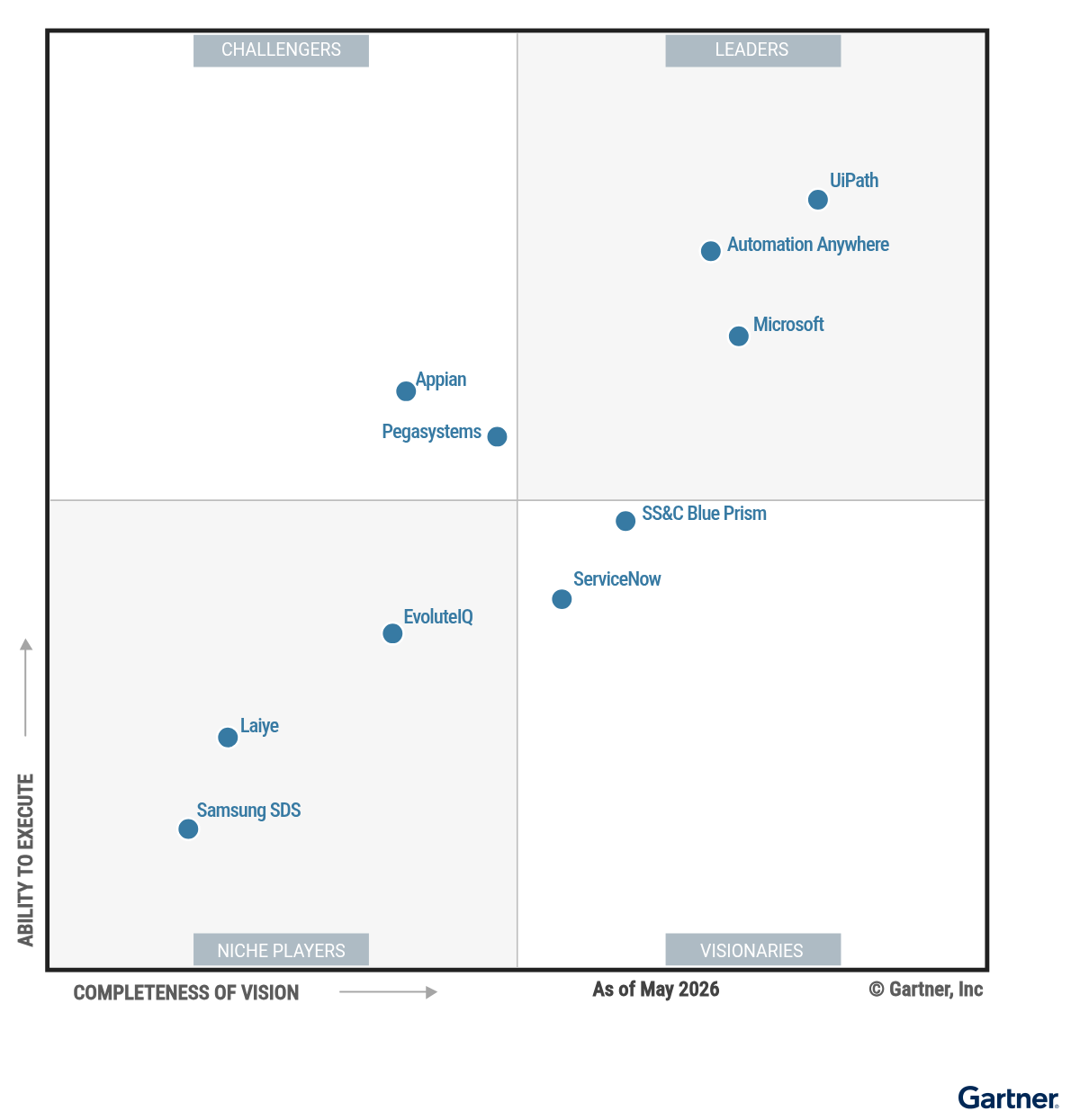
Vendor Strengths and Cautions
Appian
Appian is a Challenger in this Magic Quadrant. Its RPA solution is Appian RPA. Key components include Appian Designer, Appian RPA Agent and Appian RPA Orchestrator.
Appian has global operations. Its top industries are public sector, financial services and insurance.
Appian’s RPA roadmap includes developing a multitenant Appian Community Edition, integrating RPA as a tool for AI agents as part of Appian Agent Studio, and tracking custom business attributes for a process across various paths taken.
- Public-sector focus: Appian stands out as the only vendor to prioritize the public sector as its top industry vertical. To support public sector requirements, Appian is FedRAMP-certified, offers robust audit trails, provides on-premises orchestration and supports Citrix/VDI deployments with a lightweight agent installed in the session. This is an uncommon combination of features in this market.
- Packaging: Organizations that want to automate complex processes and reduce growing RPA spend will find value in Appian’s premium package, which includes unlimited RPA bots and a wide range of tightly integrated automation capabilities supporting broader process transformation initiatives.
- Customer experience: The vendor provides structured customer success programs, including dedicated managers, success plans and strategic initiatives, like the Insight to Action program. Additionally, tools like the Operations Console and its process intelligence solution, Process HQ, enable organizations to establish comprehensive automation impact measurements and calculate ROI natively within the platform.
- Brand awareness: Appian RPA lacks strong stand-alone brand awareness and is typically not considered unless an organization is already using the Appian platform for business process management. Gartner rarely receives inquiries about Appian RPA unless the client is already using the Appian platform.
- Product strategy: Appian is moving away from stand-alone task automation tools and focusing on its comprehensive, process-oriented orchestration platform. For customers who are not prepared to embrace this broader approach, the platform’s vision may not align with their current task automation requirements.
- Pricing: Appian RPA is available as a stand-alone product with per-bot pricing; however, it is typically sold as part of its platform, which encompasses multiple automation capabilities. Each bundle type includes a certain allotment of RPA bots, which may make scaling just the RPA capabilities difficult.
Automation Anywhere
Automation Anywhere is a Leader in this Magic Quadrant. Automation Anywhere’s RPA solution is Automation 360. Key components include Mozart Orchestrator, Automation Co-Pilot, Bot Runner and Control Room.
Automation Anywhere has global operations with a customer base focused on large enterprises. Its top industries are banking and financial services, manufacturing, and healthcare.
Automation Anywhere’s RPA roadmap includes implementing a richer orchestration layer and runtime, creating a context intelligence layer for AI agents and providing policy-based life cycle management of processes and their components.
- Customer experience: Automation Anywhere provides postsales support and an account management ecosystem, featuring a three-tiered global support model and a dedicated key accounts program to guide strategic clients. Additionally, the vendor equips customers with built-in tools, such as the CoE Manager and quarterly business reviews, to continuously measure and validate postdeployment returns on investment.
- Product capabilities: The platform’s generative recorder automatically corrects UI automation failures in real time using advanced vision models and DOM parsing. Security is ensured via an AES-256 encrypted credential vault. Additionally, the platform can perform object-based UI automations within Citrix, VMware and multiuser Microsoft Remote Desktop environments by embedding remote agents directly into these environments.
- Market understanding: Automation Anywhere demonstrates a strong understanding of customer needs by offering packaged automation solutions equipped with centralized governance, consumption-based pricing models and dedicated scaling methodologies, such as the Pathfinder Framework.
- SMB viability: Most of Automation Anywhere’s customers are large organizations with more than 10,000 employees. Smaller organizations, particularly those with fewer than 1,000 employees, may find that Automation Anywhere’s pricing, technical features and platform capabilities exceed their current requirements.
- RPA focus: Automation Anywhere is focused on agentic automation and has signaled a reduction in RPA-specific R&D compared to previous years. Organizations focused on traditional RPA should ensure that Automation Anywhere’s RPA product roadmap will continue to provide the innovation and newer AI-enabled features they require.
- Product features: The platform currently lacks native capabilities to develop automations specifically for mobile application environments and does not natively offer automated test case generation capabilities for validation. The platform’s cloud deployments are currently limited to using a single external key vault per tenant, but will be updated in the July 2026 release to support connections to multiple external key vault connections.
EvoluteIQ
EvoluteIQ is a Niche Player in this Magic Quadrant. EvoluteIQ’s RPA solution is the EIQ Platform. Key components include EIQ Automation Studio, Workflow Designer, EIQ Enterprise Connectors and EIQ Process Flows.
The majority of EvoluteIQ’s customers are large enterprises, with key markets in the U.S., U.K. and Europe. Its top industries are healthcare, banking, finance and insurance.
EvoluteIQ’s RPA roadmap includes building an agentic control plane, developing a next-gen large action model abstracting thousands of actions, and creating a unified governance fabric for policies, approvals and lineage.
- Implementation services: EvoluteIQ offers direct professional implementation services alongside its system integrator partners to assist with deployment and migration from legacy tools. This dual delivery approach provides customers with flexible options for deploying automation solutions without relying entirely on third-party integrators.
- Healthcare focus: The vendor maintains a distinct focus on the healthcare industry, citing healthcare as its top priority vertical. It offers specialized prebuilt assets tailored for this market, including automations for revenue cycle management, autonomous medical coding and care management.
- RPA migration capabilities: EvoluteIQ provides native import tools and agentic-driven script comprehension to facilitate migration from other RPA platforms. These capabilities assist enterprises in consolidating fragmented RPA estates onto a single platform, simplifying operations and reducing cost.
- RPA focus: EvoluteIQ largely operates as an end-to-end process automation platform seller, embedding its RPA capabilities within broader automation editions, and rarely focuses on selling its stand-alone RPA solution. Organizations looking exclusively for simple, task-based RPA tools may find the approach misaligned with their immediate needs.
- Partner ecosystem: With only 625 trained and active delivery personnel, the vendor has a significantly smaller pool of certified delivery resources compared to other vendors. This could constrain organizations relying heavily on third-party system integrators for rapid, large-scale global deployments.
- Pricing: Although edition-based pricing appears straightforward by removing per-user or per-bot metrics, customers may face unexpected costs or be forced to upgrade if they go over their limits. Also, the vendor charges a 25% premium for 24/7 support, which is higher than industry averages.
Laiye
Laiye is a Niche Player in this Magic Quadrant. Its RPA solution is the Laiye Work Execution Platform. Key components include Laiye APA Creator, Laiye Automation Worker and Laiye Automation Commander.
Laiye’s operations are mainly in China and Southeast Asia. Its customers are primarily large enterprises, followed by midsize enterprises. Its top industry verticals are financial services, energy and manufacturing.
Laiye’s RPA roadmap includes developing a multiagent collaboration platform, adding more LLM capabilities on bot task assignment mechanisms, and unifying AI capabilities into a centralized AI management layer.
- AI-augmented RPA capabilities: The platform has an AI-native architecture that allows users to generate production-ready workflows using natural language descriptions. This approach lowers the technical barrier for business users. Laiye employs a computer-use agent that uses visual language models to dynamically identify and interact with interface elements.
- Community ecosystem: The vendor has established a strong regional footprint in the Asia/Pacific market, particularly in China, supported by a large ecosystem of over 800,000 developers, according to the vendor. RPA buyers in China have access to a wide range of local resources to support them with their RPA initiatives.
- Sales execution: Laiye uses a multichannel, go-to-market model encompassing direct enterprise sales, system integrator partnerships and digital marketing outreach. Laiye invests in an indirect channel ecosystem by offering training programs for partner employees, as well as developer academies, certifications and automation use-case competitions.
- Pricing: Despite transitioning to newer capabilities, Laiye still relies on older node-based “binding machine” and flexible “floating license” models. Most of its contracts are single-year agreements, which could expose customers to year-over-year (YoY) pricing fluctuations upon renewal. Several common components are absent from Laiye’s most-sold base package, including nonproduction bots, automated testing and attended bot licenses.
- Geographic strategy: Although the vendor has strong penetration in Asia, its market presence and partner delivery network remain comparatively sparse in the rest of the world. This geographic limitation may restrict the availability of localized resources and system integrators for global enterprises operating outside of the APAC region.
- RPA focus: Laiye is aggressively shifting its core product focus and messaging from RPA to agentic automation. While backward compatibility is supported, existing clients will need to undergo one-time migration and assessment processes to fully adopt these new capabilities.
Microsoft
Microsoft is a Leader in this Magic Quadrant. Microsoft’s RPA solution is Power Automate for desktop. Key components include the Power Automate desktop flow designer, Power Automate machine runtime, PowerAutomate.com and Flow checker.
Microsoft’s operations are global. Its customer base includes large enterprises and small and midsize businesses (SMBs). Its top industries are financial services, healthcare and life sciences, and manufacturing.
Microsoft’s RPA roadmap includes providing end-to-end process observability, enabling agentic and deterministic automation composition and introducing passwordless authentication for unattended bots.
- Pricing: Microsoft is a cost-effective RPA solution, with pricing typically 20% to 40% lower than its most frequently compared competitors. A free version of Power Automate for individual use and attended automation, similar to competitors’ community versions, is available in newer Windows deployments.
- Migration: Gartner has observed that, for several clients, Microsoft may partially subsidize migration services for large-scale RPA deployments transitioning from competitor platforms. Since migration costs often hinder large-scale transitions, organizations that receive this incentive may find moving to Power Automate more appealing.
- Microsoft product integration: Power Automate excels at integrating across Microsoft’s portfolio, including Microsoft 365, Dynamics 365, Power Platform, Azure and Copilot. Integration with Microsoft 365 is particularly valuable, since office applications (including Word and Excel) are a top-three target for integration across nearly all RPA providers.
- Licensing: Power Automate licensing is complex and, notably, not free for enterprise RPA use. The platform’s entitlements vary across Dynamics 365, Windows and Microsoft 365, adding complexity. Most organizations must also pay additional fees for Azure orchestration and Dataverse, in order to fully use Power Automate. These extra costs and layers of support contribute to highly opaque licensing requirements.
- Product usage: Based on thousands of Gartner client inquiries, large organizations primarily use Power Automate as a secondary RPA tool and almost never as their primary RPA tool. Power Automate is most often used for automating Microsoft applications, citizen development or as a negotiating lever against a primary RPA vendor.
- Product: In Gartner inquiries and Peer Insights, Power Automate customers report challenges with sluggish performance, unreliable connections, limited development capabilities and other technical challenges that limit the ability to scale and rely on Power Automate RPA for critical business processes.
Pegasystems
Pegasystems is a Challenger in this Magic Quadrant. Its RPA solution is Pega Robotic Automation. Key components include Robot Studio, Robot Runtime, Robot Manager and Robotics Autopilot.
Pegasystems’ operations are geographically distributed. Its top industries are insurance, financial services (banking and payments), and healthcare and life sciences.
Pegasystems’ RPA roadmap includes delivering a cloud-hosted Pega Synchronization Server for Robot Runtime management, expanding AI-assisted automation authoring and refactoring, and providing automated test generation for RPA automations.
- Product: Pega enables automation developers to mix and match UI identification modes at the element level. Pega’s RPA capabilities support code injection into supported applications so automations run in the application’s memory space and can access controls for fast, direct and event-driven interactions. It also supports HTML/DOM targeting for precise web automation and dynamic content handling; accessibility/UI automation for controls with stable metadata; and OCR as a fallback. This layered approach maximizes automation reliability, efficiency and adaptability.
- Market understanding: Pega primarily targets COOs and heads of shared services, in contrast to most of the market, which targets the CIO. This provides Pega with a depth of understanding on how customer operations function. As such, the platform offers ways of working that directly support key automation value drivers, such as productivity, cost reduction, SLA attainment and operational scale.
- Customer experience: Pega offers global support 24/7 and offers multiple postcontract customer success programs, including five key customer programs, among the highest of evaluated vendors. Such programs provide multiple options to engage with technical resources and advisory. Clients share that these feedback loops often result in roadmap enhancements.
- RPA-specific innovation: Pega’s product roadmap for 2026 is heavily focused on AI-assisted automation across their wider platform, with limited innovation targeted at improving the RPA capabilities. While improvements have been seen, they are iterative and off-pace from competitors.
- Pricing: Pega promotes simple and low-cost stand-alone RPA pricing; however, most customers buy RPA incorporated into a bundled price with its Infinity platform. The promoted simple cost approach can become a complex and opaque, case-based pricing structure.
- SMB viability: Pega’s customer base is mostly large enterprises, and its go-to-market strategy supports growth for this segment. Midsize and small businesses may be deterred by technical requirements, contract size, commitments and vendor lock-in. Pega’s commercial practices negatively impact customer sentiment toward its product capabilities.
Samsung SDS
Samsung SDS is a Niche Player in this Magic Quadrant. Its RPA solution is Brity Automation. Key components include Windows Client RPA Designer, RPA Bot, Web-based Workflow Builder, Orchestrator, and Automation Agent for end users.
Samsung SDS’ operations are mainly in South Korea, and its customer base is mostly midsize and large enterprises in Asia/Pacific. Its top industries are financial/insurance, public sector and manufacturing.
Samsung SDS’s RPA roadmap includes improving efficiency in operations and execution management, enabling CU agents, and improving asset deployment and sharing across tenants.
- SMB focus: Samsung SDS stands out for its focus on small and midsize businesses, serving the largest proportion of customers in this segment among evaluated vendors. The platform addresses the unique needs of organizations with fewer than 1,000 employees through tailored support, simplified deployment and accessible pricing, lowering barriers to RPA adoption.
- Infrastructure flexibility: While many competitors emphasize cloud offerings, Samsung SDS maintains a strong commitment to on-premises deployment. This flexibility is valuable for customers in regulated industries or those with legacy IT environments, enabling alignment with specific security and compliance requirements.
- Pricing: Samsung SDS provides a range of pricing options, including annual and monthly subscriptions as well as perpetual licensing. This adaptability supports organizations with complex procurement processes and allows customers to scale automation initiatives at their own pace, facilitating both initial adoption and long-term value realization.
- Limited geographic reach: Samsung SDS’ partner and delivery network is primarily concentrated in the Asia/Pacific region, with minimal presence in North America, the Middle East and Africa. Organizations operating outside of these core markets may face challenges accessing localized support and a robust regional partner ecosystem.
- RPA innovation and support: Samsung SDS’ product development has been centered on expanding adjacent automation capabilities, with limited investment in advancing core RPA functionality. The vendor provides limited direct technical support and has no defined plans to expand RPA-focused staff or physical presence. This approach may limit the pace of RPA-specific innovation and responsiveness to customer needs in noncore markets.
- Partner strategy: Samsung SDS’ sales and partner approach remains iterative and conservative, lacking bold moves or innovative initiatives that drive rapid market expansion. While the vendor’s roadmap indicates intent to adapt its partner strategy, current efforts may not be sufficient to accelerate growth or enhance its competitive position outside its core markets.
ServiceNow
ServiceNow is a Visionary in this Magic Quadrant. Its core RPA product is ServiceNow RPA Hub. Key components include RPA Desktop Design Studio and AI Desktop Actions (previously Agentic Desktop).
ServiceNow’s operations are geographically distributed. Its customers tend to be midsize to large enterprises. ServiceNow’s top industry verticals are financial services, manufacturing and technology.
ServiceNow’s RPA roadmap includes enhanced text-to-bot generation, expanded computer use (AI Desktop Actions), and integration across ServiceNow’s emerging AI solutions.
ServiceNow did not respond to requests for supplemental information. Gartner’s analysis is therefore based on other credible sources.
- Intelligent automation: ServiceNow RPA Hub benefits from Now Assist capabilities that generate automations from text instructions, with support for multiple model providers for bot generation. Its emerging CU capabilities (named AI Desktop Actions) augments traditional deterministic automation approaches.
- Developer focus: Unlike most RPA providers, ServiceNow targets professional developers over citizen developers and fusion teams. ServiceNow has used its knowledge of software development life cycle best practices to deliver strong RPA development capabilities, including built-in source control features, version control, collaboration tooling, automation value identification, prioritization frameworks and GenAI-assisted development.
- Viability: With over 8,000 customer logos and 2,000 partners globally, ServiceNow has an engaged ecosystem that would benefit from its RPA solution. Its reach and portfolio of enterprise solutions minimize the vendor risks present among its smaller competitors.
- Visibility: Inquiries on ServiceNow RPA predominantly come from Gartner clients that use the vendor’s other solutions, such as its IT service management (ITSM) or low-code application platforms (LCAPs). Unlike competitors, ServiceNow RPA Hub is not positioned or marketed as a stand-alone RPA platform, which may impact awareness and adoption in RPA-focused evaluations outside of existing ServiceNow clients.
- RPA focus: Compared to market leaders, ServiceNow RPA has limited production-scale deployments in complex use cases across large enterprises. The platform is still maturing in RPA-specific features like advanced exception handling and citizen development. The RPA-specific ecosystem (including bots, connectors and templates) is not as developed as other established RPA vendors.
- Product: Across Gartner inquiries and Peer Insights, ServiceNow RPA customers have voiced challenges integrating with external and legacy systems, along with slow performance when processing large datasets. Some of these challenges may be due to developing UI selector capabilities, difficulty learning the product or poor RPA use-case prioritization.
SS&C Blue Prism
SS&C Blue Prism is a Visionary in this Magic Quadrant. SS&C Blue Prism’s RPA solutions are SS&C Blue Prism Enterprise, Cloud, and WorkHQ. Key components include Capture, Desktop, and Design Studio.
SS&C Blue Prism has global operations, with a strong presence in Europe, North America, and the major financial centers of Southeast Asia. Its top industries are financial services, healthcare and public sector.
SS&C Blue Prism’s RPA roadmap features enhancements such as introducing priority levels to session queuing, broadening asset management for automation objects, and advancing natural language automation development capabilities.
- Unattended automation: Downtime for unattended automations can be minimized through configurable monitoring and host-level failure detection, which enable automated restarts and dynamic scaling. Centralized, independent queues decouple workloads from specific bots, supporting burst capacity. Self-healing features, such as AI-driven UI identification and connectivity monitoring, reduce maintenance overhead from interface changes and disruptions.
- Auditability and compliance: SS&C Blue Prism enforces continuous, non-disableable audit trails and granular role-based access controls across all environments. Automated workload management and comprehensive logging enhance traceability and support compliance for highly regulated industries.
- Market understanding: To meet the market’s needs for governance, benchmarking, and value tracking, SS&C Blue Prism guides enterprise automation deployments using its Robotic Operating Model 2 (ROM2) framework. Along with a dedicated customer success function, SS&C Blue Prism reports a 94% customer satisfaction rate and a 99% SLA adherence for incident resolution.
- Sales execution: Gartner has observed much lower inquiry and contract activity referencing Blue Prism compared with prior years. Compared to other vendors, Gartner has observed a higher proportion of inquiries with Blue Prism customers evaluating other RPA solutions. Innovation pace and cost were cited as factors influencing customers to explore other options.
- Market responsiveness: SS&C Blue Prism has been slower to bring certain emerging capabilities to general availability. Native CU capabilities for natural-language-driven UI interaction are planned for 2H26. Today, the platform does not offer out-of-the-box agile project management tools, native automation ideation or backlog management features.
- Licensing: SS&C Blue Prism’s pricing model mandates a minimum 15% support fee atop high base license prices for on-premises deployments. Three- or five-year contract terms are common, with a higher proportion of Blue Prism customers in longer-term contracts than most evaluated vendors. Due to the higher base license prices, customers have experienced cost challenges when scaling RPA usage, even with discounts offered for higher-volume purchases.
UiPath
UiPath is a Leader in this Magic Quadrant. UiPath’s RPA solution is UiPath Platform, with UiPath Automation Cloud and UiPath Automation Suite as its cloud and on-premises versions. Key components include UiPath Studio, UiPath Robot, UiPath Orchestrator and UiPath Agentic UI Automation.
UiPath has global operations and serves every buyer segment. Its top industries are banking, financial services and insurance, manufacturing, and professional services.
UiPath’s RPA roadmap includes restructuring Orchestrator information architecture, extending AI assistance into operations via UiPath Autopilot, and supporting solutions directly in UiPath Studio on desktop.
- Viability: UiPath generates the highest RPA-specific revenue and creates the largest volume of client inquiries on RPA topics. The vendor’s global footprint, 10,000+ customer base and expansive partner delivery network further reinforce its market leadership.
- Product capabilities: UiPath delivers agentic CU, natural language development and proprietary self-healing capabilities, using computer vision and semantic selectors. Its AI Trust Layer provides governance, PII masking and centralized policy control.
- Geographic strategy: UiPath supports diverse international operational requirements by offering developer interfaces in 10 languages, providing cloud hosting across eight global data center regions and a distributed network of over 6,500 delivery and reseller partners across the Americas, Europe, Asia/Pacific and the Middle East.
- Pricing: UiPath is shifting its commercial model to a unified pricing structure using Platform Units. Existing customers may face initial friction as they navigate their contracts and map usage to this new unified pricing model. In Gartner inquiries, multiple UiPath customers have encountered renewal proposals significantly larger than previous years’ contracts, with unrequested additions of agentic capabilities added to the proposal.
- Sales strategy: The vendor’s shift toward industry-led, outcome-focused selling requires prospective buyers to invest effort upfront in building detailed ROI and business cases. Customers lacking mature automation intake pipelines or strong internal governance may find this engagement model challenging.
- RPA focus: UiPath’s shift in its 2026 messaging toward becoming a “business orchestration platform” may create confusion among buyers who are simply seeking tactical, task-based UI automation.
Vendors Added and Dropped
We review and adjust our inclusion criteria for Magic Quadrants as markets change. As a result of these adjustments, the mix of vendors in any Magic Quadrant may change over time. A vendor's appearance in a Magic Quadrant one year and not the next does not necessarily indicate that we have changed our opinion of that vendor. It may be a reflection of a change in the market and, therefore, changed evaluation criteria, or of a change of focus by that vendor.
Dropped
- IBM
- Salesforce
- SAP
Inclusion and Exclusion Criteria
To qualify for inclusion in this body or research, vendors had to:
- Demonstrate a clear and active go-to-market and sales strategy, primarily for RPA software, as demonstrated by their website, reviews on Gartner’s Peer Insights forum, social media communications, and direct or indirect marketing materials that explicitly mention RPA.
- Sell RPA software directly to paying customers without engaging professional services. Vendors had to provide at least first-line support for their RPA capabilities. They must not sell their RPA product solely to, and for the use of, its professional services and consultants.
- Offer a commercially supported enterprise offering — in other words, vendors must not offer their platforms as open-source software.
All vendors also had to demonstrate presence in multiple regions, with at least 30 paying RPA customers (unique logos) each in at least two of the following regions as of 31 January 2026:
- North America
- Latin America
- Europe, the Middle East and Africa
- Asia/Pacific, including Japan and China
A vendor must not have more than 65% of its unique logos from one of those regions.
In addition, vendors had to satisfy one of the following two criteria:
- At least $75 million in revenue in the fiscal year 2025 (FY25) from sales of RPA software licenses, excluding revenue from professional services, consulting and any system integrator support (see Note 1).
- At least $30 million in revenue in FY25 from sales of RPA software licenses, excluding revenue from professional services, consulting and any system integrator support (see Note 2), as well as year-over-year revenue growth of at least 50% in FY25 from sales of RPA software licenses.
Vendors also had to offer the following capabilities natively within their RPA platform or product as of 31 January 2026:
- Screen scraping with at least five UI connectors from the following list:
- Selenium IDE
- Microsoft Active Accessibility
- Microsoft UI Automation
- Java application connector
- SAP WinGUI
- Windows GUI
- Mainframe emulator
- Enterprise IT capabilities, including disaster recovery environments, high-availability support, CI/CD, software development life cycle management, and multipersonal collaboration within the RPA software.
- Support for RPA script development with standard programming languages or vendor-specific low-code representations, including graphical development.
- Ability to record tasks and convert them into scripts that can be deployed.
- Support for both attended and unattended automation.
- Ability to orchestrate and administer users, scripts and the runtime, including configuration, monitoring and security (a central orchestrator or control panel/administrative component is essential).
- Ability to deploy bots in all of the following environments:
- Desktops
- Virtual machines
- Public and private clouds
We excluded vendors that:
- Did not offer integration via screen scraping.
- Offered only platform as a service (PaaS) or back-end services without a desktop runtime component, an orchestration component, or a front-end development tool/integrated development environment to build the scripts/automation.
- Required a specific third-party component or product, or a white-labeled product, to support core RPA functions.
- Only sold their RPA product as licensed software along with development/professional services, where the product was used exclusively by the vendor’s consultants/service providers.
- Did not offer a commercial enterprise RPA offering (that is, they offered a platform only as open-source software).
- Would retire their platform by the end of 2026.
Evaluation Criteria
Ability to Execute
Gartner evaluates how well vendors’ processes and systems enable them to compete efficiently and effectively.
Factors evaluated for each criterion include, but are not limited to:
Product or service: Design and development, UI integration, self-healing and AI capabilities.
Overall viability: Sales channel strategies, revenue and revenue growth, and deal sizes.
Sales execution/pricing: Packaging, licensing and service levels.
Market responsiveness: Not evaluated because the market has matured and buyers no longer value the ability for vendors to rapidly change direction for RPA.
Market responsiveness: Not evaluated because the market has matured and buyers no longer value the ability for vendors to rapidly change direction for RPA.
Marketing execution: Marketing initiatives, target customer roles and competitive strategy.
Customer experience: Customer support and service organizations, delivery partners and update policies.
Operations: Vendor staff, support and services.
Ability to Execute Evaluation Criteria
| Evaluation Criteria | Weighting |
|---|---|
Product or Service | High |
Overall Viability | Low |
Sales Execution/Pricing | High |
Market Responsiveness/Record | NotRated |
Marketing Execution | Medium |
Customer Experience | High |
Operations | Low |
Source: Gartner (June 2026)
Completeness of Vision
Gartner also evaluates how well vendors demonstrate understanding of the RPA market’s current and future direction, including in relation to innovations, customer needs and competition and the degree to which their vision aligns with Gartner’s. This includes vendors’ ability to anticipate market forces and create new market opportunities.
Factors evaluated for each criterion include, but are not limited to:
Market understanding: The vendor’s vision for the RPA market, insight on customer needs, and why they are differentiated from their competitors.
Marketing strategy: GTM strategy, messaging, and top marketing initiatives.
Sales strategy: Customer growth, retention and channel strategies.
Offering (product) strategy: Top roadmap features across areas like design and development, governance, and security.
Business model: RPA-specific business model, market disruptors and marketplace.
Vertical/industry strategy: Vertical industry initiatives, assets and programs.
Innovation: RPA-specific innovation often found in areas like (but not limited to) AI-assisted development, self-healing and computer use.
Geographic strategy: Geographic coverage, distribution of staff and offices, and language/localization support.
Completeness of Vision Evaluation Criteria
| Evaluation Criteria | Weighting |
|---|---|
Market Understanding | High |
Marketing Strategy | Medium |
Sales Strategy | Medium |
Offering (Product) Strategy | High |
Business Model | Low |
Vertical/Industry Strategy | Medium |
Innovation | High |
Geographic Strategy | Medium |
Source: Gartner (June 2026)
Quadrant Descriptions
Leaders
Leaders have a deep understanding of the RPA market, a reliable track record and an ability to attract and retain customers.
Leaders demonstrate understanding of enterprise customers’ needs and of opportunities to expand functionality, and add AI-augmented capabilities to their core RPA offerings. A Leader must possess a strong vision and the capability to execute it.
A Leader may not always be the best choice for every customer. A focused, smaller vendor can sometimes provide superior support and commitment. Other vendors may provide a specialized capability that is essential for some organizations, such as enhanced security or specific features or functions (required, for example, by call centers and individual desktop use cases). A vendor that focuses on RPA for a specific vertical market or a limited geographic area may not be a Leader in the overall market, but it may be a competitive option within its chosen market or area.
Challengers
Challengers excel at attracting a large customer base, but are often limited to one part of the market.
Challengers often use RPA to bolster their broader automation platforms. Challengers rarely acquire new customers with RPA, but instead upsell RPA to existing customers to expand their automation capabilities.
A Challenger must demonstrate sustained excellence in execution and a significant following — a combination that few vendors have achieved in this dynamic, nascent market.
A Challenger may become a Leader if it adopts an aggressive, innovative strategy to expand its focus to encompass the entire RPA market. It would also need to demonstrate exceptional insight into the market’s direction and continue to execute excellently.
A Challenger may alternatively become a Visionary by sacrificing growth and instead focusing on developing innovative, differentiating features and capabilities.
Visionaries
Visionaries are a market’s innovators. They propel a market forward by responding to emerging customer demands and offering customers new opportunities to excel.
Visionaries must also show a good understanding of market trends and innovative strategies for marketing and sales, as well as for product and business management. Typically, these vendors appeal to leading-edge customers. A Visionary’s ability to deliver sustained, dependable execution in the mainstream enterprise market has yet to be tested sufficiently.
A Visionary could eventually grow to become a Leader. Alternatively, a Visionary may become a Niche Player if it decides to limit its target market by focusing on its core competencies, technologies or existing customers. Equally, a Visionary could become a Challenger by developing its specialties in order to advance in terms of execution.
Niche Players
Niche Players specialize in specific verticals, functions or geographies. Niche Players often have strong products tailored to these market segments.
Niche Players also include vendors that focus on other software markets, but that are moving into the RPA market.
Niche Players:
- Focus primarily on related tools, rather than RPA capabilities.
- Have yet to demonstrate excellent execution and success in terms of visibility, market share and buyer interests.
- Have limited geographic reach.
- Exhibit an unclear vision.
- Focus only on a subset of use cases.
Niche Players often represent the best choice for a specific category of customer or a particular use case. They typically offer specialized expertise, focused support practices, flexible terms and conditions, lower costs, and greater commitment to a particular market segment and its customers.
In this fast-evolving market, opportunities exist in all directions. Some Niche Players are poised to improve their execution and evolve into Challengers. Others may become Visionaries by developing innovative solutions that attract interest beyond their niche segments. Still others may strengthen and broaden their businesses to become Leaders.
Context
RPA platforms serve as the foundation for task automation, bridging gaps in legacy systems, orchestrating UI-based workflows and enabling integration where APIs are unavailable. The integration of AI, computer vision and agentic automation is reshaping the market, allowing organizations to automate more complex processes.
The RPA market includes a diverse range of options, including providers that primarily grew through RPA, megavendors that used acquisitions to enter the market, and regional players that focus on specific geographies.
New buyers of RPA solutions must ensure that their chosen provider can meet their immediate short-term needs for UI integration and intuitive design and development capabilities. Existing RPA users should ensure that their current provider is continuing to innovate on core RPA capabilities while offering complementary automation and integration solutions that support a broader enterprise automation strategy.
Organizational needs for RPA often evolve over time. New RPA buyers frequently prioritize price, ease of development and quick ROI. More experienced buyers will value analytics, governance and stability. Use Optimize Automation Using the Hyperautomation Maturity Model to understand what similar organizations value today and what you should prioritize in the future.
Market Overview
In 2025, the RPA market generated $3.9 billion in revenue, representing a 9.1% increase YoY (see Market Share Analysis: Robotic Process Automation, Worldwide, 2025).
The reason RPA continues to thrive, despite many premature predictions of its demise, is simple. Today, there are no cost-effective, reliable alternatives for automating OS-based applications through UI interactions.
If organizations need to integrate with OS-based applications that lack APIs, RPA remains the best technical solution in the market.
The three trends that will most influence the future RPA market are:
- Computer use
- Exodus of XXL vendors
- Rise of business orchestration and automation technologies (BOAT)
CU, for example, is an emerging technology that enables AI agents to interact with applications through the UI. Unlike traditional, deterministic RPA, CU is probabilistic, enabling greater runtime adaptability to changing application UIs.
Currently, CU is slow, expensive, inaccurate and works best with web applications. At this time, CU is unreliable for OS-based applications and Citrix/Remote Desktop Protocol (RDP) environments. As the technology improves and costs decrease, CU will significantly disrupt the RPA industry. For these reasons, all major RPA providers are investing in this technology to incorporate CU into their platforms. By combining traditional RPA with CU, providers will be able to offer their customers the optimal combination of predictable, rule-based, fixed-cost UI automation and dynamic, more adaptable, agent-driven UI automation.
The second major trend impacting the RPA market is the withdrawal of several XXL vendors from the stand-alone RPA market. Over the last seven years, multiple XXL software vendors acquired smaller RPA vendors to bolster their automation capabilities and defend against encroachment by competitors. In the past year, many of these same vendors appear ready to cede the stand-alone RPA market to other competitors.
The rationale for these vendor decisions vary and include:
- A focus on developing AI agent CU for UI integration, as opposed to traditional deterministic RPA.
- Challenges maintaining a profitable RPA business, due to the development costs required to keep up with market leaders.
- A greater focus on broader automation platforms over stand-alone RPA solutions.
Regardless of the reasons, the abandonment of the stand-alone RPA market by large vendors is a clear sign that the RPA market has reached market maturity.
The Rise of BOAT
BOAT represents a consolidation of automation tooling, including RPA, into a single vendor’s platform. (See Magic Quadrant for Business Orchestration and Automation Technologies.) UI-based automation is best used as a last resort when more reliable integration methods like APIs have been exhausted or are inaccessible. BOAT provides a consolidated automation platform for API integration, case and process management, orchestration, and RPA-based UI integration. This integrated approach ensures organizations can use the best integration method available while providing future possibilities, such as the automated conversion of RPA workflows to custom APIs.
Nearly every provider in this Magic Quadrant offers RPA alongside technologies such as intelligent document processing (IDP), LCAP, integration platform as a service (iPaaS), BPA and agentic automation within broader platforms like BOAT. While this convergence enables organizations to automate a wider range of more complex processes, providers also run the risk of ignoring the requirements of application leaders that only need RPA-specific solutions, as opposed to a full suite BOAT platform. Application leaders searching exclusively for an RPA solution should ensure that their chosen provider can meet their requirements without being oversold on broader automation capabilities that they may not need.
Current Market Landscape
The RPA market has matured, undergoing consolidation as larger providers acquired smaller ones, price competition intensified and growth slowed from the 40%+ YoY rates of six years ago.
The current RPA market is dominated by three major types of vendors:
- Independent market creators, which helped originate and develop the market, remain independent, and thrive through innovation and strong customer relationships.
- Orchestration-first providers, which acquired RPA as a way to complement their strong orchestration and automation capabilities. RPA provides the much-needed last mile of automation when more traditional integration methods are unavailable.
- Software megavendors, which acquired RPA to provide customers with additive automation capabilities and defend their core software revenue from encroachment by third-party automation platforms. Often, these providers compete on brand, ecosystem and price.
As the RPA market has evolved, so too have the priorities of buyers. Inquiries have shifted from elementary use-case exploration to more strategic discussions covering governance frameworks, ROI metrics and center of excellence best practices. Scaling automation initiatives has become a critical focus, with enterprises aiming to extend RPA capabilities across multiple departments and geographies. Rapid innovation and shifting capabilities have made buyers cautious about long-term agreements, leading many enterprises to seek flexible contracts.
This visible maturing of the market is mirrored in procurement patterns, with organizations increasingly evaluating vendors beyond core RPA capabilities and consolidating their technology stacks under fewer providers. Price competition has intensified, with incentives for high-spend buyers, as well as bundled solutions and occasional subsidies for migration services.
Topics that have seen declining interest among buyers include attended automation, citizen development and security concerns:
- Attended automation, sometimes referred to as remote desktop automation (RDA), involves the execution of UI automations at the desktop. In contrast, unattended automation is where the UI automations occur in a server environment, and is much more common. While novice buyers may prefer the lower licensing costs of attended automation, the market recognizes that unattended automation offers greater scalability and improved security.
- Citizen development has seen a stark decline in interest compared with previous years, when novice buyers believed they could launch RPA initiatives exclusively by relying on nontechnical business developers. The market has largely realized that citizen developers rarely create sustainable, scalable and secure automations without centralized technical governance and well-fostered communities of practice.
- Concerns that RPA or cloud-based RPA orchestration would create high-risk security vectors have largely subsided. Similar to the trend first seen when moving ERP or CRM platforms to the cloud, security concerns related to RPA have given way to the realization that encryption, access controls and proper credential management yield few risks. To date, Gartner has never seen RPA used as a point of attack by malicious parties.
Acronym Key and Glossary Terms
| AI | artificial intelligence |
| API | application programming interface |
| BPA | business process automation |
| CI/CD | continuous integration/continuous delivery |
| IDP | intelligent document processing |
| ITSM | IT service management |
| LLM | large language model |
| LCAP | low-code application platform |
| OCR | optical character recognition |
| OS | operating system |
| RDP | Remote Desktop Protocol |
| RPA | robotic process automation |
| SMB | small and midsize businesses |
| UI | user interface |
Note 1: Annual Revenue and Customer Numbers
When evaluating vendors for inclusion in this Magic Quadrant, we examined:
- Revenue and customer numbers in FY25 (or, failing that, the calendar year 2025) for RPA software licenses only (excluding professional services, maintenance, free trials and other non-RPA software licenses).
- SaaS subscription revenue (including contract value for calendar year 2025, but excluding any services included in an annual contract).
For multiyear contracts, we included only the contract value for the first 12 months.
All revenue was converted to U.S. dollars on a constant-currency basis to neutralize the effect that foreign exchange rates can have on revenue.
The default accounting standard used was generally accepted accounting principles.
Ability to Execute
Product/Service: Core goods and services offered by the vendor for the defined market. This includes current product/service capabilities, quality, feature sets, skills and so on, whether offered natively or through OEM agreements/partnerships as defined in the market definition and detailed in the subcriteria.
Overall Viability: Viability includes an assessment of the overall organization's financial health, the financial and practical success of the business unit, and the likelihood that the individual business unit will continue investing in the product, will continue offering the product and will advance the state of the art within the organization's portfolio of products.
Sales Execution/Pricing: The vendor's capabilities in all presales activities and the structure that supports them. This includes deal management, pricing and negotiation, presales support, and the overall effectiveness of the sales channel.
Market Responsiveness/Record: Ability to respond, change direction, be flexible and achieve competitive success as opportunities develop, competitors act, customer needs evolve and market dynamics change. This criterion also considers the vendor's history of responsiveness.
Marketing Execution: The clarity, quality, creativity and efficacy of programs designed to deliver the organization's message to influence the market, promote the brand and business, increase awareness of the products, and establish a positive identification with the product/brand and organization in the minds of buyers. This "mind share" can be driven by a combination of publicity, promotional initiatives, thought leadership, word of mouth and sales activities.
Customer Experience: Relationships, products and services/programs that enable clients to be successful with the products evaluated. Specifically, this includes the ways customers receive technical support or account support. This can also include ancillary tools, customer support programs (and the quality thereof), availability of user groups, service-level agreements and so on.
Operations: The ability of the organization to meet its goals and commitments. Factors include the quality of the organizational structure, including skills, experiences, programs, systems and other vehicles that enable the organization to operate effectively and efficiently on an ongoing basis.
Completeness of Vision
Market Understanding: Ability of the vendor to understand buyers' wants and needs and to translate those into products and services. Vendors that show the highest degree of vision listen to and understand buyers' wants and needs, and can shape or enhance those with their added vision.
Marketing Strategy: A clear, differentiated set of messages consistently communicated throughout the organization and externalized through the website, advertising, customer programs and positioning statements.
Sales Strategy: The strategy for selling products that uses the appropriate network of direct and indirect sales, marketing, service, and communication affiliates that extend the scope and depth of market reach, skills, expertise, technologies, services and the customer base.
Offering (Product) Strategy: The vendor's approach to product development and delivery that emphasizes differentiation, functionality, methodology and feature sets as they map to current and future requirements.
Business Model: The soundness and logic of the vendor's underlying business proposition.
Vertical/Industry Strategy: The vendor's strategy to direct resources, skills and offerings to meet the specific needs of individual market segments, including vertical markets.
Innovation: Direct, related, complementary and synergistic layouts of resources, expertise or capital for investment, consolidation, defensive or pre-emptive purposes.
Geographic Strategy: The vendor's strategy to direct resources, skills and offerings to meet the specific needs of geographies outside the "home" or native geography, either directly or through partners, channels and subsidiaries as appropriate for that geography and market.